by Steve Tanham

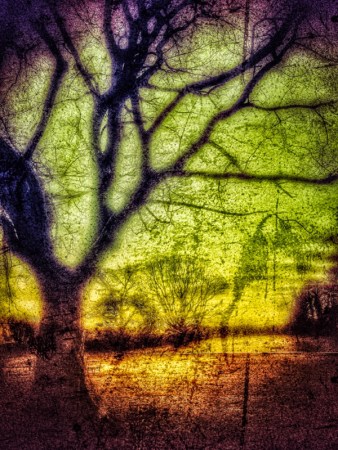
I’ve been watching, with interest and a degree of admiration, the fruits of the new generation of AI products that allow you to create images from literal descriptions like:
‘A young boy chases a red balloon through narrow dark streets in Paris.

The result is a good quality glossy image that is royalty-free and allows us writers to create a tailored image for our wordage.
But I have noticed that they all have a similar ‘artificial’ look, in that they have a painted style that is similarly ‘over-perfect’ – a chocolate box, as I have come to think of them.
It may simply be that I’ve not seen enough of them to appreciate what can be done. In any event, I have no issue with their generation or use, simply their ‘sameness’
I set out to explore this sameness by contrasting my AI image with one I created based on a ‘look’ that had a lot of artistic integrity.
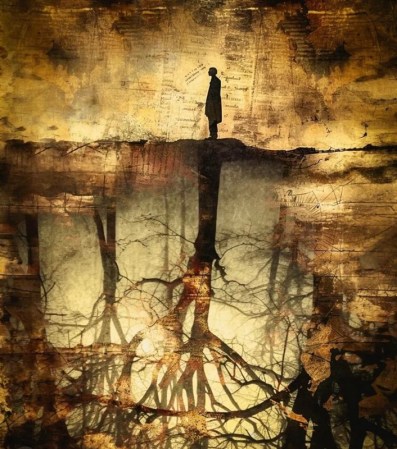
Above is an image I spotted in my Instagram feed. I liked it, followed the author, and began to examine how the creator had achieved this far more real look, despite it being heavily manipulated.
To continue the experiment, I set out to take a simple photograph of a natural scene and then manually use a variety of favourite techniques to both distort and enhance it.
I’m also interested in how and why these and the AI images look different. I have a sense that the ‘original’ content of the actual photograph is more ‘vital to our minds and emotions than the ‘wholly fabricated’ AI image,which is drawn from a ‘mechanical’ past.

Here are the stages, dead ends, and another look at the finished result:.

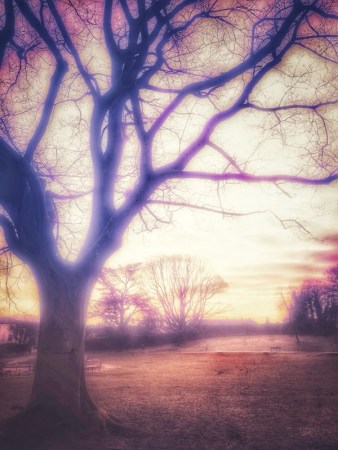

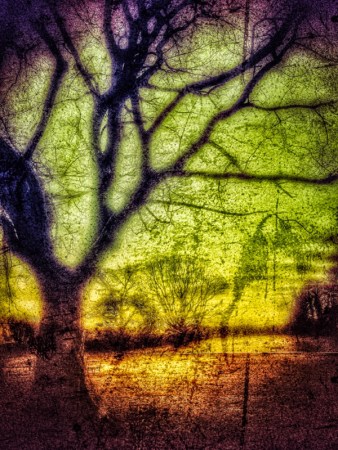
There are no rights or wrongs here. It would be very difficult to match the power of AI to create a highly specific picture, such as the Red Balloon image.
But, as a writer, it would be much easier to wrap my emotions around the natural image above … and possibly pen an appropriate poem or similar.
What do you think?
For reference: The Red Balloon, 1956.

“The story follows Pascal, a young boy, through Paris streets where he sees a red balloon atop a lamppost, chases it, catches it and discovers that it has a wonderful magic power.”
———— ———-
©Stephen Tanham 2024
All photos taken and processed on an iPhone 12 ProMax.
AI Generated by NightStudio Cafe
Stephen Tanham is a writer-photographer and mystical teacher. He is the founding Director of the Silent Eye, which offers an exciting journey of the soul guided by lessons, inner experience and outer companionship.
There are two blog streams:
(mystically-oriented writing)
and
(general interest, poetry, humour and travel)


 Sun in Gemini
Our world is changing, whether we like it or not, Steve. I suppose we will end up accepting it, although I would love to know what else they have planned…
LikeLiked by 1 person
I love the end result of your image manipulation on the tree – and like you, I’m not so keen on the perfect, chocolate-box style completely AI-generated images… 🙂
LikeLiked by 1 person
Thanks, Ruth ❤️
LikeLiked by 1 person
This is a good point, Steve. I do like that phrase” artistic integrity”. Certainly there is a peculiar feel to some of the results with Nightcafe, especially when we try to go for photographic quality. Still, I do like the boy with the balloons. Then again, when we go for something deliberately artistic, say calling up a blend of styles I’m conscious that we’re standing on the shoulders of giants – real artists – whose work the AI is aping and mixing. Exploring the portfolios on Nighcafe does yield some striking images, but I’m still not sure exactly what we’re working with, or where the future will take us. I’m very hit-and-miss with the algorithms, and certainly wouldn’t describe the outputs as original art.
I’d say your tree image is still the purer form, with greater integrity, and then if you take it to the next level and allow it to inform your poetry, that’s the better path – a project from the ground up so to speak. Incidentally, I’ve done the opposite, written a poem, then fed it word for word as a very long prompt to see what came out. The results can be startling, and unexpected.
All the best.
LikeLiked by 1 person
Thanks, Michael. It’s a fascinating topic – and good to be having a go. I’m impressed with NightStudio, so far.
LikeLiked by 1 person
And I must give that ‘poem’ idea a go. Perhaps I’ll get a song by Bowie back 😎
LikeLiked by 1 person
AI images are like Botox to me. I want to see the hand/life of the image/person. They have a flat sameness, a too-realness. But that seems to be what people want these days. (K)
LikeLiked by 1 person
Thanks, Kerfe. I do wonder if people have analysed what they are seeing. ‘Botox’ is a good word to use and may help folks to see the image, in a deeper way.
LikeLiked by 1 person
We seem to be seeking a surface perfection these days that is disturbing to me. Another attempt to deny death (and thus life, really)
LikeLiked by 1 person
That’s quite profound, Kerfe. Reminds me of young women turning themselves into caricatures with botoxed lips. Disconnected doesn’t begin to describe it…
LikeLiked by 1 person