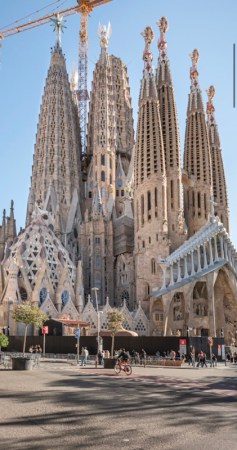
(‘Practically impossible to photograph’. The massive presence of the Sagrada Familia’. Photo by the author)
Photographs don’t do it justice…
When you first encounter the temple of the Sagrada Familia – hopefully on a day filled with the Catalonian sunshine – it simply ‘hits’ you.
Don’t be put off by the occasional giant crane; they have been part of this landscape for the past hundred years. And don’t be dismayed by not knowing ‘what on earth it is’ … no-one does, at least on first acquaintance.
Many people never find out; they are content to stare in amazement at what is before them.
But there is a way to understand this colossus in stone that has held humans entranced for over a hundred years…
‘The Basilica of the Sagrada Familia is a totally unique work. Apart from its enormous dimensions, the importance of the temple lies in the absolute originality of its style, its revolutionary technical resources and the mysticism and symbolism that were imprinted on each and every stone by its great mastermind, the Catalan architect, Antoni Gaudi.’
The dense mass of rising stone is an assault on the visual senses; as it is meant to be.
As to ‘what it is’, it’s important to realise that this is not a just a building … it’s a book, a book whose content is meant to lift our outer and interior eyes to the heavens. That is why it ‘towers’ over the district and has always done so, making casual inquirers question why it needed to be so much bigger than the other buildings around it.
Gaudi was determined that we would look up in wonder and find in that gaze a new understanding of the giants of the spiritual quest – expressed in the Christianity of the day, but in many ways applicable to any consideration of that which is noble, kind, steadfast and uplifting in the minds of women and men.
The name ‘Sagrada Familia’ can be taken literally to mean the biblical Holy Family – extending to include the Apostles, but it can also be applied the ‘inner beings’ of all of us. Gaudi was widely acknowledged to be both Christian and mystical in his approach. He believed that any great work of art should both follow the laws of nature in its proportions and project and confirm the higher aspects of the human consciousness: aspiration, compassion, joy, love and friendship, to name but a few.
The modernist natural and flowing forms of the fin-de-siecle Art Nouveau movement, at the turn of the 1900’s, were based on these principles, and almost all of them now look both exotic and strange. Lusciously so, but still strange…
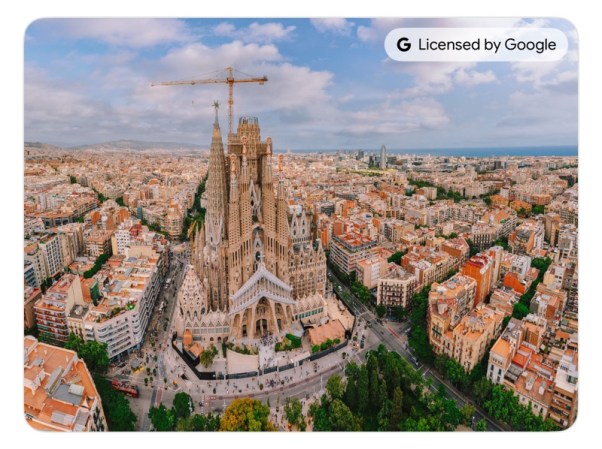
(Above: (image licensed by Google), this arial shot of the Sagrada Familia shows how vast a concept it was … and is. Note the neat pattern of the surrounding streets; a feature of the whole Modernist Exiemple district, but not typical of most of urban Barcelona)
The Sagrada Familia is located in what is now a central and busy part of Barcelona (though still a brisk 45 minute walk from the popularRamblas), but when it was conceived, far away in time, in the 1880s, the surrounding land was agricultural, and home to only a few villages.
The locals state with a proud smile that ‘Barcelona came to them!’
In the early 1880s, the poor people of the region provided the sole funding for the project. They simply wanted their own church. But Gaudi’s dramatic re-design – he was the second architect to manage the project – attracted immediate attention, both positive and negative, and pulled in a wider pool of funding.
The Exiemple district, awash with excitement and comment, became, correspondingly, a magnet for the Catalan Modernist project – with Gaudi as one of its figureheads.
Catalan ‘Modernisme’ was a cultural and artistic movement of the early 20th century. It flourished in Catalonia, northern Spain – and especially Barcelona. It worked to express an authentic identity through the visual arts, architecture and literature. It was characterised by nature-inspired symbols and motifs. These organic forms featured in a wide variety of decorative elements like the design of grand doorways, ceramic tiles and the use of forged iron.
Antoni Gaudi was not alone in this work. Other key figures included architects Lluis Domènech y Montaner and Josep Puig.
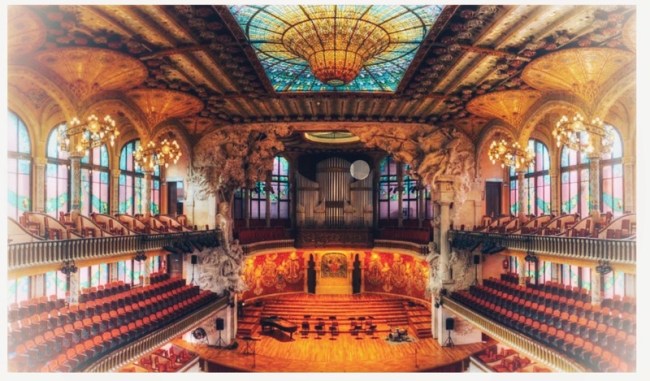
(Above: the spectacular Palau de la Música Catalana by Lluis Domènech i Montaner. It is considered to be a Moderniste gem. Image Google)
Notable works include Gaudí’s Casa Batlló and Park Güell, and Domènech i Montaner’s Palau de la Música Catalana.
Most of Gaudi’s other famous works are located in the Exiemple district. It was truly a home for the works of this great architect and engineer.
How dramatically such buildings can change a physical and emotional landscape! And how they alter the sheer ‘energy’ of a place, or even a whole district.
(Detail from the Palau Güell (pron: gway), a modern ‘palace’ built for Gaudi’s wealthy friend and patron Eusebio Güell, see below. Güell was an admirer, patron and lifelong friend of Gaudi; though the latter’s life was short)
Gaudi’s designs in both art and architecture can look strange to us now. We struggle to comprehend their origin and meaning using ‘modern’ eyes. We forget that the Sagrada Familia was an extension of what Antoni Gaudi had been working on for some time in the last quarter of the 19th century and within the modernist movement.
His works, he explained, were all based on natural forms. Perhaps, in our cubic towers of steel, concrete and glass, we have come so far that we no longer see the ‘natural’ – or worse, now see it as strange!
(Eusebi Güell, successful industrialist and lifetime friend and sponsor of Gaudi and his work. Photo is the property and copyright of the Antonio Gaudi Foundation)
Great creators need backers and substantial funding. Eusebi Güell (pronounced Gway) was Gaudí’s primary patron and a wealthy Catalan industrialist who sponsored Gaudí’s most iconic projects, including Park Güell and Palau (palace) Güell. Eusebi Güell’s significant financial support, combined with his ongoing appreciation for Gaudí’s innovative work, allowed many of Gaudí’s major architectural masterpieces to be realized, and significantly contributed to the Catalan Modernism movement.
Spain has been home to many religions. Intrinsically Catholic, it also played host to centuries of relatively gentle and tolerant Moorish influence before casting it off and literally painting over the beautiful remains of its high thought.
Today it is a strongly Catholic country, and its central ‘canon’ is the New Testament. Antoni Gaudi and his father were devoted to the Catholic faith, whose testaments and mysteries provided the backdrop to the design of the Sagrada Familia.
The name “Sagrada Família” was not chosen by Antoni Gaudí. The idea for the church, along with its name, came prior to 1882 from a local bookseller named Josep Maria Bocabella. Bocabella was a devout Catholic and the founder of the Spiritual Association of Devotees of Saint Joseph.
After a visit to the Vatican in 1872, he was inspired to build a church dedicated to the Holy Family, which in Spanish is “Sagrada Familia”. The full name of the church is the “Expiatory Temple of the Holy Family” (Basílica i Temple Expiatori de la Sagrada Família).
Josep Maria Bocabella was the father of the whole project. Without his inspired beginning, we would not have the Sagrada Familia.
The construction began way back in 1882, and was initially led by architect Francisco de Paula del Villar. But his neo-gothic design lacked public support. The poor people of the villages had waited a long time … and wanted something far more special.
A young Antoni Gaudí won the competition to replace the original design. He took over the project in 1883, completely changing the nature of the proposed church into a vast basilica in a style never seen before on this scale.
(‘The Sagrada’ – Image by the author)
What are we looking at when our gaze first falls on those vertical ‘towers’? To appreciate their ‘mass and presence’ look back at the Google image taken from the air and compare the ‘towers’ with the surrounding building. You will swiftly revise your initial idea of its size…
The Sagrada Familia in its now (2025) near-final form has 18 towers, representing key figures in Christianity. Twelve of these towers are dedicated to the Apostles, surrounding the basilica’s three main facades. Four taller towers represent the Evangelists (Matthew, Mark, Luke, and John). A tower dedicated to the Virgin Mary is topped with a star. The tallest tower, representing Jesus Christ, and yet to be finished, is crowned with an illuminated cross.
When you look at the ‘forest of stone’ that is the Gaudi Towers, this is what first confounds the eye.
In the next post we will examine the beginning of the project; a beginning in which the architect is not Antoni Gaudi.
After that, we will follow the tortuous route of the Sagrada Familia slow completion, in other words the long road from 1883 to now. It is a journey of faith in the project, faith in its goals, and faith that such a concept could be handed on from generation to generation: a narrow thread of possibility that culminated in the realisation of Gaudi’s vision.
This is indeed an amazing structure. I’ve been to visit it a number of times over the past 20 years and it gets better every time. I love seeing the changes. It’s like watching it evolve in slow motion. There is a fabulous museum near the Barcelona Cathedral all about Gaudi, his life and inspiration. I also visited his birthplace, Reus, where he grew up and got much of his inspiration. An incredible mind.
Thanks, Darlene. I’ve watched its progress over the years and was astonished this spring to find it almost complete. I’ll be continuing the story in the next few blogs.




 Sun in Gemini
A fabulous building and history..Thank you ,Steve for sharing xx
LikeLiked by 1 person
It’s my pleasure to share this masterpiece, Carol. If you ever get chance, go visit! xx
LikeLike
If I am ever that side of the world it is now my bucket list, Steve xx
LikeLiked by 1 person
Let’s hope you can xx
LikeLiked by 1 person
A wonderful place 💜💜💜
LikeLiked by 1 person
Quite unlike anywhere else, Willow!
LikeLike
I know it’s truly otherworldly 💜💜💜
LikeLike
❤️❤️
LikeLiked by 1 person
Simply incredible. It’s amazing what some people with determination and passion can achieve.
LikeLiked by 1 person
It’s one of the best examples I know of, Robbie. And we’ve just begun to tell the story!
LikeLiked by 1 person
🩵
LikeLike
WOW!!!!!!!
LikeLiked by 1 person
Thank you, Di! Yes, it’s truly Wow!! 😀
LikeLiked by 1 person
This is indeed an amazing structure. I’ve been to visit it a number of times over the past 20 years and it gets better every time. I love seeing the changes. It’s like watching it evolve in slow motion. There is a fabulous museum near the Barcelona Cathedral all about Gaudi, his life and inspiration. I also visited his birthplace, Reus, where he grew up and got much of his inspiration. An incredible mind.
LikeLiked by 1 person
Thanks, Darlene. I’ve watched its progress over the years and was astonished this spring to find it almost complete. I’ll be continuing the story in the next few blogs.
LikeLiked by 1 person
I look forward to them.
LikeLiked by 1 person