Study Periods…

THE ANNUAL BLOGGERS BASH – STUFF YOU NEED TO KNOW

More than survival

Sue Vincent's avatarSue Vincent's Daily Echo

One of my all-time favourite fantasy cycles is the Chronicles of Thomas Covenant the Unbeliever by Stephen Donaldson. They were the first fantasy books I ever read other than the classics such as Tolkien, Lewis and Carroll. My grandfather sent me a copy of the first book in paperback when I was living in France, “You’ll like this. The cover says it all…”

Well, if it did,  I didn’t fancy it. Bear in mind the fantasy genre hadn’t come my way much back then and flicking through the first chapters the style didn’t appeal, the hero was an anti-hero and commits unspeakable acts. I didn’t care for the way the opening chapters were written and honestly, the only reason I persevered was because I had already read my way through all the English language books in the library in Vichy, including the ones in the storeroom. Reading in French…

View original post 1,030 more words

Rings of Sky and Earth

To find that time and circumstance

Had placed us in an isle of fertile space

Where others led us to a place

A ring wherein the sky and earth would quarter meet

There is no sense of wonder deeper

Than that of being ‘brought’ and left

To gaze as heavens’ hands caress the land and sea

And consciousness completes the longing three

Strange markers lined the way

As if to say: be sure; discretion is required

Before that letting go of owning self

Surrenders to the land of higher health

And then the ring of bright companions forms

Called, named and present

From far and distant lands

To be here, to be now, to be

Brought forth: the moment birthed

For which no words have face

Where vision sees the depth of beauty’s kiss

And all are silent, knowing touch of grace

A sharing cake and golden mead

A silent, spellbound walk along the road

A bus to catch-mundane but vital in the gathering cold!

No-one speaks… we are so lost in gold

©️Copyright Stephen Tanham

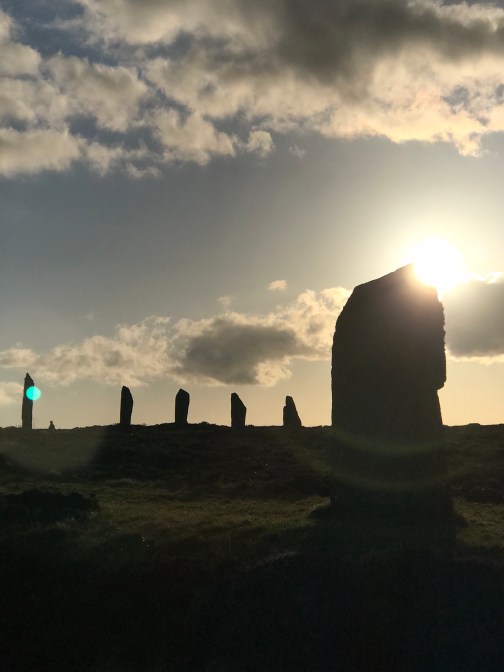
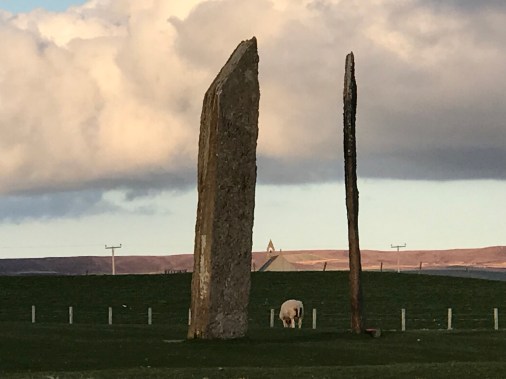
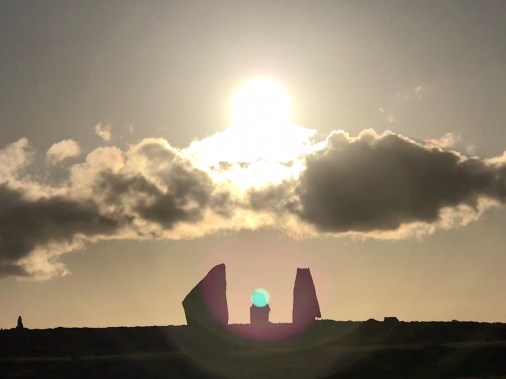
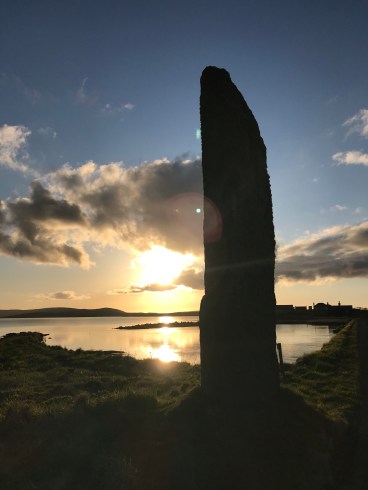
Images taken at Beltane, Ring of Brodgar, Orkney.

Stratford-Strange II…

Beltane…

Sue Vincent's avatarSue Vincent's Daily Echo

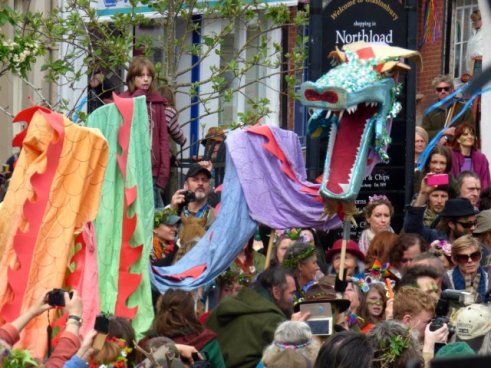
The ancient festival of Beltane has always been special to me. As I child, I was caught by its magic when my grandfather first read me the story of ‘Borrobil‘, where two children walk between the Beltane fires and are whisked away into a land of myth, magic and the obligatory dragon.

For years afterwards, every time the number seventy-seven bus passed the conical hill on the way to town, we would talk about Beltane. I learned its legends and traditions, and more than any other of the festivals of the turning of the year, this one is close to my heart, rooted, as it is, in fond memories.

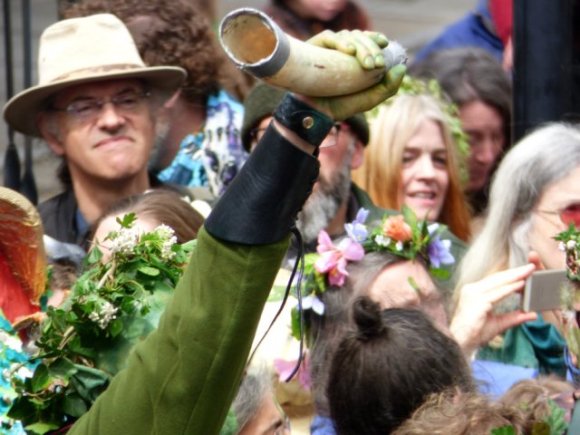
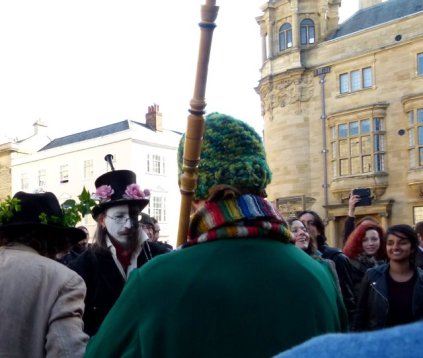
Over the years, I have celebrated Beltane in many ways and in many places. I have danced around a Maypole, weaving the ribbons in the pattern of life. Joined a spiral dance in the streets of Oxford.  Seen…

View original post 183 more words

Jewels in the Claw (ii)

Continued from Part One

He stops in the act of dismantling – the raven directly in line with his left eye. Reluctantly, he climbs onto the chair to unhook the left panel of rubberised black fabric that contains the bird’s image. Then, smiling, he remembers the last minute decision to add the raven panels… such an important part of the Queen’s journey.

Somehow, it seems a sacrilege to take them down…

The stream of consciousness that now belongs to the twenty receivers of the told story opens. It is there, again… and alive…

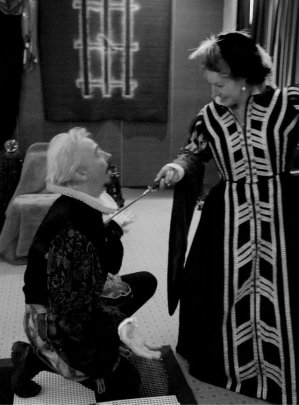
There is a moment when all the power in the room passes from the artful Marlowe, who has lived up to his reputation for skirting the edge of acceptable Elizabethan behaviour, to the Queen. Her regal gaze, a generation older than many in the room, fixes him like a serpent.

“Elizabeth, Queen of England and Ireland…” The playwright bows, backing away and leaving the intricate space of the chequered Court Floor for the sovereign. She rises, the gold dress swirling around her.

Act One is about to begin in earnest. Shakespeare’s fading life-force had been enhanced by the wild and wonderful energies of Countess Libido, but that level of abstraction now seems far away.

It is 1590. The fearful Spanish Armada is two years vanquished, and Spain – even gold-rich Spain – cannot afford another. King Phillip will never recover from the defeat inflicted by the English captains. Secure beyond question on the right side of the Court, Sir Francis Drake smiles at the Queen’s taking of the power in the chamber; smiles at the esteem in which he, also, is held; smiles at the name given to him by the Spanish crown: El Draco; Dragon of the Seas.

Time passes very slowly as the golden Queen steps onto the black and white tiles. Then the music begins. Climbing and diving, the Elizabethan orchestra weaves a story told in harmony, matching her naval victory with the inevitability of personal sadness inflicted by age. She crosses the squares wrapped in a tapestry of sound that matches her reign, and is seated at her throne in the East.

Frances Walsingham and Robert Cecil join her, right and left. Walsingham the daughter of the Queen’s fearsome spymaster, Francis. Cecil the deformed son of Lord Burghley, William Cecil, replacing his father in what many see as a staged act of political sacrifice to placate the public view of the death of the Scottish Queen Mary.

“What happens when a queen kills a queen?” she will ask, later. Her mind filled with dread, as one of her most trusted subjects turns rogue; the natural chain of Being seemingly threatened on all fronts…

The two children of illustrious parents suit her purpose, here. The other people in the room – lords, gentry and common folk – will assume that all on the royal dais understand the nature of this chamber of transformation. The Queen’s eyes flash, knowing that is not the case. All but she are ignorant of what must take place. All are to be subject to the process.

The Elizabethan realm is secure; now it must be made robust in a way that will embrace the future, not merely arm against it… Spain, deadly Spain – agent of the excommunication of Elizabeth – is a spent force. She is not stupid enough to think that God is on her side. Neither is she naive in knowing that the vast forces of nature were with her as the storms wrecked the plans of the Armada’s commanders. There is a middle ground in which intelligence and skill conspire to protect the oppressed. Small no more, England stands on the brink of a new age.

The Queen looks to her right, taking in the demure but watchful eyes of Lady Rab’ya Anouri, royal wife of the Moroccan ambassador to London. No-one but the sovereign knows her. All must wonder why the gathering includes this Saracen woman, with her strange, flowing robes of orange and white – clearly the child of a different God.

“Be welcome and be seated.”

It is time to stoke the fire… the fire of transformation.

“In here, there will be a Death and a Birth… and a journey between. Let us complete our preparations… Sir Walter Raleigh is waiting in the antechamber. Sir Walter, enter…”

The South and North are complete. Marlowe did that, well. Just enough mischief, swept aside by the royal presence; cowed but smiling: as she likes her playwrights to be. The East now holds all the power she requires, though those within it do not yet realise their capabilities. They are young. The few days here will teach them much about its wielding.

The West… place of entrance and departure, home of the tide of fortune and grace that will ebb and flow in this chamber as each plays their part. Anger, she thinks, time to show how much anger bubbles beneath this calm surface…

“Sir Walter, escort your companions to the chairs that have been prepared for them in the West.”

Moments later it is done. She can hear the silence of outrage, can feel the dread in the room at what has just occurred. Sir Walter Raleigh stands facing her, calm and measured… just as she needs him to be for all of what will follow. But not even he knows…

At his right sits a Jesuit priest, the most hunted man in England. In the heartbeat that follows their entry, she can feel the tension in the body of Robert Cecil, her Secretary. She can read how his eyes are bleeding with disbelief at what has unfolded, so soon in this meeting of sovereign and subjects.

At Raleigh’s left sits the husband of the downcast woman near the end of the Northern line of chairs. John Dee, former Alchemist and Astrologer to the Queen has returned from a fool’s errand to England and this Court.

Both sit in chairs that have been turned away from the royal gaze… The visual exile is deafening.

At the front of the Royal Court, unseen, all three of the ravens are watching….

Other parts of this story:

One


Stephen Tanham is a director of the Silent Eye School of Consciousness, a not-for-profit organisation that helps people find the reality and essence of their existence via home-based, practical courses which are low-cost and personally supervised.

His personal blog, Sun in Gemini, is at stevetanham.wordpress.com.

You’ll find friends, poetry, literature and photography there…and some great guest posts on related topics.

©Stephen Tanham

+

Seeds of Change

Sue’s photographic tour of the Jewel in the Claw.

Sue Vincent's avatarThe Silent Eye

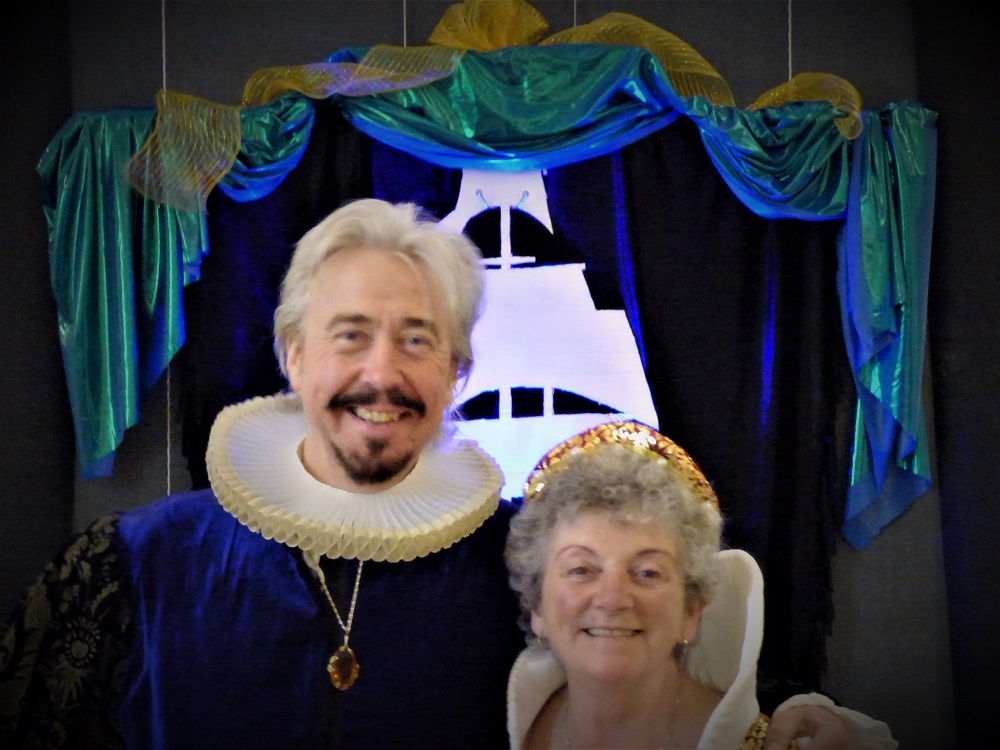
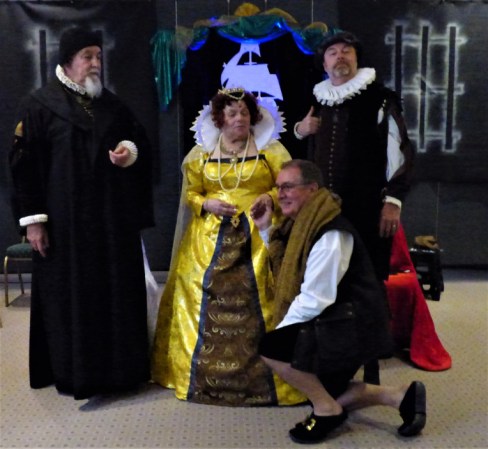
‘Dr Dee’, ‘Her Majesty, Queen Elizabeth I’, ‘Sir Walter Raleigh’ and ‘Master Shakespeare’

Time does strange things. It is just a week since our workshop and already it feels as if it is receding into the mists, and yet, it is also as clear and sharp as if we were about to enter the temple space for another act. In many ways, that last is the truest perception, for, even though we draw our inspiration from tales of bygone eras, any seeds we sow within the ritual drama of the weekend are designed to grow slowly within us and be taken out into the world.

Such seeds are not ours alone. We may plant ideas and nurture thought, but it is in the fertile soil of love and friendship, and the shared experience of working together with a common intent, that such things blossom. Even so, it is only when…

View original post 497 more words

Taxi from Hope: A Journey into the Heart of the “Jewel in the Claw”

The Hieroglyphic Monad of John Dee – by The Patrician Lady

Pat Ridell’s talk for the Jewel in the Claw weekend.

Sue Vincent's avatarThe Silent Eye

The Hieroglyphic Monad of John Dee 

By The Patrician Lady

A talk given to The Silent Eye’s ‘Jewel in the Claw’ workshop on 21st April 2018

In my talk today I’m going to tell you a little about Dr. John Dee, one of the characters you have met in the drama, and something of his famous symbol the Hieroglyphic Monad or Monas Hieroglyphica. Most people, myself included, know or knew very little about this symbol so I decided to research it. As with all research I started by reading as much about it as I could find. This led me to articles and papers and it grew and grew and grew and I realised that this symbol incorporated the whole of creation and its processes; hence its name – the symbol of One-ness, Monas Hieroglyphica. Today I’m going to try and tell you something of what it means…

View original post 3,182 more words

+

Shades of the Golden Age…

Sue Vincent's avatarThe Silent Eye

As a child, I loved the old movies of the swashbuckling variety. Even then, I knew the stories were not real and the history likely to be wildly innaccurate. Romance and adventure did not wait behind every tree. Magic, though, had its own reality.

With a family who told me a closer-to-true version of the histories portrayed on the screen, I learned early the difference between fantasy, fact and fiction. What was produced for entertainment was never supposed to be a history lesson. I learned not to believe in what I saw… except for the duration of the film, when I could lose myself in make-believe.

The over-the-top acting, the swordplay and implausible heroics delighted me, and that has never really changed as I have grown older. A more mature eye sees the flaws with clarity, but I can still choose to ignore them and daydream about flashing steel, wild…

View original post 336 more words

Jewels in the Claw (i)

SE18 TempleMasterGeneric


There is a moment when he stops, puts down his packing box, and looks at what remains of the Court Floor. It is the last vestige of a creative journey of twelve months, of twenty souls intent on giving their all to the rather unusual script, and of a Silent Eye spring weekend at the Nightingale Centre in the lovely Derbyshire hills…

Do things that have been created in the heart and mind cease to exist when they are played out in the time-honoured fashion of the mystical psycho-drama and pass from potential to actual to gone? There must be a difference between a thing – in this case a mystical play – created and performed to full effect, and a thing thought about in detail but not put into practice. The latter never makes it beyond the mind of the originator; the former becomes ‘actualised’ as a blueprint for the directed energies of a harmonic group of people, all of whom are aware that something deeper than an Elizabethan story is being told…

The man holding the box of monochrome, plastic squares thinks there is a difference… the life of the dramatic work has passed from potential to actual, and has, actually, not gone. Instead, its life has been transferred from single author to twenty others. Its story resonates differently in each of twenty acting perspectives, every one taking from its execution something unique to them and their lives; something that solidifies, then glows in the memory along with the unspoken words: “We did that. We came together and made that happen. We followed the path of the words in two-hundred pages of script and brought it to life.”

He hopes it will live for a while in their hearts, too. Long enough to ponder the many questions that the story prompts: What was most real, the dying figure of Shakespeare in 1616 or the drama created by the Tudor Queen of England when she brought an eclectic gathering of friends and enemies together at the Palace of Nonsuch in South London in April 1590 for a very unusual meeting of hearts and minds? Can we conceive of a reality that creates a plot, a story, as being different from the actual unfolding of that drama as twenty people bring it to life? Which is the most real? The passage of time is most certainly not the basis of the answer…

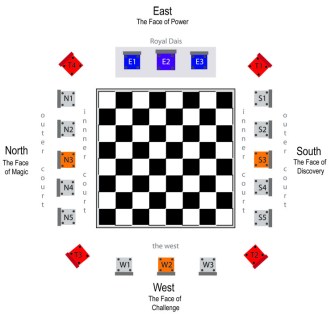
In his mind (the man with the packing box) the black and white squares re-assemble themselves into a very large chessboard known to the players as The Court Floor. It has four faces: East, West, North and South. Each face will later have a deeper name, but for now they are just the edges of a black and white, chequered surface.

In the shadows surrounding the chessboard and chairs:

“He is dying.”

“They say the spirit has come for him.”

Movement around the outside of the chairs – the Outer Court. The players realise they are being trained by doing.

“He is dying…”

Upstairs, in the chamber above the tavern, William Shakespeare lies dying on the chequered floor. At his head stands a candelabra with three lights lit. Behind this stands the surprisingly jovial figure of Death and Change: Count Mortido.

“Master Shakespeare, you have had an long and productive life, one which will be celebrated after you are gone. Are you content, now, to die?”

For the duration of two extinguished candles he nods and coughs his assent, but as the third is raised and the final chance of extended life is about to be removed, strong feminine hands grasp his ankles. Warm and sensual, they slide up the outside of his legs and an urging female voice fills the air as Countess Libido, sister-wife of the Count of Death hisses:

“Do not surrender this too soon! I will lend you my strength!”

She kisses Shakespeare on the lips, and the sexual/life charge rips through him. Filling his lungs with borrowed air and time.

“There was another story,” he says. “One that could not be told while she was alive.”

“The Queen?” asks Count Mortido.

The Bard nods.

The powerful female hands linger on his body, urging. “Tell it now…” chuckles the Count.

Elsewhen, the chequered floor, the arena and dancing-space of possibilities to come, flickers into life in 1590. Shakespeare’s form is no longer there…. but, of course, it is yet to happen.

A future-ghostly Shakespeare stands by the edge of an empty Court Floor, approached by a very real Christopher Marlowe, fellow Elizabethan playwright and friend.

“Play this with me, Master Marlowe. Be life to my ghost within this mind of life in death!”

The task between good friends is accepted. Marlowe turns to those in the outer shadows and summons them, one by one: the empty chair heading the South Face; the Dragon of the Seas, otherwise Sir Francis Drake; a spy who casts astrological charts for the powerful of Spain; the second richest woman in England…

The Southern seats are capped by the materialising presence of Count Mortido himself, come to check that the laws of causation are not being tampered with.

Marlowe moves across the empty East Face, which will soon be filled with the power of three. From the Northern edge of the Court Floor he summons others from the shadows: into the second seat walks an elegant Saracen lady, the wife of the Moroccan ambassador embarked on a trading exchange for English fancy goods… and possibly a little more; the second Earl of Essex, Robert Devereux, comes forward to take the Champion’s seat in the middle of the row; this is followed by the wife of the Alchemist John Dee and Lady Blanche Parry, a woman who has cared for Queen Elizabeth since her birth in 1533.

The empty seat at the head of the row is taken by Countess Libido, who smiles at her brother-husband across the court. Neither of them can be seen by the others… well, not yet, at least.

The faces of the East and West are polarised in their emptiness. Eyes peer into the gloom, into what is left of the mysterious tavern, and other faces are found; looking down at small tables and drinking from tiny glasses.

Marlowe speaks, again, and the shadowy lady in the golden gown slowly raises her head. Marlowe trembles, slightly, then gathers his voice….


Stephen Tanham is a director of the Silent Eye School of Consciousness, a not-for-profit organisation that helps people find the reality and essence of their existence via home-based, practical courses which are low-cost and personally supervised.

His personal blog, Sun in Gemini, is at stevetanham.wordpress.com.

You’ll find friends, poetry, literature and photography there…and some great guest posts on related topics.

©Stephen Tanham