
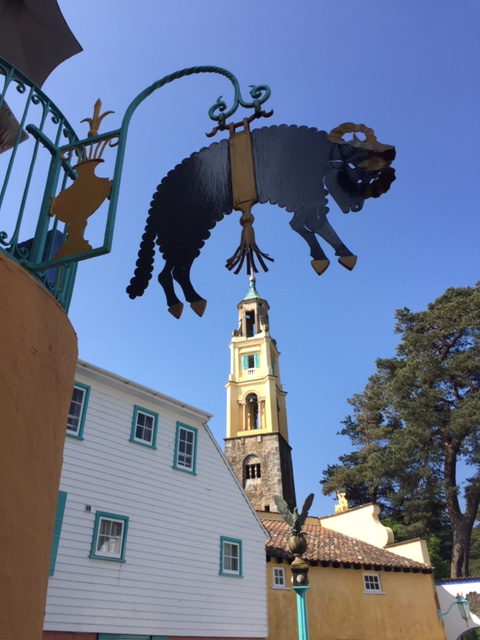
As the land-train pulls out of the main square in Portmeirion, we head up into the forest. There are three distinct internal regions within the Portmeirion site. The first is the village, itself; the second is the coastal walk; and the third is the forest walk. The little train follows the forest road, but stops to give a view of the coast in several places. Sometimes, it’s difficult to separate the often wicked humour of the creator of Portmeirion – Clough Williams-Ellis, from the mental overlay that hunters of the ‘Prisoner experience’ project onto this unique place.
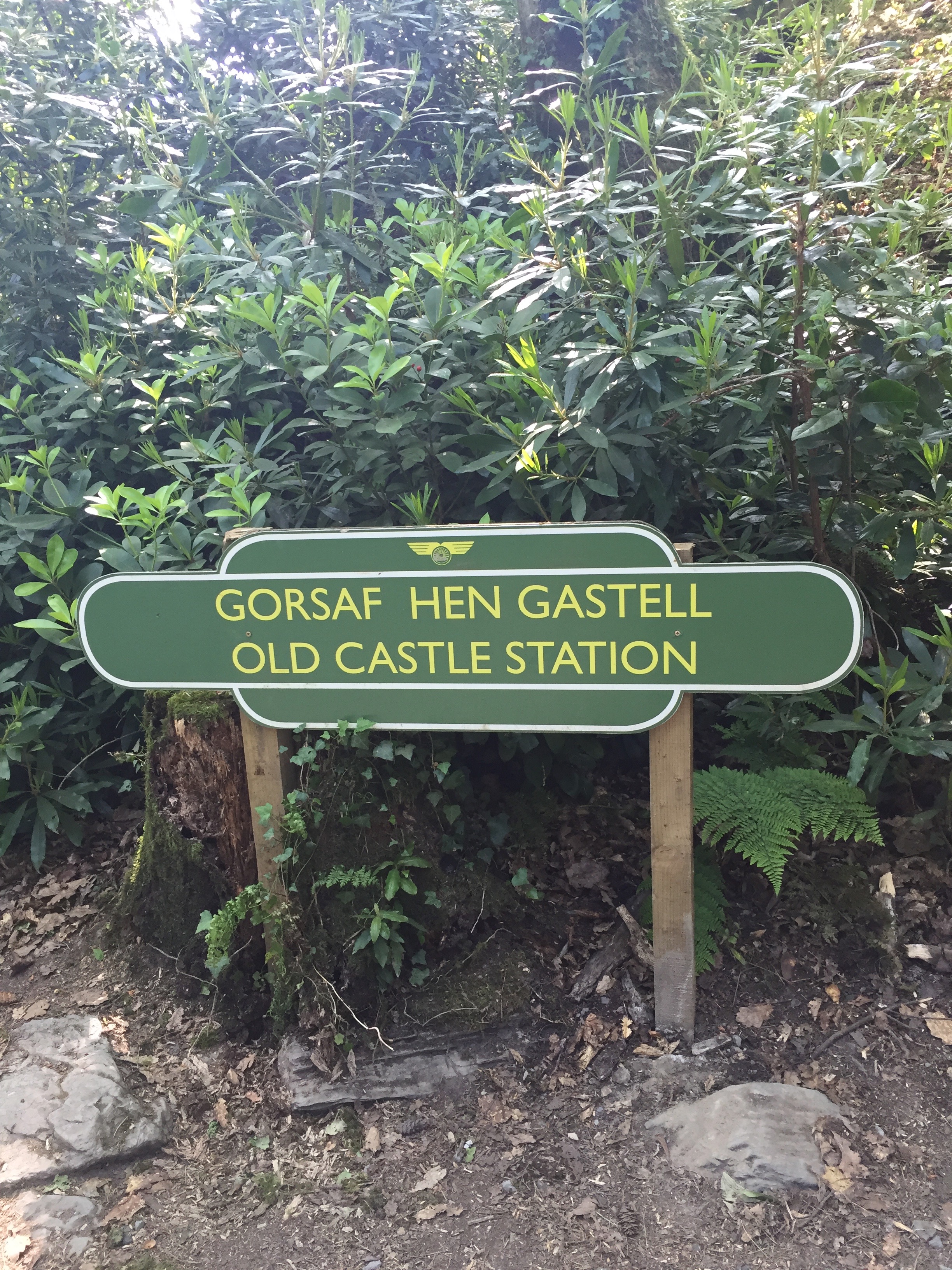
Station names like: Salutation, Old Castle, Playground, and Shelter Valley all take on a secondary, if not intended meaning within the context of following the McGoohan mind as you attempt to tease out the secrets of this landscape embedded in the Prisoner series.
We had invited our companions to spend their own time in the forest before meeting up for a group walk along the coastal path. The forest is a very special place and, to my recollection, featured in the Prisoner series only when No 6 was running away or having secret meetings with other ‘prisoners’ – many of whom were planted, and simply pretending to suffer to get No 6’s sympathy so that he would tell them why he resigned. The thought brings back the central question of the series: why was it so important that the various No 2 characters found out the motives of No 6? They were presumed to be all-powerful, so why did it matter what reasons had engendered the resignation in the first place?
“His power – the very reason for him being here and retaining a glimmer of that power – was that he had a secret,” hisses the intense green all around us… The sun is getting hotter and the deep, summer blue fills the gaps in the canopy of the forest. The shifting has begun, again….

And then, high up in the trees, a pagoda comes into view and we’re suddenly back in that different sense of presence where the voice of McGoohan is guiding us from ‘above’. There is no pretence that the being of the actor is actually here, simply that we have woven an internal, creative state – a kind of walking meditation that enables insights, using the ‘voiced presence’ of the creator of No 6 to help bring it to life. It’s a directed mediation, just like we use in the Silent Eye, and, in this rich and wonderful hillside, it’s working beautifully…
There is a real question here, beyond the mental and emotional game we are playing: what did it mean? What was the inner meaning that McGoohan went to such pains to conceal, giving only hints, even long after he had left the Prisoner behind. “It’s important, then,” says his voice in my head. “to work it out for yourself.”
We move deeper into the forest. The green intensifies…
“Who were they, then?” asks the dark voice of No 6, “The others – the supposed fellow victims of abduction to this demented heaven and hell?”
It’s a sobering question. If McGoohan was the ‘awakened’ self, projected, post-resignation, into a new reality in which his ordinary life became exposed as a prison and left him resolutely determined to escape to the ‘real’, then who were the characters who met him in the forest, pretending also to have been abducted? Agents of someone, singular or plural, but who? The mysterious No 1, presumably…
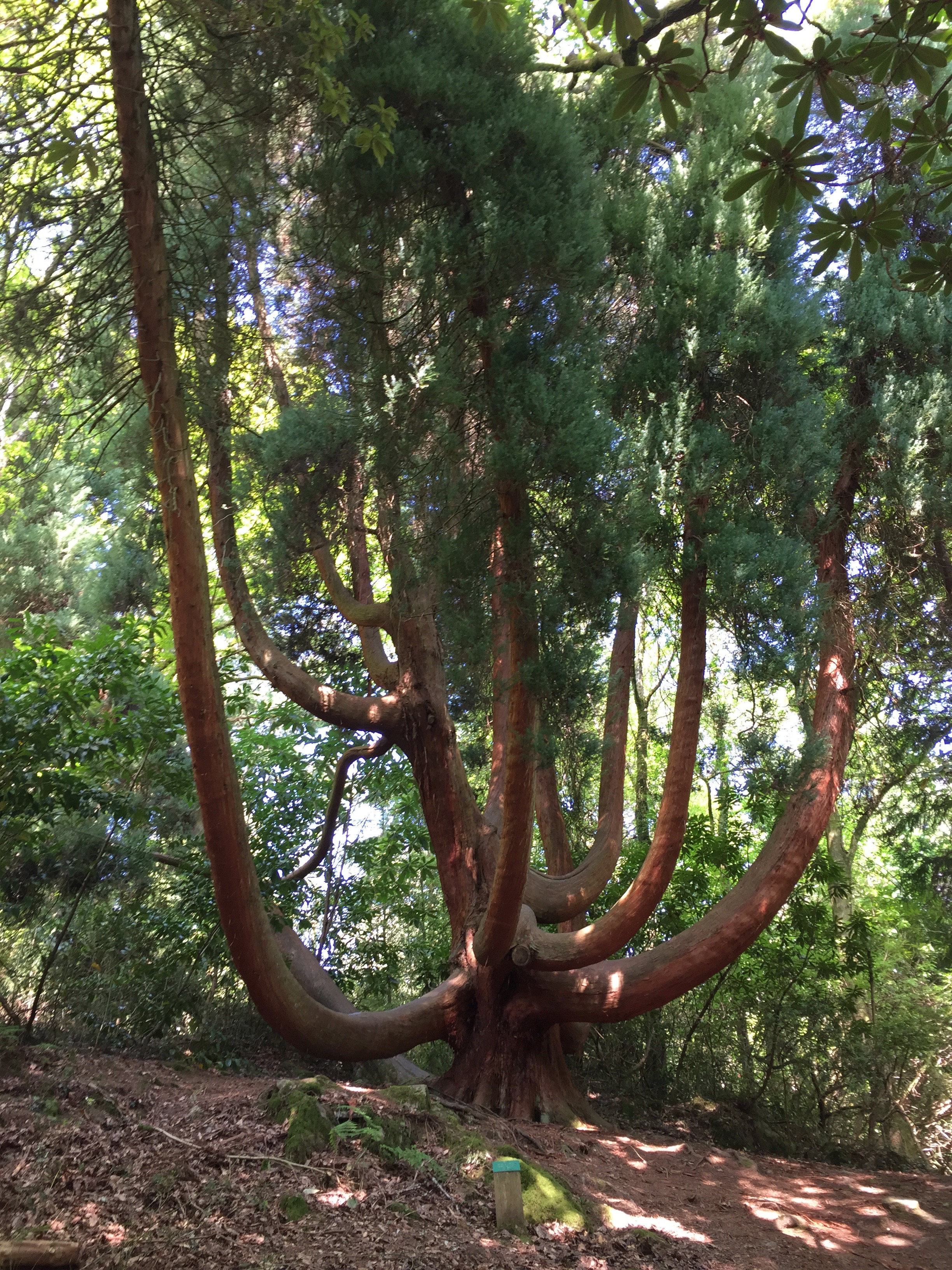
We are climbing now, and, up ahead a Japanese Cedar curls out its exotic curves, projecting an image of something that goes somewhere via a very roundabout route. Its shape suggests that straight lines don’t necessarily get you there as you expected, and sometimes curved paths are more fruitful.
How do you follow a curve? I ask myself. Then the old answer comes back, one borne of recent experience: with trust… in other words by staying on it. When the envisaged future is invisible you can either refuse to get off the bus in the forest or get off at Unknown Crossing and trust that you are where you should be…
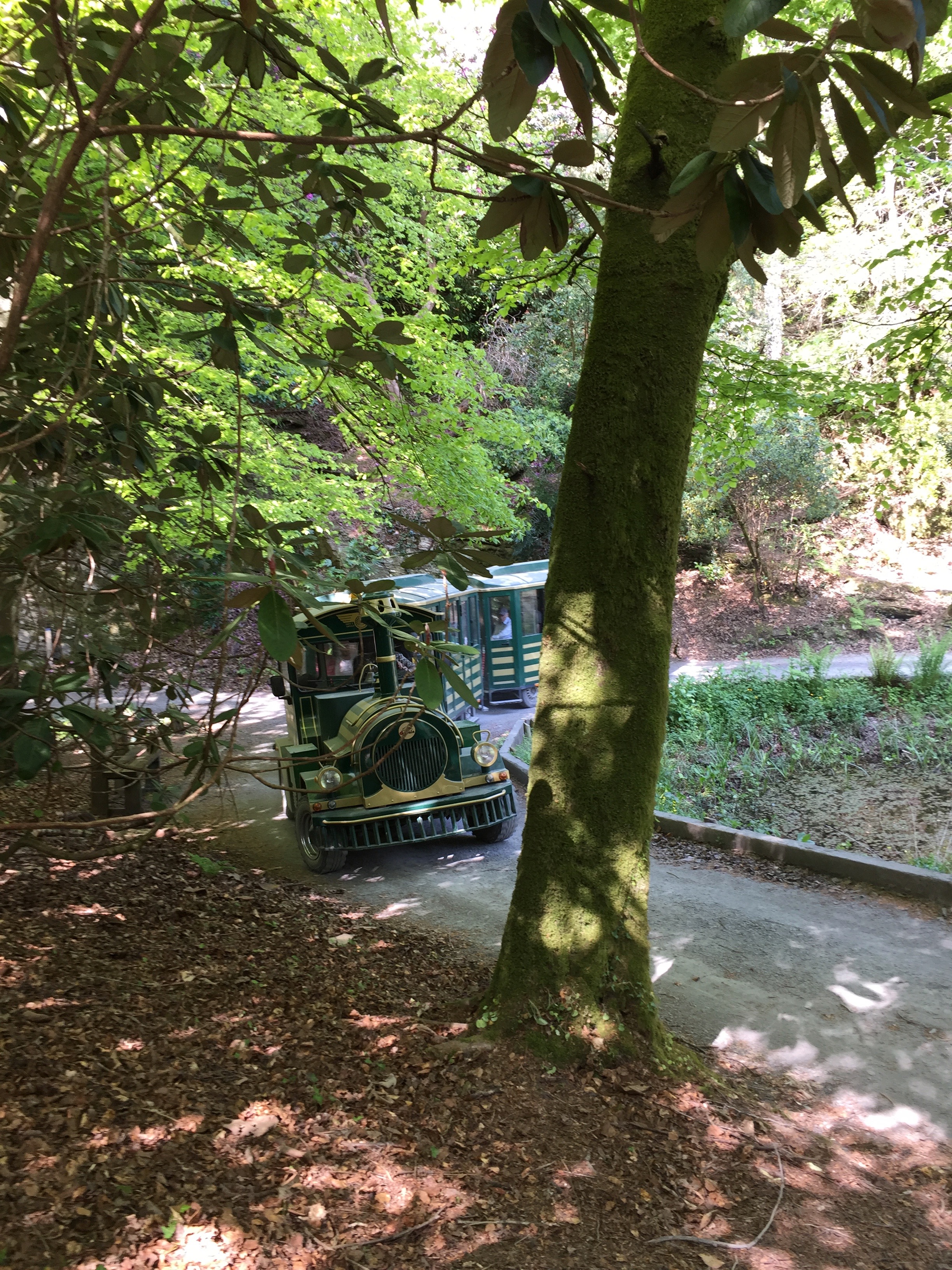
The forest begins to speak for itself; there is the sense that we have discovered enough, that if we take what we have and see it from the green wholeness that this place provides, the important patterns will emerge.
We say little, simply walking and letting our thoughts wander.

There’s a signpost up ahead. Ironically, it speaks of a lighthouse. What more potent a symbol could there be? And then, as the path moves downhill and turns sharply left, the forest gives way to the coast. The splendour of the sea is revealed, pointing us back to the place where our adventure began, the previous evening – in the tiny cove of Borth-y-Gest. It’s a wonderful omen…

“I’m going to take a stab at it,” I say to Barbara.
“What, the whole thing?” she laughs.
“What’s to lose?” I ask, sounding more sure than I am.
“Ok,” she says, challengingly; waiting and watching as I draw breath and look out to sea.
“No 6’s life as a spy is just that – he spies on life from a distance and under the cover of special powers.”
I look across at her. Initially, she says nothing, then, “It’s a good start…”
Another breath, deeper this time, because I’m assembling this, charged with the forest’s green energy, as I go.
“He realises the shallowness of his life and resigns – the brochure of a holiday paradise in his case – intending to be free of the whole thing and completely underestimating the power of the establishment to curtail his little adventure.”
“The establishment… I like that,” Barbara says, laughing, and continues. “Who promptly drag him, drugged, back to where he came from and psychologically torture him.”
“Exactly,” I say, warming to this unfolding. “He forgot the power of the establishment – the ego – to take away his new, enthusiastic consciousness and drug him back to an imprisoned state where ‘it’ could find out what he was up to…”
“So, in a sense, he stays drugged, and wakes up powerless but determined to get back to that moment of truth from which he could see his new life, his paradise?”
I look at her, so glad this has been a shared thing. “Yes… Exactly that.”
“And No 1?”
“No One, Oneself… Take your pick. The other ‘controllers’ are the regents of the ego, trying different ways to undo him – as they have done all his life. They don’t answer his question of Who is No 1?, because they can’t.” I pause, slightly giddy with the ride, and grinning like the proverbial cat.
She is smiling, too. “But when he truly wakes, again, by defeating the No 2s, he will remember that he is really No 1?”
“Exactly… and paradise will be reclaimed.”
“Bloody hell!” she says.
It’s a very precise statement…

——- to be continued ——-
Other parts in this series:
Part One, Part Two, Part Three,
©Stephen Tanham
Share this:

Got these in the wrong order!

‘The prophet takes over where the mystic stops. The mystic is ascent; the prophet descent.’
– William Everson
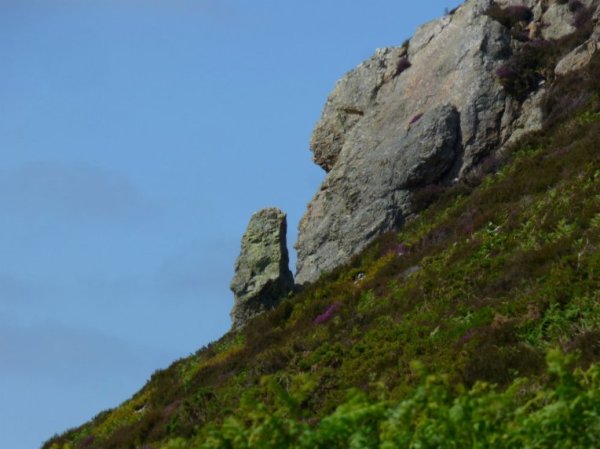
The bibliomantic reading could not have been more appropriate. From the mines, we were heading for the heights to meet a Druid on the top of a mountain.
“I’m not sure I’m really up to climbing mountains….” Between the mountain that loomed above us, the sun and the heat, the word ‘convalescence’ seemed to be at a bit of a loss for something to connect with. I had heard the tale of the day-long wander around the mountain on a spiral path that had led to my companion’s original ‘discovery’ of the site.
“That must have been the wrong way. The book…” Ah, the book… the same one that had led us on so many wild goose chases with its maps drawn to some variable scale? “… the book says it is…
View original post 1,275 more words
Share this:


*

Borth-y-Gest from Portmeirion Beach
*
“We have Take-Off!”
Resignation
“One-Nine-One, or One-Nine-Two?”
*
No 3 (Light)
‘Suddenly the world
Cracks, the phallos
Slams home, slams the ineluctable stroke.
And the universe splits, the touched-off tinder,
Fired by that blazing torch
Detonates all the tamped and pounded down empacted intensity.’
– William Everson
*
“I think we were all surprised by that reading.”
*

*
“We’ll save the dark reading for back at the Hotel.”
*
No 2 (Dark)
‘How long they lie each never knows.
This prayer, their one worship. A worship
Learned in the years. For youth leans on them:
They are getters of children: known much and have suffered.
In the deeps of the soul have ached for each other,
Accepting suffering…
*
And now in their night
They know the incarnational join: body to body
Twain in one flesh…
*
Out in the night the River…
View original post 9 more words
Share this:

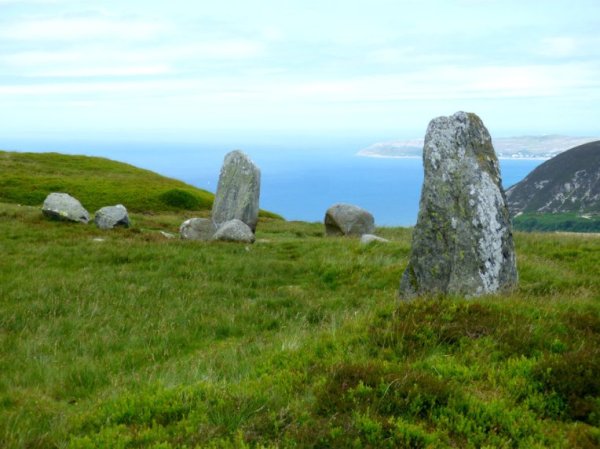
You could not wish for a more spectacular setting for a stone circle. Perched high above the sea, with views to distant mountains in every other direction, it is a magnificent site. A slight rise to the seaward side blocks the view of the modern quarrying and, from within the circle, there is no visible trace of the modern world at all.
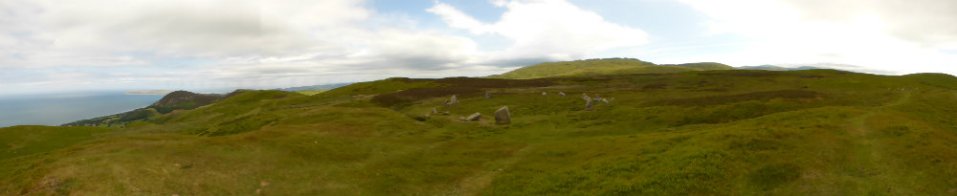
It is easy, here, to rebuild in imagination the fallen stones. There were once thirty of them standing, now only eleven remain upright. Even so, they have a presence impossible to capture on camera. It is a place to simply sit in wonder. To sit and wonder too what our forebears were thinking when they quarried Penmaen-mawr in the 1920s, decapitating the 1500 ft summit by the simple expedient of destroying Braich-y-Dinas, the Iron Age hillfort that crowned it… which was one of the largest in Europe. No trace…
View original post 1,218 more words
Share this:

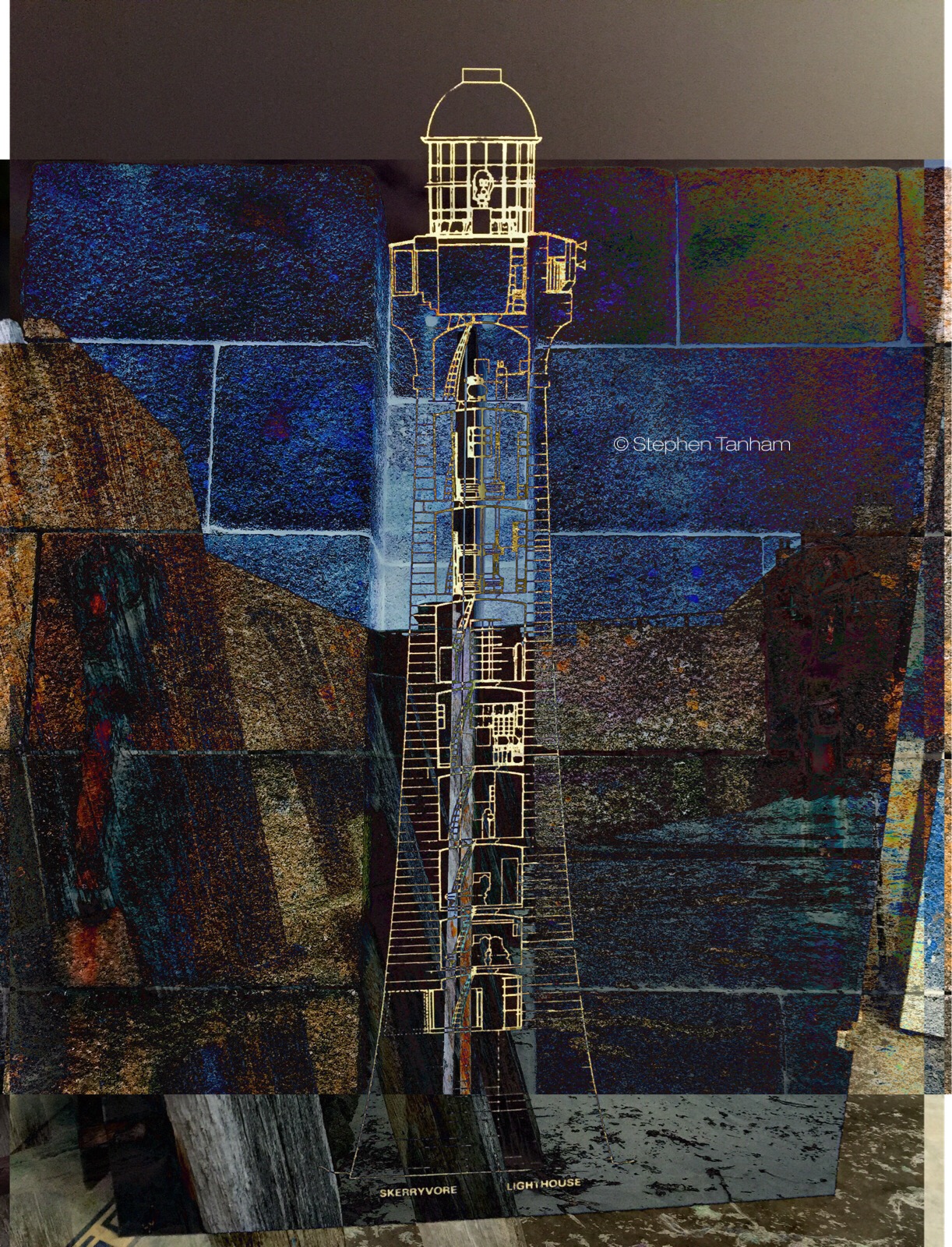
In tiny Hynish’s western shore
Where gentle waves now kiss the sand
The resting seas recall the names
Of they who built the Skerryvore
➰
Forgotten in the passing nights
Unknown to most, of even few
Who chance on Hebridean soil
And stumble on the wreck of lights
➰
For ears a story here in stone
Which value engineers of night
Of iron and glass and fearsome seas
That rivals any ancient tome
➰
Not shifting sands or limestone frieze
No Pharaoh wise, nor Mayan king
Have ever dared to light the night
With giant tower upon the seas
➰
In deep of howling winter’s night
I’ll sit upon my writer’s keys
And ‘Stevenson’ will be the word
The image: glass infused with light
➰
So come from history, taking bow
From we who sail on greatness past
We bow to you, who built our age
Forgotten on the quiet sands of now
➰
©Stephen Tanham
Underlying outline from the Hynish museum of the Skerryvore Lighthouse.
Share this:


I was distinctly sceptical…unsure what to expect when we parked at the entrance to the mines. So many ancient sites, once commercialised, seem to lose both their intimacy and essence, but I remembered watching something about the discovery many years ago and was curious to see for myself what had been found. A landscaping project in an area thought to be above Victorian mines had uncovered something much older which had astonished archaeologists and changed the way the nation’s ancient history was written.

At school we were taught that the Stone Age peoples were primitive… pretty much your archetypal cave-man, with a minimal survivalist technology and little else to recommend him. That never really added up to me, not when I had seen so many of the great stone circles as a child. It made even less sense when you looked at the incredible artwork of the caves at Lascaux…
View original post 642 more words
Share this:

*

*
“Somewhere in all that cloud stands a Druid at the head of a circle.”
“Let’s go see if we can find him.” …
*
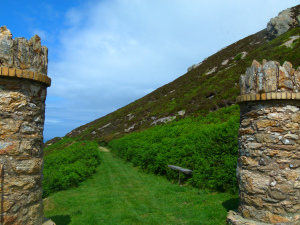 The Pillars: Penmaenmawr.
*
Tee minus Six hours and counting…
“It’s odd, I had no recollection of these pillars, yet now that I see them I do remember and it seems like only yesterday. We went that way, which is, I believe, the long way round, so we’re going to go in the opposite direction.”
“Not before we’ve taken a reading we’re not.”
“It is working isn’t it?”
“It seems to be. One-Five-Eight, so that’s Five, or One-Five Nine, or Six?”
“Five.”
*
No 5 (Light)
‘The Logos of creation in whom all things were created can be nothing other than divine wisdom. Thus it is that wisdom is eternal, for it precedes every beginning and all created reality.’
– Nicolas of Cusa
*
View original post 481 more words
Share this:

It takes only a few minutes to descend into the village from the entrance archway, beneath which is the McGoohan bronze, but in that time the temperature soars, and the rare and pure blue of the June sky, only a week away from the fullness of the summer solstice, becomes flecked with gold whenever I raise my head to stare at its beauty. But it’s a beauty that comes at a price. The harshness of that sun requires a determination to study it; the heat requires a loosening of clothing and a different rhythm of breathing. I smile… We’ve added Frank Herbert’s Dune to The Prisoner in the mix of this wonderful place; we’ve also bordered on McGoohan’s inclusion of the sinister – in the sense that June is seldom this lovely or this threatening to the unwary. I smile, wordlessly at this, and my companion and co-creator of the weekend, Barbara, notices, looking quizzically at me. I’m up to something. She can tell…
The mixture of two of my favourite things from that time in life is rich and pleasing – and who knows what part they played in turning me into a student of the deeply mystical? Herbert was heavily influenced by the Sufi style of spirituality – an immediate and world-relevant discipline that significantly moulded what became known as the Fourth Way, nurtured by Gurdjieff in the early years of the last century. I can’t speak for McGoohan’s spirituality, other than to know that it was Catholic, strongly held and influenced where he placed his creativity; to the extent, as we discussed in Part Two, of him turning down the role of James Bond, twice.

McGoohan’s penetrating and intense gaze stays with us…
The inclusion of the harsh, desert world of Herbert’s Dune makes me stop. Is this just my mind wandering or did that knocking on the door a few minutes ago produce an answer? Question: what did you really mean by the Prisoner? Did it take partial shape, refinement even, in this exotic and unique landscape? The answers begin to come thick and fast, as often happens when one listens within…
“Village!” comes the hard edge of McGoohan’s voice in my head. “In the Prisoner, it’s called The Village, isn’t it? There’s a clue for you!”
I think about the last photo I took of his bronze, the head turned slightly away to reveal part of his profile; those haunted eyes perhaps conveying the inner struggle he had trying to describe ‘the greatest enemy’ that he spoke of in interviews given in later years. Did the strangeness of the beauty he found here provide the polarity he needed to create a brutally strong story from the bare bones of the truth he found in life? I had never considered it this way, before. But it is unlikely that he arrived at Portmeirion with The Prisoner fully formed… The Village may well have coalesced, within its own unlikely menace, from the reality of Clough Williams-Ellis’ creation.

The Port of Portmeirion – complete with concrete ship. As Stuart said, “This was an architect with a sense of both humour and mischief.”
My companion follows me as the muse takes me a few steps sideways, away from the little train that takes you around the forest trails, and towards what I call the Port of Portmeirion, fake concrete ship and all… but I’m lost, now, in speculation, because I can see the sands of the estuary in the distance…

‘The lone and level sands stretch far away‘ to quote a poem that John will share with us on the final day, reciting Shelley’s masterpiece, Ozymandias, from memory. He will use it to illustrate our final theme, Escape; but that is far away in time, yet.
Fifty years on, two figures stride along a vast and beautiful beach. They don’t know that, just beyond the line of their sight, a giant ballon, nicknamed Rover by the fans, has them in its sights, lest they try to escape. Did you stand here, McGoohan? I think to myself. ‘Rover’ was conceived only after a more conventional robot failed. Clever filming make it into one of the most terrifying instruments of control any of us children had ever seen – back in 1967. I look again at the sands and realise how much this is confirmation that Portmeirion shaped The Prisoner. You arrived here with just an idea, didn’t you, Patrick?
My imagination may have wandered down to the ‘Port’, but, in reality, I’m still watching the arrival of the famous train.

“You can go anywhere you like in the Village as long as you stay in the Village,” says McGoohan’s voice in my head. What is the subtext of that? In Episode One – Arrival, No 6 tries to buy a map. The first one he is offered is black and white and covers only the area of the Village. He asks for a larger one and, when the helpful but banal shopkeeper provides the ‘larger, better and more colourful version’ No 6 finds it’s identical… again showing only the area of the Village. The moral is clear: this is all you have and you stay here, or rover comes for you. Settle in, get used to it, it’s not so bad…”
Is that ordinary life? Patrick, I ask, using his first name to provoke him. Was it all about waking up to the artificiality of life and remembering where you/we really came from – in this case, the vivid world of espionage, true life and death to No 6?
If that were the case, then what did the changing figures of No 2 represent? Those controllers and watchers of his every move, whose failure and removal No 6 took great delight in. He was definitely a fighter, our No 6; no passive acceptance, there.
Resistance! McGoohan would have selected resistance from our second set of seed-thoughts: Resistance vs Acceptance of a changed world. Later in our walk, up in the forest shared with a friendly and inquisitive robin, Sue and Stuart will get each of us to select a page from a book on Christian Mysticism. Another person will choose, at random, from the quotations on that page. The results are a wonderful example of what drops into the moment, the now, from the outside, an outside as potent as the world of the man saving the bee. They have promised to share the selected quotations in their own blogs.

——- to be continued ——-
Other parts in this series:
©Stephen Tanham
Share this:


It’s a station on the North-West main line – ‘Oxenholme’ is how it is really written. If you set quiz questions, it’s a good one: what’s the only main line station in Britain to be found in a village?

Oxenholme is really on the outskirts of Kendal – as close as the main north-south line to Glasgow gets, but there’s another station in central Kendal so they had to call it something else.
If you’re going to Edinburgh, the line bifurcates somewhere around Carstairs and trundles off at a slower pace, cross-country to Scotland’s capital. Glasgow is more fun – and a lot faster.
It gets you to London, too, via The venerable stations of Lancaster, Preston, Wigan, and sometimes, Warrington and Crewe, before thundering south to Euston. But my working life contained a lot of that, as most of our large customers were in the City, and living on such trains, via Preston or Manchester, was a way of life I’m happy to have left behind, though it served me well.
Apart from happy visits like the Bloggers Bash, I’d rather face the other way and visit romantic Scotland – a place that Bernie and I love.
My happiest London moment was always the sight of Euston’s platforms sliding into the darkness as the train left for the North-West. This does not reflect a dislike of our capital – it’s a wonderful place; just a desire to ‘breathe’ again after the crush of the city and the necessary compression of the Tube.
When we bought our ‘old’ 1960s bungalow in 2010, and set about converting it so that we could ‘ part-retire’ to the Lakes, the prospect of having a main-line station on our doorstep was very appealing. If we wish, we can walk from our tiny village of Sedgwick (one horse, no shops, nearest pub 30 mins on foot) to Oxenholme station in 45 mins. If we want to amble and arrive less sweaty, an hour. There’s a top-class coffee shop just outside the station’s rear approach which is part of a local bakery.
Sometimes, I walk Tess there, we have coffee and Danish, and then we walk home with the bread. It’s different from London, though the latter has closer shops!
I love trains, and opt for them whenever possible. Bernie is very adept in scouring Virgin Rail’s online offers to get me or is two first-class singles for the price of a standard-class return… heaven.

And the lovely, historic station at Oxenholme makes all this possible for us Lake District dwellers…
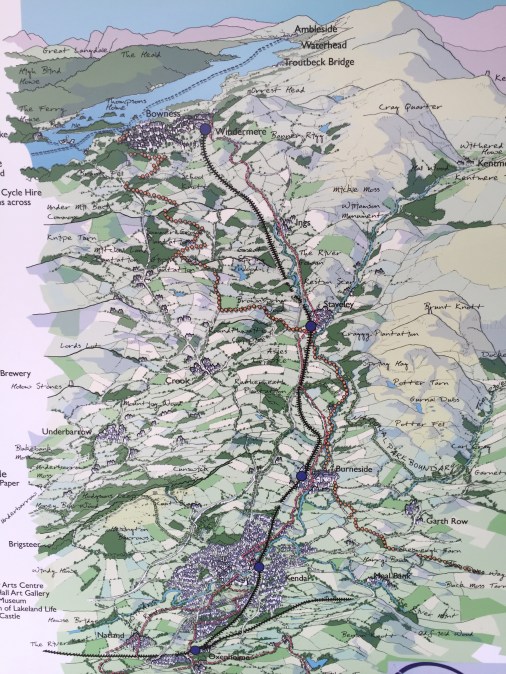
We shall shortly be leaving for Scotland, to spend the weekend with friends who have treated us to a joint birthday present – a day’s cycling around the Scottish Isle of Tiree. We will train from Oxenholme to Glasgow, meeting up for dinner; then fly to Tiree in the morning for our day’s cycling.
I’ll bring back pictures, I promise…
Share this:

The ‘bibliomatic’ process (as used during the Portmeirion weekend) explained.
* *
*
“Curses,” said Butch, tugging at his collar in the sticky heat.
“Now, what?” sighed Serafina.
“It’s another of those Silent Eye thing-a-me-jigs.”
“A Walk and Talk Weekend?”
“That’s the one.”
“And what’s so bad about that?”
“Well, nothing, ‘cept we’ll have to give some readings.”
“Not necessarily,” chimed Brown Rabbit, slipping his watch back into a jacket pocket, “you could always take some readings instead.”
“I’m not sure I understand the difference between taking a reading and giving one,” grumbled Butch.
“It’s quite straightforward,” smiled Brown Rabbit producing a small book from his other jacket pocket.
*

*
“I had a feeling it might be,” laughed Serafina.
“Then you shall go first,” said Brown Rabbit, bowing and offering her the book, “open it up!”
“What, anywhere?” said Serafina taking the book from Brown Rabbit.
“Anywhere you like.”
Serafina’s eyes closed and a moment later the book fell open…
View original post 60 more words
Share this:

Meanwhile, somewhere in North Wales…

We took our time getting organised, intending to take a leisurely drive cross-country… perhaps stopping along the way, wherever the spirit moved us. In the spirit of the planned walk-and-talk weekend, the prisoners had escaped and were heading for the border. Anyone would think we were on holiday. We did ourselves. We should know better by now.

We may not have been heading for our respective places of work, but the Work that we do when we are not at work…and even when we are… is not something that can be switched on and off. It cannot be neatly compartmentalised or assigned a designated slot on the timetable, to be dipped into when the fancy takes you; it is a state of being, not doing. Once a pinhole has been opened in consciousness, the pressure of life floods through in an unceasing current.

The problem is that the conscious mind…
View original post 604 more words
Share this:

There is so much going on that you can miss him on the downward leg of the guided introduction to Portmeirion. In a world of the strangely beautiful, one in which the normal laws of constructing a ‘village’ have been changed, there is simply too much to see to notice the quiet, deeply bronze head of Patrick McGoohan.
We stop to consider this dramatic bust – strangely overlooked when we made our rekkie trip a month prior. Then, our attention is drawn to a bee, exhausted from its work, standing in the middle of the tarmac of the roadway along which the group is walking. I stop to pick it up, using a leaf as stretcher, and relocate it beneath a laurel hedge. Later, I wonder at the world of that bee; at the intervention of a ‘higher power’ to create an alternate reality in which the little creature can have no notion of what just happened – even the fact that its life was probably saved. It is a metaphor that will return to my mind may times as this Silent Eye weekend unfolds.

And then, somewhat behind the rest of the group, we turn, again to study the bust of Patrick McGoohan, previously unseen. Amidst the splendour of Portmeirion – especially on a blazingly blue and golden summer day like this – you could be forgiven for thinking that it was just another wonderful art treasure, like so many others to be found in the village.
But it’s not…
Its a very good rendering of a man who had nothing to do with the creation of this gem of a village, just east of Porthmadog and sixteen miles south of Snowdon, the highest mountain in Wales. It’s the head of a man–a British actor– who had a passion so strong that he turned down two separate offers to play James Bond in the early films, a role that would have brought him worldwide fame and fortune, rather than the lesser pickings from his (till then), most famous role as Danger Man in the hit British TV series.

Most of the tourists passing through the gate miss the bronze completely. And rightly so… They are here to see the architectural masterpiece created over a forty year period by Clough Williams-Ellis, whose own lifelong passion was the real village of Portmeirion. Even the official guide, leading our group, does not pause at the McGoohan statue, yet someone in power, here, viewed him important enough to justify the creation of it by Tiziano, and its donation to the village. Like the man and the bee, it occupies another, parallel realm, with a modern mythology so strong that a good proportion of Portmeirion’s visitors every year still arrive in search of its ‘McGoohan secrets’…

The two worlds co-exist very nicely. There is harmony in Portmeirion’s coffers, and who can blame them? The estate did give its permission for the filming of the famous TV series of The Prisoner in 1967 – a decision that greatly enhanced their own fortunes. Even today, fifty years after The Prisoner’s creation, people come in droves to see if they can further decode the enigmatic story of No 6, the British spy who resigned and then woke to find himself in the surreal landscape of a sugar-coated but deadly ‘Village’ – Portmeirion as it was and is, but viewed from a different consciousness.
Patrick McGoohan was close to Lew Grade, the head of ITV in that heady era of the late 1960s. McGoohan was a deeply religious man – and deplored any glorification of violence – which was why he had twice refused the Bond role. Later, he spoke in interviews of the ‘greatest enemy’ that mankind faced – himself. He had been determined to create a ground-breaking series in which this deadly relationship between worldly success and inner insanity was broken open. The result was The Prisoner, which ran for seventeen episodes before Lew Grade, fearing that McGoohan was so involved he would be unable to bring it to an end, pulled the plug and forced McGoohan to curtail it, prematurely, with a single anarchic episode.
McGoohan’s adoring public, unable to understand it, jammed ITV’s switchboard for hours. McGoohan and his family fled to a rented cottage in Wales where they locked themselves in and rode out the storm. McGoohan emigrated to the USA shortly after.

One of the mysterious landscapes in the Village – the giant chess board. The chess pieces appeared only at the end of the Prisoner series, though the board was a feature from the start…
Our Friday night had begun gently at the Moorings Restaurant in Borth-y-Gest. During that evening, we had begun our consideration of the modern mythology of the Prisoner by discussion the idea of Resignation – what got No 6 in trouble, in the first place. We discussed whether it was ever valid to ‘resign’ from something or whether we were simply ducking what was before us, thereby judging ourselves ‘above it’. It’s a very complex issue – as McGoohan knew it would be for generations of people attempting to understand his creation.

The No 6 cafe. We were inside, watching the opening episode of The Prisoner
Our Saturday morning had seen us taking coffee and, for some, breakfast, at the famous No 6 cafe, where, with the permission of the staff we got out a laptop and watched the opening minutes of the Prisoner series. This was a treat for the few who had never seen the original. Soon, though, the Guide was calling for those on the first tour to gather outside.
Now, only a few minutes later, but in another world, we turned, reluctantly away from the bronze. The Guide was getting ahead of us, and I could feel that strange sensation that signals the entry of something deeper into the moment. At the base of the hill, where Portmeirion meets the estuary, we were due to consider the next ‘seed-thought’: when your world changes, completely, do you accept it or take up resistance against it?
——- to be continued ——-
Other parts in this series:
©Stephen Tanham


 Sun in Gemini
You must be logged in to post a comment.