by Steve Tanham


We look out at the world with our eyes. There is a strong, conceptual basis for our looking. We look out from an in-here to an out-there. In other words, we locate ourselves – the ‘me’ – inside something that we regard as an intimate ‘home’, never seeing, perhaps for all of our lives, that we have created the division. The immediate effect of this is to locate the rest of our ‘world’ as exterior to our selves, and therefore to define it as ‘not us’.
Because of this, we live our lives in a kind of perpetual conflict…
It is the personality (ego) that does this. And it does it in conjunction with the mind. The rest of our lives is spent at one end of this division. Its effect is therefore profound, and conditions everything that follows.
At the heart of our personal development is how we come to know things, and whether there is anything in our field of constantly-changing perception that we don’t know. We begin our consideration of this here.
We seldom examine why we are so sure there actually is an in-here. The only thing we can be sure of is that there is an awareness (me) that has a senses-based relationship with the world around it.
This view of self belongs to the personality, and develops as the use of mind grows. Mind reinforces our separation from the world … but it doesn’t have to. Mind does what we ask it to do – what we focus on in our thoughts. We can alter the focus of our minds.
We said in Part Three that the core of a person is their essence. Another word for this is the soul. The soul is our wonderful organ of experience, and the mind is our organ of knowledge or knowing. We take ‘knowing’ for granted, but its power is at the heart of our lives, and a full investigation of this will enhance our relationship with all of life.
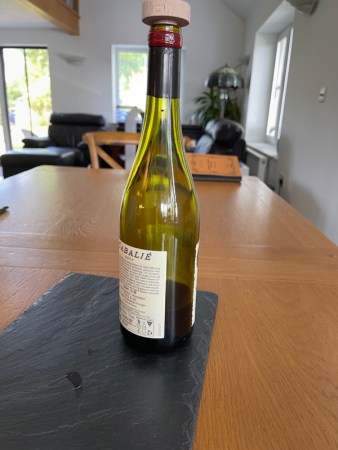
Everything out-there is what modern developmental psychology calls an object. We make ‘objects’ of things so we can recognise, understand and manage them. The bottle of wine before me in the above picture is known to me. Therefore I know how to interact with it, including whether I like or dislike it.
Years of familiarity mean I don’t need to look at it in detail to know it as a wine bottle. If the type of wine is one I drink often, just glancing at the label without actually reading it will allow me to know what’s before me.
Any bottle is an object; the wine bottle is a further defined object with certain properties – like its shape. The specific bottle and label of a wine type – here, the French wine Cabalié – give it complete visual identification. But I would still need to taste it to double-check its integrity.
Now, say we imagine our view of the bottle was a ‘painting’ like this.
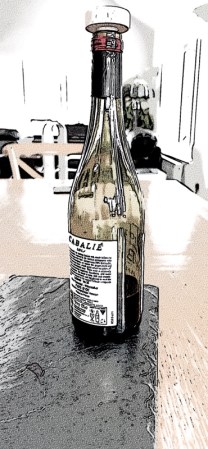
If I asked you to examine Bottle No. 2) and estimate the distance between the bottle and the dining chair behind it, you might – rightly – look at me and smile, replying that there is no distance in the unreal depth of a picture.
The same applies to the photo in the image of Bottle No. 1, but because we are used to seeing such photos as real, we easily project our logic into the equally false distance.
The overall image of our world at any time is not what is ‘actually there’; it is a learned version of that reality. When we were the new-born we spoke of in Part Three, we developed the ability to focus our eyes, but what we saw was a field of vision where there were differences but no objects. Objects belong only to the mind, and are an instrument of separation.
The infant’s view of the world is like a quilted bedspread. There is a lot of variety, but the child simply sees it as a pattern. There is no attempt to see each element as separate.
The details above are not just theoretical, they are the basis of a very useful exercise with which we can challenge the supremacy of the mind’s dominant view of our reality … and make it open its powerful eyes to a new world where division falls away and freshness rushes in.
The Exercise:
Consider the images of the two bottles. Look around you at any scene that takes your attention; either inside or outside the house. Concentrate on ‘framing it’ so that it looks to your mind like a photograph.
Now, instead of seeing this as 3D image with depth, imagine it rendered ‘flat’, as in Bottle No. 2. If you achieve this even for a second, you will notice something new in your consciousness, and the beginning of a deeper understanding of how your presence really works with the world.
Make this gentle, and as though you are interacting with an inner friend. There should be only relaxation in the experience.
In Part Five, we will deepen this journey into the known.
Parts of this series:
This is Part Four: The edge of the known.
©Stephen Tanham 2023
Stephen Tanham is a Director of the Silent Eye, a journey through the forest of personality to the dawn of Being.
http://www.thesilenteye.co.uk and http://www.suningemini.blog


 Sun in Gemini
Pingback: Nine Keys: (5) The Giant Sail – Sun in Gemini
Pingback: Nine Keys (6): An uprising of Self – Sun in Gemini
Pingback: Nine Keys (7): Dying for Love – Sun in Gemini
Pingback: Nine Keys (8): When experience grows dull – Sun in Gemini
Pingback: Nine Keys (9 – final): An emotional reunion – Sun in Gemini