by Steve Tanham


Inside this new love, die.
Your way begins on the other side.
Become the sky.
Take an axe to the prison wall.
Escape.
Walk out like someone suddenly born into color.
Do it now.
You are covered with thick cloud.
Slide out the side. Die,
and be quiet. Quietness is the surest sign
that you have died.
Your old life was a frantic running
from silence.
The speechless full moon
comes out now.
Rumi
An invitation to … die? It sounds like the title of a James Bond film…
The quotation is taken from the 13th century Sufi poet, Rumi, who was one of the most influential mystics of all time. The Sufis were an inner tradition within Islam, and survive to this day, though fundamentalist pressures threaten that.
Why would we want to die? The poem suggests there is a continuation of existence – ‘Quietness is the surest sign that you have died’. So we’re not talking about biological death, here.
To what does it refer?
In previous posts of the series, we have considered a pattern of interconnected ‘layers’ of what we consider to be our-selves.
We have the all-consciousness of the Universe. Then we have our own Essence, a perfect part of our being that needs no further evolution because it comes from the source of everything, but individualised, so that it may reflect the glory of the cosmos back to itself.
The Essence is known by other names, such as Self with a capital ‘S’, or the Atman, or the Spirit. There are many more…
For the whole of our lives, this Essence works to pervade its nature ‘outwards’ into our lives. The vehicle it uses for this is the Soul, as we have explored in the previous posts.
Normally thought of as the spiritual part of us, we have put forward the observation that the soul is actually our vehicle of experience, and layered above a ‘higher’ or more ‘inner’ part of that experience of self, known as Essence, or the Self (capital ‘S’) to distinguish it from the outermost part of us which forms around the other two: the personality or ego.
All these vehicle of self are playing their part. None of them is bad, not even the personality, which is so often seen as the villain of the piece. The personality has to manage the ‘dense’ world of matter on behalf of the expression of the other vehicles of self, and this is not a trivial task.
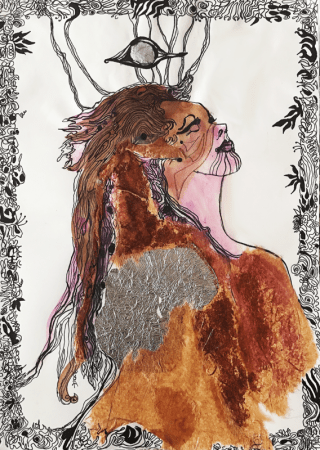
©️The Silent Eye, 2023, created by Giselle Bolotin)
As we discussed in previous posts, the soul is pliable – and also absorbent. It absorbs impressions, which gives us memory and the benefit of experience. But experience can also be negative and hurtful. Repeated negative emotional experiences condition the soul, which limits the expansion of its consciousness.
What dies, then – in the sense of Rumi’s poem?
The outward ‘radiation’ of the love of the Essence has the power to literally ‘burn away’ the negative parts of our personality, leaving it as a clear channel for the spiritual.

This journey is not for everyone… But for those who have encountered its ‘qualities’, it becomes an imperative.
To be continued in Part 8.
Other Parts of this series:
Part Four: The Edge of the Known
©Copyright Stephen Tanham
Stephen Tanham is a Director of the Silent Eye School of Consciousness, a not-for-profit teaching school of modern mysticism that helps people find a personal path to a deeper place within their internal and external lives.
The Silent Eye provides home-based, practical courses which are low-cost and personally supervised. The course materials and corresponding supervision are provided month by month without further commitment.
Steve’s personal blog, Sun in Gemini, is at stevetanham.wordpress.com.


 Sun in Gemini
Pingback: Nine Keys (8): When experience grows dull – Sun in Gemini
Pingback: Nine Keys (9 – final): An emotional reunion – Sun in Gemini
I had not seen that Rumi poem before! Very interesting.
LikeLiked by 2 people
Glad you liked it. It expresses the heart of the Sufi ‘approach’ to spirituality – which is experiential, rather than intellectual. Having said that, the Sufi poems are deeply clever…
LikeLiked by 1 person
I will have to read more of them! ☺️
LikeLiked by 1 person
If you have the ‘keys’ to understanding how they describe, you’ll get a lot from them 😊
LikeLiked by 1 person