

We could liken ourselves to a tall rocket, layered into functions. At the top would be the most sophisticated ‘computer’ the world has ever seen – the human brain. Below that would be the human-sized machinery tailored to assist the human passengers to navigate and control their tasks in space. Beneath these would be the vast machinery that balanced thrust and agility in this powerful human mechanism.
Towards the base, we would find the fuel – a set of huge tanks whose role was to safely store, then regulate the flow of this massively energetic substance so that it achieved the gaol of propelling the whole machine – including itself – upwards into space.
There are some similarities between the psyche and rockets…
The top of our ‘machine’ is the brain, which can be considered to have three main divisions. Its base, extending from the top of the spine, is the limbic brain – often referred to as the reptile brain. This ‘cold-blooded’ creature is concerned only with survival.
Above that and closely coupled with the spinal column is the mid-brain, the home of the sexual functions, such as arousal.
Beyond the mid-brain, the most recent addition to our long evolutionary journey is the neo-cortex – the ‘new brain’. This is involved with consciousness, language and other functions that we associate with societal and relational living.
There is physiology – the physical components of the human body, and their interworking; and there is psychology – the science of how this composite creature comes to assume a single idea of a ‘self’, centred on the body-mind entity.
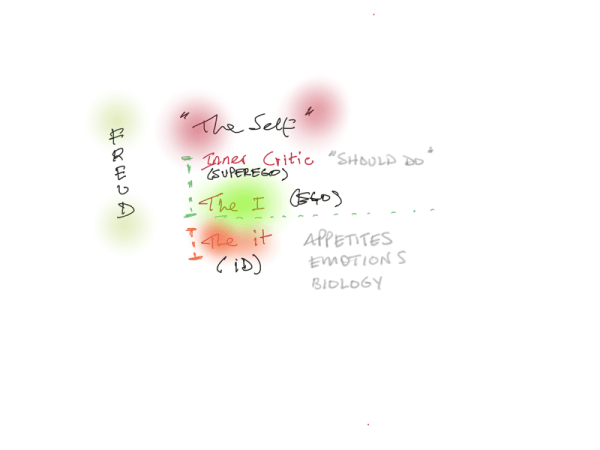
Sigmund Freud was one of the pioneers of this ‘science of the mind’. He divided the ‘sense of self’ or psyche into:
das Ich – the ‘I’;
das ‘Uber-ich’ – the ‘Over I’, which became known as the Super-ego; and
Das Id – ‘the It’
This division offered a profound view of the human makeup, particularly with the origination of the idea that there was a high-energy ‘basement’ to our being. Freud said the ‘id’ grew as we matured, and the ego learned to suppress those instincts that were not acceptable in the societal ‘layer’ we wanted to inhabit.
As the suppression of what we would now call ‘instincts’ continued, the whole of our lives would become ‘skewed’ with the force of their presence, a presence that was denied a life in the normal world. Carl Jung, the well-known contemporary of Freud wrote extensively about this.
Much much more is now known about the interaction of the physical (physiological) and the emotions. They are, effectively two sides of the same coin. We may think emotions are a ‘higher entity’, but their origin is directly in the ‘flow’ of what is happening to us: our experience. As such, their strength is to be nearer to the reality of experience than the elements of mind.
It’s easy, with some practice, to monitor our emotional states and reactions. We simply need to pause the normal state of our attention and ‘inquire into ourselves’.
The act of making them visible will teach us a lot about ourselves. But what about our instincts – those levels of response that are the first expression of our life-force in the body?
Instincts are not simply emotions; they are structures of reaction and response in the lowest levels of what we come to know as mind. They are example of early programming that underpin everything else that happens in our lives. Over time, they become – slowly – more sophisticated, and can be seen to be the core of our primary responses in the areas of survival, sexual and social interactions.
Do such instincts have a bearing on our spiritual journeys? Given that they are so rigid and controlling, we might view them as negative forces ranged against any true attempt to spiritualise our lives. This can easily be confused with then internal and critical voice of the superego.
The instincts have, however, great potential to help us on our spiritual journey, since they are the holders of the primary energies of our lives – in vast potency – the ‘rocket fuel’ of our title. More will be said about this in future posts of this series.
This is topical on a personal level. I have, for a number of years, been keen to deepen my knowledge of how the instincts operate – from a spiritual perspective. One of the teaching organisations I most respect – the Diamond Approach – has recently begun to offer some of their core knowledge as a series of online courses, available to the public.
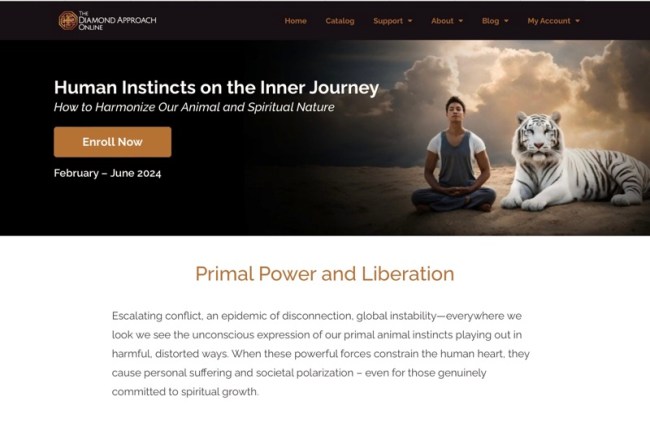
I have enrolled in the DAO online course, and look forward to sharing some personal insights in this series of blogs, though I will not be able to share the actual material of the course.
Part Two will follow in the next two weeks.
©Stephen Tanham 2024
All photos taken and processed on an iPhone 12 ProMax.
Stephen Tanham is a writer-photographer and mystical teacher. He is the founding Director of the Silent Eye, which offers a journey of the soul guided by lessons, inner guidance and outer companionship.
There are two blog streams:
(mystically-oriented writing)
and
(general interest, poetry, humour and travel)


 Sun in Gemini
You must be logged in to post a comment.