

‘Our life-force begins its journey with the instincts.’
Hearing that stopped me in my tracks. It was so exact, yet, at the same time, so counter to what I would have written on my own.
Prior to this, I would have considered the life-force to be somehow ‘higher’ to the instincts; the latter being the pesky habitual appetite-related objects that get in the way of us being ‘better humans’.
We can think of many examples. We all know the effects of fear in paralysing what we need to do; of too much drink at that dinner party; or letting our hunger make emotional pictures that override sensible eating patterns. All these begin with the instincts. Most relate to threats or appetites. The threats are usually to our perceived sense of ‘self’ at the egoic rather than the existential level, but they all pattern and distort our ‘self in the world’.
We can, though, clearly see the benefits of, for example, listening to the ‘intelligence of fear’, and trusting that sixth sense when it tells us we are in danger or even involved in a threatening situation which may not be clearly defined.
We can make all of this much more conscious…
As I wrote in the last post, there are some similarities between the psyche and rockets… The life-force IS our fuel. The fact that it is all routed to our conscious minds through the instincts is significant for everything we do and try to do.
There is a helpful analogy between the brain and the hand, one that models the evolutionary basis of our brains, and illustrates the way life – and intelligence – has evolved and is evolving through us.
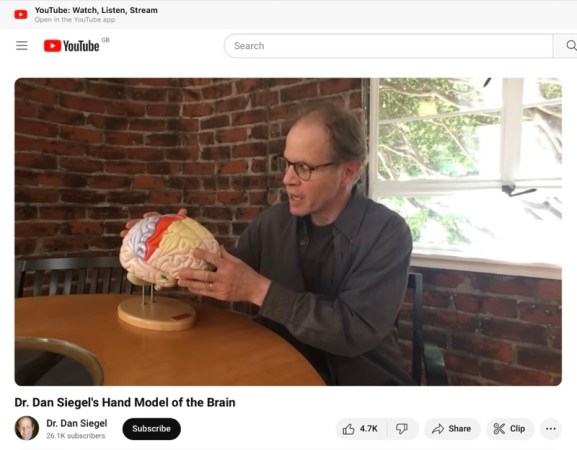
The model was developed by Dr Daniel Siegel to help us visualise this evolutionary drive at work in nature.
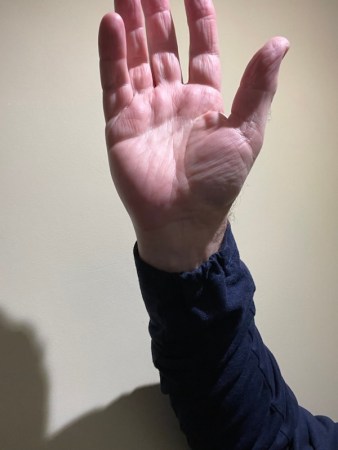
Hold up an arm of your choice, so that the forearm is vertical – representing the spinal column. The spine, together with the flat palm of the hand is known as the brain-stem, or mid-brain, and is the foundation of our survival ‘fight, flight or faint’ protective responses. These have been around for over 200 millions years, and interact, closely with what came next: the limbic brain, represented by the folded thumb in the next image. The limbic system took evolution another hundred million years to develop. These are not trivial structures!
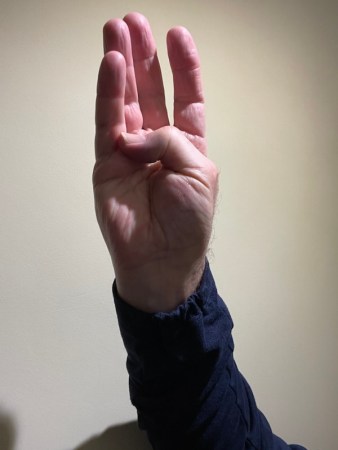
This combined sub-cortex structure is often referred to as the ‘reptile brain‘, although the mapping is only approximate. The reptile brain contains our core instincts, but none of the secondary features that ‘check and question’ the reactive actions the ‘reptile’ triggers. Real reptiles lay their eggs and leave the offspring to fend for themselves; there is no continuous ‘suckle, check and care’ as offered by mammal such as humans, dolphins, hippos, etc.
The ‘cold-blooded’ reptile is concerned only with survival. Above that and closely coupled with the spinal column is the mid-brain – the palm of the hand, below, with the odd structure of the folded thumb.
The combination of the folded thumb and palm creates the limbic-centric mid-brain, which adds – significantly – the emotions and our motivations. Now we have immediate reactions to the events of life that are of a different quality to the fight and flight responses of the reptile. The emotions are closely-coupled to the physiology and physicality of our organism. They may well convey information to us that is not of a logical nature, but of essential importance – such as the desirability and psychological ‘fit’ of a ‘mate’.
The limbic part of the brain also gives us the all-important means to connect with our caregivers, meaning that we can form the vital bonds with those who have the power to protect and nurture us. This is the basis of our whole social instinct system, which is many times more developed than the survival or even sexual instincts.

If we fold the fingers over the ‘limbic region and brain-stem, we can see how interconnected the brain is – and this is at the heart of how it works. Each new development, often taking millions of years, has integrated itself, deeply, with what came before. This has resulted in the mind having great power over what we do with our brains and body, and also an astonishing degree of ‘plasticity’ in the functioning of the brain, itself.
Brain cells are not limited to the head. New neural networks of brain cells are being discovered in the heart and lungs, for example. It is becoming obvious that our former understanding of the brain is tiny compared to its real potential.
In the next post of this series, we will consider the function of the outer layers of the brain, with particular reference to the neo-cortex, the most recent layer, and consider how our instincts may not simply be outliers of ancient evolution, but advanced societal functions capable of coming to the rescue of mankind in terms of inner strength, deep relationships and astonishing interchanges of human energy…
They might be arriving just in time.
©Stephen Tanham 2024
All photos taken and processed on an iPhone 12 ProMax.
Stephen Tanham is a writer-photographer and mystical teacher. He is the founding Director of the Silent Eye, which offers a journey of the soul guided by lessons, inner guidance and outer companionship.
There are two blog streams:
(mystically-oriented writing)
and
(general interest, poetry, humour and travel)


 Sun in Gemini
You must be logged in to post a comment.