
Share this:


On this day
A meagre seven years ago
I woke to find you gone
A day premature
Just the nursing angel in your hand
The phone receiver in mine
△
Now, at these times
I picture you in your old shop
Happy to leave your kitchen
For shop’s bell, whose call
To seek but not always to find
Mattered little, but sharing chat did
Then, happier, returning to your TV
△
On these days
I miss you most
The simple routine of your day
Grown golden in my mind
Only seven years ago
And a million miles away
△
©Copyright Stephen Tanham
Share this:

Come and join us?


At the heart of an ancient landscape is the Dorset village of Cerne Abbas. The village grew up around a Benedictine Abbey founded there over a thousand years ago and it is still a place where folklore, myth and legend come together…and few of them agree.
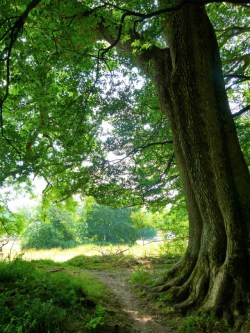
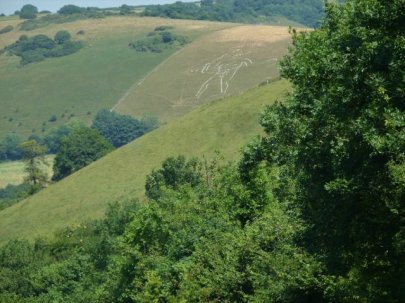
The holy spring rose from where St Augustine struck the ground… or where St Edwold saw a vision, depending on which story you prefer, just as the giant on the hillside dates from the Iron Age… or is a seventeenth century political statement. The mysteries here are real… but underpinning them all is the fact that the place was undeniably seen as sacred.
The name is interesting in itself in that respect; ‘Cerne’ is believed to come from a Celtic word for ‘stone’ and ‘Abbas’ is the Medieval Latin ‘abbot’, which means ‘father’. Does the name refer to the Abbey, or did the abbey…
View original post 277 more words
Share this:

Share this:

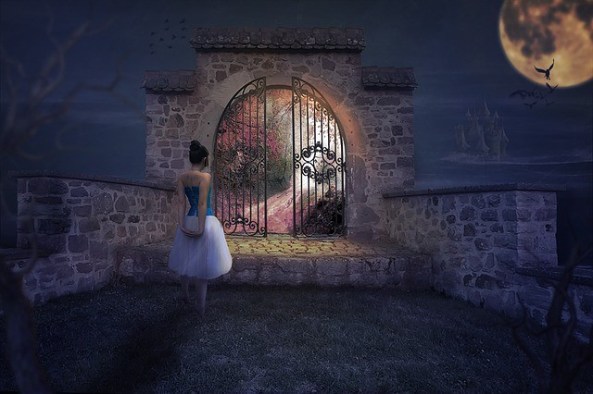
Crack.
The ruler slapped down on the desk, narrowly missing my knuckles and dissolving the magic.
“Daydreaming again? You will pay attention in my class, young lady!” The French mistress, determinedly optimistic to the last, turned her back and returned to the blackboard. Oddly enough, French was always one of my favourite subjects and one at which I did best… in spite of the daydreaming.
It was not the anxious, fretting kind of daydream, not was it just wandering attention. It was like stepping into a wardrobe and coming out the other side into a magical land where anything was possible.
I could daydream my way through most things and still take in, process and apply the information, and was always in the higher sets. I was lucky… back then, I only got into trouble for daydreaming. A few years later and I would probably have been sent to…
View original post 444 more words
Share this:

Share this:


The beautiful Northumberland village of Etal, one of a local twin, has a fine ruined castle; but this blog is not entirely about castles…
The picture above is the castle at Etal. It was constructed in the middle of the fourteenth century by Robert Manners, a Norman descendant. It consists of a residential tower in the ‘Pele’ style; a gatehouse and a corner tower of small proportions. The whole is protected by a curtain wall. The castle has a ‘bloody’ past, being close to Branxton, the nearest settlement to the site of the Battle of Flodden (September 1513), at which the English King Henry VIII’s forces under the Earl of Surrey prevailed, after a long and bloody battle, over those of James IV of Scotland.
A few days prior to the battle of Flodden, King James had stormed Etal castle and added it to the many others captured in the most audacious invasion of England ever undertaken by a Scottish army.
History judges the English King to be the primary aggressor, since the whole war was prompted by Henry tearing up the Treaty of Perpetual Peace which had previously been in place between the two countries, and with which the Scots were perfectly happy, since it recognised them as a nation.
James IV was killed at Flodden, which saw almost one-third of the 34,000 Scottish soldiers killed. Etal was a short-lived prize…
We have forgotten the emotional taste of ‘wholesale slaughter’. Like many words that are supposed to trigger a moral response, wholesale slaughter can now be rendered ‘over there’ by television. If the news is terrible we can change channel… the choice is ours. We think it’s an escape, but, really, it eats away at our collective soul… we feel we can do nothing, so we don’t try. We accept horror – real horror, as way of life. The cost is that we become farther from reality – and reality is true life…
Ten thousand Scottish men (and thousands of English soldiers, too). What does that number mean? If we asked them to come back from their dark, Northumbrian graves to help us understand this horror, and line up in rows of ten, how long would it take a firing squad to kill them again? Let’s assume that the modern firing squad uses machine guns that can kill ten men in a minute. It might take four more minutes to have them march to their positions and another five to clear the bodies away. That’s a rounded ten minutes per squad of dead men. To do this to ten thousand would take 10,000/10, which is a nice and easy one thousand minutes. There are sixty minutes in an hour, so the firing squad, with its modern automatic weapons, would be continuously active for nearly seventeen hours – most of a day, if you include the English soldiers too. Imagine being there, and watching all of it? We might get a new appreciation for ‘wholesale slaughter’, and this is a minor example…
Northumberland is full of castles. Castles and ‘Pele’ Towers: tall, fortified dwellings, less than luxurious, but safe – in which a besieged family could live for many months until help arrived. Wars, family and tribal conflicts helped create a very chequered past for this beautiful county, which holds the North East border with Scotland. When there weren’t wars between England and Scotland there were the reivers – bloodthirsty family gangs, ready to attack, plunder and kill in these historically un-policed borderlands.

Border reivers at Gilnockie Tower, from an original drawing by G. Cattermole (Wikipedia Public Domain)
The Roman emperor Hadrian had found it difficult, too. So difficult that he had ordered the construction of a wall that ran coast to coast, from the Solway Firth, near Carlisle to Wallsend, near Newcastle. It has been described as the greatest engineering feat of the Roman world, but, as is the case with walls, it didn’t really work.
A different approach and smaller than a wall is the idea of keeping people in… Being inclusive, looking after them. It’s an idea seemingly at odds with our go-getting, every man and woman for themselves, pursuit of excellence, kill the bastard, commercial world.
The reivers just killed their enemies; and were killed in return. Vendettas, feuds, usual cycles of endless violence. It makes good television and rotten societies.
Caring requires that we believe in Good. Not just as an idea but as a force, an ideal, a state to be drawn on when we are pressed or outnumbered or in despair. The people who established modern Etal believed in good. They twinned it and the neighbouring village of Ford together, establishing a ‘Model Village’. This is not to be confused with a miniature village. An model village was a term coined by entrepreneurs like Robert Owen (who wrote ‘A New View of Society‘) and William Hesketh Lever (founder of what became Lever Brothers – Today’s Unilever). It was place where, alongside work, decent housing and education were provided on the basis that, if you looked after people, you could expect them to look after that which employed them.
The village of Etal is beautiful and has a presence not entirely due to the castle.

The main street of Etal is clean and pretty, with a lovely Post Office cum tea room. Many of the buildings are thatched. This includes the Black Bull – centre in the picture above – the only thatched pub in Northumberland. The pub is being restored and is an example of what’s still very good about Etal and its nearby twin village of Ford. Nowadays, the twin villages are part of a managed country estate owned by the Joicey family. One striking thing about Etal and Ford is that no-one but the controlling family is allowed to own property. The houses, the shop and the Black Bull are only available to rent. Tenants are expected to look after their properties and everyone feels included. it’s a happy place and proud – you can feel it as you walk through on your way to the bloody castle.
About a half-hour’s drive away from Etal is the Bambrugh coast, a very beautiful place. We were staying a few miles away in a newly resurgent village with a great beach, and eating our evening meals in a local pub about a mile away, to which we walked, in the January darkness, enjoying the sound of the sea hitting the stone harbour in the inky darkness. Photography was well-nigh impossible but this shot illustrates the point I want to make:
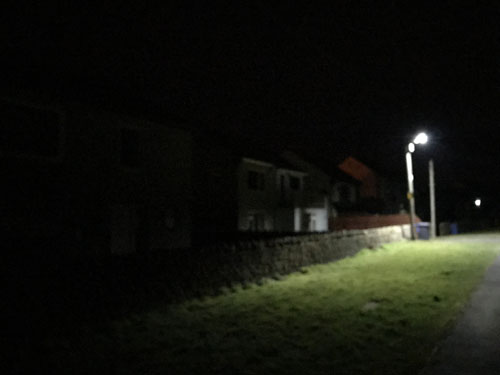
It was only on our second journey back to our holiday cottage that I realised how dark the cove was – totally dark, in fact, apart from that one street lamp. The reason was simple: there was no-one living there. The most expensive properties in the village – facing the sea – were all empty on that week in January. They had been bought as holiday homes, busy during the summer, no doubt, but a dark and ominous shoreline in winter.
Etal is not the bustling village that the the poster below records it as being in 1820, but it’s not broken, either; not like that winter shoreline a few miles away.

Of that list, there remains a church, a post office/excellent tea room, some well-kept and lovely houses, a caring landlord that ensures that everything fits; and, oh yes….a ruined castle.
Inclusion is everything…
The thought brought to mind something I read on a plaque within the gardens of San Jose University, many years ago. I didn’t write it down at the time and had to struggle to remember the gist of it, but it went something like this:
He drew a circle to keep me out
Heretic, rebel, a thing to flout
But love and I had a plan to win
We drew a circle to keep him in
It’s a lot better than a dark shoreline and empty houses, or a line of doomed people seventeen hours long condemned to die by the actions of a psychopath…
We think of our world as much bigger than villages. But the villages of our communities need not, ever, be broken. We just have to be inclusive…
Stephen Tanham is a director of the Silent Eye School of Consciousness, a not-for-profit organisation that helps people find the reality and essence of their existence via low-cost supervised correspondence courses.
His personal blog, Sun in Gemini, is at stevetanham.wordpress.com
©Stephen Tanham, Silent Eye School of Consciousness.
Share this:


“I’m re-reading Tolkien,” said my son.
“Cool. How far have you got?”
“The riddles in the dark bit.” That made me smile, as we’d taken inspiration from that chapter for the December workshop.
“What do you reckon… when Gollum says ‘my precious’, is he talking to the ring or himself?”
“I asked myself the same question when I first heard that story.” Our teacher, Miss Bedford, had read The Hobbit to a class full of ten-year-olds, sitting silent and enrapt on the library floor. I remember quite vividly being struck by that anomaly, even then. “Both.”
“Hmm…” said my son, settling back with his morning tea. “Elaborate…”
The character of Gollum is a moral tale all on its own. Greed and desire cost him his home and his place amongst his people. He murders his best friend to obtain the ring and is driven to slink away invisible, into the…
View original post 809 more words
Share this:

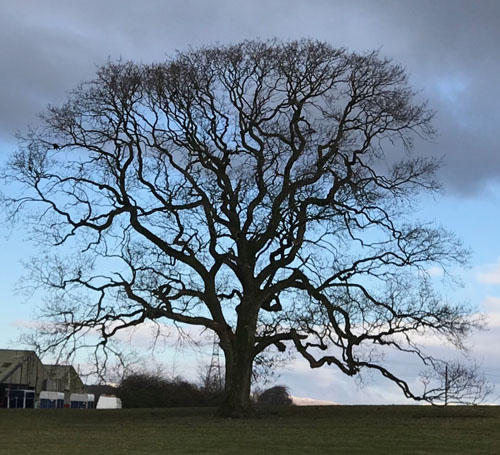
The tree in Winter
Its life-trail etched against the sky
reveals what we cannot
Who stand below and try
—
To see within
How we became this shape
This pattern in the now
And asking how
—
Did we result in this?
Our branching tale of history
Concealed in layered thoughts
And wrapped in finery
—-
We would
Be dead and left to rot
So naked in the winter wind
Yet she is not
©Stephen Tanham
Share this:


*
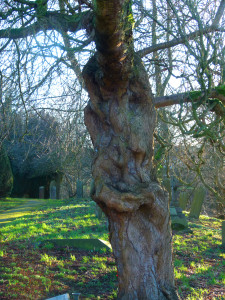
Few are born to ascent.
Those few that are may lack the strength of character to attempt it.
Without recklessness it is almost inconceivable.
Our Minstrel, hazards the mountain path alone,
and asks none for advice, for who could tell him even of its existence?
If he falters, his limbs rot where they fall.
Torn from his torso by that pitiless Cave Bear who crouches,
ravenous, in the depths of our consciousness.


 Sun in Gemini
You must be logged in to post a comment.