

Summer’s Last Kiss
When ocean’s shine turns mirror bright
And deeper love seems written there
When crested waves hiss rest awhile
And be with us in formless dream
Then know that summer’s parting kiss
Casts lingering promise bold and bare
➰
To cling is but a dreamer’s sigh
As worlds rotate and tides return
Her russet hand will still caress
Though leaves are falling, thick and slick
Her naked skin still shines within
The wood-flame’s crackling burn
➰
The smoke mosaics to fall of snow
When deepest dark encloses
Reducing days from distant blaze
Which culls as much as harvests
Now tightly held in midnight’s cold
Endurance starkly, sweetly urges
➰
Till one damp morn when green is borne
Upon a tide of coming bliss
She’ll call the rising of the sap
And deep you’ll breathe the urgent need
To be with her above the sky
Entwined in endless summer’s kiss
➰
©Stephen Tanham
Share this:


Share this:

Share this:


This series of posts are based on the outline of an exploration session presented at The Silent Eye (a modern mystery school) “The Feathered Seer” weekend in 2017. Whilst I have attempted to retain some of the flavour of the actual talk, the interactive elements of the exploration are absent, and since most of it was done “on the hoof” it is not really a true reflection of the session. Many of the sections are expanded considerably from that presented on the day…
~~~
 “Boy Mood 2” (found at eskipaper.com)
Not sure what I was thinking, really. It’s a massive topic, and whilst I did mention this during a previous exploration session, in 2016 on Spirit Animals, I somehow found myself agreeing to attempt the subject the following year.
April 2017 came far too quickly, and finding myself, the night before the session, scratching…
View original post 669 more words
Share this:


 *
*
“Sure, ’tis a terrible thing to choose one or t’other.”
The Aurally Man
*
“Alchemy as process has a number of stages.”
“And nobody seems able to agree on how many!”
“This might not though be a disagreement of number but of measure.”
“An hour possesses sixty minutes and three-thousand-six-hundred seconds, after all.”
“If we make our focus three, we get…”
*

*
“A point worth considering: all the triangles are of equal size.”
“Individually this seems obvious but, perhaps, not quite so, relatively.”
“A shortcoming alluded to in the phrase, ‘vagaries of the human eye’.”
“Which is another point worth considering.”
“The human eye follows lines like a moth to flame.”
“This is one of the reasons why the ‘Blessed Head of Joshua’ is eyeless.”
*

 *
*
Share this:

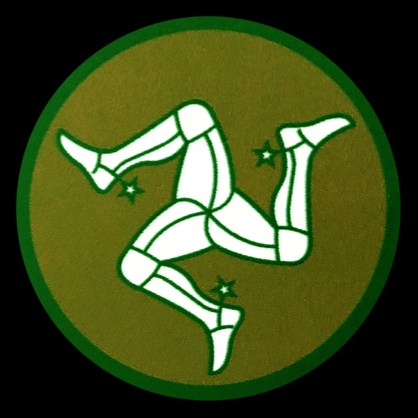
(Above – a commercial example of the use of the IOM’s symbol – author’s photo)
We have just returned from a long weekend on the Isle of Man. It is one of our favourite destinations, although it shares much of the wet climate of north Lancashire and neighbouring Cumbria, being seventy miles from the connecting port of Heysham.
The ferry journey takes four hours and can be a delight or a horror, depending on the winds… You can fly, but where’s the fun in that, these days? An hour sitting in the wind on the deck of a ship, gazing out to sea, can be a wonderful meditation. Can’t think of anything that compares on a plane…
 (Isle of Man national flag: origin Wikipedia, Creative Commons licence)
I have often looked at the Manx national flag – the three legged figure above – and wondered at its origins. Flags, like sung anthems, say a lot about what we might call the ‘national psyches’ of their countries, particularly at the time that identity was forming,
Take a moment to look at the symbol, above. Try not to analyse it; simply let it affect you as it will…
My own initial reactions were: its a fascinating design, suggesting independence, with an almost ‘engineering’ feel to it; it’s not something I’d want on my wall as it’s a ‘hard’ image; the ‘threeness’ of it really stands out and hits you… there are many more, and it is useful to let the imaginative side of the mind just play like this.
The three legged symbol of Mann (as the Manx people traditionally write it) is undoubtedly inspired by the Celtic . There are many examples, which have a common form of a ‘leg’ in the shape of a spiral or knot – one of the favourite forms of the Celts.
 A Celtic triskelion
Threeness is a very old concept, and fundamental to the world’s philosophical systems, as well as being an icon of stability. The equilateral triangle is often used to denote threeness, which can be point up or down. When it’s up, it usually indicates the ‘coming into being’ of a single point of power or will which seeks the diversification of manifestation to make the ‘garden below – creation’ a rich one. The one gives rise to the two, which are polar aspects of the one, though very different, and therefore inseparable. The Great Pyramid of Gizeh is an example of a three-dimensional triangle with a very special set of properties. As Pythagoras would have attested, all triangles are very potent forms.
Within the triangle, ‘polarity’ becomes the cornerstone of creation; and the different natures and relationships set up between the parts of ‘that which was and always will be One‘ weave the world or sub-world we see and in which we have our daily being – below’. A better way of thinking of all this is inner and outer; where the inner is the most powerful and causative, but less detailed; and the outer is the result–in all its multiplicity.
Above and below signify authority being above, whereas a more modern mystical view sees both as essential to the creative plan. What changes, with evolution, in all this, is the coming into existence of the act of Seeing from within…
The great mystical secret behind this statement is at the heart of what the Mystery Schools, such as our own Silent Eye, teach.
When we amend things in the outer, we are dealing with traditional cause and effect. To amend things on the inner is the basis of so-called esoteric magic.
Because the one that becomes two introduces differentiation, intelligent diversity has been created, and the creation can move on. All this is set within a circle – a traditionally solar symbol whose centre of activity is the centre of that circle. We can see that the three-legged Isle of Man symbol is based on a circle at whose centre is the intersection of the three centre lines of the figure’s legs. This is usually missed, but is a key aspect of the design.
So the One wills the continuation of the creation and the two that was one is therefore three, becoming four as the stability of this process is established and the Work proceeds in its unfolding.
But the symbol of Mann, above, is subtly different from the traditional Celtic treskilion. The traditional spiral of the triskelion is here replaced by actual legs; showing that this refers not to some ‘cosmic’ force, but to Mankind.
The triangle is there – look at where the tips of the feet are pointing and you’ll see it. This time, unlike the triskelion, the triangle is point-downwards, though the whole design is slightly offset from the vertical. The first image – the commercial logo that I’ve used as a simpler example, uses a different offset, which may be a legal requirement from the Manx government.
One reason for the offset may be that the design clearly implies movement. Something is ‘whirling’ – but running under is own ‘steam’. A perfectly vertical triangle would be a symbol of perfection, but the world isn’t perfect, it is ‘coming into being’ constantly, ‘unfolding’ is the world we use in the Silent Eye School.
The symbol therefore incorporates the idea of the process of evolution, driven by the creative forces embedded in the three-legged world, whose human image indicates that there is a ‘man/woman’ doing this! Not just any man/woman, but the generic human, of which we are all an instantiation – a living soul made from a spiritual and organic blueprint. In doing this we fulfil what Sue referred to in an earlier post concerning the text of Genesis.
In terms of elements, the three-legs of Mann are similar to a design I have found in a few old churches in Britain. Here, the illustrator has extracted the essential features to show the essential threeness plus the emphasis that the individual three are not the same:

There is only so much you can show in simple symbol!
Armed with the above knowledge, we can take things deeper and draw two triangles over the core Legs of Mann image like this. I’ve rotated the original to align the circular core to the vertical.
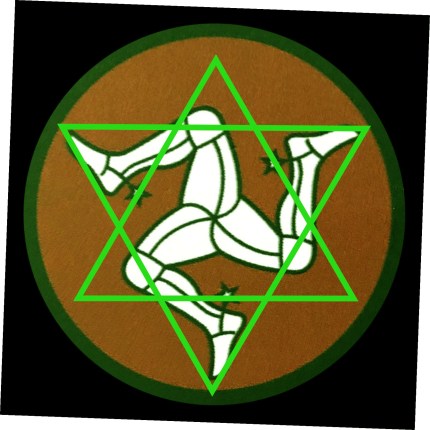
The hexagram has attracted lots of media attention over the years, being associated – like the pentagram – with sensationalised ‘magic’ over the years, but here we can see that the triangles can also be interpreted as an intertwined downwards and an upwards progression. Creation is said to proceed downwards and evolution upwards; but this representation allows us to interpret involution and evolution as driven from the point in the centre, which happens, also, to correspond with the genitals, something that has close alignment with Hebrew Kabbalistic thought. Time does not allow further discussion of this point, but it is significant…
Only one other country has a similar national symbol: Sicily. The three-legged flag is shown below:
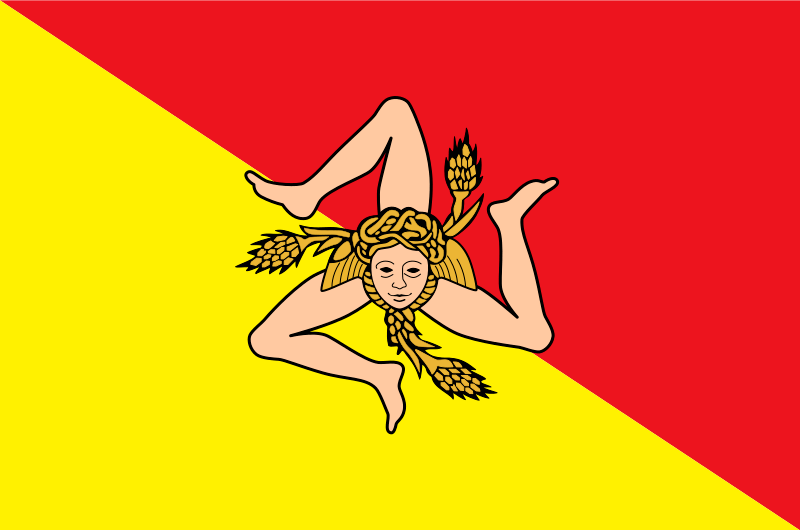
Image Wiki, public domain.
Here, the central figured is a Gorgon – the snake headed creature from Greek mythology, who had the power to turn ‘men’ into stone… but that’s for another day!
Stephen Tanham is a director of the Silent Eye School of Consciousness, a not-for-profit organisation that helps people find the reality and essence of their existence via supervised correspondence courses.
His personal blog, Sun in Gemini, is at stevetanham.wordpress.com
Images: Taken by the author and copyright unless otherwise stated.
©️Stephen Tanham
Share this:

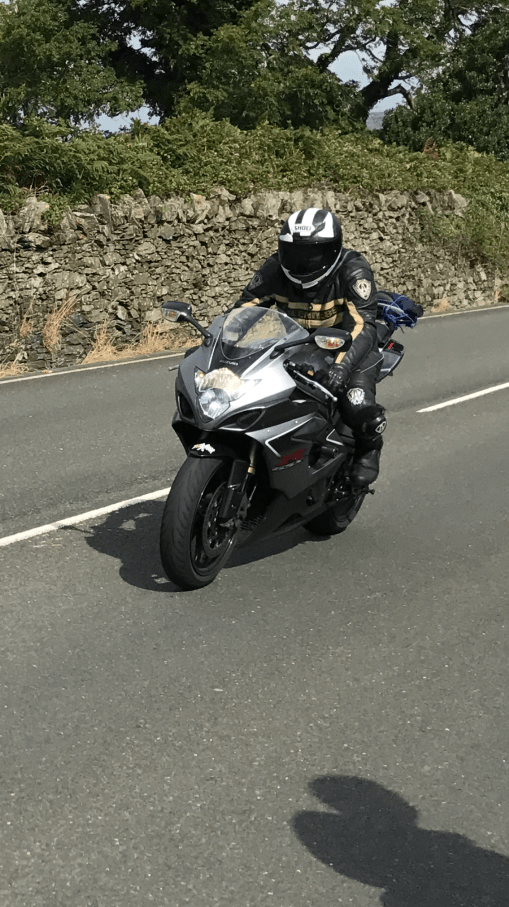
Our genial host, Mark, described it as ‘a stroll with TT’.
I was somewhat dubious at this proposal, since the Isle of Man (IOM) is famous for an invasion of super-powerful racing motorbikes during the famous TT road races in June; and the thought of somehow ‘strolling’ with several hundred motorcycles whizzing past at anything up to two-hundred miles per hour was a little unsettling, so soon after breakfast…
The traditional races are held in early June, which had come and gone, but the TT season lingers in the shape of the Classic TT. This hosts older and classic bikes, and is a gentler affair. Nonetheless, the steel and fibreglass monsters still race around the thirty-eight mile circuit at astonishing speeds.
He had, though, conceived a more subtle plan…

Like me, Mark loves the idea of a full or half day out in which the return journey is via a different route or mechanism than the outbound leg. In this case the enabling technology was going to be the electric railway that connects the Isle of Man’s capital, Douglas, with town of Ramsey – the second-most populous place on the island, and the area on the edge of which Deborah and Mark live.
Our good ladies had been dropped off in Ramsey to do some present shopping, and the plan was to meet up for a pub lunch at one of the traditional hostelries on the quayside – at the end of our walk. The Victorian electric railway would provide the transport home – Mark and Deborah live a short distance from one of the small stations.

Our walk was to take us over the last section of a ridge of hills that run from Laxey- the site of the famous industrial ‘wheel’ – to Ramsey in the north. The ridge includes the North Barrule (561metres) and Snaefell peaks, the latter being the island’s highest point, at 620 metres.
Tess, our collie, was with us, and we set off, following the line of the railway until we could cross the main road and begin the steeper climb up to the Ballure reservoir, at the base of the North Barrule peak.
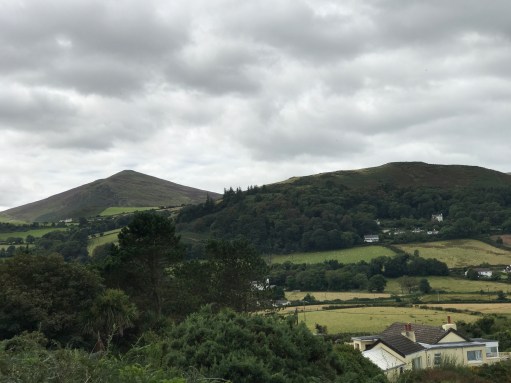
The first part of the steeper climb was a ‘bit of a grunter’ as Mark says, until we emerged onto the plateau, half way up, that holds the Ballure reservoir and nature reserve.
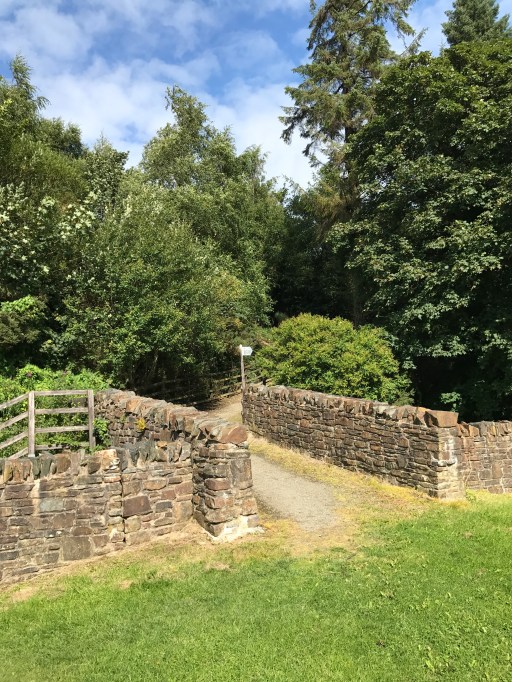
From here, the paths diverge; the most direct, for our purposes, following the sodden incline of a shallow stream, which saw us emerge, several hundred metres later, onto the mountain section of the TT course!
When we booked the trip we had no idea that we would be sharing both boat and island with hundreds of my leather-clad, two-wheeled brethren – I am a biker, though of a much more gentle persuasion that those who want to do the ‘double-ton’ – as 200 mph is named, here.
There are constant reminders of the fragility of life on that edge… Helicopter-based paramedics are on hand for the most serious injuries, but each year at the full TT, several people are killed.

The bikers we met on the outbound ferry crossing were friendly and pleasant. Now, a few days later, we were encountering them at a slightly faster rate, as bike after bike howled past us on a road that had no pedestrian pavements and few pedestrians…
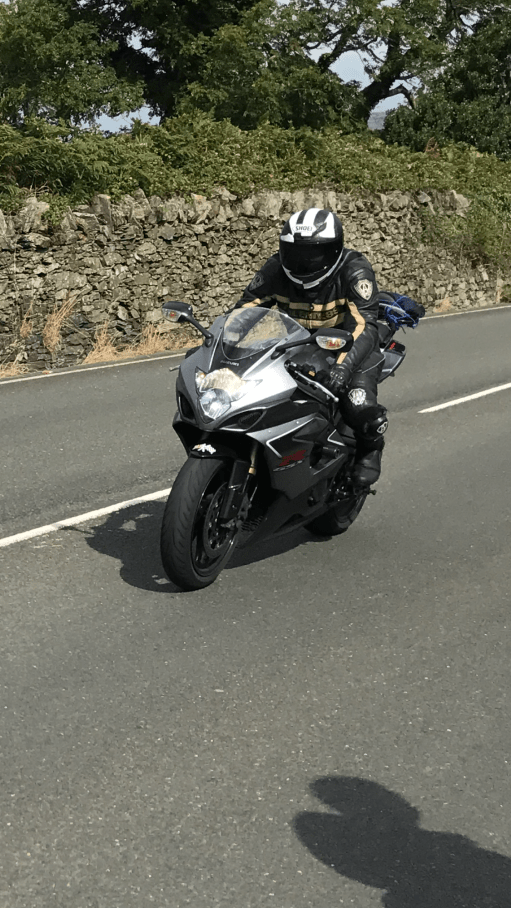
During the actual races, stepping onto the course would be illegal and deadly; but, during the practice week, the official high-speed laps are during the evening, when the roads are closed and revert to one-way flow (clockwise). This doesn’t stop many of those here for subsequent competition from opening their throttles wide on the mountain sections during the daytime, as we found…
My host watched, concerned, as a cluster of shining and snarling monsters flew past us, and Tess, securely on her lead, clung, bemused, to my right leg. Eager to minimise the dog’s exposure, we spotted a long gap and darted across to the safety of the ‘tower footpath’ – the way to our final destination before our descent into the gentle streets of Ramsey.

The tower is known as The Albert Tower, in commemoration of the only visit by Victoria’s husband, who arrived in the royal yacht on the 20th September 1847. The prince was rowed ashore at Ballure and he then walked up the hill and into the glen. From there he spent some time studying the view from the top of the hill. The hill was renamed in his honour. In 1848, a year later, the foundations of a commemorative tower were laid. It is made of granite and is forty-five feet high. It is considered a royal monument to both Ramsey’s subsequent development and the Island ongoing success.
Ironically, The Albert Tower is also known for another feature. From below, and almost any angle, it appears to be a round tower, not a square one… which did prompt much Roald Dhal-based humour on our part, based on Charlie and the Chocolate Factory and the scene about ‘Square towers that look round’.
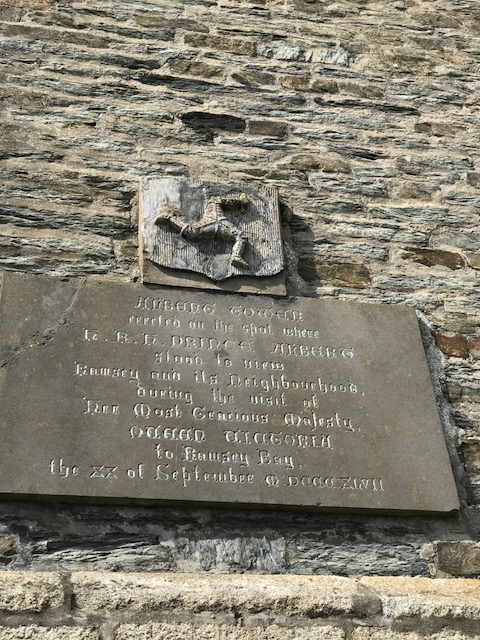
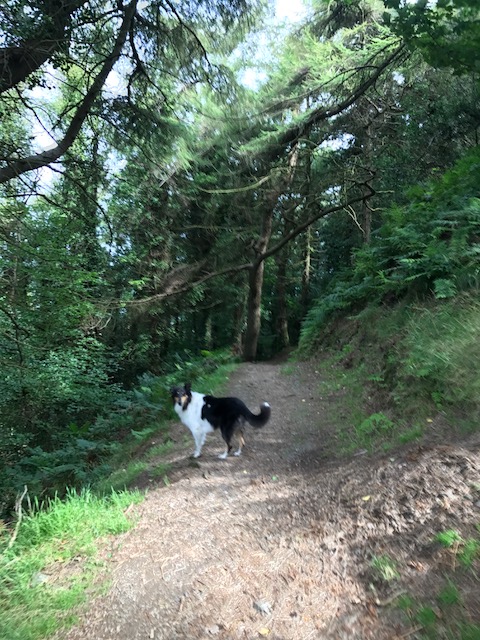
Our climb was complete. All that remained was to descend through the wide paths of the forest below us.
At the end of the descent, the outskirts of Ramsey enveloped us, with one final reminer – at one of the most dangerous ‘Z’ bends, of the extreme nature of all aspects of TT riding.
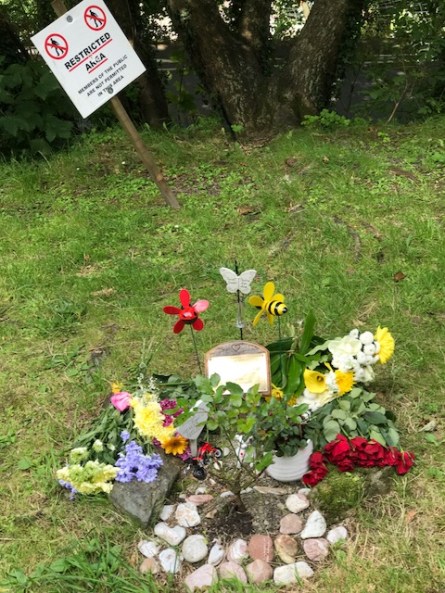
Soon, we passed the terminus for the electric railway – also an ever-present gift from the Victorian era (est. 1893). It was our good fortune that a train from Douglas, the island’s capital, was just arriving. We were able to watch as the train’s two carriages were split, allowing the powered car to have its overhead armature moved across its length – permitting reverse travel without being turned around. In the second stage, the other carriage was allowed to roll down the terminus slope, coming to a final halt in its correct position for the return journey to Douglas. Simple, space-saving and resilient – as its longevity has proved.

Our route to the quayside took us through Ramsey’s main streets.
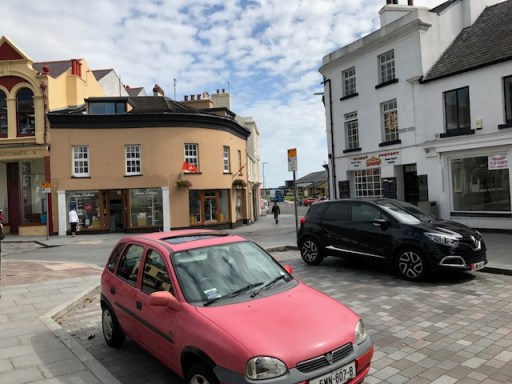
And finally along the quay…
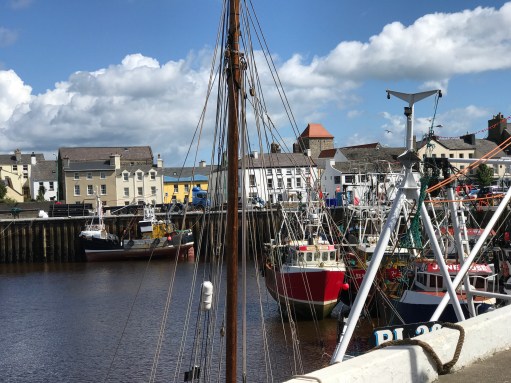
Our destination lay ahead – the Trafalgar, where we would, an hour later, meet up with Bernie and Deborah. It had been a wonderful walk – and a vivid reminder of the dual nature of the wonderfully vivid and world-famous TT.

Stephen Tanham is a director of the Silent Eye School of Consciousness, a not-for-profit organisation that helps people find the reality and essence of their existence.
His personal blog, Sun in Gemini, is at stevetanham.wordpress.com
Images: taken by the author and copyright.
©️Stephen Tanham
Share this:

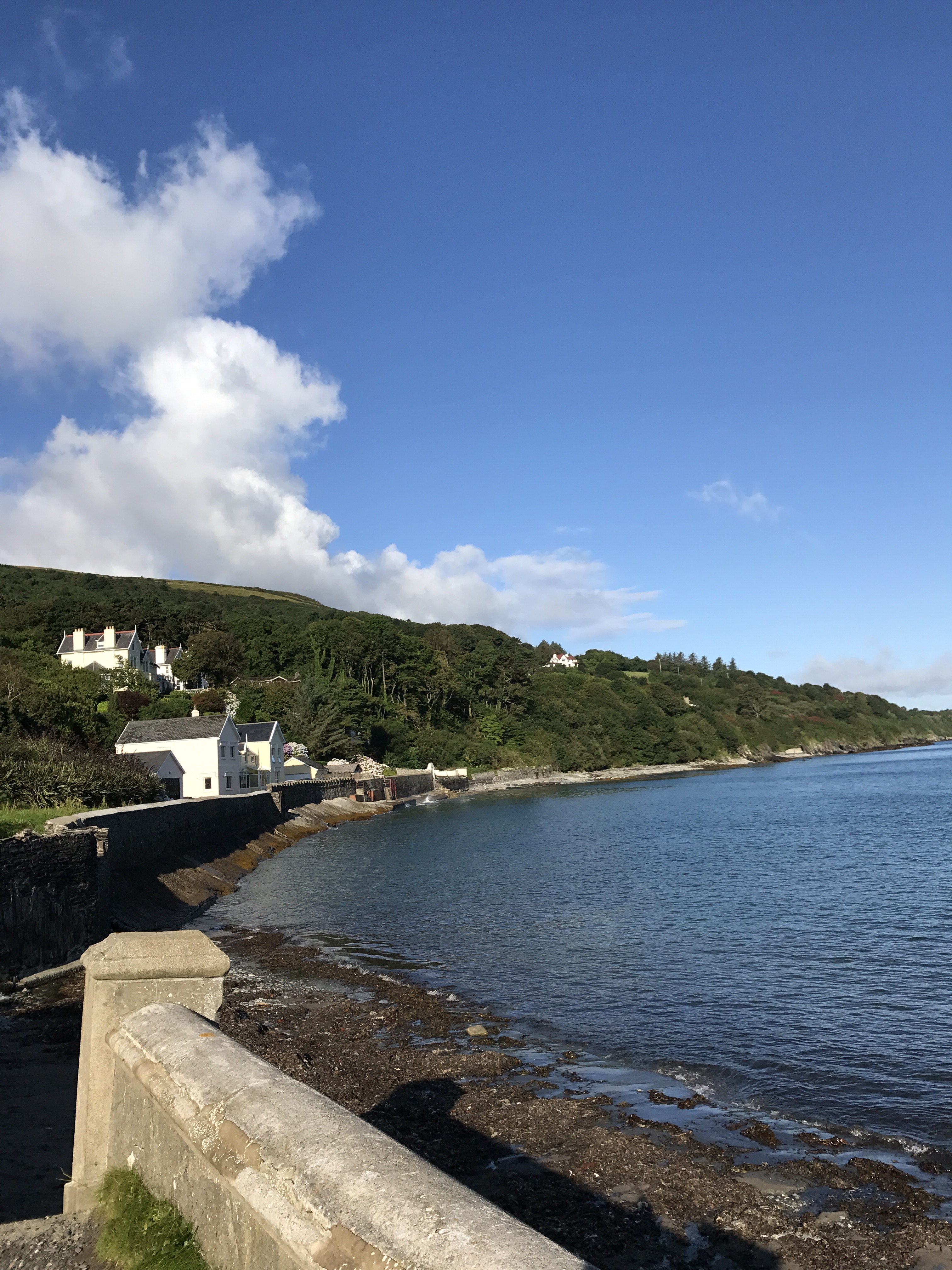
Port Lewaigue (pronounced ‘lage’) is a small cove to the south of Ramsey, on the Isle of Man. At the time of writing, we are spending a long weekend with some friends who now live here; having moved from Douglas, the island’s capital, last year.
Mark is due to retire from the Manx insurance business in a few weeks, and the purchase of a beautiful old house, a few yards from the shore of this lovely spot, marks the final part of their long-held retirement plans.
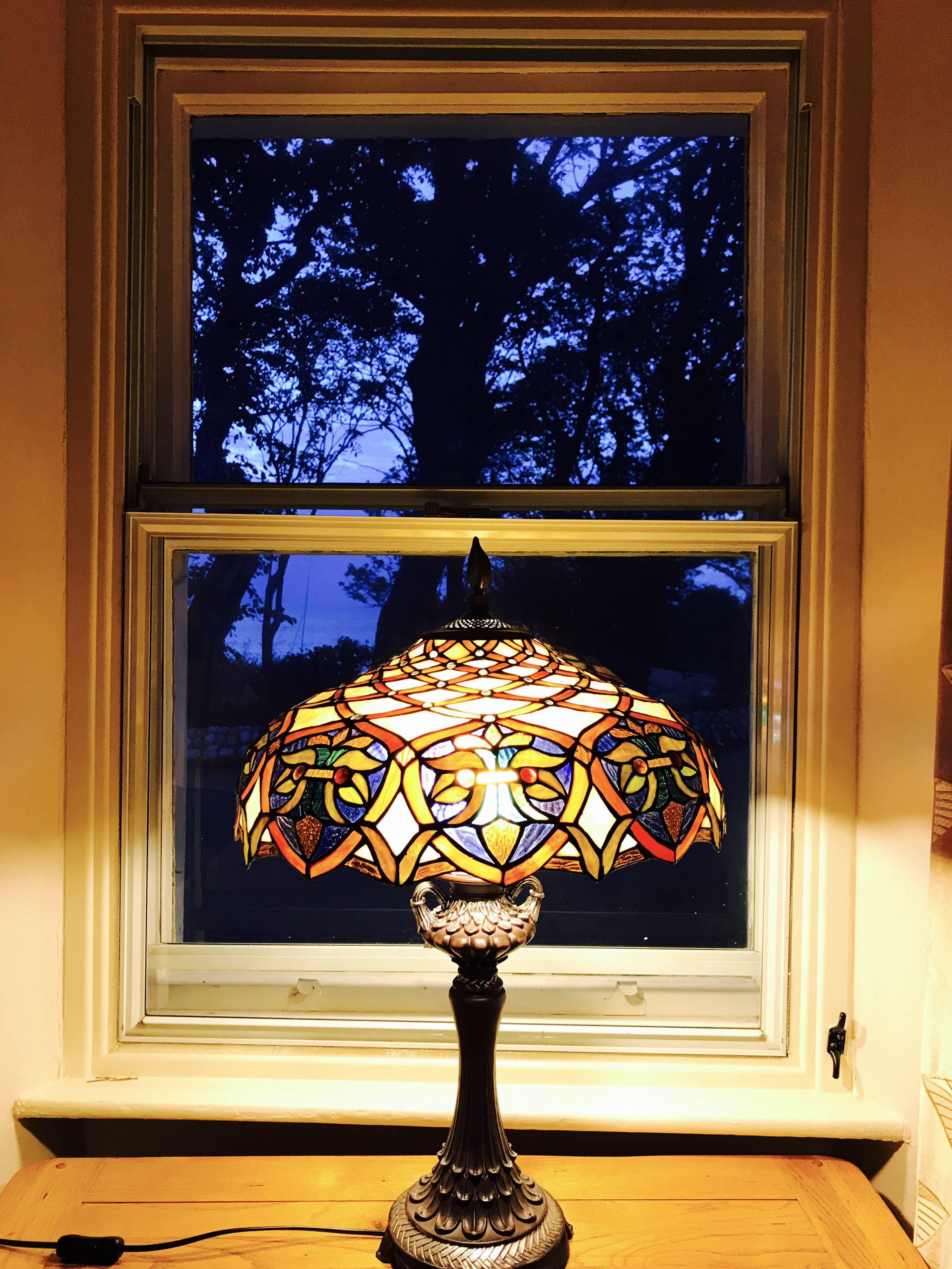
Until yesterday, Bernie and I were strangers to this beautiful part of the island, though we had driven through the fishing town of Ramsey on previous trips – usually in November, as we reserve a few destinations for quieter, out of season breaks; we like the feel of a cold and half -empty resort when we’re wrapped up warm and deciding where to have the next bowl of hot, local soup…
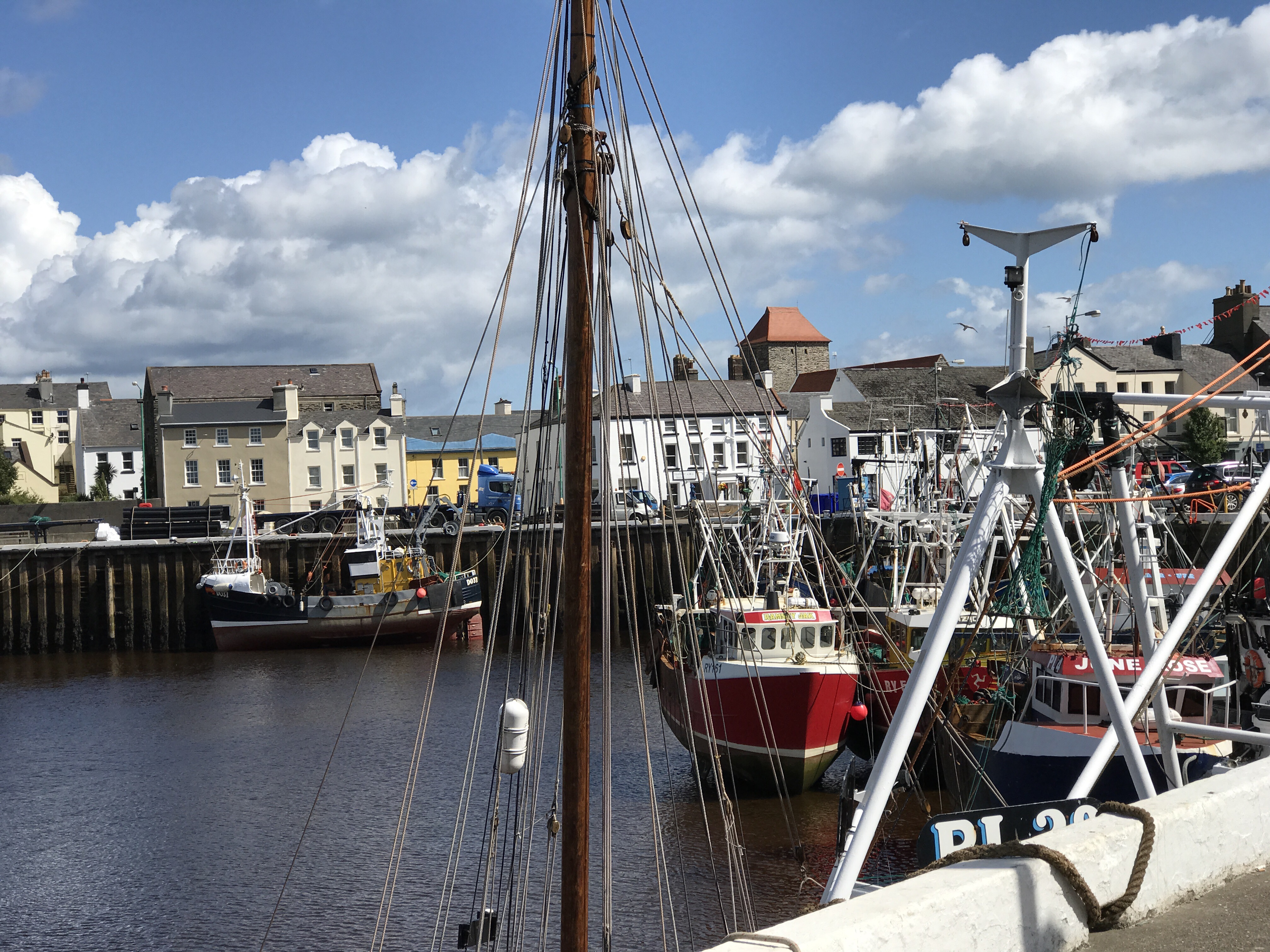
(Above: the port of Ramsey, with its deep and snaking harbour)
Port Lewaigue is a leafy and picture-postcard place that most holidaymakers will bypass, not realising that the tiny but steep road off the A2 will take you down to one of the most beautiful coastlines on the island.
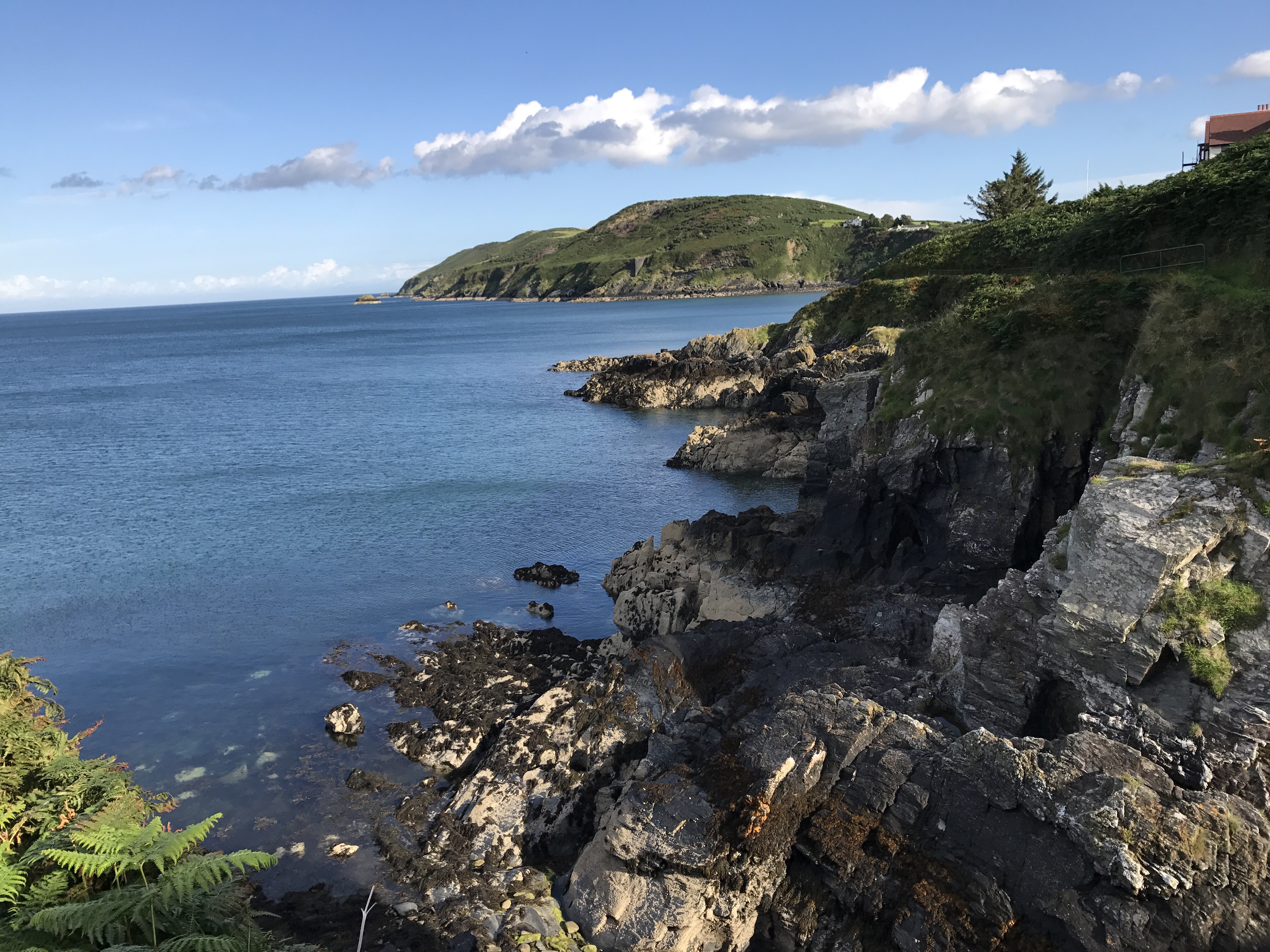
My own exploration of this idyllic spot began yesterday morning, when the household was still sleeping off a glass of wine or three from the night before. Tess, our collie, needed a walk and the excitement in her eyes as the world of new sight and smells beckoned was infectious.
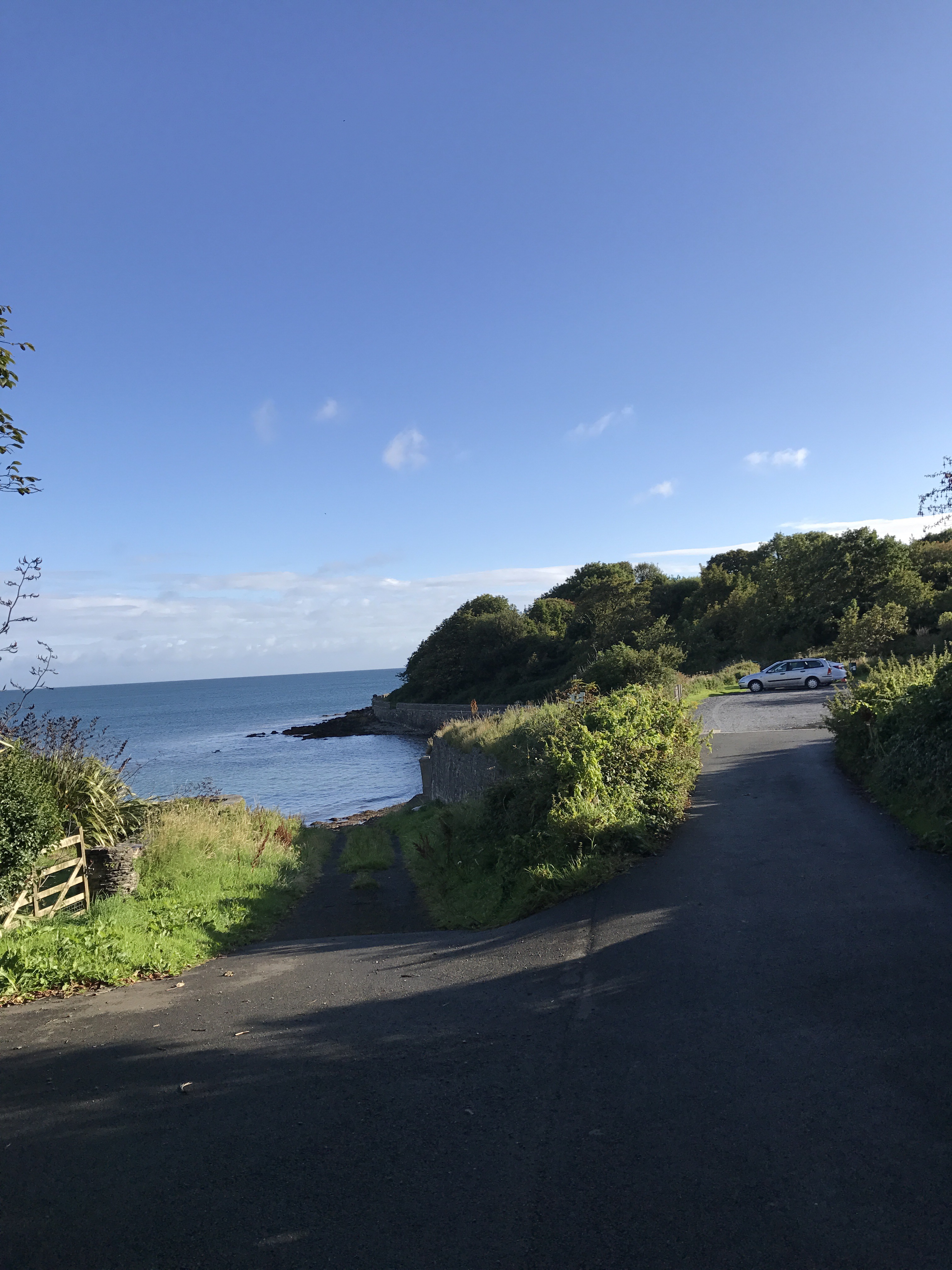
Within two minutes, we were at the bottom of the lane and entering the beach where we met a helpful elderly lady with two King Charles spaniels. Those with dogs will know the camaraderie that prevails on such occasions – as long as the furry ones get on! They did, and we were soon chatting like old friends. It was still very early and there was that sense of sharing the morning world…
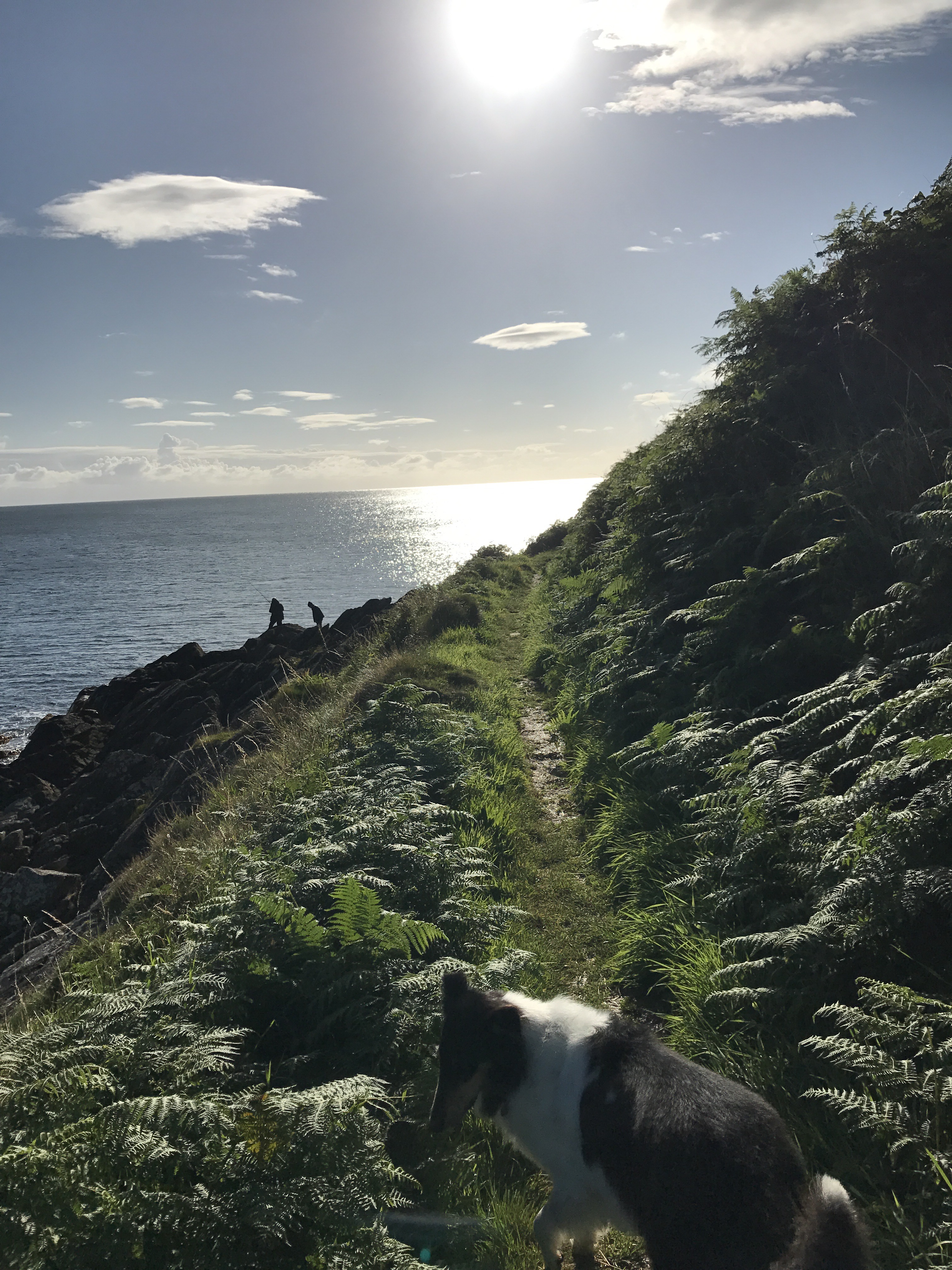
She told me that there was a circular path around the headland, but that I should ‘beware the false paths in the ferns’ – something that would make sense when I got there.
After a few more minutes of chatting, Tess and I set off on our walk of discovery. There is something lovely about encountering a new landscape for the first time.
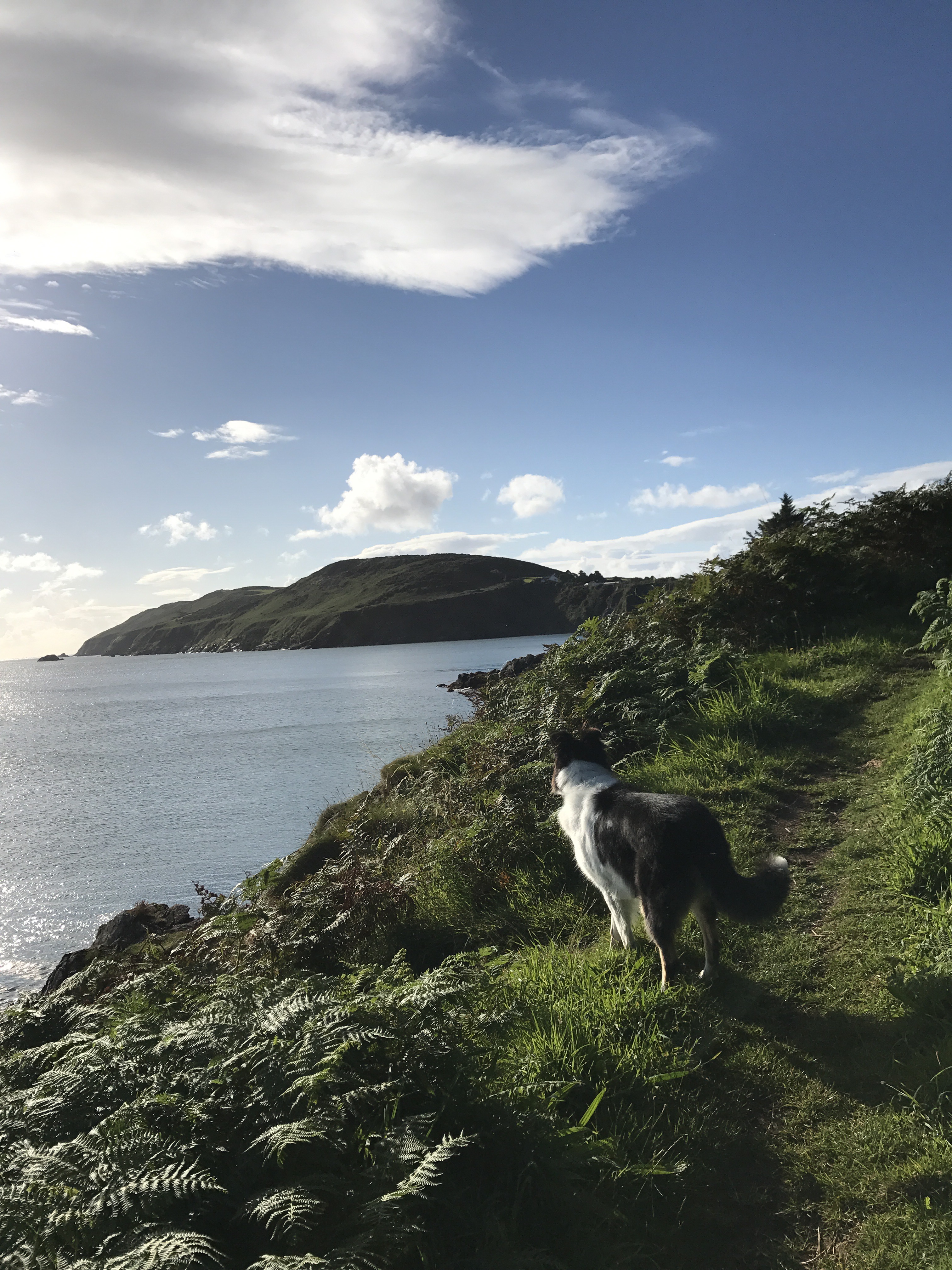
We followed the curling path, which climbed up the headland, becoming muddier as we went. I cursed my lack of foresight in leaving the walking boots in the car, but it was too late to go back – the household would soon be stirring to life and Tess needed her morning run. The outside tap and a good brush would have to suffice on my return.
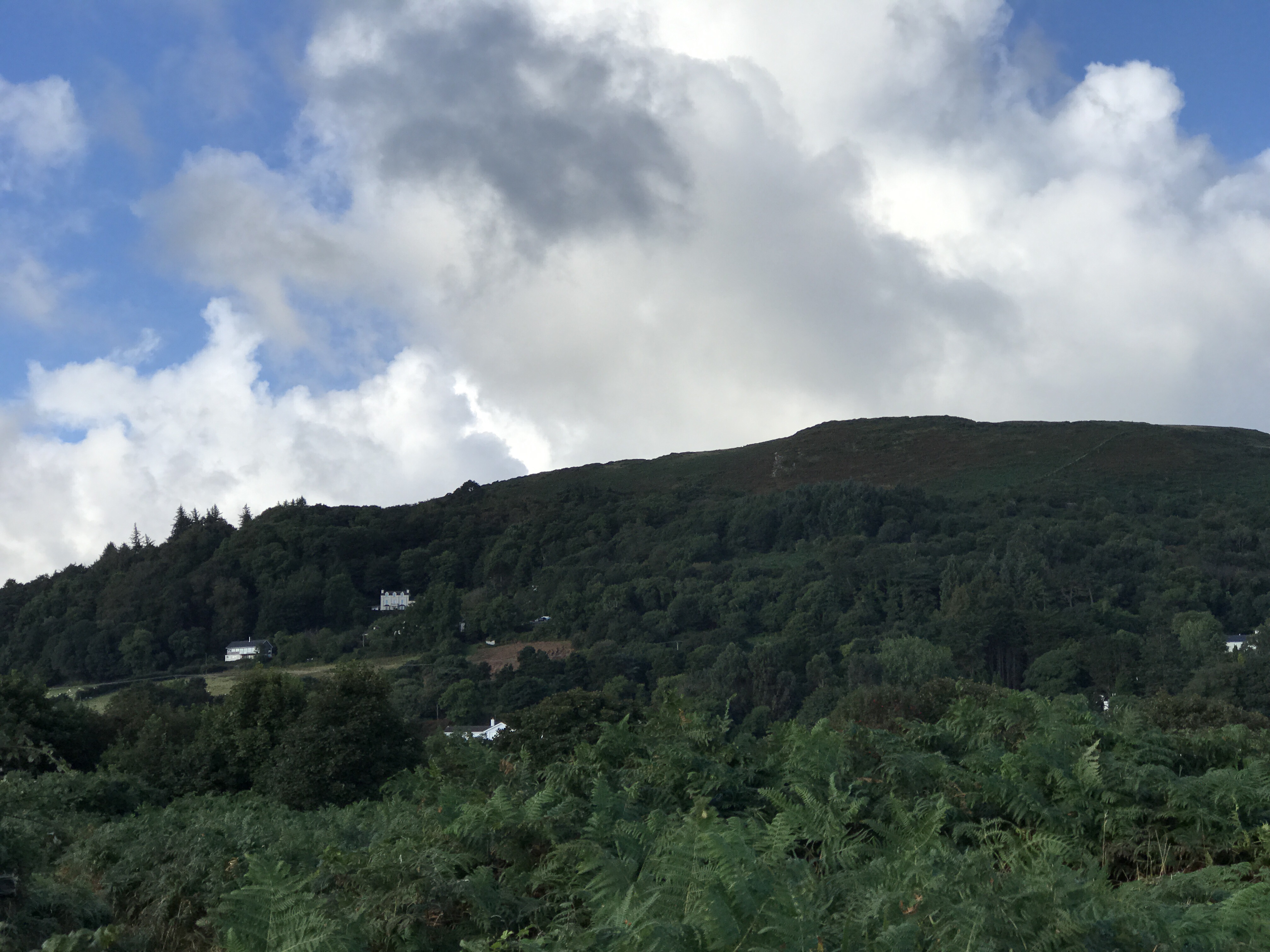
We climbed, and eventually the path opened up to the promised ‘fern field’ revealing also the view of the lovely line of hills that ring this part of the island – not too far from the famed TT motorcycle circuit.
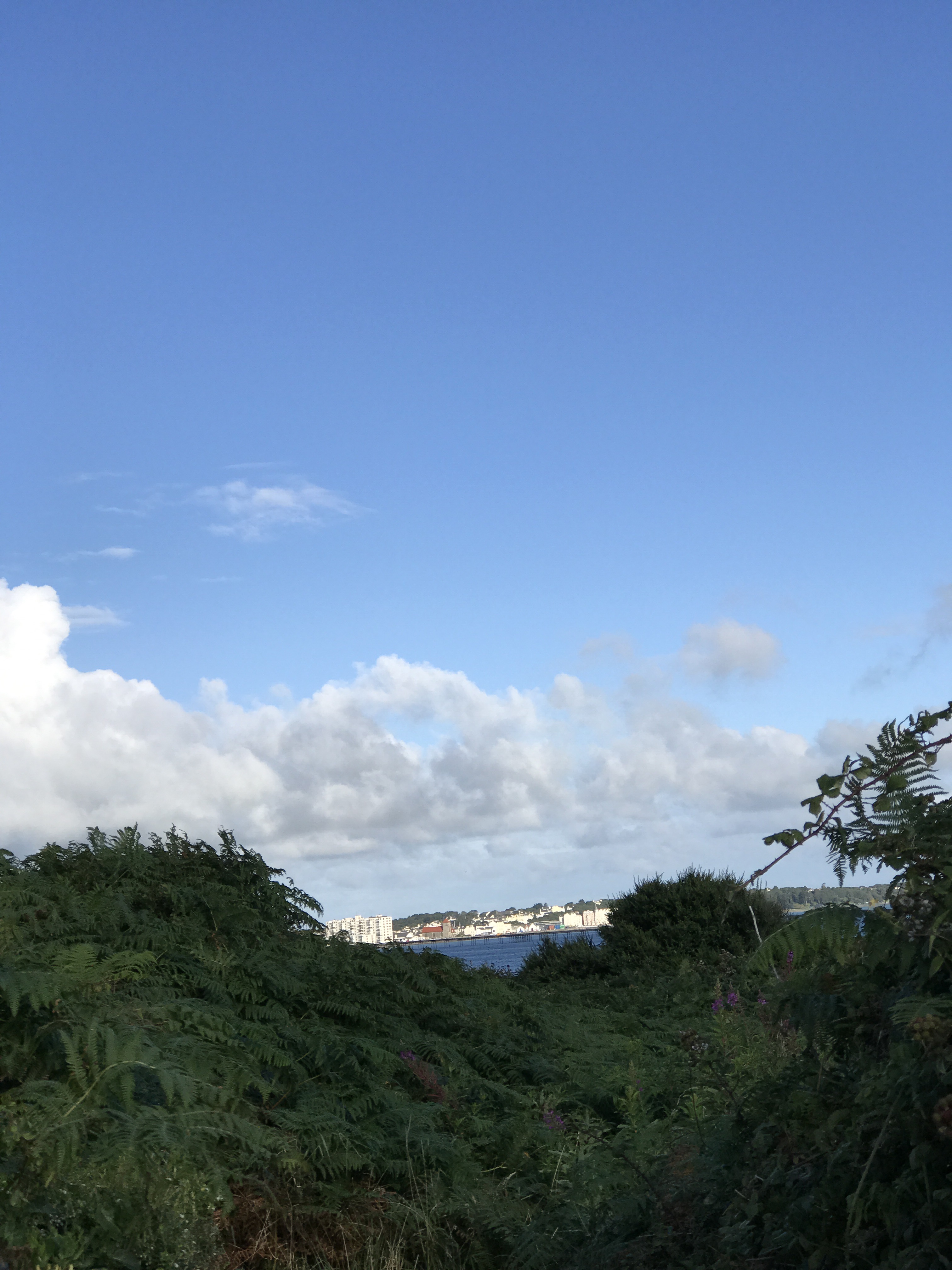
At this point, with the tiny port now visible again in the distance, I realised the significance of the lady’s warning. There were at least five paths before me. All looked equally well-trod. I reasoned that to keep within the sight of the small cove, below, would be the most sensible; but it proved to be entirely the wrong logic.
Five minutes later, and surrounded on three sides by sharp brambles hidden in the ferns, I gave up, envious of Tess’s thick fur coat, which rendered her impermeable to the attacks.
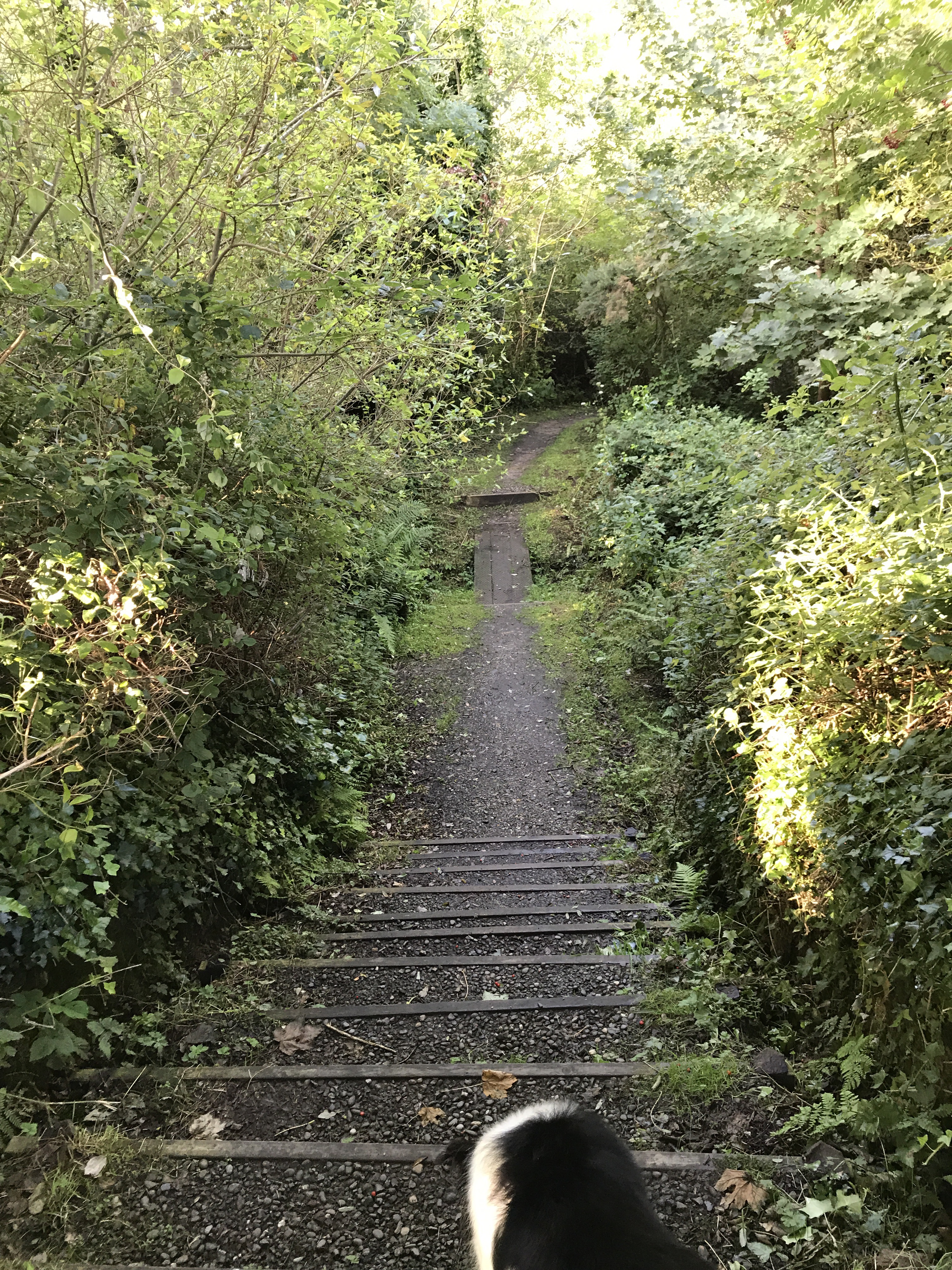
Eventually, we found the right route – on the opposite side of the plateau – and the way descended to reveal the rest of the circular path back to Port Lewaigue.
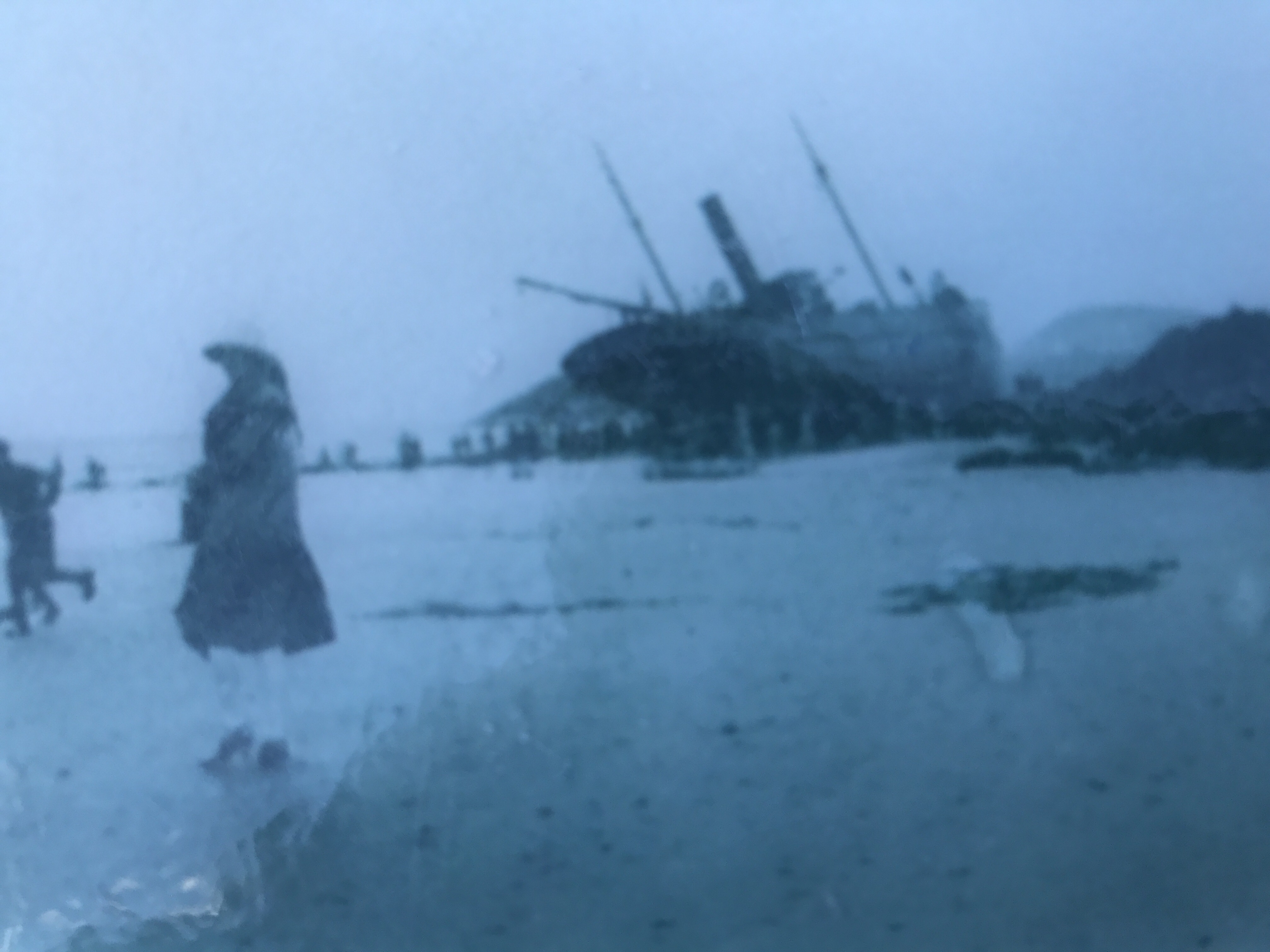
At the end of the descent, a helpful notice board, perched, unseen, above the cove on our outward leg, gave the history of the cove, which includes a dramatic shipwreck – the steam trawler ‘Cevic’, in 1927; and two attempts to develop the little port for wider use. The first of these was in 1887 when George Kay, a local businessman, bought a substantial stretch of land to create a promenade and some seaside cottages. These were completed, but his greater plan to build a concrete walkway to link the port with nearby Ramsey floundered. A popular walk, available only at low tide, is to follow the high-water line into the nearby town, and that remains the only option, barring the road.
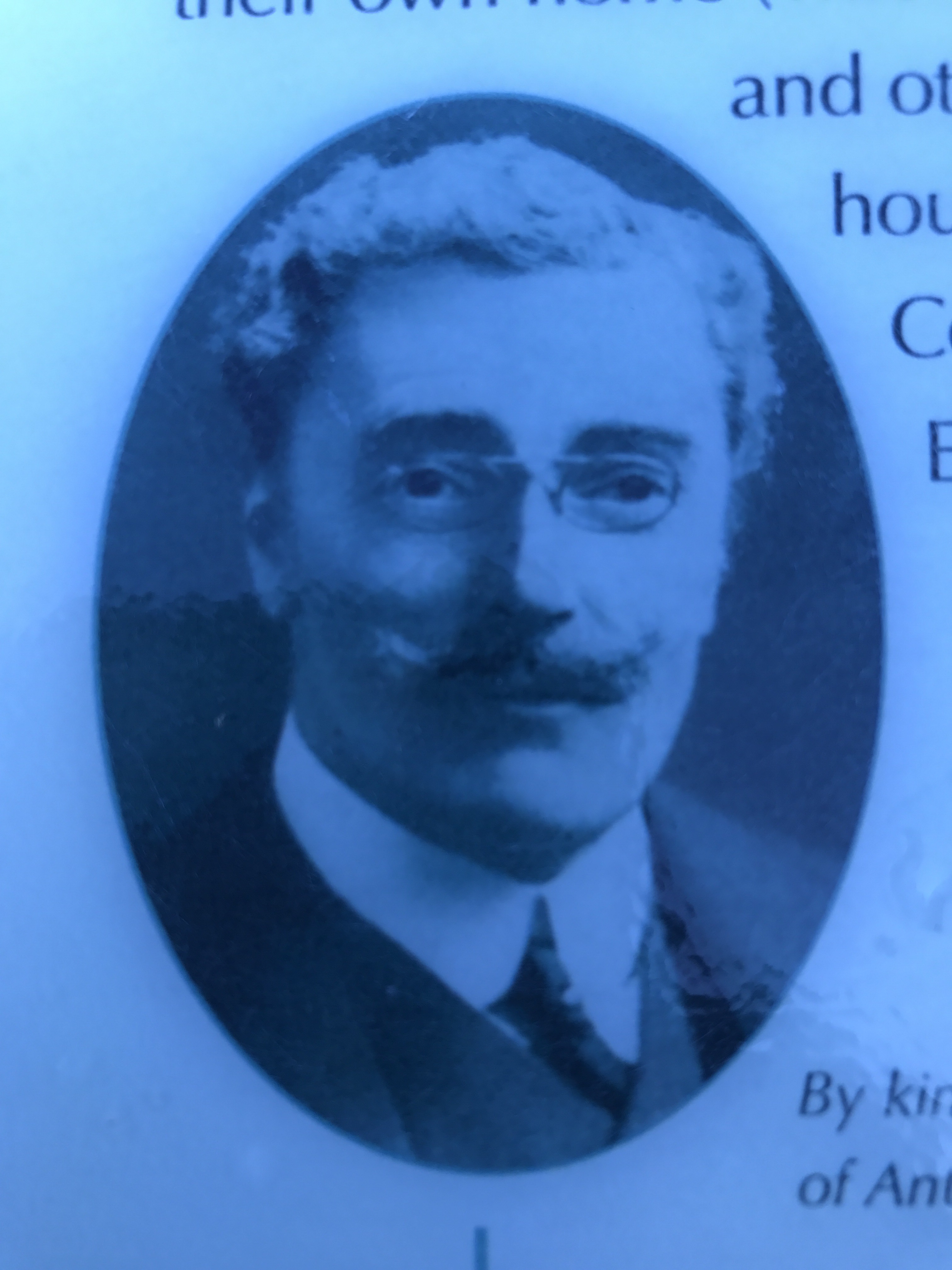
A second development, by a wealthy Salford brewer – James Grimble Groves (above) was more successful. As an aside, wouldn’t that name be great for a period detective! Groves’ plan was less prosaic but more doable. This canny man, who was also MP for Salford, bought a large tract of the land (where I had struggled with the fern paths), and developed it into a small estate of prestigious, large houses. These were named ‘The Colony’ and are still sought-after dwellings, with unrivalled views- see photo below.
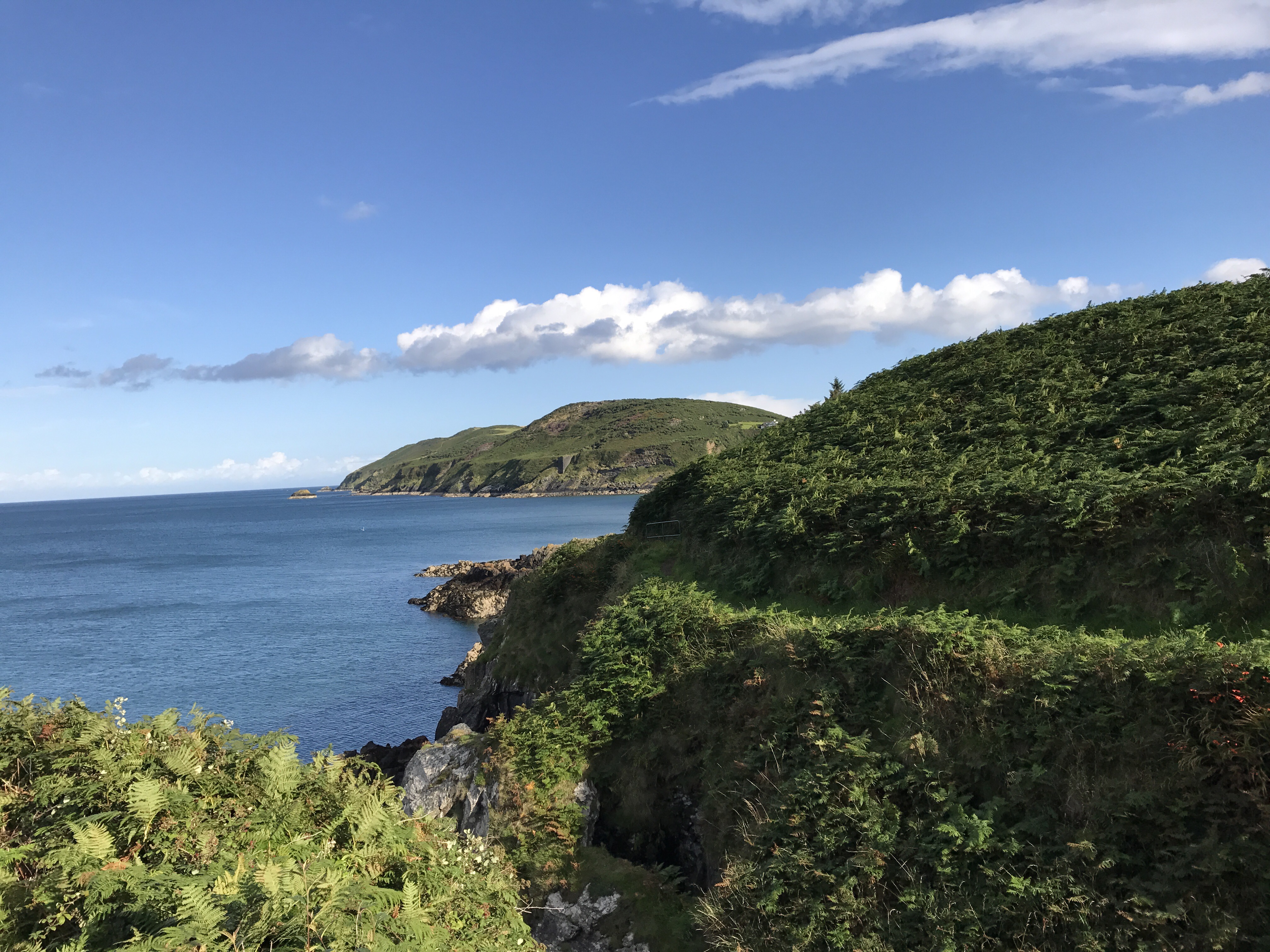
Port Lewaigue remains largely undeveloped. Its charm is its simplicity. Our hosts tell us that it is local custom to go sea-bathing on a Sunday morning… we’ll see. I think they are winding us up!
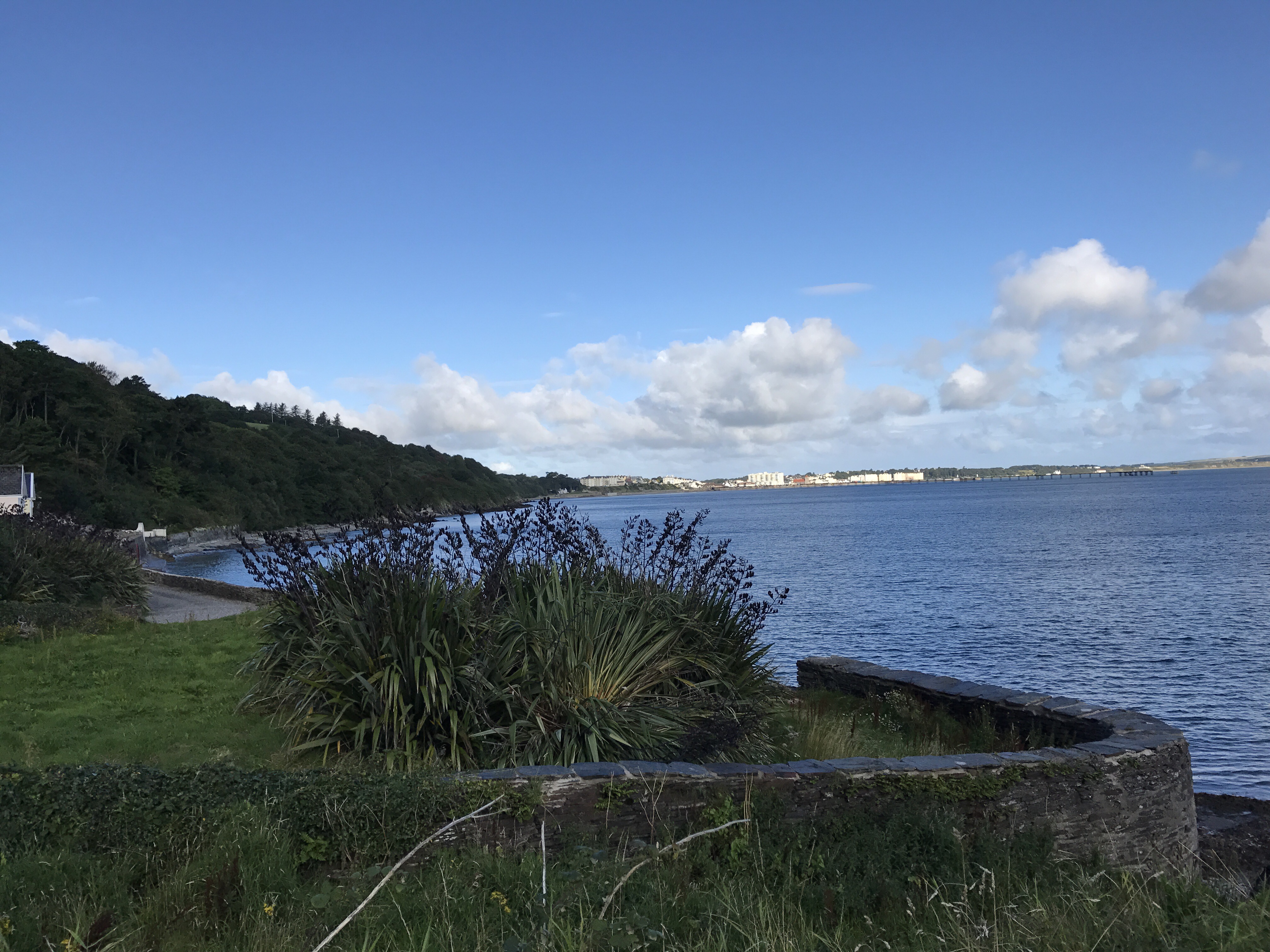
©Stephen Tanham.
Share this:

Share this:


It may be that the present compressed and negative feelings that we humans are experiencing is a birthing chamber rather than a vice.
This outrageous idea ties in closely with what was written in last week’s blog. In it, I suggested that just as a body has trillions of cells, so the planet has a vast number of connected parts of its ‘mineral, animal and mammal’ consciousness; each made up from the physical atoms of the Earth, Sun and the ‘debris’ of ancient exploding suns; without which there would not have existed the chemical components of life.
Through our human body passes the dying bodies of life on earth, be they vegetable or animal. We cannot, yet, ‘eat the Sun’ though one wonders if this is where evolution will eventually take life on Earth.
We don’t really question this ‘eating’ of other things – and plants are alive, too, of course; yet our aliveness depends on the absorption of this sacrifice.
The biggest act of sacrifice we know of is the Sun, the ancient symbol of ‘life-giving’ in all cultures. The Sun – our Sun, because we owe it our very lives – literally gives up its energies to feed the lives of its children. Looked at from a mystical perspective, it is slowly dying so that we can live. Something has made a transition from the cosmic level of physics to the vastly organised awareness of the human (and other) organisms, whose eons-long development has resulted in consciousness not only of things, but of ‘self’. This is a pinnacle very different to being top of the food chain.
The star that made this possible – our Sun – is not outside the laws of physics, and the atomic fusion of hydrogen can only last so long before the whole solar system dies to organic life.
Is the Sun conscious? Mystics speculate it has a hyper-consciousness, a vibrational awareness of life in the whole solar system, but over a vast timescale which sees our own lives as a blink. Scientists, quite reasonably, from their training and experimental perspective, say this is emotional nonsense, and that the laws of gravity and nuclear physics take care of the rest. It is wise to be open to both perspectives, and to remember that even science, accurate and marvellous though it is, is conceived and evolved through the window of the human consciousness, though it seldom acknowledges this perspective. A growing number of scientists have observed, wryly, that the ‘mystics got there first’ when it comes to some of the consciousness-related revelations from the quantum world.
Whatever the truth, no-one steps out on that first spring morning of the year, when the power of the sun replaces the long and cold winter chill, and feels physics in their hearts…
As a species, we are rather taken with our ‘specialness’. Educated to be the top of the food chain, the ‘apex predator’, our civilisation has felt free to work its indulgent will on our world… and we wonder at the resulting lack of happiness, and that lack of inner belonging.
The idea of us being organically eaten – as we do, unthinkingly, with our own food, seldom occurs to us, yet it is plain that everything that lives is eaten in its turn – only the fleeting and creative state called consciousness seems to be from a different place than the purely organic… though it would be nothing without that organic basis as a vehicle.
This kind of thought can be both humbling and re-aligning, since it shakes the fluffiness from our life-expectations and also threatens us with some basic reality – a very important aspect of being alive in an age where we increasingly live in our heads and in front of screens that distance us from the vividness of life ‘out there’. When we are disconnected in this way, it is easy for intolerance and prejudice to fester. We meet, on social media, with those of like mind… and Like their actions and opinions. If we don’t like what someone ‘says’, repeatedly, we Unfriend them, leaving us in a potentially sterile pool of self-reinforcing opinion.
The human process of maturing requires that we brush up against often painful experiences that are definitely not what we like… but the digital world is taking us away from this school of maturity that has ensured that our lives are at least broadened rather than narrowed. It is to the credit of the emerging generation that many of them seem to be caring and involved, and, certainly in the UK, politics and social involvement are on the increase. Much of this is a reaction – a very positive one – to years of so called ‘austerity’. Sharing the pain of overspending is a necessary goal, but not if that sharing is a farce…
The most troubling parts of the world are where those in charge are exhibiting the strongest ‘egoic’ characteristics. It is as though we are being shown the inner nature of this negative and tyrannical aspect of the human soul; shown it in a way that bares its ugliness. There are, of course die-hards who thing such fundamentalism is a good thing, and will offer us control of our lives again, making our countries great in the process. But anyone with real maturity in their own lives knows the bitter taste of such egoic self-aggrandisment; and its ultimate cost.
To truly ‘come together’ we need to feel our shared humanity in a way we have not done, before. We need to see the unsurpassed beauty of being part of a life-wave that has been gifted this beautiful planet for our collective and personal evolution; and, within that, to see that we also have the power to destroy it. To ride that edge of the utmost danger can only be part of our collective maturity as we evolve from eating and eaten to something potentially magnificent that is ‘involving’ itself with the star-dust of the Earth.
Our survival as a species is by no means assured. But the large-scale awareness of the present horror shows that fill our screens might just bring us, kicking and certainly screaming, into a new age – one where the true ghoul is seen to be the dark side of human nature and not circumstance or those we can victimise.
Other parts in this series:
Stephen Tanham is a director of the Silent Eye School of Consciousness, a not-for-profit organisation that helps people find the reality and essence of their existence.
His personal blog, Sun in Gemini, is at stevetanham.wordpress.com
Image: Sweetheart Abbey, near Dumfries, Scotland. Taken by the author.
©️Stephen Tanham
Share this:

Share this:


“.. before I can live with other folks I’ve got to live with myself. The one thing that doesn’t abide by majority rule is a person’s conscience.” Harper Lee, To Kill a Mockingbird
“Is everything okay over there?” said my son, calling from half a world away. “Yes… fine…” I replied, moments before madness hit London Bridge. Britain, like so many countries recently, reeled once again as violence destroyed lives and peace. That attack followed hard on the heels of Manchester and Westminster, and would precede a lethal attack on Finsbury Mosque.
“My daughter and granddaughter were there,” said our Companion, speaking of the Manchester bombings that killed children as young as eight years old, as we struggled to come to terms with yet another explosion of hatred and inhumanity.
Britain is far from being unique in this. Globally, over eight hundred terrorist attacks have been listed this year alone…
View original post 656 more words


 Sun in Gemini
You must be logged in to post a comment.