
Share this:


Last night BBC2 aired part two of the documentary Secrets of Silicon Valley, subtitled ‘The persuasion machine’. by Jonathan Bartlett.
The programme charted the rise of the modern Tech giants, many of which are not traditional ‘product or services’ companies in the sense we have become used to. For example, Facebook, one of the main subjects of the programme, is viewed as not only a social network but one of the world’s largest publishers of information. Yet, Facebook actually originates nothing, rather providing a world-wide platform within which others – us – publish our thoughts and, increasingly, emotions, to a network of our ‘friends’… or those we seek to influence.
The word ’emotions’, above, is the key to much of what followed in the programme. Recent motivational studies, representing the cutting edge of how people (we) can be psychologically profiled – put into data silos of opinion and response – have shown that there are two ways in which the human mind absorbs and responds to information.
The first is what we might call emotive: ‘I just know that’s true’ or ‘yes, I’ve always felt that way’. The second is more considered, and uses more rational parts of our brain and mind to self-question our assumptions.
Specialists have found that the first category of what we might call ‘triggers’ are the basis for mass response and are capable of nudging the opinions of millions in a certain direction; particularly in an age when many feel dissatisfied with their lot. The message is everything…
So, now, imagine we can change the message, tuning, say, it’s Facebook layout so that a red button is used instead of a green one; a slightly more aggressive image instead of a subtle one; and that we can do this in hundreds of thousands of variations in real-time… each of them tuned to the selection of the human silo that I, as a well-funded advertiser, want to reach with my message, like, for example, being President of the USA.
The vast majority of the $85 million dollars spent on Donald Trump’s election campaign was spent within a secretive and unmarked building in Texas which became know as ‘Project Alamo’. The money was spent on Facebook ads in the way described above. The name ‘Project Alamo’ was inadvertently brought to the Trump elections campaign by an English company – Cambridge Analytica – who had been employed by Ted Cruz’s failed campaign to win the Republican nomination. Cambridge Analytica transferred the vast profiling work they had been doing, code-named ‘Alamo’, to Donald Trump’s presidential programme… and the name stuck.
Tens of thousands of permutations of presentation of each story were broadcast at tens of millions of Facebook subscribers (us) as the US election and, later, the UK’s Referendum gathered pace.
In both cases, the use of social networking platforms was central to campaigns that changed the way we are governed. In both cases the result was a shift of control to a more right-wing basis for our daily lives in which racism, among other dark things, now flourishes more openly.
These campaigns focus on dissatisfaction. Dissatisfaction is one of the emotive triggers referred to in the opening paragraphs, above. Show someone poor who believes that a billionaire can be on their side a generalised emotive ‘trigger advert’ in their social media feed and they might doubt it. Show them the same advert tailored exactly for them by the new world of opinion analytics and enough of them will respond to vote with their bruised instincts, even though the other side of their brains might doubt it…
The data that provides such exact matching to our emotive triggers is what we give the social media platforms every time we click on a Facebook Like. In the BBC 2 programme, the producer, Jonathan Bartlett, is seen receiving his sifted profile from one of the leading psychologists in the USA. “But I didn’t tell anyone I was a Catholic,” he says. The psychologist nods, agreeing. In this new world he didn’t need to, his actions, preferences and ‘likes’, gathered by Facebook and made available to targeted campaigns for everything from products to presidents, is there to be acted on if you have the money. Sifted and summarised the inference engine showed him to be Catholic, whether he liked it or not
The programme also highlighted the contradictions in all this. In general, Silicon Valley does not vote for Republicans. Older footage showed President Obama (the USA’s first ‘social media’ president) talking with Facebook founder Mark Zuckerberg. They were singing each other’s praises. Today there is a very different mood, and Barack Obama is one of the voices calling for very much tighter control of the content of social media sites – and naming Facebook as a prime example of a company that needs to address this. Senior Facebook technicians and analysts were on-site in the Project Alamo building, helping the Trump campaign, spend the lion’s share of their $85M wisely; yet, Silicon Valley, in general, did not want Trump as President.
Of intense concern to social media companies is the proposed challenging of the 1996 Telecommunications bill in the USA. This contained a vital clause that the providers of a social media platform could not be held responsible for the legality or accuracy of the content. Politicians on both sides of the Atlantic are now disputing this, and citing many examples where social media companies have failed to ‘self-police’.
The Tech giants are spending billions in Washington, trying to get this killed off and promoting their own ‘myth’ that they are Disruptors whose ultimate effect is good. See part one of this series of posts for more details. The frightening thing is that, having opened Pandora’s box, they are no more in control of all this than we are.
I will conclude this personal review of the new world of ‘democratic manipulation’ next week, with an examination of what value the mere human has left, and whether we have any effective responses left to us in this tsunami of manipulation. We live in a very frightening age…
Other part of this series: Part One,
To be concluded in Part Three
Stephen Tanham is a director of the Silent Eye School of Consciousness, a not-for-profit organisation that helps people find the reality and essence of their existence.
His personal blog, Sun in Gemini, is at stevetanham.wordpress.com
©️Stephen Tanham
Share this:

Share this:


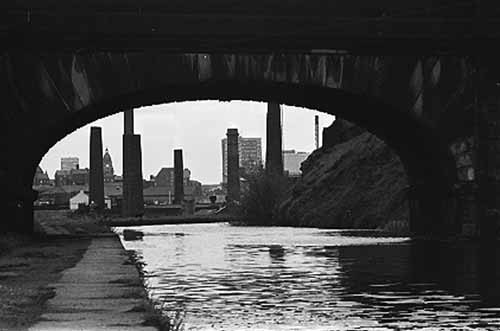 It is pitch black; like an idiot, I am teetering on a stool cleaning windows and muttering that there are far better ways to spend my life that doing chores. To say that I hate housework would be inaccurate. I don’t mind the jobs themselves, and I love the feeling when they are done, but, after decades of doing them, I’ve gone right off the necessity of housework.
I do not make a habit of nocturnal window-cleaning, but the rain-splattered panes had been bugging me for a while and, having rolled up my sleeves to do some heavy-duty cleaning, I didn’t feel like leaving this, the final job, till morning. When that rare mood takes me, it is one of those ‘I’ve started so I’ll finish’ things. And I was having company… and that means that in spite of my best efforts, I cannot help myself.
This is an ancient…
View original post 943 more words
Share this:


“Salmon of Wisdom
Dodging hazelnuts swims the hungry salmon, swallowing the nuts as they plunge into the depths. Pity the poor pondskater skimming the surface while beneath lies the kernel of wisdom, waiting for those who plunge deep below their surface and get their feet wet.”
That bit of oddness represents a page in my notebook. I have but the vaguest recollection of writing it. I know I was sitting on the kitchen step… I know there was wine… and I can see the context of the conversation from the notes either side. We were obviously deep in discussion of something or other.
Which has nothing whatsoever to do with the Salmon of Wisdom. Or pondskaters.
I cannot remember the entire conversation that surrounded the notes, though reading them brings back the essence of it. I can’t even recall if this bit was mine. It can…
View original post 578 more words
Share this:

Where are we going?
When things are going well in ‘our’ world, there is an understandable tendency to assume that a generally benign evolution of civilisation is taking place, one in which we play our part, however small, being a kind of swimmer who lives and dies within that flow of slow progress.
But when we are faced with the kind of politics, violence and social upheaval we are surrounded with at present, we find ourselves questioning the assumptions of the good times. These are certainly not good times, not when measured against a yardstick of caring, kindness and any semblance of equality. They may be good times for the relative few who ‘own’ the planet, but they are not so for those who care about the general welfare of mankind. The general system we call capitalism has carried us far into the expansion of our world, and produced wonderful systems and things, but now seems to be falling from its own, autonomous ledge into an unknown abyss.
This is not a political website, though, as directors of the Silent Eye, we are free to express our own, often strong, opinions.
Normally, I would not begin a post with the above sentiments, but I have begun to see a strong spiritual thread in the events around us, and on a global scale.
The human has a psychology. The concept, given to us by the early pioneers like Freud and Jung, is based on the fact that we form a ‘self’ which governs our actions at a different level to our biological survival mechanisms, though it derives from them, in its primitive stages of individual development. This multi-faceted self is what psychology addresses in its treatments. For other schools of teaching, such as the Silent Eye, the elements of this self are the starting points in the individual search for a deeper identity – one without the limitations of the egoic nature we wear during the day.
The self forms by separation. We are born a part of the world. Though seen by our loving parents as separate, that is not our experience. Reaction is the key to our development. Reaction forms from pleasant and unpleasant organic responses and an increasing need to choose the pleasant. Eventually, this reaction become a ‘thing’, a centre for our experience; and the brain turns it into a self. The attributes of this self are ‘groomable’ to make us fit better into the world by conformance and intelligence, which grow together until they are challenged by the individual who comes to see their unhappy limitations.
Sadly, this thing at the centre, this ‘us’ is little more than a machine of reactions, a composite of our personal history, conscious of its vulnerability but intent on its own survival at the centre of things.
So here’s the link to our civilisation: nations have ‘selves’, too. They are made up of the collective selves of the individuals, just as our own bodies are made up of the trillions of cells that have evolved to work together to provide us with an aware and sensitive vehicle. The human self or ego has its parallel in the society where we have our lives. We are a part of it, dramatically linked to its essential health in a way we cannot yet see, but our spiritual qualities of essence, kindness and selflessness do not flow into us through the ego – they come from beyond it. In the same way, the outer, conditioned responses of the individual within a society do not represent the potential inner state of that nation; or group of nations, that make up a country or continent.
The lowest levels of control centre on violence. Violence generates fear, which conditions group behaviour. Is it more violent to have a war or to find that the wealth of a society is concentrated in the hands of a few? There are many forms of violence, and we need to take a fresh look at them and empower ourselves to feel true, moral outrage, again or we will sink beneath the sea of despair that threatens to overwhelm us now.
I am not an advocate of revolution. It solves nothing. I do, however, believe in the power of the deep, collective mind to link with others of like intent in the throwing off of old ideas which have become morally and spiritually bankrupt. What is seen in truth is seen differently. That action of truly seeing is its own light and its own motive force. Quietly and without violence, it reveals what can no longer be hidden; and in so doing shows a pathway to a different future.
In this lies hope, and hope is so very needed in these dark times. We were never society; that is an invention to help us manage the collective. We were never a body, that is a collective to allow us to experience the trials and joys of matter. We are, singly and collectively, an un-cageable creative individuality whose existence is part of the unfolding of the universe – our aliveness ranges from atom to cell to human to planet, and is something that will not be denied… We were born to share it because we are it…
Stephen Tanham is a director of the Silent Eye School of Consciousness, a not-for-profit organisation that helps people find the reality and essence of their existence.
His personal blog, Sun in Gemini, is at stevetanham.wordpress.com
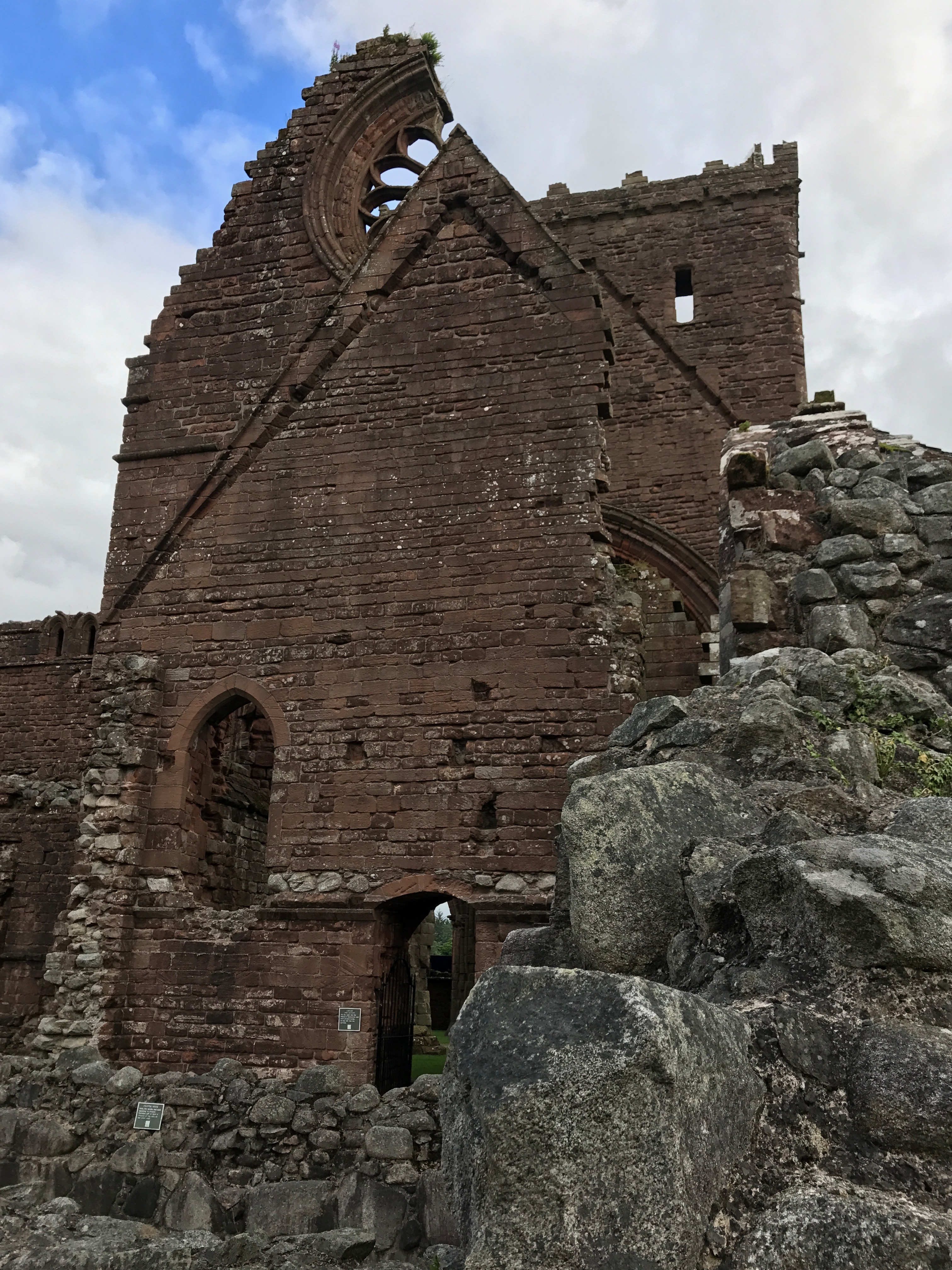
Image: Sweetheart Abbey, near Dumfries, Scotland. Taken by the author.
©️Stephen Tanham
Share this:

Share this:

Lovely news from Sue.
“…when the first baby laughed for the first time, its laugh broke into a thousand pieces, and they all went skipping about, and that was the beginning of fairies.” J.M. Barrie.
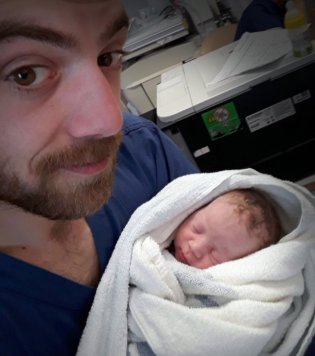
Imogen Lucie, which means means ‘maiden of light’, is my youngest granddaughter. She was born this morning into a small world of love. And she is beautiful.
My love and congratulations to her parents, Alex and Laura and her big sister, Hollie.
xxx
Share this:

The Open University (OU) is a wonderful institution. I have watched its progress for decades, and it’s a fine example of the power of education and broadcasting, combined. Last night we happened to watch a BBC Two documentary produced as part of the OU series: ‘Secrets of Silicon Valley‘ by Jonathan Bartlett.
Its premise was that Silicon Valley (referred to as the Tech world) has a dark side; dark in the sense that it is changing society at such a fast rate that our social, political and legal structures are failing to keep up. The Tech companies view this as a good thing, and there is the collective vision – incredibly well-funded in its PR – that this is productive for us all and that the inevitable result, like the industrial revolution before it, will be that we’ll all have richer and better lives. TheTech define their own role in this vision as that of ‘The Disruptor’.
Anyone remember the ‘Tomorrow’s World’ type programs of the 60s and 70s? They were great television and offered a bright and optimistic vision of how technology was a boon and would result in a world where our biggest problem would be how to spend our free time.
You’ll forgive the sound of hysterical laughter from here…
How naive that now seems, and how predictable the good and the bad we have inherited from that curve of post industrialisation. The underlying problem, of course, is a combination of politics and human nature. Whatever mankind does seems to reflect the collective psyche of our humanity. Wonderful things happen, as do very bad things.
Those of us who have ridden the wave of Tech for the past forty years, especially those like me whose living it has been, have done very well out of it. I’m typing this blog on a device that is a phone, camera, office and international information retrieval system. As a young boy, fascinated by ‘devices’, I couldn’t have predicted that in a million years. I remember a Superman comic where the baddie was allowed his own personal computer in his prison, and I wondered then if such a thing would ever happen in my life. It seemed unlikely…
Tech is now at the heart of all large-scale human processes. It has made wonderful things safer, faster and more accurate, and the incredible scale of that success is its own problem, because the huge money to be made from a globally successful Tech product or service now requires that it challenges what is normal within society.
One of the examples given by the BBC programme was that of the virtual taxi company, Uber. Uber don’t have any taxis, but they licence those drivers with the right quality of vehicle to operate as Uber drivers. The heart of the Uber system is a very neat graphical display running on your phone. When you call for a taxi using Uber, the display shows you on a real-time map where your taxi is. You can actually see it coming down the virtual street as it comes down the real street to pick you up. The taxi chosen by Uber is the one nearest to you, so the service is good. All in all, it’s a major advance on how taxis used to be.
So what’s challenging about this great concept? The BBC programme highlighted Uber’s setting up in India. In order to get ‘its’ drivers to have the right cars, it advertised how much they would be earning per month, once they signed up to be Uber drivers – on a self-employed basis, of course. Uber also offered to help with loans for the new cars. The new vehicles were ordered, and their drivers, with proud families watching, set off in their fine newly-financed cars, carefully chipped by Uber for their location services tracking. What happened next was what always happens in a market with high demand that attracts those willing to provide it: So many drivers signed up that the earnings for months two, three and four dropped dramatically, so much so that a few months on, the drivers were on a small fraction of the ‘expected earnings’ and were unable to keep up the payments on their cars, let alone feed their families. Uber’s revenue was not affected by this.
Uber does offer a great product. They aren’t doing anything illegal, or deliberately uncaring; but, in the case of the example in the programme, the secondary effects on the people in the market they are aggressively targeting are suffering. Typically, the Tech companies are not too concerned about this. They view that pushing the social and legal acceptability is a necessary part of being a Disruptor. That may well be true, but there has been no debate on the matter – just the forging ahead of a global product that they hope will sweep aside any social issues – forcing society to come to terms with a new ‘norm’ faster than it can be challenged on the grounds of ‘people factors’.
Uber was recently challenged in the UK courts, which ruled that the company could not claim that its drivers were working for themselves, and that they had to provide a full employment contract. We can imagine that this is not at all what Uber’s business model is based on… They are challenging the ruling. The second hearing is set for September.
To be concerned about this, we have to care about ‘people’. The kind of old-fashioned attitude that Tech hopes you’ll view as outdated and irrelevant to these elegant solutions; solutions that are changing our world faster than we can comprehend – or control. No-one’s saying that companies like Uber don’t care. Its just that they are pushing the ‘envelope’ of what society is for, and expecting they can change it so fast that any other considerations become irrelevant. Disruptors are clever, rich and very focussed on what works.
We can’t control them, because, for the first time in our evolutionary history, the very essence of ‘we’ is being challenged… So, within this larger Tech world, of which Uber is just one example, what value do we put on the human?
To be continued in Part Two
Stephen Tanham is a director of the Silent Eye School of Consciousness, a not-for-profit organisation that helps people find the reality and essence of their existence.
His personal blog, Sun in Gemini, is at stevetanham.wordpress.com
©️Stephen Tanham
Share this:

Share this:

Beautiful sentiments and photos from Sue.

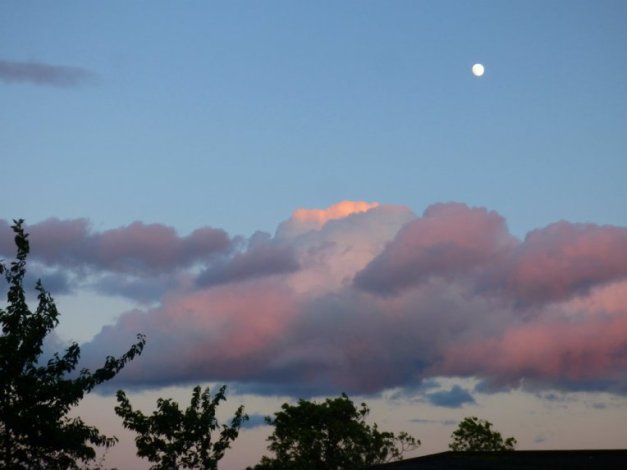
Ah, Love! could thou and I with Fate conspire
To grasp this sorry Scheme of Things entire!
Would not we shatter it to bits – and then
Re-mould it nearer to the Heart’s Desire!
– Omar Khayyam
“I wish….” How many times have I heard that phrase? How many times have I said it, with irony or with longing… or both… wishing that the world was somehow different? Wishing it would shape itself more conveniently… just for me? From that big win on the lottery we do not play to the weather over which we have no control, wishing things would change seems to be part of the human outlook.
There are many who make that wish and revisit it wistfully from time to time, still hoping vaguely that things might change, but doing little or nothing to make it come to pass except relying on life to…
View original post 579 more words
Share this:


There are two schools of thought on what to wear on a cycling summer day in which there is the possibility of a downpour, far from home…
The first (Plan A) says you should put up with the weight and pack a good set of waterproofs. Then, as soon as the heavens open, stop cycling and put them on. The second (Plan B) says that, as long as the underlying temperature is warm-ish, there’s only so wet you can get, and you’ll soon dry, so why bother…?
Which was why, at about three in the afternoon of our cycling day on Tiree, and as a proponent of Plan B, I was standing alongside my bike, skin and metal drenched, looking back down the climbing valley road at the other man in our party (a follower of Plan A) who was doing some sort of dance with what appeared to be a bright red ghost…
But, I digress…
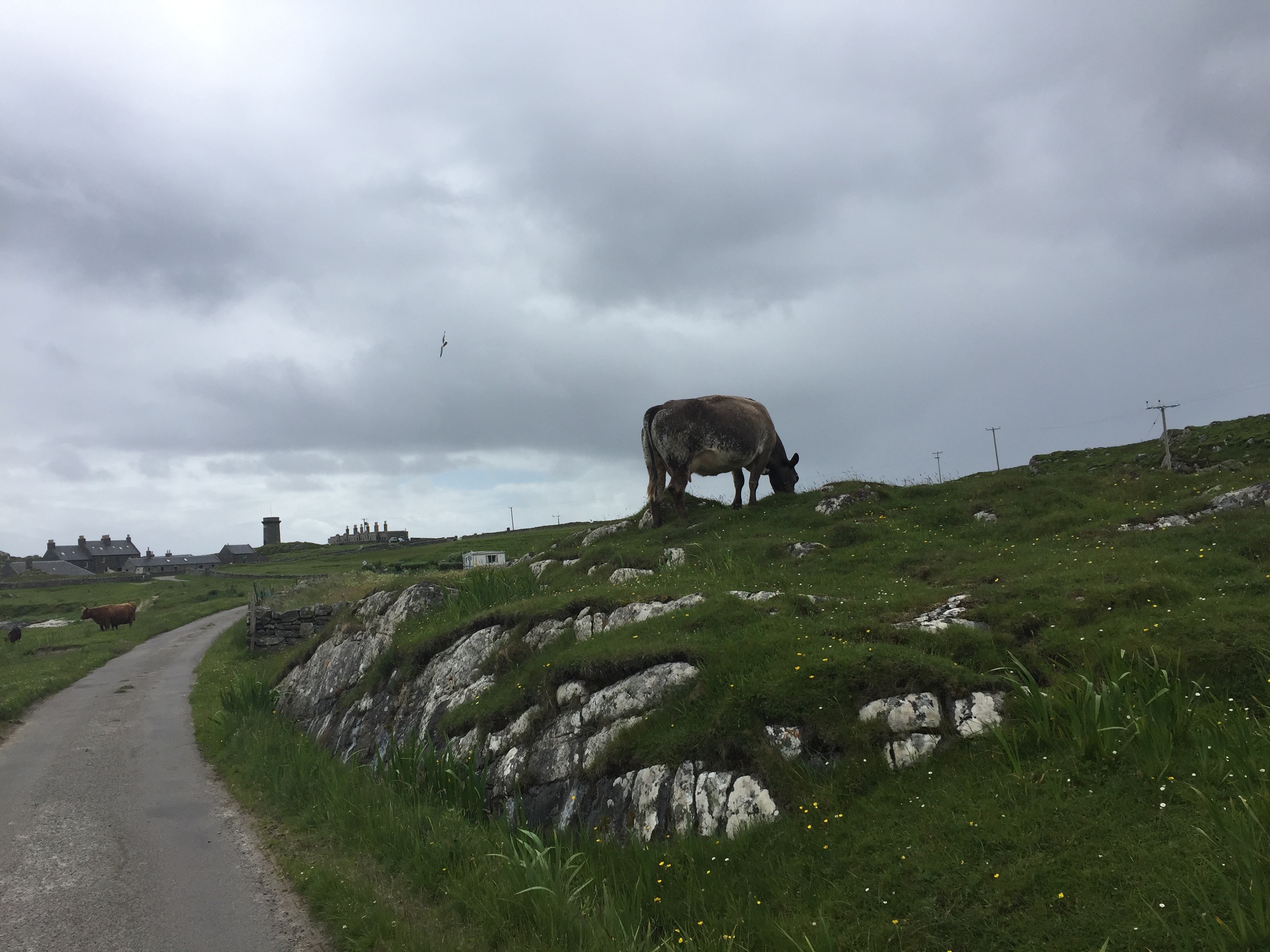
The lone cow on the rocky outcrop as we were pedalling away from Hynish should have warned us. Still feeling euphoric from the previous two hours, I had dismissed the ‘You’ll be sorrrry’ cartoon that sprang to mind, Warner Brothers style, from my subconscious. Failing that, the vertical orientation of the seagull’s body in the photo above should have shouted a hint, but no… what looks obvious in hindsight, in the photos, was less so on the day.
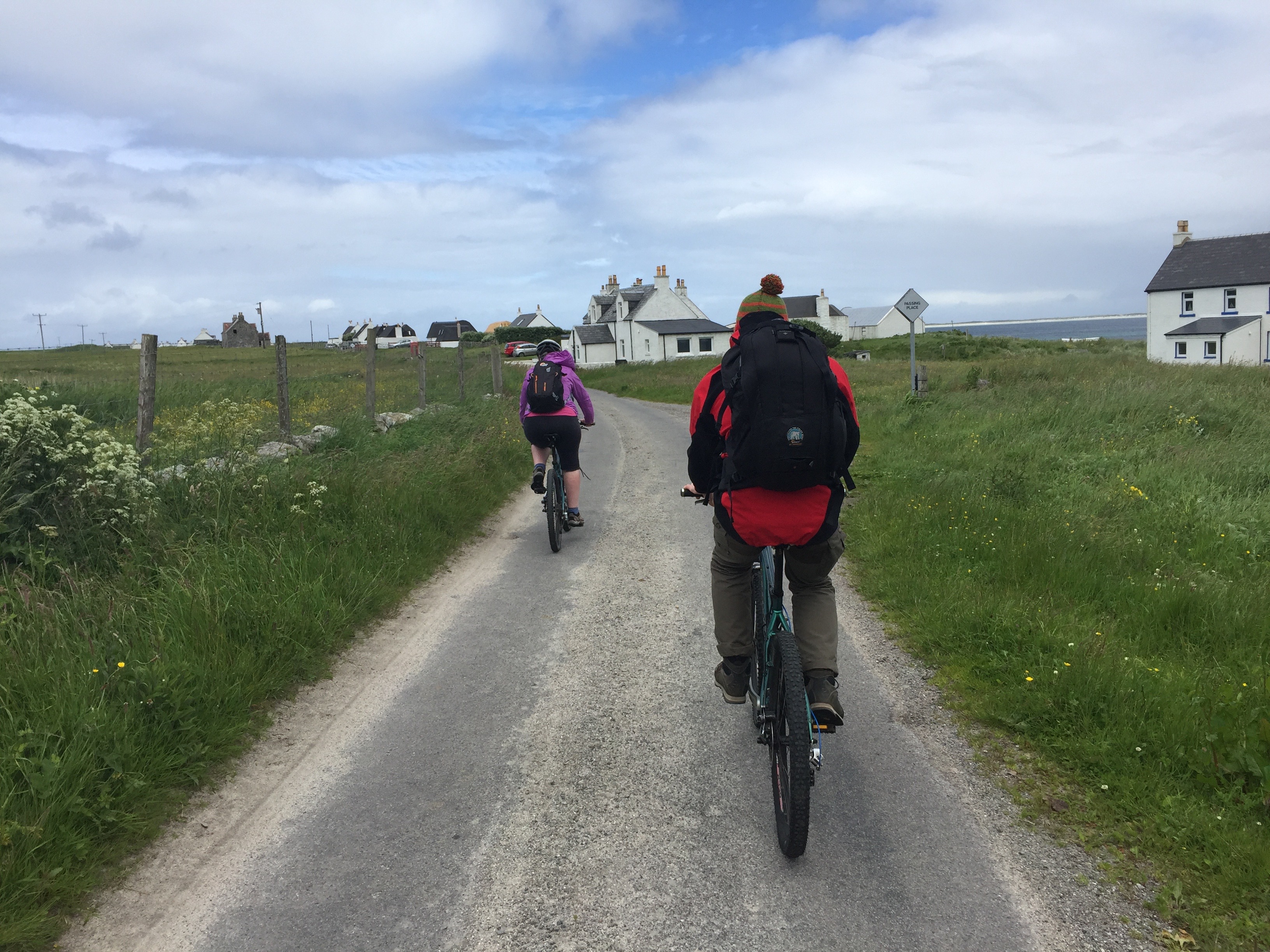
So we pedalled on, and now, looking at the shots, I can see the blue sky ahead that we embraced and the darkening silver behind, that we ignored. The deluge wasn’t instant; those dark clouds took a while to arrive, while we cycled into the seeming blue. At least wary of the weather, we had a further destination in mind: Soroby. This hamlet is the site of a graveyard of considerable interest because it links the pilgrim island of Iona with Tiree.
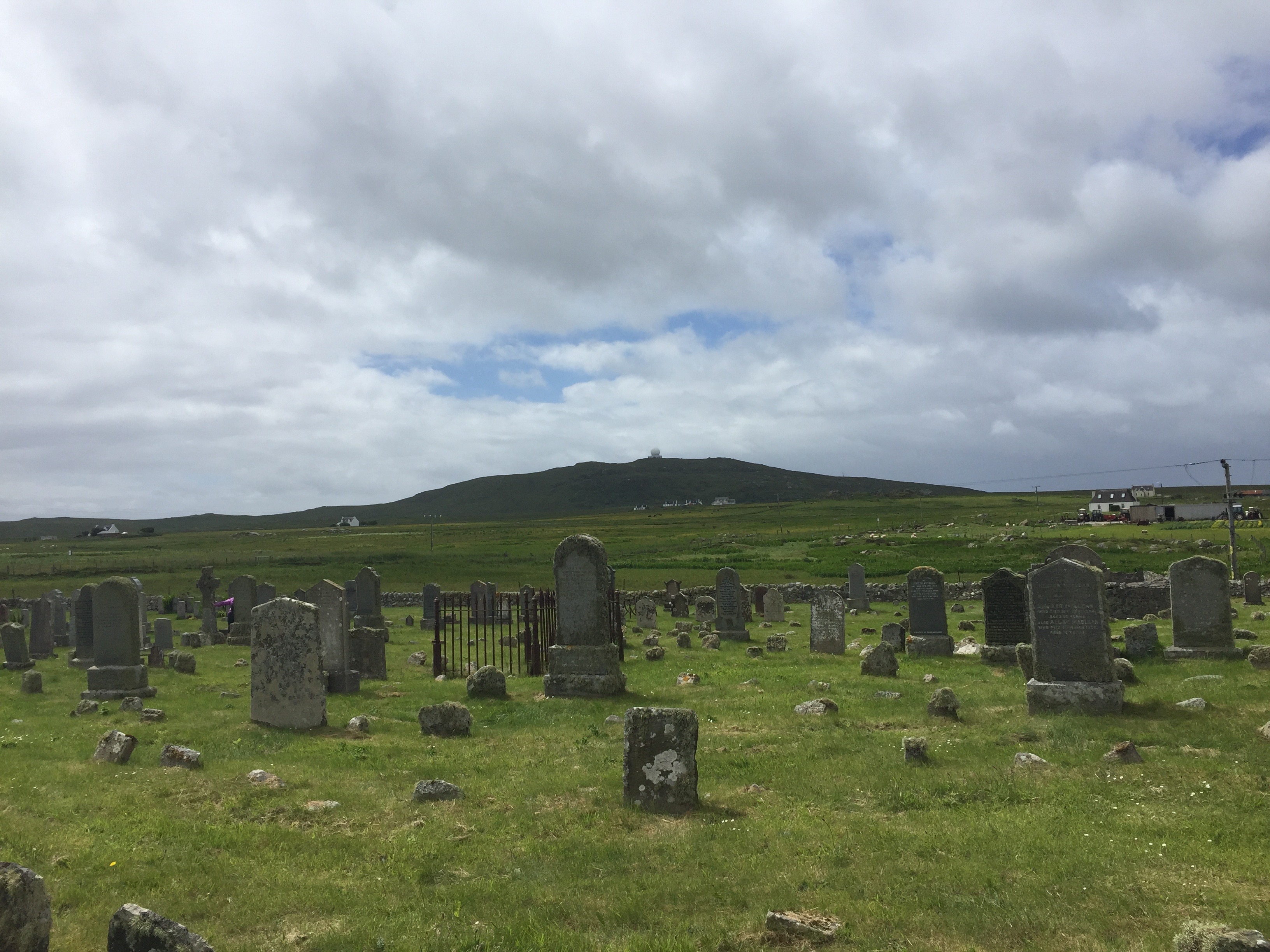
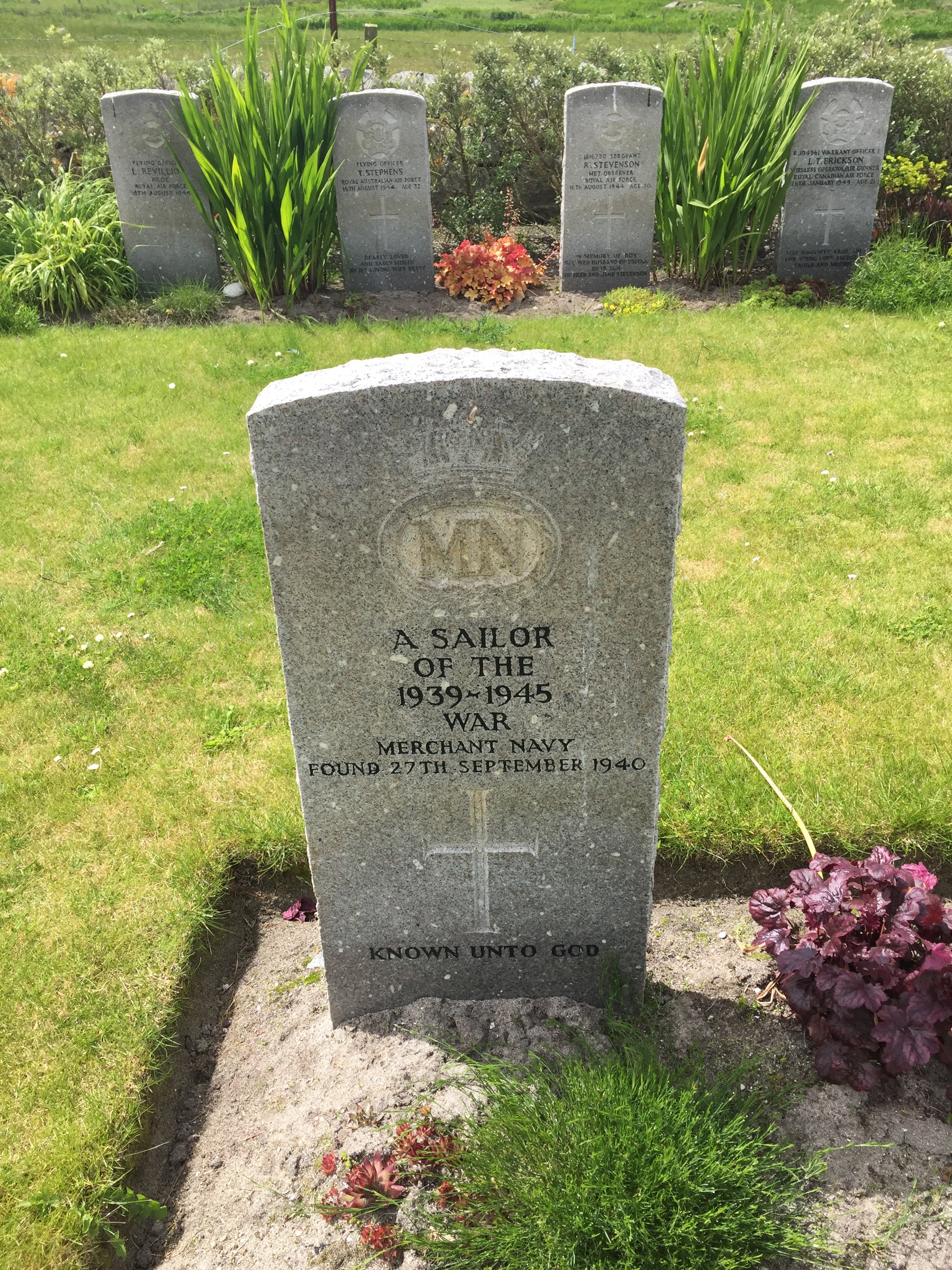
Much of the graveyard is relatively modern, and many of the (well-tended) graves mark the tragic loss of life of a merchant ship in World War II. Many of the bodies were washed up on the beaches of Tiree and their identities never discovered. The beautiful epithet ‘Known to God’ marks their anonymous sacrifice.
But, a smaller and older part of the graveyard is believed to be the site of a monastery established by St Columba as an extension of the work of his first church on Iona, following his self-imposed exile from Ireland, where it is said he led a rebellion and started a war which resulted in ten thousand deaths. This was prior to his conversion to Christianity, which he then vowed to spread across the seas to Scotland. This man, loved and feared in equal measure it is said, also established a monastery on Tiree for ‘wayward monks’. If you’ll forgive the humour, it appears to have been a kind of early ‘Craggy Island’ as in the Father Ted series… This was known as Baithene’s Monastery, and was founded in 565 AD.
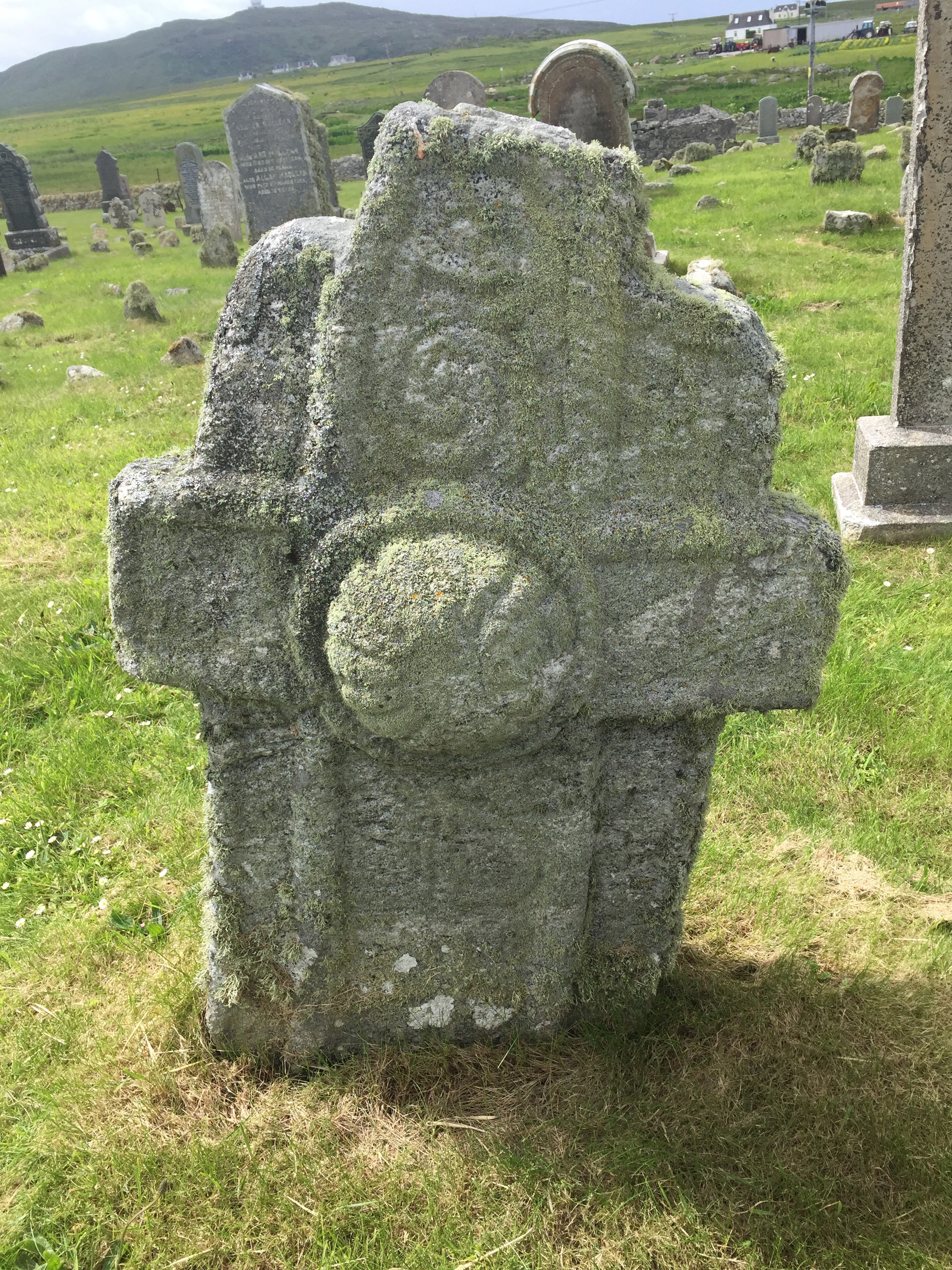
The ruins of that original monastery have never been found, though it is known that a church stood here from the 13th to the 19th centuries. However, one very important artefact remains: a double-faced stone cross from that early period of religious life on Tiree. It is known, now, as McLean’s cross, after the clan which ruled Tiree from 1390 to 1680, it is linked to the life of Anna McLean, who was the prioress of Iona from 1509 – 1543.
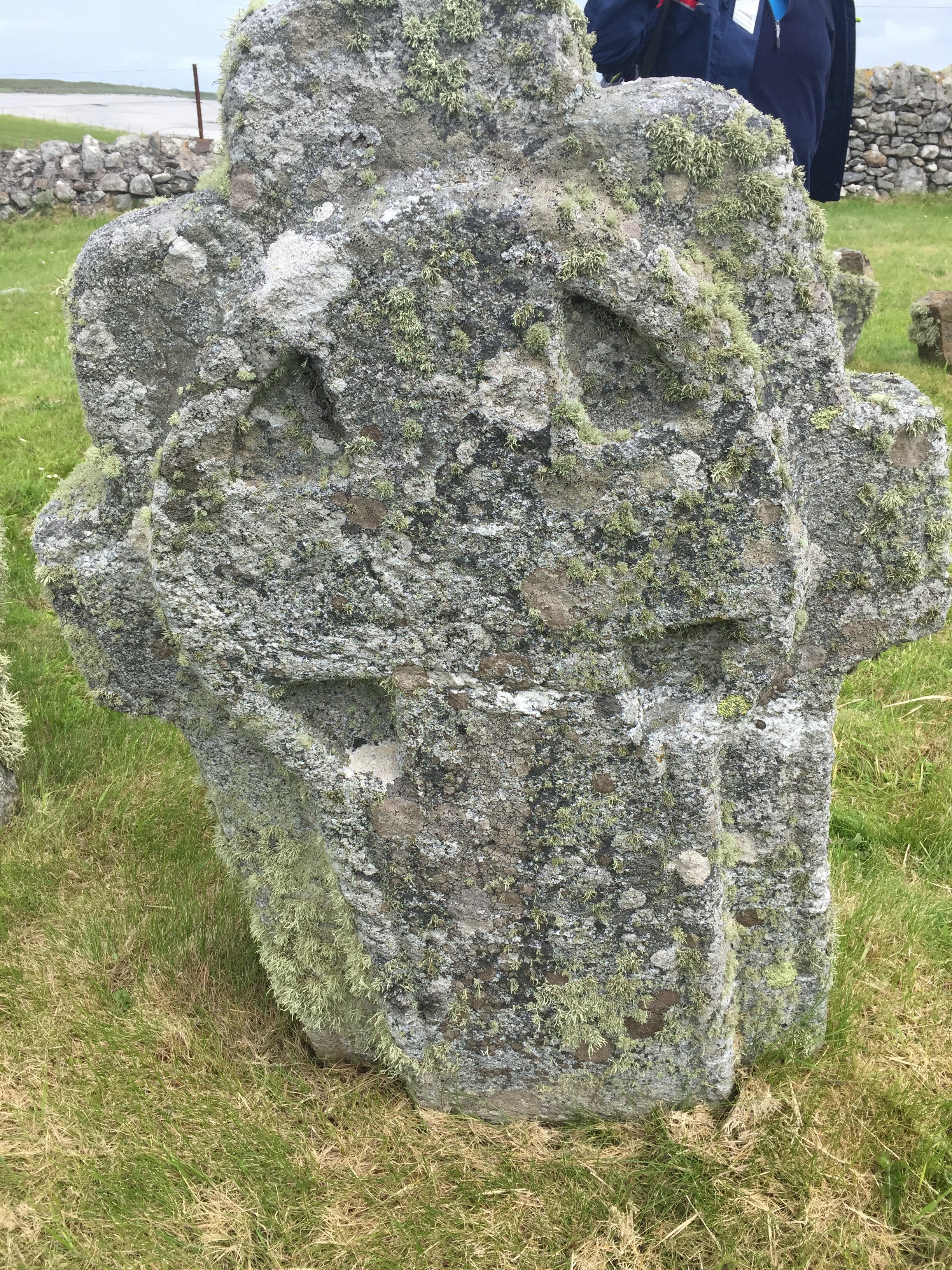
The cross has two sides: the first, with its raised boss at the centre of a ‘cross and spiral’ design, is Celtic. The reverse is in the form of a Latin Cross. It suggest an ancient piece, created when Christianity was well established, yet still in touch with its Celtic roots in these parts. One of the locals suggested it was 8th century, but we had no way of verifying this, and I can find no other reference to it.
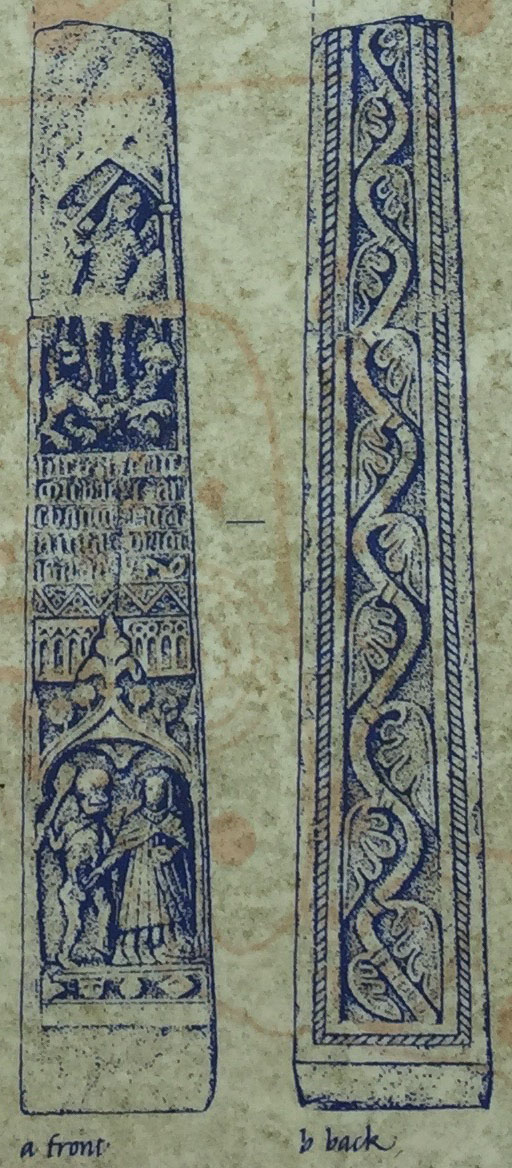
Another artefact once shared this site: the cross of Anna McLean, herself, stood here (illustration above). On it , she is shown ‘disembowelling death’; an action that merits scholarly and philosophical attention. Only the shaft of the cross is recorded, and the original was removed from the island long ago. The inscription reads ‘This is the cross of Michael, Archangel of God. Anna, Prioress of Iona‘. I would imagine no-one knows the full story of how she came to be interred on Tiree, possibly her original family home. She must have been quite a woman…
Quietly, and deep in thought, we left Soroby, intending to double-back on ourselves a short distance and take the direct road over the spine of the island and to Tiree’s north coast.
We had cycled away from the wonderful village of Hynish knowing that the best part of the day was likely over. The sheer mental adventure of discovering the story of the Shore Station and the Skerryvore Lighthouse had provided a kind of peace; a sense of a day well spent; and yet we were only a quarter of the way around the island of Tiree.
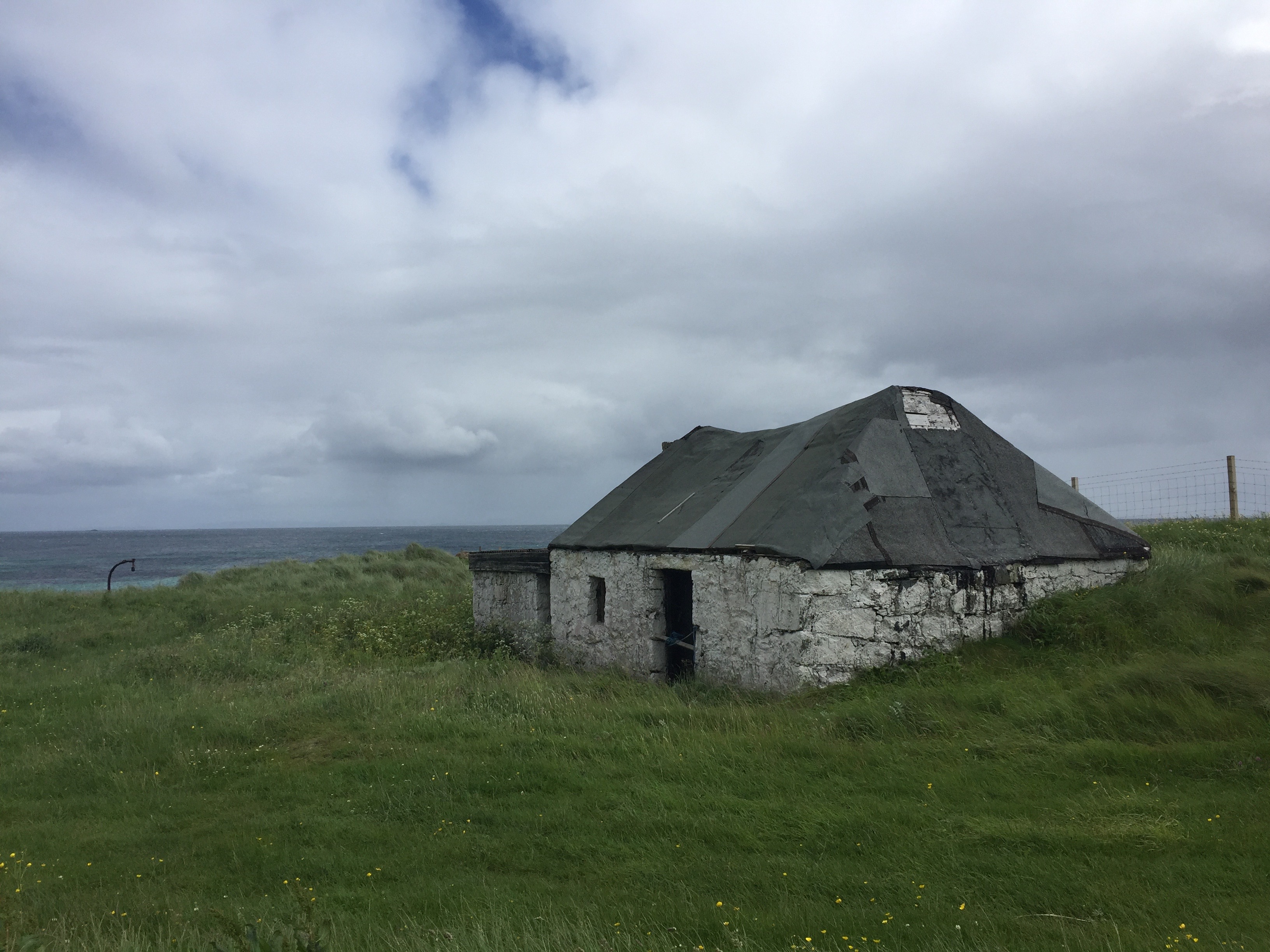
And then the dark clouds behind us caught up with the broken blue sky in front and the deluge hit. With a hissing of dark, low clouds, the threatened storm began. The rain was so intense that we abandoned any thought of climbing the hill towards the north coast. Instead, we fled back to the only point of refuge we knew – our morning cafe at Balemartine – and ran from the front car park into its inviting interior.
Henrietta had more sense than to be waiting for us, this time, and the staff of the Balemartine Cafe laughed in warm mirth as four wet cyclists abandoned their machines near the door and fled into the cafe’s warm interior.
“It can be verra unpredictable, the weather here,” said the lady owner of the cafe, studying our dripping state and clearly happy that the formal restaurant section was now full of decently-dressed weekend diners. She coughed gently and pointed to the coffee lounge where we had taken our late breakfast. “Will your usual table suffice?”
It did… and the humour helped; assisted by tea and cake, twice, as the building seemed to shake under the wrath of the storm god. You can feel very vulnerable in situations like this, when you’re thinly dressed, far from home, and more than slightly concerned whether the small plane from Glasgow could even get through the teeth of a highland storm like this…
And the figure jumping up and down in the red rain-suit. it was Paul, of course – the other husband in the party. After another hour in the cafe we felt duty bound to try again, despite the rain. Halfway up the road to the north coast, we abandoned any attempt at further travel. We were strung out in a line on the saturated hill. The ladies were a few hundred metres ahead of me. As group leader, and the most experienced cyclist, I was keeping a watchful eye on Paul, fighting a red ghost in the driving rain and not having the heart to tell him that the ladies had written the day off and decided we all needed to get back to the airport where we would at least be warm and, eventually, dry again.
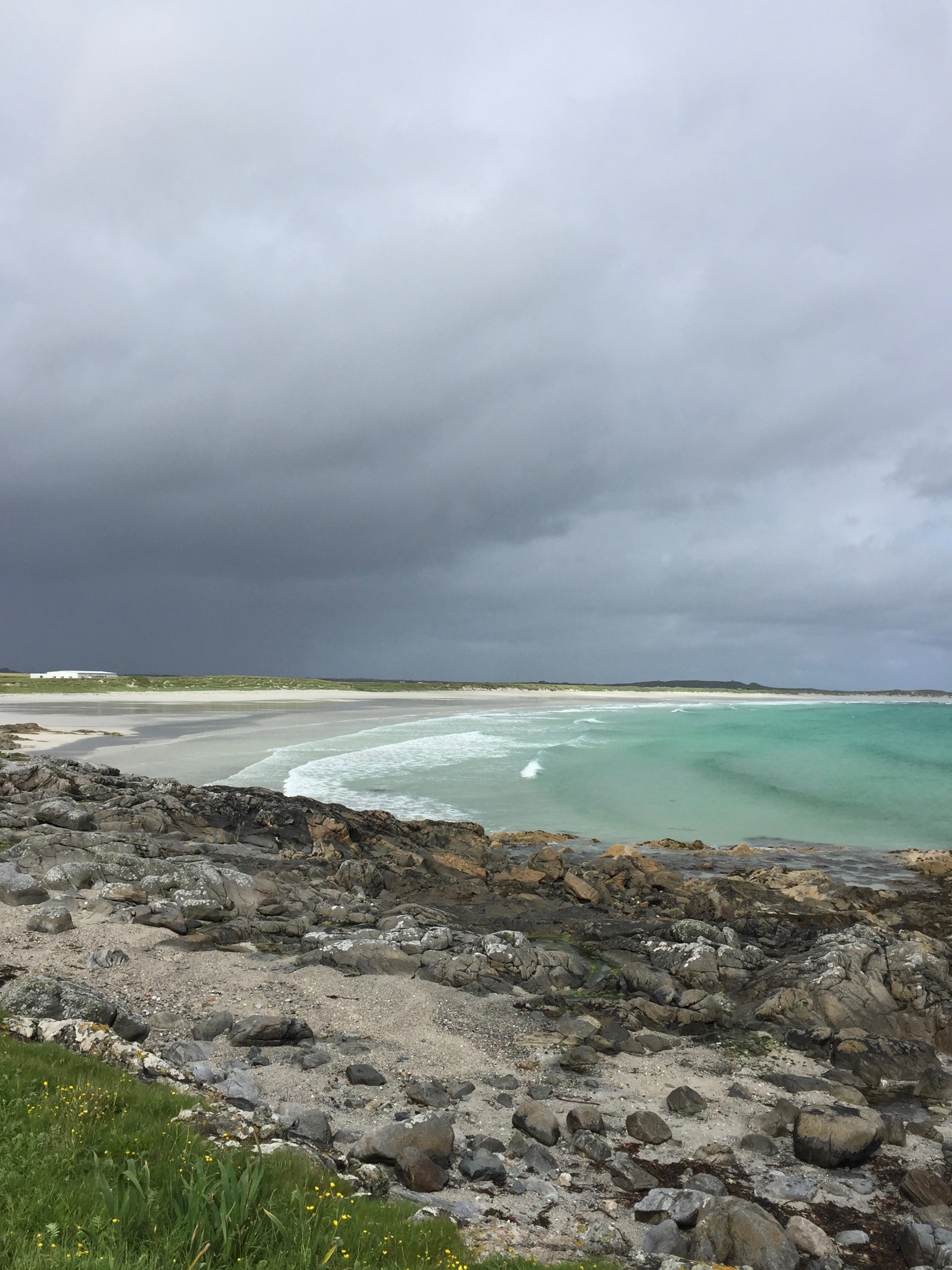
It took us about thirty minutes to get back to Tiree Airport. We did, eventually dry off and get warm again. The plane, did get through. We did get back to Glasgow. None of the bad weather mattered, we had a wonderful day full of adventure.
It’s our turn to assemble on of these, next year. I’ll keep you posted…
Thank you, Tiree.
©Stephen Tanham
Previous posts in this series:
Steve Tanham is a director of the Silent Eye school of Consciousness. His personal blog is at stevetanham.wordpress.com
©Copyright Stephen Tanham, text and pictures. Re-use with permission.


 Sun in Gemini
You must be logged in to post a comment.