
A great blog for Imbolc from Ali Isaac, storyteller
Share this:


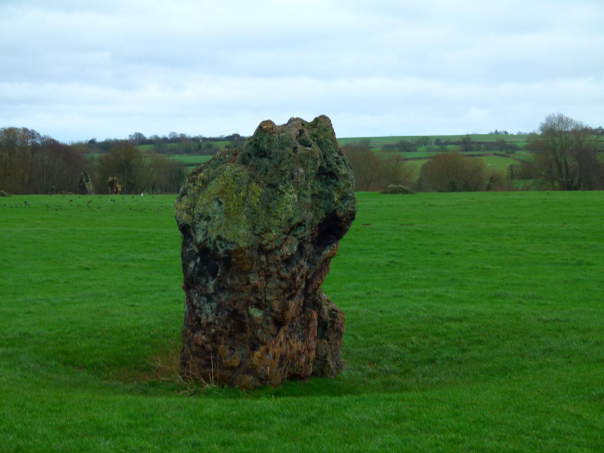
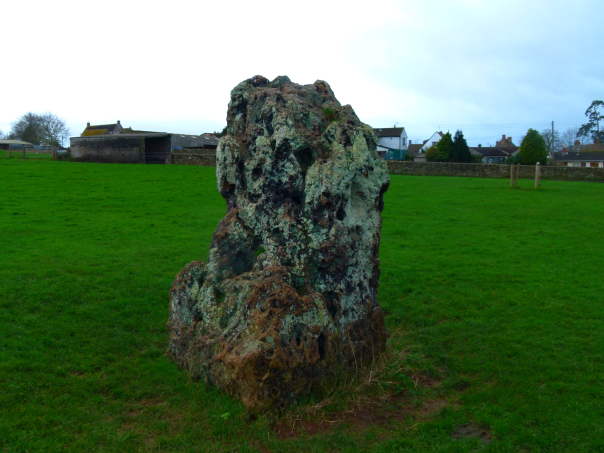
‘Standing Stone of the Druids’
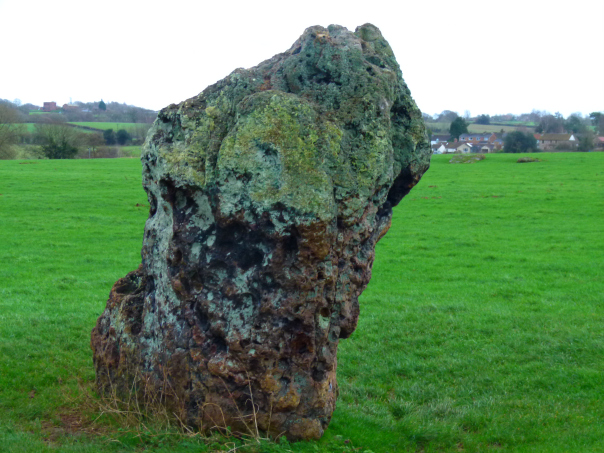
‘STANding sTONe of the DRUids’
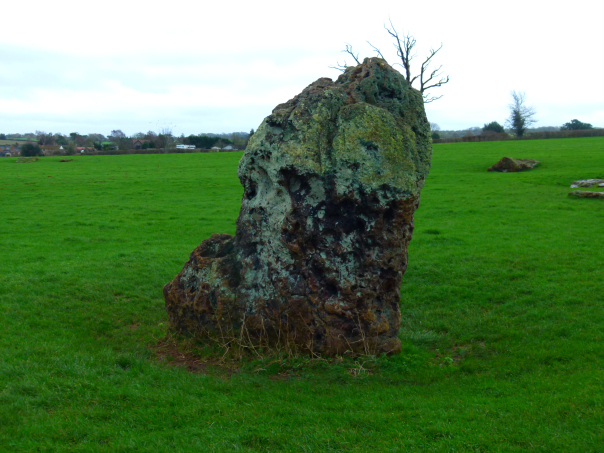
STAN-TON-DREW
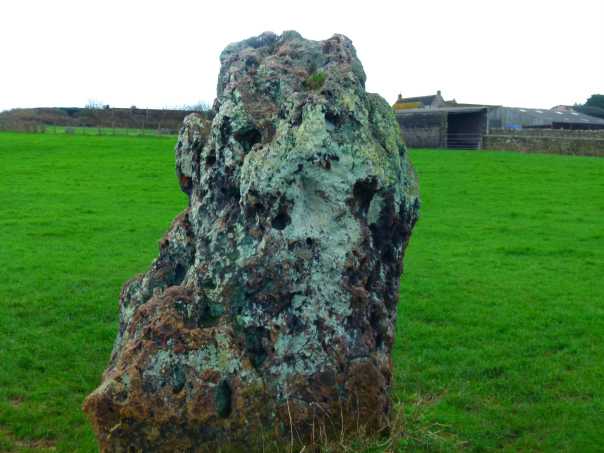
Stanton Drew
Share this:


River of the Sun, chapter 13 – The Binding Voices
“Kneel before the sacred third point!”
Amkhren fell to his knees and, once again, faced the clear lake of tranquillity at the temple’s centre. But this time, the sense of potency within his young soul threatened to overwhelm him…
The Vessel of Sekhmet was speaking again, “Behold Shemu, season of Harvest, the home of the Goddess Mut, wife of Amun-Ra, and the patron of our High Priestess, when she travels from the East and into her world. It was the time of Shemu when the High Priestess came across you on the bank of the Nile, seven years ago. Now you have returned, on the cyclic wheel of Neheh, to that same place, but wiser. The river beside which you now stand is full of meaning and potential, but it is also the place where great fear can be generated within the soul – your Ba. Are you a man of courage, Amkhren?
Amkhren swallowed before speaking, “I will try to be so…”
The young priest-to-be felt the body of Sekhmet kneel beside him, pressing close to his flesh, her warmth penetrating his thin robe. “That will be tested before you pass through the portal of Priesthood!” Then her deadly closeness was gone, and soft hands pulled him to his feet, guiding him along the line of the inner temple’s bounding triangle and back to the East. His feet were suddenly leaden, his body weary, as though a heaviness had dropped on him, replacing the sense of vibrant potency he had felt when standing before the Vessel of Khonsu.
He half-shuffled the distance to the Eastern point, then looked up. The impassive eyes of Neferaset looked back into his.
“Amkhren, there must be a weight… for there must be struggle. There will be many trials; but, within these seasons, there will also be gifts.” Neferaset looked over Amkhren’s shoulder. “Vessel of Sekhmet, take our priest-to-be, whose body is made made heavy by what lies ahead, on a further journey; this time around the inner Wheel of Djet, the path of eternity.” Amkhren blinked in astonishment as the high priestess’ fingers stroked polar lines from the middle of his forehead to the temples, banishing the heavy clouds from his face. He became like a person emerging from darkness, glimpsing the first rays of the dawning sun. “Let him receive the blessings of those who mark his future path…”
Sekhmet turned and looked at the high priestess. Their eyes exchanged a look of such depth that Amkhren could only wonder at the intensity of his passiveness, that he could become the target of such deliverance…
Trust, Amkhren, said the voice of Anzety in his head. Even when the darkness seems to take you… Trust in the far shore of the inner river…
As Sekhmet’s strong fingers spun him around again to face the gentle figure of Hathor for the second time, the heaviness in his body faded, to be replaced by a feeling that the still waters of the central altar were reaching for him, flooding up his spine and changing weariness into acceptance and healing. His vision became unfocussed–not blurred, but as though he were only one of many now seeing through eyes that had been his, alone. Looking up at the beautiful and kindly figure of Hathor, the sense of himself sank beneath the clear waters that were claiming him.
“Amkhren, ” whispered Hathor. “Mine is a place of healing. When your way is harsh and your wounds seem to overwhelm your will, turn to me and I will reach into your body and heart, and fill you with the milky balm that flows from the sky, a shining flow that can never end, no matter how dark or long your days.”
Amkhren bowed to Hathor in thanks, his body bending like a reed in the great river. Then the claws were urging him around the inner circle, past the watchful eyes of Khonsu, to stand before the Vessel of Tefnut, the goddess of moisture.
“There are no waves on the water that is claiming you, as its own,” said the gentle voice of the Lion-headed woman. She held the was staff, its strange shape anchored to the floor with twin feet, while the simple stylised head watched him.
“Honour to you, priest to be. “The honeyed voice echoed the power of water – gentle and restoring, yet containing the hidden power of the great inundation within it. “Let the deeper mysteries of the world of moisture be as a breath of life to you in your trials. Never forget that the water came before the land that rose from its depths; nor that the power of moisture is only the other part of that which contains dryness.”
The reed in the river that was Amkhren bowed, unable to find the right words before this flowing presence. He looked again at the was sceptre as the claws turned him away, one more time, but he took the fleeting image with him; it seemed to be a flowing thing–not solid at all– reflecting the inner fountain that had claimed the seat of his spine, now rising up its length and flowing around his heart…
A few more steps, during which his weighty limbs regained a little more of their power, and he stood before the Vessel of Ptah.
The green skin of the God curved from a calm face, disappearing into the tight folds of a white robe, to emerge at the wrists and hands that clutched a more ornate form of the was staff – the sceptre. The presence of this god-form was overwhelming. Amkhren could feel the power of thought behind eyes that were split by the form of the ankh which crested the top of the coloured layers of the sceptre’s length. Here is creation, Amkhren, said Anzety’s voice in his head, you do not speak to creation… it speaks through you, when you are ready…your voice is its presence in the land of Egypt…
When they came, the words uttered through the Vessel of Ptah were like the water in the silver bowl at the temple’s centre, as though they were dancing patterns of light that gave life to the ghostly flow which moved, now, up the top of his spine and into his head.
Lips verdant with the power of making spoke, “Honour to you, priest to be. Look deeply into my eyes and see the power of creation! As shaper of all around you, I have the primeval beat of the heart that wishes, and the tongue that frames. Used rightly, this force can set everything in its proper place, as my consort Sekhmet will show you.”
Sekhmet moved behind Amkhren, who found himself caught in the current of love that flowed between the green god and the fierce lady lioness. His body tried to twist away from its power but the claws held him fast and his head exploded with the golden child of liquid love that overwhelmed what was left of his senses. Through the haze he heard her words, “We share with those who are ready, Amkhren–” A gentler set of claws stroked the sides of his head. “–when those whose ears have reached maturity learn to listen…”
Once more, the reed bowed, and then his feet were moving through a dead and empty space where there was, for a moment, intense sadness. Within this, Amkhren could feel the strength and resolve of Sekhmet as it guided him through the inner black. We do not know why, Amkhren, whispered Anzety’s voice in his head, equally sad, we do not know how… But, though the hand of the Lioness carried him through the void, he could feel a much more deathly grip closing on them all from the outside circle. But his young mind could not separate intuition from experience and he said nothing as Sekhmet led him, safe for now, to stand before the Vessel of Thoth.
“Honour to you, priest to be,” said the tall, Ibis-headed figure, whose curving beak nearly touched Amkhren’s forehead. “Listen deeply to my words, for they are power clothed in the substance of air. Invoke my name to strip away the false – turning language into meaning. If meaning is known it may be written – but only by they who live in understanding. Think carefully on these things as your trials progress. The word is far more than it seems; therefore speak only when you understand. Otherwise, let silence be your guide.”
The words were simple, yet so very powerful in their clarity. Amkhren felt their meaning burn itself into his mind, as though the beak of the Thoth Vessel had pecked them onto his flesh.
The claws of Sekhmet did not allow him further time to consider. Her movements seemed designed to tear him, always, from the edge of full comprehension – as though another journey, or even many journeys, around the great circles would be necessary for his passing through the portal of priesthood.
“Honour to you, priest to be,” said the graceful figure in the simple robe, distinguished only by a single, ostrich feather standing proud from a narrow, red headband. “Let Thoth’s words fill you with intent. But, behind the word must lie the real; behind understanding must lie the flame of that which is true in the Eyes of Amun-Ra, not simply what is true in the minds of women and men. Therefore let your life’s search be for what is true, for that, in the final judgement before Osiris, will be the worth of your time on the great river of life.”
Beyond words, now, Amkhren could only bow to the simple figure of beauty. The claws returned for him, but, this time, with a gentler touch…And then he was standing, again, before she who personified both Mut and Isis.
The high priestess softened her eyes, seeing in his the devotion and intoxication she needed.
The Vessel of Sekhmet spoke from behind his left shoulder, “High Priestess, spiritual guide for all those who seek deeper understanding of the life and the power of She who goes beyond; your chosen apprentice has been shown the path ahead of him. I return him to your care.”
Amkhren felt his legs begin to shake. Ashamed of his weakness in the face of the woman who had plucked him from the banks of the great river, he stiffened his young body, raised his head and drew in a deep breath, banishing fear in the way he had been taught.
Neferaset studied his resolve, nodding her head, imperceptibly, in a gesture invisible to anyone but him. “Amkhren,” she began. “before you are the vessels of the Gods and Goddesses of Egypt. Not all are represented here, because one sacred place can only be host to one view; one perspective on the beyond. But those who are with us – in spirit as well as in flesh -represent a way, a path to the inner strength, knowledge and vision that awaits you – should we have chosen well… For seven years you have been worked and tested, while we searched to see if such dedication was rooted in the blown sand or had the true seed of will and endeavour that marks out those who would be great in service to the Gods…”
Gentle fingers touched the skin of his tense neck. They dropped to his shoulders and pulled him forward until he could feel the warmth of Neferaset’s skin, as he had that of Sekhmet’s. Mere inches away from his face, she looked deeply into his tearful eyes and spoke, “Before we open the portal to your future life, I must ask one final time–with your heart and mind; with your body and hungers; with your senses and that which moves joyously through them all – do you submit yourself to the continuation of this rite, from which, after this moment, there will be no turning back until death or dismal failure takes you or casts you away from us?”
With the waters flowing down his cheeks, the young man replied, “With all my being, High Priestess, you who has guarded and nurtured me… yes…”
The gentle hands on his shoulders became firm and spun him round to look out from the East, across the temple and its candle encircled watery altar, to the great bronze doors of the sacred chamber.
In startling counterpoint to Neferaset’s newfound gentleness, Anzety took one step nearer to the temple’s centre, where he struck the Moon-sceptre into the stone of the floor; the thumping sound splitting the air. “Then the real process of your training as a Priest of this temple will begin.”
The Vessel of Tefnut stepped forwards, “And it begins in the Waters…”
The Vessel of Ptah joined the new ring of command, “And it begins in the miracle of that which was never spoken yet is rendered as signs.”
The Vessel of Thoth moved silently to join his companions, “And it begins with knowledge, which must be grown and harvested, as those by the great river plough, sow and harvest the fruit of the flood when Akhet comes.”
Joining her consort, Thoth, the feathered figure of Ma’at moved inwards to enrich the new circle, “And it begins and grows in the living sea of Truth, which ever flows around those with ears to hear and eyes to see.”
Amkhren’s eyes flickered left as the Vessel of Hathor moved inwards, to speak gently, “And it begins with a great trial of healing, in which the self of a person is laid bare, and that which is poisonous is burned away, so that he may rise, again, in newness.”
In the blurred wind of the silent temple Amkhren heard Anzety’s voice, again.
“Is this the way you will begin, Amkhren?”
“Yes, High Priest.” He had spoken the reply before he could stop to consider the trap in the question.
Anzety’s voice was harsh, “That is the wrong answer!”
Losing his calmness in agitation, he pulled away from Neferaset’s gentle grasp and leaned forward to appeal to the man he considered friend. “Then I will enter this path in the way that I am shown . . .Vessel of Khonsu, God of the Moon.” The word, friend, died on his lips, correctly unspoken.
With a softer voice, the Vessel of Khonsu replied with knowing tones, “You will obey in all things?”
This time, Amkhren, sensing that the intellect had to be regained to pass this test, replied, “I will obey my teachers in all things.” Were they doing this deliberately? To return him from the heights of the emotional contact with the Neters? He could see how a man–especially a priest, needed to inhabit both worlds.
Anzety walked to a position in the West, directly opposite his sister in the East, before speaking.
“Good . . . Before you, in the centre of the temple, is an executioner’s bench, and upon it you will see a flail and a sword. You will kneel before it and offer your life to the Gods…”
With a gentle and curving push, the High Priestess sent her apprentice into the space of the temple. Amkhren followed her parting gesture and navigated the half-circle to the West before following a direct line back towards the East, daring to cross the very centre of the altar space, his simple robe almost touching the silver crescent upon which glistened the pool of the water of life. Unseen, as he passed, a signature of tiny waves was written across its surface…
Amkhren knelt before the wooden bench, placing his hands between the sword and the flail, and lowering himself to kneel so that his forehead touched the wood.
The soft sound of a woman’s feet, gliding in leather slippers, approached him. So focussed was she on the wellbeing of the boy before her, that she did not see that many of the hooded visitors in the outer shadows had turned away to face the darkness… But, pressed against the wood, Amkhren was conscious that the clutching hand of that feeling of ill intent he had felt in crossing from the place of Ptah to that of Thoth had now returned, stronger than ever.
He was about to raise his head, determined to trust his instincts and warn his beloved Neferaset, but she began to speak in her harsh tones of command before he could give voice to the urgency of his fears, “And there you will stay, though your limbs endure agony, and your mind lives at the edge of darkness. You will endure in complete silence, released only by my command – is that understood, Priest-to-be?”
It must be a test, thought Amkhren, his mind wracked by doubts. The dark forces must be part of the rite, too?
“Yes, High Priestess..” he said, his obedient voice muffled against the wood.
He heard the soft leather of her temple slippers retreat to the East; then the clear tones of command as she raised her voice, triumphantly, “High Priest of Isis, Vessel of Khonsu. Ring the Western Bell to tell the world that the ordeal of Amkhren has begun and that the Gods count his hours . . .”
Anzety approached the huge bell in the West of the temple. He raised the wooden striker, whose end was covered in layers of tightly-bound leather. Drawing back his right arm he struck the bell in its midsection. The melodic sound filled the air of the chamber, in wave after wave, ringing loud and true as it swung, like the vibrations of sound thrown up by the wings of a huge bird of prey.
But the sound which followed this dwarfed its harmony, filling the hearts of most of those in the temple with dread and horror, as the great bronze doors of the Temple of Isis shook on their buckling hinges and the screaming of torn metal filled the air…
——————————–
Index to previous chapters:
Chapter One – Gifts From the River
Chapter Two – An Agony of Sunset
Chapter Three – The Dark Waters
Chapter Four – Touching the Sky
Chapter Five – The Fire Within
Chapter Seven – The Crystal Air
Chapter Eight – The Unchosen Darkness
Chapter Nine – The Priestess Calls
Chapter Ten – Darkness at the Door
Chapter Twelve – Above and Below
—————————
Introduction to River of the Sun
In April 2015 a group of people gathered in the Derbyshire hills to enact the Silent Eye’s annual Mystery Play, entitled, The River of the Sun. The five-act mystical drama formed the backbone of that Spring weekend, and told the fictional story of a clash of ego and divinity set in an Isis-worshipping temple located on an island in the Nile, during the the fascinating period of the 19th dynasty, the time of Rameses the Great.
The 18th and 19th dynasties were a time of upheaval for ancient Egypt on many levels. The reign of the ‘Heretic King’ Akhenaten saw Egypt’s religious structure torn apart, as the revolutionary Pharaoh became what Wallis Budge called the ‘world’s first monotheist’; re-fashioning the power of the many Gods with one supreme entity – the visible sun disc, the Aten, for which Akhenaten, alone, was the high priest. Many have pointed to the failure of the ‘herectic’ Pharaoh’s politics, but few have doubted the sincerity of his religious vision. He will, forever, remain an enigma.
Whatever the nobility of his goal, the actions he took were ruthless, and included the shutting down of the annual deity festivals which were the sole point of ritualistic contact between the ordinary people of Egypt and their locally-worshipped gods. In addition, Akhenaten paid little attention to the domestic and military affairs of Egypt, allowing the country’s enemies to encroach on its borders, greatly weakening Egypt’s power at that critical time for the region.
After Akhenaten’s brief reign, culminating in the Pharaoh’s mysterious death, shadowy military forces took control of Egypt, instigating the 19th dynasty in the persons of Rameses I and, soon thereafter, Seti I, whose throne name derives from the god Set – often considered the ‘evil one’ because of his slaying of his brother, Osiris.
Seti I is judged by modern historians as having been one of the greatest-ever pharaohs, yet his importance in the 19th dynasty was eclipsed by the actions of his second son, the brilliant Rameses II, whose long reign of over sixty years included much self-promotion and the alteration of Egypt’s recent history. Both Seti and Rameses II (Rameses the Great) were passionate about the evisceration of the last traces of Akhenaten’s ‘chaos’, as they saw it.
But, although, by the 19th dynasty, the the ‘Son of the Sun’ was long dead and the buildings of his embryonic and doomed city of Tel-al-Armana were reduced to rubble, something of that time remained in the Egyptian consciousness. A new kind of connection between Pharaoh and God had been established, one which elevated mankind, if only in the being of the Pharaoh, to be someone who ‘talked with God’. It was, at the very least, a bold experiment and, though the world would have to wait until the 19th century to re-discover the ‘erased’ pharaoh, the philosophical waves of that period rippled out and dramatically affected the way the incoming 19th dynasty had to repair the worship of the Gods, uniting the people of Egypt under a trinity of Amun-Ra, Khonsu and Mut.
Our fictional story is a tale of politics, friendships, mind and faith. It is set against an historically accurate background, and at a time when Rameses was due to take the throne from the dying Seti .
Returning to Thebes in his swift warship, crewed by his fearsome Talatat mind-warriors, Rameses decides to mount a surprise night-time raid on the island-based Isis temple which has prospered under the sponsoring reign of his father. Rameses suspects that the inner teachings conducted by the revered High Priestess and Priest conceal views that relate to the thoughts of the heretic Pharaoh, Akhenaten. He plans to insert himself and his warriors of the mind into the islands’s Spring rites as the high priest and priestess begin a cycle of initiation for a chosen apprentice priest who has proved himself worthy of special advancement.
The resulting clash draws everyone, including the young Pharaoh-in-Rising, into a spiralling situation where each is forced to confront their own fears as well as living out the roles which life has allocated them. River of the Sun is the story of a spiritual and political encounter from which none emerge unchanged, including the man who will shortly be Pharaoh, the mighty Rameses II, whose secret name for himself is ‘the unchosen’.
Through the eyes and minds of those surrounding the chosen priest and the ‘unchosen’ Pharaoh, the River of the Sun takes us on a tense and compelling journey to the heart of power and its eternal struggle with truth.
The chapters of the book will be serialised in this blog. The finished work is planned to be available in paperback and Kindle in the Spring of 2016.
————————————————–
River of the Sun, serialised here, and its associated images, is the intellectual property of Stephen Tanham and is ©Copyright material.
Share this:

Beautifully, searingly honest … a lovely sharing of part of a life’s journey.
Share this:


+ Greek Myths, Heracles, Hercules, Higher Mind, Journey of the hero, Labours of Hercules, Mystery Schools, myths and spirituality, Silent Eye School, Uncategorized
Nine Deadly Sins with Coffee, part 46 – A Forgiving Girdle
by Steve Tanham
Nine Deadly Sins with Coffee, part 46 – A Forgiving Girdle
.Alexandra.
I was trying hard to hide my annoyance but I could tell he knew.
“Difficult one?” he asked me, but smiling at Rose as she deposited our coffees, none too gently, on one of the side tables – our usual had been taken by some non-regulars… the nerve!
“More like all the discarded out-takes from the other myths,” I muttered.
“You can learn a lot from out-takes,” he offered, looking reasonable and calm and generally hateful.
“Not from this lot!” I moaned, then was immediately ashamed of myself.
“Why don’t we just play with the out-takes, then?” he asked, watching me sigh and let out the tension whose source was less than obvious. I had come far in the past few weeks; I didn’t want to blow it, now.
I sat back; drank a minute’s worth of coffee and composed myself. “Okay,” I began. “Heracles has to retrieve something called the Girdle of Hippolyte.” More coffee, then, “Hippolyte is an important Queen who rules a land by a great sea, the home of all the women in the known world – no men to be seen, at all!”
“Kind of Amazons, then?” John asked.
I held my hands up and rolled my eyes in gesture of unknowing, then took a breath before continuing, “The women worship around their beloved Queen in a temple of the moon, but, once a year, they go off to have a party with some unnamed men…” It was sounding preposterous, but, as far as I knew, that had been a true account so far…
I gathered together what I had studied about the rest of the myth and finished my coffee.
“The Queen is forewarned of his approach at the same time that Heracles is given his mission–to take the Queen’s Girdle, whatever that was in ancient times…”
“A magical girdle, I should think,” said John. “Probably had special properties…” He looked at me for a reaction, then let it go, continuing, “Parents are usually important, whose daughter was Hippolyte?”
“Well, there’s another strange thing!” I said, a certain and mysterious enthusiasm for my task germinating. “Despite all the womanly focus, Hippolyte was a daughter of Mars–Ares, I should say…”
John leaned forward to speak, “The most physical of the Gods of War!” he said. “A very strange combination, especially when you think that the other God, or should I say Goddess, of war was Athena – she of the wise owl…”
I looked at John, fixing his eyes. “As though anyone could choose their parents?”
John held my stare. “Oh, but the creators of myth certainly did choose the parents…”
My mind changed gear, seeing the chasm of what I had missed. “Of course… they are not people at all, they’re parts of us, principles…” I sighed.
“And did the Queen of all these men-less women give the magical girdle to Hercules?”
“No!” I blurted. “Well, yes and no… She was ready to give it to him, but, ignorantly, he fought to take it off her and killed her in the process, thereby killing the mother of the sacred child…”
John finished his coffee. “Sounds serious to me, killing the Queen, who is the mother of the sacred child?”
My mood had become sombre. “Does, doesn’t it?” And then I remembered that this story of Heracles had a further ending. But I knew it was getting late. I looked at my watch and stood up to go, giving my closing speech.
“But Heracles was seen to redeem himself, later, by fighting his way into the innards of a sea monster that had eaten the sacrificed Hesione, wife of the Trojan, Priam, rescuing her in her hour of greatest need and balancing the scales of his life.”
John nodded as we both headed for the door. It had been a complex and unsatisfactory half hour. “Yes,” he said. “he was seen to redeem himself, though the mother, the Queen of the sacred child, was dead… and the women of the land by the sea were leaderless.”
He opened the door for me. “And you got the introduction slightly wrong,” He said.
“I did?”
“Yes. Hercules didn’t get his instructions about the girdle from his teachers, those instructions – the surrender of the magical girdle – were sent directly to Hippolyte. All Heracles did was to arrive at the edge of the watery kingdom, where the moon was worshipped, by women, alone; and where the god of war was sacrificed to, by a Queen who wore the girdle of love and was the key to the generation of the sacred child.” he paused for breath, smiling at how much he was trying to put into his closing words. “Was Hercules really active, apart from killing someone who was likely to meet his greatest need?”
I was stunned by this summing up. Just before he crossed the busy road, he laughed and shouted back over his shoulder.
“Oh and don’t forget that all this takes place in the month of Virgo!”
And then he was gone… and I was left with an old file full of very confusing out-takes…and only a week to make sense of them…
———————————————————–
Nine Deadly Sins with Coffee is usually published on Thursdays.
All images and text ©International copyright, The Silent Eye School of Consciousness, 2016.

Share this:

I am proposing to add a new word to the English language…
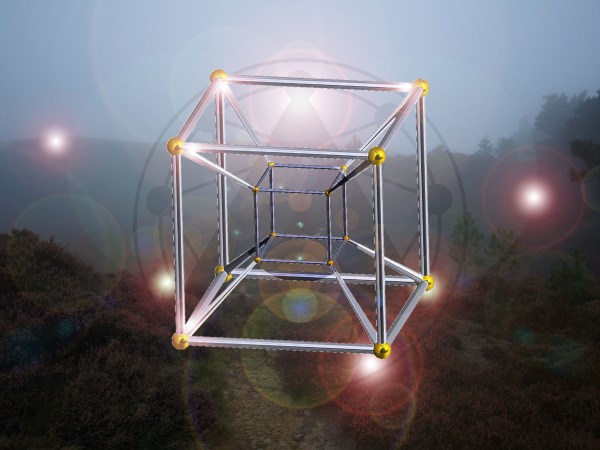
The new word is ‘Tesseracting’; and I want to use it to replace a beautiful word that, in my opinion, has been degraded to a point where its use is compromised – that older word is ‘Ritual’.
My interest in the tesseract began as a result of the work of Stuart France (one of the three directors of the Silent Eye, along with Sue Vincent and myself). Stuart had been working on the spiritual implications of a particular geometric figure, known as the tesseract. The period of his study was one where he had been ill and that had produced a vivid dream in which this geometric figure revealed its relationship to the enneagram – the primary teaching figure we use in the School.
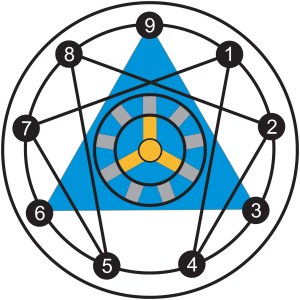
The Silent Eye’s teaching enneagram
Stuart’s insight, some of which was published on his blog, showed that there was a solid relationship between the properties of the tesseract and those of the enneagram.
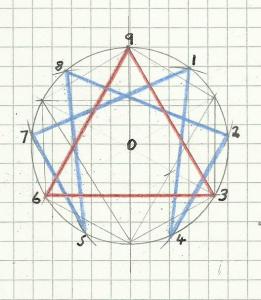
Part of Stuart France’s work on the enneagram and the tesseract
Working into the wee small hours last night, I was one of the first to read Sue’s blog “Simple Space”, about the different dimensions of creativity required to bring into existence a weekend workshop which has at its heart a five-act series of ritual dramas whose job is to transform the consciousness of everyone taking part. Sue’s blog goes on to describe the ‘divergent’ thinking that you have to do to get the emotional energy of the initial creation and envisioning. She then talks about the realities of narrowing down the engineering so that the same result will be delivered within a ‘simple space’ – as she points out, anything more complex and it just wouldn’t get delivered.
The three of us have learned this – sometimes painfully, as wonderful scenarios have failed to translate into what can be done within a simple room turned temple. Fortunately, such periods of learning usually precede the April Workshops, as Sue’s article shows, giving us a period of grace in which to get things right.
And that’s the essence of good ‘ritual’ – it uses the geometric properties of space, treated with reverence, to produce a shared consciousness that is quite unlike anything else you will experience. Cast off the ‘sensational’ images of Hammer Horror gothic rites… Real ritual owes nothing to the latter, except the degradation of its name.
Good ritual is simply a relationship with that ‘simple space’, embellished only to the degree that it will touch the hearts and minds of the participants, not glorify the guiding officers.

Tess in the brief period when the rain froze, earlier in the month.
This morning, I took Tess (our collie dog) out for a much needed walk in what I can only describe as some of the worst weather I’ve ever experienced. Driven by a ferocious gale, the rain was coming at me horizontally, and even my long boots (an essential feature of dog-walking in Cumbria) were full of water. In the soggy mud of what used to be Sedgwick, we are having a tough winter. This is not because of extreme cold, but, rather, because it seems to have been raining, with very few breaks, since November. I’ll not ramble on, because the destructive effects on our landscape have been well documented by TV news teams over the past two months…
I was thinking about Sue’s piece as I sloshed through the mud, looking, miserably, at Tess and thinking how much washing she would need when I got her home…when suddenly, a gleeful look in her eye reminded me of how much dogs live in the ‘now’, being fed from it without judgement and with total involvement, regardless of the dreadful weather that often surrounds them. It struck me that her eagerness perfectly reflected how we all should be in our temples of whatever size, and how, we who build such workshops, having done our best to engineer that experience for all attending, owe it to our participants to relax into our little cube of space… and trust…
…and that’s when it hit me… how the tesseract, a four-dimensional figure that is to the cube as the cube it to the square, perfectly describes how a temple of the Mysteries feels to be in.
We enter the cube of the temple in reverence, determined to ‘raise its vibrations’; to put it in tune with a much greater dimension of objective reality that is always there, but that we seldom see because of the power of the lenses we create in the constant reaction of personality to experience. The combination of the space made sacred – in perfect geometrical harmony with what we are reaching for – plus an open-hearted appeal for the higher principles to fill our cube with the intelligent energy of the transformational, exactly maps onto the tesseract as a symbol.
So, in some humility, I offer ‘Tesseracting”: to act (as in ‘play a part’), with geometric movements, thoughts and words, within a cube of space made sacred by our actions, and in recognition that our small cube is a tiny but representational microcosm within an undivided, intelligent cosmos – but no less important for that…
There are still a few places left for the Silent Eye’s April 2016 workshop, “Leaf and Flame”, open to all, beginner or those more experienced. Special care will be taken of those who have never encountered Tesseraction before… we’re good at that, you’ve nothing to fear. Why not give it a go?
(Underlying Tesseract image from Wiki used with permission and created by Robert Webb, using his Stella Software, linked to here: http://www.software3d.com/Stella.php )
Share this:


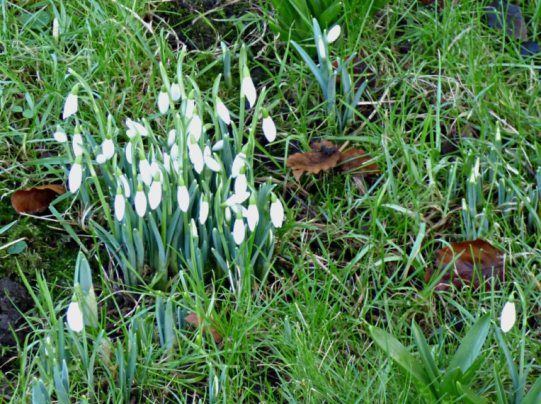 You know how it is… you have an idea, then try and find a way to put it into practice. What at first seems obvious suddenly throws up all kinds of complications and what had appeared so simple becomes a real headache. You wish you’d never thought of it, but it is too late to change your mind and go back… but going forwards feels as if you will be wading through treacle for the foreseeable future. You start worrying or fretting and that sets up a vicious circle that clouds vision even further.
We had been feeling a little like that with some of the details planned for the upcoming workshop in April. It all worked beautifully on paper, but between the vision and creating a concrete form for those details lay a gulf the imagination struggled to cross.
So, you step back and take another look. Instead…
View original post 305 more words
Share this:

Share this:

Sue’s beautiful description of what we do…

It was one of those mornings when every conversation, across three continents has seemed to lead to the same place. The scraps of paper upon which I’ve been writing notes are strewn across the desk, and it is just as well I can deal with some of these letters online, given the half formed thoughts scrawled over them, for they would tell a strange story taken out of context.
I was talking with a friend, as you do, comparing notes over coffee and a few thousand miles. He described his own spiritual tradition as ‘walking in Beauty’. That, I thought, was a wonderful way to describe any path. Yet it came to my mind that if I had to describe as simply the path that has drawn me, the path we seek to share with the School, I would have to say that we ‘walk in Love’.
For me there…
View original post 798 more words
Share this:

River of the Sun, chapter Twelve – Above and Below
Sarkur the Stonemaster lay beneath Egypt’s stars, looking deep into the sky as though reading the story of his own life.
As a young child, his mother would walk him to the cliff-edge, where the stars were brightest, and point out the patterns in the sky. For each, she would tell him the tales handed down by the people of the land, tales of humour, adventure and what he would later know as wisdom. Then there were secret tales, too – tales of her own with which she would embellish the traditional stories, providing a newer narrative on the popular exploits of the Gods, as though seen from a different and hidden perspective. “Always look for the other side, Sarkur” she had said to him, putting him to bed and stroking his forehead while sleep claimed his young body. “Every tale has two faces… the wise man makes a friend of the second and doubles his world.”
He had never forgotten that moment–nor the warmth and humility of the woman who raised him. Now, as he stared up at the masterwork of Nut’s glory, he wondered, once again, why this remote tower could be of such importance to the young Rameses?
Mareuka and his team were sleeping far below, in the moon-shadow of the stone finger. Within the last few hours, fired up by the foreman’s example, they had done the work of a full day, toiling with a fury that belied their tiredness after the earlier march from the great river.
Now they slept.
The narrow, central spiral stairway that connected the ground with the sky-platform was, by now, a hated place–a nightmare of twisting, up which they had to haul themselves and much of their materials. No-one had elected to join Sarkur when he announced he wanted to sleep high under the stars.
Nestled in his solitary tiredness, he smiled at that… he hadn’t wanted anyone with him, anyway, but, unusually for someone of his authority, felt he should ask…
He looked around him in the silver light. Over a quarter of the sun platform had been finished. Its circular perimeter forming a dividing line between ghostly white and shadowy black as it glistened in the bright moonlight. There were no raised edges as you approached that division. The only non-uniformity in the growing disc was a single darker stone, fitted, perfectly, with the others and just offset from the centre of what would be the full circle. When Sarkur had asked its purpose, Rameses had called it the testing stone, for reasons no-one knew. The King-in-Rising had said little else about it, other than to say he was having it made and they need not worry further about it.
With a trick of the tired eye, you could imagine that the growing surface extended like a flat plain out into the high valley beyond the foothills. Sarkur knew the stone workers were proud of what they were building. He also knew that the King-in-Rising would tolerate nothing less than perfection; and would soon be searching for any reason to be dissatisfied with those favourites of his father who now sought favour from the son. He had no wish to lose his royally-backed livelihood… and Seti concurred.
Sarkur traced one of the star patterns with a dusty finger, trying to remember which God’s adventures were written in the tapered shape. He moved his head to align himself with its vertical length, seeing for the first time that it resembled one of the pylons at the entrance to the temple on the island of Gezirah-al-Nabatath. He thought of the long months, many years ago, when practically half of Seti’s building team had worked to restore the old ruins of the ancient Isis temple there, adding and extending as they went, creating what all agreed was one of the great river’s most beautiful wonders.
Correspondences had always fascinated him. He chuckled as a sharp pain in his back reminded him that he had brought up to the starry platform a particularly pure length of sandstone, which had detached itself from a badly fractured larger rock while they had been furiously preparing the last of the day’s raw blocks. The piece had reminded him of one of the main pylons on the Isis island. He loosened the hemp blanket which would later protect hm from the cold that came with the vision of the stars, twisting so that he could extract the rock stump. He held it up to the night sky and marvelled that, although lacking finish, it was nearly the same shape as the sky pattern he had been tracing…
Seeking to get the alignment exact, as though that held some unknown importance, his arms cramped from the day’s over-exertion, and the rock dropped from his tired fingers, bouncing, painfully, off his chest and spinning across the stone and towards the edge of the platform. Despite his age, Sarkur spun, rapidly around and threw out a hand to arrest its motion, but the blanket snagged his movements and he ended up pushing the block over the edge…
For the briefest of moments, he watched it fall, spinning in the moonlight. Then the darkness took it and he could only look down and pray it would miss his stoneworkers. He thought about crying out a warning, but decided it would be too late… The splintering crash told a safe but sad tale and the secondary sounds indicated that the pieces had been scattered far and wide on the rocks below.
He could hear Mareuka cursing in his sleep, which did something to alleviate the unexpected feeling of sadness that dropped from the dark sky.
——————————–
Index to previous chapters:
Chapter One – Gifts From the River
Chapter Two – An Agony of Sunset
Chapter Three – The Dark Waters
Chapter Four – Touching the Sky
Chapter Five – The Fire Within
Chapter Seven – The Crystal Air
Chapter Eight – The Unchosen Darkness
Chapter Nine – The Priestess Calls
Chapter Ten – Darkness at the Door
—————————
Introduction to River of the Sun
In April 2015 a group of people gathered in the Derbyshire hills to enact the Silent Eye’s annual Mystery Play, entitled, The River of the Sun. The five-act mystical drama formed the backbone of that Spring weekend, and told the fictional story of a clash of ego and divinity set in an Isis-worshipping temple located on an island in the Nile, during the the fascinating period of the 19th dynasty, the time of Rameses the Great.
The 18th and 19th dynasties were a time of upheaval for ancient Egypt on many levels. The reign of the ‘Heretic King’ Akhenaten saw Egypt’s religious structure torn apart, as the revolutionary Pharaoh became what Wallis Budge called the ‘world’s first monotheist’; re-fashioning the power of the many Gods with one supreme entity – the visible sun disc, the Aten, for which Akhenaten, alone, was the high priest. Many have pointed to the failure of the ‘herectic’ Pharaoh’s politics, but few have doubted the sincerity of his religious vision. He will, forever, remain an enigma.
Whatever the nobility of his goal, the actions he took were ruthless, and included the shutting down of the annual deity festivals which were the sole point of ritualistic contact between the ordinary people of Egypt and their locally-worshipped gods. In addition, Akhenaten paid little attention to the domestic and military affairs of Egypt, allowing the country’s enemies to encroach on its borders, greatly weakening Egypt’s power at that critical time for the region.
After Akhenaten’s brief reign, culminating in the Pharaoh’s mysterious death, shadowy military forces took control of Egypt, instigating the 19th dynasty in the persons of Rameses I and, soon thereafter, Seti I, whose throne name derives from the god Set – often considered the ‘evil one’ because of his slaying of his brother, Osiris.
Seti I is judged by modern historians as having been one of the greatest-ever pharaohs, yet his importance in the 19th dynasty was eclipsed by the actions of his second son, the brilliant Rameses II, whose long reign of over sixty years included much self-promotion and the alteration of Egypt’s recent history. Both Seti and Rameses II (Rameses the Great) were passionate about the evisceration of the last traces of Akhenaten’s ‘chaos’, as they saw it.
But, although, by the 19th dynasty, the the ‘Son of the Sun’ was long dead and the buildings of his embryonic and doomed city of Tel-al-Armana were reduced to rubble, something of that time remained in the Egyptian consciousness. A new kind of connection between Pharaoh and God had been established, one which elevated mankind, if only in the being of the Pharaoh, to be someone who ‘talked with God’. It was, at the very least, a bold experiment and, though the world would have to wait until the 19th century to re-discover the ‘erased’ pharaoh, the philosophical waves of that period rippled out and dramatically affected the way the incoming 19th dynasty had to repair the worship of the Gods, uniting the people of Egypt under a trinity of Amun-Ra, Khonsu and Mut.
Our fictional story is a tale of politics, friendships, mind and faith. It is set against an historically accurate background, and at a time when Rameses was due to take the throne from the dying Seti .
Returning to Thebes in his swift warship, crewed by his fearsome Talatat mind-warriors, Rameses decides to mount a surprise night-time raid on the island-based Isis temple which has prospered under the sponsoring reign of his father. Rameses suspects that the inner teachings conducted by the revered High Priestess and Priest conceal views that relate to the thoughts of the heretic Pharaoh, Akhenaten. He plans to insert himself and his warriors of the mind into the islands’s Spring rites as the high priest and priestess begin a cycle of initiation for a chosen apprentice priest who has proved himself worthy of special advancement.
The resulting clash draws everyone, including the young Pharaoh-in-Rising, into a spiralling situation where each is forced to confront their own fears as well as living out the roles which life has allocated them. River of the Sun is the story of a spiritual and political encounter from which none emerge unchanged, including the man who will shortly be Pharaoh, the mighty Rameses II, whose secret name for himself is ‘the unchosen’.
Through the eyes and minds of those surrounding the chosen priest and the ‘unchosen’ Pharaoh, the River of the Sun takes us on a tense and compelling journey to the heart of power and its eternal struggle with truth.
The chapters of the book will be serialised in this blog. The finished work is planned to be available in paperback and Kindle in the Spring of 2016.
————————————————–
River of the Sun, serialised here, and its associated images, is the intellectual property of Stephen Tanham and is ©Copyright material.
Share this:

+ Greek Myths, Heracles, Hercules, Higher Mind, Journey of the hero, Labours of Hercules, Mystery Schools, myths and spirituality, Silent Eye School, Uncategorized
Nine Deadly Sins with Coffee, part 45 – Mortal Combat
by Steve Tanham
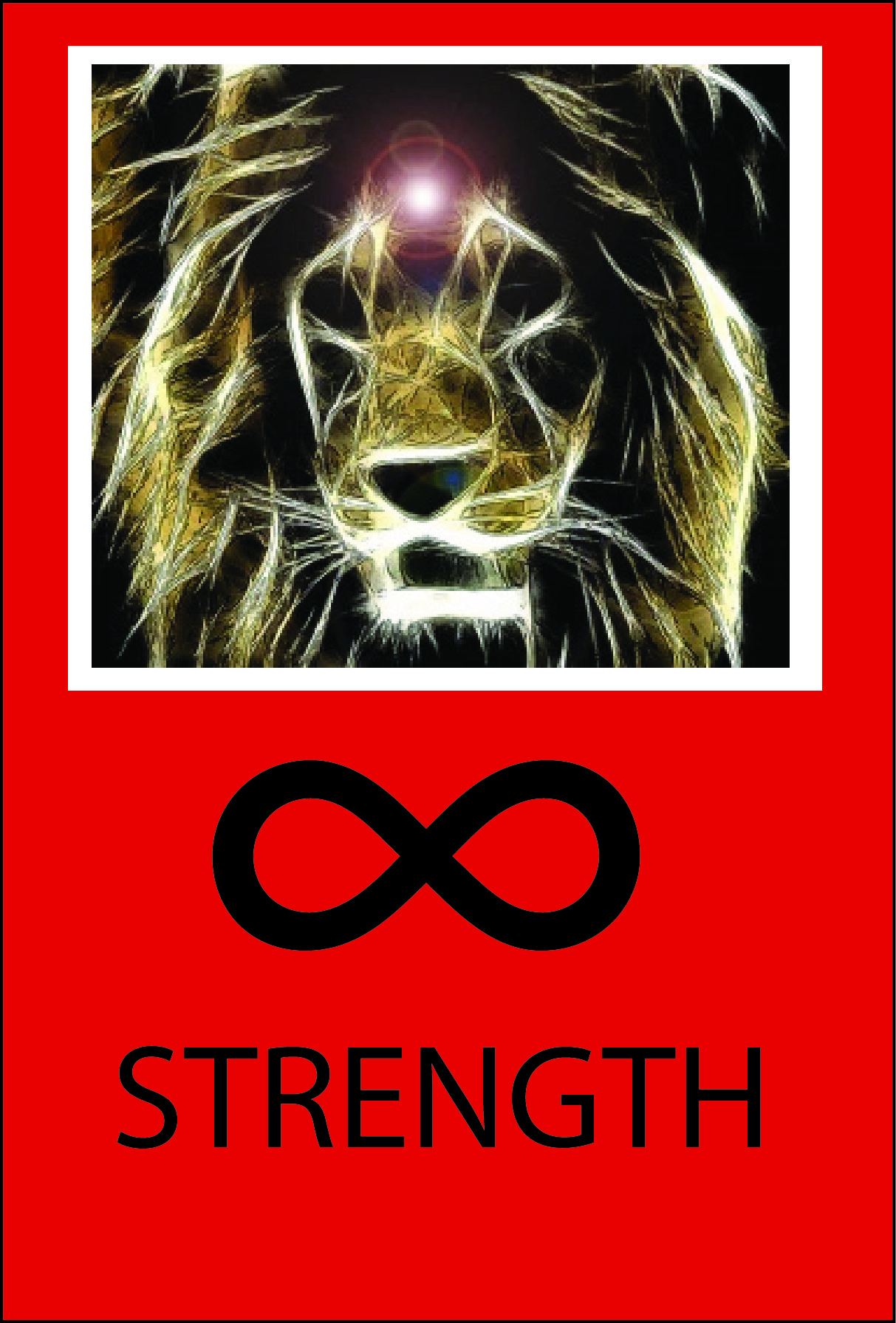
Nine Deadly Sins with Coffee, part 45 – Mortal Combat
.Alexandra.
I brought the lion scarf-gloves-hat back with me on the next Monday, but tied it up, neatly, in a wide, red, ribbon. I placed it on the table before John arrived. It and his coffee were waiting for him on arrival.
He smiled as he sat down and took in the tabletop. “Tied it yourself?” he asked with a twinkle in his eye.
“All my own work…”
“Bet you could do it blindfold?”
“Well, in dim light, at least,” I replied, sure that I had, finally, fathomed the inner meaning of the myth of the Nemean Lion.
“Did it struggle?”
“Put up one hell of fight… nearly cost me my life!”
“Lions are like that – all or nothing, really!”
“But strangely linked with our destiny… and our past, too.”
“Symbol of courage in much of mythology,” he said, widening his smile. I could sense the trap.
“But not here…” I just let the words fall onto the table top.
“Wasn’t Heracles courageous?” he asked.
“Very much so, but he wasn’t fighting a lion…”
“He wasn’t?” John sipped his coffee and feigned surprise.
I drank my own and chose my words carefully. “Leo, here–” I smiled. “–very clever that little throw-away as we were leaving, last time…” I sipped some more coffee, making him wait. “Leo here isn’t a Lion… he’s a self…”
“Which self?” His eyes had become as hard as diamonds, sensing the end of the chase.
“The Leonine self – the one that wants to be centre stage, like the star sign… the ego.”
“Oh…” he said, twinkling again and grinning behind the raised coffee cup. “Ohhh, that one.”
“But you didn’t kill it?” he said, nodding to the pile of wool trussed up in bright red.
“There are days when I might fancy eating a villager!” I said, reasonably.
He nodded. “So, you don’t need to kill it, but as far as the world is concerned it’s dead?”
“Exactly. As long as I can look at it, tied up in red, and remember its nature, then I know I have it tamed…”
And then something else came to me, something that completed the sequence of meaning and wrapped it up, neatly, with my captive combo before us. “… and I could just carry on wearing it, of course, but in a way that showed I was only wearing a lion’s skin, not being one…”
“Clever that…” he said, looking at the captive Leo and nodding to Rose as she approached, smiling, with our second round of coffees.
———————————————————–
Nine Deadly Sins with Coffee is usually published on Thursdays.
All images and text ©International copyright, The Silent Eye School of Consciousness, 2016.


 Sun in Gemini
You must be logged in to post a comment.