+ Esoteric Meaning of Myth, Greek Myths, Higher Mind, Labours of Hercules, Silent Eye School, Spirituality
Nine Deadly Sins with Coffee, part 38 – The Three-sided Coin
by Steve Tanham

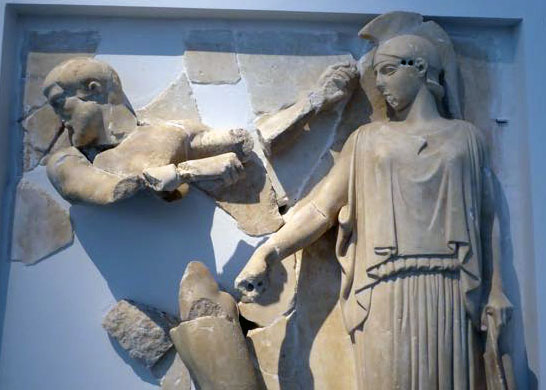
.Alexandra.
“The story of Heracles and the Golden Apples begins with failure…” I said.
“It does,” replied John, sipping his latté. “Just as, in the first story, with the Wild Mares, Heracles gets a bitter lesson that never leaves him, with his failure to protect the life of young Abderis, despite his success in overcoming the wild she-horses.”
He stopped, then, and looked at me very seriously. “Failure is very important… it not only teaches us about success, it teaches us about the fragility of both – and the existence of a third … thing.”
He had lowered his voice when speaking the word ‘thing’, as though its impact had been pivotal in his own life. For a short while I watched him drink his coffee, saying nothing. I decided we could afford to come back to it – he had, inadvertently, touched on something far below his confident exterior and I wanted to know more…
“If we didn’t have adversity, we could never really do anything, could we?” I ventured.
John looked up, shocked. “That’s really good,” he nodded. “It touches on the basic polarity of the universe. We can only ‘do’ when there is a raw material to do with.”
“And that is opposition?”
“Perhaps a better word is resistance, which removes the idea of hostility – though hostility may still apply…”
“So, sometimes we overcome the resistance and a new thing, a third thing, you called it, is born.”
“Born, yes–excellent word! Born of the struggle, just like birth itself is a struggle.”
“And sometimes we don’t win…” it wasn’t a question.
“If we always won, there could be no winning.” He sat back, drinking his coffee, looking thoughtfully upwards, shaping what he wanted to say. “But winning is as illusional as losing, since our birthright – our true birthright – is to be the agents of the right change…”
“The right change…” I said, musing. “Like the Buddha’s Right Action?”
“Exactly so,” he said. “Which has nothing to do with winning or losing, and may involve the invocation of the simplest action, or even one of deliberate sacrifice… as you so bravely chose to do with our little piece of theatre last week.”
He watched while I cringed at the memory… “Two worlds?” he said.
“What?”
“Are you, perhaps, thinking about the choice of ongoing worlds that depended on your decision at that point?”
I thought back to the woman sitting at the table, forced–no, resolved–to carry on holding the world because there had been no other ‘right thing’ to do…
“You didn’t give me much choice,” I said, looking into his eyes for something.
“Would you have wanted me to–” there it was… the truth. “Didn’t it change you, in a small but significant way?”
My voice was a whisper, “Yes.”
“Success feeds the ego, unless we watch its effects very carefully,” he smiled. “And we spent many coffees talking about the outer rim of the enneagram,which is the world of the ego – to which we shall return, once our quest around this zodiac of labours is done.” He drank the last of his coffee. “Did you feel that your heroic gesture of last week fed your ego?”
“No.” I answered, truthfully. “It felt like it fed a different part of my ‘interior’.”
“And you didn’t feel you had failed in any way?”
Suddenly, it was there–the picture he was carefully painting, I grasped at it. “No–neither success nor failure… just a sense of rightness, whatever the world might have thought!”
“The world apart from Rose?”
I laughed then, remembering the unlikely partnership that occasionally manifested on the strange stage of our Monday coffee-shop meetings. “Yes… darling Rose.” I looked behind me to flash a look of gratitude at the cafe’s elderly owner; but she was nowhere to be seen.
“But last week she was there when you needed her?”
“Oh yes…”
And she was completely present to your ‘suffering’, and came, from nowhere, to stand beside you, offering the most unlikely and exact help…”
I nodded, lost in the bliss of the memory of that help.
“Heracles had a ‘Rose’, too” John said. “but despite the skill of Nereus the shapeshifter, Heracles never saw the help being offered… Often, it’s right in front of us, but we are looking for something else, something the rational mind decides we need for the problem it cannot solve…” He allowed himself a grin.
“So, he had to find it through his wanderings around the four directions of his world, eventually discovering the key by not looking for it, but helping someone else…”
I’ll swear there was a tear in his eye as he got to his feet, grabbing his raincoat, then kissing the top of my head before striding out into the deluge of a mid-November morning. That and a smile…
———————————————————–
Nine Deadly Sins with Coffee is usually published on Thursdays.
All images and text ©International copyright, The Silent Eye School of Consciousness, 2015.

Share this:

When the strength of our reaction
Creates the enemy
Giving him a strength in life
He never had in death.
(c)Copyright Stephen Tanham 2015
Share this:

Share this:

Share this:

Chapter 5 – The Fire Within
Neferaset, high priestess of the temple of Isis, entered the red-stone building through the twin pylons, and ascended the flight of wide, stone steps before stopping to carry out her personal invocation at the huge bronze doors to the inner sanctuary. She knew that no-one would be watching her as she performed the sacred walk to inspect the place of initiation. The temple apprentices could be trusted to do their jobs well; and the guardians of the inner space were well versed in her ways.
Now, young and mature, both, would be seated in their priestly alcoves, adding their inner powers to the ascending, invisible notes that would soon swell and fill the air which hovered, expectantly, over the temple island of Gezirah an-Nabatath. Everyone would be present at the ceremony to come, but only one person would hold the focus of them all… it was a terrifying ordeal, Neferaset, knew, but once in a generation someone came along with so much promise that the risks were worth it…
Placing both hands on the shining metal, she called down the power of her birthright and spoke the litany of the left and right hands.
“I am only a vessel
I have the gift of two
In me are the opposites born
And in me, alone can they die
As they were meant to
In my heart lies the gate of reconciliation
Let my mind be clear
Let my thoughts be their tongue
Let my left and my right be the sound and the mouth
Now let me enter to work for those whose day becomes”
She could feel the descent of the invisible flames, the build-up of energy in her arms and hands. She pushed with all the strength her compact frame allowed. The two temple doors, designed to be operated by a duo of burly guardians, swung, slowly, open…
The young priest-to-be was kneeling in the West of the temple, opposite the shining east, with its distant and part-shadowed figures of great Isis and Mut. He knelt in line with the central altar in which burned the flames which were always tended. She examined the boy become man and marvelled that seven years had passed so quickly. He had emerged, as she had hoped, to be a leader among the apprentice priests; and tonight would see his reward for that.
The season of Akhet, the great inundation, had begun; the time when the Nile overflowed its banks, flooding the growing lands with the fertile black alluvium. On this day, the temple offered the leading apprentice the highest honour – the chance to undertake three initiations, the first, that night; the subsequent two as the year rolled on. By the harvest, the season of Shemu, the boy would be a fully-raised priest; and great power would be invested in him by the accelerated induction which would, otherwise, have taken several years.
There were risks–she knew only too well! But the rewards were great for those strong enough to endure the intensity.
“Amkhren!” she said, softly enough not to frighten him; hard enough to command his instant attention.
She watched his back stiffen at her voice. She had been exacting in his training; but only because she believed him capable of so much. In other respects, she had been a mother to him, too, offering an ear and a heart, while moderating his troubles and energies into adulthood; though his aged grandmother, the venerable Snefer, was always on hand to provide familial comfort if the high priestess had pushed him too hard. There was little substitute for a gentle family touch.
“The flames,” she said, into the space that contained the priest-to-be.
She watched as he bent forward, taking hold of two alabaster bowls, ridged with gold, fired in a pattern that would form a complete sphere if the halves were brought together. Within the half-spheres burned two tallow candles. Amkhren extended his arms until they were each at a right angle to his body, then bent his head forward, his back curved and offered, the angle of his arms raising slightly so that his shape, seen from behind, assumed that of the Horus hawk in flight.
Neferaset stepped out of the temple slippers, then walked, slowly and silently, to stand behind the bowed figure, taking the left hand bowl from him. She held it up to the east, invoking Isis of the right wing, then placed one foot onto the white, crystalline surface of the outer of two rings of the circle, which bounded the sacred space within temple. As her freshly washed skin made contact with the perfect mosaic of shining white stone crystals, the air sang… Amkhren’s stretched body trembled as the high priestess intoned her chant of cleansing, using one of the most pure sounds he had ever heard. He had never been witness to this before; the establishment of the true temple, the invisible counterpart of the physical, was normally permitted only to those who had passed through the inner gates, themselves. Preparation was everything in this space.
By the time Amkhren had recovered his composure, the high priestess had walked to the east, censing the half temple with the flame, and lighting the incense burner at the point of the south. The cloud of heady incense billowed from the burner into the sanctified air of the vibrating space, curling around the circle in an act of love as Neferaset raised the flame of purification to the head and outstretched right wing of the goddess, chanting the secret song and making Amkhren tremble with its beauty.
When the High Priestess returned around the circle to the west, to take the second flame from the kneeling young man, the rich and heavy fragrance of the incense had taken its toll on Amkhren. His head was swimming and his outstretched muscles began to slacken, despite his best efforts to hold his position. Neferaset smiled to herself as she heard him flex his thighs to ease the tension in his body, but said nothing. She completed the cleansing of the temple, lit the second burner in the north, and returned down the centre line to where he was now straining, head slightly lower than it should have been, and nearly on the cold stone floor. She finished the cleansing ritual. Bowed to the east, then came back to stand behind the agonised youth.
“Enough. You may release the tension.” He would not know that certain of the herbs in the incense were there to relax the body. He would think he had come close to failing her. This was all part of the build-up to his initiation, to take place later. That edge of failure – and the chasm beyond, were part of a pattern that began the breaking of the reflection…
She smiled as she walked past him, taking the hammer to the gong and summoning the temple guardians from the shadows. She nodded at the near comatose figure of the priest-to-be as they entered.
“To his cell,” she said. “Ensure he rests, he will need his strength.”
She knew that rest would come immediately – she had seen to that. There had to be certain unseen things she could do for the chosen one… after all, she had chosen him…
——————————–
Index to previous chapters:
Chapter One – Gifts From the River
Chapter Two – An Agony of Sunset
Chapter Three – The Dark Waters
Chapter Four – Touching the Sky
—————————
Introduction to River of the Sun
In April 2015 a group of people gathered in the Derbyshire hills to enact the Silent Eye’s annual Mystery Play, entitled, The River of the Sun. The five-act mystical drama formed the backbone of that Spring weekend, and told the fictional story of a clash of ego and divinity set in an Isis-worshipping temple located on an island in the Nile, during the the fascinating period of the 19th dynasty, the time of Rameses the Great.
The 18th and 19th dynasties were a time of upheaval for ancient Egypt on many levels. The reign of the ‘Heretic King’ Akhenaten saw Egypt’s religious structure torn apart, as the revolutionary Pharaoh became what Wallis Budge called the ‘world’s first monotheist’; re-fashioning the power of the many Gods with one supreme entity – the visible sun disc, the Aten, for which Akhenaten, alone, was the high priest. Many have pointed to the failure of the ‘herectic’ Pharaoh’s politics, but few have doubted the sincerity of his religious vision. He will, forever, remain an enigma.
Whatever the nobility of his goal, the actions he took were ruthless, and included the shutting down of the annual deity festivals which were the sole point of ritualistic contact between the ordinary people of Egypt and their locally-worshipped gods. In addition, Akhenaten paid little attention to the domestic and military affairs of Egypt, allowing the country’s enemies to encroach on its borders, greatly weakening Egypt’s power at that critical time for the region.
After Akhenaten’s brief reign, culminating in the Pharaoh’s mysterious death, shadowy military forces took control of Egypt, instigating the 19th dynasty in the persons of Rameses I and, soon thereafter, Seti I, whose throne name derives from the god Set – often considered the ‘evil one’ because of his slaying of his brother, Osiris.
Seti I is judged by modern historians as having been one of the greatest-ever pharaohs, yet his importance in the 19th dynasty was eclipsed by the actions of his second son, the brilliant Rameses II, whose long reign of over sixty years included much self-promotion and the alteration of Egypt’s recent history. Both Seti and Rameses II (Rameses the Great) were passionate about the evisceration of the last traces of Akhenaten’s ‘chaos’, as they saw it.
But, although, by the 19th dynasty, the the ‘Son of the Sun’ was long dead and the buildings of his embryonic and doomed city of Tel-al-Armana were reduced to rubble, something of that time remained in the Egyptian consciousness. A new kind of connection between Pharaoh and God had been established, one which elevated mankind, if only in the being of the Pharaoh, to be someone who ‘talked with God’. It was, at the very least, a bold experiment and, though the world would have to wait until the 19th century to re-discover the ‘erased’ pharaoh, the philosophical waves of that period rippled out and dramatically affected the way the incoming 19th dynasty had to repair the worship of the Gods, uniting the people of Egypt under a trinity of Amun-Ra, Khonsu and Mut.
Our fictional story is a tale of politics, friendships, mind and faith. It is set against an historically accurate background, and at a time when Rameses was due to take the throne from the dying Seti .
Returning to Thebes in his swift warship, crewed by his fearsome Talatat mind-warriors, Rameses decides to mount a surprise night-time raid on the island-based Isis temple which has prospered under the sponsoring reign of his father. Rameses suspects that the inner teachings conducted by the revered High Priestess and Priest conceal views that relate to the thoughts of the heretic Pharaoh, Akhenaten. He plans to insert himself and his warriors of the mind into the islands’s Spring rites as the high priest and priestess begin a cycle of initiation for a chosen apprentice priest who has proved himself worthy of special advancement.
The resulting clash draws everyone, including the young Pharaoh-in-Rising, into a spiralling situation where each is forced to confront their own fears as well as living out the roles which life has allocated them. River of the Sun is the story of a spiritual and political encounter from which none emerge unchanged, including the man who will shortly be Pharaoh, the mighty Rameses II, whose secret name for himself is ‘the unchosen’.
Through the eyes and minds of those surrounding the chosen priest and the ‘unchosen’ Pharaoh, the River of the Sun takes us on a tense and compelling journey to the heart of power and its eternal struggle with truth.
The chapters of the book will be serialised in this blog. The finished work is planned to be available in paperback and Kindle by the end of the year, and will contain the full novel plus an appendix of the dramatic rituals used to enact the story in April 2015.
————————————————–
Index to previous chapters:
Chapter One – Gifts From the River
Chapter Two – An Agony of Sunset
Chapter Three – The Dark Waters
Chapter Four – Touching the Sky
River of the Sun, serialised here, and its associated images, is the intellectual property of Stephen Tanham and is ©Copyright material.
Share this:


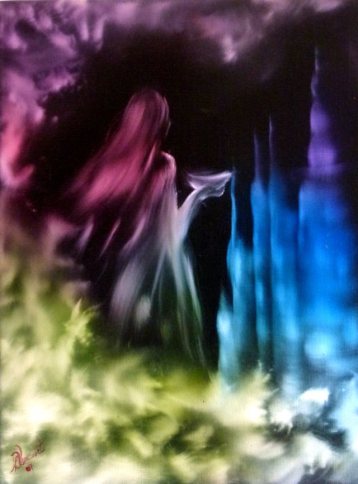
I had picked up the book from the shelves at the top of the stairs. When I am too tired to read anything useful in bed, I go to old and familiar friends that I know I can re-read and enjoy as pure relaxation without having to concentrate or analyse. This one I hadn’t read for a good few years, but it caught my eye and attention as my son and I had been talking about a picture he had ‘acquired’ on a visit home long ago.
The painting had been on my wall, the oils barely dry. “I like that.” It reminded him, he said, of a book we had both enjoyed when he was in his teens and read every sci-fi and fantasy on my shelves… usually by the light of the street lamp outside his bedroom window. I knew the book without him having to name it…
View original post 503 more words
Share this:


Meditations
What aspects of the personality could be represented by:
…The Hooded Figure
…The Bearer of the Cross
…The Haloed Female Figure
…The other female figures
…The figures disrobing Jesus
…The figure of Jesus
…The body of Jesus
…The figures entombing the body?
Share this:

+ Esoteric Meaning of Myth, Greek Myths, Higher Mind, Labours of Hercules, Silent Eye School, Spirituality
Nine Deadly Sins with Coffee, part 37 – Golden Apples
by Steve Tanham
.Alexandra.
I made a special effort to be at Rose’s coffee shop early the next Monday morning. Despite that, he was there before me …
“Morning, John,” I muttered, trying not to let my irritation show…
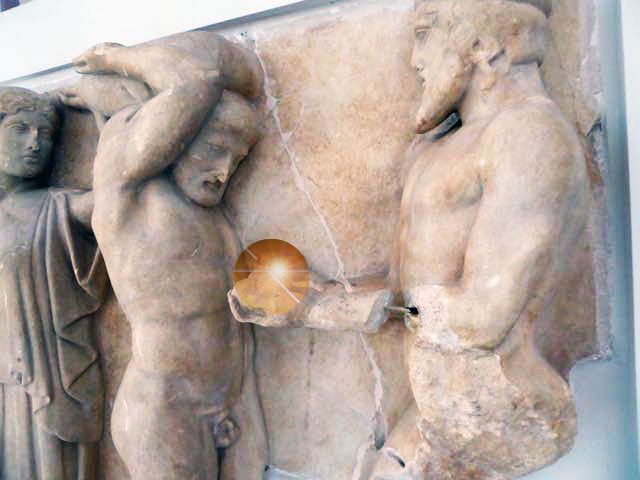
“Morning, Alexandra,” said my uncle, cheerfully. It was only then that I noticed two things were–well, wrong… To start with he was sitting with his hands on his head, but with the palms facing upwards… he never did that. The second wrong thing was that he’d gathered every menu from the tables not in use and had stood them all upright on ours. Now that I was sitting down, I could barely see him over the vertical mass of laminated plastic.
“That’s a mess,” I said frankly, watching him pull that smug face. Once you were trapped in his visual logic, there was seldom an escape…
“The story of Heracles and the Golden Apples is a mess?” he asked, feigning innocence.
“No, I didn’t mean–” and then I saw the gentle nudge the ‘mess’ was giving us–a head start on the complex myth which, at first reading, was, indeed a mess…
“Oh, yes…” I said. “That’s very good…”
Rose arrived with the two lattés. I thanked her and watched her shoot a sneering glance at her long-time adversary, pretending to ignore his Manhattan skyline of a table.
“I’ll put them back… promise!” he called to her departing and disgusted back.
“Drink your coffee,” I urged, in mitigation of my earlier presumption.
“Can’t…” he said.
“Why not?”
“Because the world will fall down…”
I stared at him, getting it quickly, this time. “Okay Atlas,” I said. “Pass it to me.”
“It’s not a football,” he responded. “You have to take it–it’s a world!”
“Whose world?”
“Well, if you must know–yours! Now are you going to relieve me of it?”
Stifling a belly laugh, I got up and pretended to take the ‘world’ from his upturned palms, ignoring the Monday morning ridicule from the occupied tables around us – I had, at least, learned to endure that…
“You can’t hold it like that,” he said, grinning at me. You have to hold it over your head.”
“But then I won’t be able to drink my coffee!” I protested.
“But, it’s your world… and you did offer!”
I fought back the urge to scream. Before me, my delicious coffee, made by the fair Italian (despite her very English name) hand of one of the finest coffee alchemists I knew, was going cold. My heart began to hammer as I realised he was serious.
“You want me to sit here like an idiot carrying nothing?”
“Like now,” he asked slyly. “You sure that’s nothing…?”
I could feel little beads of sweat forming on my forehead as I strained against this fate – it was so cruel…
“Prometheus thought so, too, but he endured… for others,” he said, reading my mind.
In disbelief, I felt my arms rising to meet this outrageous obligation. As I did so he smiled and reached into the infamous black bag which I now noticed lying on his knee. He took something out but concealed whatever it was in his palm. He watched me suffering… I fought the hatred.
Then something happened that shook me. Rose appeared from behind our table and picked up my coffee cup, letting me sip it, gently, while she held it at an angle. She remained alongside me, emotionally sharing my fate and daring others to intervene.
John picked up the black bag and zipped it up. He smiled and came to stand next to Rose, placing on my saucer three small, gold-wrapped, chocolates. “Ferrero Rocher – closest I could find to a golden apple,” he said, gently. “Well done, you…”
And then he reached for the world on my head. “I’ll take this now,” he said, slinging his now empty bag over his arm and carrying the world out on his head.
As he opened the cafe door with a swiftly juggled hand, I called to him, “But you’ve not touched your coffee!”
“Offering to the Gods…” he said, his voice fading into the drizzle of a November morning.
Rose put my coffee down in front of me. “I’ll get you a fresh one on the house, to go with the Golden Apples,” she said, patting my shoulder and making me cry at the kindness of others, and its ability to go where we, alone, cannot… I felt as though there were two of me sitting, snivelling at that table–and I didn’t give a damn who was watching us both.
———————————————————–
Nine Deadly Sins with Coffee is usually published on Thursdays.
All images and text ©International copyright, The Silent Eye School of Consciousness, 2015.
Share this:

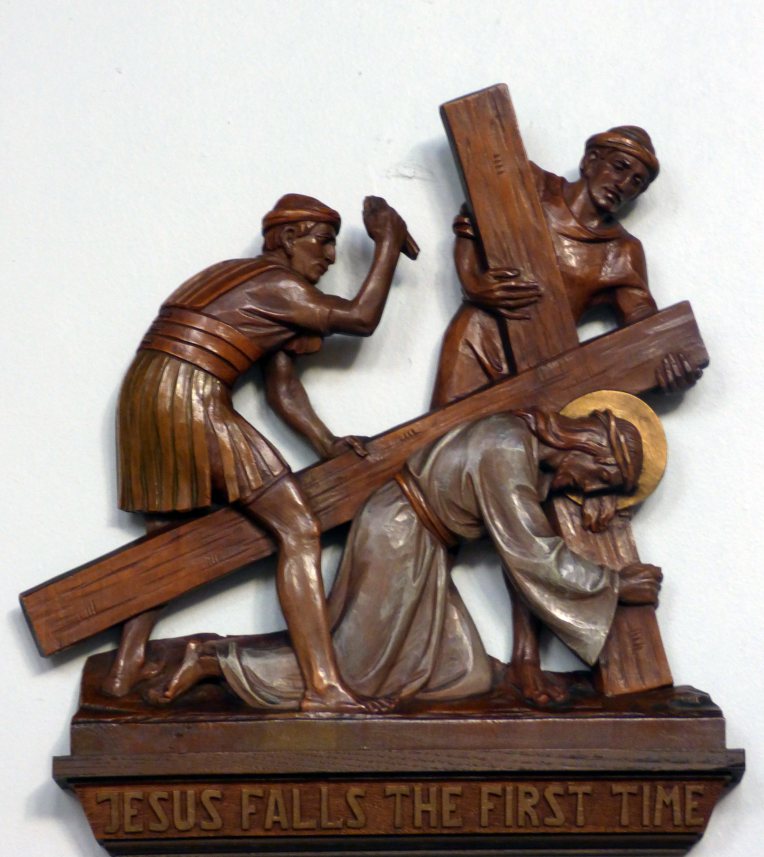
Stuart’s very deep exploration of the Stations continues…
Questions
If the story of Jesus is historical then why contemplate unhistorical episodes of that story?
Why would the Roman soldiers coerce Simon into helping carry the cross?
To what does the prophecy uttered by Jesus to the Women of Jerusalem refer?
What do the hieratic gestures of the hooded figure signify?
What do the colours of the women’s robes signify?
Why does it take two people to strip Jesus?
Why is one of them bare headed and the other not?
Share this:

Chapter 4 – Touching the Sky
The Stonemaker halted his weary band in the shade of the rocky escarpment, allowing them too much water from the team’s meagre supplies. It had been a long march from the banks of the Nile, where their boat lay tied up to stout wooden stakes, recently cut and driven deep into the banks of the fertile river.
This was to be the last of their visits to the rising tower in this remote part of Egypt. They had only one evening and two days to complete their work. The leader knew that what lay ahead would have to be forced, but saw in the eyes of his team a determined look that spoke of their understanding of the royal command. Royal, yes, but not from the usual source of the Pharaoh Seti or his vizier – this instruction had come from Seti’s son, the King-in-Rising, Rameses, second of that name and heir to all that Seti had built, against the background of an Egypt that had seemed, two generations ago, to be falling apart.
Now, it wasn’t; and the feeling of renewal was palpable. No-one doubted that the young Rameses had been raised to be a capable and determined warrior and statesman. There remained, however, among those who had worked closely to bring Seti’s visions to life, a sense of unease, as though they could feel the seething forces that were said to lie just beneath Rameses’ efficiently quiet exterior.
The stone-workers carried with them the plans for the final, topmost section of the Tower of the Sun, which had been neatly drawn on parchment by the young regent. The royal tower neared completion, standing proud and gleaming with its casing of smoothed limestone. The monument was being built on the ruins of an older foundation, one that Rameses seemed strangely fond of. No-one knew why. It was part of an estate that the royal house had taken in payment of a longstanding debt from the past.
Sarkur, the leader, and master architect of the stone-working team, had taken the liberty of letting slip their increasing workload on the tower the last time that he and Seti had strolled through the royal gardens at Pi-Ramesse. They were discussing the progress on some of the more advanced water-channels that were to supply the newly created oasis, rising, like a vision, out of the Nile delta’s marshes. The response had been emphatic. “Give him what he wants, old friend,” Seti had instructed. “Egypt is his now, though I wish he could feel the love with which that is given …”
Sarkur had winced at the pain in his beloved Pharaoh’s eyes. Although they were from very different backgrounds, the master architect and craftsman had excelled and come to his King’s attention. After many years of mutual trust, their work together had become the most valued thing in the Stonemaker’s life.
“I am dying, Sarkur,” Seti had said, in simple and honest tones, in response to his friend’s enquiring glance. “My son knows that, though he is uncharacteristically absent at such a propitious time…”
Sarkur had forced himself to smile at his Pharaoh’s expression of irony. Dying he might have been, but his mind was as sharp as ever. Seti had risen from humble origins and had gained his ascendancy as a result of brilliant military campaigns, which had restored and extended the frontiers of the black land. His latter years had seen a more peaceful Pharaoh, as the great man’s mind turned to what he wished to leave behind as legacy.
Now, Sarkur raised his head from the shadow of the ominous tower into the evening’s still-potent heat and dismissed the memory of that last conversation. He knew that he was unlikely to see Seti, again; and that the execution of the Pharoah’s last instruction was therefore of prime importance. How poignant that the task had taken the stone-workers so far from the royal palace at this time of transition.
Sarkur looked into the eyes of his dark-skinned foreman, Mereuka. The huge man was unpacking the chest of tools with which they would make precision cuts into the selected limestone blocks before them. Constructing anything round was always a challenge, and the upper floor of the Rameses Tower was now twenty cubits above them, accessed only by an internal spiral stone staircase.
Mereuka studied his leader’s worried face and picked up one of the massive hammers. “We can do it,” he said, flexing the hefty bronze tool. “If we will it like this!” He drove the hammer into the edge of a discarded block, hitting it so hard it split long its length. Everyone looked at the results of the blow. It was as though the giant had known exactly where to strike the rock to find the tiny fault lines within the stone’s structure. For long seconds, the shattered rock seemed to vibrate with the intent of Mereuka’s blow. When it settled, the air around them had changed.
“Yes,” said Sarkur, nodding gratefully at his friend. “Just like that…” He began to smile. Around him the stone workers were hauling themselves to their feet, taking the tools offered by their foreman and beginning the ascent of the strange tower of the Pharoah-in-Rising.
None of them knew why the tower was so important, but all of them knew it would be finished as commanded by the severe young man who would soon rule Egypt.
——————————–
Index to previous chapters:
Chapter One – Gifts From the River
Chapter Two – An Agony of Sunset
Chapter Three – The Dark Waters
—————————
Introduction to River of the Sun
In April 2015 a group of people gathered in the Derbyshire hills to enact the Silent Eye’s annual Mystery Play, entitled, The River of the Sun. The five-act mystical drama formed the backbone of that Spring weekend, and told the fictional story of a clash of ego and divinity set in an Isis-worshipping temple located on an island in the Nile, during the the fascinating period of the 19th dynasty, the time of Rameses the Great.
The 18th and 19th dynasties were a time of upheaval for ancient Egypt on many levels. The reign of the ‘Heretic King’ Akhenaten saw Egypt’s religious structure torn apart, as the revolutionary Pharaoh became what Wallis Budge called the ‘world’s first monotheist’; re-fashioning the power of the many Gods with one supreme entity – the visible sun disc, the Aten, for which Akhenaten, alone, was the high priest. Many have pointed to the failure of the ‘herectic’ Pharaoh’s politics, but few have doubted the sincerity of his religious vision. He will, forever, remain an enigma.
Whatever the nobility of his goal, the actions he took were ruthless, and included the shutting down of the annual deity festivals which were the sole point of ritualistic contact between the ordinary people of Egypt and their locally-worshipped gods. In addition, Akhenaten paid little attention to the domestic and military affairs of Egypt, allowing the country’s enemies to encroach on its borders, greatly weakening Egypt’s power at that critical time for the region.
After Akhenaten’s brief reign, culminating in the Pharaoh’s mysterious death, shadowy military forces took control of Egypt, instigating the 19th dynasty in the persons of Rameses I and, soon thereafter, Seti I, whose throne name derives from the god Set – often considered the ‘evil one’ because of his slaying of his brother, Osiris.
Seti I is judged by modern historians as having been one of the greatest-ever pharaohs, yet his importance in the 19th dynasty was eclipsed by the actions of his second son, the brilliant Rameses II, whose long reign of over sixty years included much self-promotion and the alteration of Egypt’s recent history. Both Seti and Rameses II (Rameses the Great) were passionate about the evisceration of the last traces of Akhenaten’s ‘chaos’, as they saw it.
But, although, by the 19th dynasty, the the ‘Son of the Sun’ was long dead and the buildings of his embryonic and doomed city of Tel-al-Armana were reduced to rubble, something of that time remained in the Egyptian consciousness. A new kind of connection between Pharaoh and God had been established, one which elevated mankind, if only in the being of the Pharaoh, to be someone who ‘talked with God’. It was, at the very least, a bold experiment and, though the world would have to wait until the 19th century to re-discover the ‘erased’ pharaoh, the philosophical waves of that period rippled out and dramatically affected the way the incoming 19th dynasty had to repair the worship of the Gods, uniting the people of Egypt under a trinity of Amun-Ra, Khonsu and Mut.
Our fictional story is a tale of politics, friendships, mind and faith. It is set against an historically accurate background, and at a time when Rameses was due to take the throne from the dying Seti .
Returning to Thebes in his swift warship, crewed by his fearsome Talatat mind-warriors, Rameses decides to mount a surprise night-time raid on the island-based Isis temple which has prospered under the sponsoring reign of his father. Rameses suspects that the inner teachings conducted by the revered High Priestess and Priest conceal views that relate to the thoughts of the heretic Pharaoh, Akhenaten. He plans to insert himself and his warriors of the mind into the islands’s Spring rites as the high priest and priestess begin a cycle of initiation for a chosen apprentice priest who has proved himself worthy of special advancement.
The resulting clash draws everyone, including the young Pharaoh-in-Rising, into a spiralling situation where each is forced to confront their own fears as well as living out the roles which life has allocated them. River of the Sun is the story of a spiritual and political encounter from which none emerge unchanged, including the man who will shortly be Pharaoh, the mighty Rameses II, whose secret name for himself is ‘the unchosen’.
Through the eyes and minds of those surrounding the chosen priest and the ‘unchosen’ Pharaoh, the River of the Sun takes us on a tense and compelling journey to the heart of power and its eternal struggle with truth.
The chapters of the book will be serialised in this blog. The finished work is planned to be available in paperback and Kindle by the end of the year, and will contain the full novel plus an appendix of the dramatic rituals used to enact the story in April 2015.
————————————————–
Index to previous chapters:
Chapter One – Gifts From the River
Chapter Two – An Agony of Sunset
Chapter Three – The Dark Waters
River of the Sun, serialised here, and its associated images, is the intellectual property of Stephen Tanham and is ©Copyright material.
Share this:

+ Esoteric Meaning of Myth, Greek Myths, Higher Mind, Labours of Hercules, Sex, Silent Eye School, Spirituality
Nine Deadly Sins with Coffee, part 36 – Three Eyes of the One Mind
by Steve Tanham

.Alexandra.
“There were three of them!” I said, getting the first word in before he had chance to open the ominous black bag sitting on his knee.
“Three of what?” I watched as his fingers let go the zip that ran across the top of its length.
“Three cyclopses…”
“Ah,” he said, smiling at our agreed corruption of the word. “Yes, three of them… I had a feeling we hadn’t finished with the Labour of the Bull.”
I sipped my coffee, then, “Not by a long way, I would say.”
He sighed. “Okay then. You got to be a cyclops, what’s not to like?”
“The other two – who are they?” I said, smirking and pleased at my insight. I knew he was playing with me, secretly pleased that I had uncovered more depth to the myth than we had spoken of last week.
John sat back and looked at me, smiling. “Which ones do you remember?” he asked.
“Brontes, Steropes and Arges, that’s all I know.”
“Any idea of the meanings?” he asked.
“None – couldn’t find any clues, but maybe I was looking in the wrong places?”
“The myths are difficult because so many scholars have had a go – without the benefit of an esoteric perspective – and that often renders what they say useful only at an intellectual level…”
“So tell me…” I said, narrowing my eyes in an imitation of the strange thing he did with his.
He smiled at the gesture. “Brontes means ‘thunder’, Steropes is ‘lightning’ and Agres means ‘a whirling activity’.”
I mused on that. “Thunder, lightning and whirling – strange names for single focus entities?”
“And three things…” he said, breathing as though he were reaching deep. “Three things remind you of anything significant?”
There was still in me a reticence to say the obvious, but I blurted it out anyway, “The Trinity, perhaps?”
“All trinities, possibly?” he countered, quickly.
“All trinities?” I asked, surprised. “There are more than one?”
“There are many – all esoteric systems are based on a threefold concept that the creation of the universe is far from that which science teaches, but even farther from what the fundamentalists preach…”
I had seldom seen him as animated as this. I pressed on. “Tell me then, what this conception of creation is?”
He leaned forward–a sure sign that the best was coming. “The universe is divided into life – the One Life – and that which gives the invisible spirit of life a Home, and thereafter they long for each other, for their union to make things complete.”
“We’re not just talking sex here, are we?” I asked, knowing it was a statement and not a question.
“Oh, but we are,” he smiled, “The Universe is a very sexual place, but we need to widen our concept of sex so that we see its divinity in everything, instead of being engulfed and then ashamed by just one facet of it…”
I sat back, stunned. John watched in silence as I digested the enormity of that sentiment. Weren’t we all like that – seeing sexuality only as joy between two bodies. What John had indicated was that the ancient mystery school behind the myth of Heracles was fully aware of the sexuality of the universe… and then a revelation came…
“Polarity!” I blurted out “That’s what all this stuff on polarity is really about, the division of something primal into its ‘children’ – and beyond, to fulfil the original, loving intent…”
John said nothing, just sat back and smiled at me, nodding and waiting.
I rode the revelation, “Father, mother, son, the father needing the mother as receptacle… divine receiver, birther into matter of that intent, that onward spark which becomes the son… a product of them both.” I looked up at the mental sky. “And the cyclopses?”
John spoke gently, “Hercules has to hand the bull over – to dedicate the full potency of the divine energy in him, the all-sex, to the intelligences that can use it on his behalf. This does not mean that he becomes celibate… far from it.”
“And the names,” I asked, beginning to quake a little at the vastness of this.
“Brontes is thunder, which is sound – the Word if you like your St John. Sound has always been considered symbolic of the the shaped and directed force which creates the universe. Steropes is the individual soul, the divine incarnated into matter, undertaking something truly wonderful from within the creation in agreement with the creator, knowing the darkness which sometimes lies ahead, before the real light of inherent belonging is seen …”
I was barely breathing. “And Arges?”
He sat back, practically whispering, “The whirling, which is a pretty good analogy for the atomic motion of matter; what soul isn’t; what the subjective ‘me’ thinks of as ‘out there’. What the soul longs for union with…”
I barely heard him stand up and prepare to leave…
Once more, and smiling at his unopened black bag, he left me with another coffee, brought, with uncanny prescience, by the ever watchful Rose.
———————————————————–
Nine Deadly Sins with Coffee is usually published on Thursdays.
All images and text ©International copyright, The Silent Eye School of Consciousness, 2015.


 Sun in Gemini
You must be logged in to post a comment.