+ Ancient Landscapes, guided mystical walks, Silent Eye School, Spirituality, Winter Solstice weekend
Below and Above – Souls on a Hillside
by Steve Tanham

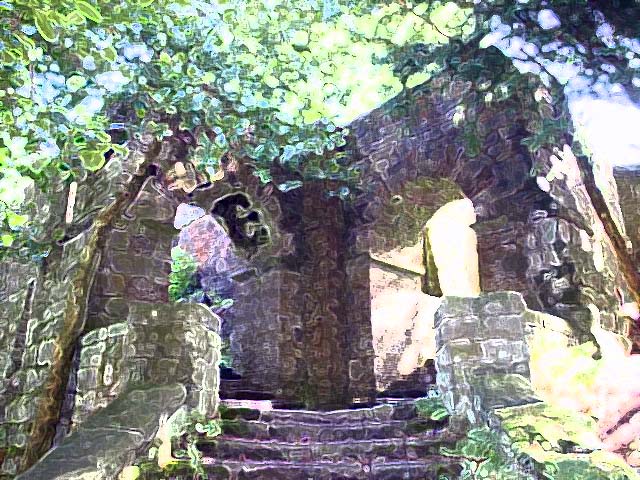
Friday, 4th December, 2015. A group of companions, some old friends, some just introduced, all made very welcome, meet in the comfort of a small hotel on the edge of a mysterious range of hills, the last outliers of the West Pennines. A short distance from the old mill town of nearby Bolton, the hillside above them is very different in character from the urban landscape a few miles away.
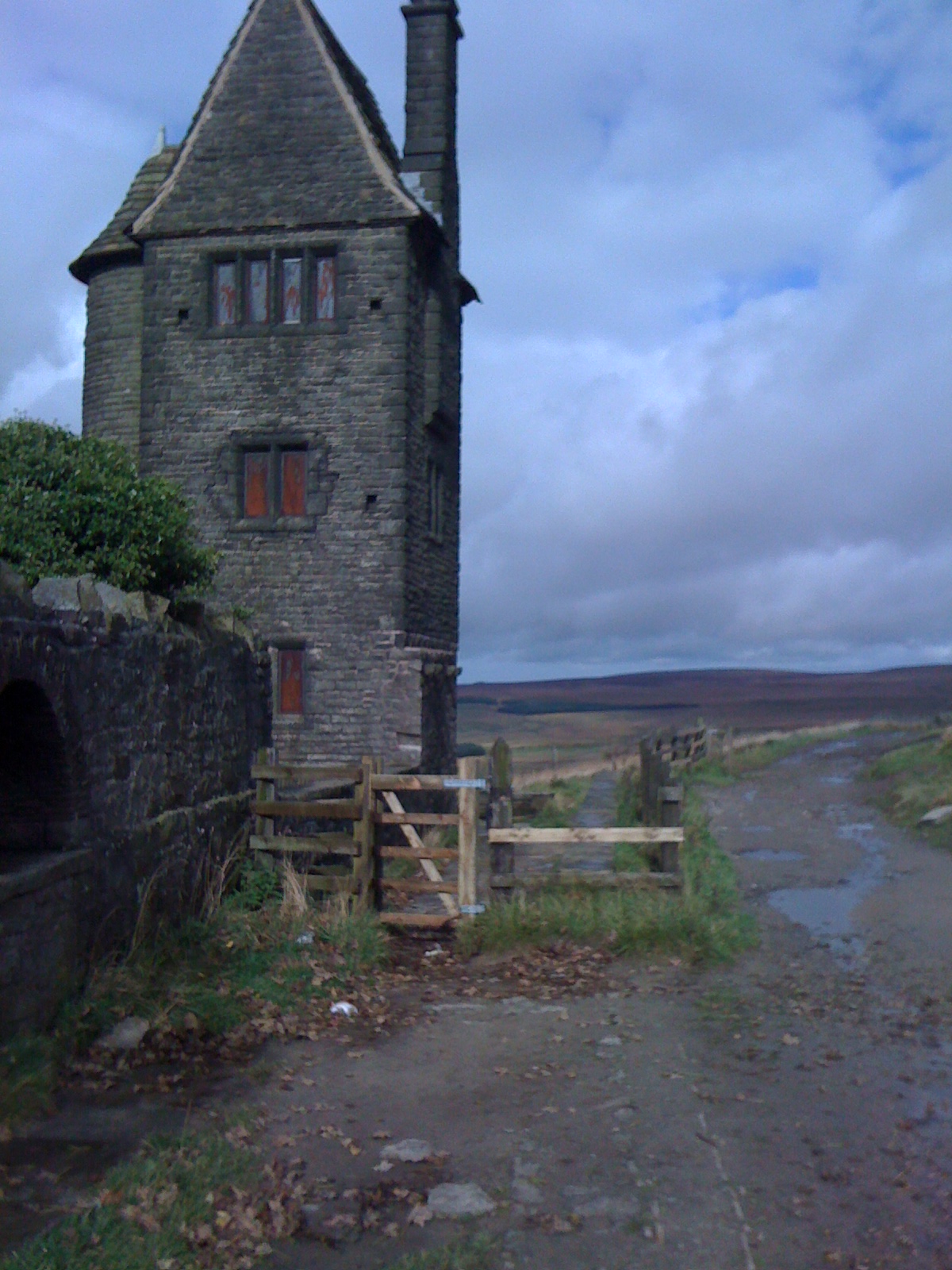
They unwind from their journeys over hot drinks, then are offered a short introduction to the landscape to be explored with mind and heart over the next two days. Dinner and wine have been arranged at the next door inn; good company and, perhaps a mellow nightcap see them to bed …
The winter morning of the 5th December dawns and our good companions take breakfast before wrapping up warm and putting on walking shoes to prepare them for the modest climb through the mysterious ancient gardens of Rivington, long abandoned by their creator. Perhaps a final coffee while the plans for the day are refreshed, then they set off for a journey of inner and outer exploration. As they climb, the landscape changes. The public parkland with its huge reservoirs gives way to smaller paths which snake up the hillside, revealing new and fascinating vistas, as though a great mind designed this as a journey of the soul, before moving on to other things, leaving it as mysterious legacy for others to contemplate.
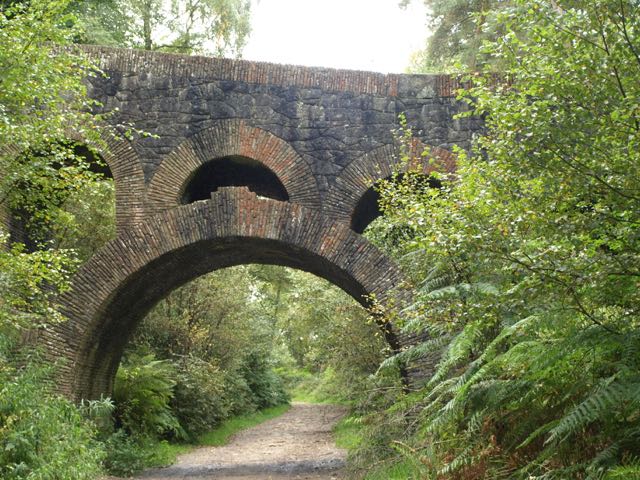
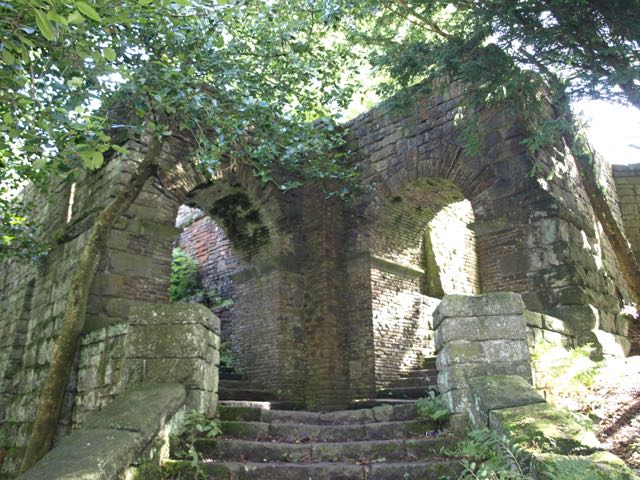
Without warning, an old stone bridge appears on the path ahead. Its arches are graceful, and its vaulting span seems to divide the entire hillside into the above and the below. What will each of the companions make of this, so soon in their journey? Examining the old bridge, it is found to be a footpath to the next level of a series of terraces, cut into the hillside, long ago. Before climbing further, one of the guides suggests they prepare themselves by a short detour to sit by the Lake of Reflection, hidden on this level, not far away. Some have brought texts and poems to read which seem to fit with this tranquil lake and the challenging bridge ahead.
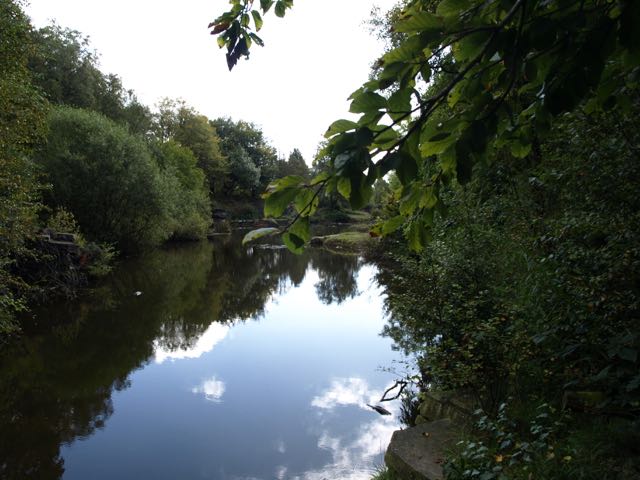
Everyone listens, attentively, as inner voices reveal themselves. Soon, the readings are done and it is time to climb, again …
The party returns to the arching bridge and we enter the mysterious landscape beyond. At the top of the next incline we are presented with a dark image–what looks like an old prison cell looks down on us as we climb. We stop to consider the positioning of this and the bridge – a symbol of hope and aspiration; followed by a test, perhaps? What could the creator have meant by this?
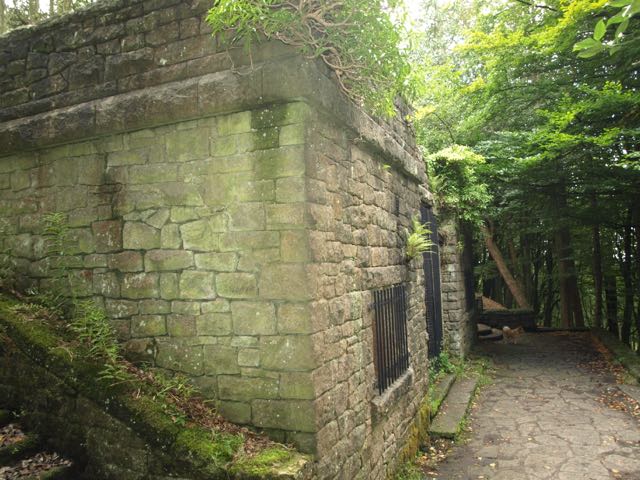
Leaving this question unresolved, we climb, gratefully, up the adjoining steps, bypassing the dark place to reach an expanse of gardens bordered by a wide stone path. From here, we can see the whole valley below us; and the view brings the thoughts of the approaching winter solstice. We stop at this level of the gardens to think about the inner meanings of the turning point: when the darkness reaches its deepest state, and mankind is challenged to find meaning at the point where nature, for a moment, stops …
We turn right to find yet another line of stone stairs leading upwards to a strange gateway of two halves. We consider the symbology: found versus designed? Given the nature of our thoughts during the climb, it is natural to look at this enigmatic gateway as representing the human brain, organ of the mind. Will we choose the way of logic or of the heart? How can both hemispheres be combined?
Ahead lies an expansive space at the edge of which there is the ruin of an old house, grand in its design and now seen only in the shapes of its ground floor and a few remaining tiles from an long-abandoned ballroom, whose black and white squares brings to mind the kind of flooring found in ancient temples. Being magical companions, this makes us think of how the fiery rites of winter often bring strength and endurance for the dark months that lie ahead. We begin to conjure with possibilities … dare we?
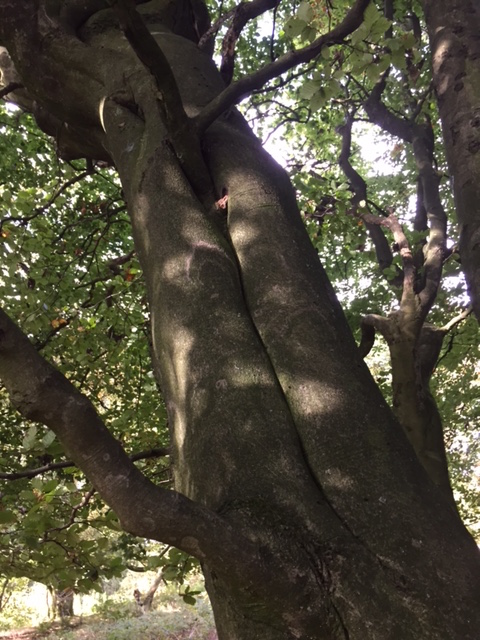
Our question is shortly answered as, beginning our walk to the fire-warmed Crofters Arms pub, which is expecting us for lunch, we pass a most mysterious and beautiful natural temple, set on the edge of a wood … maybe we could …?
Thus begins the Silent Eye’s 2015 Winter, pre-solstice weekend, running from Friday evening 4th December, to lunchtime Sunday 6th. The setting will be the wonderful landscapes of Rivington and Anglezarke.
The cost for the guided weekend is £50.00. Meals and accommodation are extra and left to the individual’s choice, though we expect to gather for group drinks and dinner on the Friday and Saturday nights at the Beehive Restaurant, Horwich, which is next door to the local Premier Inn. Please note this is a weekend and not just a single day as originally published.
Fancy a bit of mystery in an amazing landscape? The chance for the world of being to help guide our steps, and the most warm company? Join us. The booking form can be found http://thesilenteye.co.uk/events/, or email us at rivingtide@gmail.com.
rivingtide@gmail.com
Share this:


Share this:


In April 2015 a group of people gathered in the Derbyshire hills to enact the Silent Eye’s annual Mystery Play, entitled, The River of the Sun. The five-act mystical drama formed the backbone of that Spring weekend, and told the fictional story of a clash of ego and divinity set in an Isis-worshipping temple located on an island in the Nile, during the the fascinating period of the 19th dynasty, the time of Rameses the Great.
The 18th and 19th dynasties were a time of upheaval for ancient Egypt on many levels. The reign of the ‘Heretic King’ Akhenaten saw Egypt’s religious structure torn apart, as the revolutionary Pharaoh became what Wallis Budge called the ‘world’s first monotheist’; re-fashioning the power of the many Gods with one supreme entity – the visible sun disc, the Aten, for which Akhenaten, alone, was the high priest. Many have pointed to the failure of the ‘heretic’ Pharaoh’s politics, but few have doubted the sincerity of his religious vision. He will, forever, remain an enigma.
Whatever the nobility of his goal, the actions he took were ruthless, and included the shutting down of the annual deity festivals which were the sole point of ritualistic contact between the ordinary people of Egypt and their locally-worshipped gods. In addition, Akhenaten paid little attention to the domestic and military affairs of Egypt, allowing the country’s enemies to encroach on its borders, greatly weakening Egypt’s power at that critical time for the region.
After Akhenaten’s brief reign, culminating in the Pharaoh’s mysterious death, shadowy military forces took control of Egypt, instigating the 19th dynasty in the persons of Rameses I and, soon thereafter, Seti I, whose throne name derives from the god Set – often considered the ‘evil one’ because of his slaying of his brother, Osiris.
Seti I is judged by modern historians as having been one of the greatest-ever pharaohs, yet his importance in the 19th dynasty was eclipsed by the actions of his second son, the brilliant Rameses II, whose long reign of over sixty years included much self-promotion and the alteration of Egypt’s recent history. Both Seti and Rameses II (Rameses the Great) were passionate about the evisceration of the last traces of Akhenaten’s ‘chaos’, as they saw it.
But, although, by the 19th dynasty, the the ‘Son of the Sun’ was long dead and the buildings of his embryonic and doomed city of Tel-al-Armana were reduced to rubble, something of that time remained in the Egyptian consciousness. A new kind of connection between Pharaoh and God had been established, one which elevated mankind, if only in the being of the Pharaoh, to be someone who ‘talked with God’. It was, at the very least, a bold experiment and, though the world would have to wait until the 19th century to re-discover the ‘erased’ pharaoh, the philosophical waves of that period rippled out and dramatically affected the way the incoming 19th dynasty had to repair the worship of the Gods, uniting the people of Egypt under a trinity of Amun-Ra, Khonsu and Mut.
Our fictional story is a tale of politics, friendships, mind and faith. It is set against an historically accurate background, and at a time when Rameses was due to take the throne from the dying Seti .
Returning to Thebes in his swift warship, crewed by his fearsome Talatat mind-warriors, Rameses decides to mount a surprise night-time raid on the island-based Isis temple which has prospered under the sponsoring reign of his father. Rameses suspects that the inner teachings conducted by the revered High Priestess and Priest conceal views that relate to the thoughts of the heretic Pharaoh, Akhenaten. He plans to insert himself and his warriors of the mind into the islands’s Spring rites as the high priest and priestess begin a cycle of initiation for a chosen apprentice priest who has proved himself worthy of special advancement.
The resulting clash draws everyone, including the young Pharaoh-in-Rising, into a spiralling situation where each is forced to confront their own fears as well as living out the roles which life has allocated them. River of the Sun is the story of a spiritual and political encounter from which none emerge unchanged, including the man who will shortly be Pharaoh, the mighty Rameses II, whose secret name for himself is ‘the unchosen’.
Through the eyes and minds of those surrounding the chosen priest and the ‘unchosen’ Pharaoh, the River of the Sun takes us on a tense and compelling journey to the heart of power and its eternal struggle with truth.
The chapters of the book will be serialised in this blog. The finished work is planned to be available in paperback and Kindle by the end of the year, and will contain the full novel plus an appendix of the dramatic rituals used to enact the story in April 2015.
————————————————–
Chapter One
Gifts from the River
The water was soft on his skin. He was used to bathing in the river at sunset, but there was something special about today. He looked across at the glittering image of the sun as its reflection folded on the water, bouncing the golden light along the gentle waves at him. A boat had just sailed by and he felt the lapping waves caressing his thighs. It tickled and he giggled to the river.
His reverie was disturbed by the sound of his grandmother’s voice. “Wash, Amkhen! Stop your daydreaming!” He flashed his cheeky smile back at Snefer, sole guardian to him since the death of his parents many years ago, in the fire that had destroyed their home while they slept. The nickname, ‘Snefer’, which he had given the old woman, made her smile, though he was too young, yet, to know the kindness behind such tolerance.
The name derived from a present from his father, which he still kept. His father had travelled in his own youth – selling his beautifully hand-woven carpets, which he would pile onto his faithful donkey, before leaving for days or even weeks. He always came back with tales of his adventures, and Amkhren’s delight had been to sit, balanced precariously on his knee; and listen.
One day, his father had returned with a carved wooden object – a gift to his son. He took it from his bedroll and presented it, smiling as he did so. He had carved it out of a single block of wood. It was like one of the drawings his father had shown him of the fabulous white pyramids that legend said graced the upper parts of the river, just before it spread and flowed into the sea. The wooden carving had a square base, whose four corners rose in two stages, to meet at a single vertical point. The angle of the climbing sides became shallower half way up and this gave the whole thing a comic element. His father had said that its location was called Sneferu, and it was known as the bent pyramid.
The day after that, he had pointed at his grandmother and said, “Grandma is bent, too! Can we call her Sneferu, like the pyramid carving?”. His father had looked at his own mother and smiled in that mischievous way that his young son had inherited. Then he had said, “Well, we don’t want to anger the Gods, so let’s shorten it to Snefer!”
She had sighed, inside, on that day. But now the memory of that time brought back such happiness that old Snefer didn’t mind it at all. She looked at the boy, who had finally taken off his loin-cloth and was washing himself. Her heart burned with feeling for him – the sole survivor of a family that had known how to love and to laugh, together. The sight of him always drove away the aches and pains that had begun to afflict her ageing frame . . . and the sad memories, too.
The sound of footsteps behind her made her whirl in alarm. After that, she could only drop to her knees in the sand, wailing.
“High Priestess, forgive me!” She bowed her head to the mud. Before her was one of the most beautiful and stately women she had ever encountered – Neferaset the high priestess who led the worship at the Temple on the island, a mile or so south along the river. Alongside her brother, Anzety, they were the most powerful of the bright people.
“Do not be frightened, old woman,” said the glowing one, bending down to take the withered hands from the dust and pull Snefer up to her normal, if bent, standing position. “We are not in the temple, and, if I chose to leave the sanctuary of the island and walk along the river, I am going to meet strangers . . .”
Snefer kept her head bowed. But spoke, “My grandson is bathing in the river. Forgive his rude nakedness.”
Neferset looked beyond the old woman and saw her grandson. He was talking to another boy who stood ahead of him in the deeper water. “And who is that with him?” she asked.
“There is no-one with him, High Priestess . . .”
Neferaset frowned and blinked her eyes, focussing on the sight of the two boys bathing. One was plainly visible, his naked form dancing in the water. But he was definitely speaking to another boy – one who stood motionless before him and had a bright but much less distinct outline . . .
Amkhren was delighted with his new friend. As golden as the ripples on the river, he had appeared before him in the beautiful sunset, smiling. He had asked Amkhren’s name, but refused to give his own. He had, though, given Amkhren a cloth bag of beautiful, carved stones. Now, the other watched, while Amkhren laid them out on the wet sand.
“Used rightly, they have great power,” he said.
“And how do I learn?” Amkhren asked, overwhelmed with the gift. “Will you teach me?” He looked up, but the other boy was shaking his head.
“My time here is gone,” he said, with sadness in his young eyes. “But your life will teach you” he smiled again, bringing joy to Amkhren’s face. “Many wonderful things lie ahead of you!” said the other boy.
Amkhren wanted to ask him more but he turned when his grandmother’s urgent voice cut through the peacefulness of their playful talk.
“Amkhren! Put on your garment and come here at once!
Amkhren, saddened, but obedient, spun back to say goodbye to his friend; but the other boy was gone. He peered deep into the waves in case his friend had swum off, but there was no trace. A second, and sterner call from Snefer dragged him from his searching. Panting, he retrieved his rags and tied them across his wet waistline. Only then did he look up to locate the old woman. She was standing, with her head bowed, next to another woman. This was a day of surprises! He looked harder, narrowing his eyes to carry his vision deeper into the tableau. Then, he stopped walking and his mouth fell open. There on the raised bank, his grandma was talking, though her head was bowed, with the High Priestess of the nearby island temple – a woman he had once glimpsed from the sanctuary of a hastily built log raft, which had floundered shortly thereafter.
The day had been baking hot and Amkhren had walked along the river bank, far from where Snefer had said it was safe for him to travel. He had, gradually, been extending his walks, because he knew that the temple island lay just beyond the next twist of the river’s course. On that day, he had caught sight of a temple procession on the sacred isle and had thrown caution to the wind, trusting his life to a few logs hastily lashed together with the stalks of reeds in the way that his father had shown him, so long ago.
Before the raft had fallen apart, he had caught sight of the winged one, as he thought of her. She had shone in the sun in her finery and splendour. All around her there was total silence, total reverence. Beside her, another of equal stature walked, but this one was a man, tall and purposeful, yet with a hint of gentleness to his bearing. The reed bindings gave way, the logs parted and, plunging into the river with a cry, he was forced to cling to the largest as it rolled. Gone were the wild thoughts that someday he would find a way to return to the temple island to serve them. Choking on the inhaled river water, he clung desperately to the remains of his capsized raft and forced his legs to kick, pushing the log slowly towards the far bank.
Now the Goddess stood before him. Disguised, yes, but it was her . . Amkhren took a few more steps and fell to his knees, prostrating himself in the dust.
“I feel I know you, boy?” said the shining one.
“Oh, you couldn’t know us, High Priestess – we are just beggars in your world,” blurted out his grandma, her head still bowed.
Amkhren’s mind raced. Should he tell her of his moment on the raft? Surely it would be to invite death . . . and yet, he didn’t want to miss the only chance that his life might hold to reach for that impossible goal.
“The river has many secrets, High Priestess,” he managed, somewhat proud of his cleverness.
“And dreams, perhaps?” the tone of her voice was soft; there was deadliness there, too, but her knives were sheathed. She knelt down in the dust of the bank and, with soft hands that contained more power than he had ever felt, pulled his head up to stare back at her almond eyes. “And what does this young man dream of?” she asked, running a painted finger up the side of his jaw.
River of the Sun, serialised here, and its associated images, is the intellectual property of Stephen Tanham and is ©Copyright material.
Share this:

Share this:

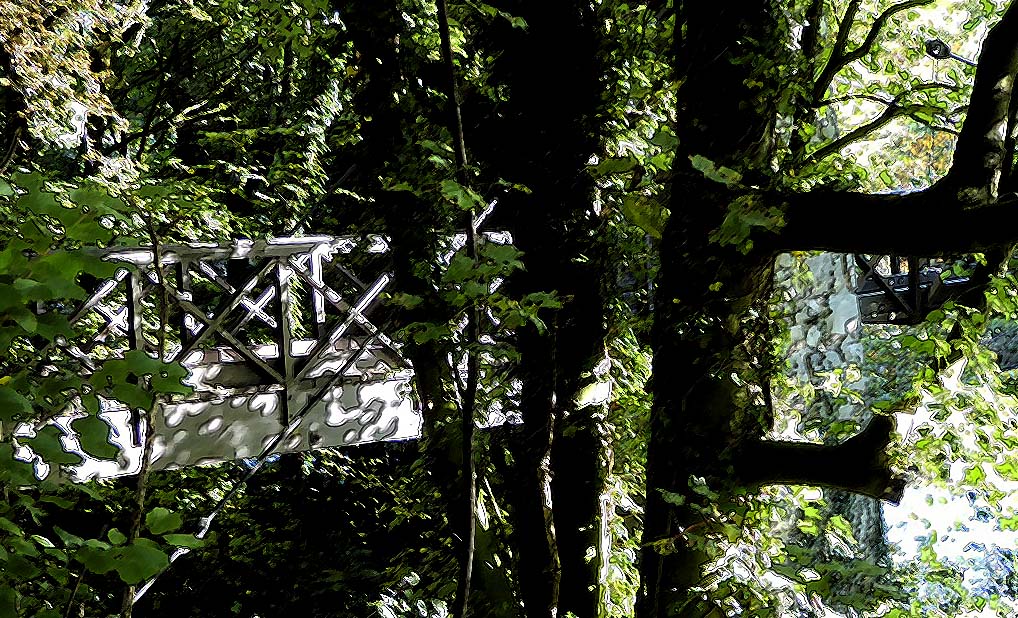
.Alexandra.
“I’ve had a week of threes,” I said, wanting to seize the initiative. I felt empowered, full of energy; and I wanted to be at it … the labours of Heracles, that is.
He looked at me over a succession of objects: the coffee cup, poised next to his bemused lips; the newspaper, held in his free hand until I arrived and tapped its top; and the reading glasses sitting halfway down his nose. “Good morning,” he replied, beaming; then, chuckling to himself, he added, “Threes? Tell me about the threes.”
I calmed myself down, digging deep for the essence of what I wanted to say. “Each group of three has a purpose, a possibility of growth from one to two to three. Getting to three would be the end of that cycle … for the small ones.”
“There are big ones, too?” he asked.
“Yes – there are very big ones, overarching stages, in which the smaller sets of three are building blocks.”
“And you feel you might be making a transition between two of these very big ones?” He smiled. It was a kindly smile, full of encouragement.
“A kind of jumping between levels,” I responded, desperate to find that right word. “A fundamental change of direction… a moment of ‘no going back’.”
“Ah …” he said, sipping his coffee. “An initiation …”
I sat and drank my own. Initiation. It was a word I had heard many times. It conjured up bad horror films or scary fiction. Was there a different side to it? Had I stumbled with my earnest words upon something that was really rather special … and personal? Was there a world of real initiation where those involved wouldn’t dream of demeaning it in fiction?
“It’s a deeply personal thing,” John said, reading the thoughts in my mind. “Initiation can only belong to the person going through it. Other people can help with the environment that assists it, but the gateway to that ‘fundamental change’, as you so rightly called it, admits only one passenger.”
I was fighting to stay level with his concepts; as often happened; yet I knew how far I had come in understanding in the past year; I could feel it, taste it and, sometimes, in a moments of extreme clarity, see it.
“So tell me,” I said without sarcasm. “What this has to do with the Labours of Heracles?”
John sat back, closing his eyes in a way that I hadn’t seen before. He sipped his sightless coffee and waited. I knew that his introspection had nothing to do with making me wait.
At last he spoke, “What you are experiencing is the start of initiation, which is truly wonderful, given that you’ve had so little instruction …”
He closed his eyes again, this time for longer. I waited, practically breathless, until he surfaced.
“I’ve been trying not to use ancient words,” He sipped his coffee through a wry smile. “But sometimes they are too good not to use.” His eyes flicked up from the coffee cup to look at me. There was calmness and clarity in them, as they brought something very special into the moment.
“You, along with Heracles, are being initiated into the world of the disciple.”
The eyes didn’t leave me, measuring my inner and outer reactions to this shock of a statement. “Disciple?” I muttered, quite flummoxed by the notion. “Like the disciples of Jesus you mean!”
“The word and the concept are older than the story of Christ,” he said, softly. “And don’t be put off by the gravity of the Gospel stories; no-one is expecting you to sell all your possessions and follow some wandering Teacher.”
“Not even you, then?” I regretted the words as soon as I had uttered them. I closed my eyes in a gesture of apology, shaking my head. “I didn’t–“
“I know,” he said. “It’s okay. We all do irrational things when the ego is threatened by some profound truth. In this case the profound truth belongs to you, alone, and is to do with an inner realisation you have already had. It has nothing to do with me as your so-called ‘teacher’.” He fell silent, but added a few seconds later, “But, in any event, you would not be my disciple – I don’t have any; that destiny is reserved for others of much more importance …”
Before I could speak, he added, “In any case, your greatest teacher is the one who is calling you … your own Soul.”
It took me a while to speak. “So, everything I’m feeling … sensing … is part of a call to a different journey?”
“Yes,” he said. “It’s a call to those who begin to see the world differently – very differently; to those who realise that we could practically rip up most of what we were taught, because the world – the real world beyond received illusion – is a ball of singing life much richer and infinitely more beautiful that the outer layer that science does its honest best to describe …”
“And what does that journey entail?” I asked, my voice a whisper.
“Going backwards,” he laughed, rocking with the mirth of an inner meaning that he knew I could not yet fathom. He coughed, apologetically, then continued, “The new journey imposes the Will of the inner you on the world you react to; and thereby tests and cleanses it …”
“It will test and cleanse me?”
“Only those parts of you that need it,” he said, the eyes never leaving mine. “It knows; trust me, it knows …”
“The journey is intelligent?” I gasped at the thought, watching him nod at me, seeing the fullness of the meaning take root in my mind and heart.
“So now to the Labours,” he smiled, brushing aside my disbelief. “And so you must study the nature of wild female horses.”
“Not lions?” I asked, surprised that my preparation had been tripped up.
“No,” he answered. “We are to follow Heracles around the Zodiac, anticlockwise – the world of the changed direction, beginning with the Wild Mares of Aires, in the symbolic Spring.”
He tapped his watch, wordlessly. As he got up to go, he bent to whisper, “Lovely new coat.”
The unseasonably warm October weather had continued. “I don’t have a coat on,” I protested, still stunned by the whole encounter.
“Minerva has given you a robe,” he said. “though few will see it …” Then, he kissed me on the top of my head. “We are allowed to be proud of our children.”
———————————————————–
Nine Deadly Sins with Coffee is usually published on Thursdays.
All images and text ©International copyright, The Silent Eye School of Consciousness, 2015.

Share this:


Couldn’t resist reblogging this …

 Hand of female lying on bed with a man caressing her
Earlier this week, a fellow writer chap I met on twitter gave me a piece of advice that, quite frankly, gave me the heebie-jeebies. ‘To succeed as an author,’ he told me, ‘you need to prefer writing to sex’.
‘You’re joking?’ I replied. Surely no one in his or her right mind prefers writing to sex?
‘Nope,’ he told me, ‘I’m not joking. Writing is my life. I perk up when I develop a good plot, I get excited when my characters interact and I practically orgasm when I spin a great twist.’
My first reaction was to get straight onto twitter and unfollow the weirdo. Block, block, block!
But just as I was about to hit that blue button, I had a thought. What if he’s right? What if all successful authors shun the bedroom in favour of…
View original post 423 more words
Share this:

‘The silent door slams shut it seems
The perps have fled the scene
To ancient places far away
To leave no trace
…. of where they’ve been’Ben lingers, wishing he could write that on the crumbling plaster of the old wall. For a second, it makes him smile …

 It is easy to get caught in a web of frustration and despair when life seems to wander off at a tangent and do its own thing without bothering to consult you. It isn’t always easy to see the positive side of change, not when you are stuck in the middle of it and trying to juggle the consequences and understand a whole new game plan…especially when the game, as well as the rules, seems to have changed.
There are those who revel in the adventure of new challenges, others prefer familiar terrain rather than a tangential path, but sometimes the unexpected happens and change occurs, whether you like it or not. When it comes, you have two basic options… fight it tooth and nail in an attempt to maintain as much of the status quo as you can, or embrace it and see where it takes you. There is
View original post 776 more words
Share this:

Share this:

A lovely and vibrant poem from Éilis.

Change moves silently through this place
Embrace it if you dare
Where is the future you wish to shape
Escape the illusion of control
Whole worlds could go by without you knowing
Glowing with mysteries all their own
Wind-blown, and shimmering in the soft-spun light
Delighting in possibility, no fear
Here where moments are born
Torn from the fabric of unkempt time
Sublime, unnerving, beautiful, strange
Change moves silently through this place
Share this:

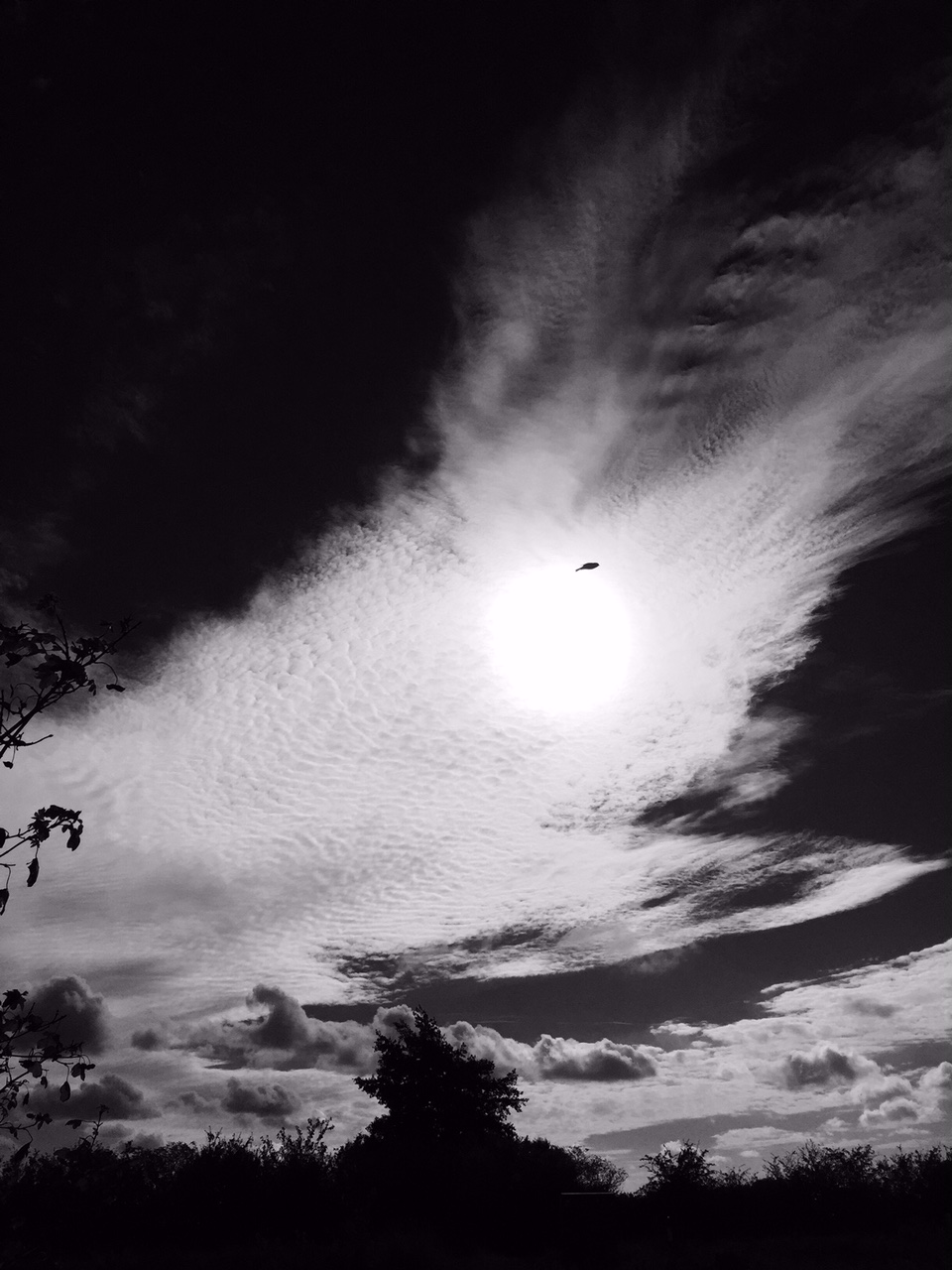
Seldom seen
I am
The edge of action
——-
Seldom seen
I am
The liquid in which light flows
——-
Seldom seen
I am
The Spirit that animates all
——-
Seldom seen
I am
What you think you are not
—
©Copyright words and image, Stephen Tanham 2015
Share this:

We climbed yet further …
Share this:

+ Greek Myths, Hercules, Labours of Hercules, Silent Eye School, Spirituality, Truth and Esotericism
Nine Deadly Sins with Coffee, part 32 – New Grains for Old
by Steve Tanham
Nine Deadly Sins with Coffee, part 32 – New Grains for Old
.Alexandra.
“They have a new menu,” he said casually.
I felt myself tense; then got hold of it, recognising the reaction and how it had absorbed me into the moment in a bad way: making me identify with the building anger, rather than watching it unfold as a thing in its own right … losing me, in other words; losing me, that all-important sense of being present, rather than being mechanical. He had, I had to admit, taught me certain things well … so why, this Monday morning, did I have a mounting sense of ‘smug git’ as I looked at him?
John held up the computer-printed coffee menu. “It says they have recognised that their clientele fall into three bands.” He spoke evenly, in measured tones. There was no hint of his overbearing side; which was why I was suspicious … “It says that they are going to offer three levels of coffee from now on: ‘Good and Basic’, by which I take it to mean that old fashioned black or white coffee with no Italian frills,” he paused to look at me over his reading glasses, nodding when I appeared attentive. “‘A Continental Range’, by which I assume they mean Italian-derived staples, such as cappuccino and latté …” he sipped his own latté, looking slightly peeved that he’d only achieved mid-range on the new scale. “… and ‘Something Special’ which includes extra flavouring like vanilla and flashes of genius like a chai tea latté.”
He put down the folded paper, looking across at me for a verdict. I sipped my own coffee and said nothing … The phrase ‘smug git’ was still writing itself on the surface of my wresting consciousness. I had first called him it on my sixteenth birthday; having learned it from a friend on whom I was, at that time, modelling myself. He had made some closing point in an argument. It was an unassailable piece of logic and I had wanted to bring him down a peg or two, so I said it to his face …
It was the first time I had been conscious of psychologically hurting an adult. It was also the first time I had watched someone else wrestle with themselves, not externally, for he kept his cool admirably, as uncles are supposed to do; but inside, where the barb had struck and stuck. Looking back on that moment I realised that he had known that he could, indeed, be a ‘smug git’, and had probably tried, without too much success, to suppress it. Five minutes after I had said it, it was forgotten, and the dinner party picked up without damage.
He had, over the years, reminded me of it, but never with rancour … always with a joke, a remembering of a shared gateway to a different world – for us both.
“A bit like the myths, then?” he said, softly, across from me now, in a voice that was very different to then.
“Like the myths … coffee?” I asked.
“The three levels of meaning,” he said simply.
My head was starting to whirl. From unwarranted annoyance, to long-ago memories, to coffee and … myths? “You’ve lost me!” I said, taking a deep breath and trying hard to direct my attention to what he was saying.
“The best of the myths, from whenever they derive, often have three levels of meaning.”
I sat up, concentrating as I would in a legal situation. “Give me an example,” I said.
“We’ll come to the Greeks, later,” he said, “But let’s take a classic – the different ways to describe the truth in the Gospels.
I pretended to look shocked. “You’re taking the Gospels as myth!”
“In the best way possible, yes …” he responded, but that’ s for another day … what I wanted to do was to take situations you would recognise to illustrate a point.”
“Okay,” I said, playing it cool.
“How did they represent truth in the Old Testament?” he asked me.
I wracked my brains; religion had never done much for me, despite John’s attempts to get me to see ‘under the covers’ as he had often said. From somewhere, the image of Moses surfaced, standing, in the pages of my childhood’s illustrated Bible, on a mountain, holding up huge tablet of …
“Stone …” I said, triumphantly.
“Exactly!” he enthused. “Stone … Tell me the properties of ‘stone’.”
I was onto this, now. I could see that this was an interesting avenue of exploration.
“Fixed,” I said. “As in ‘set in stone’.”
“Exactly. So the older concept of truth would be something that is still with us: the letter of the law …”
I cringed at that. How often had I railed at the legal system that made all of us who earned our living under its wings reduce our thoughts to the most simple forms of logic. And how unfair some of the results of that were.
“We should be able to do better, in this day and age, but how could we measure it?”
“Another day,” he said. “Or you’ll miss your train.” He rotated the forefinger of his right hand. “Now fast forward to the Gospels. How was Jesus baptised into the truth of what was to be a short, dramatic and painful ministry?”
The ideas were flowing … I could feel as well as see where this was headed. “With water,” I said, watching the words fly through the space to his gently knowing face.
“And water is …?”
“Not stone,” I answered, entering the mystery he had set. “Not stone at all. It flows around things, it’s all connected …” I pulled my head up as a revelation hit home. “It’s whole!”
John was nodding. “Whole, indeed,” he said. “So the Gospels moved the concepts of truth on, but did they stop at water?”
Now I was struggling. I wracked my brains but couldn’t think. John looked at his watch and shook his head. It was a easy gesture; with no impatience. “No matter,” he said. “and next week, we’ll finally begin to look at one of the Labours of Heracles – armed with a certain knowledge that truths are represented in different ways and on different levels, depending on who they’re addressed to.” He paused to finish his coffee. “But, for now, I must go. He tapped his jaw, wincing slightly. “Dentist. Need a filling, I think …”
Just before leaving he pushed the new drinks menu across the table to me. “Interesting reading,” he said.
As the old glass door swung shut I looked at my watch and realised that he had left early. I had time to finish my own coffee and peruse the new delights being offered by Rose’s establishment. Not bothering with the cover, I went straight for the detail. Sure enough, there were the three categories of hot drinks, labelled: Good and Basic; Continental; and Something Special.
And then my eyes saw it. Right at the bottom of the page was a single paragraph: ‘For those of us of sufficient years who have developed their ability to taste, we offer a small selection of fine wines.’
And then I noticed that there were no prices against any of the items on the menu. Beginning to smile, I turned the unread front cover into view. There, in simple block letters were the words:
The Smug Git Cafe
presents:
The Truth of the Matter
;<)
I was still smiling as I swung my black bags onto the carriage and climbed aboard my week.
———————————————————–
Nine Deadly Sins with Coffee is usually published on Thursdays.
All images and text ©International copyright, The Silent Eye School of Consciousness, 2015.


 Sun in Gemini
You must be logged in to post a comment.