
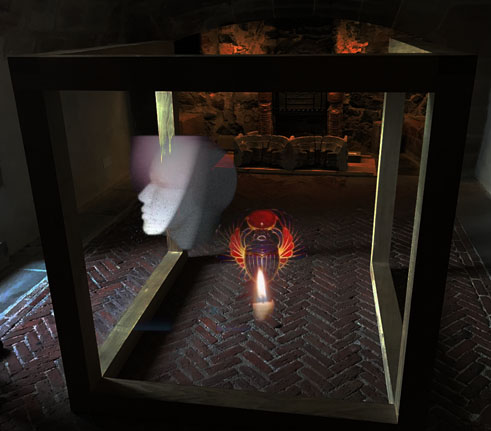
In Part One, we looked at the implications of one of the hot topics in modern physics: that of Block Theory, and its two offspring theories – Expanding Block Theory and Evolving Block Theory. These dull names hide a very exciting and radical view of the universe – our world – and the dynamic part that awakened humans can play in it.
We don’t need to change what we do to work within the ‘Block’ of Block Theory. We can’t do anything else. Our ability to ‘do’, including the logic of decision, is built into the dynamic of being Human – which means the organic part of us operates wholly within the framework of the Block universe. When we turn our head, go to the car, decide to drive to the petrol station, and then pick up a chocolate bar as we pay, we are exercising the under-considered power of choice. We are creating the next moment of the present. The result of that choice is the equivalent of what quantum physics calls ‘measurement’. Measurement, in this sense, means interacting with the now.
Evolving Block Theory is related to Quantum Physics. Within Quantum Physics, a very different universe exists from the ‘solid’ one we think we live in. Our real quantum world is a sea of possibilities so vast that the mind struggles to conceive of it. This ‘sea’ resolves itself into a ‘something’ only when we interact with it; the equivalent of the scientific action of measurement. The classic thought-experiment of Schrodinger’s Cat was initially put forward to mock this, but the (both) alive and dead cat is there in full potential until the box is opened – this is actually the truth in a quantum universe. Within our minds, we have normalised this process into the Newtonian classical and solid world, but, really, we live in a shifting sea of potential – and our minds have a unique relationship with it; they may even be able to co-create the unfolding now in an advanced way, once we have mastered the ‘magic’ of the mechanics…
How does Block Theory, and in particular Evolving Block Theory, fit into this quantum world? The two are the other halves of each other. Block Theory says that, while there is length, breadth and height, there is no time as we think of it, conventionally. There is only the human mind choosing from the possible courses of action – intelligence, in other words. Everything that could be done exists, before us, in the quantum universe, powered by something wonderful. But it is not the future; just potential. To become the present: the only place where reality exists, we have to make that choice and combine consciousness with it. Once that actualisation begins, we not only create the present, we are the present.
Evolving Block Theory contributes something very special to this: it puts forward the potential of light, itself, to be the living sea of possibility from which the present is knitted. Only light has the vastness of ‘atomic’ potential to fit the requirements of this world which constantly resolves itself into what we have chosen… But, once that choice is made we do not ‘move’ into that future, the combined now of us and light unfolds before us…
Choice has, therefore, many components. The world in which ‘we’ find ourselves from birth is not in any way fixed. At the atomic level it is the potential of pure light. We live in a three-dimensional world but the property of time belongs to us – possibly to all Life, though the powers of mentation and therefore choice are more sophisticated in the human – and often cruel. We can surmise that, as yet, we are mere infants in the exercise of this ‘supermind’ potential.
While science has made enormous progress, it has done so without a conscience. It may say that is not its role, but there is a growing sense of responsibility among scientists. The ancients did not have the benefit of our powers of instrument-enabled observation and measurement – in a general sense, though the Greeks, peoples of India, and medieval Arabs laid the foundations of what became Western science. But the ancient philosophers did understand consciousness – and the disciplining of the mind; and this has always been the other half of the equation. In this, they pursued the deeper meanings of consciousness, rather than taking it for granted in the way that science initially did.
Thankfully, Quantum Theory changed that, though an understanding of it still evades most people – and why wrestle with it, if the older Newtonian world will do just fine?. Evolving Block Theory offers a radical new view of the ‘out there’; one potentially controlled by the fully balanced human capable of bringing wise choices into the all-powerful present, whose potential, like the chess pawn becoming a Queen, would then be, literally, limitless.
The emotions empower our choices, as does habitual pleasure and pain. But in a mentally-strong human, the mind, alone makes that choice. The depth of intent is therefore of prime importance in navigating the art of the possible which unfolds before us. This is astonishingly close to the ancient art of magic, which aside from the fluff and egoic dross, is concerned with the focussing of intent.
Acting for the good is very different from acting out of self-interest, only. The greatest ‘magicians’ of the coming age may be those who combine deep intent with the universe-expanding power of ‘good’ and thereby step beyond the level of humanity as we know it, reaching back to teach and show those of us who yearn for those heights of the soul.
A Meditation
So let’s imagine that we are a new type of magician, one intent upon working with this world of Evolving Block Theory. How could we act in accordance with what we see as its potential?
We need to comprehend that, organically, we are already its child. Our creative power within the ‘Block’ will already have been at work in our lives – in both positive and negative ways. But, consciousness of this brings greater power to work with it in the light of knowledge rather than accident.
Realising that we stand in the threshold of a new world, our first action might be one of cleansing; by which we mean freeing the apparently frozen world around us from negative patterns we have unconsciously imposed on it – as creator…
To help us, we can consider that what we thought of as being ‘set in stone’ might not be; that thoughts, feelings and outdated opinions can be, literally, dissolved.
Let us see ourselves as a castle made of heavy and solid stone. Imagine each part of you: thoughts, emotions and your sheer physicality. Let each of them be a part of a castle of self – see it clearly.
Now imagine that this, your castle, has actually been carefully constructed by skilled builders from blocks of ice, not stone. See that fixed structure melting slowly until it resolves itself into a lake of water. It has lost none of what it had except for the restrictive patterning that held it fixed. Really, it was always water…
When the waters of the ice castle have melted, and the lake is full, let us imagine that we are gazing down onto the pure, glowing surface of the lake. Behind us, high in the sky, is the golden disk of the Sun. The gold is so bright that, initially, we see ourselves only as a silhouette. But then our eyes become more powerful and we look deeper…
What do you see?
Stay as long as you wish above the golden lake. When you are ready, close the meditation with this affirmation:
“I am a co-creator of this world and I will create in full consciousness.”
©️Stephen Tanham
Stephen Tanham is a director of the Silent Eye School of Consciousness, a not-for-profit organisation that helps people find a personal path to a deeper place within their internal and external lives.
The Silent Eye provides home-based, practical courses which are low-cost and personally supervised. The course materials and corresponding supervision are provided month by month without further commitment.
Steve’s personal blog, Sun in Gemini, is at stevetanham.wordpress.com.
You’ll find friends, poetry, literature and photography there…and some great guest posts on related topics.
Share this:

From Sue…

One of the things we take away from our weekend workshops are the memories. Faces, places, people, conversations and realisations, all combine to create a kaleidoscope of intangible souvenirs that find their own place in the hierarchy of memory. We may share an adventure, but the memories are unique for each of us and it would only be by combining all of them that a true picture of the weekend would even begin to emerge. We each bring our own perspective to the experience, and what will seem unimportant to one may be awe-inspiring to another. Some of what we experience will seem so mundane that it fades into the background, barely registering its presence in our minds, some moments will make such an impression that they remain fresh and evergreen for the rest of our lives.
Memories are more important than we consciously realise most of the time. They…
View original post 319 more words
Share this:


We have a phrase in English; that someone is a ‘chip off the old block’. Its meaning is that someone of merit is continuing the ‘family’ tradition. I suppose it could also refer in a wider context to someone in a group or organisation doing the same thing.
A group of scientists are promoting a ‘new’ theory: that of the ‘Block Universe’ or “Evolving Block Universe’. It’s not entirely new. The idea of a static universe where the only change is the evolution of the conscious inhabitants has been around for a while; and touches on some of the deepest ideas in philosophy and metaphysics.
Just think about that for a moment to grasp the sheer strangeness of the concept. Look around you and watch the shifting view, the tiny changes, the way you move your coffee mug, shift your position on the chair, drive the car through an autumnal landscape…. But you don’t do any of that, according to Block Theory. Instead what you are experiencing is your journey of consciousness along a hyper-road which maps and separates what is possible (with reference to where you started) to where you might choose to be next.
Only you change… and even then, only your consciousness; the hyper-globe in front of you reveals itself in an experience of movement – including your own body and organs. But… and it’s a big one… nothing out-there is really changing – we are just choosing what to see next amongst the possibilities. And, startlingly, this may be the ultimate purpose of the brain.
Within this world, the present has reality; the past has a lesser reality but is at least consistent; but the future does not exist. Reality belongs to where consciousness is. Conventional Block Theory conceives of a supremely thin wedge of passing time that is now… but philosophers dismissed this long ago as meaningless. There is not, nor can there ever be, a wedge of the ‘present’ small enough to contain the conscious now. In simple terms the observation may be in the present, and recorded in the brain; but the observer, by definition, isn’t… The observation becomes immediate history.
Those interested in metaphysics of any sort will recognise much of what is taught and experienced in their Work in this ‘new’ theory. We do not have a centre of consciousness, we are a centre of consciousness. In fact, within us there are two conscious centres: the first is a self that is grown in reaction to the world we experience – even though we are choosing it – The second is a deeper, super-conscious ‘presence’ which is not really a centre at all, it just retains an outer identity for the lifetime in which it is linked to the organic being and its personality.
Why is it called ‘Block Theory’? Here it gets interesting. There are two theories based on this idea of a three dimensional cube of length, breadth and height; where time is the expansion, but only via interaction with consciousness. The second, or derived theory is named ‘Evolving Block Theory’.
The use of ‘Expanding’ suggests that this newly envisioned cosmos is actually growing… Mystics may recognise the idea that the universe or ‘God’ expands through the consciousness of its creation growing from within. It’s a staggering thought, that God is ‘not finished’, but evolves, too! Such a view has, of course, caused much controversy over the years.
Previous centuries have contained cosmological views that are very primitive in the light of modern science; but science is only now learning to value the presence of consciousness in the whole world-picture. Interestingly, some of the most ancient philosophies and religions were the very opposite and placed the development of consciousness, itself, at the centre of knowledge of the ‘world’.
The idea that the universe has past and present realities but no future except that which is unfolding in the now dovetails nicely with some of the better science fiction stories. One in particular that fits is the Hugo Award winning Hyperion series by Dan Simmons. In the story, Hyperion is a simple, colonised world to which a future civilisation sends an horrific artificial monster; a cyborg so dreadful that the whole of the Earth-derived space ‘Federation’ is drawn into a cataclysmic battle around its destiny. The cyborg – the Shrike – has been sent backwards in time to show the children of Earth the consequences of mindlessness, violence and lack of compassion. Although written in 1989, it is chillingly prescient about today’s society. The Shrike’s victims are impaled on a ‘tree of metallic thorns’ where their suffering is endless. I would imaging many abandoned souls on this Earth would describe their plight as similar…
From a mystical point of view – and in keeping with Block Theory – we may speculate that all that people of sufficient positioning and power within society would need to do would be to choose a different path, together. But then we may consider that we have no power nor right to change someone else’s path. We only have responsibility for our own. Mystics have taught for millennia that when we change our own thoughts, we change our own worlds.
This brings to mind the nature of real choice. most of the choices we make are as a result of our conditioning: they are automated responses based on pleasure and pain. This conditioning, and its resulting force – habit, is a necessary feature of our organic existence and as such is important for our survival. However, when faced with the idea of a voluntary higher evolution, we may choose to approach the nature of choice from a different perspective; especially in the light of theories such as the Block Universe. We will explore this further in the concluding part two.
From the point view of our choice of accelerated evolution, if Evolving Block Theory has any truth in it, then our personal possibilities have just expanded greatly. In fact, we only need make the right choices in order to radically change our lives.
On a chessboard a pawn may, with a few moves, gain the back row – the 8th rank, and transform itself into any of: Bishop, Rook, Knight or Queen of the same colour Only the King remains beyond this alchemy, though a Queen may mate with a King… We may reflect on this and wonder at how these deep and significant patterns are threaded through our history in ways that keep them in front of our unawakened gaze, like seeds awaiting their time in the sun… The important parallel is that to completely change our lives would take far fewer moves than we imagine.
If the block theories have merit, then we may be able to transform ourselves into personal ‘kings and queens’. As ‘royals’ in our own lives, we would have our own kingdom and would have no desire to control others and thereby restrict the freedom of those we should be helping along their own path.
To borrow from Isaac Newton: we may find our selves (our consciousness) crossing the paths belonging to Giants. Through the right choices: the Buddhist ‘right action’, for example, we may find ourselves ‘on the shoulders of giants’ in the sense of inheriting their wisdom – and choosing, with all our being, to follow it… Our journey through the Block of the intelligent universe as the fourth dimension may just have become a lot more lively!
To be continued…
©️Stephen Tanham
Stephen Tanham is a director of the Silent Eye School of Consciousness, a not-for-profit organisation that helps people find a personal path to a deeper place within their internal and external lives.
The Silent Eye provides home-based, practical courses which are low-cost and personally supervised. The course materials and corresponding supervision are provided month by month without further commitment.
Steve’s personal blog, Sun in Gemini, is at stevetanham.wordpress.com.
You’ll find friends, poetry, literature and photography there…and some great guest posts on related topics.
Share this:


Inspector Sunday stopped walking when he reached the place by the river. He felt at home, there, but didn’t know what to do next.
The sky, which had tried to teach him about the cat, told him a story of intersection. From behind him and to the left came a voice that delighted but shocked him.
“Grandad!”
©Stephen Tanham
Share this:

Can they pull it off, again? Oh, I think so…


*
It was over 14 years ago now in March 2004 that I first sampled the delights of Derbyshire at a Mystical Weekend in the Nightingale Centre, Great Hucklow.
In those days I was a relativley new member of a worldwide Mystical Order and the idea of a ‘Weekend Retreat’ amongst strangers was unfamiliar and rather daunting.
I recall a moment of panic on my way to this remote spot as the bus from Sheffield headed deeper and deeper into the Derbyshire wilds… ‘It’s in the middle of nowhere,’ I thought with mounting hysteria, ‘we could all be murdered in our sleep and no one would ever know…’ I can now smile at such momentary fears brought on no doubt by a teenage staple of Dennis Wheatley and H.P. Lovecraft but there is a legitimate question here for those with no experience of such matters.
‘What does one do on…
View original post 496 more words
Share this:

A brilliant exportation by Tiramit of what the Mind is, and how it works, by example, in a situation of pain.

 POSTCARD#331: Bangkok: I’m a Western migrant, living in the East for these last 30 years, and looking at my conditioning in the light of being inescapably part of the Eastern culture; all the ups and downs of life in Asia, and finding the way through in situations where language/behaviour are unfamiliar to the Western mind. Also the headache, from three years ago, learning how to live with that, requires an alertness, a sharp focus on how the pain gets stuck from time to time. There’s a built-in wake-up alarm that rings when this happens and every other time mindfulness is absent.
Being mindful of pain and the experience of suffering (dukkha) is necessary because there is the negativity surrounding pain, “Pain is bad – I must have done something ‘bad’ to deserve this!”… The locked-in reaction to criticize oneself for having the pain. Knowing there’s a difference…
View original post 416 more words
Share this:


Perhaps we are all wired
With hidden volts so high they hiss
With cables that endure-
The filaments of gods
Mapped, secretly, to only one
➰
Is the source touched, still?
Their coded ringing telling this?
Their presence in our sky
So long established, that
They are no longer seen
➰
Sing, shimmering wires
Remember the exiles
And bring back melodies
And words to trigger hearts
From the days of us
➰
Hiss, divine light-stream
Break down my walls to love
Blow what I am amongst the meadows
Of summer’s parting joy
And call forth the seeded knowing.
➰
©Stephen Tanham
Stephen Tanham is a director of the Silent Eye School of Consciousness, a not-for-profit organisation that helps people find a personal path to a deeper place within their internal and external lives.
The Silent Eye provides home-based, practical courses which are low-cost and personally supervised. The course materials and corresponding supervision are provided month by month without further commitment.
Steve’s personal blog, Sun in Gemini, is at stevetanham.wordpress.com.
You’ll find friends, poetry, literature and photography there…and some great guest posts on related topics.
Share this:

From Sue
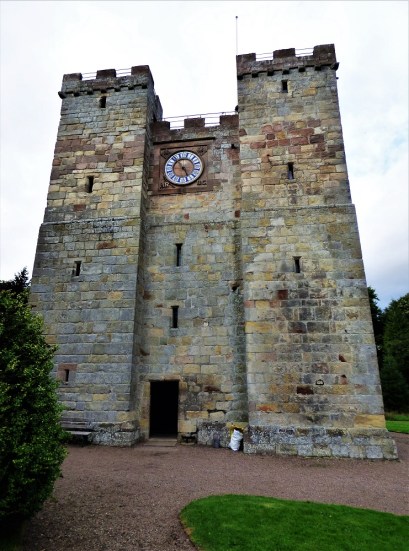
There is something about a map, a proper, paper map, that makes a journey personal. We don’t tend to use sat-nav, resorting to such technologies only when cities force us to do so… and we had invested in a brand new map too, the other one having been worn to shreds over the past couple of years. So, instead of following the directions given by the leader of the expedition, we took the winding backroads to get to the last site of the day and arrived there a little while before the others. We killed a little time by snacking on the remains of lunch, then had a wander up the path to wait outside the tower.

Time, though, was getting on. Knowing Steve had been really impressed by this place and worried that it might close before the others arrived and we had chance to see it properly, we…
View original post 961 more words
Share this:


Inspector Sunday left the house wearing the leather backpack… containing the mysterious cat… Or did it? From somewhere in his fuzzy memory he knew this was a scientific joke…
He came to a valley with trees and a sky. The sky tried to explain the geometry of it all to him, but it was too much.
They walked on; Sunday, the backpack and, possibly, the cat…
©Stephen Tanham
Share this:

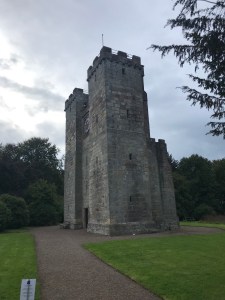
We stumbled upon the Preston Pele Tower, fifteen miles south-west of Bamburgh, back in February, 2018. My wife and I had seen a reference to it on a noticeboard in a cafe some distance to the north. It’s quite hard to find; tucked away down a tiny country lane not far from the A1 – the main road through Northumberland to Edinburgh. We’d never heard of a Pele Tower, either… We got out of the car and stared at it, never having seen anything quite like it. Was it a castle – or the remains of one? The location suggested not. It looked purpose-built, yet somehow incomplete….
Right up to the time the Castles of the Mind group approached the building, I didn’t know what part of the ‘self’ we could use it to describe. I entered the (to me) familiar building and trusted that the answer would reveal itself. Either way, and even at the end of a long day of adventure, the Companions of the trip were not disappointed, and seemed to be having the same ‘look at that!’ experience that we had enjoyed in early February.
The famous architectural historian, Sir Nikolaus Pevsner, described Preston Pele Tower as ‘amongst the most spectacular pieces of medieval masonry in England’. Its stone walls are seven feet thick and carry the same mason’s marks as those of the evocative Warkworth Castle twenty miles south. Sadly, we did not have enough time in our short weekend to visit the latter… another trip methinks!

It was never a castle, but it is incomplete; what you see in the top photo is only a half of what was built, originally. So, imagine that the two vertical towers are reflected back on themselves and you have it as it was created in 1392 (pic above): a four section Pele Tower.
How to pronounce Pele Tower? Probably because of the famous Brazilian footballer, it’s natural to call it a ‘Pel ay’ tower – and some of the locals we spoke to did just that. But Sue, who’s a fluent French speaker, says it’s probably derived from a French word and should be ‘Peel’ – that the final ‘e’ is there to turn the ‘eh’ in the middle to an ‘ee’.
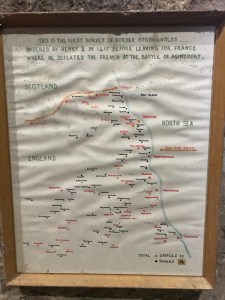
It matters little; but there were a lot of them – nearly eighty, in fact. So they were rather important in this part of the world… The hand drawing from the Tower’s museum shows the location of the fortified dwellings in Northumberland, most of which were towers. The original of this chart was drawn up by Henry V, just prior to his departure for France and the victorious battle of Agincourt.
Many of the fortified towers were constructed during the frequent wars between England and Scotland, which ended with the Act of Union in 1603 – after James I came to the English throne. In the sixteenth century, while the rest of England enjoyed relative peace, Northumberland – the eastern border county with Scotland – remained on a state of alert due to a scourge called the Border Reivers, and the towers saw a second lifetime as an essential way for the landed gentry to protect their people, servants and livestock.
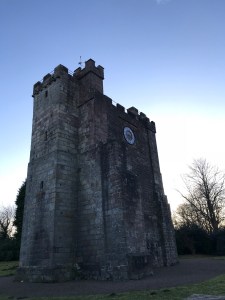
Reivers were lawless gangs, both sides of the border, who would steal, murder and rape their way across whole swathes of an undefended Northumberland and its disputed border with Southern Scotland.

One of the Preston Tower’s celebrated features is a combined great bell and clock. The bell is approximately four feet in diameter and weighs 500 kg. The mechanism for the bell, which strikes on the hour, is linked to the twin clocks on both sides of the Tower faces. The power is provided by a set of two giant stone weights whose ropes run most of the height of the building.
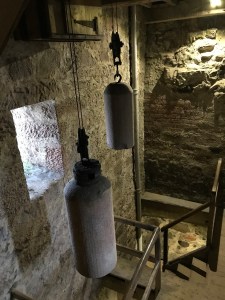
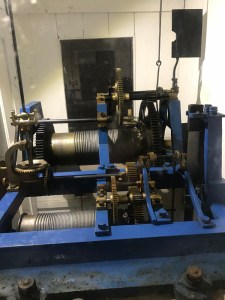
The clock mechanism on the second floor drives the twin clock faces on the north and south faces of the tower, and is based on the same mechanical design that powers Big Ben in London. The clock was added in the nineteenth century, which shows that the Preston Tower continued to be a place of historical interest for a long time.
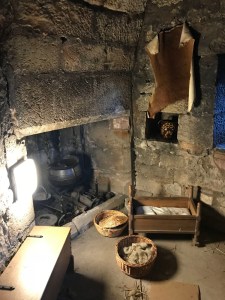
As part of its function as a museum, Preston Pele Tower contains rooms which are furnished as they would have been at the time of its construction in the 14th century. The recreated interior spaces are sparse, and, to us, feel very basic. Being safe during a time of great insecurity was their central function.
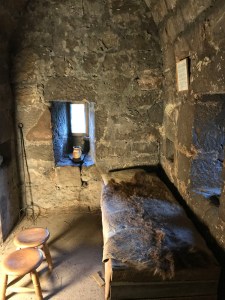
The basic cooking facilities are shown in the second of the two rooms.
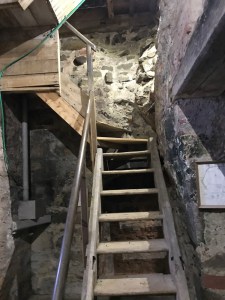
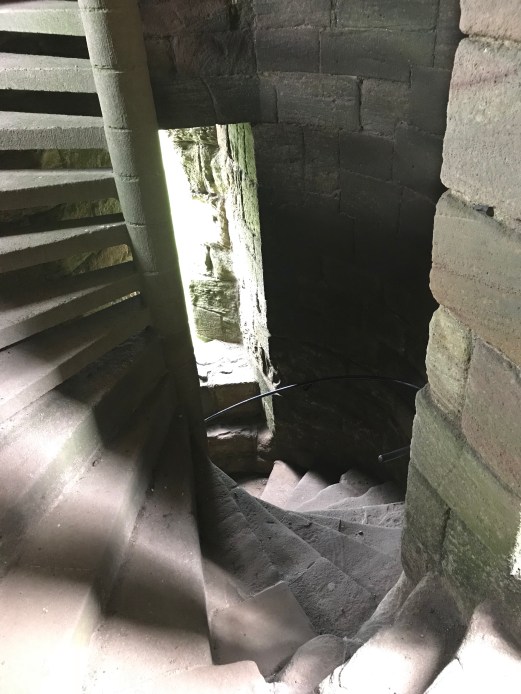
The staircase is a simple wooden structure that runs all the way to the roof on the east side of the internal wall.
Once on the roof, the view of the countryside around is commanding.
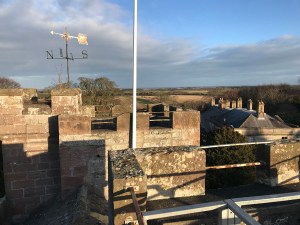
Standing on the roof, in the last few minutes of our visit, the key I was looking for came to mind: Hope…
The Pele Tower was not a basis for aggression; its purpose was to defend the home and hearth, the family and those who worked for them, including the animals.
An image came to mind: that of the householder standing watch under the stars, scanning the horizon for reivers. The dawn is beginning in the east, but the sky is still filled with the strange darkness of the pre-dawn. He nods his head towards the coming light, then opens the door to descend to the chambers in which his family are sleeping, safe within the thick stone walls.

He pauses by the thin window, a defensive structure so narrow that a man could not pass through it. The shutters have not been drawn on this single light and he stops to consider the pale light, one final time. In that moment, I catch his thoughts in a line of poetry, a gift from the now that places such as these are so good at bestowing…
Through these thin lights, now so forlorn
Will one day stream a different dawn
It will take another hundred years – a time during which the rest of Tudor England will undergo transformation to modernity. But in this liminal zone of Northumberland, the change will be slower, as borders and reivers are set to rights.
But that day will come… and that fervent hope in my ghostly host’s eyes will empower it… And there is something very spiritual about that…
We left the Pele Tower quietly. Others had felt its unique personality. We were all tired, and the dinner booked at a nearby pub was very welcome.
Our mental and emotional preparation was complete. We had been witness to the internal architecture of the self as seen in these vast and very different structures of stone.
The sun would rise on a day dedicated to the Holy Island of Lindisfarne… and its ancient mysteries; the Companion Pilgrims were coming home…

The Preston Pele Tower is a privately-owned museum. It charges a very reasonable £2.00 admission and has car parking and toilets on site.
To be continued.
©️Stephen Tanham
Other parts of this series:
Part One, Part Two, Part Three, Part Four,
Stephen Tanham is a director of the Silent Eye School of Consciousness, a not-for-profit organisation that helps people find a personal path to a deeper place within their internal and external lives.
The Silent Eye provides home-based, practical courses which are low-cost and personally supervised. The course materials and corresponding supervision are provided month by month without further commitment.
Steve’s personal blog, Sun in Gemini, is at stevetanham.wordpress.com.
You’ll find friends, poetry, literature and photography there…and some great guest posts on related topics.
Share this:

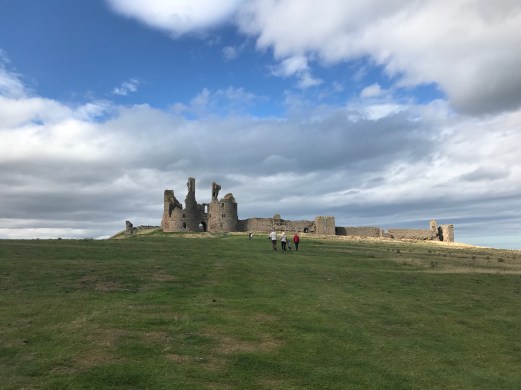
“It’s as though… there’s something wrong with the horizon…”
Barbara was speaking softly, giving voice to one of the defining thoughts of the day. Something wrong with the horizon, how true. Craster’s harbour was disappearing behind us, but the cut-up horizon was still far away. There is no other way to reach Dunstanburgh Castle than on foot; though, back in history, distinguished visitors could arrive by sea – into it’s private harbour – as well. You had to be very wealthy to build a castle with its own private harbour, and the Earl of Lancaster was very wealthy. He was cousin to the King, Henry II, but, more significantly, he was the nephew of a man he considered to have been a much greater king – Henry I.
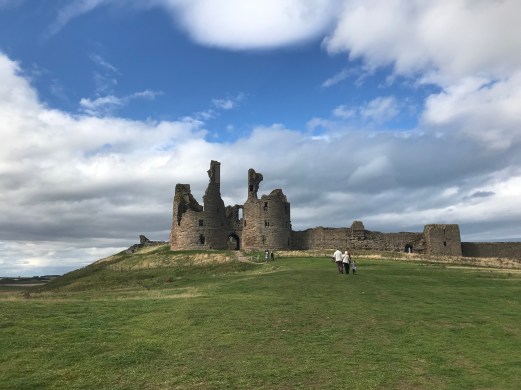
The dark, jagged vision grows as we walk. Back in the winter, when Bernie and I had come this way to explore the possible sites for the weekend, I could find no words to express that distant starkness. Now, one of the Companions did: “It’s as though it was deliberately punished, in such a visible way that no-one could ever forget…” History shows that, actually, it wasn’t. The ravages of time, neglect and a life on a Northumbrian cliff did that. But, emotionally, it looks exactly like a ‘punished place’, and that serves our ‘psychological’ purpose, here. The nature of the illusion lies in the mystery of the shapes used in its architecture…
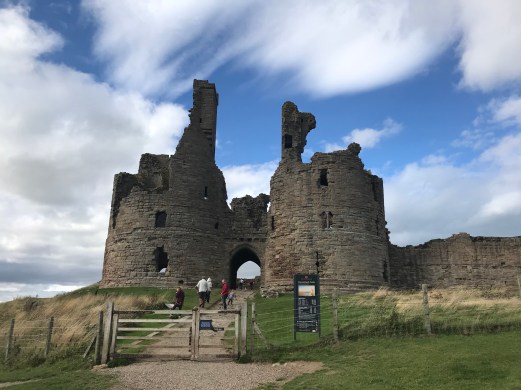
Emotions are important on this, Day 2 of the Castles of the Mind weekend. We are hunting them, and encouraging them when they arise, naturally, like on this long walk over the headland. Emotions may not be as reliable as the more mundane reason, but they manifest immediately, and, if we learn their language, and know when to combine them with the mind’s discrimination, we can get much closer to the ‘soul’ – the essence of ourselves, using their energy. The external natural essence we’re tapping into in the land at Dunstanburgh is a strange one… beauty and the beast, almost.
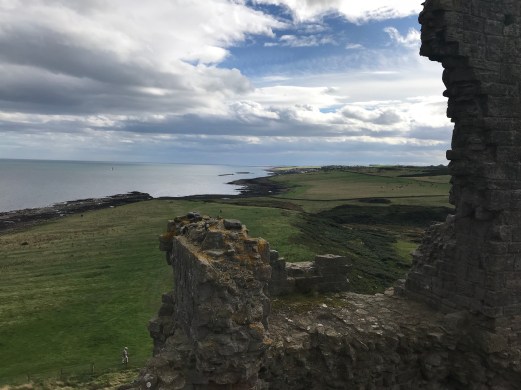
Here, we have to have a little history to appreciate what we’re looking at; for the jagged horizon takes us back to the later years of the Medieval era, a time of battle and romance – or so the popular view suggests. 1313 is the date on which work on Dunstanburgh Castle began – just one year after the unholy alliance of the French king and the Pope ‘dissolved’ the Knights Templar.
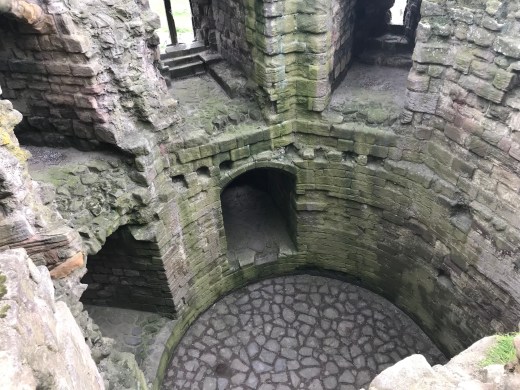
It is hard to imagine taking a landscape so beautiful and ending up with a place scarred in such a lasting way. Yet, Dunstanburgh Castle is just that – at least emotionally. And that was what swung it into the short list of places for our weekend; what could be visited in the few short days that a Silent Eye weekend has available to it. There’s nothing logical about declaring that we are ‘pilgrims of the heart and mind’ travelling between the splendour of Bamburgh and the noble simplicity of Lindisfarne – and then making a detour fifteen miles south…
But once we had seen it on that dark horizon, it had to be part of the itinerary. It had to follow Bamburgh Castle because a human existence energised and brought back to ‘life’ by examination and a restless dissatisfaction with ordinary living must face up to a critical stage before it can move on.
The spectre growing in the near distance was the best example we had ever met of the word ‘ruin’. You don’t need to see your life as a ruin to make life-enhancing changes to it. What has been hard-won in life can serve what follows without destruction, only the captain of the ship needs to change. Yet, as Shakespeare understood so well, to tell a story that involves ruin challenges us to examine ourselves; in ruin lies a compelling set of emotions; emotions that energise change.
‘There was a powerful man who had a favourite nephew’. It could be the opening to one of the Bard’s plays, but, instead, it’s our own history – part of the story of how the English came to be. The powerful man was King Edward I; the young nephew became Thomas, earl of Lancaster, and he built Dunstanburgh Castle. It may seem odd for the powerful house of Lancaster to have estates so far away from the north-west, but it was normal for the Lancaster and York houses to have far-flung estates, in places of military importance. Both were, essentially, southern-based houses of power and the Wars of the Roses were yet to start, though they were not far away in time.
The Earl of Lancaster seems to have been an accomplished but arrogant man. He inherited the barony of Embleton from his father; Edmund ‘Crouchback’, who was the younger brother of King Edward I. King Edward was a major castle-builder, and created many of the spectacular castles that we visit in Wales, today. Previous lords of Embleton included the famous rebel Simon de Montfort, earl of Leicester, on whose life Lancaster may well have modelled his own.
Another, and more negative force forged Thomas, earl of Lancaster’s life: he hated his cousin the King, Edward II.
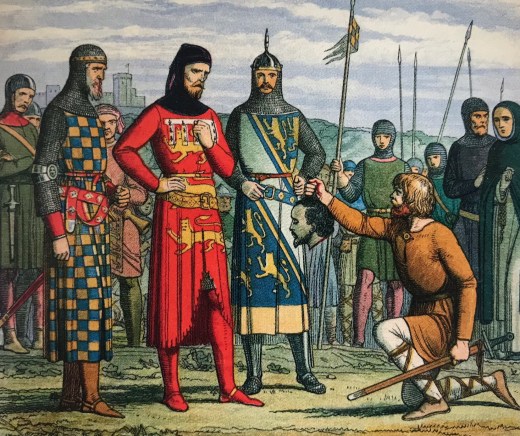
King Edward II was homosexual. His outspoken lover, Piers Gaveston, was despised by the barons, who plotted to ambush and kill him. The picture, above, photographed from the English Heritage guide book, shows the presentation of his head to the earls of Warwick, Lancaster (centre) and Hereford in 1312.
Edward bided his time in exacting his revenge. Cooler-thinking that the hothead Lancaster, he initially pardoned the earls who had kidnapped and murdered his lover (on Lancaster land). But history showed he was awaiting his opportunity.
With an eye on his own future security, Thomas decided that he would do something with the property he had inherited near Embleton, and he began work on Dunstanburgh, work that included the construction of not only one of the most ambitious castles of its day, but freshwater lakes surrounding it, and a stone harbour that brought important visitors and guests face to face with the twin stone towers, modelled on those used in his uncle’s Welsh masterpieces – a style lacking in anything build by his cousin, the King.

I hadn’t noticed it on our preparatory visit, but, facing it now with the knowledge of why it was constructed, it was such an obvious statement of intent…
Thomas, earl of Lancaster, was beheaded by the sword in 1322, after mounting a further unsuccessful rebellion against his patient king. His retreat to the finished castle at Dunstanburgh – designed to withstand any siege – was cut off by a party of the King’s troops. Lancaster was later unofficially venerated as a victim of royal murder, like his namesake St Thomas Becket.
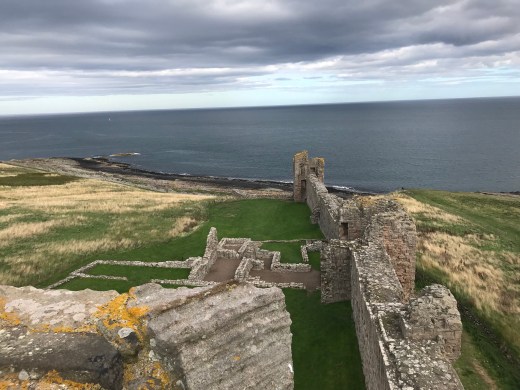
We were all strangely silent in the interior of Dunstanburgh. Lost, probably, in our own histories and their triumphs and disasters…
It had been a long day, already, but, prior to a well-earned dinner in a country pub, we had a final surprise in store for the Companion pilgrims…
To be continued.
©️Stephen Tanham
Other parts of this series:
Part One, Part Two, Part Three,
Stephen Tanham is a director of the Silent Eye School of Consciousness, a not-for-profit organisation that helps people find a personal path to a deeper place within their internal and external lives.
The Silent Eye provides home-based, practical courses which are low-cost and personally supervised. The course materials and corresponding supervision are provided month by month without further commitment.
Steve’s personal blog, Sun in Gemini, is at stevetanham.wordpress.com.
You’ll find friends, poetry, literature and photography there…and some great guest posts on related topics.
Share this:

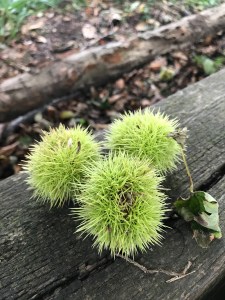
Let Autumn Harvest keep you safe,
And winter’s teeth remove
Till spring sun’s warmth again doth shine
On buried seed touched deep in sleep
And life renew with tender love
©Barbara Walsh


 Sun in Gemini
You must be logged in to post a comment.