by Steve Tanham

That feeling of being behind a time-travelling invisible ‘camera’, the result of a compelling narrative that plays you as witness to the action – or misdemeanour – that’s just taken place.
Crime writers know it well. It’s one of the tools of their trade. The proverbial smoking gun, borrowed by just about everyone else who wants to invoke that sense of vivid event a moment prior.
Only this event happened a long time ago. And there was a crime, rather, one crime and vast series of errors; recorded at the time in a set of conclusions that changed the maritime world.
It was an inevitable process of learning at the edges of the science of materials. Directly related to what was was to happen decades later, when the De Havilland Comet airliner pushed the boundaries of passenger aviation to find out that metal at high rates of speed and vibration suffered ‘fatigue’ … and disintegrating planes fell out of the sky.
No sky, here…
Only the chill, dark waters of the North Atlantic on the night of 14th April 1912.
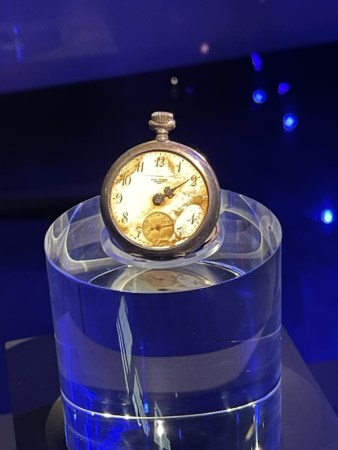
Not smoking, perhaps, since the deep sea would have long extinguished the cigarette that perhaps accompanied the final moments of Malcolm’s life: a life whose cessation was exactly marked by the coming to rest of the mechanism in his pocket watch… found later when his body was recovered from the sea.
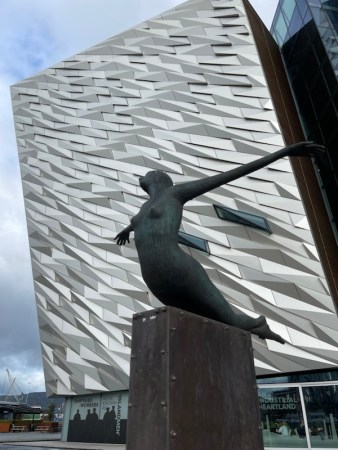

We’re in the Titanic District of Belfast … And at the end of a self-paced tour of the Titanic Ship set in the context of a proud city that built it; only to see it sink during her maiden voyage, after striking an iceberg in the middle of the ocean, four days after leaving from Southampton en-route to New York.
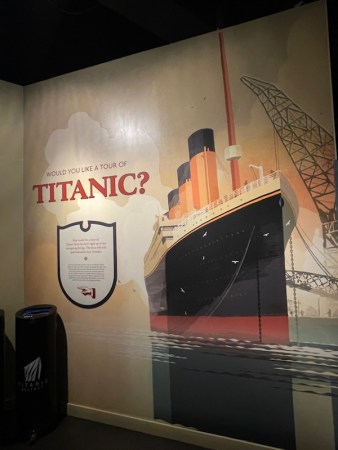
Despite being viewed as ‘unsinkable’, the giant liner took only two hours and forty minutes to slide into the dark depths. .
The Omega pocket watch belonged to Malcolm Johansson, a third-class passenger onboard Titanic. He was 33-years old when the icy waters of the North Atlantic claimed the ship and his life.
Although he was born in Sweden, he lived and worked in Minneapolis, USA where he owned and ran a successful construction business.
In early 1912, he decided to return home to Sweden where he planned to purchase the farm he grew up on as a boy in Bjorkaryd. However, his attempt to recover the property was unsuccessful and so he decided to return to the USA.
It is believed that Malcolm travelled from Sweden to England onboard SS Calypso before booking his passage on Titanic for £7, 15 shillings. He boarded her at Southampton on 10th April 1912.
The Titanic hadn’t been his first choice. Like so many others at the time he was due to travel to America on board the White Star Line’s RMS Adriatic but as a result of the 1912 coal strike in Britain, the Adriatic was unable to sail, and her coals stocks were transferred to the Titanic.
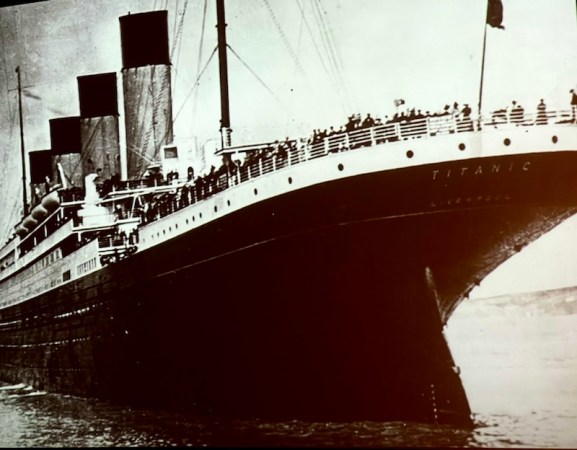
Malcolm died in the sinking of the famous ocean liner, and his body, No.37, was picked up by the Mackay-Bennett crew.
According to the official records, when his body was recovered he was still wearing his boots, but his socks were missing … the socks that contained the money he had taken to buy back his childhood home. The money was never recovered by his family, despite repeated attempts.
‘A shroud needs no pockets’ comes to mind. We can’t help speculating on the route and destination of the theft…
Malcolm was buried in Fairview Cemetery, Halifax, Nova Scotia, Canada on 10th May 1912.
The hands of his Omega pocket watch were frozen in time at 01.37 in the morning of 11th May. It may have been the only witness to his passing.
Calculating the time difference reveals that it stopped just four minutes after Titanic began her final journey to the bottom of the Atlantic Ocean.
At auction, decades later, ‘Malcolm’s’ archive sold for £155,000, the luggage ticket leading the way at £59,000 closely followed by his pocket watch at £58,000.
Malcolm purchased the watch in Sweden on 9th June 1910. It was a Lepine Omega of Grade A quality and is the only documented example of an Omega watch to have survived the Titantic disaster.
In addition to the pocket watch there was also a rare Manifest Ticket for Titanic stamped “10th April 1912.” This particular ticket was initially to be used by Malcolm for his journey to the USA on board the Adriatic. It would have been very important to Malcolm as he would have needed to present it to the US Immigration Authorities at Ellis Island after Titanic docked in New York.
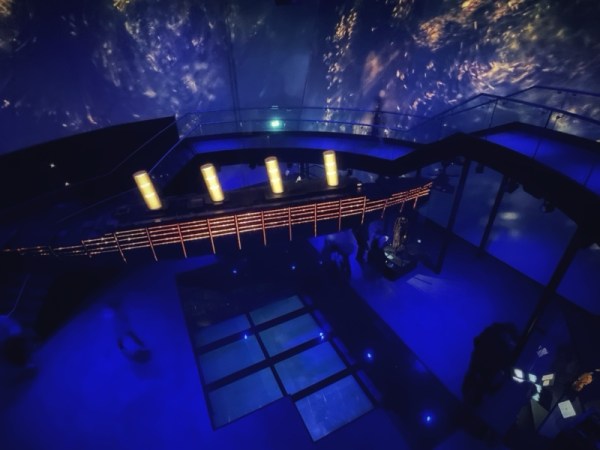
Titanic Belfast is too vast a subject to write a single, encompassing blog about. Instead, I will try to create a series of ‘slices’ through the story of this fine city and its troubled great liner told in this breathtaking ‘experience’.
This is the first of those…
©Stephen Tanham 2023
Stephen Tanham is a writer, mystical teacher and Director of the Silent Eye, a correspondence-based journey through the forest of personality to the dawn of Being.
http://www.thesilenteye.co.uk and http://www.suningemini.blog


Fascinating. I like the snippets of life from individual passengers of this fated journey. Thanks.
LikeLiked by 1 person
Thank you, Darlene. It’s a ‘mind-sharpening’ process to try to write it!
LikeLiked by 1 person
I believe it.
LikeLiked by 1 person
An interesting post, Steve. I have always been fascinated by the tragedy of the Titanic and the stories if individuals who were aboard.
LikeLike
Thank you, Robbie. If you get chance, you would love the extensive exhibits at ‘Titanic Belfast’. It’s a huge area dedicated to the culture and engineering that produced the ship at the Harland and Wolf yard, there. It’s also a very poetic and moving tribute to those who lost their lives.
LikeLiked by 1 person
It sounds great. My husband does want to visit Ireland 🌺
LikeLiked by 1 person
The perfect excuse!
LikeLiked by 1 person
A deeply moving artefact, Steve. What a poignant exhibition.
LikeLiked by 1 person
It’s quite overwhelming, Michael – in a good way. And ferries to Belfast are plentiful.
LikeLike