by Steve Tanham


It has been a thing of joy to me that most of the writers and teachers who have a desire to communicate the ‘mysteries’ of the human soul use the same language to describe the innermost nature of it.
The word ‘Essence’ is often used to describe this living ‘jewel’ that is our most fundamental identity – though a more liquid, honey-like metaphor might be more exact. The human essence has certain qualities or aspects. There are many of them, but – as an illustration – consider the qualities of Love, Intelligence, Will, Joy and Value.
Each of these is an aspect or facet – hence the use of jewel – of the human’s inner self. They are not created by any other process; they simply are what makes up our most sacred self… And they are therefore a part of our fundamental place in existence.
The years of our childhood are among the most vivid of our lives, and the challenges of this period of ‘first maturing’ provide us with the basis for our character – technically, our egoic self. The ego is a protective shell with which we face life. Its development is well documented by modern psychology. The egoic self, however, is formed ‘in the world’ (see last week’s post) and is therefore not woven from our aspects of essence; our deepest natures.

In simple terms, the egoic self is a complex network of programmed responses that we see as beliefs and opinions from our personal past and societal expectation, most of which operate beyond our active consciousness, and are therefore unseen and ‘unconscious’, though their presence is at the centre of our daily lives. Making this self of unwitnessed responses visible is a slow process, but one which, as Carl Jung attested, is essential to our spiritual development.
“Until you make the unconscious conscious, it will direct your life and you will call it fate.”
C.G. Jung
The creation of the egoic self happens in stages. The child is aware of the great beauty and ‘emotional-centrality’ of that which they are seeing slip away… But the world is an exciting place; full of sensual delights and energetic experiences. The full array of the essential aspects of the person are still there, but now lost to everyday awareness, buried even deeper than our network of responses, though certain character traits reflecting a favoured essential aspect may continue to shine through into the personality – we all have our personal strengths!
Is there a causal link between the underlying jewel of our essence and the developed, reactive egoic self – the personality?
One man who set out to map this in accessible and non-technical form goes by the pen-name of A.H. Almass. Born Hamid Ali in Kuwait, he emigrated to California as a young man and became part of a group whose work was modelled on Gurdjieff’s teachings, borrowing the latter’s use of ‘Seekers After Truth – SAT’.
The SAT met frequently in the area south of San Francisco and was led by Claudio Naranjo, a psychiatrist who had worked as Fred Pearls’ assistant in the development of Gestalt theory.
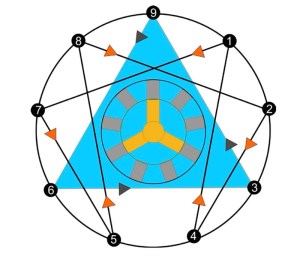
Almass and Sandra Maitri, another of the SAT members, worked closely with Naranjo to refine the use of the nine-pointed enneagram to map the human journey from essence to personality, a psycho-spiritual approach that had little to do with the subsequent and extensive promotion by others of the enneagram as a tool for ‘polishing the personality’; one that degraded into a widespread business-oriented movement thereafter.
It is interesting that during this period, a group of leading Jesuit thinkers (Rohr and Ebert) also decried the dilution of the original intent of the enneagram and began publishing their own guide to this sacred symbol.
Eventually, Naranjo refused to teach the enneagram in ‘English’ in protest at the commercialisation of what he saw as sacred knowledge. From that day on until his recent death, he only taught in Spanish, his native language from his home country, Chile.
Almaas, however, assisted by Karen Johnson, Sandra Maitri and others, believed that their findings pointed to a deeper approach to the links between personality and the underlying human essence. Almass formalised his methods under a school of the soul named ‘The Diamond Approach’, which today numbers thousands of students, some of them passing through a seven-year training program. One of my oldest Rosicrucian friends, who lived in San Francisco, graduated from this process.
The approach detailed by Almass was to link the facets of mankind’s underlying essence (Love, Will, Intelligence, Strength etc) to the main characteristics of the egoic self via what he called ‘The Theory of Holes’.
Working with hundreds of students, he analysed what they reported that, under psychological guidance, they made contact with what, as a child, had been their core natures. Repeatedly, they said they now – as adults – felt like they had a ‘hole’ where the strong and loving element of their inner natures had been.
Almass knew that the inner nature was still present … simply unconscious and therefore inactive in their daily lives. Our inner creative natures ‘fade away’, unseen and ‘untended’ in this way.
But still present…
Almass and his close colleague studied what had happened to compensate for these ‘holes’. They found that, in each case, the hollow sense of emptiness had been ‘part-filled’ by substituted experiences from the ‘outer’ lives of those involved. These were ‘things of the world’ in the language of the last post. Often these ‘fillers’ were relationships with other people with whom the subject partnered to ‘fill the hole’ of their emotional and spiritual loss.
This mapped, clearly, onto the findings of psychology when approaching, say, narcissistic personality types. The narcissist will constantly thrust their self-importance into the world to make up for a deep-seated and unconscious wound (hole) of lack of attention and reflected worth in early childhood.
Almass knew he could create a holistic and non-clinical ‘way back’ that would gradually weaken the power of the hole, enabling the student to reconnect with their essential nature. Thousands of graduates of the Diamond Approach now attest to the success of this.
In the next post, we will examine the foundational elements of this method, including the nature of ‘passions and fixations’; terminology that defines why such ‘holes’ are so difficult for us to detect and heal.
To be continued in Part 2.
Recommended reading:
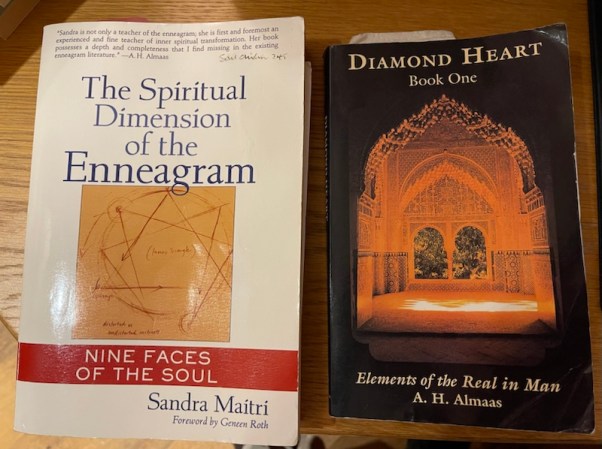
The Diamond Heart series of books by A.H. Almass.
The Spiritual Dimension of the Enneagram by Sandra Maitri
—————-
Other parts of this series:
This is Part Two
———-
©Stephen Tanham 2023
Stephen Tanham is a writer-photographer, mystical teacher and Director of the Silent Eye, a correspondence-based journey through the forest of personality to the dawn of Being.
http://www.thesilenteye.co.uk and http://www.suningemini.blog


 Sun in Gemini
Thank you, Steve. I began to read up on the thinking behind the ennegram some years ago, but picked it up somewhere along that diluted path, and consequently made little progress with it. You have pointed me back to the source. 👍🙂
LikeLiked by 1 person
And a pleasure to do so, Michael. I have found it has repeatedly deepened my understanding of- and continues to do so.
LikeLike