by Steve Tanham

Continued from Part Two

The rest of the story is best told in the pictures taken on the day…
The Basilica of Aquileia as seen today is the result of a series of evolutions of the church built by Bishop Teodoro at the beginning of the 4th century, much of it remarkably intact.
These periods of enlargement culminated in the long nave seen in the photo above. And the original visitor or pilgrim would have walked the length of this in rapturous silence.

The main feature is a parallel hall system, which, between the XI and the XIV centuries, assumed the form of a Latin cross divided into three naves, with a presbytery and an apse decorated with frescoes.
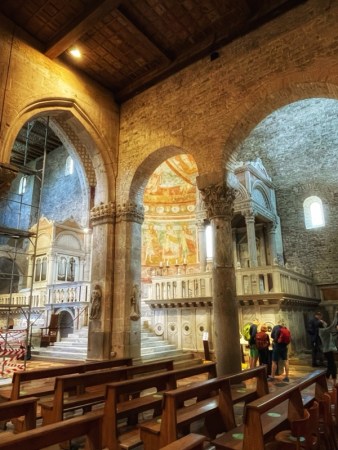
Today, due to the fragile nature of the restored mosaics, we must walk along the edges of the room on raised pathways. One can be seen on the left of the above image.

The purpose of this walk was and is to bring us face to face with the transept and its ingress to the sanctuary and the altar. But in the case of this beautiful building, the raised sanctuary (ironically) also offers access to the oldest and deepest part of the basilica in the form of a descending narrow passageway that opens into the magnificent crypt.
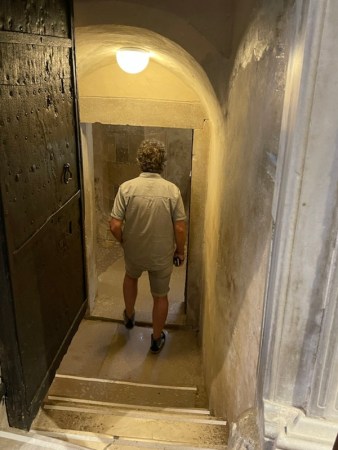
And what a crypt…


Soon it was time to take our leave and, via hastily drunk coffee, walk the mile or so back to the canal dock, where our boat back to Grado now waited…
We have plans to return, hopefully next year.

This concludes the series on Aquileia.
©Stephen Tanham 2024
All photos taken and processed on an iPhone 12 ProMax. Illustrative images created using NightCafe Studio AI.
Stephen Tanham is a writer-photographer and mystical teacher. He is the founding Director of the Silent Eye, which offers a monthly Zoom-based gathering of companions, each one on their own, unique journey to deeper states of self-realisation.


 Sun in Gemini
Wow! Simply amazing. I’m sure you’ll be back.
LikeLiked by 1 person
I think we will 😎
LikeLiked by 1 person