
Share this:

Ali’s anticipation of our coming workshop…

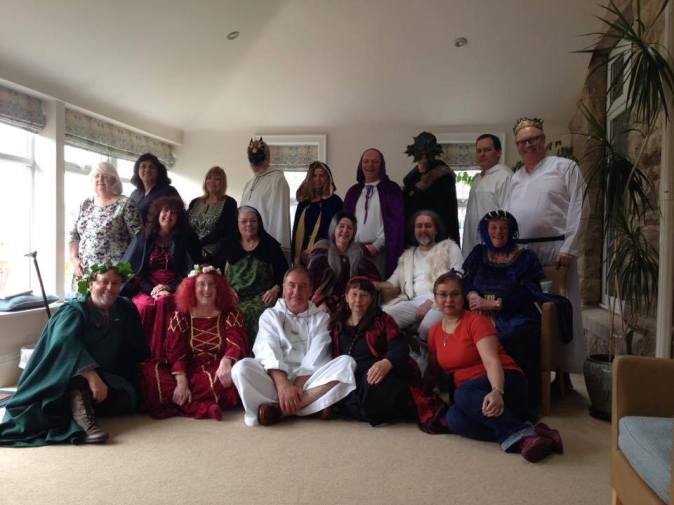 The Silent Eye School of Consciousness, a Modern Mystery School –(https://thesilenteye.co.uk/) – was born in April 2013, after its three Directors (Stephen Tanham, Sue Vincent – https://scvincent.com/ – and Stuart France) had laboured long and lovingly to bring it into the world.
I already knew Steve and Sue from Ritual with Purpose and Gathering of Light weekends run by Servants of the Light – and, when I heard about Silent Eye, I was keen to come along, witness its birth and meet up with friends both known and, at that point, unknown.
That first April very much set the tone, and the tight seal of friendship, upon subsequent ones – and, no matter what’s going on in my life, the end of April is always bright upon my calendar and the workshop booked and ready.
I am trained in ritual magic. I have also been a member of…
View original post 419 more words
Share this:

+ #Silenti, Consciousness, esoteric psychology, Mystery Schools, nature, Silent Eye School, Spirituality
Intimate Flames – #Silenti
by Steve Tanham
What is it to be intimate? The touch of a lover’s hand or lips, perhaps? Two bodies locked together in desire for a common fulfilment; the intellect muted while the emotional and sexual energies dance their own bolero?
We generally associate intimacy with the body, but it’s not always so, and the exceptions can point the way to something much deeper…
The body has its own wisdom, and lives by an organic truth. We can play all sorts of games with our minds, but a bodily ‘state’ is just that – an undeniable and persistent experience that has no form outside of its representation as pleasure or pain. As such it exists at a level beyond misrepresentation.
The ability to move, especially two beings together – like when we dance – might be considered another physical aspect of intimacy, and certainly forms an abiding part of physical passion.
Can we move beyond the physical and retain intimacy? Can intimacy also be exchanged around a dining table, when the pressures of the day give way to a sudden sharing of moment? Or at a meeting with a close, but non-sexual friend, one that we might not see for another decade or so?
Encounter is a good word to set the scene for real intimacy. It implies something new in that meeting of body, heart and sometimes mind – although our usual level of mind can introduce as many problems as it seeks to solve.
We might substitute encounter for what happens in this intimate context; yet how can there be anything new from two organisms that have shared much, before? We could have said ‘different’ and our minds might have felt more secure. Mind can understand different – it builds its picture of the world – our lives – out of differences…
The essence of these kinds of intimacy lies in their potential for opening a new level of awareness – even if that lasts only for seconds or less. In that moment we can glimpse a far more peaceful, harmonious and ‘speaking-to-me’ level of life, as though a liquid nectar has poured from another world into this one.
The deeper level of ‘speaking-to-me’ is not an experience, it is a certainty. There is no room for doubt in one who finds it. The finder moves from possibility into knowing.
Many kinds of love can point the way. Some of them, like the moment of orgasm, are brief, though wonderful. Others are calmer and longer-lasting. Mysticism is founded in the the personal unveiling of the deep intimacy of something behind the self. Many words have been used to describe the qualities of what is found, yet all are doomed to be approximations. Words come from the mind, and the mind is incapable of experiencing what is known without reason.
Only the heart, understood fully and not the subject of romantic trivialisation, will take us there. This is true meditation. To follow that path is to take the openness and trust that normally accompanies physical intimacy and offer it, internally, to that which lies above the mind and is wedded with the heart. This state, if spoken of at all, is referred to in hushed or symbolic terms. One of the best of these is what the Sufi mystics have called ‘The Beloved’.
There is a deep mystery about the beloved that can only be found through a personal journey. She has always been present. She waits; and the only key that will open her chamber is that offering of love, trust and presence spoken of above.
We may think that we already possess these qualities, but life, in its development of the personality, takes the ‘brilliance’ away from our existence – it becomes more important to be secure than to be occasionally touched by the inner parts of who we really are. A certain resolve is needed to re-learn the essential qualities, and then refine them from the darker clay that the outer ‘us’ has become. It’s not an easy journey, but it is mapped out, in many reliable forms, including the Silent Eye’s three-year correspondence course.
We might liken the quest for this deepest of intimacies to the re-finding of a ruby jewel, given by Mother to us in childhood, and which was subsequently lost. For years we searched for it, gradually surrendering to the fact that the vague and fading memory of its glory was all we had left of what was once so precious.
And then, one day, we enter a room in a strange and quiet inner state, to find a drawer in an old cabinet whose existence we had forgotten. Inside is a glowing red jewel, more intimately connected to everything in our lives than we could possibly have imagined.
From then on, the journey becomes one of the heart rather than just the mind, though the mind also finds renewal in the ruby rays, allowing something special to happen to its nature, too…
©️Copyright Stephen Tanham 2017
Share this:

Share this:

When the war is over will we go down to the water, again?
Was it like this, for Rene and Georgette Magritte
Did they walk in the park by the lake and smile
And hold hands while their world went to hell
Should we put scratchy records on the dusty machine
And dance in our underthings, or maybe something more
While the hissing records play?
⦿
How did they get so scratchy, those old discs?
Did we forget to get them out and wash them
And show our youth the glory of the covers
Did we not show the younger ones the joy?
Or, maybe, the younger ones already know
And the scratchy records are just scratchy, older people
Who have no time for what has not yet passed.
⦿
When the war is over will we go down to the waters, again?
©Copyright Stephen Tanham 2017
Share this:

Share this:


How do you make a wrier’s day? Leave a review.
How do you make their year? Leave a review like this!
I make no apologies for reposting this… the best review we could have wished for!
A Book Review by author Paul Adruss
The Initiate
by
Sue Vincent & Stuart France

I have only read spiritual writing as a tourist, never a seeker. Yet I am often captivated by the images the words conjure in my imagination. Sometimes it feels like a thousand lights are turned on inside, while I peer greedily through a chink in the curtains. Standing open-mouthed, gawking in wonder at glimpsed fragments, without ever knowing the whole.
Is this not our world? The infinite casually swapped for the instant; meaning for sensation. We insatiably wade through today in search of tomorrow, relegating each experience to yet another tick on the bucket list. Tick… tick… tick… tick……
View original post 37 more words
Share this:


image source CC BY-SA
Pity poor King Canute (Real name ‘Cnut’ pron: Kn-ootr). He went down in English history as the King who was so self-important that he sat in a ceremonial chair on the beach, ordering the tide not to come in…
Only, according to many leading historians, he didn’t…
This intelligent eleventh century ruler of England, Norway and Denmark – the ‘North Sea Empire’, as it was known, had conquered the English by force of arms, but sought to rule with fairness. The gesture with the incoming tide was to illustrate that the only Will that really mattered was of a much higher nature than his own. He carried out the quoted royal act to illustrate his impotence in the face of God’s will, expressed through nature’s forces, to show that even Kings were subject to higher laws.
We could call this the art of ‘acceptance’, but there is a modern use of the word ‘allowing’ that ascribes a more potent meaning. Potency is the key, here; one will subsumed into another – a greater flow that we are all part of – one whose nature, though often unpredictable, is both to support and teach us…
Many would dispute that, believing that the hostile world of nature is one which teaches us only survival – and devil take the hindmost. It’s an attitude prevalent in some sections of modern political life, who feel that liberal values and compassion have gone too far and it’s time to look after ourselves.
We can liken life to a river. We can stand on the riverbank and observe a part of the river that constantly changes as it flows past, or we can jump in and be part of the river’s life, taking our chances. In the former, we are completely passive to the great flow, and likely to have a stagnant, if safe, existence. In the latter, we can, at least, exercise our own choices about how we navigate the fluid body around us – and to recognise that we are very much made of the same stuff, with one special attribute.
We can swim – that act of staying alive is analogous to surviving to reproductive maturity. Better swimming produces the art of direction: we can choose where in the immediate flow we wish to be. But we can’t choose (unless we want to daydream) to be somewhere unrelated to where we already are; we can only get there by a series of heres. And there may have changed from our perceptions when we get to it… You can’t anticipate reality, you can only be it.
We can do nothing about that nasty fork in the river’s flow, just ahead of us; nor the rocks we narrowly avoided a minute ago. We have our dominion, and it’s largely around our intimate space. If that floating log behind us gets any closer, we have the right and the ability to fend it off, but not to choose whether it’s there or not.
The ‘Life in a River’ idea can teach us a lot, but it’s finite in its extensions. At the heart of all the world’s truly deep spiritual traditions is the idea that things are really perfect if we can only see them objectively. Nothing I know of causes more unrest in the modern intellect. We cry out that we haven’t come this far in evolution to surrender to blind and stupid forces, intent on eroding our values and way of life. We’ve climbed out of that bloody river, says the angry self, and there’s no way we’re going back – even if most of humanity are still in there…
At the heart of this tale of the riverbank is an erosion of fundamental trust. Psychologically, we come into our lives with total trust, experienced as oneness in the womb. This absolute trust is eroded shortly after birth when the harsher, separated world – even with Mother’s help – cannot satisfy all our needs. The egoic self, (used, here, in its positive connotation), develops from this, shedding trust and learning fear as it develops to fend for it-self.
Civilisations go through this kind of cycle, too, though the cycle time is very much longer. Families understand compassion, but extending that boundary into a society involves bumping into power and greed and they often have guns and want to control through trust in fear.
The parable of the Prodigal Son is a good example of a wisdom-story designed to help those ready to understand what happens if you leap into the river. The symbolic son, leaving home, has to make his/her way in the world, but eventually comes to realise what a store of providence was already on the table at home. The price of that return is his experience, bitter and wonderful, which he ‘lays’ on his Father’s table, while his uncomprehending brother looks on… from the riverbank.
In mystical terminology, the Prodigal Son flows out, at the end of the river’s course, into the sea, realising that what he/she truly is, is the water made conscious – infinitely changing and unending. The ‘forms’ of those left on the riverbank lose their vitality, eventually, and decompose to become part of the life of the soil, again. Nothing wrong with that, but we can imagine that the sparkling sea is more fun?
To even speak of such things can mark you out as crazy. To be a King and attempt to demonstrate them may always be doomed to failure. But what’s the harm in trying to be a misunderstood Cnut once in a while…
©️Copyright Stephen Tanham 2017
Share this:

Share this:

Share this:

Share this:


I have a notion
That eons’ light and dark
Have left their mark
Upon our inner ocean
➰
I have a shadow
Whose lengthening crease
Is cast on mood and body’s peace
When walking muddy meadow
➰
We have duration
The dog and I endure the grime
Of Cumbria’s winter prime
Intent on silence in privation
➰
But then…
➰
Like surgical precision
Spring’s herald of the special day
Will set that spiral switch to ‘play’
In alchemy of healing human fission
➰
Enduring soul, dark knight
That through the darkening days
Must hold and trust in its own ways
Embraces reborn outer light
➰
©Copyright Stephen Tanham 2017


You must be logged in to post a comment.