
The ‘Heart Unafraid’
Share this:


We Trudge treacherous trails
Rough mountains and the thorny plains of tomorrow
We listen as landscapes keep up their crying
Memorizing wounds and their places
Hot sun rises, leaving burned faces
Here, human hatred, there is no shade
We taste the tears of the left behind
Wander the day, sharp with remembering
Never stop building
The changes we wish for our children
Never stop moving
Toward something, anything good
Again and again feet step around boulders
Hearts heavy with sorrow
We are holding onto the edges of hope
Often simply for balance
The vision blurs
The directions weave in front of drooping eyes
We fall, but do not lie down
We stand, but are never still
Only the steps, one, and the next
Out into a sharp and staggering world
Stumble through actions
Hope the helpful ones take hold
Whatever end you are seeking
You might reach it on the…
View original post 53 more words
Share this:

River of the Sun, chapter 18 – Rider on the Dawn
The marshlands by the great river gave way to the firmer, broken rock of the valley’s floor as the mule track climbed towards the far hills. The many trails fanned away on either side, as the possible destinations thinned to a single, rocky path. The great white horse did not slow in its thundering passage. The finest breeders in Egypt’s long history had gradually refined the purposeful form of the mighty creature which now bore its rider up the steep incline in the pale light of a the high desert’s pre-dawn, with barely a faltering of its elegant speed.
The air was cold, but the rider felt little discomfort, assured within his lithe and powerful young body of the limits of his endurance. He did, though, pull his cloak around him against the last of the short night’s biting breeze. He smiled at the brightening rocks as mighty Ra edged over the far hills beyond the East bank of the great river, covering in a breath the distance the horse had travelled in the whole time since the boatman had rowed him ashore and made ready his prepared and favourite mount.
He liked to ride with the dawning sun behind him. It brought him into alignment with that very special feeling within his breast – that sense of immense destiny. He knew his real life was about to begin–could sense his passing father’s imminent death on the wind.
Pharaoh at last! No longer just the youth, the boy-regent, the King-in-Rising. Now Egypt would tremble in obedience to the ways of his mind, to the cleverness of his strategies; and he would, of course, tell them as his campaigns brought riches flooding into Egypt’s coffers, again, how very fortunate they were to have the Unchosen as their God-King.
Except that he never used the word Unchosen. It was his private key to inner power. It was a word that described how he would spring back from adversity, overcoming what may have appeared to have defeated him, what had stood in his way, as he played with it… teasing out victory in the manner of the truly confident warrior. “Learn to build greater edifices, Egypt,” he shouted at the dawn, “you will need them to honour me!” His voice, thin in the cold air, dissipated, unheard, on the ancient rocks that were turning to gold.
Approaching a plateau, he slowed and wheeled his great steed around in a tight circle. He let it rest and breathe, reaching into his well stocked provisions to open a skin of water and let it drink. He pushed himself high in the saddle. Now facing East, he had to shield his eyes from Ra’s glory as the rays streamed along the paths he had ridden, creating a shimmering ghost of his journey. “See how Ra honours me!” he shouted at the dawn.
And then his eyes caught the newly glowing top stones of the Isis temple on the island from which he had made an early departure, secure in the knowledge that his orders would be creating havoc, below. “I will have you, Neferaset!” he shouted into the golden light, his loins surging with energy. “But when all your choices have dried like water on the sand…” the white horse pawed the rock before them both, adding to the combined symbol of power, “…then you will come begging for the touch of royal flesh!”
He thrilled at the thought, imagining how he would prolong their lovemaking, how she would marvel at his prowess as her own body betrayed her in its writhings. But, then, she would be discarded, another fallen priest, if a pretty one. Trust none of them, his father had said the last time they had talked, the last time – he now knew – that they would ever talk. Events in Thebes had turned his father’s loyalty against the resurgent priesthood. There is coming a new age, he had said. In which the royal line will need to be much cleverer than its priests… Cleverer. That had become his watchword, first-chosen or not. A new age… and the mind would be the arrow that took the new royal line forward into that golden tomorrow.
He looked down at the vision of the brightening temple on the island far below. His beloved Talatat would be waking to the possibilities of the day, would be stretching mind and body in the service of the wishes he had left in coded form, written on Obion’s scroll. Poor Menascare, he thought. What chance do you stand now? He laughed, a bitter noise against the golden force of the rising sun. Perhaps it is time for you to die along with my beloved father?
The wings of light streaming over his head formed themselves into an imagined escort as he turned Salama to face their upward path, again. The narrow plateau echoed one last time to his laughter, and then there were only falling motes of dust to mark the passage of the rider; that and the sound of thundering hooves on the single trail.
—
The dull ringing of two alabaster goblets striking each other was an incongruous accompaniment to the rising of the sun over the natural walls of the place Rameses had named, The Crescent of the Lost. Sarkur was uneasy in the gesture, just as he was uncertain about the wisdom of drinking temple wine so early in the day, if at all…
“Come, old friend,” said the royal rider, smiling through the unwiped film of white dust that covered his face. “Drink with me and we will mark the birth of the day that will see you finish my Tower.”
Sarkur the Stonemaster did as his companion bade him. But sipped the wine, rather than gulping it down in his companion’s fashion. “Majesty,” he said. “We do not know if there are enough hours in this day to accomplish the task!”
Despite his years of experience with Seti, the master builder took no chances with his son. It was like dealing with a snake, indeed, one of the early royal child-names of Rameses had related to that similarity – and the watchful stare of his early guardian. You had to be certain of your intent before you responded – if you responded at all… Now, in the full glare of the other’s unblinking gaze, the older man swallowed, acknowledging by gesture that he was uncertain of the wisdom of what he had just uttered.
The Regent raised his hand, and, for all his strength, Sarkur winced at the anticipated royal strike. But Rameses cupped his head to his ear. “Hear that, Sarkur?” he said, smiling in a way that was more chilling than any royal rage could be. “Do you know what that is the sound of?”
Sarkur gulped at the wine, despite his earlier resolve. He looked down over the edge of the tower. Below, and under the Regent’s careful guidance, his men had formed a perfect moon crescent around two-thirds of the base of the edifice. The pillar on which the two were seated rose out of this cradle, phallic and proud. The human crescent mirrored the canyon walls in this airless place. Seated on the ground and chanting their prayers to the distant royal household, the stone workers below kept their eyes to the ground, well away from those of the royal predator above.
“He’s dying, Majesty.” said Sarkur. “They lament the passing of their great King,” and quickly added, “and the great fortune which sees his son, the King-in-Rising being with them at this terrible time…”
“Terrible?” whispered Rameses, looking up at the clear, blue sky, with its burning heat, and smiling, cruelly.
“Would you not rather be there, Majesty – at your noble father’s bedside while he passes from this world?”
Rameses lay back onto the stone platform, letting his palms touch the stone, and feeling how the heat had begun to make the perfectly sculpted blocks intolerably hot, despite the earliness of the hour. Sarkur watched as the Regent’s fingers traced out the strange design which the Stonemaster had, himself, carved and fitted.
“My father is Pharaoh of the whole world, Sarkur,” said Rameses. “It does not matter where his body is, he will pass from all the places in this land as sweat passes from the tiny caves in the skin.”
“This, then, is your chosen place for your witness-watch?” asked Sarkur, gently.
“There is no right place,” answered the royal son. “He is a great man and his passing may be honoured by all, everywhere…” his lips formed a narrow line. “And why should I bow to the rituals of another clutch of Priests?”
Sarkur said nothing, holding his breath and willing the moment to pass.
“Life and death,” said Rameses. “Your men are making the sounds of life and death.”
“Majesty?”
“This very platform is a place of life and death…” He turned his body over, lying prone on the hot stone and looking down over the deadly edge, again. The heat passed quickly through his robes, warming his lower body. The energy reminded him of the ride up to the Tower, of the heat in his loins at the thought of Neferaset’s slow demise. “Be careful which you choose, Stonemaster…”
Rameses uncurled and sat up, his strong back sinuous and flexible in its raising of the royal head. He held out his goblet for Sarkur to join him in the gesture. The older man did so, but much more awkwardly.
“To life, then, Majesty,” the Stonemaster said.
“To death,” said Rameses, the fingers of his other hand idly tracing the edge of the strange design now set into the stone. The Cobra’s eyes were fixed on the far horizon, where, through the smooth gap in the crescent canyon’s wall, the end of the trail up which he had ridden was visible.
But Sarkur was not following the King-in-Rising’s gaze. He was studying, in minute detail, the patterns made by Rameses’ stroking fingers.
——————————–
Index to previous chapters:
Chapter One – Gifts From the River
Chapter Two – An Agony of Sunset
Chapter Three – The Dark Waters
Chapter Four – Touching the Sky
Chapter Five – The Fire Within
Chapter Seven – The Crystal Air
Chapter Eight – The Unchosen Darkness
Chapter Nine – The Priestess Calls
Chapter Ten – Darkness at the Door
Chapter Twelve – Above and Below
Chapter Thirteen – The Binding Voices
Chapter Fifteen – The Intimacy of Enemies
Chapter Sixteen – Old Friends, New Dangers
Chapter Seventeen – The Rule of Three
—————————
Introduction to River of the Sun
In April 2015 a group of people gathered in the Derbyshire hills to enact the Silent Eye’s annual Mystery Play, entitled, The River of the Sun. The five-act mystical drama formed the backbone of that Spring weekend, and told the fictional story of a clash of ego and divinity set in an Isis-worshipping temple located on an island in the Nile, during the the fascinating period of the 19th dynasty, the time of Rameses the Great.
The 18th and 19th dynasties were a period of deep upheaval for ancient Egypt. The reign of the ‘Heretic King’, Akhenaten saw Egypt’s religious structure torn apart, as the revolutionary Pharaoh became what Wallis Budge called the ‘world’s first monotheist’; re-fashioning the power of the many Gods with one supreme entity – the visible sun disc, the Aten, for which Akhenaten, alone, was the high priest. Many have pointed to the failure of the ‘herectic’ Pharaoh’s politics, but few have doubted the sincerity of his religious vision. He will, forever, remain an enigma.
Whatever the nobility of his goal, the actions he took were ruthless, and included the shutting down of the annual deity festivals which were the sole point of ritualistic contact between the ordinary people of Egypt and their locally-worshipped gods. In addition, Akhenaten paid little attention to the domestic and military affairs of Egypt, allowing the country’s enemies to encroach on its borders, greatly weakening Egypt’s power at that critical time for the region.
After Akhenaten’s brief reign, culminating in the Pharaoh’s mysterious death, shadowy military forces took control of Egypt, instigating the 19th dynasty in the persons of Rameses I and, soon thereafter, Seti I, whose throne name derives from the god Set – often considered the ‘evil one’ because of his slaying of his brother, Osiris.
Seti I is judged by modern historians as having been one of the greatest-ever pharaohs, yet his importance in the 19th dynasty was eclipsed by the actions of his second son, the brilliant Rameses II, whose long reign of over sixty years included much self-promotion and the alteration of Egypt’s recent history. Both Seti and Rameses II (Rameses the Great) were passionate about the evisceration of the last traces of Akhenaten’s ‘chaos’, as they saw it.
But, although, by the 19th dynasty, the the ‘Son of the Sun’ was long dead and the buildings of his embryonic and doomed city of Tel-al-Armana were reduced to rubble, something of that time remained in the Egyptian consciousness. A new kind of connection between Pharaoh and God had been established, one which elevated mankind, if only in the being of the Pharaoh, to be someone who ‘talked with God’. It was, at the very least, a bold experiment and, though the world would have to wait until the 19th century to re-discover the ‘erased’ pharaoh, the philosophical waves of that period rippled out and dramatically affected the way the incoming 19th dynasty had to repair the worship of the Gods, uniting the people of Egypt under a trinity of Amun-Ra, Khonsu and Mut.
Our fictional story is a tale of politics, friendships, mind and faith. It is set against an historically accurate background, and at a time when Rameses was due to take the throne from the dying Seti .
Returning to Thebes in his swift warship, crewed by his fearsome Talatat mind-warriors, Rameses decides to mount a surprise night-time raid on the island-based Isis temple which has prospered under the sponsoring reign of his father. Rameses suspects that the inner teachings conducted by the revered High Priestess and Priest conceal views that relate to the thoughts of the heretic Pharaoh, Akhenaten. He plans to insert himself and his warriors of the mind into the islands’s Spring rites as the high priest and priestess begin a cycle of initiation for a chosen apprentice priest who has proved himself worthy of special advancement.
The resulting clash draws everyone, including the young Pharaoh-in-Rising, into a spiralling situation where each is forced to confront their own fears as well as living out the roles which life has allocated them. River of the Sun is the story of a spiritual and political encounter from which none emerge unchanged, including the man who will shortly be Pharaoh, the mighty Rameses II, whose secret name for himself is ‘the unchosen’.
Through the eyes and minds of those surrounding the chosen priest and the ‘unchosen’ Pharaoh, the River of the Sun takes us on a tense and compelling journey to the heart of power and its eternal struggle with truth.
The chapters of the book will be serialised in this blog. The finished work is planned to be available in paperback and Kindle in the Spring of 2016.
————————————————–
River of the Sun, serialised here, and its associated images, are the intellectual property of Stephen Tanham and is ©Copyright material.
Share this:

More Stuart inspiration… Clearly written after a second or third breakfast…


“Right, if we start from Midwinter…”
“You’re going to have to rename all the months.”
“…Not necessarily.”
“Why not?”
“We want to get beyond names.”
“Beyond names?”
“Before the months were named there was a metaphor of the year.”
“And the metaphor of the year was what precisely?”
“The metaphor was the year as fire, or better, as a fire.”
“How do you know?”
“Because all the autumn months are still ’embers’.”
“The year, like a fire, rises to flame after first being kindled and then dies down to ash?”
“To ash and more, because there always is. So we will have three kindling months, three flaming months, three ember months and an ash month.”
“But no names?”
“Not to start with. There might, though, be names later.”
“So how are you going to distinguish the months?”
“As First, Second and Third Kindling… etc. Are there any more questions?”
The…
View original post 327 more words
Share this:

How to be alone … for lonely is a freedom
by Steve Tanham

HOW TO BE ALONEby Tanya Davis, poet, songwriter and singer. Her style is primarily spoken word set to music. She performed in this video, which was directed by Andrea Dorfman. Andrea did the animation. She is a screenwriter as well as a director.
The film was shot in Halifax, Nova Scotia. As of this writing, this poetry video has had more than 7,620,000 views, which is a league of its own when it comes to poetry videos. As ar as I know the only poet who gets those numbers – actually twice as much – is Shane Koyczan, also a Canadian and a spoken word poet.
After making the film Tanya and Andrea put together a book, How to Be Alone (Harper,2013) with the poem and illustrations. Tanya also has a published poetry collection, At First, Lonely (Acorn Books, 2011). The former, I think, makes a good gift for someone after a…
View original post 32 more words
Share this:

Nine minutes to One – part one, The Bridge of Falling
Later, they told him that he had not come from the mountains.
But that was much later…
In the beginning there was a storm on a mountain top. He is falling, tumbling, blown by the gale as he falls, like a thing that no longer has a home there. There is lightning and fire and pain… The wind laughs as his garments are flayed from him… For a second two other lights blaze over his left and right shoulders, but they leave, ahead of him, and disappear into the dark distance. He knows it will be a long time before he recognises them, again.
Then there is no more sharp rock, and the falling is through air and then through the coolness of water, which is bliss, but strips from him the last of the memories of those heights.
And somewhere, there is laughter; for it has begun…
He is rolling now, turning again, but much more slowly, this time. He is struggling to see as he emerges into air again. The brightness of the origin is gone; there are only shadows here… and steps. Black step followed by white step, and then black step, again; and he has no control as he tumbles down the hard steps and shrinks and rolls, bruised and, apart from the tatters, naked, into the middle of the clock face.
She of the shadows forms from the stuff of this world and looks down at him, curled on the floor. He experiences but does not know. Knowing will come later, he knows… He thinks on the irony of that sentiment, how can he know what he does not know? Then he looks up at her tall presence and smiles. It seems like a good thing to do… It seems like the only thing to do.
In her soft arms and against her warm skin his mouth completes the forgetting. The liquid of this life fills him, becoming the blood that flows through the world within – the world that is not him but is where the ‘him’ locates itself… and the shadow becomes brighter, alone in his world, where his every small need is met.
But not the larger ones…
He knows he is where he is supposed to be, as though some agreement, some pact was made before the time of the mountain. He does not know who he is; and, in this world of shadows it is essential that he knows who he is. Without knowing who, how can he act, and know that it is himself acting? There is acting, which is power; and there is who, which is identity. This who will be a poor shadow of the forgotten, but it will be a start…
And as he falls to sleep, full of the white liquid of this life, he knows that the who will also give life to the blood that flows inside him, endowing it with far more than came in with the white liquid…
And then there is only rest and the dreams.
And the warmth of loving flesh.
Share this:

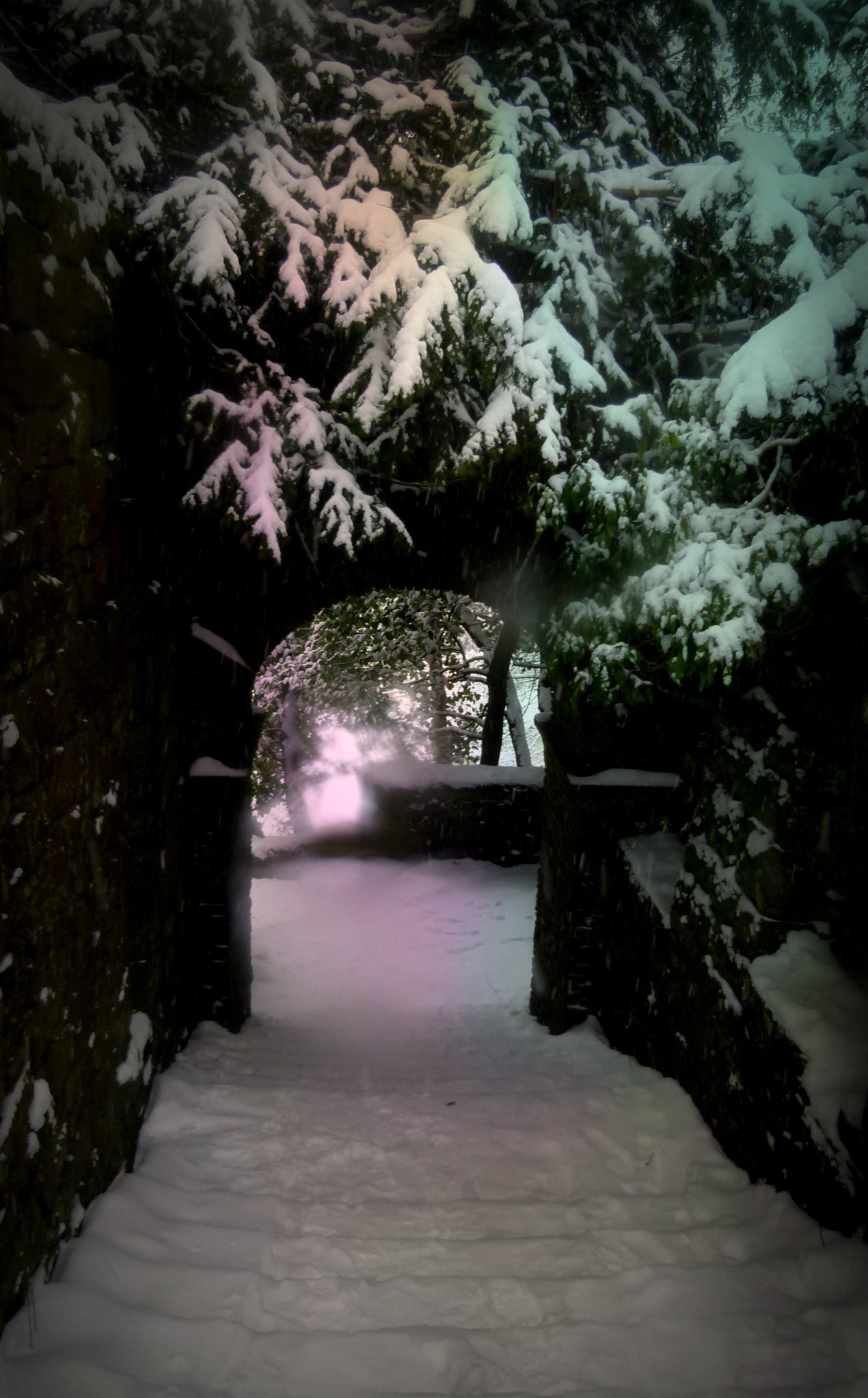
In response to Sue Vincent’s photo prompt – The Stairway
http://scvincent.com/2016/03/25/photo-prompt-the-stairway/
(In the style of Sufi poetry)
Frozen Steps
—-
Examine frozen
Find your rhythm
In the tapping of ice crystals
—
With your most foolish foot
Slide forward the sole
And feel the danger
In the deadly realm where
Blood and pain meet
—
And then
—
Disregard them all
In noble purpose
And, stripping fear back
To where no fall rules
Descend to love
——-
©Stephen Tanham, 2016
Share this:


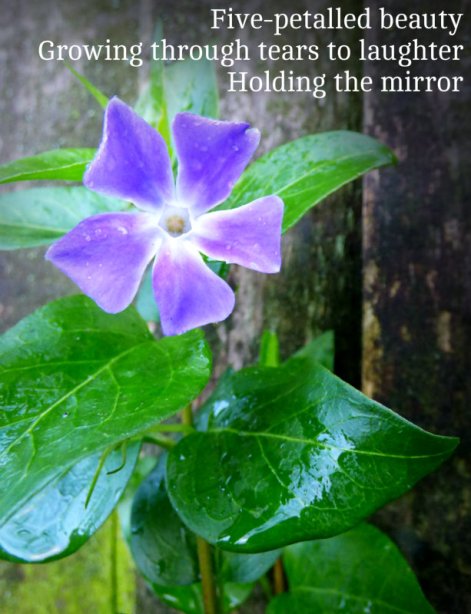
The long stems of the periwinkle, vinca major, were used to make garlands and their Latin name comes from vincio, ‘to bind’. Periwinkles have been used medicinally for centuries, principally for its astringent qualities and to help stop bleeding. It is also used by herbalists to help diabetes. In folk medicine, an ointment of lard and the bruised leaves was used to reduce inflammation. Its older herbal history, though, is somewhat more colourful.
One old name for the plant is ‘cut finger’, referring no doubt to its ability to stop bleeding.
In Germany it was known as the Flower of Immortality, while in Italy it was flower of death and used to garland the biers of children.
In Macer’s 16thC herbal it is referred to it by one of its common names as Joy of the Ground. Another name is violette des sorciers… the sorcerer’s violet and…
View original post 89 more words
Share this:

+ Ancient Landscapes, Bakewell Jail, Ben's Bit, Doomsday series of books, esoteric psychology, Silent Eye School
Ben’s Bit, part 15 – Bolero
by Steve Tanham
Ben’s Bit, part 15 – Bolero
At first, I think it’s a memory of a dream – of that night when knowledge of the unknown Miss Goodnight, soon to be Golding, came into my life. The heels on the concrete corridor this time are tapping a slower rhythm. It passes my cell door, rendering me fully awake, then diminishes as she walks further along the corridor. There is a missed beat as something happens, and I can hear a scratching noise as though one of the shoes is being reinstated; then nothing but the silence of agonised thinking as a direction changes in the dim light out there in one of the darkest of Bakewell Gaol’s old corridors…
And then the heels are coming back… This time they stop and linger at my door. I am, by now, fully awake, and I rise from my bed and slip on my dull, grey, prisoner’s overall and stand facing the door.
When the door opens without the sound of the old key turning, I have to check that I am actually awake and not in a dream. I suspect it has not been locked since Roger Sylvester brought me the tea, in a kindly gesture that left me wrecked for hours afterwards, but something has blocked me from trying it… as though it would be a betrayal of Roger’s obvious trust in me…
But, now, it is not Roger who stands before me. Miss Golding, in all her slightly inebriated beauty, clicks into the cell, carrying a bottle of red wine, two plastic glasses and a carrier bag from Marks and Spencer.
“Tell me to sod off, if you like,” she says, simply, opening her eyes wide to punctuate the question. Just at that moment, she looks a lot more vulnerable than I feel, which, in itself, is considerable…
“Why would I do that?” I ask her, stepping aside and indicating that, heels notwithstanding, the wine would be safer on my small table. “It’s not like I get a surfeit of visitors.”
She’s more sad than drunk, though a degree of alcohol has played its part in her being here.
“Told him to take a hike,” she says, sitting down on the bed. “Told him to take his twisted mind and lacklustre body and stuff it…”
Whatever it is, it has begun. The wings of this and not-this are beating over my head, A world is being separated, polarised.
“Some wine?” I ask, delighted to be re-acquainted with my second favourite indulgence. Fortunately, the bottle is a screw-top and, seconds later, the gentle and familiar sound of pouring wine brings delight into the dank air of the cell. As she pours, the smell of her perfume fills the air and I realise how much you can miss something…
“Don’t worry,” she says, chinking the plastic glasses which produce a dull tap, but it suffices. “He’s gone – flounced off in a rage… typical!”
I sip some of my wine. “I assume we’re speaking of Dr Grey?”
“Yes,” she replies in a little girl voice, then takes a deep breath and pulls herself back to adulthood. “The renowned Dr Grey…” she draws out the word ‘renowned’“. “Who screws his lively assistant any time he can get the the keys to the interview room…”
It’s an admission that doesn’t surprise me. What surprises me is that she’s here in my cell, and we’re drinking red wine…
“And they’ve all set it up so carefully,” she glugs some more red. “and they didn’t think there’d be any cracks…”
I almost daren’t ask. “And it all centres on me?” I ask, incredulous.
“You just happened to be here at the right… sorry wrong time,” she says putting her free hand out and stroking my thigh. “I realise that this is not a game for you, no matter that those bastards think…”
“Those bastards?” I ask quietly, refilling her glass, and wondering about the all-important plural.
“Don’t ask,” she says, having some more red. “More than my life’s worth – I’d never work again… not in this field anyway.”
Knowing a lot more than I did, I leave revelation to take its own course. Another half bottle of pleasant small talk and she gets to her feet, less steadily this time, and beckons me to follow.
We stand facing each other. It’s a seminal moment…
“Take the overall off,” she says. She’s a woman who knows what she wants. It’s refreshing… especially as I appear to be it.
Smiling like it’s Christmas, I pull down the zip on the hated garment and step out of it, revealing my rather average body and a pair of standard issue white boxers. She looks at the pale, winter skin and smiles, then takes a new shirt out of the Marks and Spencer bag.
Presuming nothing, and somewhat confused, I reach for my wine and sip it while I watch her fingers expertly dispense with the packaging. She shakes out the shirt, “Sorry about the creases.” Then she pulls my arms up and slides the pleasant blue shirt onto my torso. Soon she is doing up the front buttons, leaving the cuffs to flap.
Finished, she stands back and drinks some of her wine, while she surveys my new outer layer.
“Nice,” she says simply. “Sorry about the creases…” With that, she puts down her plastic glass and slides her body into mine. Her precise nails slide up my back, making her intentions very clear as our midsections dance.
“Just wanted to see you in something beautiful before I undressed you…” Miss Goodnight says, with tears in her eyes.
But they are tears which do not diminish her ardour…
<See index below for other parts of this story>
———————————————————–< to be continued-
Ben’s Bit is a continuing first-person narrative of the character created by Stuart France and Sue Vincent, which may bear some relation to the author of this story, Steve Tanham, their fellow director of the Silent Eye School of Consciousness. In the latest of their books, Scions of Albion, Ben is arrested for his overly enthusiastic part in a mad escapade, and the other two are nowhere to be seen . . . For more, enjoy their Doomsday series of books, and the new series (Lands of Exile) beginning soon. Click here for details.
Index to Ben’s Bits:
Part One, Part Two, Part Three, Part Four, Part Five, Part Six, Part Seven, Part Eight, Part Nine, Part Ten, Part Eleven, Part Twelve, Part Thirteen, Part Fourteen,
Sue Vincent describes her and Stuart’s perspective on Ben’s imprisonment: Part One, Part Two
The Doomsday Series of books by Stuart France and Sue Vincent
The Silent Eye School of Consciousness – a modern mystery school.

Share this:

+ Greek Myths, Hercules, Higher Mind, Journey of the hero, Labours of Hercules, Mystery Schools, myths and spirituality, Silent Eye School, Uncategorized
Nine Deadly Sins with Coffee, part 54 – The Tower of the Red Figures
by Steve Tanham

Nine Deadly Sins with Coffee, part 54 – The Tower of the Red Figures
.Alexandra.
There was a coffee, a rucksack and a small, red, paper person waiting for me when I arrived at Rose’s Cafe that last Monday morning.
But no uncle John…
The coffee was hot, so I knew he had been there. Besides, I could ‘feel’ his presence, even though he was nowhere to be seen.
My sense of unease grew when I unzipped the black bag – the one he had often brought with him to our coffee meetings. Inside was an envelope with ‘Alexandra’ written on the front. I sipped some of the hot coffee before sliding my well-manicured thumbnail under the upper edge and slicing it open.
Inside were a standard-class rail ticket to London, a note and a picture of a place I knew well… Its golden dome a familiar landmark of the area in which our legal chambers were situated.
I picked up the red paper person, which was a crude figure, like a child’s cutout. For a second, I thought it had fallen apart in my hands. But the three paper people, linked hand in hand, opened, concertina-style; the lowest touching the table with its bouncing arm.
For the next few minutes, I sipped my coffee, thinking loudly. Was he sending me on a treasure hunt? I was, as usual, bound for London, anyway. Had he gone on ahead? Was our final coffee talk to be carried out in a different landscape to the native north?
An hour later, I was speeding south on the Virgin Intercity, set to stop only at Preston, Warrington and then on to London’s Euston station. I had used his ticket, even though I already had one for the first-class compartment adjacent. I had only done that because I thought it might be a test and he might have boarded the train, unseen, at the same time. My seat had, at least, been reserved… He had been very thorough in his planning. I noted that, my legal mind working overtime to extract the deepest meaning from this strange experience.
I opened John’s black rucksack, again, and examined the note. ‘The cattle were red,‘ It said. ‘You can make the connections with ease.’ I looked at the three red paper people, spread out before me next to my bacon bun, bought from the trolley as it passed, a poor substitute for the full breakfast being served in First. Beneath the reference to the Labour were the words, ‘Like Heracles, seek the blazing Sun.’
In his final Labour, corresponding to the astrological sign of Pisces, Heracles faces a task from which he may not profit. There is no payment due for his rescue of the Red Cattle, ‘imprisoned’ on an island under the control of the three-bodied Geryon, his double-headed dog, and a mysterious shepherd who has looked after the red cattle for time immemorial. I knew that much, but what to make of the clues John had left me?
I was no wiser when the train arrived at Euston some two hours later – My legal team knew not to expect me before midday on a Monday; I put in the extra hours during the week, no-one doubted that. I had a short time to make some sense of it all. Within minutes, I was speeding in a red underground train beneath the streets of the City and towards Monument – the tube station with the same name as the tower on the mysterious picture. Minutes later, I emerged into the unexpectedly bright sunshine and looked up at my destination. The tower, arrowing into the clear sky, had been built in the seventeenth century to commemorate the Great Fire of London, and was designed by Christopher Wren. It is capped by a blazing gold sculpture symbolising the Great Fire, itself.
There are three hundred and eleven steps to get to the golden viewing platform which forms the base of the massive sculpture. I am a fit person, but each circuit of that spiral was increasingly painful – in heels. On the third, I stopped, mouth open. A larger scale red paper man was fastened to the wall of the ascending stairwell. There was no other sign. I stopped and stared at it, happy to have any excuse to rest my feet and get my breath back. He had been here–and obviously just ahead of me…

After three further circuits of the spiral, I encountered another paper man on the stairway wall; but this one was black. Again, there was no other reference to my increasingly lonely quest.
The final figure came, as expected, on the ninth circuit, but this time the paper man was white. Red, black, white. The sequence triggered a distant memory of a conversation John and I had about the time we were beginning to talk about the esoteric. Now, I remembered that he had said that, from an ancient British perspective, the generic colours of the Goddess were red, black and white… Was I ascending, with much effort, through these colours? Would John be waiting for me at the top?
My heart was hammering in my chest, but I pushed on, clicking in a much slower rhythm on the old stone spiral. With my head hanging on my gasping chest, I staggered onto the viewing platform and looked, anxiously, around. I had to suppress a small sob when I found I was alone. The golden light, reflected from the massive, burning sculpture above me, was intense…but, slumped against the safety rail and gazing down the sixty metre drop to see the masses of people below, I knew nothing…
The revelations started when I began to descend. Passing the white paper man, I suddenly realised that the two-headed dog was a reference to the above and the below, and that Herakles had moved – had graduated – in the certainty of his own light to a being whose home was the above, the causal layer of all Being. He had therefore ‘slain’ the lower, seeing it for the resultant, if useful, shadow it was.
When I reached the black paper man, I became aware that the Shepherd in the story – the one guarding the red cattle – had been spared by the hero because he represented the one who looked after the the cattle; in human terms, the mind of man, woven, in a seemingly inextricable pattern, into the fibres of his being. Of course he had been spared – he was the way forward, once unity of being was established.
Crossing the final threshold of the red paper man, I realised with a smile that I was about to re-enter the world of the red cattle, that the three bodies represented our old friends the instinctive man, the emotional man and the intellectual man – all at odds with each other until the single arrow of redemptive purpose bore through them, as Heracles’ fiery arrow had finally done, not killing them, but fusing them all into a single entity, capable of being guided from above…
And now I had travelled up and then down that arrow, uniting the totality of my experience with John.
The golden sunlight streamed through the portal of the entrance. But, to my right something else red caught my eye. A scarlet rose had been taped to the old, rusty metal of exit’s door frame. With tears forming in my eyes, I took it…knowing it was for me.
And then I was in the street, and people were staring at me. Everywhere I turned people were curious about the woman with the flower in her hands, walking into a new world seen for the first time.
I wanted to give the rose to them, but I had only one rose and there were so many of them. How could I do that?
The sun shone at my back, I could feel its warmth on my head. I did not know what to do, but the previous sense of panic and confusion belonged to another world. In this one, the need to do something would be accompanied by the knowledge of what to do. That, I knew with a certainty.
Somewhere nearby, John might be watching… But it no longer mattered.
Everything that mattered was here… Everything that mattered was now…
End of Nine Deadly Sins with Coffee
If you have enjoyed these episodes; if you have enjoyed being challenged to explore yourself in this journey of myth, magic and esoteric psychology, why not take a look at what the Silent Eye offers to Companions on our three year, self-exploration programme. Click here to link to our website page where you can download a free colour brochure.
The Silent Eye School of Consciousness is a not-for-profit organisation, based in the UK. It has students (we prefer ‘Companions’) on four continents and offers a friendly journey towards the soul taken with the guided help of those who have taken that journey. There is no membership fee and no ongoing commitment, other than to buy the next, monthly lesson. Each lesson is priced (March 2016) at the minimum possible charge to allow us to attempt to break even – £10.00 per month.
Pictures of The Monument, London, from: http://www.themonument.info/
It’s an amazing creation. If you are in London, and you like its history, why not visit?
———————————————————–
Nine Deadly Sins with Coffee is usually published on Thursdays.
©Copyright, The Silent Eye School of Consciousness, 2016.

Share this:


I’d told them before, the chromatic lens effects were just that: blue light…stuff and nonsense…
And they had smiled, kindly, and another pint of Guinness had arrived in the old pub in the forest.
And then the dream came and the bar vanished. And I was in this bright wood, alone with the blue light…and two old stone mills, that whispered, “Follow…”
Now the old wheel is freed, once more; and I go round and round and the voices giggle and the green things grow and grow and grow…”Hello…hello?”
Response to Sue Vincent’s photo prompt:
Share this:


There I was, happily putting a few things together to take north at the weekend… odds and sods that need adding to the things we will be packing to take to the April workshop, when I realised that this could be it… the last time I run north before the workshop… A quick calculation says that yes, it will be just a matter of six weeks away… and I’m not ready!
Deep breath, calm down, panic over…
Okay, so what if I’m not ready… I have six weeks and that is more than enough time for what remains to be done. As long as everything goes according to plan.
Which it won’t. It never does.
And it never matters.
You name it, we’ve had all sorts of crises in the run-up to these workshops, including Steve’s heroic last-minute re-write of the entire script when illness cut our ranks…
View original post 475 more words


 Sun in Gemini
You must be logged in to post a comment.