
River of the Sun, Chapter Nine
The Priestess Calls
Anzety, high priest of the Isis temple, watched from the east of the temple as his sister, Neferaset, the prime figure of authority on the island, entered through the opened portal of the west. The symbols of her status as high priestess, worn at forehead and throat, reflected the candle lights and seemed to shimmer as she moved. With her were Amkhren, the novice priest to be initiated, and Snefer, his only surviving relative and the woman who had raised him, fighting frailty and pain to do so. Neferaset held her hands behind her, bringing both of them into the temple space with an unusual gesture of equal status.
The only noise in the temple was the movement of Neferaset’s golden slippers, as their leather made subtle sounds of sliding contact, carrying the priestess over the crystalline white floor in a movement that resembled a snake gliding over water. Although the temple’s central space was arranged as twin circles – one inside the other – within each of the rings there was traced an equilateral triangle of marked points; its head being in the east and its twin tails spaced equally to divide the edges of the circles into thirds.
Moving clockwise around the outer circle, Neferaset stopped the boy at the first of these markers, wordlessly instructing Amkhren to remain there with gestures from the fingers of her right hand, which flickered like a cobra’s forked tongue. Once she was sure he had understood, Neferaset continued to take Snefer towards the east and the waiting Anzety, knowing that the novice’s eyes would, from now until the end of the rite, be fixed on her, no matter what happened.
She was so engrossed in binding his attention, that she failed to notice that, dotted in the sea of robed and hooded faces, massed in the half shadows of the outer parts of the temple, several were not facing her, as was customary, but turned away…
Reaching the east, the high priestess smiled at a bowing Anzety, who had taken a step backwards to stand in the outer ring. Neferaset returned the greeting, before passing Snefer to him. Gently grasping the old fingers, the high priest continued the clockwise momentum around the outer circle, taking the boy’s grandmother with him. They stopped at the final point of the triangle, on a line opposite Amkhren. In a mirror of Neferaset’s earlier gesture, Anzety pointed the first two fingers of his right hand at Snefer’s eyes, then closed the gap between the fingers and pointed at the high priestess, who now stepped into the inner circle, as did Anzety, taking his place in the tri-fold structure of power, which lacked only one figure – the experienced priest who took the role of the Vessel of Mut; and who should, many hours prior, have returned from acting as envoy to one of their sister temples, a day’s walk away…
Without preamble and caring deeply for the terrified old woman in their midst, Neferaset began to speak, softly; but it was impossible to hold back the power which streamed from her in this place, and the old woman had tears running down her cheeks as the high priestess began.
“You are known as ‘Snefer’ – we honour you.”
The six other temple officers in the inner ring turned to face Neferaset’s honoured guest and bowed.
“For all our titles,” the high priestess continued. “you have truly done the work of the Gods in the raising of one fit to become a priest in this temple.” Neferaset fought back her own tears as she looked at the pride in the gleaming eyes of the bent old figure. “Tonight,” she continued. “this child of your child joins us on the path to becoming an initiate, a training which will, eventually, equip him to absorb and reflect the Will of the Gods.”
Neferaset looked for recognition of this condition and received it in the eyes of the other woman.
“You know that, from this day on, you will not able to accompany your grandson. Do you have any special words for him as he stands at this portal?”
Snefer looked across the north-south axis of the twin circles below which they had both been placed. The old voice was calm if a little ragged, “I will say, simply, that you have brought great honour on us all, Amkhren, and I know that your mother and father would have been so very proud of you. Hold them in your hearts, now . . . make them part of this moment!”
Amkhren bowed his head to his one surviving relative, “I will, Grandma, and thank you… for everything.”
Neferaset’s voice resumed its authoritative tone as brought to an end the rare indulgence of personal feelings into the sacred space of the sanctuary.
“And now the familial and the familiar must end! Let Snefer stay here and watch, as we begin Amkhren’s initiation into the company of the Gods.”
Neferaset stared at Amkhren, the gentleness passed, the authority returned. “Amkhren!” she held up one hand and all present would have sworn they saw the image of the sun held between her fingers of a hand that she let slide down to the horizontal. “Great Ra has set in his horizon. The boat of a million years has taken him where we cannot go while we live…” She opened the fingers and the perceived ball of light seemed to dissolve into the air, becoming briefly large in its final flourish, then shrinking in light and heat as it sank into an orange space.
“But, tonight,” continued the high priestess, “you must go where the river of your life has not taken you before,” She raised her right hand and fixed him with the hypnotic power of her gold-capped fingers, turning them over and forming them into hooks so that Amkhren was mentally pulled towards the east. “Follow the circle to me, now!” she commanded… Amkhren walked, slowly around the outer circle, clockwise towards the high priestess.
“Look around you, Amkhren,” said Neferaset. “Look and see them for the first time; see them not as the teachers that you knew in the seven years since I brought you, an untutored boy, from the banks of the great river; but as the forces which rule and shape our lives and the landscapes of encounter upon which those dramas are played out …” Neferaset took hold of the young man’s shoulders, turning him away from her and rotating his body clockwise so that his eyes lingered for a few seconds on each of the ritual priests before him–but not long enough for him to fix his mind on any of the details. It was like waking up from a dream into a state of total attention, only to be denied the details of the newly unfolding vision.
“Their stories will follow, Amkhren… Each will take you on a journey tonight…”
As Neferaset turned him, the glories of the Neters–the god-forms held by the temple Vessels around the inner ring of the temple–were revealed in fleeting glimpses of gold, blue, white and skin; each very different, yet each conforming to some time-honoured language of form depicting how their ancient powers were portrayed.
Here, Sekhmet, fierce and challenging; then the kindly face of Hathor, whose gaze melted him with its motherly love, making his heart ache for what had been taken away from him in childhood; then Anzety’s smiles, calm and watching, always watching, like the quiet face of the full moon, whose Neter, Khonsu, he represented in the temple. Then came Tefnut, she of the essence of moisture, the precious liquid of life. To Tefnut’s right, as he spun, was Ptah, one of the most ancient of the gods; then there was a gap, a space which, to his young and unknowing mind, felt like a wound… But then he was turned, again, and there was Thoth, wise Thoth, the giver of knowledge and writing. Finally, just before his vision spun back to take in the controlling high priestess, there was Maat, not really one of form, She of the Truth, the single feather, dancing on the breeze, the weight of the true heart …
“Three, Amkhren,” said Neferaset, now in front of him again; mysteriously, as he would swear that he had just travelled around the inner ring of the temple and away from her…
“Three stages lead to completion–your completion as a priest of the Island of Isis.”
Through glazed eyes he looked at hers. There was precision as well as caring in those eyes. She knew where this went, he did not… he tried to concentrate, but his mind would not focus, as though many here – but not all, he observed – were mentally shouting his name, urging him on. The sense of elation was taking his breath away. Had they given him the high water, the one brewed from the orange petals in the high valleys? He thought not; that was not the way of Isis – knowledge, leading to fuller consciousness, in turn leading to higher knowledge, which again led on to… the way of the true priest, the way of becoming one with the Neters, of sacrificing self, this was his chosen path, and this dimming of the light in his head was not a child of that path. What was it? It felt near… it was threatening, yet he was not sure that the high priestess sensed it yet?
“Three stages that are reflected in the greater journey of Amun-Ra,” the high priestess continued. “from season to season to season, the three of them constant for a million years.” She held up her arms and the two rings of the temple materialised in circles drawn for him in the air. “Djet and Neheh” she said, “Eternity and becoming. Tonight you will begin to understand them; tonight we will begin to open the gates in you so that their presence can make itself felt…”
The high priestess pulled back and turned to her left, looking down into the nearest ring, the Wheel of Djet. It was time to throw Amkhren to the lioness, but no ordinary lioness…
——————————–
Index to previous chapters:
Chapter One – Gifts From the River
Chapter Two – An Agony of Sunset
Chapter Three – The Dark Waters
Chapter Four – Touching the Sky
Chapter Five – The Fire Within
Chapter Seven – The Crystal Air
Chapter Nine – The Unchosen Darkness
—————————
Introduction to River of the Sun
In April 2015 a group of people gathered in the Derbyshire hills to enact the Silent Eye’s annual Mystery Play, entitled, The River of the Sun. The five-act mystical drama formed the backbone of that Spring weekend, and told the fictional story of a clash of ego and divinity set in an Isis-worshipping temple located on an island in the Nile, during the the fascinating period of the 19th dynasty, the time of Rameses the Great.
The 18th and 19th dynasties were a time of upheaval for ancient Egypt on many levels. The reign of the ‘Heretic King’ Akhenaten saw Egypt’s religious structure torn apart, as the revolutionary Pharaoh became what Wallis Budge called the ‘world’s first monotheist’; re-fashioning the power of the many Gods with one supreme entity – the visible sun disc, the Aten, for which Akhenaten, alone, was the high priest. Many have pointed to the failure of the ‘herectic’ Pharaoh’s politics, but few have doubted the sincerity of his religious vision. He will, forever, remain an enigma.
Whatever the nobility of his goal, the actions he took were ruthless, and included the shutting down of the annual deity festivals which were the sole point of ritualistic contact between the ordinary people of Egypt and their locally-worshipped gods. In addition, Akhenaten paid little attention to the domestic and military affairs of Egypt, allowing the country’s enemies to encroach on its borders, greatly weakening Egypt’s power at that critical time for the region.
After Akhenaten’s brief reign, culminating in the Pharaoh’s mysterious death, shadowy military forces took control of Egypt, instigating the 19th dynasty in the persons of Rameses I and, soon thereafter, Seti I, whose throne name derives from the god Set – often considered the ‘evil one’ because of his slaying of his brother, Osiris.
Seti I is judged by modern historians as having been one of the greatest-ever pharaohs, yet his importance in the 19th dynasty was eclipsed by the actions of his second son, the brilliant Rameses II, whose long reign of over sixty years included much self-promotion and the alteration of Egypt’s recent history. Both Seti and Rameses II (Rameses the Great) were passionate about the evisceration of the last traces of Akhenaten’s ‘chaos’, as they saw it.
But, although, by the 19th dynasty, the the ‘Son of the Sun’ was long dead and the buildings of his embryonic and doomed city of Tel-al-Armana were reduced to rubble, something of that time remained in the Egyptian consciousness. A new kind of connection between Pharaoh and God had been established, one which elevated mankind, if only in the being of the Pharaoh, to be someone who ‘talked with God’. It was, at the very least, a bold experiment and, though the world would have to wait until the 19th century to re-discover the ‘erased’ pharaoh, the philosophical waves of that period rippled out and dramatically affected the way the incoming 19th dynasty had to repair the worship of the Gods, uniting the people of Egypt under a trinity of Amun-Ra, Khonsu and Mut.
Our fictional story is a tale of politics, friendships, mind and faith. It is set against an historically accurate background, and at a time when Rameses was due to take the throne from the dying Seti .
Returning to Thebes in his swift warship, crewed by his fearsome Talatat mind-warriors, Rameses decides to mount a surprise night-time raid on the island-based Isis temple which has prospered under the sponsoring reign of his father. Rameses suspects that the inner teachings conducted by the revered High Priestess and Priest conceal views that relate to the thoughts of the heretic Pharaoh, Akhenaten. He plans to insert himself and his warriors of the mind into the islands’s Spring rites as the high priest and priestess begin a cycle of initiation for a chosen apprentice priest who has proved himself worthy of special advancement.
The resulting clash draws everyone, including the young Pharaoh-in-Rising, into a spiralling situation where each is forced to confront their own fears as well as living out the roles which life has allocated them. River of the Sun is the story of a spiritual and political encounter from which none emerge unchanged, including the man who will shortly be Pharaoh, the mighty Rameses II, whose secret name for himself is ‘the unchosen’.
Through the eyes and minds of those surrounding the chosen priest and the ‘unchosen’ Pharaoh, the River of the Sun takes us on a tense and compelling journey to the heart of power and its eternal struggle with truth.
The chapters of the book will be serialised in this blog. The finished work is planned to be available in paperback and Kindle early in 2016.
————————————————–
River of the Sun, serialised here, and its associated images, is the intellectual property of Stephen Tanham and is ©Copyright material.
Share this:

Share this:


Nine Deadly Sins with Coffee, part 41 – When Logic Dies
.Alexandra.
It had been quite a week. I had wrested with the challenge that John had thrown down: the nature of the golden-antlered doe in the Heracles story. He had hinted that it was symbolic of something that underwent a transformation in the human being; something that was a key attribute, an ability that developed as an extraordinary kind of skill at a certain point of the spiritual path.
I entered the cafe. Once more he was was there before me, folding a large sheet of paper into complex pattern of triangles. Beside him on the table was one he had finished earlier, which appeared to have six pointy legs holding it upright, in a stance that looked quite formidable, as two of the six were pointed up at me.
“Morning, Alexandra,” he said, without taking his concentration from…
View original post 883 more words
Share this:

River of the Sun, Chapter Eight
The Unchosen Darkness
Darkness had just fallen when the Beak of Horus rounded the curve in the river and fixed its course on the stone landing of the Island of Gezirah al Nabatath. The ranks of the oarsmen, led by the Obion Guard, relaxed their stroke, feathering their oars as one. Menascare, known to all as the most trusted friend and arch mage of the Pharaoh elect, strode from the raised command point at the rear of the craft and stood beside his King-in-Rising in the prow, looking at the lights of torches which ringed the fringes of the temple island.
“A welcome, Majesty?” asked Menascare, seemingly recovered from his former collapse.
“No,” said the Pharaoh elect, “they could not know of our arrival. We travel in darkness for a reason…
“Then why their lights?”
“I think we join them at a fortuitous time.”
“A ritual in progress?”
“The ritual, old mage – Akhet!” he smiled indulgently at the man to whom he had looked up for so long. “Do you think I am here, at this time, by accident?”
Rameses put the wooden frame, to which was clipped the parchment on which he had been scribbling, into the pocket of his cape and leaned over the prow of the boat, thrusting his face towards his target. “Won’t that be interesting!” he said with a cruel smile. “What a shock we will deliver! Maybe we will catch them out?”
Menascare considered his next words, carefully. “But we have no evidence against them,” he said. “The whole of the black land speaks of the excellence of their work and the discipline of their methods … ” He leaned as close as he dared to the young ruler to be. “Surely we should not judge what we do not know?”
“Perhaps,” answered his royal companion. “But my father has always seemed overly supportive of this mysterious temple; and I mean to find out why!” He pulled himself upright, resting a firm hand on Menascare’s shoulders, patronisingly.
“But that is why you are here, old friend . . . to find out the truth.”
“The truth, Majesty, can be an elusive thing… and I would not begin by suspecting the rites of Isis-Mut, carried out, by all accounts, diligently, by the celebrated high priestess and her brother”
“Is not the renowned Lord Menascare the most revered hunter of truth of all those along the great river?” It was a sly response, but it illustrated the younger man’s deadly intelligence.
Menascare thought of the twist of fate that had befallen the royal house. Initially groomed for Kingship as the eldest son of Seti, Rameses’ elder brother, Nebchasetnebet, had died in a tragic accident at sixteen years of age. The family had swiftly elevated the younger boy to the position of Regent, King-in-Rising – a role for which he seemed admirably suited. Now, with the imminent death of his father, Seti, he was on his way to Pi-Ramesse to take the twin crowns and assume absolute power.
The Beak of Horus was the fastest boat on the Nile, the Obion Guard were a hand-picked cadre of royal defenders who would, unhesitatingly, put their lives at risk to defend their King-in-Rising. They were agile, strong and fearsome, though the world along the great river knew little about their existence. “Yet . . . ” whispered Menascare, voicing the last of his thoughts out loud. “Yet . . .”
The black boat approached the deserted stone pier. Four of the team of oarsmen brought it to a perfect landing, and soon the ropes held it fast. Rameses stepped onto the island, then turned and threw the writing tablet back to his teacher. Caught off guard, Menascare dropped it, then stooped to pick it up, as the others walked past him and towards the torches. He would forget all about the unfinished piece, but the fragment would remain among his records and, long after his death, would re-discovered by scholars, rendered into stone, as a great poem, and left for those searching for clues to the motivations of the man who would become ‘King of Kings’.
The Unchosen
It was not always like this.
There was not always a sleek-boat,
driving relentlessly along the great river,
in search of the white rats of the Sun.
Soon, I will be taken from here, made less by my duties.
Made king where once there was the brother.
Oh fate, how strange thy serpentine turns and twists,
But he is truly gone.
Now laughter in the darkness
Where stealth failed, now follows the vulture.
Horizons mourn for I shall not; but beware soft world,
Of he who was not chosen, your gentle time is gone . . .
Brave father, bold and faithful, now dying far from here.
No fault to you, no scarab walks your lies.
I will honour you before all others, as you did, lately, me
And though unchosen I will absorb your hate,
That what you feared might come to pass
Shall pass to me.
And, riding my head, when yours is deep within the earth
We shall hunt down
All the unfound traces of the Erased.
And fool who thinks it other, like women, washing waters,
who ebb and flow around what should be target of archers’ bows.
Brave island of Isis, now ahead in lanterns’ lights. Let them beware
For if, as sand-talk lies on the wind,
They hold harbour for such flights of mind
As those who, leaving, spoke, be true.
Then swift swords of Obion will prevail, and those that there survive
Will walk a different path,
When Great River’s banks again swell,
And fill with abundance
My coffers, gold and green will bloom
To protect noble Egypt, soon to be made mightier.
Weak white fool, let his despite live like lemon’s spit on the tongue
That each sad reflection on the riser over horizons come to nothing.
What matters lives and breathes,
Who rules carries a sword,
They that plough know nought of power
What does not live and breathe is a dream.
Who lives and breathes and dreams is a fool
Let those who live plough or make or take the sword
One man alone steers a boat, the rest empower
Swish, swish, the water from the oars.
No slaves here, the Obion are chosen,
Cousins to the blade, the whip, the Royal order.
The river is mine, at least that part which dares to hold me.
Mighty river, that I might fill thy length, as I do other women,
But so dares the arrogance of youth!
Yet time will not blunt me.
Now do I go to show the royal fire…
——————————–
Index to previous chapters:
Chapter One – Gifts From the River
Chapter Two – An Agony of Sunset
Chapter Three – The Dark Waters
Chapter Four – Touching the Sky
Chapter Five – The Fire Within
Chapter Seven – The Crystal Air
—————————
Introduction to River of the Sun
In April 2015 a group of people gathered in the Derbyshire hills to enact the Silent Eye’s annual Mystery Play, entitled, The River of the Sun. The five-act mystical drama formed the backbone of that Spring weekend, and told the fictional story of a clash of ego and divinity set in an Isis-worshipping temple located on an island in the Nile, during the the fascinating period of the 19th dynasty, the time of Rameses the Great.
The 18th and 19th dynasties were a time of upheaval for ancient Egypt on many levels. The reign of the ‘Heretic King’ Akhenaten saw Egypt’s religious structure torn apart, as the revolutionary Pharaoh became what Wallis Budge called the ‘world’s first monotheist’; re-fashioning the power of the many Gods with one supreme entity – the visible sun disc, the Aten, for which Akhenaten, alone, was the high priest. Many have pointed to the failure of the ‘herectic’ Pharaoh’s politics, but few have doubted the sincerity of his religious vision. He will, forever, remain an enigma.
Whatever the nobility of his goal, the actions he took were ruthless, and included the shutting down of the annual deity festivals which were the sole point of ritualistic contact between the ordinary people of Egypt and their locally-worshipped gods. In addition, Akhenaten paid little attention to the domestic and military affairs of Egypt, allowing the country’s enemies to encroach on its borders, greatly weakening Egypt’s power at that critical time for the region.
After Akhenaten’s brief reign, culminating in the Pharaoh’s mysterious death, shadowy military forces took control of Egypt, instigating the 19th dynasty in the persons of Rameses I and, soon thereafter, Seti I, whose throne name derives from the god Set – often considered the ‘evil one’ because of his slaying of his brother, Osiris.
Seti I is judged by modern historians as having been one of the greatest-ever pharaohs, yet his importance in the 19th dynasty was eclipsed by the actions of his second son, the brilliant Rameses II, whose long reign of over sixty years included much self-promotion and the alteration of Egypt’s recent history. Both Seti and Rameses II (Rameses the Great) were passionate about the evisceration of the last traces of Akhenaten’s ‘chaos’, as they saw it.
But, although, by the 19th dynasty, the the ‘Son of the Sun’ was long dead and the buildings of his embryonic and doomed city of Tel-al-Armana were reduced to rubble, something of that time remained in the Egyptian consciousness. A new kind of connection between Pharaoh and God had been established, one which elevated mankind, if only in the being of the Pharaoh, to be someone who ‘talked with God’. It was, at the very least, a bold experiment and, though the world would have to wait until the 19th century to re-discover the ‘erased’ pharaoh, the philosophical waves of that period rippled out and dramatically affected the way the incoming 19th dynasty had to repair the worship of the Gods, uniting the people of Egypt under a trinity of Amun-Ra, Khonsu and Mut.
Our fictional story is a tale of politics, friendships, mind and faith. It is set against an historically accurate background, and at a time when Rameses was due to take the throne from the dying Seti .
Returning to Thebes in his swift warship, crewed by his fearsome Talatat mind-warriors, Rameses decides to mount a surprise night-time raid on the island-based Isis temple which has prospered under the sponsoring reign of his father. Rameses suspects that the inner teachings conducted by the revered High Priestess and Priest conceal views that relate to the thoughts of the heretic Pharaoh, Akhenaten. He plans to insert himself and his warriors of the mind into the islands’s Spring rites as the high priest and priestess begin a cycle of initiation for a chosen apprentice priest who has proved himself worthy of special advancement.
The resulting clash draws everyone, including the young Pharaoh-in-Rising, into a spiralling situation where each is forced to confront their own fears as well as living out the roles which life has allocated them. River of the Sun is the story of a spiritual and political encounter from which none emerge unchanged, including the man who will shortly be Pharaoh, the mighty Rameses II, whose secret name for himself is ‘the unchosen’.
Through the eyes and minds of those surrounding the chosen priest and the ‘unchosen’ Pharaoh, the River of the Sun takes us on a tense and compelling journey to the heart of power and its eternal struggle with truth.
The chapters of the book will be serialised in this blog. The finished work is planned to be available in paperback and Kindle early in 2016.
————————————————–
River of the Sun, serialised here, and its associated images, is the intellectual property of Stephen Tanham and is ©Copyright material.
Share this:

+ Esoteric Meaning of Myth, Greek Myths, Higher Mind, Labours of Hercules, Silent Eye School, Spirituality
Nine Deadly Sins with Coffee, part 40 – The Obedience of the Heart
by Steve Tanham

Nine Deadly Sins with Coffee, part 40 – The Obedience of the Heart
.Alexandra.
Little furry model animals don’t normally do much for me, but this one, placed in the middle of our usual table in the cafe, made me giggle. It had big doe-eyes, the sort you’d see in Japanese comic books. With somewhat smaller eyes, at least proportionately, John was smiling at me from across the table. I took a breath, but Rose arrived with our two lattés before I could speak.
“One of my favourites, this,” he said, still grinning like the proverbial Cheshire Cat and stealing the silent pause.
“Because it’s my birthday this mythical month?” I asked, somewhat cheekily.
He laughed. “The sign of Cancer, the crab; Glorious June…rather far in the future… won’t buy you a pressie just yet!” he said, doing his best to copy the deer’s eyes and using them to peer, pathetically, out at the dark and wet November morning. Then he added, in response to my mock frown, “Go on then, tell me the story.”
“Okay,” I said, ready. “Heracles is tasked with capturing a wild fawn, and taking in to the Temple of Apollo, the Sun-god. He finds himself looking at a beautiful landscape. On one far hill, near Apollo’s temple, he spies the female deer, but, as he looks at it, the voice of Artemis, the huntress, comes from the disc of the moon, overhead, and warns him that the animal is under her protection and that she has nurtured it from its infancy.”
“Very good,” said John. “Was it Artemis alone who warned him off?”
“No,” I answered, “The mighty Diana, the sky huntress dear to the Gods, claimed ownership of the fawn, too. Both said they had guarded it to maturity.”
As I spoke, John leaned forward, as though listening intently, though there was nothing wrong with his hearing. In so doing, he inadvertently pushed his hot coffee mug towards my left hand, lying flat on the table top. I could feel the heat and my hand moved, automatically, away from the scalding pot.
He seemed not to notice my discomfort. “So Heracles had an easy time of this one?” he said. “He just used his powers to capture the fawn, knowing that the temple to which he was to return the creature was that of Apollo, the greatest of the Gods?”
“No–” I said, conscious that my left hand had again flinched away from something hot. I looked down and saw that his cup was, again, very close to my skin. His eyes were on me, as though boring into my soul. It could only have been a repeated accident, so I continued. “–far from it! The two goddesses spent a year helping the golden-antlered fawn to evade Heracles, despite his great skills.”
“But he caught it, eventually?” said John.
“Yes…” I replied. “After a year of trying – it was rather sad. In his exasperation, I presume, he shot at the fawn and wounded its foot, Unable to flee, it was captured and carried by Heracles into the temple of Apollo, and remained there, claimed and healed by Apollo himself, despite the protestations of Artemis and Diana.” Suddenly, I became conscious of the burning, again. “Bloody hell!” I exclaimed, “You’ve got to be doing that deliberately!”
With eyes like a cobra his gaze never left mine, not even looking down as I moved my hand far away from the hot mug to show him what he had been doing. “And what did the fawn symbolise?” he asked, apparently unbothered by my outburst.
There was that funny ringing in my head when he said this. He had set up one of his situations while we were speaking. What was the link between my singed skin and the fawn?
“Did you need to use reason to decide to pull away your hand?” he asked, continuing to look at me intensely.
I was calming down – knowing that there would be a noble motive behind the idiot’s actions. “Reason?” I muttered, still hurt with the idea of being burned like this, even though the pain had been slight. “No, of course not – my body knew exactly what to do in reaction!”
“So it did,” he said. The intense and unsettling gaze was subsiding. “And the fawn represents that instinctive nature… but this fawn was taken from its natural state, hunted for a year by a hero, shot at the point on its body where it made contact with the earth, and then carried, lovingly on the breast of Heracles, into the highest of temples…”
There was a noise in my head that was not a noise but something more profound–more like a beating of wings…Something was opening up. I grasped at what he had said, the slight pain in my little finger forgotten. “So, an instinctive ability, not requiring reason, is hunted, despite the grasp of two goddesses, and, though wounded, successfully delivered to the Sun-god in his temple?”
“Where it heals and is returned to the same hillside on which Heracles first saw it.” His eyes had resumed their normal kindly state. The cobra stare had gone. He was now sitting back in his chair, the offending mug transferred to its normal duties.
“So, what was transformed, or rather, re-homed?”
I didn’t want him to tell me. I knew this was important. “Can I have a week to think about that?” I asked, watching him smile and nod into the latté.
———————————————————–
Nine Deadly Sins with Coffee is usually published on Thursdays.
All images and text ©International copyright, The Silent Eye School of Consciousness, 2015.

Share this:

Sue’s memories touch a cord…
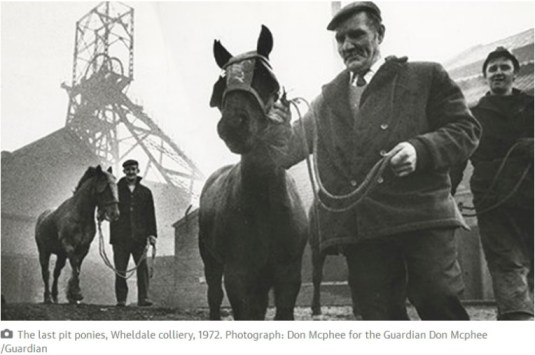
As soon as I was considered old enough to wander alone… a ridiculously young age by today’s standards… I would knock on the doors of the various elderly relatives that lived within a stone’s throw of home or school. Their doors opened onto another era that to my young eyes qualified as the ‘olden days’. There would inevitably be a cup of tea; none of your new-fangled tea bags or ‘gnats water’, but the rich mahogany brew that seethed in perpetuity beside the flames of the range. If I was lucky and timed it right, there would be a slab of fruit cake topped with a slice of tangy cheese or perhaps a curd tart, or we might toast a teacake in front of the fire on the toasting fork and I would sit and listen, fascinated as the old ones spoke of their lives.
Between my great-grandparents and their…
View original post 1,054 more words
Share this:

Chapter Seven
The Crystal Air
The great candles hissed and spat, casting off acrid fumes that were masked by the sweet incense rising from the copper burners, made to an ancient formula which spoke of purple flowers in the night. Their light was bright, and cast flickering shadows off the sacred objects in the temple which became dancing forms that flowed across the walls like the mental ghosts of the shadow, the enemy within that the young priests had been trained to see.
The silence in the temple of Isis was so profound that the slightest variation of breathing on the part of any of the temple officers could be heard. Anzety turned to face the eastern wall of the temple. In his mind, Neferaset came forward from the darkness of that inner east and stepped up to meet him, taking his hands and her usual position as the head of ritual… but, this time, she wasn’t here. She was waiting for his signal, beyond the bronze doors of the sacred chamber. The temple was his to command.
Saluting the east, and the great statue of Isis overseeing all that went on in the temple of the sun, he turned to look at the swelled ranks of those who had come to celebrate the inner meanings of the festival of Akhet – and the elevation of the island’s chosen priest. The forces represented by the figures of the triumvirate of Amun-Ra, Khonsu and Mut, symbolically united in their shadowy figurehead of ancient Isis, waited in expectant and respectful silence as he began the rite of Akhet.
Such was the power of the priest…
Anzety held up his hands, palms turned towards the sky; welcoming all in a silent gesture of respect.
He stepped forward into the inner ring, the Wheel of Djet, symbolising eternity, and followed it around the circle, clockwise, extending his arms to all present. “Many of you have travelled from the far lands to be with us at the time of the great inundation – Akhet. We welcome you to our Temple home, where life is devoted to the worship of the Divine Feminine, through the worship of Amun-Ra, Khonsu and Mut, expressed in the service of the supreme goddess, Isis.
“It is customary at the time of Akhet, for us to bring to initiation the most promising of the apprentice priests. Today we honour a young man named Amkhren, an orphan, alone in the world apart from his grandmother. Amkhren was adopted for temple apprenticeship seven years ago by our own High Priestess, after a chance meeting by the great river that revealed some of his promise.”
Anzety studied the faces around him. Most he recognised, but there were a few who were strangers – not unusual for such an occasion, as the priests from other temples would rotate in their attendance, especially as this was seen as an honour–given that the temple of Isis at Gezirah island was sponsored by Seti, himself. Anzety did his best to calm a growing sense of unease. Regaining the east, he bowed to the images of Amun-Ra and Isis, then turned once more to face the visitors.
“An initiation must also be a trial for it to stir into action the hidden chambers of the heart. The worship of Isis is centred in such magic. The young man will be safe through these trials,” Anzety paused, thinking back to a similar occasion, a long time ago… “but he does not know that. For him, this will be a life and death challenge, and we ask you all to hold the dread of that in your hearts, to help fill Amkhren’s next moments with the needed feelings.”
Anzety raised his head to address the Guardian in the far west of the temple. “Guardian!” the white-robed figure stood to attention. The black and gold bands, running diagonally from his shoulders to his waist, reflected the shimmering light of the flames. “Open the temple doors and admit our Sister, the High Priestess, Neferaset; Amkhren, the one whose trial has come; and his proud grandmother, known to us as Snefer, the bent one, our trusted temple servant. This will be the last time his grandmother is allowed to accompany him in his sacred duties, and we do this to honour her devotion to his upbringing amidst such hardship.”
The temple guardian struck the huge brass gong three times. The temple reverberated with the pure resonance of the sound and its harmonics, which took long seconds to fade. “Brethren of the temple,” said the guardian, in a voice that matched the fading sound of the gong. “stand tall and, in the way sacred to your own traditions, honour the entrance of the high priestess and her charges.”
Those in the temple straightened, holding their heads high. Some held their hands over their hearts, using one hand or two, some held their hands upwards forming a part square; others simply bowed their heads. The temple guardian looked to the high priest for his signal that the next part of the rite should begin. Anzety made a slight movement of his head, then stared down, for a second, at the altar in the middle of the sacred space, lending his love and will to what lay ahead for the boy. In doing so, he did not notice the frantic eye gestures of the guardian, trying to communicate something urgent to him…
——————————–
Index to previous chapters:
Chapter One – Gifts From the River
Chapter Two – An Agony of Sunset
Chapter Three – The Dark Waters
Chapter Four – Touching the Sky
Chapter Five – The Fire Within
—————————
Introduction to River of the Sun
In April 2015 a group of people gathered in the Derbyshire hills to enact the Silent Eye’s annual Mystery Play, entitled, The River of the Sun. The five-act mystical drama formed the backbone of that Spring weekend, and told the fictional story of a clash of ego and divinity set in an Isis-worshipping temple located on an island in the Nile, during the the fascinating period of the 19th dynasty, the time of Rameses the Great.
The 18th and 19th dynasties were a time of upheaval for ancient Egypt on many levels. The reign of the ‘Heretic King’ Akhenaten saw Egypt’s religious structure torn apart, as the revolutionary Pharaoh became what Wallis Budge called the ‘world’s first monotheist’; re-fashioning the power of the many Gods with one supreme entity – the visible sun disc, the Aten, for which Akhenaten, alone, was the high priest. Many have pointed to the failure of the ‘herectic’ Pharaoh’s politics, but few have doubted the sincerity of his religious vision. He will, forever, remain an enigma.
Whatever the nobility of his goal, the actions he took were ruthless, and included the shutting down of the annual deity festivals which were the sole point of ritualistic contact between the ordinary people of Egypt and their locally-worshipped gods. In addition, Akhenaten paid little attention to the domestic and military affairs of Egypt, allowing the country’s enemies to encroach on its borders, greatly weakening Egypt’s power at that critical time for the region.
After Akhenaten’s brief reign, culminating in the Pharaoh’s mysterious death, shadowy military forces took control of Egypt, instigating the 19th dynasty in the persons of Rameses I and, soon thereafter, Seti I, whose throne name derives from the god Set – often considered the ‘evil one’ because of his slaying of his brother, Osiris.
Seti I is judged by modern historians as having been one of the greatest-ever pharaohs, yet his importance in the 19th dynasty was eclipsed by the actions of his second son, the brilliant Rameses II, whose long reign of over sixty years included much self-promotion and the alteration of Egypt’s recent history. Both Seti and Rameses II (Rameses the Great) were passionate about the evisceration of the last traces of Akhenaten’s ‘chaos’, as they saw it.
But, although, by the 19th dynasty, the the ‘Son of the Sun’ was long dead and the buildings of his embryonic and doomed city of Tel-al-Armana were reduced to rubble, something of that time remained in the Egyptian consciousness. A new kind of connection between Pharaoh and God had been established, one which elevated mankind, if only in the being of the Pharaoh, to be someone who ‘talked with God’. It was, at the very least, a bold experiment and, though the world would have to wait until the 19th century to re-discover the ‘erased’ pharaoh, the philosophical waves of that period rippled out and dramatically affected the way the incoming 19th dynasty had to repair the worship of the Gods, uniting the people of Egypt under a trinity of Amun-Ra, Khonsu and Mut.
Our fictional story is a tale of politics, friendships, mind and faith. It is set against an historically accurate background, and at a time when Rameses was due to take the throne from the dying Seti .
Returning to Thebes in his swift warship, crewed by his fearsome Talatat mind-warriors, Rameses decides to mount a surprise night-time raid on the island-based Isis temple which has prospered under the sponsoring reign of his father. Rameses suspects that the inner teachings conducted by the revered High Priestess and Priest conceal views that relate to the thoughts of the heretic Pharaoh, Akhenaten. He plans to insert himself and his warriors of the mind into the islands’s Spring rites as the high priest and priestess begin a cycle of initiation for a chosen apprentice priest who has proved himself worthy of special advancement.
The resulting clash draws everyone, including the young Pharaoh-in-Rising, into a spiralling situation where each is forced to confront their own fears as well as living out the roles which life has allocated them. River of the Sun is the story of a spiritual and political encounter from which none emerge unchanged, including the man who will shortly be Pharaoh, the mighty Rameses II, whose secret name for himself is ‘the unchosen’.
Through the eyes and minds of those surrounding the chosen priest and the ‘unchosen’ Pharaoh, the River of the Sun takes us on a tense and compelling journey to the heart of power and its eternal struggle with truth.
The chapters of the book will be serialised in this blog. The finished work is planned to be available in paperback and Kindle early in 2016.
————————————————–
River of the Sun, serialised here, and its associated images, is the intellectual property of Stephen Tanham and is ©Copyright material.
Share this:

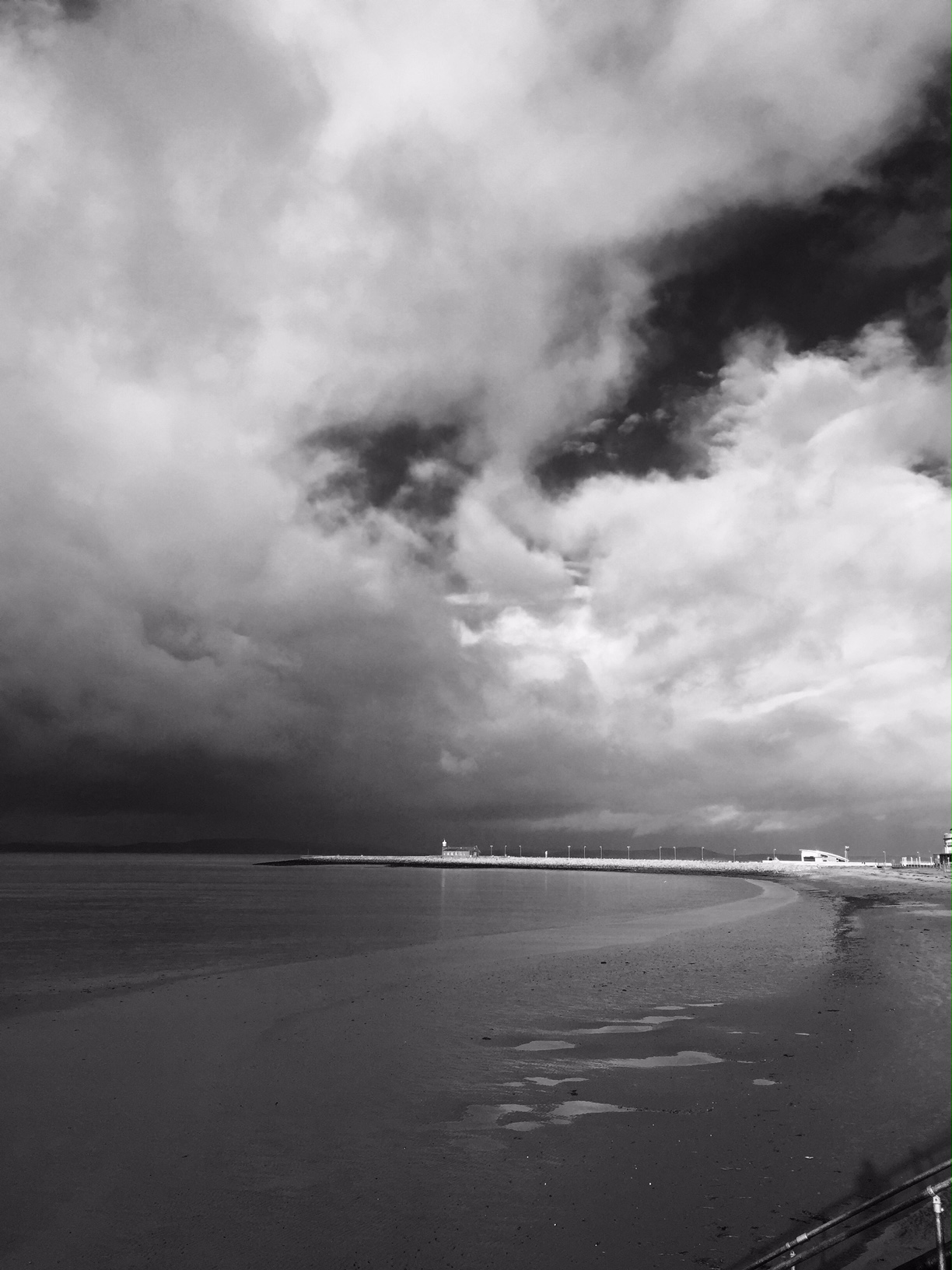
A line of sight
Which calls in frozen white
To towering forms of shapeless spray
That shield incoming night.
©Copyright Stephen Tanham 2015
Share this:

+ Esoteric Meaning of Myth, Greek Myths, Higher Mind, Labours of Hercules, Silent Eye School, Spirituality
Nine Deadly Sins with Coffee, part 39 – Twins of Time
by Steve Tanham
.Alexandra.
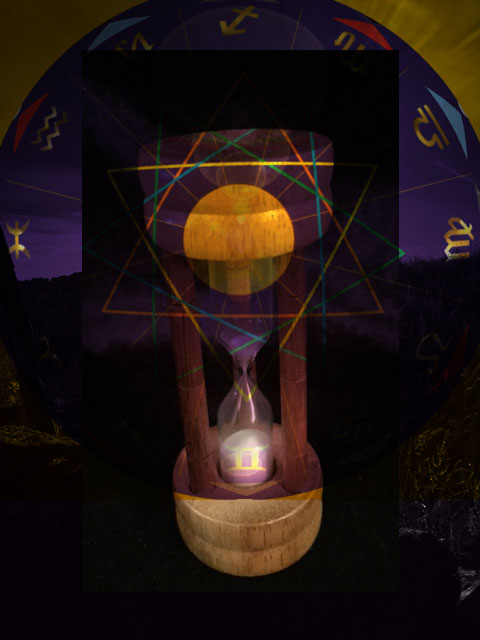
I wasn’t late, but the object placed ominously in the middle of our table suggested I might be…
“Morning John,” I said, warily. “Is this supposed to tell me that time is running out – that I’d better get enlightened quick or you’ll pass the time with another acolyte?”
He stared at me, saying nothing, as I digested what I had just uttered… Then, he turned the old-fashioned egg-timer flat on its side, so that none of the sand inside was moving. “Better?” he asked, pleasantly.
“I…I didn’t mean…” I muttered, realising how presumptuous I had been. His eyes were dancing with humour, and there was no anger there at all.
“We do things…” he said. “We do things, usually out of some kind of fear, that are knee-jerk reactions, of which we are then ashamed.”
He looked at me. I nodded, composing myself and letting the tension go. “It was just that I saw the ‘clock ticking’ and felt… well, you know–got at!”
He was laughing now, and pointed at the levelled timer. “You’d rather nothing happened at all?”
It was pure mischief but I realised that I had created the whole thing. I reached across and restored the ticking sand. “You were saying,” I said, softly. “or, rather, you weren’t saying.”
“One last look at the third labour,” he said, smiling. I realised that the tiny episode was completely gone, that he had moved on – almost as though he spent most of his life observing the strangeness of ego-based reactions in others… and no doubt in himself, as he never professed to be a saint.
I fought to reclaim some high ground. “Gemini, you said? “The twins?”
He nodded, pleased I had remembered the earlier reference which we had not yet discussed.
“What do twins have to do with the trials of Heracles, do you think?”
I thought long and hard. I was beginning to get the ‘key’ to this way of thinking. Twins could refer to siblings, of course, but they could also refer to things linked at different levels, like a matching or contrasting set of rooms on different floors of a good hotel.
“We are twinned within ourselves,” I said, feeling the certainty flow through me in a way that ordinary knowledge did not. “We are twin beings…”
“And the other bit is referred to as the–”
“Soul,” I said, ready with the answer, in a way that did not upset the flow of the moment, which I was beginning to see was its perfection. I followed through on the idea that had just come to me. “And we can chose which room we live in, as long as we have enough intent – we can view the world through the eyes of the ego or the eyes of the soul… with a bit of help!”
John laughed, gently, at my finale. “Yes,” he said, his eyes filled with kindness. “We all need a bit of help from time to time – but the soul itself will help, we just have to ask it!”
“Knock and it shall be opened unto you…” I said, half dreaming the words from my childhood.
“Exactly so,” he said. “This is not a new art…”
I looked down at our table. The sands had all run into the bottom part of the glass figure, which I now realised resembled a leminscate: the figure of eight symbol of infinity… and probably a host of other things. “Time’s up?” I ventured.
“Depends where you want to live; like Heracles, once he had it figured out, you have a choice…and it’s really very simple.
I watched his eyes lead mine down to the egg timer. Feeling elated, I pulled it into the air and turned it around.
“And so, like Heracles,” he said. “With one action, you have defeated the serpent, by pulling it from its native earth, and established where you want your new home to be.”
I looked at the tiny grains of tumbling sand. Whatever I did–unless I laid the object down, sideways again–they would flow. And the flow would always be into the world, like a multi-dimensional field of spiritual gravity – that was, presumably, why we were here. But I could, at any time, raise it up, by inverting the object… just as I could choose to see things from the perspective of the soul – by asking it to fill my life, as the sand grains filled the glass chambers.
For the first time that morning, John picked up his coffee and drank some, smiling at me over the rim of the cup.
I did the same; and we grinned at each other like children.
———————————————————–
Nine Deadly Sins with Coffee is usually published on Thursdays.
All images and text ©International copyright, The Silent Eye School of Consciousness, 2015.
Share this:

+ Bakewell, Bakewell Jail, Ballad of Reading Gaol, Ben's Bit, imprisonment, Incarnation, Journey of the hero, Mystical poetry, Oscar Wilde tribute, Uncategorized
From Bakewell with love – the gift of surprise
by Steve Tanham
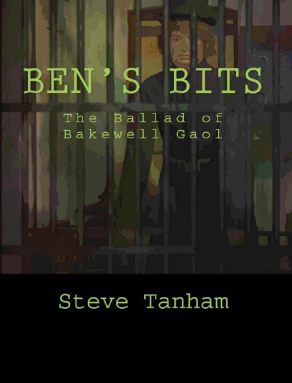
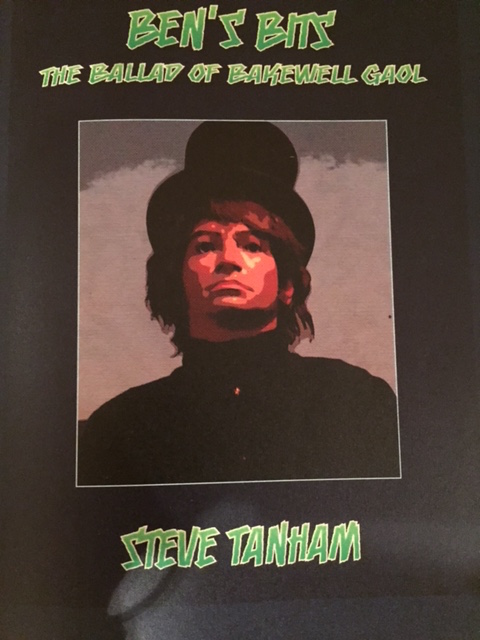
His new life, denied expression in the free world, can be seen as symbolic of the journey of the soul, ‘imprisoned’ in the world of matter.
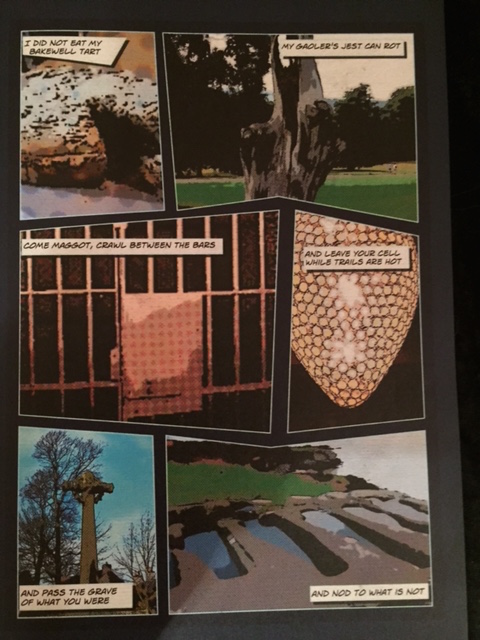
‘So maggot – former pillar tall
Of their community
Examined, tried, and now your kind
Demand they end your liberty
A pillory they have prepared
For public’s careful scrutiny’
“The second force is subtly bred
As wealth and stealth extend their leach”
“With single candle lit and says,
“It is The Will, this dark descent,”
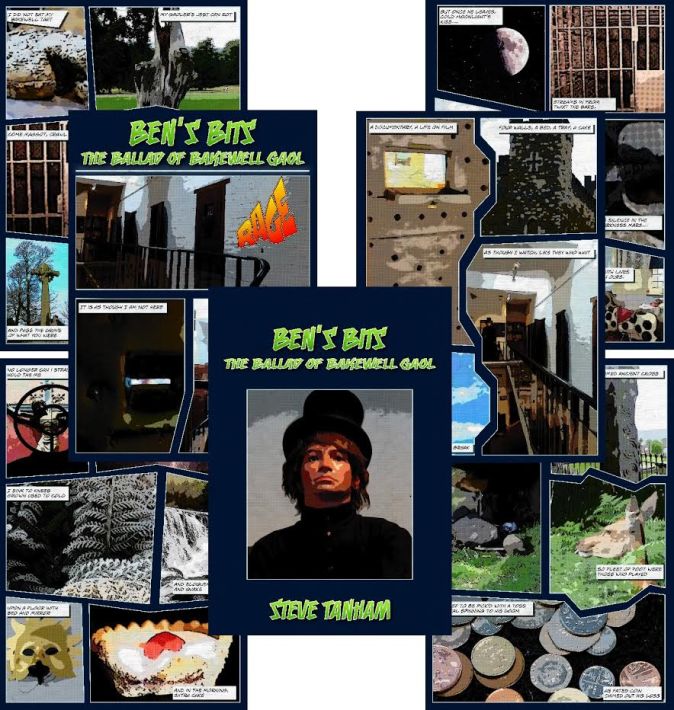
Ben’s Bit: The Ballad of Bakewell Gaol is a graphic novel, in poetic style, of 38 pages, written by me, Steve Tanham and designed and produced, in colour, by Sue Vincent and Stuart France. It is available in both Amazon paperback and Kindle formats.
Share this:


My son has been through hell lately. Not for the first time and, life being what it is, probably not for the last. As some will know he faced a major challenge in 2009 when he was stabbed through the brain and left for dead in an alley. His determination to heal on all levels has been astonishing to watch and never more so than now. As he grows a beard to match that of his hero, he has written his thoughts to share. With great pride, I re-introduce my son, Nick Verron.
Well, hello again. I’ve had a major realisation and really felt the urge to share. It has completely changed the way I look at life 🙂
I’ve just been through the most terrible experience in my life. If you imagine how bad it was when my world collapsed following my attack, that was preferable to what I’ve…
View original post 687 more words
Share this:

Chapter Six – The Wide Waters
Anzety, brother of Neferaset and the high priest of the temple of Isis, stood between the landing pillars and looked into the distance at the pilgrim boat departing from the eastern bank of the great river, heading for the temple island of Gezirah an-Nabatath, his home for the past ten years.
The old and rickety craft rolled heavily at the limit of his vision. He could see that she was packed with the final group of official visitors to the temple, whose numbers would soon swell the rites of Akhet, the all-important season of inundation. Many of those now making their passage across the powerful side currents of the river would have journeyed for days or even weeks to join in the festivities of this, the most revered of the island’s religious festivals.
The old barque was the last temple ferry to depart the despatch point on the mainland and, upon its arrival at the landing dock which he now guarded, the gates of the island would be closed and locked; not to be opened for the three days to follow.
For that time, all present would help begin the cycle of initiation–bestowed, in honour and recognition, to the one chosen from among those destined to become the new priests of Isis. Anzety knew Amkhren, the chosen, well. He had spent the past seven years trying to put a hard head on those young and too-trusting shoulders. But the young man had a secure future as a fine priest; and, possibly, if his sister, the high priestess, had her way, something more…
Anzety thought of Neferaset, now at her preparatory duties inside the closed bronze doors of the central temple, beyond the tall pylons which marked the entrance to the sacred inner sanctuaries–where none but the priests or their invited guests dared to tread. He turned to look at the stragglers from the previous boat – talking happily in the late afternoon sun near one of the outbuildings, which would act as dormitories for the days ahead. There were few luxuries on the temple island – everything was dedicated to that which lay beyond the senses. The reflection brought to mind the condition of what he thought of as the mind of Egypt, herself, and Anzety grew wistful as he reflected on the turbulent times in which sister and brother had chosen to establish their unorthodox temple.
“But for Seti…” Anzety mused to himself, closing his eyes and dissolving a knot of fear at the thought of the imminent transition of their long-time friend and protector.
Egypt was a changed land; no longer the assured centre of the known world, it had suffered two cataclysms in its recent past. The first had been its six-generation occupation by the Hyksos Kings–those from the lands of the far north-east. The second had been the brief but deadly, fourteen-year reign of Akhenaten, the self-styled Son of the Sun; a man so devoted to religious revolution that he had closed down all the temples, forbidden the annual festivals–the only chance the working people had to participate in the worship of their local deities–and sacked all the priests, installing himself as the only connection between the all-giving Aten, the sun-disc, and the inundated Black Land of Egypt, ruled by his ruthless civil service.
Now, just over forty years later, the last of the stones of the city of Armarna, the Heretic King’s replacement for the temples of Amun Ra at Thebes, were being removed, an evisceration that had lasted several decades, to provide building materials for the common folk who had been so brutally robbed of their birthright. Akhenaten had become known, simply, as The Erased, and his memory was being literally chisled from the lists of Kings and and from the story of the land of Egypt. The erasers were those who came after him – including, and most passionately, the present pharaoh, Seti, himself. The dwellers on the island lived a complex and precarious existence, Anzety thought, quietly…
There was, of course, another view of what Akhenaten had done.
To speak of it meant death; but there was a different perspective, at least as regards the heretic King’s religious ideals. This belief was held by a strange and eclectic group of minds whose focus was the divine – in all its forms. To them, the doomed heretical pharaoh had opened a bridge to the world beyond the neters – the gods; but the priestly pharaoh had failed to leave behind a priesthood that could teach its revolutionary methods. Politically immature, but possibly closer to the Creator than any other Egyptian had ever been, Akhnaten had left no spiritual heirs …
Anzety turned his head to look at the temple’s huge bronze doors. Only two people were in that sacred space – the chosen apprentice, Amkhren, and Anzety’s sister, the high priestess. He looked to the sun and smiled into the golden light of the late afternoon, imagining it reflecting from those tall doors. No-one knew better than he how skilled she was in the theatre of the rites; and how easily she could provoke the reactions she needed, in order to bend the mind of another to her, admittedly noble, purposes. Although they had spent much of their childhood apart, they had come together again following his years in the reinstated temples of Thebes, to establish the island sanctuary of Isis/Mut. Had that only been ten years ago?
In many ways, the temple on Gezirah an-Nabatath was her creation. Oh, he had been happy to lend his experience, and willingly; but it was she who had painted the vision to Seti I, their benefactor, now lying in his bed in far-away Pi-Ramesse, the new royal capital in the Nile’s vast delta. Anzety shook his head at the thought of a world without Seti. He hoped that history would be kind to the great thinker and warrior; the leader who had risen from humble origins and reunited a devastated Egypt after the psychological crumbling of the Heretic’s short reign.
King Seti had been a fine benefactor. He had provided the island, the stone builders, the money for the construction; and the all-important approval for the spiritual mapping of the rites. And now, Seti was dying…
Anzety looked down at the orange sun-scarf wrapped around his right wrist and left there while he read the messenger’s sad news on the parchment wrapped in the bright linen. There was work to do; and the temple cycle about to start was too important to the continuation of the cult of Isis to let the death of a King interrupt it… and Seti, strangely-named Beloved of Set–the slayer of Osiris and enemy of Horus– would have understood that…
The high priest raised his hand and waved the bright scarf to the lead oarsman in the prow of the ferry now approaching the landing stage. He wondered at the number of fellow priests massed in the overloaded boat, but dismissed the thought as unimportant.
——————————–
Index to previous chapters:
Chapter One – Gifts From the River
Chapter Two – An Agony of Sunset
Chapter Three – The Dark Waters
Chapter Four – Touching the Sky
Chapter Five – The Fire Within
—————————
Introduction to River of the Sun
In April 2015 a group of people gathered in the Derbyshire hills to enact the Silent Eye’s annual Mystery Play, entitled, The River of the Sun. The five-act mystical drama formed the backbone of that Spring weekend, and told the fictional story of a clash of ego and divinity set in an Isis-worshipping temple located on an island in the Nile, during the the fascinating period of the 19th dynasty, the time of Rameses the Great.
The 18th and 19th dynasties were a time of upheaval for ancient Egypt on many levels. The reign of the ‘Heretic King’ Akhenaten saw Egypt’s religious structure torn apart, as the revolutionary Pharaoh became what Wallis Budge called the ‘world’s first monotheist’; re-fashioning the power of the many Gods with one supreme entity – the visible sun disc, the Aten, for which Akhenaten, alone, was the high priest. Many have pointed to the failure of the ‘herectic’ Pharaoh’s politics, but few have doubted the sincerity of his religious vision. He will, forever, remain an enigma.
Whatever the nobility of his goal, the actions he took were ruthless, and included the shutting down of the annual deity festivals which were the sole point of ritualistic contact between the ordinary people of Egypt and their locally-worshipped gods. In addition, Akhenaten paid little attention to the domestic and military affairs of Egypt, allowing the country’s enemies to encroach on its borders, greatly weakening Egypt’s power at that critical time for the region.
After Akhenaten’s brief reign, culminating in the Pharaoh’s mysterious death, shadowy military forces took control of Egypt, instigating the 19th dynasty in the persons of Rameses I and, soon thereafter, Seti I, whose throne name derives from the god Set – often considered the ‘evil one’ because of his slaying of his brother, Osiris.
Seti I is judged by modern historians as having been one of the greatest-ever pharaohs, yet his importance in the 19th dynasty was eclipsed by the actions of his second son, the brilliant Rameses II, whose long reign of over sixty years included much self-promotion and the alteration of Egypt’s recent history. Both Seti and Rameses II (Rameses the Great) were passionate about the evisceration of the last traces of Akhenaten’s ‘chaos’, as they saw it.
But, although, by the 19th dynasty, the the ‘Son of the Sun’ was long dead and the buildings of his embryonic and doomed city of Tel-al-Armana were reduced to rubble, something of that time remained in the Egyptian consciousness. A new kind of connection between Pharaoh and God had been established, one which elevated mankind, if only in the being of the Pharaoh, to be someone who ‘talked with God’. It was, at the very least, a bold experiment and, though the world would have to wait until the 19th century to re-discover the ‘erased’ pharaoh, the philosophical waves of that period rippled out and dramatically affected the way the incoming 19th dynasty had to repair the worship of the Gods, uniting the people of Egypt under a trinity of Amun-Ra, Khonsu and Mut.
Our fictional story is a tale of politics, friendships, mind and faith. It is set against an historically accurate background, and at a time when Rameses was due to take the throne from the dying Seti .
Returning to Thebes in his swift warship, crewed by his fearsome Talatat mind-warriors, Rameses decides to mount a surprise night-time raid on the island-based Isis temple which has prospered under the sponsoring reign of his father. Rameses suspects that the inner teachings conducted by the revered High Priestess and Priest conceal views that relate to the thoughts of the heretic Pharaoh, Akhenaten. He plans to insert himself and his warriors of the mind into the islands’s Spring rites as the high priest and priestess begin a cycle of initiation for a chosen apprentice priest who has proved himself worthy of special advancement.
The resulting clash draws everyone, including the young Pharaoh-in-Rising, into a spiralling situation where each is forced to confront their own fears as well as living out the roles which life has allocated them. River of the Sun is the story of a spiritual and political encounter from which none emerge unchanged, including the man who will shortly be Pharaoh, the mighty Rameses II, whose secret name for himself is ‘the unchosen’.
Through the eyes and minds of those surrounding the chosen priest and the ‘unchosen’ Pharaoh, the River of the Sun takes us on a tense and compelling journey to the heart of power and its eternal struggle with truth.
The chapters of the book will be serialised in this blog. The finished work is planned to be available in paperback and Kindle by the end of January 2015, and will contain the full novel plus an appendix of the dramatic rituals used to enact the story in April 2015.
————————————————–
©Copyright. River of the Sun, serialised here, and its associated images, is the intellectual property of Stephen Tanham and is Copyright material.


 Sun in Gemini
You must be logged in to post a comment.