
Don and Wen are now pursued on their, increasingly, anarchic journey through the ancient British landscape… while poor Ben rots in Bakewall Gaol! … “Stone Hugger” – could it get any worse?
Share this:

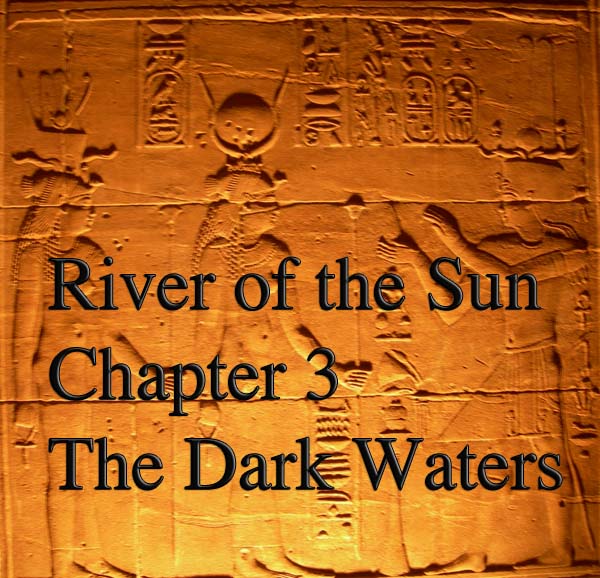
Chapter 3 – The Dark Waters
Rameses II, soon to be King, Chosen of Ra, Justice of Ra, stood in the prow of the Beak of Horus, looking northwards into the darkness that had fallen like spilled ink onto the smooth waters of the great river. There was nothing on his mind; he was exercising his considerable powers of mental control to keep it as empty as the still, black surface below him. To know when to do nothing was one of the skills he had learned from his former mentor, now missing somewhere in the nearby hills, with behaviour sadly typical of his advancing years.
The day had been fraught with difficulties. His plans to spend the night in the small port of Faris had been thwarted by a failing rudder that had grown progressively heavier to turn, reducing their normal progress to a series of zig-zags as an increasing number of the sparse crew were needed to change the boat’s direction. To compound the problem the great river narrowed and deepened in these parts, its current becoming more turbulent.
Eventually, he had surrendered to the onslaught of the forces of mechanical chaos, offering a small prayer to Amun-Ra, and a curse to Apophis, the great serpent of the underworld, then retreating to the forward observation nest of the ship, allowing, as Menascare taught him many years prior, ‘the moment to reveal its potential’.
He did not have long to wait. From behind him came the sound of a body being dropped, none too gently, onto the forward deck of the warship. He turned to see the tall and strong body of the Talatat of Vengeance, standing on the sloping wooden floor. She bowed to him, then, still wordless, stood back to reveal the unconscious form of his former mentor and guide, Lord Mensacare. Rameses stepped into the dark air, letting his agile body drop, cat-like, onto the wood next to the older man. Immediately, he smelled the musk; initially mistaking it for sweat, but this was a sweeter odour than that produced by bodily effort or fear, and pervaded his senses in a way that no temple incense ever had. The scent pulled at something within him, tore at memories just beyond his waking mind. But, try as he might, he could not retrieve the essence of it, nor its hidden name.
Rameses looked into the darkness, lit now by flickering pitch torches, and spoke to the fearsome warrior who had unceremoniously dumped before him the body of one of the most powerful men in Egypt.
“On the assumption that you didn’t kill him, would you like to tell me why my former teacher is lying on my forward deck?”
The Talatat bowed, again. There was the hint of a smile there – Rameses knew that very little frightened her.
“That was how I found him, Majesty.” she shook her head. “All I know is that he screamed just before I got to him on the cliff edge. But there are no signs of injury,” she bowed, again. “Majesty.” Her voice carried in the night. She was breathing heavily from the enormous effort of carrying the older man’s weight down from the cliffs above the river. Rameses shook his head; his beloved and elite Talatat guard never failed to astonish him with their power and their focus. He preferred their company over all those who thought themselves high and noble in the family palace at Pi-Ramesse, whatever Menascare thought of them.
Ignoring the comatose figure at his feet – something that would have been unthinkable in former times – he studied the lithely powerful and nearly naked body of the warrior woman.
The narrow short sword, worn across the centre of the back, projected over her head like a beacon that announced her intent to any who might cross her path. Her skin held a shining pattern of arrowhead tattoos, picked out in the deep blue that signified the sisterhood of assassins. He watched, for the thousandth time, and let his gaze be drawn, seduced, along her skin, as his body warmed to its compelling trail. His gaze followed the dark blue arrows across the backs of her strong hands to the rippling muscles of her upper arms and shoulders, before gliding along a neckline too delicate to belong to the power beneath; and then plunging downwards over the breasts just as the sister patterns arced upwards from ankle to calf to thigh.
The dual tracks, upper and lower, met in a spiralled twinning that raced across upper thigh and hip beneath the weather-beaten hide skirt. And there it should have ended; but, lured by a masterstroke of the body-engraver’s art, the eye of the young Regent was drawn upwards by an unseen force that seemed to torment him–on, further, past the front of the braided skirt to a single arrow at the navel, set within a blood-red circle, and pointing at the eyes in the Talatat’s face above, which now danced with mischief for the King-in-Rising, but would have, just as easily, danced with delight at the impending death of a victim held paralysed by the deadly glory before him.
She was watching him with a smile, her face lit with the flickering flames of the smoking torch that she was using to examine the fallen Lord Mensacare. “Majesty?” she asked, in a sentiment that needed no embellishment, other than the subtle movement of her right foot, which traced an arc like the opening of a dance.
Rameses shook his head, suppressing the deep and guttural groan in his throat, heard only by himself and the warrior woman before him. In an agony of self-denial, he closed his eyes against the effects of the deadly blue tracks.
Rameses spun away. “Tend him! Bring the Talatat of Poisons to help you. I want to know what felled him!” He shook his head at the madness of the situation. He examined, and then controlled his breathing. Deep, said the remembered chant, taught him by the younger Menascare, so long ago. Go deeper and find the root – the root that does not look like the flower, but feeds from the source which thought it into life . . .
The Regent easily jumped the two feet back to the observation platform with barely a flex of his own young body. There, he resumed his study of the inky blackness of the great river, reading it with a quietened mind, studying the pages of a scroll held open on a lighted bench by the weight of white stones from the high cliffs above.
For a long time, and barely conscious of the healing efforts behind him, Rameses watched the dark water as its tiny eddies whirled and spoke in the gathering light of the moon. The life of Seti, his beloved and dying father, with whom he had enjoyed a complex but close relationship, was its subject.
Was his second son really ready to take the reigns of the great chariot of the sun – the land of Egypt? Why was he not making every effort to be with his father on his deathbed at Pi-Ramesse; within the sublime walls of their new palace in the fertile lands of the delta? Perhaps it had something to do with the fact that, deep in his heart, there was still the irrational pain of not being the first chosen; the memory of the long years when his long-dead elder brother stood in the light of the royal sun, to be trained and groomed for rule.
Menascare had been his father’s gift, to ease the seen pain of that. The revered mage had grown up in his father’s house, although, himself, a younger friend to the great man. The gift of such a well-known figure – to be his personal mentor and teacher – had been seen as significant. Such an action marked the wisdom of Seti, yet both he and his second son knew that, within the young royal breast, there beat a heart that knew intense jealously. This had focussed itself on an odyssey of self-glorification, and the palace officials had smiled nervously as the young King-in-Rising paraded his every achievement in the face of his perceived tormentors. ‘Rolite’, the small, yellow weed that grew wild along the banks of the great river had been his nickname – concealing the hidden meaning Royal Little Me, which had been the cruel but accurate jibe whispered in the stony corridors of power.
None, though, had stood in his way, and his father had taken him, early, into battle, following years of military and tactical training at the hands of the best generals in the land. Seti, The second King of the 19th Dynasty had acted decisively when it came to consolidating the power they had achieved after the fall of The Erased. The glory that followed had only added to the legend that was Seti’s rule. Seti I, Lord of the Restored Lands, Fortifier of borders, Rake of the Erased . . .
“Majesty! He wakes!”
It was the sound of The Talatat of Poisons in the darkness below. Rameses turned to examine the scene. The patterned warrior was now kneeling on the deck, using the light of the torch to allow the former deputy to the royal physician to do his work.
Apart from his famed golden collar, a beautifully made torc in the shape of cobra, Menascare was now naked – something that caused the warrior woman a slight smile. Rameses doubted they had ever been lovers, and was curious as to the gesture’s origins. Despite his forty years, the older man’s body was still in good condition, though the pale skin lacked the vibrant musculature it once possessed when he and the boy Rameses had shared an active life of hunting, instruction and plotting together.
Rameses nodded into the dark air – a gesture no-one saw – and stored the Talatat warrior’s reaction in his mental web – some day it might prove useful.
“What ails him, Talatat of Poisons?”
“I can find nothing, Majesty,” said the kneeling healer, “I have examined every inch of him and there are no wounds. Perhaps his age has overtaken him?”
It did not ring true. Even now, Menascare was strong and swift – when he wanted to be – but pretended to be slow and old when it suited him. He was a fox of the desert, and everyone knew it. He had used age to create a screen for his deeper interests, and they were a curious mixture; indeed, they alone, Rameses thought, would likely be the cause of his death at the hands of Obion, the Talatat commander of the elite guard and the sworn enemy of the ‘old meddling fool’ as the soldier had dubbed his long-time adversary. Rameses looked up from the moaning, dribbling and, Rameses thought to himself, sadly recovering Menascare to search out the ever-watchful eyes of his master of warfare. He found the stocky commander standing on the rear deck of the bow-hulled warship, using its height to examine every detail of the scene below.
“Sadly, still here to irritate us all, then,” said Rameses, loud enough to solicit Obion’s nodded approval across the full length of the ship. “We must endure your all-pervasive wisdom a while longer, eh?” Despite the Regent’s exaggerated ire at the recovery of his former mentor, his gesture of wiping the brow of the mage with a wet cloth passed to him by the Talatat of Poisons showed the deeper bond between them. But gesture was such a subtle language, thought the young scion, studying Menascare’s flickering eyes as the older man fought to return to his senses.
There was a sudden fury of activity in the middle of the boat. Rameses ran over to follow the unfurling lines of rope being thrown over the side of the Beak of Horus to a much smaller craft, the Sobeki – a narrow rowboat of a very streamlined design; built only for speed and land-based assaults. As he watched he could see a white-robed young man being forced up the rope ladder. Soon, he stood, trembling on the deck, then dropped to his knees before the King-in-Rising, putting his forehead onto the wood of the deck and moaning in fear.
Before he could continue his obeisance, the Tatatat of Spying, the leader of the scouting party that Rameses had sent out after their forced delay, clambered over the side of the ship and spoke.
“He was observing from the bank, Majesty. We thought you would wish to know why?”
Rameses knelt down and pulled the white-robed man to his knees. He focussed his blue-grey eyes into the pools of terror before him. “Spying on a royal ship is a foolish thing to do,” he said, in tone that was terrifyingly gentle, “But, be assured, we will have the full story from you, soon . . .”
From the shadows emerged a slim woman, dark of features with silky black hair combed tightly into a silver lattice which crowned her head. Her willowy body was covered by a black cloak, which seemed to absorb the light around her.
“This is my Talatat of Inquistion,” said Rameses, cruelly enjoying the fear in the young priest’s eyes. “She will entertain us all with an exploration of your motives – you must understand that the House of Seti has many enemies.”
The white robed figure tried to pull away from the royal arms holding him fast. The upper folds of his robe parted and Rameses’ hand darted out to clasp the carved wooden pendant hanging on a leather cord around the man’s neck. With a savage pull, he snapped the leather and held up the pendant for all to see in the flickering light.
“Perhaps we begin to know our enemies?” he said, softly.
Eleven pairs of eyes stared at the circular glyph. Nine points on the circumference were joined together in a complex pattern of lines. To the Talatat, including their commander, Obion, this was something new – and much more complex than the simple insignia of traditional enemies, such as the Hyksos invaders of Egypt’s recent history. To Rameses, this was the justification he had been waiting for – not that he needed any, but political power had its necessary forms.
To Menascare, getting slowly to his feet, still naked and silently present to the whole of the unfolding events, it was further evidence that the long and tortuous drama of his life was, most likely, coming to its final act.
—
Index to previous chapters:
Chapter One – Gifts From the River
Chapter Two – An Agony of Sunset
—————————
Introduction to River of the Sun
In April 2015 a group of people gathered in the Derbyshire hills to enact the Silent Eye’s annual Mystery Play, entitled, The River of the Sun. The five-act mystical drama formed the backbone of that Spring weekend, and told the fictional story of a clash of ego and divinity set in an Isis-worshipping temple located on an island in the Nile, during the the fascinating period of the 19th dynasty, the time of Rameses the Great.
The 18th and 19th dynasties were a time of upheaval for ancient Egypt on many levels. The reign of the ‘Heretic King’ Akhenaten saw Egypt’s religious structure torn apart, as the revolutionary Pharaoh became what Wallis Budge called the ‘world’s first monotheist’; re-fashioning the power of the many Gods with one supreme entity – the visible sun disc, the Aten, for which Akhenaten, alone, was the high priest. Many have pointed to the failure of the ‘herectic’ Pharaoh’s politics, but few have doubted the sincerity of his religious vision. He will, forever, remain an enigma.
Whatever the nobility of his goal, the actions he took were ruthless, and included the shutting down of the annual deity festivals which were the sole point of ritualistic contact between the ordinary people of Egypt and their locally-worshipped gods. In addition, Akhenaten paid little attention to the domestic and military affairs of Egypt, allowing the country’s enemies to encroach on its borders, greatly weakening Egypt’s power at that critical time for the region.
After Akhenaten’s brief reign, culminating in the Pharaoh’s mysterious death, shadowy military forces took control of Egypt, instigating the 19th dynasty in the persons of Rameses I and, soon thereafter, Seti I, whose throne name derives from the god Set – often considered the ‘evil one’ because of his slaying of his brother, Osiris.
Seti I is judged by modern historians as having been one of the greatest-ever pharaohs, yet his importance in the 19th dynasty was eclipsed by the actions of his second son, the brilliant Rameses II, whose long reign of over sixty years included much self-promotion and the alteration of Egypt’s recent history. Both Seti and Rameses II (Rameses the Great) were passionate about the evisceration of the last traces of Akhenaten’s ‘chaos’, as they saw it.
But, although, by the 19th dynasty, the the ‘Son of the Sun’ was long dead and the buildings of his embryonic and doomed city of Tel-al-Armana were reduced to rubble, something of that time remained in the Egyptian consciousness. A new kind of connection between Pharaoh and God had been established, one which elevated mankind, if only in the being of the Pharaoh, to be someone who ‘talked with God’. It was, at the very least, a bold experiment and, though the world would have to wait until the 19th century to re-discover the ‘erased’ pharaoh, the philosophical waves of that period rippled out and dramatically affected the way the incoming 19th dynasty had to repair the worship of the Gods, uniting the people of Egypt under a trinity of Amun-Ra, Khonsu and Mut.
Our fictional story is a tale of politics, friendships, mind and faith. It is set against an historically accurate background, and at a time when Rameses was due to take the throne from the dying Seti .
Returning to Thebes in his swift warship, crewed by his fearsome Talatat mind-warriors, Rameses decides to mount a surprise night-time raid on the island-based Isis temple which has prospered under the sponsoring reign of his father. Rameses suspects that the inner teachings conducted by the revered High Priestess and Priest conceal views that relate to the thoughts of the heretic Pharaoh, Akhenaten. He plans to insert himself and his warriors of the mind into the islands’s Spring rites as the high priest and priestess begin a cycle of initiation for a chosen apprentice priest who has proved himself worthy of special advancement.
The resulting clash draws everyone, including the young Pharaoh-in-Rising, into a spiralling situation where each is forced to confront their own fears as well as living out the roles which life has allocated them. River of the Sun is the story of a spiritual and political encounter from which none emerge unchanged, including the man who will shortly be Pharaoh, the mighty Rameses II, whose secret name for himself is ‘the unchosen’.
Through the eyes and minds of those surrounding the chosen priest and the ‘unchosen’ Pharaoh, the River of the Sun takes us on a tense and compelling journey to the heart of power and its eternal struggle with truth.
The chapters of the book will be serialised in this blog. The finished work is planned to be available in paperback and Kindle by the end of the year, and will contain the full novel plus an appendix of the dramatic rituals used to enact the story in April 2015.
————————————————–
Index to previous chapters:
Chapter One – Gifts From the River
Chapter Two – An Agony of Sunset
River of the Sun, serialised here, and its associated images, is the intellectual property of Stephen Tanham and is ©Copyright material.
Share this:

+ Esoteric Meaning of Myth, Greek Myths, Higher Mind, Labours of Hercules, Silent Eye School, Spirituality
Nine Deadly Sins with Coffee, part 35 – Mr Cyclops
by Steve Tanham

.Alexandra.
I had done my homework the previous weekend and arrived at our cafe early, eager to organise my thoughts before John arrived for our Monday get-together.
“Dark out there,” he said, entering behind me and kissing the top of my head in his customary fashion before sitting down. I looked out of the window at the clear blue morning sky. We were having the most amazing autumn, though the summer had been standard issue, British wretched. I shook my head and turned back to look at him, forming the words as I finished the head-turn, only to be struck dumb by what greeted me.
“What is that?” I shrieked, trying hard not to laugh out loud and ruin the peace of Rose’s morning.
“What?” he asked, innocently.
“That bright thing on your head.” I responded, “And don’t tell me it’s dark out there–despite being late October, it could be a summer’s morning!”
But it was too late; I collapsed into a mess of giggles at my idiot uncle sitting opposite me, wearing a lighted head torch and a big grin.
“Desperate to find something that worked,” he glanced apologetically upwards, rolling his eyes. “Best I could do!”
I recovered some self-control. Strangely, the whole of the cafe’s inhabitants were not studying the Monday lunatics, just a few of them.
“It’s quite good, though,” I said. “You are Mr Cyclops, I take it?”
“Ah yes…” he smiled. “And on that basis, it is double dark out there…”
I sat back, sipping my coffee, thoughtfully; just studying him. He was seldom single dimensional and some of his best teaching had, at first, seemed ludicrous.
“So, we’re not on Crete, presumably because we’ve already been there, but we are in the month of Taurus?”
“Not on the island of Crete to be precise.” he said, slightly narrowing his eyes. “And, yes, we are in the sign of Taurus, and rippling with the energy of beginnings from our trip to the Mares of Aries.”
I chewed on that, taking another sip of the still-scalding coffee. “Island? Okay then,” I said. “So being off the island is a good thing, though it was Crete where Heracles successfully tracked down the Bull with the shiny star on its head, helping him ride it out of the maze and across the ocean to the mainland?”
“That’s very good,” John said. “you should carry on…”
“So Heracles had to go somewhere…” I paused, trying to dig for the meaning I had sensed. “Separated!” I blurted into my coffee, nearly spraying the hot liquid off the surface of my cup.
His eyes did that flickery thing. He leaned forward, pushing the moment at me. “Yes,” he said, enthusiastically. “Heracles had to go to Crete to gain a deep understanding of something that it is essential to know the whole of.”
I sat back and drank some more coffee, catching Rose walking past and asking her for another, as I was going to run low with all this frantic thinking. John refused my offer of a second. I took a deep breath and waded in. “So, something, presumably connected with Taurus, had to be learned in finding the Bull and riding it – that’s it – riding it!” I was onto the trail now, I could feel it, and see it in his gleeful eyes.
“What happens when we ride something?” he asked, innocently.
“We master it!” It was a crude description, but it would have to suffice.
“Do we kill it?”
“No,” I replied, “We get the best out of it.”
“So a bull could do a range of things, from pulling a plough to keeping a herd of cows happy?”
Suddenly, it was there before me. “Sex – Taurus, Venus!” I said, laughing. “Heracles went to Crete to learn to master his sexual forces, not suppressing them, but riding them back to higher beings – The Cyclopses.” I had no idea what the plural was and had to improvise.
“And what relationship did the three ‘Cyclopses’ have to him?”
I was struggling. Barely able to suppress his mirth, he reached up and switched his single light on and off, again.
“He, he…” I was practically screaming inside. I knew the answer was literally shining in … in my face.
“He was one…” I whispered. “Having mastered something utterly fundamental to everything, he was able to be accepted in the company of his kind … or at least, of those he could now recognise as his kind.”
“And the single light – sorry eye – in the head of the ‘cyclopses’?” John asked, pressing me while the virile energy of the Spring roared inside my laughing mind.
My voice, when it came, was dreamy. Like I was listening to someone else speak. “Single rather than dual,” I said, “Seeing the higher, causal plane as the more real; seeing that there is a single light – the light of understanding that, alone, illuminates the universe; or, possibly, seeing from a unified Self…” I stopped, timeless and, finally, wordless, staring at the stars in the constellation of Taurus.
“I think that’s plenty enough for now,” he said, gently. “Well done, you…”
I did not hear him get up; did not see Rose change my un-drunk coffee for a fresh one; did not hear him leave. I didn’t even know, until I saw myself reflected in the cafe’s window, that he had put the head torch on me, and left it switched on …
———————————————————–
Nine Deadly Sins with Coffee is usually published on Thursdays.
All images and text ©International copyright, The Silent Eye School of Consciousness, 2015.

Share this:


Several years ago a friend asked me to work with him preparing one of his books for publication. The task expanded a little as we worked and eventually, we had a book, The Mystical Hexagram: The Seven Inner Stars of Power. Contracts were signed and the book went to press. I will not forget the feeling of holding that first book with my name on the cover in any hurry…
By this year we felt that the book needed to be amended, updated and dressed in a new cover, based on a detail from the Splendor Solis, an 16thC alchemical tract.
 Extract from
The Mystical Hexagram
G. Michael Vasey & Sue Vincent
“A symbol is a representation of a quality or concept. Mankind has always used symbols to share ideas. Language is, in itself, a series of symbols, used in infinite combination, to communicate complex ideas.
From the earliest…
View original post 865 more words
Share this:

Hey, you!
———–
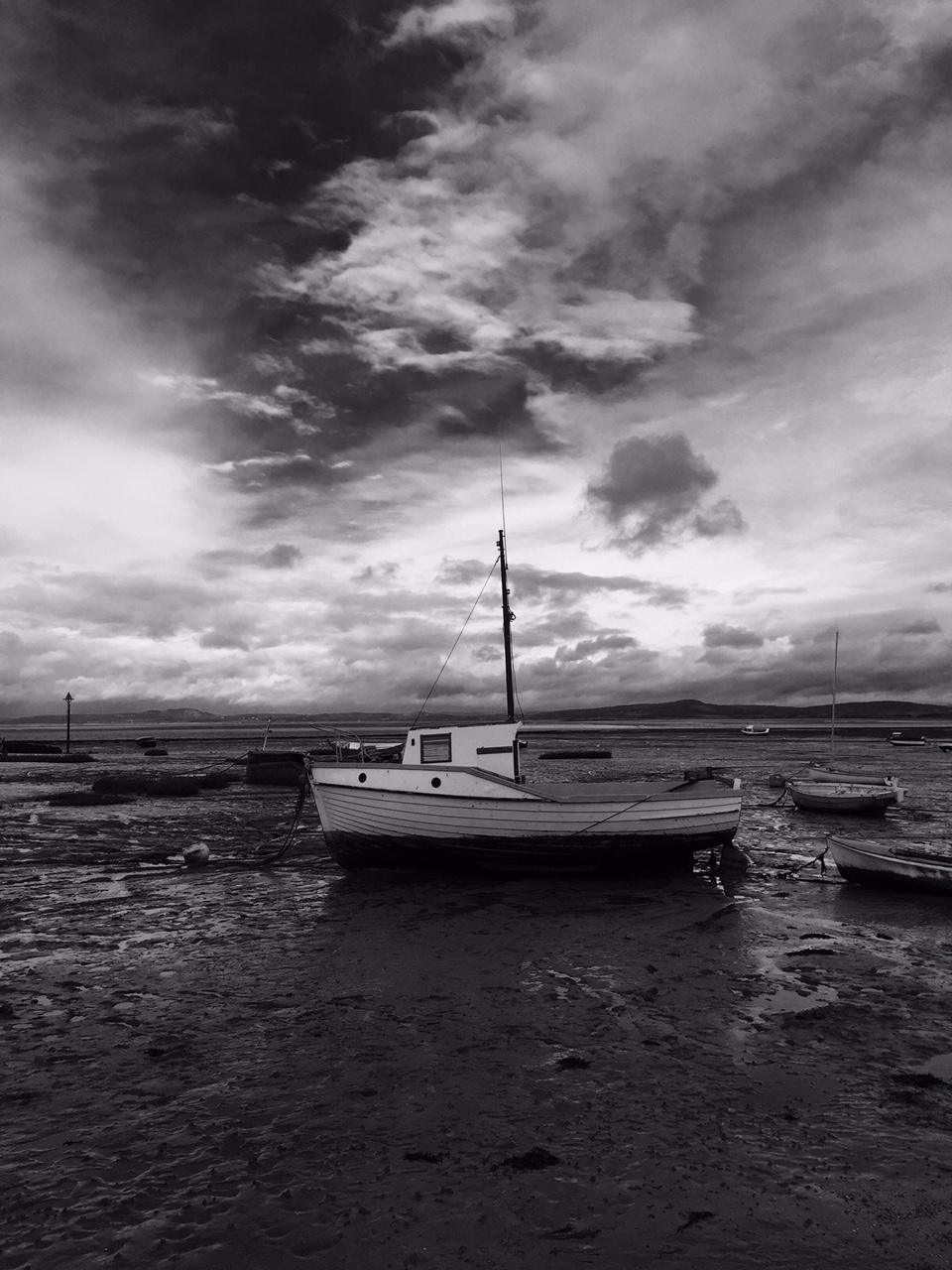
Hey, you, come play! said the wind in the heights
Whipping the sail in a dance of the round
Me?, said the cloth, but I’m tied to the mast
I can play all you like but to steel I am bound
——-
Hey, you, come play! said the sky to the steel
Reflecting its rust, through the colour of blood
Me? said the steel, but I’m rooted below
I can play all you like but I’m anchored in wood
——-
Hey you, come play! said the cloud to the wood
Teasing shadowy fingers where verticals stood
Me? said the wood, but I’m stranded in slime
I can play all you like but below me is mud
——-
Hey you! said the boat to the watcher behind
You who weaves and who forges and powers with mind
When the sky calls to play and you step from my shadow
What stops you from flying to seek out your kind?
—
©Copyright Words and Image Stephen Tanham 2015
Share this:


Chapter Two – An Agony of Sunset
(introduction follows the text)
Seven Years Later
Far below, Rameses was angry; so angry that Lord Menascare could hear the merciless tones in the young voice that would soon be the controlling instrument of the Egyptian 19th Dynasty. The whole of Egypt would tremble when that voice was raised – but they would love him, too. The young warrior, soon to be made King, would be adored by his subjects. The continuity of the great black land of Kemet would be assured, as the power passed from the dying Seti to his second son.
Menascare wondered how many more days Seti would linger? Would they get there in time? Rameses, the young King-in-Rising, seemed strangely unmoved by the idea that he might not be present for his father’s passing.
Rameses’ warship – The Beak of Horus, was at anchor just off the landing stage of the temple of Ber Sobek, house of the strange crocodile god whose sweat was said to be the waters of the great river, itself. The enigmatic nature of such a beast – dispensing life and death in equal measures – had always appealed to Rameses. When the rudder of the boat began to stiffen, Ber Sokek had been an easy choice of landing place. The repair appeared complex, and it was obvious that their northward journey could not continue until morning.
Menascare looked down at the painted figures of the Talatat warriors who were fixing the boat, working furiously to use the last of the light before the sun set beyond even their reach in the jagged crags of the western horizon. What he saw made him shudder. The icy perfection of the movements well suited their role as the King’s personal elite. They were men and women of many talents, but their most developed feature was the power of destruction – of minds, of hearts and quite possibly, Menascare reasoned, of souls, too . . .
He turned away from the human machines of regally-dispensed death and looked up at the sun disc, Ra, now renamed Amun-Ra, in honour of the adjusted pantheon, the emotional rallying point around which Egypt had, once again, reconstructed itself following the slaughter of the heretic, Akhenaten, the self-appointed Son of the Sun.
The sun disc had lost most of its burning power. Menascare stared at its fading beauty, knowing that it took the life of Egypt with it, as it entered the underworld of night. Akenaten’s beloved Aten was dying to the day between two pillars of natural stone on the cliff top beyond the Sobek temple. Without thinking, Menascare reached into his black robe and pulled the cobra staff away from his body, saluting the passing sun in the way he had done since Seti had trained him in the magical arts, long ago.
To have Seti himself as mentor had been quite an honour for one of lowly birth; but then, Seti, too, had come into the world in humble circumstance, and his rise to unrivalled royal power had been enigmatic; calling to mind unseen forces and fortune manipulated with great intelligence. The blow of happenings, that curious Egyptian way of looking at seemingly random events, did not always prevail, and Menascare observed wistfully that his own period of influence was setting with that golden orb…
He had not expected his gesture to be met with a response; not here, so far from Pi-Ramesse, Seti’s new royal city in the delta, far to the north; but the golden figure riding the light towards him flickered in his vision, making him fall to his knees, gasping for breath in a dearth of preparedness so uncharacteristic of the way he led his life. Before him, the sky came alive with vibration, and the cobra staff began to heat up in his grasp. All thought of letting it go vanished from his mind as the cool evening air changed its very substance and she of the silence opened the layers of his consciousness like the very finest of mortuary surgeons would the organs of a newly dead royal body.
“Did you think you were unwatched?” said the taunting voice that was not.
“It has been so long, forgive my unpreparedness!”
The silence was so potent it would have felled the stones of the nearby temple. “Forgiveness is not in my nature. Is my chosen Eye of the Cobra weakening in the face of these turning times?”
There was laughter and a challenge in the unspoken voice that whispered painfully in his bowed head. She did not wait for an answer, but continued the interrogation. “The offering of your life was accepted many inundations ago, have you not lived well since then?”
Menascare pulled himself as tall as his kneeling position would allow. He clutched at the staff, which began to flow in form from effigy to real cobra, burning his flesh in a test of will so characteristic of her presence. He had always known, since entering the service of the Goddess, that, one day, the head of this cobra would come alive and turn on its bearer. “Has my hour come?” he asked.
In response, there was silence for a while, as though she hadn’t expected humility. The the sinuous staff began to cool against the flesh of his fingers, though he doubted he would be able to use his charred hands, should the sudden need arise. From hot, the staff turned to cold and then became as ice in his grasp. He looked down and was amazed to see that he was clutching a polished sword so sharp that blood was already dripping from where the edge of the blade was gripped by his unresponsive fingers.
“There is work to do, renew your vows to me with this blood spilled on my metal!”
“I swear to it . . .” His voice was faint, the encounter overcoming already drained strength at the end of a long day fencing with the iron will of Obion, the King-in-Rising’s Talatat commander – a man whose star was in the ascendant, just as his own was waning.
The slicing sensation of the cold metal ended, to be replaced by licking flames, which caressed his wounds, sealing and restoring the flesh. But the flesh had passed beyond consciousness, and, when the Talatat of Vengeance came racing up the cliff path, drawn sword in hand, to investigate his screams, there was only his body, lying, sodden with sweat in its dark robes, unconscious on the pale stone.
Beside him was the cobra staff, its dark and unseen eyes satiated… for now.
—————————
Introduction to River of the Sun
In April 2015 a group of people gathered in the Derbyshire hills to enact the Silent Eye’s annual Mystery Play, entitled, The River of the Sun. The five-act mystical drama formed the backbone of that Spring weekend, and told the fictional story of a clash of ego and divinity set in an Isis-worshipping temple located on an island in the Nile, during the the fascinating period of the 19th dynasty, the time of Rameses the Great.
The 18th and 19th dynasties were a time of upheaval for ancient Egypt on many levels. The reign of the ‘Heretic King’ Akhenaten saw Egypt’s religious structure torn apart, as the revolutionary Pharaoh became what Wallis Budge called the ‘world’s first monotheist’; re-fashioning the power of the many Gods with one supreme entity – the visible sun disc, the Aten, for which Akhenaten, alone, was the high priest. Many have pointed to the failure of the ‘herectic’ Pharaoh’s politics, but few have doubted the sincerity of his religious vision. He will, forever, remain an enigma.
Whatever the nobility of his goal, the actions he took were ruthless, and included the shutting down of the annual deity festivals which were the sole point of ritualistic contact between the ordinary people of Egypt and their locally-worshipped gods. In addition, Akhenaten paid little attention to the domestic and military affairs of Egypt, allowing the country’s enemies to encroach on its borders, greatly weakening Egypt’s power at that critical time for the region.
After Akhenaten’s brief reign, culminating in the Pharaoh’s mysterious death, shadowy military forces took control of Egypt, instigating the 19th dynasty in the persons of Rameses I and, soon thereafter, Seti I, whose throne name derives from the god Set – often considered the ‘evil one’ because of his slaying of his brother, Osiris.
Seti I is judged by modern historians as having been one of the greatest-ever pharaohs, yet his importance in the 19th dynasty was eclipsed by the actions of his second son, the brilliant Rameses II, whose long reign of over sixty years included much self-promotion and the alteration of Egypt’s recent history. Both Seti and Rameses II (Rameses the Great) were passionate about the evisceration of the last traces of Akhenaten’s ‘chaos’, as they saw it.
But, although, by the 19th dynasty, the the ‘Son of the Sun’ was long dead and the buildings of his embryonic and doomed city of Tel-al-Armana were reduced to rubble, something of that time remained in the Egyptian consciousness. A new kind of connection between Pharaoh and God had been established, one which elevated mankind, if only in the being of the Pharaoh, to be someone who ‘talked with God’. It was, at the very least, a bold experiment and, though the world would have to wait until the 19th century to re-discover the ‘erased’ pharaoh, the philosophical waves of that period rippled out and dramatically affected the way the incoming 19th dynasty had to repair the worship of the Gods, uniting the people of Egypt under a trinity of Amun-Ra, Khonsu and Mut.
Our fictional story is a tale of politics, friendships, mind and faith. It is set against an historically accurate background, and at a time when Rameses was due to take the throne from the dying Seti .
Returning to Thebes in his swift warship, crewed by his fearsome Talatat mind-warriors, Rameses decides to mount a surprise night-time raid on the island-based Isis temple which has prospered under the sponsoring reign of his father. Rameses suspects that the inner teachings conducted by the revered High Priestess and Priest conceal views that relate to the thoughts of the heretic Pharaoh, Akhenaten. He plans to insert himself and his warriors of the mind into the islands’s Spring rites as the high priest and priestess begin a cycle of initiation for a chosen apprentice priest who has proved himself worthy of special advancement.
The resulting clash draws everyone, including the young Pharaoh-in-Rising, into a spiralling situation where each is forced to confront their own fears as well as living out the roles which life has allocated them. River of the Sun is the story of a spiritual and political encounter from which none emerge unchanged, including the man who will shortly be Pharaoh, the mighty Rameses II, whose secret name for himself is ‘the unchosen’.
Through the eyes and minds of those surrounding the chosen priest and the ‘unchosen’ Pharaoh, the River of the Sun takes us on a tense and compelling journey to the heart of power and its eternal struggle with truth.
The chapters of the book will be serialised in this blog. The finished work is planned to be available in paperback and Kindle by the end of the year, and will contain the full novel plus an appendix of the dramatic rituals used to enact the story in April 2015.
————————————————–
Index to chapters:
Chapter One – Gifts From the River
River of the Sun, serialised here, and its associated images, is the intellectual property of Stephen Tanham and is ©Copyright material.
Share this:

.Alexandra.
“Wild horses,” I said, sitting down with both our coffees and passing his across our small table.
“Wild women horses!” John replied, a glint in his eyes.
“Okay, then, wild women horses, if you must. But you said we were now, in our studies, in Aries, the sign of the ram, surely?” I watched him nod. “So why wild horses?”
“I do not have definitive answers to some of these,” he said. “I often have to go away and study them, too.” He sipped some of his hot coffee, a long-standing veteran of coffee-gone-cold in the intensity of some of our encounters. I waited … “I suspect that rams and horses were both carriers of important things, and therefore somewhat interchangeable.”
“I think I can add something to that,” I said, proudly. “Neptune gifted Heracles horses so that his emotions could take him farther than his thoughts, and …” I halted, for the sheer theatre of it. “… the waves of the sea are said to resemble galloping horses.”
Eventually, he spoke, again, “So, lady horses – mares to be precise; lets just play with it. What do we associate with the female nature, in terms of general capabilities?”
I thought carefully, eager to be leading some of these discussions. John had indicated that, in his mind at least, I had passed some key stage, to which he had referred in our prior meeting as, ‘discipleship’, though the implications of that concept still concerned me.
“Knowing, now, a little of the language of myth, I would imagine that we are looking at women as exemplars of emotion.”
“I would say that’s absolutely right.” He looked pleased. “So what happens in the story for which we can make that fit?”
I gathered my thoughts and sipped my coffee. I wanted to be as exact as possible. “Heracles is fresh into his challenge. The classic freshness and expansiveness of the natural new year – April, the spring – are therefore central to his actions. He rushes into his first task, raw and cocky, and makes a mess of it …”
“Makes a mess?” John raised an eyebrow. “But he rounded up the Mares and saved his home region!”
“Yes, but it cost him the life of a close friend, Abderis.”
“Whose relationship to Heracles was …?”
“We don’t know,” I said, now not so sure.
“Yes we do,” said John. “He was his inferior, someone he treated as beneath him and who he therefore left to finish the job … which he couldn’t, and lost his life, accordingly”
“Okay,” I said, grasping the horns, again. “So, much of this story is about levels.”
“I agree,” John said, cunningly. “Levels of what?”
It was there before, me, spinning and waiting to be grasped. I could feel it. I had been right in my alignment of emotions and wild horses, but they weren’t just horses – the wildness was more due to where they came from. Suddenly, I had the key.
“The higher and lower selves,” I shouted, causing several of the people near to us to turn and study my outburst. “Heracles is striving to act from his higher self. The mares represent untamed thoughts. They emanate from the disciple in the time of Aries because Aries rules the head, as in ‘hot-headed’.”
John was smiling now. “Yes,” he said. “Aries is said to rule the whole of the head, very much as in ‘hot-headed’; which would be a lower level of its possible function. But what of the poor man who was trampled to death?”
Like Heracles in the Aries spring, I was full of energy and passion. Nothing was going to stop me getting this right. “Hercules acted with the blind passion of the new quest, full of energy but badly directed. He delegated the all-important ending of his task to his lesser, who was killed as a result of Heracles’ carelessness.”
John leaned forward to finish his coffee, looking at his watch. “But Heracles did finish his task?”
I started speaking from somewhere within me. The words came tumbling out. “But lived in despair of what his actions had cost his friend, his lower self, his personality.” I could feel the hero’s sadness. “But sometimes such sadness makes us very much wiser … and the Gods smile on those who can grow in sadness.”
John was standing and tapping the side of his jaw again. “Second part of the crown,” he winced. Wish I’d looked after them better, particularly that one.” He paused and gave me the kindest look. “So, when you engage the energy of the spring, at the start of your quest, make sure your thoughts – the mares – are well controlled and pointed in the right direction … in other words, don’t underestimate the powers of discrimination that you’ve spent a lifetime learning!”
The right direction? As he left I continued to wrestle with that one. How could this ‘energy of the spring’ have two directions?
———————————————————–
Nine Deadly Sins with Coffee is usually published on Thursdays.
All images and text ©International copyright, The Silent Eye School of Consciousness, 2015.
Share this:

+ Ancient Landscapes, guided mystical walks, Silent Eye School, Spirituality, Winter Solstice weekend
Below and Above – Souls on a Hillside
by Steve Tanham
Friday, 4th December, 2015. A group of companions, some old friends, some just introduced, all made very welcome, meet in the comfort of a small hotel on the edge of a mysterious range of hills, the last outliers of the West Pennines. A short distance from the old mill town of nearby Bolton, the hillside above them is very different in character from the urban landscape a few miles away.
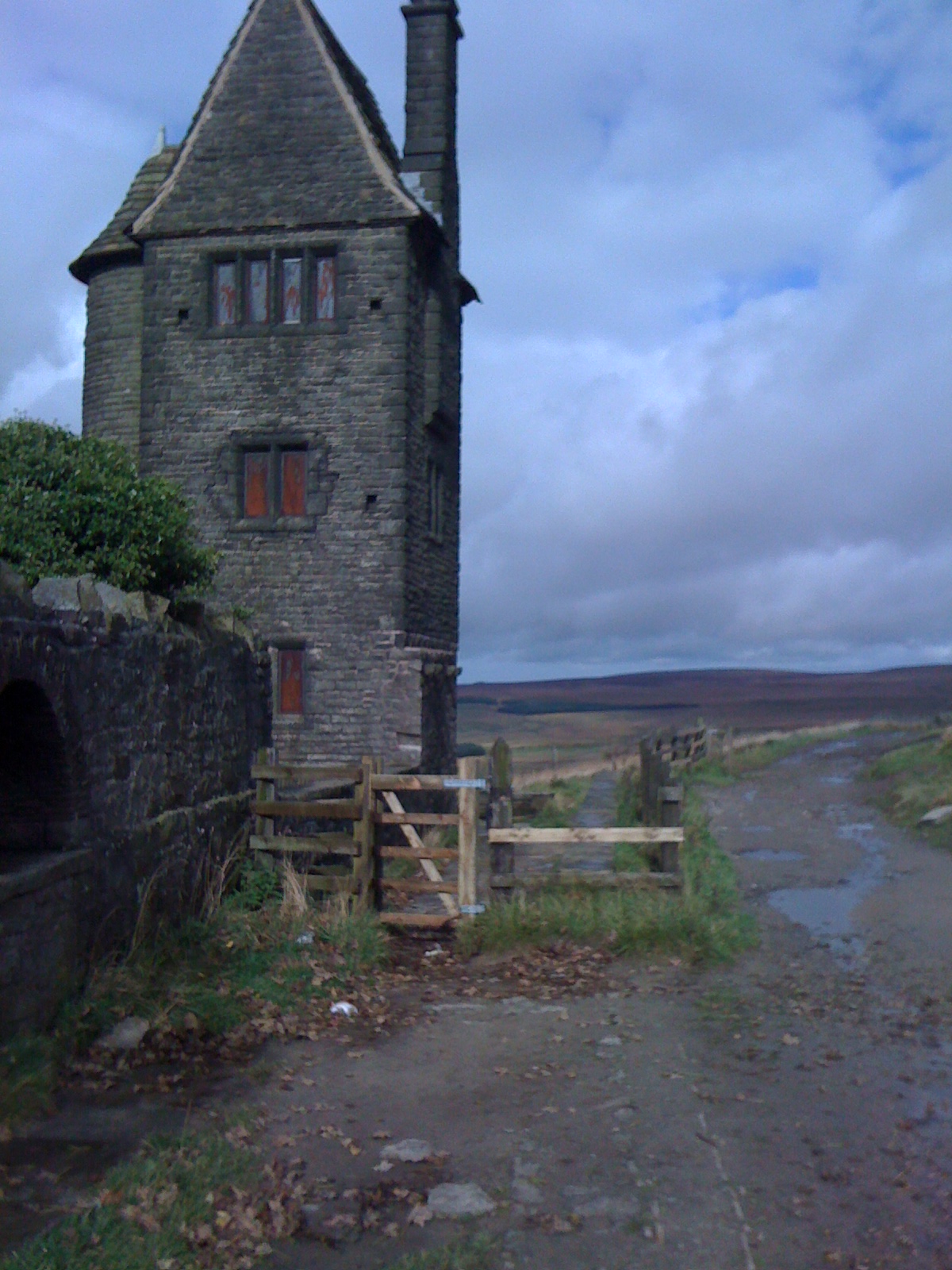
They unwind from their journeys over hot drinks, then are offered a short introduction to the landscape to be explored with mind and heart over the next two days. Dinner and wine have been arranged at the next door inn; good company and, perhaps a mellow nightcap see them to bed …
The winter morning of the 5th December dawns and our good companions take breakfast before wrapping up warm and putting on walking shoes to prepare them for the modest climb through the mysterious ancient gardens of Rivington, long abandoned by their creator. Perhaps a final coffee while the plans for the day are refreshed, then they set off for a journey of inner and outer exploration. As they climb, the landscape changes. The public parkland with its huge reservoirs gives way to smaller paths which snake up the hillside, revealing new and fascinating vistas, as though a great mind designed this as a journey of the soul, before moving on to other things, leaving it as mysterious legacy for others to contemplate.
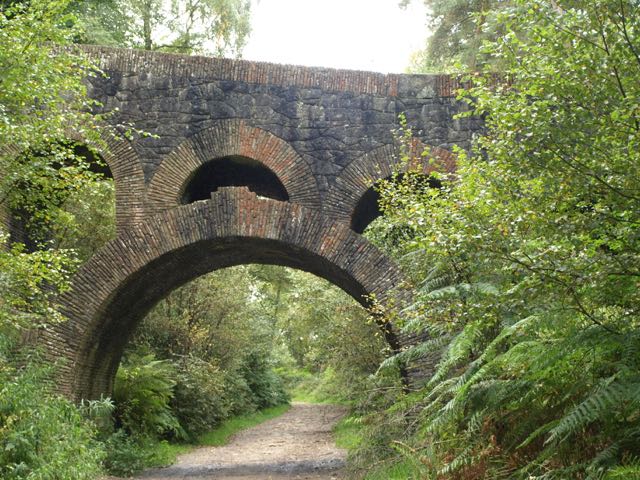
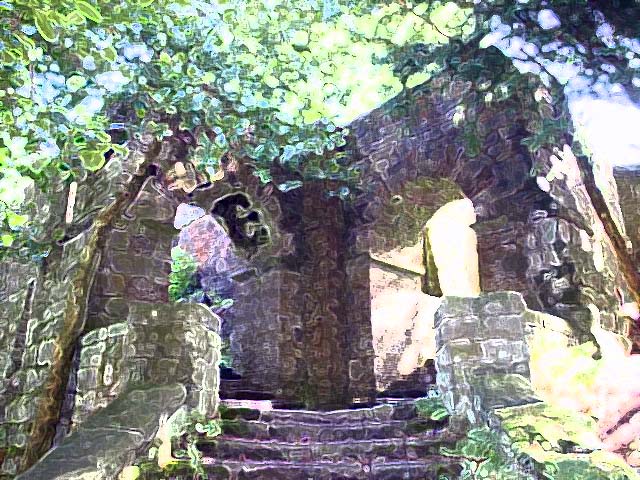
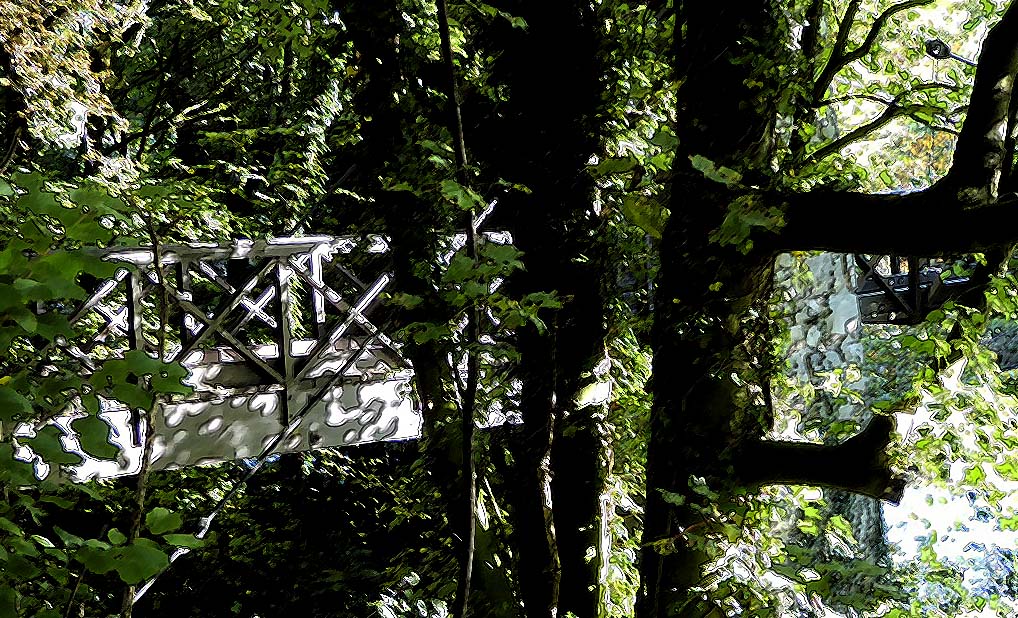
Without warning, an old stone bridge appears on the path ahead. Its arches are graceful, and its vaulting span seems to divide the entire hillside into the above and the below. What will each of the companions make of this, so soon in their journey? Examining the old bridge, it is found to be a footpath to the next level of a series of terraces, cut into the hillside, long ago. Before climbing further, one of the guides suggests they prepare themselves by a short detour to sit by the Lake of Reflection, hidden on this level, not far away. Some have brought texts and poems to read which seem to fit with this tranquil lake and the challenging bridge ahead.
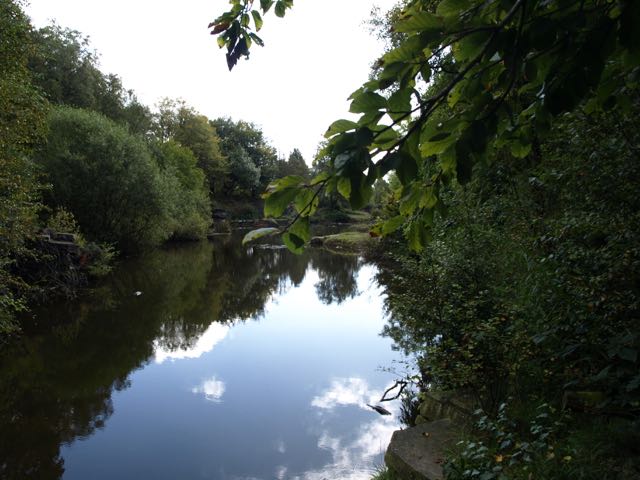
Everyone listens, attentively, as inner voices reveal themselves. Soon, the readings are done and it is time to climb, again …
The party returns to the arching bridge and we enter the mysterious landscape beyond. At the top of the next incline we are presented with a dark image–what looks like an old prison cell looks down on us as we climb. We stop to consider the positioning of this and the bridge – a symbol of hope and aspiration; followed by a test, perhaps? What could the creator have meant by this?
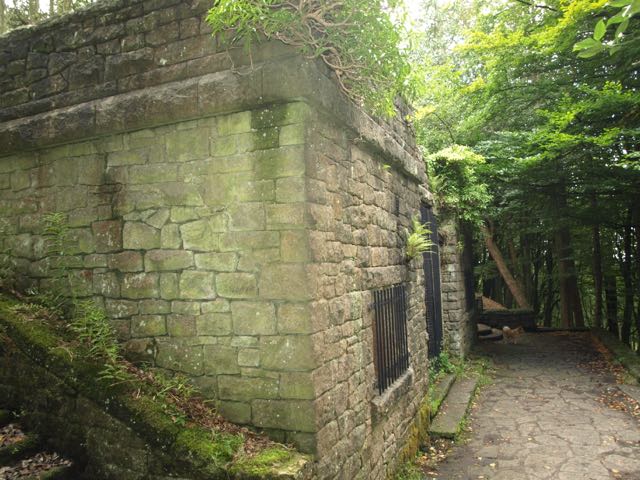
Leaving this question unresolved, we climb, gratefully, up the adjoining steps, bypassing the dark place to reach an expanse of gardens bordered by a wide stone path. From here, we can see the whole valley below us; and the view brings the thoughts of the approaching winter solstice. We stop at this level of the gardens to think about the inner meanings of the turning point: when the darkness reaches its deepest state, and mankind is challenged to find meaning at the point where nature, for a moment, stops …
We turn right to find yet another line of stone stairs leading upwards to a strange gateway of two halves. We consider the symbology: found versus designed? Given the nature of our thoughts during the climb, it is natural to look at this enigmatic gateway as representing the human brain, organ of the mind. Will we choose the way of logic or of the heart? How can both hemispheres be combined?
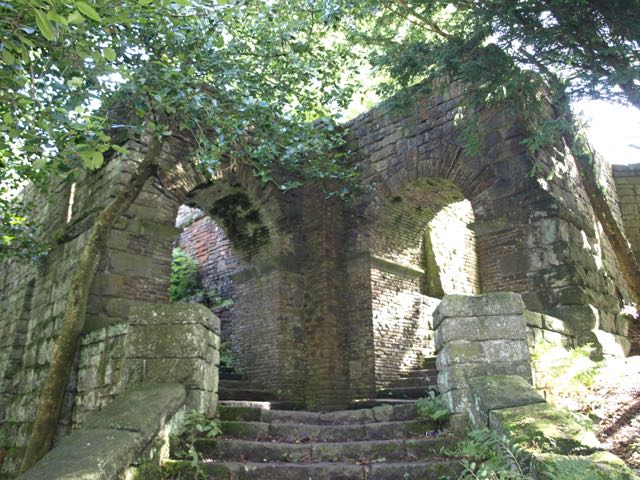
Ahead lies an expansive space at the edge of which there is the ruin of an old house, grand in its design and now seen only in the shapes of its ground floor and a few remaining tiles from an long-abandoned ballroom, whose black and white squares brings to mind the kind of flooring found in ancient temples. Being magical companions, this makes us think of how the fiery rites of winter often bring strength and endurance for the dark months that lie ahead. We begin to conjure with possibilities … dare we?
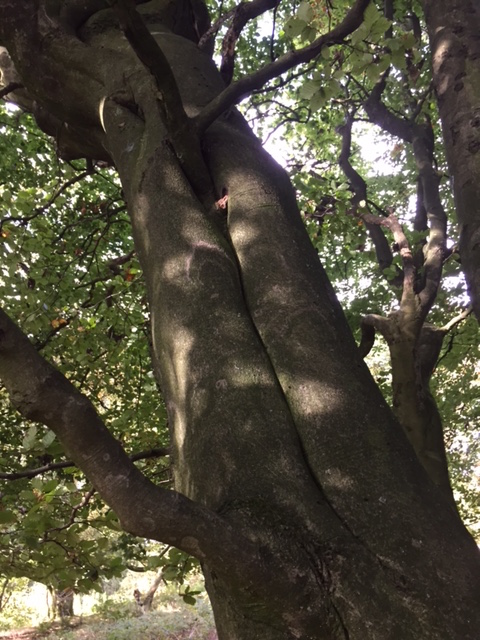
Our question is shortly answered as, beginning our walk to the fire-warmed Crofters Arms pub, which is expecting us for lunch, we pass a most mysterious and beautiful natural temple, set on the edge of a wood … maybe we could …?
Thus begins the Silent Eye’s 2015 Winter, pre-solstice weekend, running from Friday evening 4th December, to lunchtime Sunday 6th. The setting will be the wonderful landscapes of Rivington and Anglezarke.
The cost for the guided weekend is £50.00. Meals and accommodation are extra and left to the individual’s choice, though we expect to gather for group drinks and dinner on the Friday and Saturday nights at the Beehive Restaurant, Horwich, which is next door to the local Premier Inn. Please note this is a weekend and not just a single day as originally published.
Fancy a bit of mystery in an amazing landscape? The chance for the world of being to help guide our steps, and the most warm company? Join us. The booking form can be found http://thesilenteye.co.uk/events/, or email us at rivingtide@gmail.com.
rivingtide@gmail.com
Share this:


Share this:

In April 2015 a group of people gathered in the Derbyshire hills to enact the Silent Eye’s annual Mystery Play, entitled, The River of the Sun. The five-act mystical drama formed the backbone of that Spring weekend, and told the fictional story of a clash of ego and divinity set in an Isis-worshipping temple located on an island in the Nile, during the the fascinating period of the 19th dynasty, the time of Rameses the Great.
The 18th and 19th dynasties were a time of upheaval for ancient Egypt on many levels. The reign of the ‘Heretic King’ Akhenaten saw Egypt’s religious structure torn apart, as the revolutionary Pharaoh became what Wallis Budge called the ‘world’s first monotheist’; re-fashioning the power of the many Gods with one supreme entity – the visible sun disc, the Aten, for which Akhenaten, alone, was the high priest. Many have pointed to the failure of the ‘heretic’ Pharaoh’s politics, but few have doubted the sincerity of his religious vision. He will, forever, remain an enigma.
Whatever the nobility of his goal, the actions he took were ruthless, and included the shutting down of the annual deity festivals which were the sole point of ritualistic contact between the ordinary people of Egypt and their locally-worshipped gods. In addition, Akhenaten paid little attention to the domestic and military affairs of Egypt, allowing the country’s enemies to encroach on its borders, greatly weakening Egypt’s power at that critical time for the region.
After Akhenaten’s brief reign, culminating in the Pharaoh’s mysterious death, shadowy military forces took control of Egypt, instigating the 19th dynasty in the persons of Rameses I and, soon thereafter, Seti I, whose throne name derives from the god Set – often considered the ‘evil one’ because of his slaying of his brother, Osiris.
Seti I is judged by modern historians as having been one of the greatest-ever pharaohs, yet his importance in the 19th dynasty was eclipsed by the actions of his second son, the brilliant Rameses II, whose long reign of over sixty years included much self-promotion and the alteration of Egypt’s recent history. Both Seti and Rameses II (Rameses the Great) were passionate about the evisceration of the last traces of Akhenaten’s ‘chaos’, as they saw it.
But, although, by the 19th dynasty, the the ‘Son of the Sun’ was long dead and the buildings of his embryonic and doomed city of Tel-al-Armana were reduced to rubble, something of that time remained in the Egyptian consciousness. A new kind of connection between Pharaoh and God had been established, one which elevated mankind, if only in the being of the Pharaoh, to be someone who ‘talked with God’. It was, at the very least, a bold experiment and, though the world would have to wait until the 19th century to re-discover the ‘erased’ pharaoh, the philosophical waves of that period rippled out and dramatically affected the way the incoming 19th dynasty had to repair the worship of the Gods, uniting the people of Egypt under a trinity of Amun-Ra, Khonsu and Mut.
Our fictional story is a tale of politics, friendships, mind and faith. It is set against an historically accurate background, and at a time when Rameses was due to take the throne from the dying Seti .
Returning to Thebes in his swift warship, crewed by his fearsome Talatat mind-warriors, Rameses decides to mount a surprise night-time raid on the island-based Isis temple which has prospered under the sponsoring reign of his father. Rameses suspects that the inner teachings conducted by the revered High Priestess and Priest conceal views that relate to the thoughts of the heretic Pharaoh, Akhenaten. He plans to insert himself and his warriors of the mind into the islands’s Spring rites as the high priest and priestess begin a cycle of initiation for a chosen apprentice priest who has proved himself worthy of special advancement.
The resulting clash draws everyone, including the young Pharaoh-in-Rising, into a spiralling situation where each is forced to confront their own fears as well as living out the roles which life has allocated them. River of the Sun is the story of a spiritual and political encounter from which none emerge unchanged, including the man who will shortly be Pharaoh, the mighty Rameses II, whose secret name for himself is ‘the unchosen’.
Through the eyes and minds of those surrounding the chosen priest and the ‘unchosen’ Pharaoh, the River of the Sun takes us on a tense and compelling journey to the heart of power and its eternal struggle with truth.
The chapters of the book will be serialised in this blog. The finished work is planned to be available in paperback and Kindle by the end of the year, and will contain the full novel plus an appendix of the dramatic rituals used to enact the story in April 2015.
————————————————–
Chapter One
Gifts from the River
The water was soft on his skin. He was used to bathing in the river at sunset, but there was something special about today. He looked across at the glittering image of the sun as its reflection folded on the water, bouncing the golden light along the gentle waves at him. A boat had just sailed by and he felt the lapping waves caressing his thighs. It tickled and he giggled to the river.
His reverie was disturbed by the sound of his grandmother’s voice. “Wash, Amkhen! Stop your daydreaming!” He flashed his cheeky smile back at Snefer, sole guardian to him since the death of his parents many years ago, in the fire that had destroyed their home while they slept. The nickname, ‘Snefer’, which he had given the old woman, made her smile, though he was too young, yet, to know the kindness behind such tolerance.
The name derived from a present from his father, which he still kept. His father had travelled in his own youth – selling his beautifully hand-woven carpets, which he would pile onto his faithful donkey, before leaving for days or even weeks. He always came back with tales of his adventures, and Amkhren’s delight had been to sit, balanced precariously on his knee; and listen.
One day, his father had returned with a carved wooden object – a gift to his son. He took it from his bedroll and presented it, smiling as he did so. He had carved it out of a single block of wood. It was like one of the drawings his father had shown him of the fabulous white pyramids that legend said graced the upper parts of the river, just before it spread and flowed into the sea. The wooden carving had a square base, whose four corners rose in two stages, to meet at a single vertical point. The angle of the climbing sides became shallower half way up and this gave the whole thing a comic element. His father had said that its location was called Sneferu, and it was known as the bent pyramid.
The day after that, he had pointed at his grandmother and said, “Grandma is bent, too! Can we call her Sneferu, like the pyramid carving?”. His father had looked at his own mother and smiled in that mischievous way that his young son had inherited. Then he had said, “Well, we don’t want to anger the Gods, so let’s shorten it to Snefer!”
She had sighed, inside, on that day. But now the memory of that time brought back such happiness that old Snefer didn’t mind it at all. She looked at the boy, who had finally taken off his loin-cloth and was washing himself. Her heart burned with feeling for him – the sole survivor of a family that had known how to love and to laugh, together. The sight of him always drove away the aches and pains that had begun to afflict her ageing frame . . . and the sad memories, too.
The sound of footsteps behind her made her whirl in alarm. After that, she could only drop to her knees in the sand, wailing.
“High Priestess, forgive me!” She bowed her head to the mud. Before her was one of the most beautiful and stately women she had ever encountered – Neferaset the high priestess who led the worship at the Temple on the island, a mile or so south along the river. Alongside her brother, Anzety, they were the most powerful of the bright people.
“Do not be frightened, old woman,” said the glowing one, bending down to take the withered hands from the dust and pull Snefer up to her normal, if bent, standing position. “We are not in the temple, and, if I chose to leave the sanctuary of the island and walk along the river, I am going to meet strangers . . .”
Snefer kept her head bowed. But spoke, “My grandson is bathing in the river. Forgive his rude nakedness.”
Neferset looked beyond the old woman and saw her grandson. He was talking to another boy who stood ahead of him in the deeper water. “And who is that with him?” she asked.
“There is no-one with him, High Priestess . . .”
Neferaset frowned and blinked her eyes, focussing on the sight of the two boys bathing. One was plainly visible, his naked form dancing in the water. But he was definitely speaking to another boy – one who stood motionless before him and had a bright but much less distinct outline . . .
Amkhren was delighted with his new friend. As golden as the ripples on the river, he had appeared before him in the beautiful sunset, smiling. He had asked Amkhren’s name, but refused to give his own. He had, though, given Amkhren a cloth bag of beautiful, carved stones. Now, the other watched, while Amkhren laid them out on the wet sand.
“Used rightly, they have great power,” he said.
“And how do I learn?” Amkhren asked, overwhelmed with the gift. “Will you teach me?” He looked up, but the other boy was shaking his head.
“My time here is gone,” he said, with sadness in his young eyes. “But your life will teach you” he smiled again, bringing joy to Amkhren’s face. “Many wonderful things lie ahead of you!” said the other boy.
Amkhren wanted to ask him more but he turned when his grandmother’s urgent voice cut through the peacefulness of their playful talk.
“Amkhren! Put on your garment and come here at once!
Amkhren, saddened, but obedient, spun back to say goodbye to his friend; but the other boy was gone. He peered deep into the waves in case his friend had swum off, but there was no trace. A second, and sterner call from Snefer dragged him from his searching. Panting, he retrieved his rags and tied them across his wet waistline. Only then did he look up to locate the old woman. She was standing, with her head bowed, next to another woman. This was a day of surprises! He looked harder, narrowing his eyes to carry his vision deeper into the tableau. Then, he stopped walking and his mouth fell open. There on the raised bank, his grandma was talking, though her head was bowed, with the High Priestess of the nearby island temple – a woman he had once glimpsed from the sanctuary of a hastily built log raft, which had floundered shortly thereafter.
The day had been baking hot and Amkhren had walked along the river bank, far from where Snefer had said it was safe for him to travel. He had, gradually, been extending his walks, because he knew that the temple island lay just beyond the next twist of the river’s course. On that day, he had caught sight of a temple procession on the sacred isle and had thrown caution to the wind, trusting his life to a few logs hastily lashed together with the stalks of reeds in the way that his father had shown him, so long ago.
Before the raft had fallen apart, he had caught sight of the winged one, as he thought of her. She had shone in the sun in her finery and splendour. All around her there was total silence, total reverence. Beside her, another of equal stature walked, but this one was a man, tall and purposeful, yet with a hint of gentleness to his bearing. The reed bindings gave way, the logs parted and, plunging into the river with a cry, he was forced to cling to the largest as it rolled. Gone were the wild thoughts that someday he would find a way to return to the temple island to serve them. Choking on the inhaled river water, he clung desperately to the remains of his capsized raft and forced his legs to kick, pushing the log slowly towards the far bank.
Now the Goddess stood before him. Disguised, yes, but it was her . . Amkhren took a few more steps and fell to his knees, prostrating himself in the dust.
“I feel I know you, boy?” said the shining one.
“Oh, you couldn’t know us, High Priestess – we are just beggars in your world,” blurted out his grandma, her head still bowed.
Amkhren’s mind raced. Should he tell her of his moment on the raft? Surely it would be to invite death . . . and yet, he didn’t want to miss the only chance that his life might hold to reach for that impossible goal.
“The river has many secrets, High Priestess,” he managed, somewhat proud of his cleverness.
“And dreams, perhaps?” the tone of her voice was soft; there was deadliness there, too, but her knives were sheathed. She knelt down in the dust of the bank and, with soft hands that contained more power than he had ever felt, pulled his head up to stare back at her almond eyes. “And what does this young man dream of?” she asked, running a painted finger up the side of his jaw.
River of the Sun, serialised here, and its associated images, is the intellectual property of Stephen Tanham and is ©Copyright material.
Share this:

Share this:

.Alexandra.
“I’ve had a week of threes,” I said, wanting to seize the initiative. I felt empowered, full of energy; and I wanted to be at it … the labours of Heracles, that is.
He looked at me over a succession of objects: the coffee cup, poised next to his bemused lips; the newspaper, held in his free hand until I arrived and tapped its top; and the reading glasses sitting halfway down his nose. “Good morning,” he replied, beaming; then, chuckling to himself, he added, “Threes? Tell me about the threes.”
I calmed myself down, digging deep for the essence of what I wanted to say. “Each group of three has a purpose, a possibility of growth from one to two to three. Getting to three would be the end of that cycle … for the small ones.”
“There are big ones, too?” he asked.
“Yes – there are very big ones, overarching stages, in which the smaller sets of three are building blocks.”
“And you feel you might be making a transition between two of these very big ones?” He smiled. It was a kindly smile, full of encouragement.
“A kind of jumping between levels,” I responded, desperate to find that right word. “A fundamental change of direction… a moment of ‘no going back’.”
“Ah …” he said, sipping his coffee. “An initiation …”
I sat and drank my own. Initiation. It was a word I had heard many times. It conjured up bad horror films or scary fiction. Was there a different side to it? Had I stumbled with my earnest words upon something that was really rather special … and personal? Was there a world of real initiation where those involved wouldn’t dream of demeaning it in fiction?
“It’s a deeply personal thing,” John said, reading the thoughts in my mind. “Initiation can only belong to the person going through it. Other people can help with the environment that assists it, but the gateway to that ‘fundamental change’, as you so rightly called it, admits only one passenger.”
I was fighting to stay level with his concepts; as often happened; yet I knew how far I had come in understanding in the past year; I could feel it, taste it and, sometimes, in a moments of extreme clarity, see it.
“So tell me,” I said without sarcasm. “What this has to do with the Labours of Heracles?”
John sat back, closing his eyes in a way that I hadn’t seen before. He sipped his sightless coffee and waited. I knew that his introspection had nothing to do with making me wait.
At last he spoke, “What you are experiencing is the start of initiation, which is truly wonderful, given that you’ve had so little instruction …”
He closed his eyes again, this time for longer. I waited, practically breathless, until he surfaced.
“I’ve been trying not to use ancient words,” He sipped his coffee through a wry smile. “But sometimes they are too good not to use.” His eyes flicked up from the coffee cup to look at me. There was calmness and clarity in them, as they brought something very special into the moment.
“You, along with Heracles, are being initiated into the world of the disciple.”
The eyes didn’t leave me, measuring my inner and outer reactions to this shock of a statement. “Disciple?” I muttered, quite flummoxed by the notion. “Like the disciples of Jesus you mean!”
“The word and the concept are older than the story of Christ,” he said, softly. “And don’t be put off by the gravity of the Gospel stories; no-one is expecting you to sell all your possessions and follow some wandering Teacher.”
“Not even you, then?” I regretted the words as soon as I had uttered them. I closed my eyes in a gesture of apology, shaking my head. “I didn’t–“
“I know,” he said. “It’s okay. We all do irrational things when the ego is threatened by some profound truth. In this case the profound truth belongs to you, alone, and is to do with an inner realisation you have already had. It has nothing to do with me as your so-called ‘teacher’.” He fell silent, but added a few seconds later, “But, in any event, you would not be my disciple – I don’t have any; that destiny is reserved for others of much more importance …”
Before I could speak, he added, “In any case, your greatest teacher is the one who is calling you … your own Soul.”
It took me a while to speak. “So, everything I’m feeling … sensing … is part of a call to a different journey?”
“Yes,” he said. “It’s a call to those who begin to see the world differently – very differently; to those who realise that we could practically rip up most of what we were taught, because the world – the real world beyond received illusion – is a ball of singing life much richer and infinitely more beautiful that the outer layer that science does its honest best to describe …”
“And what does that journey entail?” I asked, my voice a whisper.
“Going backwards,” he laughed, rocking with the mirth of an inner meaning that he knew I could not yet fathom. He coughed, apologetically, then continued, “The new journey imposes the Will of the inner you on the world you react to; and thereby tests and cleanses it …”
“It will test and cleanse me?”
“Only those parts of you that need it,” he said, the eyes never leaving mine. “It knows; trust me, it knows …”
“The journey is intelligent?” I gasped at the thought, watching him nod at me, seeing the fullness of the meaning take root in my mind and heart.
“So now to the Labours,” he smiled, brushing aside my disbelief. “And so you must study the nature of wild female horses.”
“Not lions?” I asked, surprised that my preparation had been tripped up.
“No,” he answered. “We are to follow Heracles around the Zodiac, anticlockwise – the world of the changed direction, beginning with the Wild Mares of Aires, in the symbolic Spring.”
He tapped his watch, wordlessly. As he got up to go, he bent to whisper, “Lovely new coat.”
The unseasonably warm October weather had continued. “I don’t have a coat on,” I protested, still stunned by the whole encounter.
“Minerva has given you a robe,” he said. “though few will see it …” Then, he kissed me on the top of my head. “We are allowed to be proud of our children.”
———————————————————–
Nine Deadly Sins with Coffee is usually published on Thursdays.
All images and text ©International copyright, The Silent Eye School of Consciousness, 2015.


 Sun in Gemini
You must be logged in to post a comment.