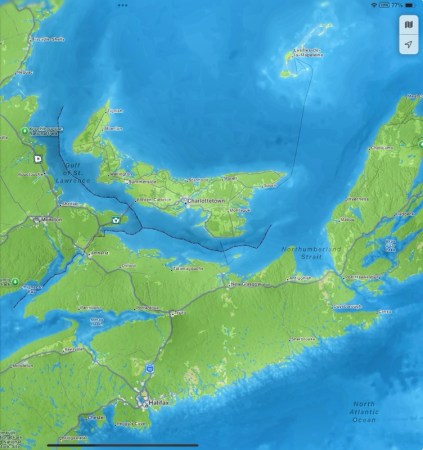
Prince Edward Island, often shortened to its initials PEI, is Canada’s smallest province. It lies only 13 miles off the New Brunswick Atlantic coast. It is connected to the Canadian mainland by one of the world’s longest bridges to pass over ice-covered waters (in winter), named the Confederation Bridge.
It is one of Canada’s Maritime Provinces, and the waters that flow around it are those of the Gulf of St. Lawrence. To the south is the Nova Scotia peninsula.
The island has an excellent and friendly airport to look after tens of thousands who come to visit the home of their favourite childhood character.
(Above: the life of LM Montgomery)
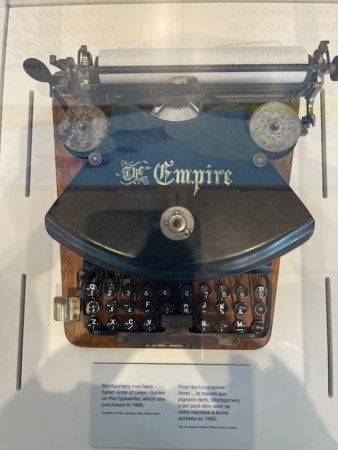
(Above: a celebration of life, work and favourite writing tools)
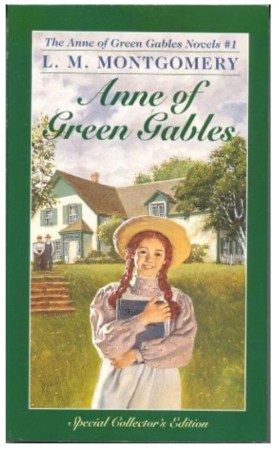
PEI was the home of L. M. Montgomery, the best-selling author who created the Anne of Green Gables series of books, in its time, among the world’s most popular books for teens.
(Above, centre: Prince Edward Island – PEI. Home of Anne of Green Gables and William Brent, to name but two…)
Long before the Anne of Green Gables books, it was the new home of William Brent and his family, after their successful schooner voyage from Bideford in North Devon – See Part One.
The outline of William Brent’s two amazing voyages was told in the previous post. In this blog, we consider some of the underlying conditions of the time: the backdrop to William Brent’s decisions.
(Above: The self-styled ‘emperor’ of France – Napoleon. Bonaparte)
Thomas Bernard, a relative of William Brent from Britain, had been on Prince Edward Island for many years before William Brent arrived with his family in the late 1820s.
Thomas Bernard’s business had two operations; they had established themselves as one of PEI’s major shippers, using their extensive knowledge of the Atlantic Ocean and its main ports, and secondly, they were poised to inject a very familiar ‘new’ cargo into those supply lines – quality timber.
Prince Edward Island was sparsely populated and had plenty of timber – though the land was unforgiving and less productive as a basis for agriculture. PEI, being a maritime province, had an existing reputation for quality ship building, and was growing in nautical importance despite the extremes of weather during the winters.
Thomas Bernard was aware how political tensions created markets. The self-styled French emperor, Napoleon Bonaparte, saw the British as his primary enemy.
Bonaparte, furious at Britain’s continued domination of the seas via their superior Royal Navy – used the smaller French fleet to blockade the Baltic ports, preventing the vital supply of raw timber Britain needed to maintain and increase ships of the fleet.
(Above and below: an example of Britain’s defences against the emperor Napoleon, this Martello Tower on the Orkney Island of Hoy was a heavily fortified naval tower, bearing a single, highly accurate ‘24 pounder’ gun. with comfortable soldiers’ living quarters on four floors. On the roof, was a rotary iron track around which the main cannon could be accurately aligned- enabling any ship within Scapa Flow to be targeted.)
The Hoy Martello Tower was never used in anger. But it did help to establish the vast Sea-Loch of Scapa Flow as one of the Royal Navy’s most defensible waterways. In addition, in Thomas Bernard’s time, the vast Scapa Flow sea loch was used as faster route to the open Atlantic, and therefore allowed Napoleon the possibility of ambush of timber shipping.
(Above: the vastness of Scapa Flow, Orkney – wartime home of the British Fleet_
Napoleon Bonaparte was a thinker … and the presence of the Martello Towers would have weighed heavily on any considerations of a British Invasion by the French. A single, accurate, canon shot from this formidable weapon could sink a ship.
(The design of the Martello tower was based on close observation of the Martella Tower in Corsica, which successfully repelled a British naval attack in 1794. Astonished, the British officers took (remote) measurements of the tower and used them as the engineering basis of their own version)
Over 100 Martello towers were made along England’s south and east coasts between 1805 and 1812.
None were ever fired in anger – an early example of ‘deterrence’ at work on a geo-political scale.
William Brent was a relative of Thomas Bernard. He saw his chance to take a low-risk move to PEI, moving his family from Cornwall to Prince Edward Island to join the carpentry operations of the relative Thomas Burnard.
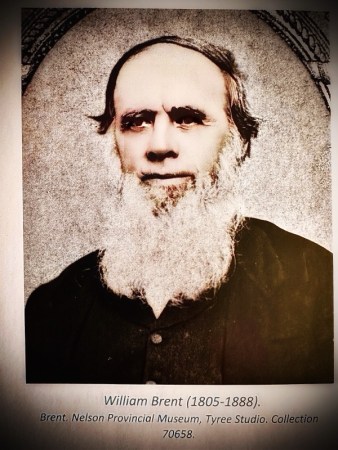
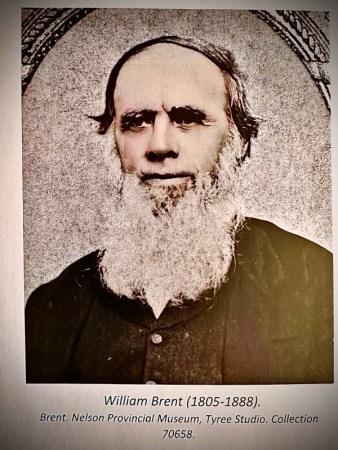
(William Brent (1805-1888) Family man, carpenter and adventurer!)
His advanced carpentry skills were in wider demand. He built his own house, then was instrumental in the design and building of a local church – one of the first on PEI, thus firmly establishing himself at the heart of the Charlottesville community.
‘Back in the present’, the research was going well – continually aided by Paul and Russ’ historical facts and the right kind of summaries that help the story; no-one wants a list of facts!
The start of our trip to Canada to see the family was fast approaching. We had to plan carefully. Family time had to be the first priority… but after that…
Bernie had arranged a long-overdue reunion in Ottawa with one of her cousins, Lee. Lee’s family had travelled, luxuriously, around the world in the 1960-70s, moving as part of their father’s career as a senior Shell Oil executive.
Bernie and Lee hadn’t seen each other in 53 years, though they had kept in touch.
Lee now works for the government in Ottawa and was keen to show us around that fine city. That, she said, would take us a full day – with some social time mixed in for lunch and dinner.
(Bernie and Lee (sitting) – reunited after 53 years)
After leaving Toronto, Lee would collect us from the railway station in Ottawa and was and put her heart into the task of genial host for our two days there – far too little time for such a beautiful city.
That left a few days on PEI at the end of the trip…where we hoped to be of use to Russ and Paul in providing at least some ‘feel’ of St Mary’s Bay – the place where their new ship – The Lady Grey schooner had been built. We wondered if there might be one or two photographs of the harbours in use on the eastern seaboard, especially those that may have had the skills to take on the building of an entire ocean-crossing schooner, back in the 1820s … it was a long-shot.
(Above: The Atlantic Ocean on a globe of the time. Image by the author)
Upon our arrival, two days would be devoted to getting to know the layout and scale of PEI by rental car. Our travel experience had shown the importance of that!
(Above: Not the Lady Grey, but similar: a typical schooner of the 1820s)
We’d allocated a full day for having a good look at The Anne of Green Gables visitor centre – on which I would like to invite my wife do do a separate post, using this blog.
The final day would be an attempt to do justice to our historical mission – To locate and explore St Mary’s Bay, the place at which the Brent family’s new boat: The Lady Grey, was constructed; the place from which they had sailed into the relative unknown, successfully crossing the oceans to New Zealand in the early years of the 18th century.
Russ had only asked us to take some general photos of PEI, for use in he and Paul’s historical research. But I had the feeling that we could get closer
A sidewards skirmish via the internet had revealed that PEI had a fine set of lighthouses – one of my favourite subjects to photograph. I hoped to feature one or two photographs as we went along.
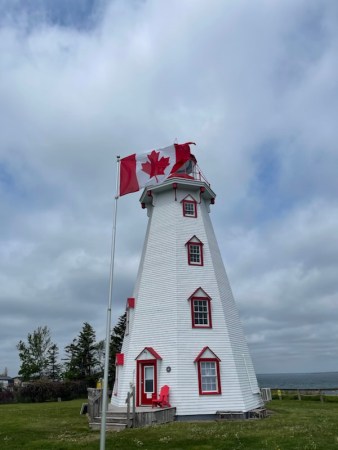
(Above: one of the beautifully preserved lighthouses of PEI taken on the trip – yes, we’re future-gazing here!)
The airport gate was shortly to close. It was time to leave mainland Canada behind, though we would eventually connect to Dublin and Manchester via a swift return to Toronto.
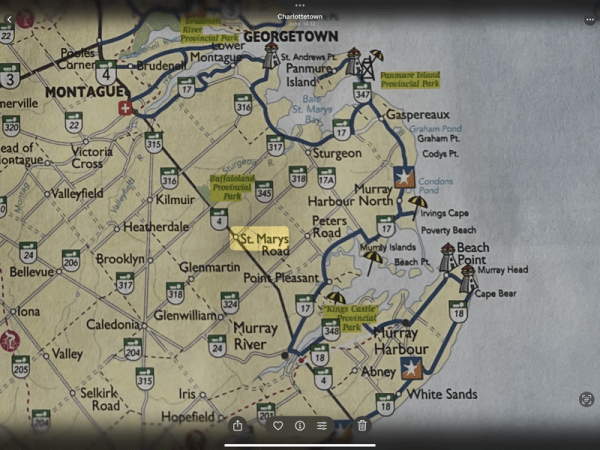
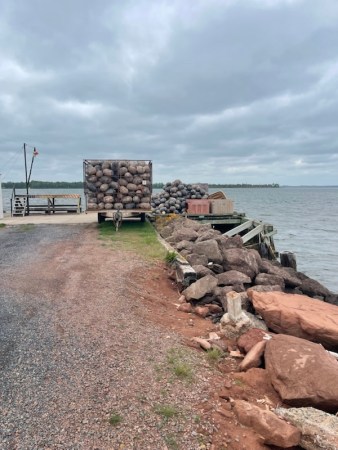
(Above: St Mary’s Bay, PEI. Its a complex area and sparsely populated)
Was it reasonable to presume we could have any success at all? Photos a friend had supplied made it look sparsely-populated. Fishing trips seemed to be a major business – with a few cafes and farm shops close to major road intersections.
We could only try…
And at least the photography would be plentiful…
Below is one of very few documents related to The Lady Grey, built somewhere in St Mary’s Bay. It comes from the shipping register of New Zealand and is dated after the ship was subsequently sold. . Details of the ship are well documented, and it fulfilled its twin roles of transporting the Brent’s safely to New Zealand, and providing the initial capital for their lives.
They never moved again…
For us to find anything meaningful – and of use to assist Russ and Paul – we were going need much more than logic.We would need that telling intervention of serendipity- luck.
September one of my favourite months, though I’m always sad to see the summer end.
September is a kind of ‘transition zone’ between the golden end of the warm months and their colder counterparts that live on the edge of true winter.
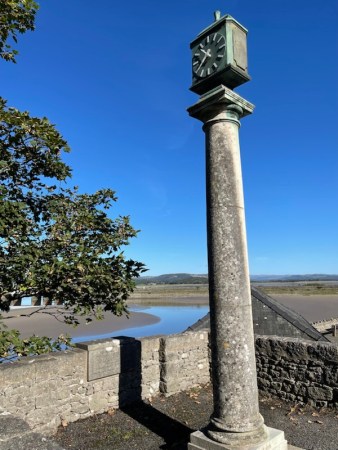
(The famous clock that doesn’t)
For us on the southern edge of the Lake District, it’s a time when, on the right clear-skied morning, getting the dog up and out early can pay dividends in the form of clear shots with a hint of mellowness.
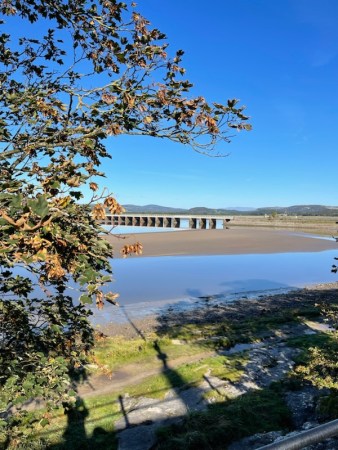
(The Arnside rail viaduct, a lifeline for western Cumbria)
The incoming colder days lend a clarity to the morning sky, one that is often ‘hazed’ in warmer months.
And we’re lucky to have Arnside close by, with its rich mixtures of estuary, sandbanks and that ever-present rail viaduct; the lifeline for the folks from Barrow and Ulverston and beyond
Deep blues, clear skies and historic objects – including this tall clock that hasn’t worked for years, yet has a loyal band of supporters.
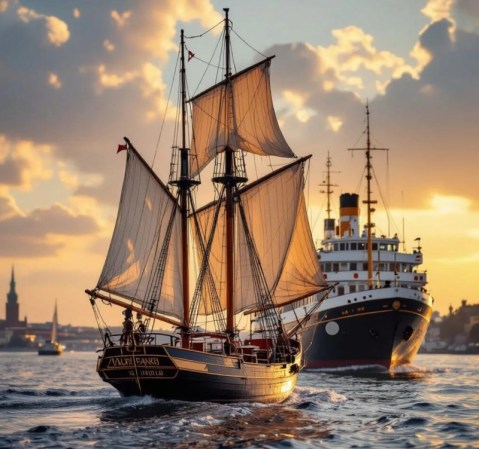
(Above: ‘Ships and Crossings’ by the author. Created using NightCafe Studio)
It was Easter Sunday, 20th April, 2025. Bernie had cooked us a fabulous Sunday lunch, now finished, leaving us relaxed and reflective. .
We had three guests; our longstanding friends and fellow dog-owners Siobhan and Paul, and a visiting new friend of theirs from New Zealand – Russ -who is pivotal to the rest of this true story.
Although you might have good reason for thinking that what follows is fiction…
The sun was shining and the air was warm. Russ and I went out into the garden with our drinks, leaving the others talking through the details of our forthcoming trip to Canada. We were to be reunited with the family in Toronto before visiting Ottawa and Montreal, ending our trip on a small island that was the home of L.M. Montgomery, the creator of the famous Anne of Green Gables novels.
Bernie remembers loving these books as a child. She hadn’t expected to be able to visit the place of their origin and setting: Prince Edward Island…
But it was shortly to come true.
Beyond books, this is a story of ancestors, and a great adventure undertaken by those ancestors. It’s quite a story, but it’s not our story. The people who follow in this true tale are not our ancestors. They are the ancestors of Russ and Paul – with Russ being a direct descendant of the main adventurer; a man we will shortly meet.
(A map of Prince Edward Island in 1820. The significance of the date will become clear…)
Here’s a photo of those whose story this is; Paul (leading) and Russ, the ‘Kiwi’ following behind. Both with ice creams in the Cornish sunshine – where the ancestral story, here, was uncovered.
(Above: Russ (left) and Paul (right) doing ancestral research in Cornwall. St Michael’s Mount, Penzance, in the background)
Back to our garden and the post-lunch sojourn.
Russ is a keen gardener. We chatted about the difficulty of keeping on top of mowing the grass at that time of year, when the new life literally bursts forth with a very determined push.
Finishing his drink, Russ sat back, enjoying the sunshine. I assured him that Easter weather in England was seldom this kind.
We had been talking about travel and its joys and also how exhausting it can be.
“The problem with New Zealand,” he said. “Is how far away it is from anywhere else … except Australia!”
I chuckled in agreement. We had visited New Zealand a few years ago at the end of another Australian family reunion, followed by a short cruising holiday down the Australian coast from Sidney, via Melbourne and on through the Tasmin Straits. It is a beautiful place but very far away.
“Did Paul tell you about the family connection with New Zealand?”
“He did!” I smiled at the sheer courage of those – his ancestors – who had emigrated there.
“Did he say where they travelled from?”
I sipped the last of my wine. There was a quiet determination at work, here…
“From Prince Edward Island, off the Canadian east coast.” He half closed his eyes. “In a schooner, for heaven’s sake”.
(Above: a typical schooner of the 1820s)
My father had a modest sailing boat that he kept on Ullswater in the Lake District. It would sleep four people as long as they could cope with ‘camping’ under fibreglass. There was a toilet: ‘head’ in boatish, and a very small sink. We’re not talking posh…
Named Vogelsang – birdsong from German – it was my father’s pride and joy. It was moored in a small bay just off the northern shore of Ullswater, next to a rather snotty sailing club whose members always refused to have anything to do with us.
There’s much to learn about people from such encounters.
My girlfriend and I stayed on the boat one Easter holiday and practically froze to death. Each morning we had to break the ice on the hatch to get out to the deck, then row the dingy ashore to take an hour’s walk (we didn’t have a car) into Pooley Bridge where we’d try to find a warm coffee shop that was open. It was a frozen Easter.
Once there, we hoped the owner would take pity and let us eke out our meagre funds and stay in their lovely warmth.… for three very slow coffees.
Boats are seldom the objects of romance we might imagine!
And that was just a lake…
(Above: the remarkable William Brent – carpenter, builder, father, mariner, adventurer)
In my early twenties, I learned to sail Vogelsang by trial and error – often more of the latter. In the winters I used to read up on boating and ships. What Russ had just said surprised me: you would not normally choose a schooner – which, typically was used for offshore cargo between ports in the same country – to cross major oceans.
“A schooner?” I asked, looking into Russ’s smiling eyes. “All the way from Canada down across the Atlantic, under Africa and straight on across one-third of the planet to a barely-developed New Zealand?”
“Right…” he said, wistfully. “Or some similar ‘great circle’. It stopped me in my tracks, too; and we don’t even know the route they took … so far, we’ve found no further details of the voyage.” He leaned forward, laughing. “But we know what happened afterwards… And our family is at the end of that tree of descendants!”
Neither of us spoke for a while. I was trying to envisage the courage and skill such an adventure would have demanded.
Russ continued:
“With his family, a skipper they had hired…” he sipped the last of the juice, looking slightly theatrical. “And a cow.”
He waited for that to sink in.
“A cow?”
“Yes, so they could enjoy fresh milk as protein. They were resourceful people!”
I shook my head in wonder, and went quiet, trying to consider the logistics of putting that voyage together – and the slim chances of success.
“And they made it?”
“Yep,” Russ said. Just as they had made it from Bideford in Cornwall to Prince Edward Island in the first place!” He was lost in silent respect. “Took them 238 days.”
He let the import of that sink in. We were both quiet.
(Above: The Atlantic Ocean on a globe of the time. Image by the author)
Bernie had seen us chatting away – this was the first time we had met Russ – and brought us fresh drinks. We sipped, deep in thought.
“And you found all this out in Cornwall.”
“We did…” Russ said. He took some more fruit juice. “Except for one important part.”
I chuckled, feeling that something key was about to be revealed. I said to Russ. “And?”
“Sadly we know little about Prince Edward Island – the place William Brent and his family had settled in after they left Cornwall; the place where his skills as a carpenter were put to full use and they prospered, the place where he had lived for over twenty-five years and raised a family.”
There was a sadness in his tone. “And I’m unlikely ever to be able to visit it.”
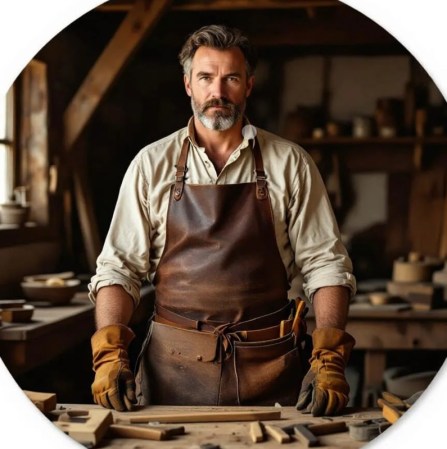
(Above: it’s likely that William Brent, master carpenter, wore this kind of apparel when working in the 1820s)
I had a feeling this might be our part in the story.
“But he eventually left Prince Edward Island? I asked. “Was there still a restless hunger?”
“None of us will ever know the background,” Russ said, staring into the blue sky of that lovely day. “But it may be linked to the fact that Prince Edward Island was becoming depleted of its once-abundant forests. Over-felling had decimated its tree population. William Brent may have had to make a decision: go back to England or carry on–‘
“-Around the planet!” I laughed. “What a brave soul he was!”
“They had the schooner built for them. Probably took most of their money. They took on a skipper, a first mate and a few deckhands, and set off across some of the Earth’s most dangerous seas…”
He sipped his orange juice, deep in thought. How could you not be! As fiction, it would be a fabulous story. As fact, it was astonishing.
“And they made it, intact?”
“Even the cow,” Russ said. “Sold the boat in New Zealand – which had always been the plan – and used the money to set themselves up there.”
“And they stayed?”
“Yes… Finally, William Brent had come to the end of his sailing adventures.”
“And now you know the whole story!”
“Not quite,” he said.
I leaned back, smiling.
“Prince Edward Island?” I ventured.
Russ laughed. “We’d love to know exactly where on Prince Edward Island the schooner was constructed. All we know is it was somewhere in St Mary’s Bay – which is a big area.”
(Above: a small part of St Mary’s Bay, Prince Edward Island)
“And we’re about to leave on a trip to Canada,” I said with a grin “culminating in Prince Edward Island…”
“Couldn’t make it up, could you!” Said Russ. “Just a few photos of the area would be great?”
And so our small part in this historical detective story emerged – willingly undertaken and quite an adventure in itself.
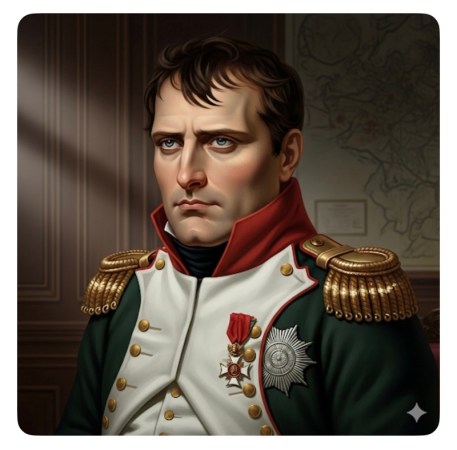
(Above: relevant to this story – Britain’s deadly enemy, Napoleon Bonaparte, ‘emperor’. Image by the author using AI)
And a picture of Napoleon Bonaparte. What’s he doing here? Well… the story of why Prince Edward Island was vitally important to Britain is closely related to the actions of Napoleon. More in Wooden Ships, part two.
In one sense, that is the beginning and end of this barely believable tale, but there is so much more fascinating detail, about people, geography and lives, to tell.
I’ll try to set some of this background information down – in context- in the parts that follow, beginning in the second part – Wooden Ships (2).
(Above: one of the beautiful restored lighthouses overlooking the entrance to St Mary’s Bay, Prince Edward Island)
You can come to the memorial gardens within Kendal’s Maude’s Meadow either by Maude Street, which runs off the town centre, or by a dark and tree-overshadowed path from the old Quaker district of Fellside.
The latter is the best at this time of the early autumn. Much of the descending path is shrouded in venerable trees. If you’re lucky, upon entering the edge of the small park, your darkness-conditioned eyes will be met by the most wonderful circle of golden yellow – seeming to give off its own light.
I’m told by my wife that they are ‘black-eyed Susans’, otherwise know as Rudbeckia. A concentric disc of beauty, they surround the heart of the WW1 memorial here, to welcome everyone with the symbol of beauty and life emerging from the ruin of war.
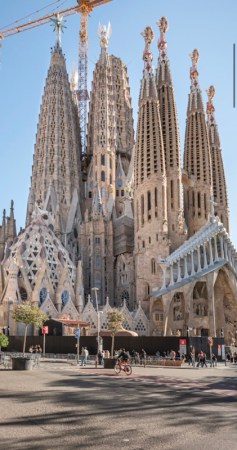
(‘Practically impossible to photograph’. The massive presence of the Sagrada Familia’. Photo by the author)
Photographs don’t do it justice…
When you first encounter the temple of the Sagrada Familia – hopefully on a day filled with the Catalonian sunshine – it simply ‘hits’ you.
Don’t be put off by the occasional giant crane; they have been part of this landscape for the past hundred years. And don’t be dismayed by not knowing ‘what on earth it is’ … no-one does, at least on first acquaintance.
Many people never find out; they are content to stare in amazement at what is before them.
But there is a way to understand this colossus in stone that has held humans entranced for over a hundred years…
‘The Basilica of the Sagrada Familia is a totally unique work. Apart from its enormous dimensions, the importance of the temple lies in the absolute originality of its style, its revolutionary technical resources and the mysticism and symbolism that were imprinted on each and every stone by its great mastermind, the Catalan architect, Antoni Gaudi.’
The dense mass of rising stone is an assault on the visual senses; as it is meant to be.
As to ‘what it is’, it’s important to realise that this is not a just a building … it’s a book, a book whose content is meant to lift our outer and interior eyes to the heavens. That is why it ‘towers’ over the district and has always done so, making casual inquirers question why it needed to be so much bigger than the other buildings around it.
Gaudi was determined that we would look up in wonder and find in that gaze a new understanding of the giants of the spiritual quest – expressed in the Christianity of the day, but in many ways applicable to any consideration of that which is noble, kind, steadfast and uplifting in the minds of women and men.
The name ‘Sagrada Familia’ can be taken literally to mean the biblical Holy Family – extending to include the Apostles, but it can also be applied the ‘inner beings’ of all of us. Gaudi was widely acknowledged to be both Christian and mystical in his approach. He believed that any great work of art should both follow the laws of nature in its proportions and project and confirm the higher aspects of the human consciousness: aspiration, compassion, joy, love and friendship, to name but a few.
The modernist natural and flowing forms of the fin-de-siecle Art Nouveau movement, at the turn of the 1900’s, were based on these principles, and almost all of them now look both exotic and strange. Lusciously so, but still strange…
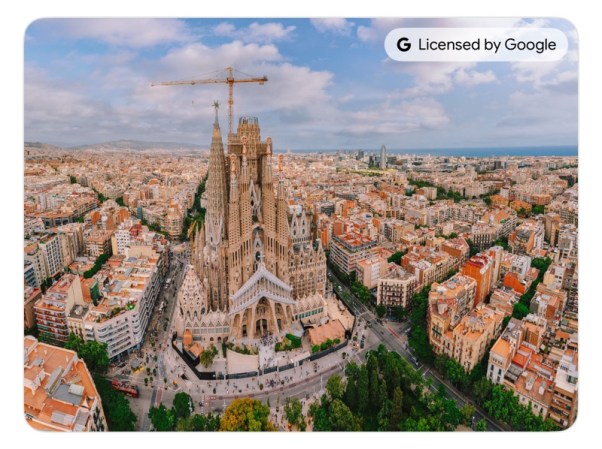
(Above: (image licensed by Google), this arial shot of the Sagrada Familia shows how vast a concept it was … and is. Note the neat pattern of the surrounding streets; a feature of the whole Modernist Exiemple district, but not typical of most of urban Barcelona)
The Sagrada Familia is located in what is now a central and busy part of Barcelona (though still a brisk 45 minute walk from the popularRamblas), but when it was conceived, far away in time, in the 1880s, the surrounding land was agricultural, and home to only a few villages.
The locals state with a proud smile that ‘Barcelona came to them!’
In the early 1880s, the poor people of the region provided the sole funding for the project. They simply wanted their own church. But Gaudi’s dramatic re-design – he was the second architect to manage the project – attracted immediate attention, both positive and negative, and pulled in a wider pool of funding.
The Exiemple district, awash with excitement and comment, became, correspondingly, a magnet for the Catalan Modernist project – with Gaudi as one of its figureheads.
Catalan ‘Modernisme’ was a cultural and artistic movement of the early 20th century. It flourished in Catalonia, northern Spain – and especially Barcelona. It worked to express an authentic identity through the visual arts, architecture and literature. It was characterised by nature-inspired symbols and motifs. These organic forms featured in a wide variety of decorative elements like the design of grand doorways, ceramic tiles and the use of forged iron.
Antoni Gaudi was not alone in this work. Other key figures included architects Lluis Domènech y Montaner and Josep Puig.
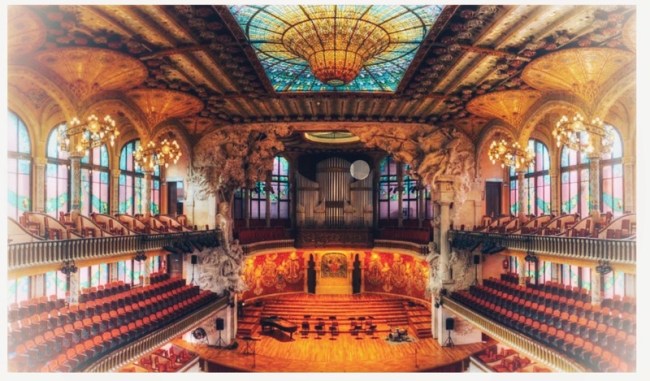
(Above: the spectacular Palau de la Música Catalana by Lluis Domènech i Montaner. It is considered to be a Moderniste gem. Image Google)
Notable works include Gaudí’s Casa Batlló and Park Güell, and Domènech i Montaner’s Palau de la Música Catalana.
Most of Gaudi’s other famous works are located in the Exiemple district. It was truly a home for the works of this great architect and engineer.
How dramatically such buildings can change a physical and emotional landscape! And how they alter the sheer ‘energy’ of a place, or even a whole district.
(Detail from the Palau Güell (pron: gway), a modern ‘palace’ built for Gaudi’s wealthy friend and patron Eusebio Güell, see below. Güell was an admirer, patron and lifelong friend of Gaudi; though the latter’s life was short)
Gaudi’s designs in both art and architecture can look strange to us now. We struggle to comprehend their origin and meaning using ‘modern’ eyes. We forget that the Sagrada Familia was an extension of what Antoni Gaudi had been working on for some time in the last quarter of the 19th century and within the modernist movement.
His works, he explained, were all based on natural forms. Perhaps, in our cubic towers of steel, concrete and glass, we have come so far that we no longer see the ‘natural’ – or worse, now see it as strange!
(Eusebi Güell, successful industrialist and lifetime friend and sponsor of Gaudi and his work. Photo is the property and copyright of the Antonio Gaudi Foundation)
Great creators need backers and substantial funding. Eusebi Güell (pronounced Gway) was Gaudí’s primary patron and a wealthy Catalan industrialist who sponsored Gaudí’s most iconic projects, including Park Güell and Palau (palace) Güell. Eusebi Güell’s significant financial support, combined with his ongoing appreciation for Gaudí’s innovative work, allowed many of Gaudí’s major architectural masterpieces to be realized, and significantly contributed to the Catalan Modernism movement.
Spain has been home to many religions. Intrinsically Catholic, it also played host to centuries of relatively gentle and tolerant Moorish influence before casting it off and literally painting over the beautiful remains of its high thought.
Today it is a strongly Catholic country, and its central ‘canon’ is the New Testament. Antoni Gaudi and his father were devoted to the Catholic faith, whose testaments and mysteries provided the backdrop to the design of the Sagrada Familia.
The name “Sagrada Família” was not chosen by Antoni Gaudí. The idea for the church, along with its name, came prior to 1882 from a local bookseller named Josep Maria Bocabella. Bocabella was a devout Catholic and the founder of the Spiritual Association of Devotees of Saint Joseph.
After a visit to the Vatican in 1872, he was inspired to build a church dedicated to the Holy Family, which in Spanish is “Sagrada Familia”. The full name of the church is the “Expiatory Temple of the Holy Family” (Basílica i Temple Expiatori de la Sagrada Família).
Josep Maria Bocabella was the father of the whole project. Without his inspired beginning, we would not have the Sagrada Familia.
The construction began way back in 1882, and was initially led by architect Francisco de Paula del Villar. But his neo-gothic design lacked public support. The poor people of the villages had waited a long time … and wanted something far more special.
A young Antoni Gaudí won the competition to replace the original design. He took over the project in 1883, completely changing the nature of the proposed church into a vast basilica in a style never seen before on this scale.
(‘The Sagrada’ – Image by the author)
What are we looking at when our gaze first falls on those vertical ‘towers’? To appreciate their ‘mass and presence’ look back at the Google image taken from the air and compare the ‘towers’ with the surrounding building. You will swiftly revise your initial idea of its size…
The Sagrada Familia in its now (2025) near-final form has 18 towers, representing key figures in Christianity. Twelve of these towers are dedicated to the Apostles, surrounding the basilica’s three main facades. Four taller towers represent the Evangelists (Matthew, Mark, Luke, and John). A tower dedicated to the Virgin Mary is topped with a star. The tallest tower, representing Jesus Christ, and yet to be finished, is crowned with an illuminated cross.
When you look at the ‘forest of stone’ that is the Gaudi Towers, this is what first confounds the eye.
In the next post we will examine the beginning of the project; a beginning in which the architect is not Antoni Gaudi.
After that, we will follow the tortuous route of the Sagrada Familia slow completion, in other words the long road from 1883 to now. It is a journey of faith in the project, faith in its goals, and faith that such a concept could be handed on from generation to generation: a narrow thread of possibility that culminated in the realisation of Gaudi’s vision.
The older man came quietly into the basement studio. In near darkness, his son was making the final adjustments to what looked like a huge sculpture in string…and hundreds of corks.
“I thought you’d be along soon,” the young man whispered to the ghost of his father. ‘What do you think?’
“Parabolas?” The older one smiled the words. “You’ve modelled the whole thing with gravity using strings and corks!” The senior voice wavered, filled with an emotion he had successfully passed to his son.
(The Sagrada Familia in corks and string; and upside down…)
“God’s own curves…” The imagined words were filled with a creative reverence known to both.
(A stylised portrait in stone of Antoni Gaudi)
Antoni Gaudi, the controversial but revered architect who, in the closing years of the nineteenth century was becoming admired and loathed in equal measure among the intellectual elites of Barcelona, found himself nodding into the gently lit darkness.
“And light,” he whispered. “Always light…”
It was to be over a century before the vision that empowered the architect’s devotion came to fruition, though the main structure would tease and frustrate the citizens of Barcelona in equal measure in its partial completeness for another hundred years before it finally rose, to finished magnificence.
This is one person’s story of a life-long fascination with the Sagrada Familia. Glimpsed as a young man on a black and white TV screen and finally visited in adulthood, though the visits revealed only achingly slow progress.
Untilthis year, (2025) when, finally, we were able to see this temple to divine proportion in its full magnificence.
In these posts, and through time, I hope to offer a journey of awe and delight, as one of the most beautiful buildings on Earth emerges from the inverted corks in the designer’s basement, to a glorious and unique soaring temple.
And, along the way, I will share the photos I was finally able to take of this nearly completed masterpiece.
The time-travelling whimsy is mine. The building is real…
In August, a wonderful peacefulness descends on the estate around Levens Hall – the ancestral home of the Baggot family. The Levens Estate is a few miles south-west of the Cumbrian town of Kendal.
(Levens Hall)
The recently upgraded cafe – with its large, open courtyard – makes for an ideal destination by car or, as with me and the Collie, on foot. Many people walk several miles to get there, restoring themselves at the cafe before reluctantly lacing the walking boots back up and setting off for home.
There’s another approach if you’re lucky enough to live relatively close. One person can walk the dog, the other leaving an hour later to join and collect the dog and its walker – via lunch.
(Tess the Rough Collie – now ten years old)
We’re lucky enough to live an hour’s walk away. It’s the perfect dog walk, and just about at the limit of what our old Collie can manage these days. At ten years old, she is towards the end of the life expectations for the breed.
(We cross the busy A590 … which never sleeps!)
The first part of the walk crosses over the busy A590, the main feeder road from the M6 motorway into the heart of the Lake District. It’s good to be above and not in the flow of this hard-working road.
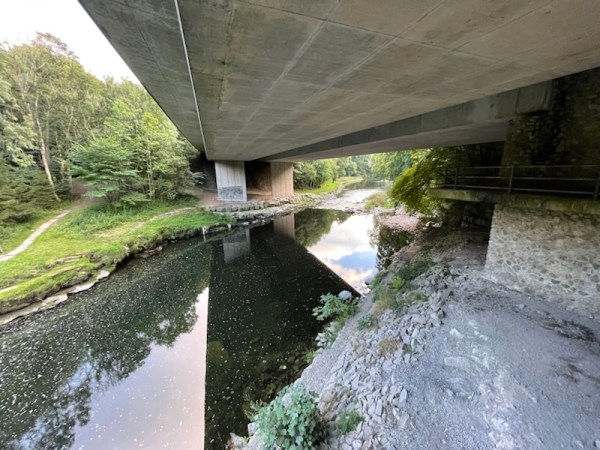
It’s worth noting that there is also a largely-unseen dimension of the terrain below the A590, which is also the crossing point of the River Kent just before it enters the Levens Estate and flows out into the top end of Morecambe Bay.
(Above: the scale of the A590 road bridge can be seen in the context of the River Kent flowing beneath it; a major piece of civil engineering!)
From the bridge – and staying on the quiet country lane, we come to a very tall stile that literally bestrides the sturdy stone wall of the Levens Park estate.
(The view into Levens Park from the rather high stone stile, with supporting ironware!)
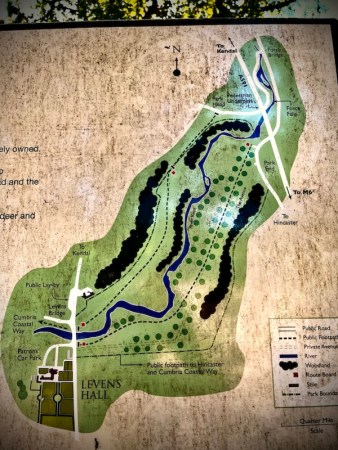
(The Levens Estate information board showing (top-right) the A590, and below it, the eastern boundary of the park. Note the River Kent flowing through the entire heart of the park)
Dogs have to be on leads as there are deer. It is also the home of the unique Bagot Goats, named after the ancestral family who own the estate.
(The formidable Bagot Goats. Formidable looking but generally peaceful and unfazed by walkers)
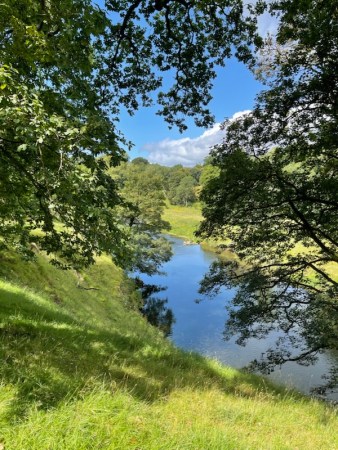
The first half-mile of the walk is a wide avenue between tall trees, with little variation. But soon the River Kent comes into view on the right-hand side and the path descends to meet it. This stretch is the most valued by photographers.
(The first half of the estate path is pretty but only a glimpse of what’s to come)
(After about 30 mins walking, the River Kent is sighted, again, through the tree – many of them venerable)
(As the curve deepens, we see the full vista that awaits)
(The river is not the only star, Many of the trees are splendid in size and shape)
(The River Kent widens at the southern end of the park. This is a popular spot for family picnics in summer)
After a further twenty minutes’ walking we cross the busy A6. This used to be the main ‘trunk-road’ route between north-west England and Scotland, bridging the two with the notorious Shap Summit – one of highest stretches of road in England.
The huge ornamental gates of Levens Hall are dead ahead. Immediately after, we enter the grounds and seen the grand house on the left. The garden is one of the few surviving Tudor designs in the UK.
(And finally, we cross the busy A6 to reach Levens Hall)
Tess has just about enough ‘puff’ to make this distance, and she enjoys a rest in the courtyard while we order a snack and a latté.
Returning from the south coast we saw signs to the Weald & Downland Living Museum. We didn’t have time to stop and explore it there and then but were able to return a few days later with Bernie’s relative from Haslemere.
We had a small lunch at the excellent cafe, then bought our tickets – not cheap at a shade under £18.00 each – and entered this large parkland set in the heart of the beautiful Sussex countryside.
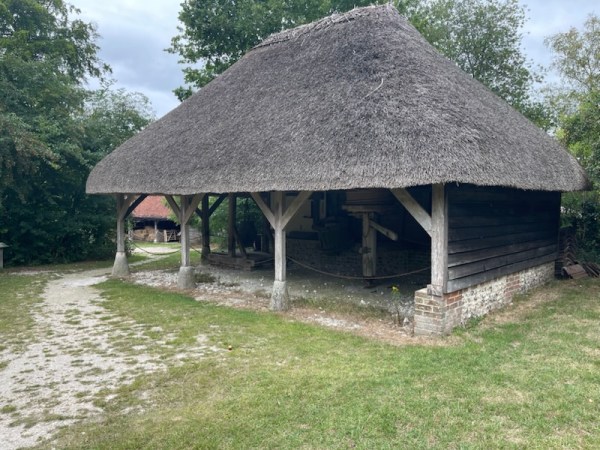
The Weald and Downland Living Museum is located in the South Downs National Park in West Sussex, England. The museum features over 50 historic buildings dating from 950 AD to the 19th century.
The grassland site covers 40 acres and takes a good two hours to even stroll around. Stopping to investigate each building – most can be entered and explored – will double that time. We found the best approach was to highlight the most interesting and map out a route.
Above: it’s striking how simple these historic rooms were. Above a workman’s cottage bedroom. The emphasis was definitely sleep!
The cost of the tickets means you need to spend a reasonable time here to get the value. Three hours later, we emerged, tired but enriched with a much deeper knowledge of rural life in the past.
Here are a sample of the photos I took, together – where possible – with the matching description.
Above: a wind-powered water pump
The Weald & Downland Living Museum offers a captivating journey through over 1,000 years of rural history in South East England.
This acclaimed open-air museum is a testament to the preservation of heritage, featuring more than 50 meticulously re-erected historic buildings saved from destruction across the region.
Above: Winkhurst Tudor Kitchen. Barrels for brewing beer – one of the few ways of getting safe liquid.
As you wander through its 40-acre site, you discover a living landscape where traditional trades and crafts are demonstrated daily, bringing the past vividly to life – such as ‘our daily bread’, below.
A combined hearth and small oven in which bread is cooked for visitors to sample.
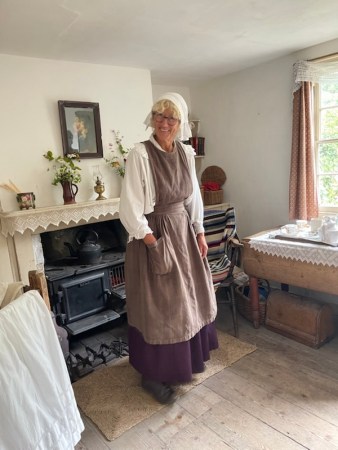
And lovely volunteers to help bring it all to life!
Among the museum’s major exhibits are:
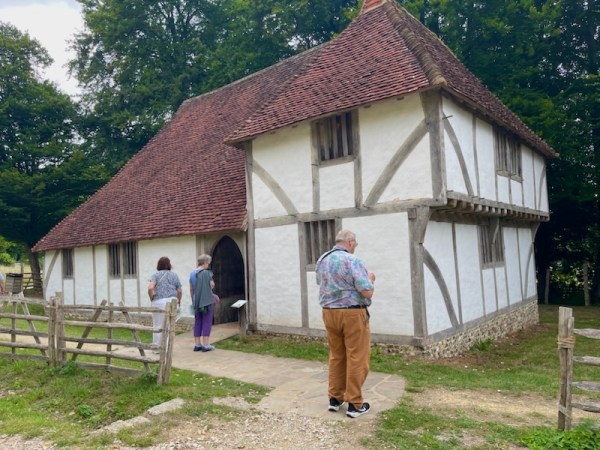
Bayleaf Farmhouse: A stunning 15th-century timber-framed Wealden hall house, offering a glimpse into early medieval domestic life.
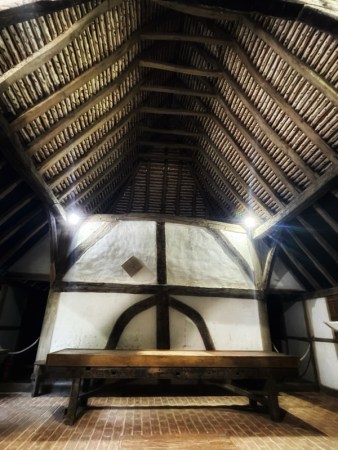
The Medieval Barn from Cowfold: Dating back to 1536, this impressive timber barn showcases agricultural practices of the late medieval period.
Winkhurst Tudor Kitchen: An early 16th-century building that provides insight into Tudor-era cooking, brewing, and preserving.
Market Hall from Titchfield: A striking public building that once served as a bustling hub of commerce.
Aisled Barn from Hambrook: Built around 1771, this large barn with its distinctive aisle allowed wagons to easily enter for threshing and storage.
Working Watermill and Bakery: Demonstrating traditional milling of flour and baking of bread, often available for visitors to sample.
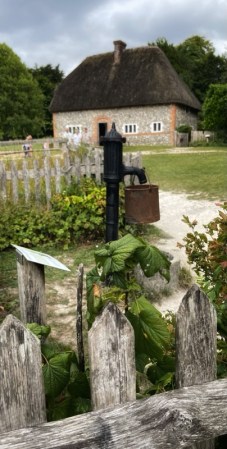
A fully working underground water supply with ‘village pump’.
Victorian Schoolroom: A step back in time to the classrooms of the 18th and 19th centuries.
Above: back to school…
The village has a working supply of pump-based fresh water.
The museum also features a range of other fascinating structures, including cottages, workshops, and agricultural buildings, all set amidst period gardens and populated with rare-breed farm animals, offering an immersive historical experience.
We loved it. Three hours later and tired, we made our way back to the car. The other two occupants slept their way to our hosts home in Haslemere.
We stopped for a bite to eat at a specialist car seller based in a huge converted barn in the middle of beautiful Hampshire – long one of my favourite counties.
On the way back to the car this beautiful sky was above us. No words needed…
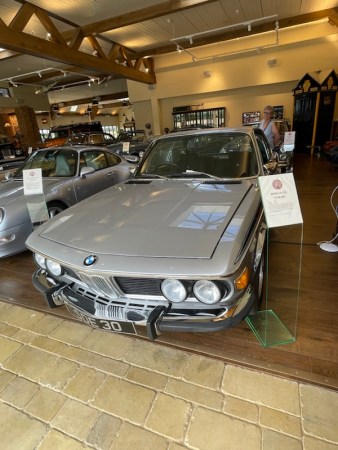
(A mere £140,000!)
And for the fellow petrol-heads among us, here’s my pick of what was on offer in this fascinating motor emporium: a 1970s BMW CSL. The ‘L’ designated its construction from aluminium, endowing it with lightness and great strength.
Yours for a mere £140,000…
The world has moved on. I’ll stick to my electric car! But the trip down memory lane was fun! In my first computing job, my lady boss had one of these.






































 Sun in Gemini
You must be logged in to post a comment.