
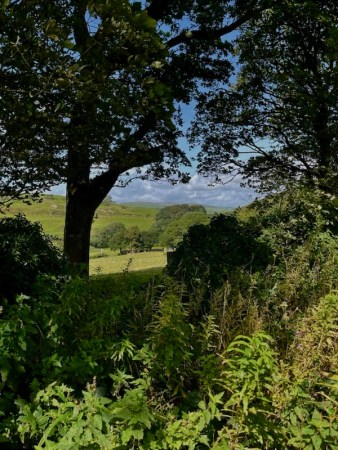
There is a circular walk around the hilltop that houses The Hoad monument to Sir John Barrow, at Ulverston, on the Cumbrian coast.
It was a perfect day – the epitome of summer. I spotted this view through the trees and loved it.
©️Stephen Tanham, 2025
Share this:

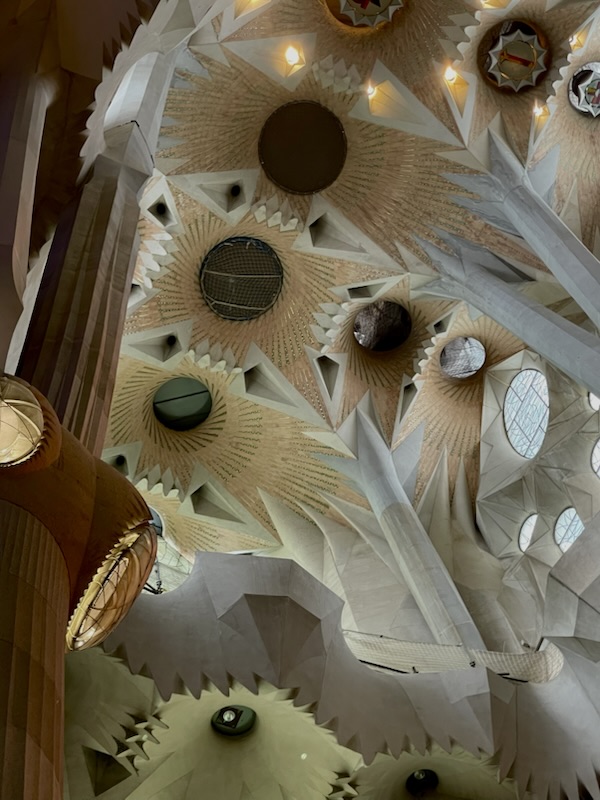

The older man came quietly into the basement studio. In near darkness, his son was making the final adjustments to what looked like a huge sculpture in string…and hundreds of corks.
“I thought you’d be along soon,” the young man whispered to the ghost of his father. ‘What do you think?’
“Parabolas?” The older one smiled the words. “You’ve modelled the whole thing with gravity using strings and corks!” The senior voice wavered, filled with an emotion he had successfully passed to his son.

“God’s own curves…” The imagined words were filled with a creative reverence known to both.
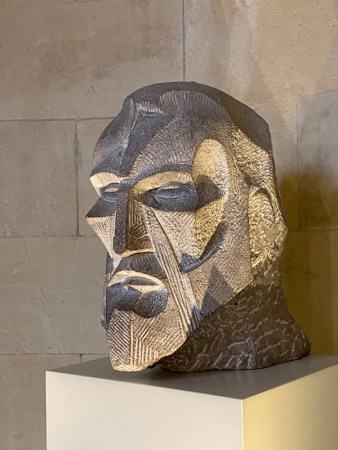
Antoni Gaudi, the controversial but revered architect who, in the closing years of the nineteenth century was becoming admired and loathed in equal measure among the intellectual elites of Barcelona, found himself nodding into the gently lit darkness.

“And light,” he whispered. “Always light…”
It was to be over a century before the vision that empowered the architect’s devotion came to fruition, though the main structure would tease and frustrate the citizens of Barcelona in equal measure in its partial completeness for another hundred years before it finally rose, to finished magnificence.
This is one person’s story of a life-long fascination with the Sagrada Familia. Glimpsed as a young man on a black and white TV screen and finally visited in adulthood, though the visits revealed only achingly slow progress.
Until this year, (2025) when, finally, we were able to see this temple to divine proportion in its full magnificence.
In these posts, and through time, I hope to offer a journey of awe and delight, as one of the most beautiful buildings on Earth emerges from the inverted corks in the designer’s basement, to a glorious and unique soaring temple.
And, along the way, I will share the photos I was finally able to take of this nearly completed masterpiece.
The time-travelling whimsy is mine. The building is real…
©️Stephen Tanham 2025.
Share this:

+ #iphonephotography, #Photography,, #Silenti, #TravelwithaMysticalEye, Ancient Landscapes, landscapes, Travel and Photography
August comes to the Levens Estate
by Steve Tanham
In August, a wonderful peacefulness descends on the estate around Levens Hall – the ancestral home of the Baggot family. The Levens Estate is a few miles south-west of the Cumbrian town of Kendal.

The recently upgraded cafe – with its large, open courtyard – makes for an ideal destination by car or, as with me and the Collie, on foot. Many people walk several miles to get there, restoring themselves at the cafe before reluctantly lacing the walking boots back up and setting off for home.
There’s another approach if you’re lucky enough to live relatively close. One person can walk the dog, the other leaving an hour later to join and collect the dog and its walker – via lunch.

We’re lucky enough to live an hour’s walk away. It’s the perfect dog walk, and just about at the limit of what our old Collie can manage these days. At ten years old, she is towards the end of the life expectations for the breed.

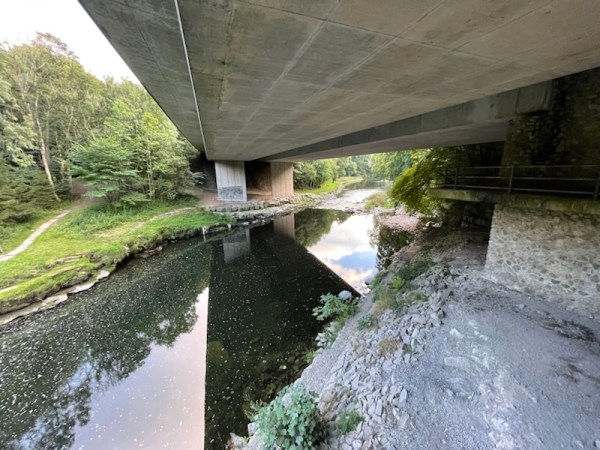
The first part of the walk crosses over the busy A590, the main feeder road from the M6 motorway into the heart of the Lake District. It’s good to be above and not in the flow of this hard-working road.
It’s worth noting that there is also a largely-unseen dimension of the terrain below the A590, which is also the crossing point of the River Kent just before it enters the Levens Estate and flows out into the top end of Morecambe Bay.
From the bridge – and staying on the quiet country lane, we come to a very tall stile that literally bestrides the sturdy stone wall of the Levens Park estate.

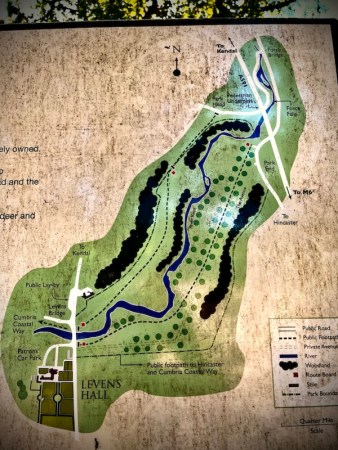
Dogs have to be on leads as there are deer. It is also the home of the unique Bagot Goats, named after the ancestral family who own the estate.

The first half-mile of the walk is a wide avenue between tall trees, with little variation. But soon the River Kent comes into view on the right-hand side and the path descends to meet it. This stretch is the most valued by photographers.


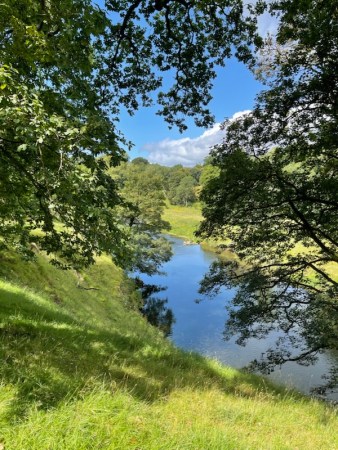
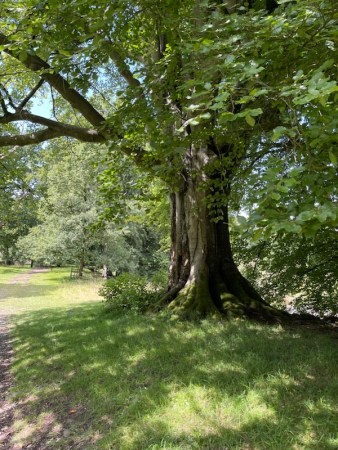


After a further twenty minutes’ walking we cross the busy A6. This used to be the main ‘trunk-road’ route between north-west England and Scotland, bridging the two with the notorious Shap Summit – one of highest stretches of road in England.
The huge ornamental gates of Levens Hall are dead ahead. Immediately after, we enter the grounds and seen the grand house on the left. The garden is one of the few surviving Tudor designs in the UK.

Tess has just about enough ‘puff’ to make this distance, and she enjoys a rest in the courtyard while we order a snack and a latté.
I hope you enjoyed the walk…
©️Copyright Stephen Tanham, 2025.
Photos by the author.
Share this:


Returning from the south coast we saw signs to the Weald & Downland Living Museum. We didn’t have time to stop and explore it there and then but were able to return a few days later with Bernie’s relative from Haslemere.
We had a small lunch at the excellent cafe, then bought our tickets – not cheap at a shade under £18.00 each – and entered this large parkland set in the heart of the beautiful Sussex countryside.
The Weald and Downland Living Museum is located in the South Downs National Park in West Sussex, England. The museum features over 50 historic buildings dating from 950 AD to the 19th century.

The grassland site covers 40 acres and takes a good two hours to even stroll around. Stopping to investigate each building – most can be entered and explored – will double that time. We found the best approach was to highlight the most interesting and map out a route.

The cost of the tickets means you need to spend a reasonable time here to get the value. Three hours later, we emerged, tired but enriched with a much deeper knowledge of rural life in the past.
Here are a sample of the photos I took, together – where possible – with the matching description.

The Weald & Downland Living Museum offers a captivating journey through over 1,000 years of rural history in South East England.

This acclaimed open-air museum is a testament to the preservation of heritage, featuring more than 50 meticulously re-erected historic buildings saved from destruction across the region.

As you wander through its 40-acre site, you discover a living landscape where traditional trades and crafts are demonstrated daily, bringing the past vividly to life – such as ‘our daily bread’, below.

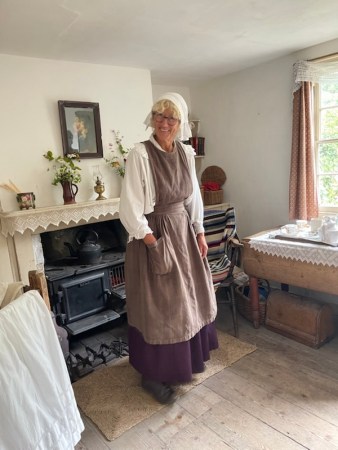
Among the museum’s major exhibits are:
- Bayleaf Farmhouse: A stunning 15th-century timber-framed Wealden hall house, offering a glimpse into early medieval domestic life.
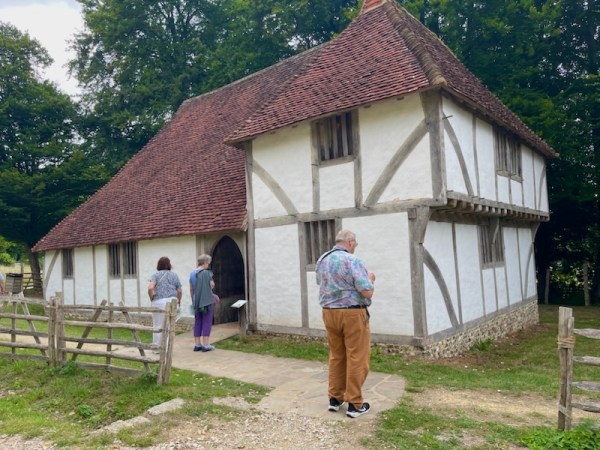
- The Medieval Barn from Cowfold: Dating back to 1536, this impressive timber barn showcases agricultural practices of the late medieval period.
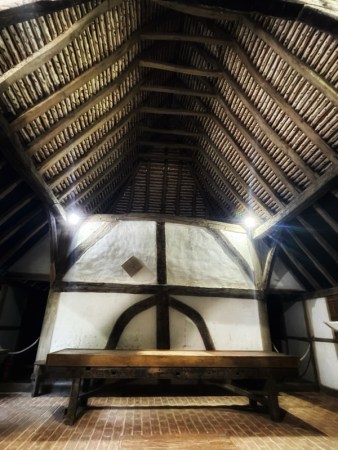

- Winkhurst Tudor Kitchen: An early 16th-century building that provides insight into Tudor-era cooking, brewing, and preserving.


- Market Hall from Titchfield: A striking public building that once served as a bustling hub of commerce.
- Aisled Barn from Hambrook: Built around 1771, this large barn with its distinctive aisle allowed wagons to easily enter for threshing and storage.
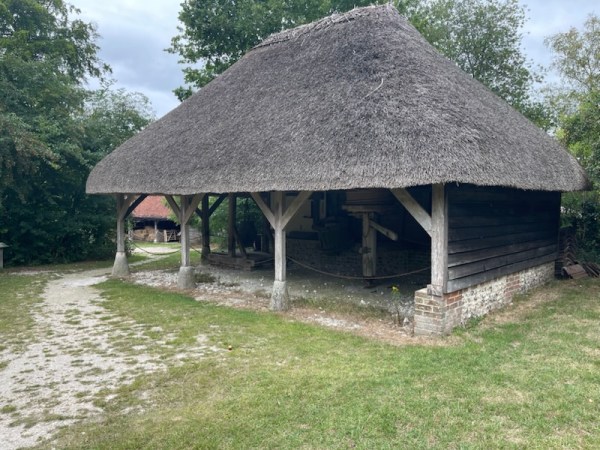
- Working Watermill and Bakery: Demonstrating traditional milling of flour and baking of bread, often available for visitors to sample.
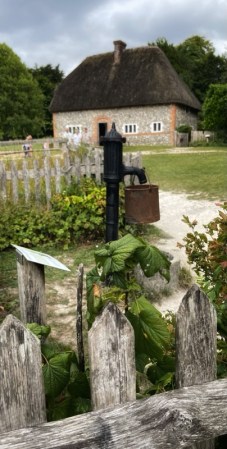
- A fully working underground water supply with ‘village pump’.
- Victorian Schoolroom: A step back in time to the classrooms of the 18th and 19th centuries.

- The village has a working supply of pump-based fresh water.
- The museum also features a range of other fascinating structures, including cottages, workshops, and agricultural buildings, all set amidst period gardens and populated with rare-breed farm animals, offering an immersive historical experience.
We loved it. Three hours later and tired, we made our way back to the car. The other two occupants slept their way to our hosts home in Haslemere.
©️Stephen Tanham, 2025.
Share this:


It’s busy on the beach at Bognor…
Not a line from a Music Hall song, as far as I know but it would have made a good one!
©️Stephen Tanham, 2025.
Share this:


We stopped for a bite to eat at a specialist car seller based in a huge converted barn in the middle of beautiful Hampshire – long one of my favourite counties.
On the way back to the car this beautiful sky was above us. No words needed…
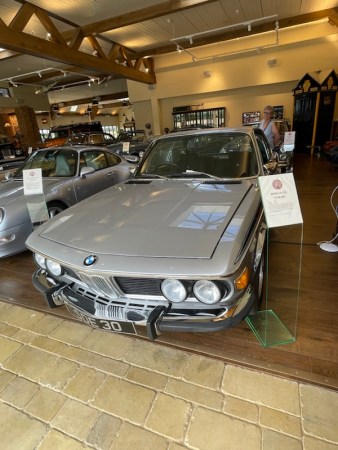
And for the fellow petrol-heads among us, here’s my pick of what was on offer in this fascinating motor emporium: a 1970s BMW CSL. The ‘L’ designated its construction from aluminium, endowing it with lightness and great strength.
Yours for a mere £140,000…
The world has moved on. I’ll stick to my electric car! But the trip down memory lane was fun! In my first computing job, my lady boss had one of these.
Quite…
©️Stephen Tanham, 2025.
Share this:


Look at her…
This once-stray has now ruled our household for over ten years. The Collie – now well trained and subservient to her – knows its place..
It’s been a long battle but Misti is now working on me. My wife is not a morning person. The cat has figured this out, and has been refining her cat-terrorist skills as the summer progressed.
The problem with cats is that they are natively nocturnal – if they can be bothered. And, given a free paw, will exit the house to hunt all the interesting nightlife that passes through the garden.
The house is securely locked at night and we don’t believe in cat-flaps.
Hmmm purrs the cat… you can hear the devious cogs whirring.
Recently, I’ve noticed an increase in the Olympic long jumps off the windowsill with her landing on our resting bodies. But, as these have resulted in her being threatened with a holiday in the cattery, she has desisted.
Or rather, gone back to the drawing board.
I must have missed the prototypes, but at 04:17 this morning, Misti sailed through the bedroom air to land on the dog, who sleeps at the foot of the bed.
The dog became a howling fury of spinning claws on wood and headed for the door to the garden, ensuring I had to get up to avoid a poonami in the house.
Cat Billiards is a genius strategy.
She spent what was left of the night in the boiler room…
Anyone need a cat!
©️Stephen Tanham 2025.
Share this:


There is a mysterious power about the number three. For some deep reason it is associated – in the human consciousness – with ‘completeness’.
Designers and gardeners will advise that you need an odd number of ‘arranged things’ to look good. The number one is exempt from this, as it, itself, is associated with unity – and not multiplicity, where the design considerations apply, therefore three is the first true odd number in a design sense.
In ancient spiritual thought, this is partly explained by ‘how things happen’. There is an initial impetus ‘to do’. This has to act on something, giving two entities. The result is a new state made by the combining nature of the two and taking the ‘whole’ onwards.
My photo, above, is hopefully a good example of such threeness. Taken in a local park, there are actually four ascending trunks from three trees: one of them has a double trunk.
The impact of the shot is the visual three-ness of the large beautiful trees that mark the exit of the park and the return to the tarmac beyond.
Like guardians, they wish us well – and urge us to return, soon; to refresh ourselves with their oxygen and symmetry.
©️Stephen Tanham, 2025
Share this:


I did a short post on the striking ‘Setas de Sevilla’ back in February 2025, shortly after we returned from our Spanish city break. There was a lot of interest in that exotic structure in the sky and I promised to return with a fuller post – and some more photos.
Here it is…
Where is Seville?
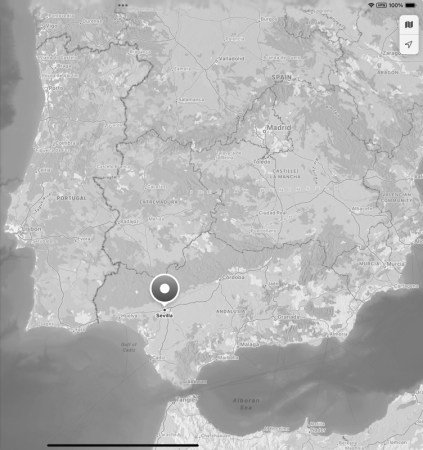

Andalusia is an autonomous region, located on the Iberian Peninsula. It comprises eight provinces: Almería, Cádiz, Córdoba, Granada, Huelva, Jaén, Málaga, and Sevilla.
Seville is Andalusia’s capital city. Seville’s Spanish name is Sevilla, pron: Say-vee-ya) – a much more beautiful sound than the English version. If you say it correctly, local people smile back at you. It’s a rich experience.
Sevilla’s climate is beautiful in winter-spring, but can be ferociously hot in summer.

The story of the Setas de Sevilla…
In the spring of 2011 a strange structure began to rise above the busy La Encarnación Square.
The Setas de Sevilla (literally the Mushrooms of Seville) was not its original name. In the beginning, it was conceived as a giant parasol over the large and busy square, and named accordingly.

The original name was the Metropol Parasol, a giant wooden structure – the largest in the world – built as the centrepiece of the rejuvenation of one of the oldest quarters of the city.

It was created to operate as a dramatic but inviting ‘walkway-parasol’ upon which people could stroll along curving paths high above the streets. Aerial pathways would rise and fall, revealing different aspects of the city to those walking above. The whole experience would be nuanced by the journey of the bright ‘Spanish sun’ across the sky and the ever-changing light it cast.
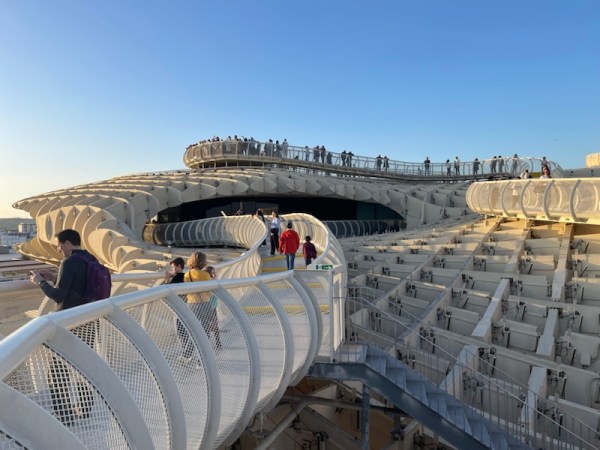
The vision was delivered- magnificently. Just being there makes you tingle… Sunset is the most magical time.
The people of Seville continued to call it ‘the mushrooms’, so the wise city authorities went with the flow and agreed. It became Setas (mushrooms) de Sevilla: trips off the tongue and easy for us foreigners to remember… and what’s wrong with a mushroom, anyway!
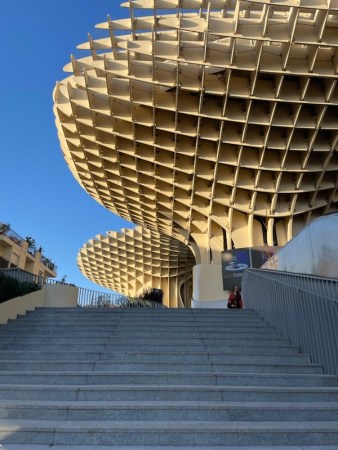
The slow climb up the quite steep steps takes you to the entrance level. Tickets are purchased at a cost of approximately 16 euros. It’s well worth it, and – to the best of my knowledge – you can stay up there for as long as you wish.
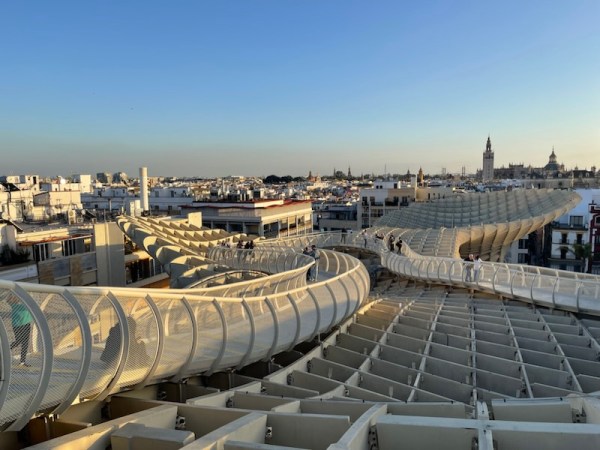
Seville established a city-sponsored competition to choose a design for the Setas. 65 submissions were made. The winning design was by a German architect: Jürgen Mayer,
The new building was completed in April, 2011. It is 150 metres by 70, with an approximate height of 26 metres. Seeing it from below and walking around it on top, it seems to be a lot bigger.
The unique, wooden ‘parasols’ are made from an astonishing 3,500 cubic metres of micro-laminated Finnish pine. The building is certified and marked as the world’s largest wooden structure.

Creation of the Setas de Sevilla was not easy. There were technical problems as well as schedule delays. There were naming problems, too, as it was discovered that the architect had trademarked the name ‘Metropol Parasol’ and would charge for its use!
The town authorities reacted promptly, adopting the popular name the people used and Setas de Sevilla became the building’s official name.
Since its opening, the Setas de Sevilla has become the city’s third-most visited site in the city.

If you are ever close, make the trip and experience it. It’s an exciting and very ‘happy’ place. But then, sunshine tends to do that to people!
©️Stephen Tanham. Photos by the author.
Share this:


I love Italian cafes. One of my favourites is in Bowness-on-Windermere. The Old Pump House nestles by the lake at the southern end of the town, close to the marina.
When Tess the Collie needs a longer walk, I drive us here. We try for a space in the free public parking by the pitch & put then use the ‘chucker’ to throw her ball (permitted) across the small golf course which climbs steeply, to finish looking down on the town. After this – and with Tess sensing what lies ahead – I get pulled down the hill onto the lake shore, with its Italian cafe – the Old Pump House. The staff make a fuss of her and she gets treats, so she always remembers the way!

The success of The Old Pump House is in my opinion, due to the quality of its coffee… and the views from the jetty behind…

The interior walls have a very 1950’s feel about them because of the arty photos. Many of these are reproductions of what at first appear to be 50’s Italian ‘tin plate’ posters for the great coffee served in that lovely and friendly country. Only later do you notice that many of them also carry subtle humour in their wording.

Complementing these are some equally arty and period pictures of classic scooters of the time.

My mother had an Italian scooter in the late 1960s – a Vespa. As a teenager, I would come home from school, put on her helmet and race it up and down the small interior drive of our bungalow – a journey lasting approximately five seconds.

Two seconds accelerating, one second to savour ten miles per hour, then two more to stop before you hit the garage door. I got very good at emergency stops! And the garage door remained (largely) free from dents…

Occasionally, mum would come out to check that I wasn’t lying on the flags, bleeding. But I never had an accident, and it prepared me well for future two-wheeled adventures. It also annoyed the hell out of the odious woman next door.
My love affair with scooters was brief. Soon, I discovered the more stable motorbike, and from my 16th birthday onwards, rode these more powerful steeds. But my admiration for the styling of the scooter never waned.

But back to scooters… Go to any Italian city and you will see them at their best; parked practically anywhere, and seemingly requiring minimal protective gear on the part of their young and stylishly-dressed Italian riders.

My mother was less fortunate. She had two narrow escapes where she ended up sliding across roads on her back with only her helmet and anorak for protection… minus the scooter which would be inserted into some hedge to mark the bend that she’d missed.
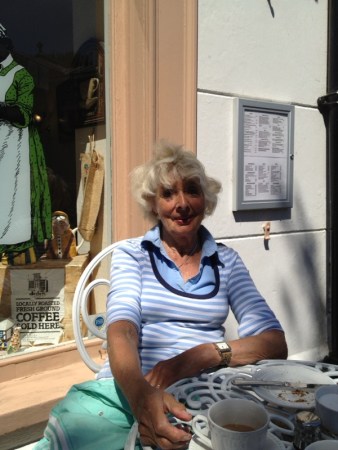
Realising she was a terrible driver, she gave up – and we all heaved a sigh of relief… She lived to be 95 years old, finally leaving us this February. Until recently she still joked about her adventures on ‘Jenny’ – her Vespa scooter.

The Old Pump House takes me back to the happiness of those times. It’s nostalgic but with a self-deprecating smile. The world moves on – its walls seem to say – but here there’s a different rhythm.
I hope this little photo-journey ‘took you back’, too!
Ciao Bella ❤️

——-o——-
©️Stephen Tanham, 2025.
Share this:


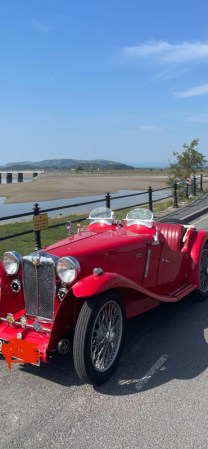
It was blazing hot in Arnside on Friday. I was walking the collie along the shoreline when a flash of red from the road above caught my eye.

The pier steps were nearby, so I coerced a reluctant Tess to come up with me, promising her a treat and a quick return…
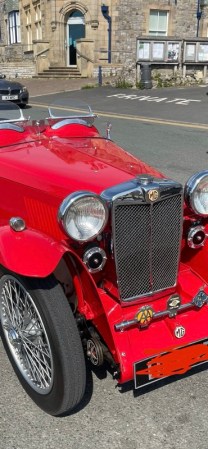
I used to have an MGB soft top. It’s throaty twin-carb engine was a delight; in many ways the best and most affordable of British sports cars. I loved it.
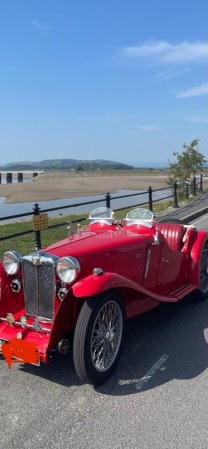
I wasn’t sure which model it was. The MGs of the 1940-1950 period were classics with a deliberately old styling – to make you dream of open-topped journeys along country lanes with the girlfriend’s hand resting on your thigh…

I suspect it was a special ‘racing edition’ MGA or MGT. Those in the know kindly advise. All I know is that I wanted to sling my leg over and take it for a spin, which I didn’t, of course.
You can only stare at a car for so long without being rude…
A few more moments and we had to go. One final glance back…
©️Stephen Tanham, 2025
Share this:

In a fading sway of notes rehearsed
The music stills like clouds dispersed.
From the empty grass the subtle hiss
Of a gentle breeze with a greener kiss
Accompanies those whose hearts contain
What happened here…
———-
No finer hour – nostalgia ‘brassed’ so well
That warmed the hearts of those who smiled
Young and not so…
Dwellers now, in later years, and by
Whose sides, grand-children’s gentle hold reveals
That aging fingers’ pain is not concealed.
———-
Darker tones yet richer chords play out within
The elders’ smiles: his hand in hers and theirs
Below, where grand-children’s grasp, small and loving
Speaks silently of day well spent… and are content
To snooze in back of car while homeward bound.
———-
Steering safe on quiet roads, his hand seeks hers again.
A single glance. A sense of time entranced.
He looks at her, she holds his stare
Each knows their thoughts are one
From daughter, son, both raised and flown
To these delights who sleep with smiles, behind
———-
A life within vibration; harmony as love
A choir, a band, A fullness of sound.
The longing for a tune enduring
That these, so young
Can ride their growing melody to the future.
———-
©️Stephen Tanham, 2025.


You must be logged in to post a comment.