
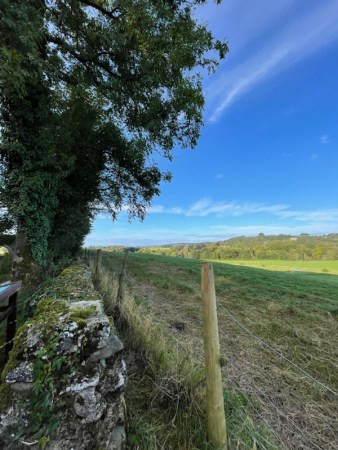
The ‘gentle autumn’. It’s a phrase you might find in a poet or painter’s description of their work. As far as I know it has no official meaning.
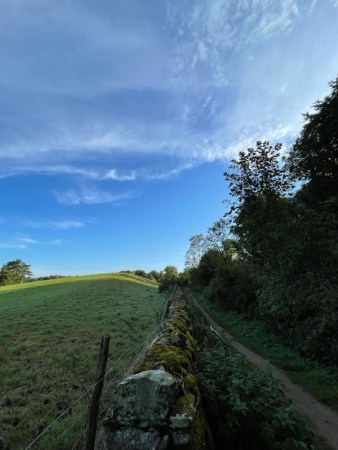
But for me, it’s quite specific, and describes the period in which the end of summer and start of autumn overlap.
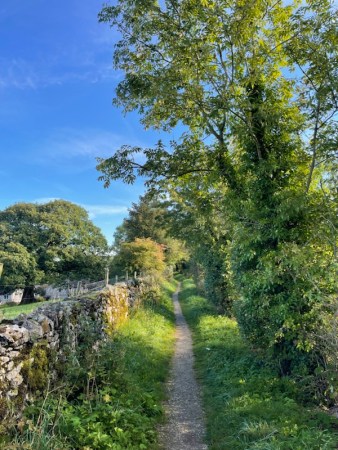
That time when there is still heat in the air – at least once the night’s chill has been soothed away by the golden rays of the morning.
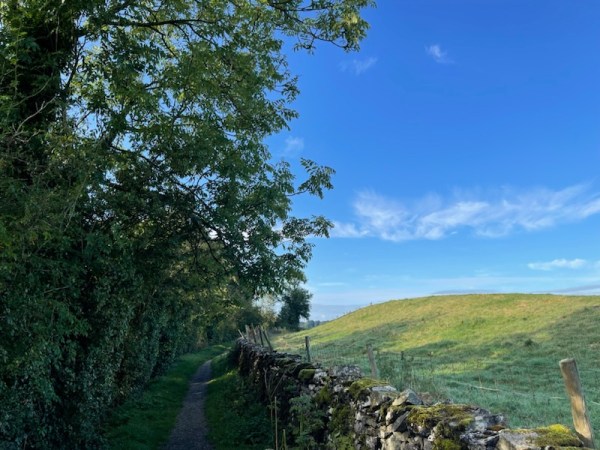
As a young child I decided that the autumn was ‘my season’. I loved its mellowness, though it was many years before I understood the depth of the onomatopoeia.
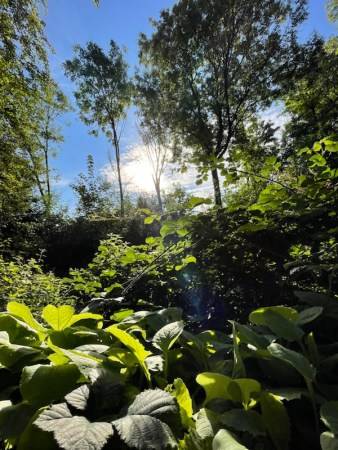
Nowadays I am content to point the iPhone and see how much of this ‘green and goldenness’ comes through into a usable image.
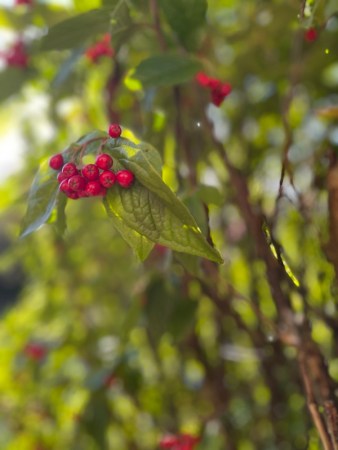
I hope you enjoy the sharing of these.
©Stephen Tanham 2024
All photos taken and processed on an iPhone 12 ProMax or created using NightCafe Studio Al.
Stephen Tanham is a writer-photographer and mystical teacher. He is the founding Director of the Silent Eye, which offers a monthly Zoom-based gathering of companions, each one on their own, unique journey to deeper states of self-realisation.
Www.thesilenteye.co.uk
Share this:

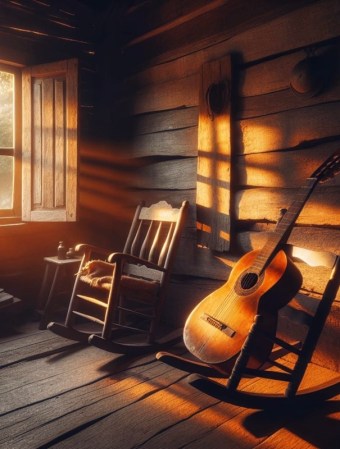
Playing with some NightCafe Studio AI.
A rustic cabin in the woods. A place of peace and self.
Poetry and song notes litter the floor, to be swept up next visit.
For now, before that soft and golden late summer sun sets over the treeline on the ridge, I want to capture the memory of her soft voice and gentle fingers on my neck as I find the heart of that melody-to-be in the first three chords.
Stephen Tanham, normally mystical, is whimsical this morning.
Happy Sunday.
Image by the author using NightCafe Studio AI.
Share this:


I didn’t expect to be going back to Carcassonne in 2024.
A few years ago, we began our cycling trip along the Canal du Midi here. I wrote extensively about the trip at the time.
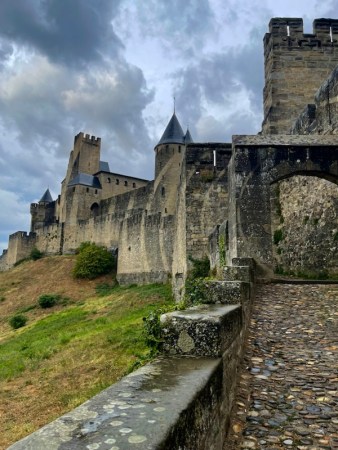
But then my son, who recently moved their family to Canada as part of a job promotion, announced he had booked a few days in Carcassonne to allow the family to spend some time with their two year old grandson.

This part of south-eastern France: ‘Cathar country’ and close to both the Pyrenees and the Mediterranean coast is filled with both beauty and history.
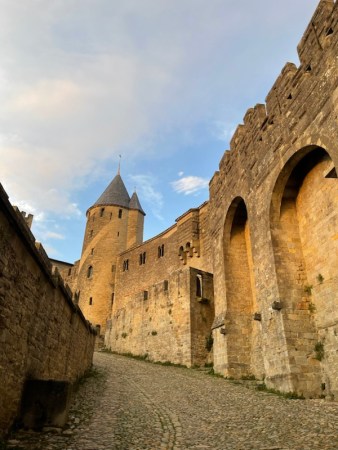
My son’s family are not keen on having photos on social media, and I’ve respected this, posting here only a few images of this spectacular Unesco world-heritage site, which preserves an entire medieval walled city, intact and functioning now as a visitor base, bringing considerable income into this rural part of France.

The two sets of photos were taken on the same day, but some in the morning, which was overcast, and others in the evening in the glorious light of the setting sun.
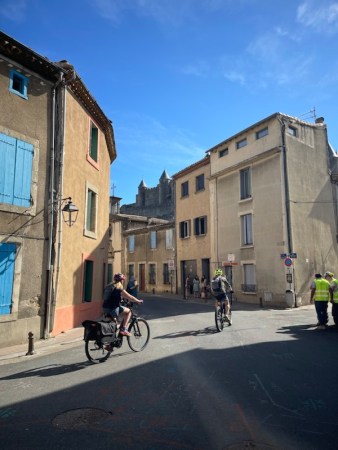
but it’s always a delight, especially when it lengthens the summer in such a heartwarming way.

And, below, (and the header image) a final sunset shot from the Barbacan walls of the cité. Two members of the family are discretely in there, if you can find them…

©Stephen Tanham 2024
All photos taken and processed on an iPhone 12 MaxPro.
Stephen Tanham is a writer-photographer and mystical teacher. He is the founding Director of the Silent Eye, which offers a monthly Zoom-based gathering of companions, each one on their own, unique journey to deeper states of self-realisation.
Share this:


Kingston-on-Thames; an ancient English borough, and a place we love to return to each year as the summer is coming to a close, and the sense of the autumn is on the breeze.
Three hours on the train from Oxenholme – Kendal’s main west-coast station – a quick snack in London, then on to Waterloo Station and another train out to the south-west, getting off seven stops later alongside the River Thames at Kingston-on-Thames.
I love the ‘soft’ light here and, for this year’s trip, had an idea to create a ‘mood’ for a series of photos that would bring out some of the corresponding shapes and tones that we like so much in this fascinating town.
These are the results…
After arriving an checking into our budget hotel, we did our usual walk through the town and down to the river. Many of the streets are curved rather than straight – it’s a delightful change from colder and more clinical grids!

We love being here for our special weekend. There’s so much to do. Cafes and casual restaurants are plentiful – many on the banks of the Thames, itself.
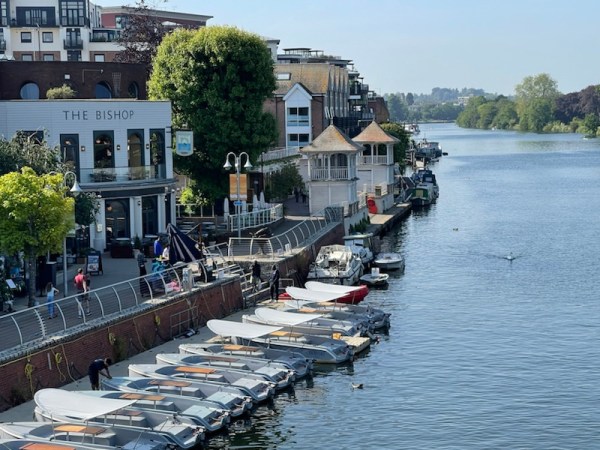
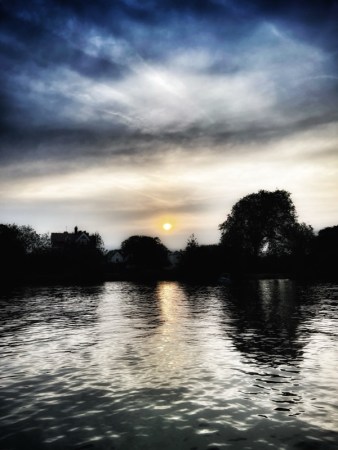
The central attraction is a plethora of local boat trips from Kingston to places like Hampton Court, Cardinal Wolsey’s palace during the reign of Henry VIII.
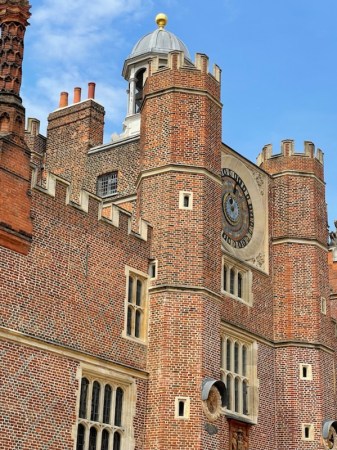
Thomas Wolsey was an English statesman and Catholic cardinal. When Henry VIII became King of England in 1509, Wolsey became the king’s almoner. Wolsey’s affairs prospered and by 1514 he had become the controlling figure in virtually all matters of state. His significant personal income – enabling the building of Hampton Court – was paid by Rome.

King Henry, profligate and increasingly desperate for money, saw Wolsey as an easy target and, following the Cardinal’s failure to negotiate the annulment of Henry’s marriage to Catherine of Aragon, the King turned on him, stripping most of his titles, and confiscating Hampton Court as his own at the same time as he separated the church from Rome and created the Church of England.
Hampton Court is a vast estate which hosts important festivals through the year. Arriving by boat just adds to the charm…

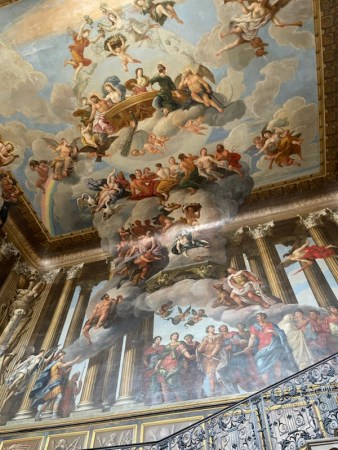
Kingston’s summers get a lot more sunshine than we do in Cumbria, so we actually get to use warm weather garments for a change!
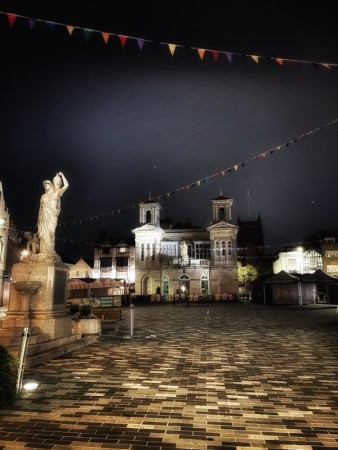
Kingston Upon Thames, to give it its full name, has a long history and was England’s earliest royal borough, first referenced in 838 AD as Cyninges tun, meaning ‘Kings Estate’. Its position on the River Thames, with the only bridge over the river upstream of London Bridge for many years, resulted in Kingston’s importance and was a major factor in the town’s rapid growth.
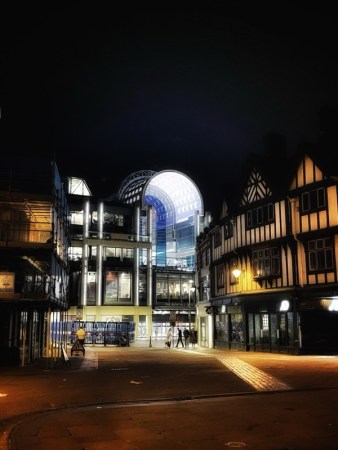
There are many beautiful buildings in the ancient Market Place, not all of which are what they appear to be. The terraces on the North side (to the right on the photo) are resplendent with mock Tudor features, which were added to the existing Edwardian building in the twentieth century. The small, unassuming building next door dates to the early years of the 16th century and is actually one of the oldest buildings in Kingston.

It would be wrong to close without mentioning the Bentall Centre, since its such a dramatic piece of architecture… and divides opinion in our household!

I love its open spaces and the gentle infusion of light from outside. My wife is less enthusiastic.

Modern architecture tends to divide opinion. Visit it yourself and see!
©Stephen Tanham 2024
All photos taken and processed on an iPhone 12 ProMax.
Stephen Tanham is a writer-photographer and mystical teacher. He is the founding Director of the Silent Eye, which offers a monthly Zoom-based gathering of companions, each one on their own, unique journey to deeper states of self-realisation.
Share this:

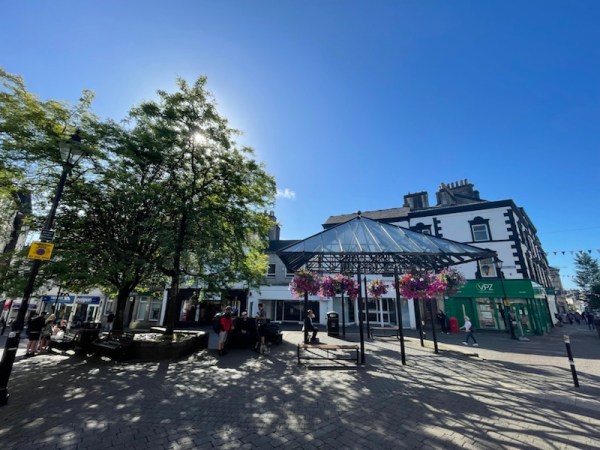
A simple (self) assignment… I was on my way to a haircut in Kendal and – leaving the main car park – I emerged into ‘bright soft sunshine’. It’s a feeling that only happens a few times each year and it has a definite ‘sweet’ quality to it.
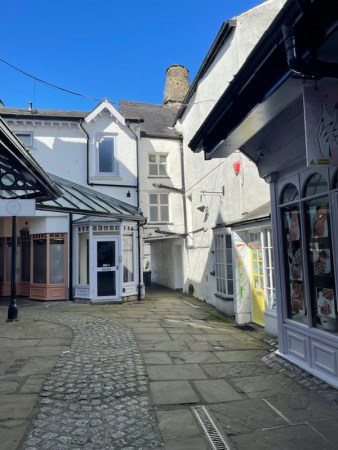
I decided to try to capture the light (in all senses of the word) mood in a few photos.
The Westmorland Centre offers all day parking for a mere £1.10, as long as you’re in before 09:00! It’s a lovely concession, and I’m normally an early riser – I have to be as Tess the collie needs to go out as soon as she hears sounds of life in our waking household.

The Westmorland Centre connects on different levels to the sloping streets around it. It can be confusing for those visiting for the first time. We often extend help in the stairwell!
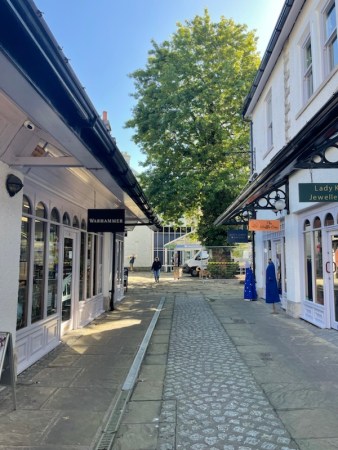
The old cobbles reveal the age of the underlying structure on which the retail complex was built.
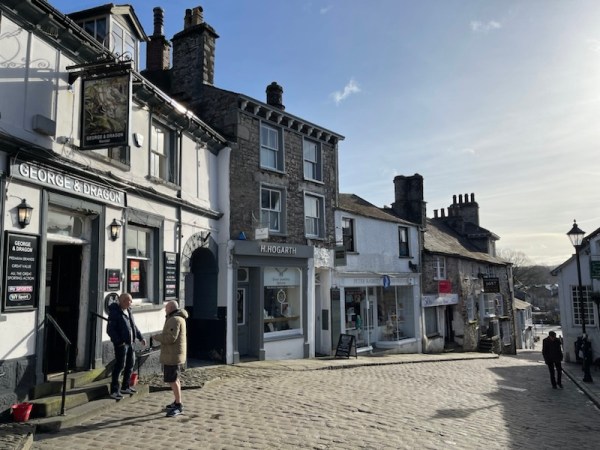
We emerge into Kendal’s Main Street – Stricklandgate – with the sunlight streaming along the old highway.
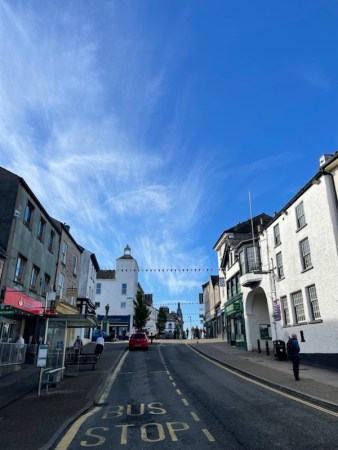
The ‘gap’ on the left is market square, bounded by the white ‘bell tower’ above one of the larger jewellers. In the far middle distance; actually only a few minutes’ walk, is the iconic town hall.
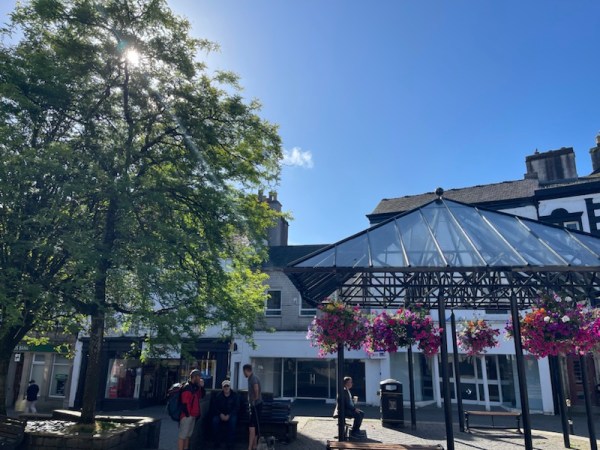
The ‘bandstand’, at the top of Finkle Street, is the point of intersection with Stricklandgate. The bandstand structure is used by local MPs to host open meetings.
It’s a nice morning, and I’m early. I remember that my usual coffee shop is closed on Wednesday … and it’s Wednesday. So, we have an extra ten minutes to fill before I’m due at Karol’s salon.
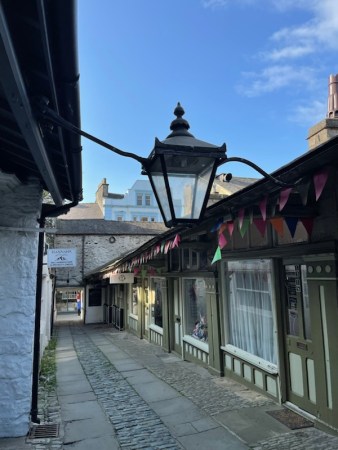
I double back and linger in the best of Kendal’s surviving commercial alleyways. With a smile, I remember that a new coffee shop has opened at the far end of this which will enable me to have a take-away.
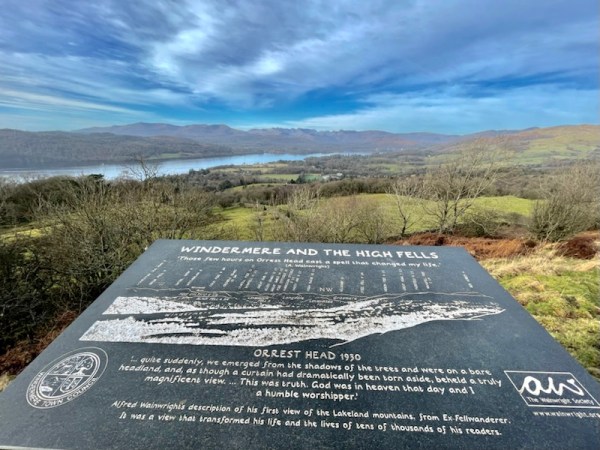
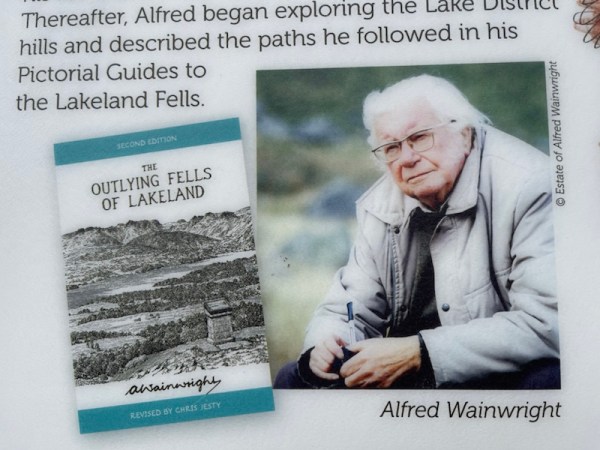
Above and below: Alfred Wainwright, local author of the famous Walkers guides to the Lake District.
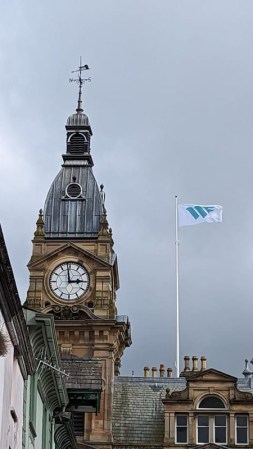
With a final turn, we emerge from the end of Finkle Street to see the iconic town hall before us. Karal’s salon is fifty metres beyond.
It’s been a perfect start to the day… and that coffee was a treat. I hope you enjoyed our walk.
©Stephen Tanham 2024
All photos taken and processed on an iPhone 12.
Stephen Tanham is a writer-photographer and mystical teacher. He is the founding Director of the Silent Eye, which offers a monthly Zoom-based gathering of companions, each one on their own, unique journey to deeper states of self-realisation.
Share this:

Continued from Part Two

The rest of the story is best told in the pictures taken on the day…
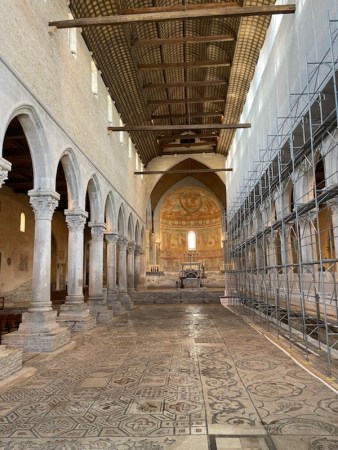
The Basilica of Aquileia as seen today is the result of a series of evolutions of the church built by Bishop Teodoro at the beginning of the 4th century, much of it remarkably intact.
These periods of enlargement culminated in the long nave seen in the photo above. And the original visitor or pilgrim would have walked the length of this in rapturous silence.

The main feature is a parallel hall system, which, between the XI and the XIV centuries, assumed the form of a Latin cross divided into three naves, with a presbytery and an apse decorated with frescoes.
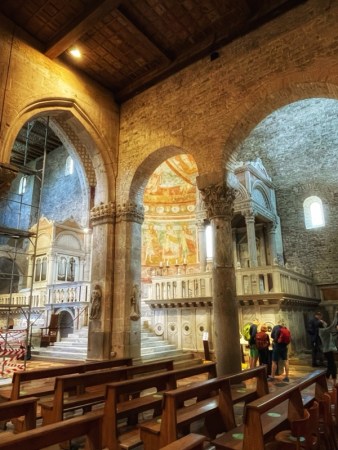
Today, due to the fragile nature of the restored mosaics, we must walk along the edges of the room on raised pathways. One can be seen on the left of the above image.

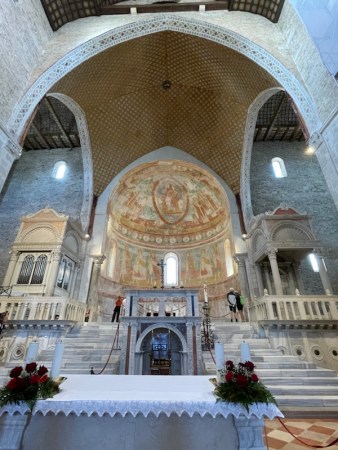
The purpose of this walk was and is to bring us face to face with the transept and its ingress to the sanctuary and the altar. But in the case of this beautiful building, the raised sanctuary (ironically) also offers access to the oldest and deepest part of the basilica in the form of a descending narrow passageway that opens into the magnificent crypt.
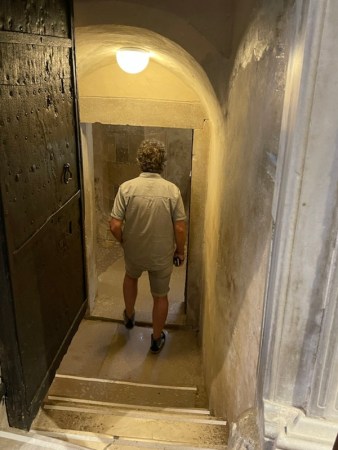
And what a crypt…


Soon it was time to take our leave and, via hastily drunk coffee, walk the mile or so back to the canal dock, where our boat back to Grado now waited…
We have plans to return, hopefully next year.

This concludes the series on Aquileia.
©Stephen Tanham 2024
All photos taken and processed on an iPhone 12 ProMax. Illustrative images created using NightCafe Studio AI.
Stephen Tanham is a writer-photographer and mystical teacher. He is the founding Director of the Silent Eye, which offers a monthly Zoom-based gathering of companions, each one on their own, unique journey to deeper states of self-realisation.
Share this:

Continued from Part One.
There was a taxi service from the canal’s dock to take those not wishing to walk into the centre of Aquileia.
The weather was mild and pleasant. We opted to walk. Fifteen minutes later we came to the centre of the village; a pleasant place with small shops, a local bar and a restaurant.
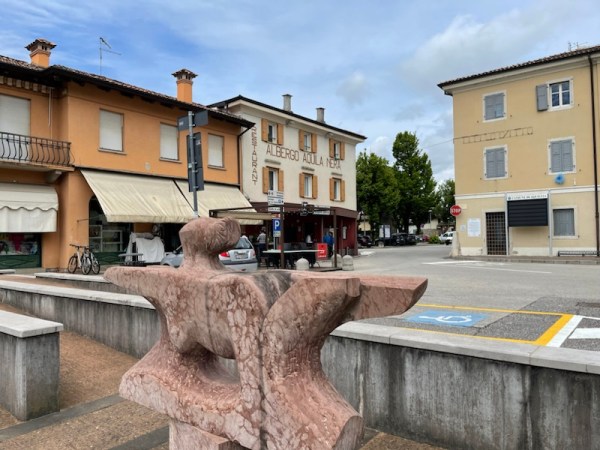
Our destination – the ancient Christian complex centred on the Basilica of Bishop Chromatius – was on the far side of the small town.
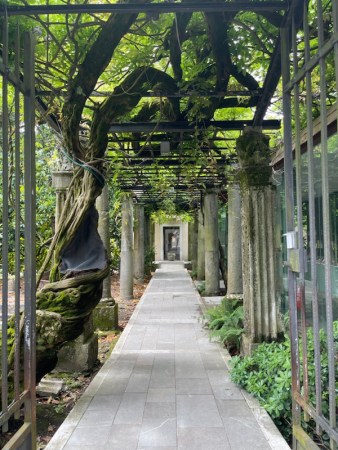
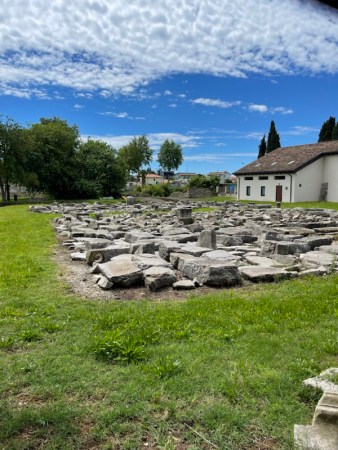
The walk revealed Roman ruins on either side, but little that hinted at the splendour that was to follow.
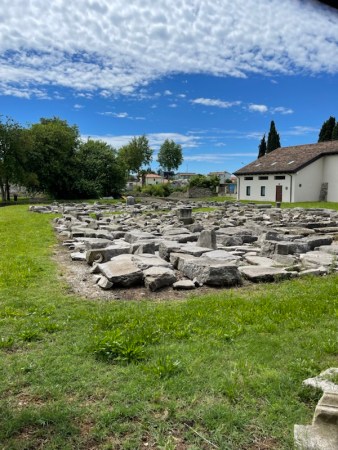
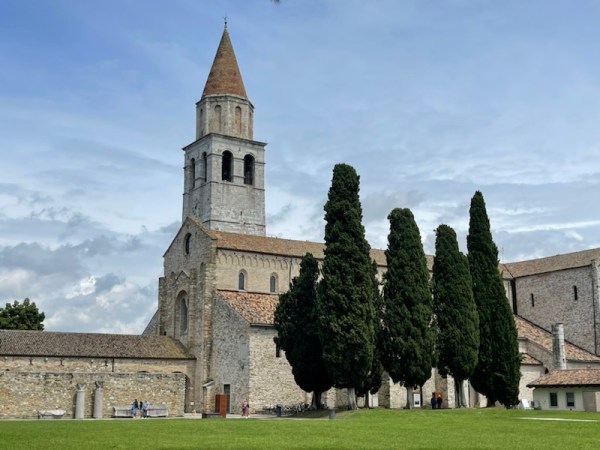
We saw the ‘campanile’ bell-tower first; then the outline of the rest of the basilica. Even from a distance the size of the complex was impressive.
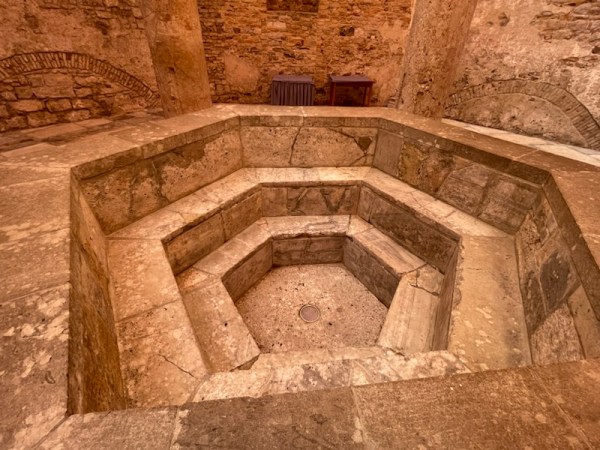
Visitors are guided, first, to the smaller building on the left of the photo, above: The Baptistery of Bishop Chromatius, built, like most of the site, in the 4th – 5th century AD, the period when the Roman Empire was coming to its end, but a time that marked the expansion of the Roman Church into a formiddible religious force.
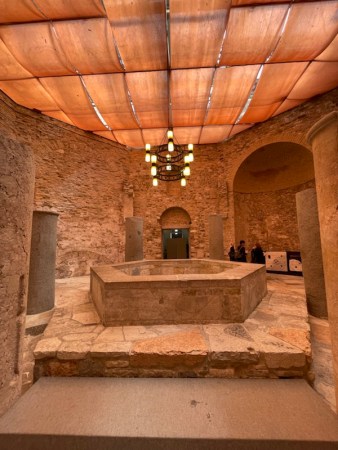
The Baptistery is an integral part of the basilica complex created by Bishop Chromatius (388 – 408). The original plan was square with four corner niches, above which the building is octagonal, with windows in the eight sides, an internal vault and a sloping roof above.
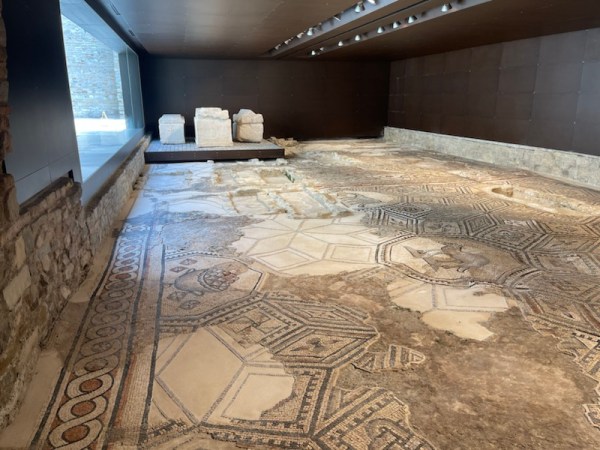
The floor and socle were probably in marble, whereas the walls and vault were certainly decorated with mosaics and frescoes.
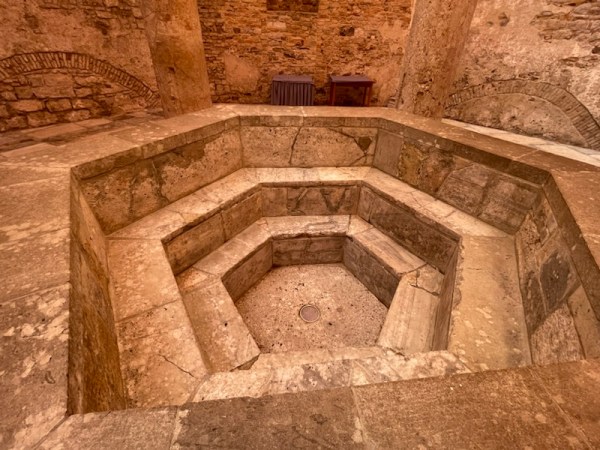
The Baptistery was joined to the narthe by two long chambers which had functions connected with baptism and religious instruction.
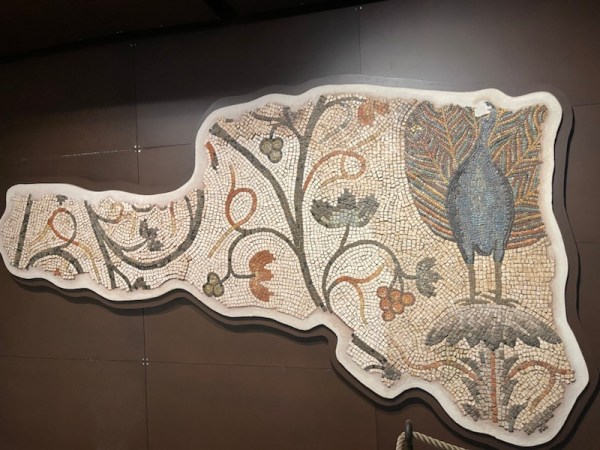
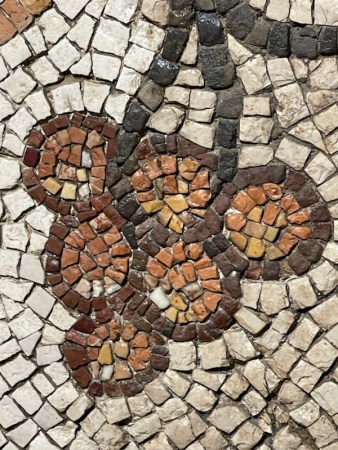
In the 9th century, after the demolition of the two side wings, a direct connection with the portico of the basilica was built (the “pagans’ church”) and three of the four corner niches were eliminated, giving the Baptistery a basically octagonal shape.
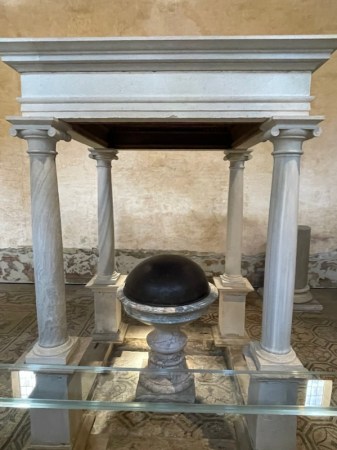
The same period saw the construction of an ambulatory, with reused Roman columns placed at the corners of the hexagonal baptismal font.
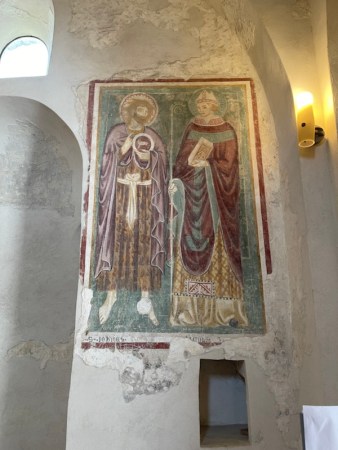
But if the Baptistry was impressive, what followed left us dazzled.
To be continued in Part Three
©Stephen Tanham 2024
All photos taken and processed on an iPhone 12 ProMax. Illustrative images created using NightCafe Studio AI.
Stephen Tanham is a writer-photographer and mystical teacher. He is the founding Director of the Silent Eye, which offers a monthly Zoom-based gathering of companions, each one on their own, unique journey to deeper states of self-realisation.
Share this:


The Old Bridge mills once formed the heart of Kendal’s industry. They have since been converted into offices and other commercial properties.

The River Kent flows right through their heart, providing a dramatic urban landscape which can be seen from the castle, a twenty minute walk away.

The height of summer is a good time to reach into this landscape and capture its lushness.
©Stephen Tanham 2024
All photos taken and processed on an iPhone 12
ProMax.
Stephen Tanham is a writer-photographer and mystical teacher. He is the founding Director of the Silent Eye, which offers a monthly Zoom-based gathering of companions, each one on their own, unique journey to deeper states of self-realisation.
——————-
Share this:

You can approach the Roman ruins of Aquileia by road or by water. The road to Grado passes right through the small town, displaying the ruins on either side of the tarmac. What you don’t realise is how ‘basic’ these are compared with what lies beyond the nearby field to the east.
In these ruins and the carefully preserved artefacts found here is told the story of one of Rome’s most important cities, and the place from which its embrace of the Christian faith was spread throughout its empire. Yet, they are practically unknown except to the dedicated tourists researching Italian history.
Aquileia has another story to tell, one of the post Roman era, whose local remains are far more than tumbled stone by the modern roadside…
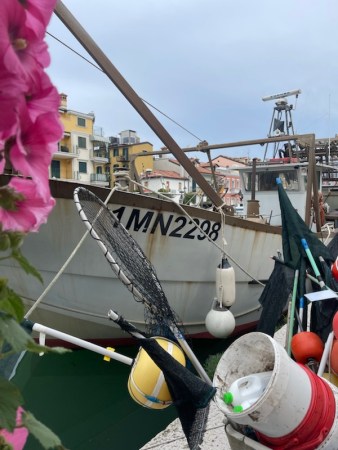
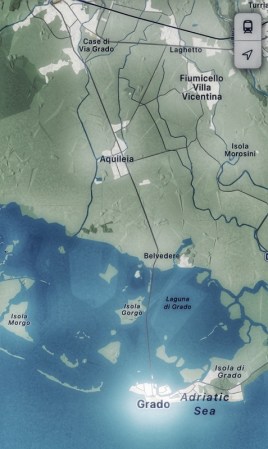
From Grado, where we were staying, you can use either road or water to get to Aquileia. We chose water, uniquely enabled by Grado being an island surrounded (apart from a long causeway) by sea which gives access to waterways that reach deep into the Italian countryside.
The first part of the journey is from Gerado’s port and along the coast, as though following the route to the deeper waters and out towards Trieste or Venice.
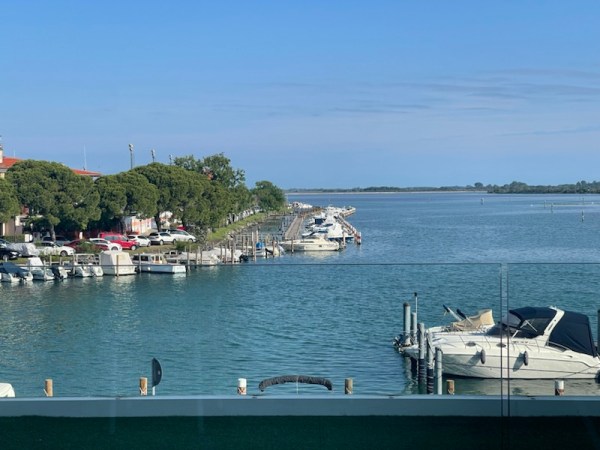
After about twenty minutes of sailing, the ferry makes a surprising change of course towards what look like swampy waters along the mainland coast.
A number of small islands appear in the stream, some of them inhabited. What a hermit-like existence! But there’s something tranquil about it… Better see it in winter before we make an offer!
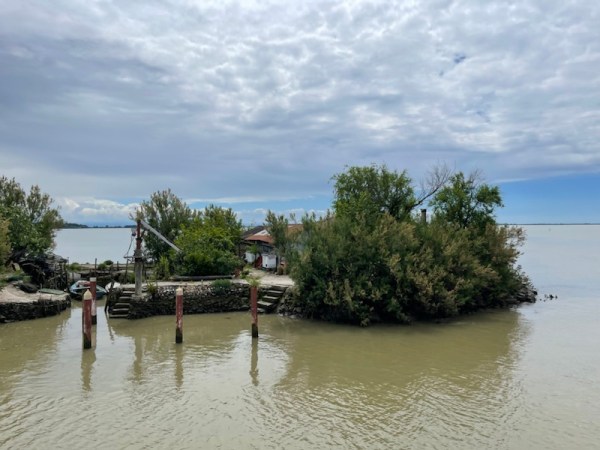
Ahead, the dense vegetation seems to part, and the ‘canal’ to Aquileia is revealed.
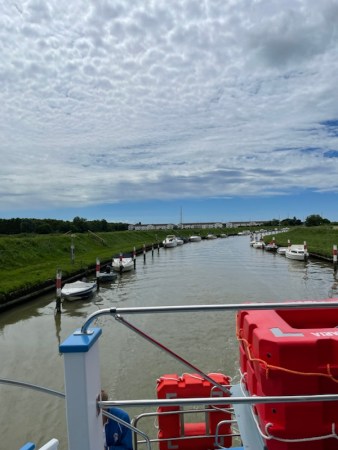
The number of boats moored here is surprising but I suspect economic. It’s a lot less expensive to keep a boat in this quiet backwater than on the expensive island of Grado, itself. As we sail deeper into the mainland – the outbound trip last about 30 mins – we notice more and more sophisticated craft.
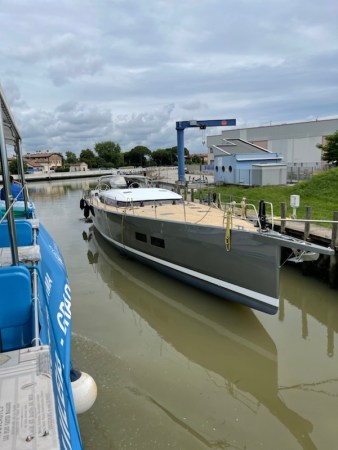
Eventually, the mystery is solved. One of the province’s oldest boatbuilders operated from the edge of Aquileia. It’s a place of the ancient and the very modern.
Ahead of us now are the edges of Aquileia town. There is a feeling of surprises to come…
To be continued in Part Two.
©Stephen Tanham 2024
All photos taken and processed on an iPhone 12 ProMax. Illustrative images created using NightCafe Studio AI.
Stephen Tanham is a writer-photographer and mystical teacher. He is the founding Director of the Silent Eye, which offers a monthly Zoom-based gathering of companions, each one on their own, unique journey to deeper states of self-realisation.
Share this:

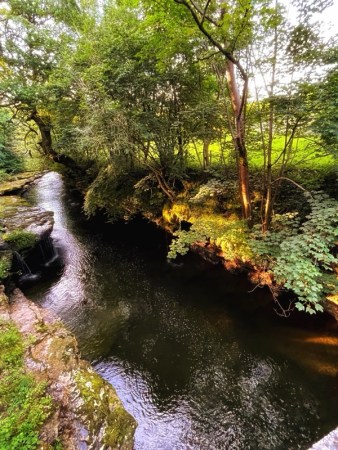
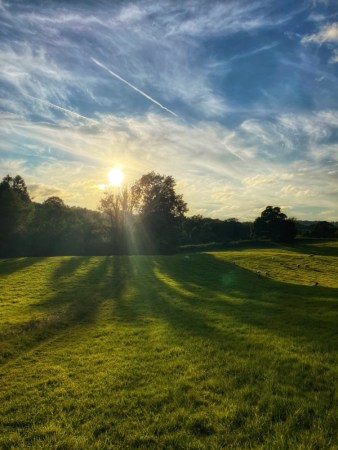
The sun was starting to set when we took the collie for her final walk; along the old canal path …
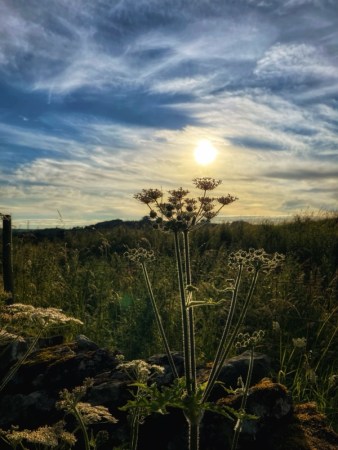
… and down across the fields to emerge at the old bridge over the River Kent.
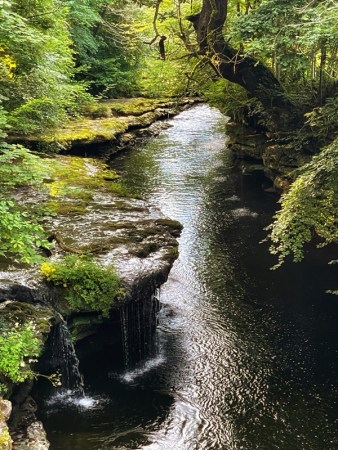
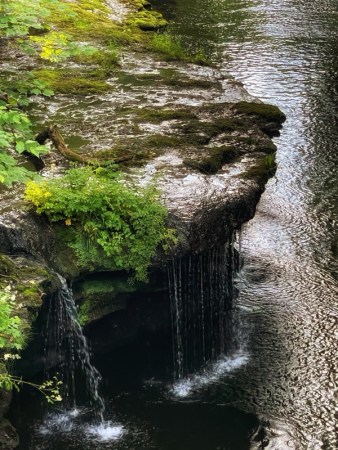
There are certain evenings when the mellowness of the water on limestone is exquisite.
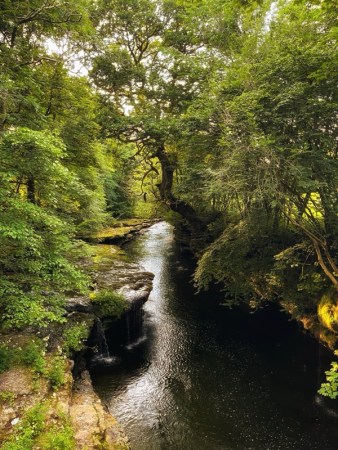
Worth taking a few detailed shots to show it off.
Still filled with the glow, we returned the way we came to find one or two surprises where we were least expecting them.
©Stephen Tanham 2024
All photos taken and processed on an iPhone 12ProMax or created using NightCafe Studio Al.
Stephen Tanham is a writer-photographer and mystical teacher. He is the founding Director of the Silent Eye, which offers a monthly Zoom-based gathering of companions, each one on their own, unique journey to deeper states of self-realisation.
Share this:


©Stephen Tanham 2024
All photos taken and processed on an iPhone 12 ProMax.
Stephen Tanham is a writer-photographer and mystical teacher. He is the founding Director of the Silent Eye, which offers a monthly Zoom-based gathering of companions, each one on their own, unique journey to deeper states of self-realisation.
Share this:


For over twenty years, Hampstead, in north London was my ‘business home’ for at least half the working week. I would join the thousands of other workers taking the Northern Line tube into The City.

London, like most large cities, can be overwhelming and a permanent assault on the senses, but I got to make peace with it when I found a budget hotel in the lovely suburb of Hampstead – discovered one summer evening when I was on a long stroll.

I immediately fell in love with its gentle and individual streets and cafes, and its cultured and generally polite residents. Soon, it was a home from home…

We hadn’t been back in a while, so the prospect of a long weekend during which my wife could catch up with her godfather and celebrate her birthday was something to look forward to.

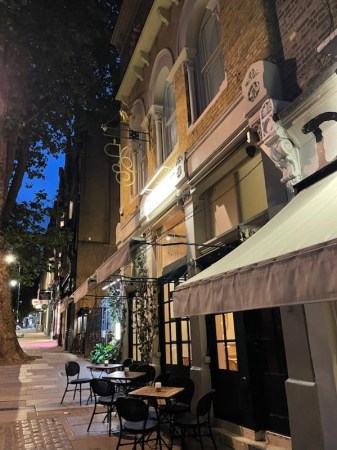
Our first day completed, we walked up from the hotel in Belsize Park to ‘the village’ of Hampstead. The soft summer light was perfect for taking some ‘muted’ shots on the iPhone.

It was all as we remembered: the quirky shops, mysterious gates and general sense of being somehow apart from the rest of the capital.

A coffee at the top of the hill, then we crossed over to take the easier walk back down.

A very happy reunion. The mild summer night helped, and it was noticeably warmer than our home in Cumbria.
©Stephen Tanham 2024
All photos taken and processed on an iPhone 12 ProMax.
Stephen Tanham is a writer-photographer and mystical teacher. He is the founding Director of the Silent Eye, which offers a monthly Zoom-based gathering of companions, each one on their own, unique journey to deeper states of self-realisation.


 Sun in Gemini
You must be logged in to post a comment.