+ #Silenti, Child of Light, esoteric psychology, Mystery Schools, Spirituality, Truth and Esotericism
The Origin of Me
by Steve Tanham


Out of a hidden fear, we seldom examine our personal origins – this sense of ‘me’. Yet, if we let go that fear, the journey can teach us so much, and leave us with an emotion of deep belonging.
We can explore this with a meditation, rather than the intellect; if you’d like a little journey?
Be quiet and become conscious that our everyday lives define us by how we react to the world. Feel all the things, now, that are defining you. Feel the tensions in your body, the worries and concerns about the day ahead. Feel the aspirations that you have; possibly today holds the chance of a furthering your ambitions? Or perhaps many of those have been defined by others… for you.
Feel how all these things resolve themselves into your body. Is the centre of your body in a knot? If so, relax it with kindness. It is only tense because you have let a state of non-consciousness make it habitual. See it, now, forgive it and free the tension. Let all the tension from whatever source become non-threatening; like a cloud you believed was solid, but which turns out to be only shaped water vapour… through which you can sink.
The real is below, and now comes into view as the tapestry of a landscape far beneath you. You are sinking, slowly, through the air towards it. Breathe gently as you sink. Let any residual tension be captured, magically, by your in-breath; and released to be part of the cloud above you as you breathe out. When this is complete, something still remains around us. We seem to have a thin layer of cloud that clings to us, shielding us from complete and open vision of our true world.
You look at the landscape coming slowly into focus below. You are a twin being: organic and something more than organic. Your purpose in life is to be present to that landscape below. You can choose what to look at, what to focus on. Now that the tensions have been turned into the cloud above you, we can choose, with complete freedom, what to become present to.
With a touch of our mind now calmed, we can revolve in this blue space and examine the world below… We see it is predominately green – the colour of life. The region of your heart resonates to this vivid colour and all that it supports…
This universal life is you, but this is not all you are… for you are conscious of it.
Hovering above the Earth in this perfectly clear air, we look at the more complex things below. As we sink, slowly, we take in the perfection of the trees in a forest. Their shapes are a representation of time, itself, showing us in three dimensions their journey of growth in four.
We see a wolf, running along a track deep in the forest. His furtive movement mirrors how we too have grown a body from the organic earth, a body that learned through intelligence, yet still has to live in state of caution and, sometimes, fear. And we are this, but this is not all we are…
A church is coming into view. Its spire dominates the little village, though it is something abstract – it has no useful organic function, unlike the other faces of life, below. And yet, in many ways, that abstraction represents a depth of thought not needed for simple survival….
The plants evolved to animals to humans. But humans are not content with simply being. They have to seek for deeper meaning, meaning that can be at odds with their organic natures. We look for meaning in our lives, but seldom examine our origins as a source of wisdom. What if we let go of who we are and become content to just ‘be’?
At the idea of this ‘merging’ there is a resistance, a not-wanting to lose this individual perspective that we are attached to; this centre of ‘me’ as it views the beautiful world. ‘I’ have collected my life, have stored and distilled its lessons, making this organic creature that I am stronger and smarter… or at least more resilient.
This Me is important. It is only through Me that things get done… As these thoughts and feelings crystallise in our minds, the thin envelope of vapour around us becomes more dense, and the landscape becomes less clear.
As though to counter this, we look down at the beautiful Earth below, we smile at how little the Me does, compared to the vast industry of nature which feeds us. Sinking slowly in the perfect air, we wonder how it would feel to lose the Me, to lose the history of Me… What would be left of the sense of Self, then?
With this, the construct of the self around us feels very fragile, like a thing that was meant to be temporary. The inner point of total awareness that has no history has become our new Self and is diamond bright, so bright that its rays crack and melt the thin layers of the cloud of self around us. In a moment of total clarity we see that we need not be defined by anything in our past – neither limitation nor identification. The view below is lost to us and we fall to Earth, struggling, as the two parts of our selves vie for our future direction. Our will to be deeper and more real prevails…
In that moment the last of the shell of self is rendered transparent and we find ourselves as newborn bird, in a nest, high in the oak tree we saw from above. Time, or rather, process, is not as before. There is a vast power at work in our transformation as the first few weeks of our new birth are condensed into eight heartbeats. By the ninth, our wings are full of power. The bright sun in the clear blue sky calls to us and we spread those strong wings, lifting ourselves off the nest and climbing into the sky.
The Earth has finished its job. The Sun of truth will teach us now.
©️Stephen Tanham
Stephen Tanham is a director of the Silent Eye School of Consciousness, a not-for-profit organisation that helps people find a personal path to a deeper place within their internal and external lives.
The Silent Eye provides home-based, practical courses which are low-cost and personally supervised. The course materials and corresponding supervision are provided month by month without further commitment.
Steve’s personal blog, Sun in Gemini, is at stevetanham.wordpress.com.
You’ll find friends, poetry, literature and photography there…and some great guest posts on related topics.
Share this:


From Sue…


The soft colours of dawn were painting the sky as I left for work. The village streets, preternaturally quiet now that the schools were on holiday, were, for once, easy to negotiate. Parked cars take up half the width of every street and, on a school day and with oncoming traffic, getting out of the village becomes a slalom exercise in courtesy and patience.
By the time I reached the long stretch into town, the sun was cresting the horizon, setting fire to the skyline and casting long shadows across the road. Another mile, a bend in the road, and the brilliant disc had revealed itself in all its golden glory. I, and every other motorist in the now-queuing traffic, hit the brakes, dazzled by the low-lying orb on a road that runs due east.
There is, I thought, such a thing as too much light.
As the traffic crawled…
View original post 584 more words
Share this:


How beautifully you say goodbye
When damp of cold affects the eye
When rustle shuts off bustle’s hiss
And says ‘so brief must be our kiss’
How beautifully you say goodbye…
©Stephen Tanham
Share this:

“The best and gentlest introduction to practical modern mysticism,” said one of our attendees, last year. Come and join us…

 *
*
‘Gilgamesh is among the greatest things that can ever happen to a person.’
– Rainer Maria Rilke.
Those of you with an eagle eye will have realised that next year’s Silent Eye, Spring Workshop has a mythological theme.
It is based upon The Epic of Gilgamesh which is a story worked up into its present form over four thousand years ago.
Prior to its re-incarnation as an epic poem it existed as five independant mythological episodes, which, as we traditionally split our April Workshops into five ritual dramas tends to suit our purposes rather well.
But why do we insist on revisiting the past in this way?
It is our contention that drama as we now have it derives from sacred drama as practised in the mystery temples of old where it was used to develop the psyche of the neophyte and initiate them into the sacred and secret…
View original post 286 more words
Share this:

Gorgeous Autumn image from Jaye and Anita

 Image by Pixabay.com
 Share this:


From Sue…
Share this:


If you belonged to a species that regularly threw itself off a cliff, you’d expect that species – or that tribe – to die out pretty quickly…
Let’s imagine that there was an annual contest of head-beating with sticks, and the losers – those left alive – were honour bound to march or stagger to the cliff-top and mumble a ceremonial farewell before casting themselves off the edge.
From the outside, the problem is pretty plain to see, and it has a repeating pattern: The issue occurs annually; the initial problem is honouring the ‘game’ that allows sticks to be used as weapons. Then there are the people who promote the annual gladiatorial spectacle, but, personally, avoid the cliff tops at all costs. They make a better living providing the best sticks; and avoid the annual self-cull by living in fine houses in the hills. The producers of fine sticks have a statistical problem – they don’t want too many people to die or the market for fine sticks will diminish and they’ll end up fighting among themselves, which could be very short-lived…and they like life in the hills.
One day a man in a white robe comes along and teaches that this cyclic suffering is not inevitable. He teaches that there is enough in this wonderful world to go around. He says that all it takes is for everyone to agree on that and people will be able to live creative, caring and industrious lives. All we have to do is look after each other and recognise that differences dissolve when we talk… And try to see things from each other’s point of view.
It boils down to this: that all we have to do is to say, “This is my problem.”
Some of the people listening get it. The problem is learning, which the man in the white robe knows. He makes up clever stories that can be interpreted on different levels. At the basic level, the stories are of faith in something deeper. At the deeper levels, the same stories reveal the inner workings of the human soul. He knows that the makers of fine sticks control learning so that only a few get the finest teachings of how to perpetuate success – in making fine sticks.
The people who make fine sticks don’t like the man in the white robe or his kind. It would end their customer base overnight. So they take their best-educated minds and teach them to sew the seeds of distrust of such people-centric thinking, saying that it will kill off the tribe’s need for success, which is so much a part of their cultural inheritance. The makers of fine sticks are specialists in reaching into the hearts and minds of the least-educated parts of the tribe and whipping up energy and hatred. Some of their brightest children create other stories to counter the ones given by the man in the white robe.
The man in the white robe is put to death in a very public and painful way. But his teachings were popular, so the makers of fine sticks extract what he said into a new system of thought – one that they can control using the power of collective ignorance, fear, and not thinking-for-yourself. They teach the most violent of the least educated to rise up against people in any kind of white robe because they are a threat to their fine way of life.
Then they get back to making the next generation of fine sticks so that most of the money of the tribe comes back to them.
One night soon the moon will be at its most full. The good earth will be ripe with its bounty. The annual ritual of head-beating will begin. This year, the makers of fine sticks have introduced a new feature: they are letting children have small sticks so that they can join in this contest. Children can so easily be taught hatred; and fighting comes naturally to the poor ones who have to fight because all the money has gone to the makers of fine sticks.
As the heads are crushed the moon will sigh that the gift of intelligence serves this, and the earth will weep and collect their blood. The survivors on the losing tribe will stagger to the cliff top to swear allegiance to this noble rite, then throw themselves off… and all will be well for the makers of fine sticks who are far away in the hills.
©️Stephen Tanham
Stephen Tanham is a director of the Silent Eye School of Consciousness, a not-for-profit organisation that helps people find a personal path to a deeper place within their internal and external lives.
The Silent Eye provides home-based, practical courses which are low-cost and personally supervised. The course materials and corresponding supervision are provided month by month without further commitment.
Steve’s personal blog, Sun in Gemini, is at stevetanham.wordpress.com.
You’ll find friends, poetry, literature and photography there…and some great guest posts on related topics.
Share this:

From Sue, and an inspiration for tomorrow’s post.

Honour
Empty spectre
Encompasing boundless grief
Vacant cradles rock silently
Wasted
*
Futile
Bringing ruin
Shades haunting memory
Lost generations asking why
Warfare
*
Cinquains for Colleen’s Poetry Challenge
Share this:


Vast and swirling force, below
How silently you flow round truth
When hearts and minds let drift
The shallow link of living life
Between the tides of love and loathing
⦿
No fanfare; charge of war
But grey and ancient mud, which
Turning molten silver, deadly,
Quicker than truth half-shaped
Can lie its way to heaven
⦿
The visitor, swept beyond his depth
Finds death in once fond shallows
When tide as fast as horses rages
⦿
The tide is all and everything
A higher form whose children, born
Are life and death made polar
Death seen in full is life made whole
The song of Vishnu’s Shiva
⦿
It is, perhaps as it should be
But they are rising on our shores
The muddy undertow takes and grinds
The simple guest of visiting mind
⦿
©Stephen Tanham
Share this:


“Grandad!”
The little girl was shouting his name from the far bank of the river. She was waving something at him; her excited voice carried across the water. “Look, Grandad, I’ve got your book… the one you wrote…the one you read me the stories from!”
His world was unravelling. Memories came crashing back; real memories, not confusion… not the fog. Sunday stared across the river at Vicky, his grandaughter, who was no running and waving their shared copy of Inspector Sunday and the Cheng Mysteries, his first and only novel.
“We don’t live here any more, Dad,” The voice was soft and came from behind him. Emotions flooded his soul as he turned to see the redhead: his daughter, Jessica. Her hand was held out to him. She wore the yellow jacket with the marigold-patterned belt – the image of her that he always carried.
Sunday realised what he had done… saw the concern in Jessica’s eyes. “I… I went into the house…the old house.” he said. “I had to see it one more time…” He heard the age in his voice, the bravado gone. “I’m hungry,” he whispered.
Jessica said, softly, “It’s okay, Dad. The nice people who bought it said that someone had been in… They had been away for the weekend… but we explained that you may have kept a key…”
She was crying now, the redhead – his daughter. ‘They were only concerned that we found you.” She came a step closer.” He could hear the relief in her voice. He took her hand. She swept him into a hug. They held each other, uncertain but together.
“She knew… Vicky knew you’d be here.”
The tears were wet on his shoulder. “I can’t make it better, Dad, but we can surround you with love…”
Vicky had been running across the old wooden bridge. She arrived, breathless, and took his free hand, clutching the first two fingers, tightly. She looked up as he looked down.
“You can keep your cat, Grandad. Mummy says so…”
End of Inspector Sunday
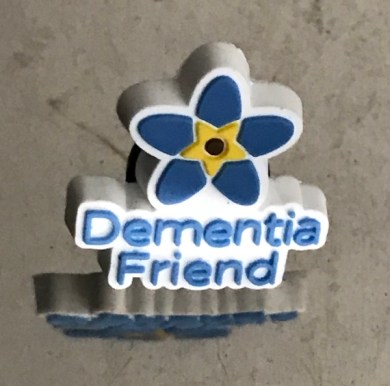
Dementia affects many people and families. Within the shrinking prison of the condition, people are very much alive – and still as they were before they lost their ability to remember and handle complex things.
Nearly a million people have dementia in the UK. My mother is one of them. Kindness and consideration go a long way to making them feel they still have a place in life…
©Stephen Tanham
Other parts of this short story:
Part One, Part Two, Part Three, Part Four, Part Five, Part Six, Part Seven
Part Eight, Part Nine, Part Ten
Share this:

From Sue…


 Sun in Gemini
You must be logged in to post a comment.