
A depth of past from Stuart…
Share this:

From Sue:
Share this:

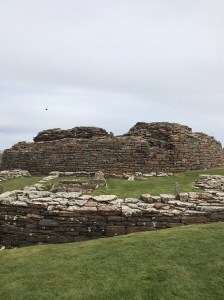
I was struggling with the height of the walls – 10 metres. I am distinctly medium in height; my two sons tower over me, at six foot, three inches each. But ten metres is a long way into anybody’s domestic sky; and yet that’s how tall the central stone tower of the Broch of Gurness was.

The small cheeseboard (above) bought in Kirkwall, the capital, has served us well as geography prop. Locate the island of Rousay and, from its south coast, drop down to the shark-shaped headland on the West Mainland below. That’s where we are, at the Broch of Gurness, with Rousay opposite, so close you feel you could swim to it – but those waters are treacherous…

I hope someone else is asking, ‘What’s a Broch?’ It’s a well-known word north of the border, but I had to ask the Historic Scotland guide at the tiny visitor centre; and felt diminished by his incredulous stare. He wasn’t being unfriendly; he was genuinely surprised at my ignorance – but only momentarily…
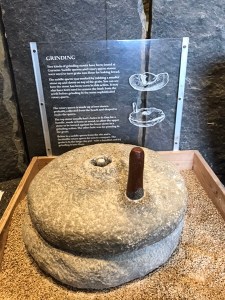
… He ceased grinding corn on the rotary quern- just long enough to educate me – and then resumed his skilful use of the two stones; a steady stream of flour, below, being the result. Inviting me to have a go by way of penance, he explained that a broch (pronounced ‘brock’) was a fortified tower at the centre of an ancient settlement. In this case the settlement was a large one, and, 2000 years ago, would have been one of the most important places on Orkney.
The sea is everywhere on Orkney. Indeed, after a few days of meeting it beyond each bend in the road, or over every gentle hill, you come to realise that Orkney is the sea, and that you are in a kind of paradise where the gentle curls and fronds of the welcoming land live, in gentle harmony, with the mother force of the blue-green waters. We gave you this, the waters seem to say. Look after it and that which gave it life and it will become home in your heart.

The mysterious Iron Age peoples who lived here, two thousand years ago, felt that way. The sea was their highway, and probably a big part of their religion, too. Along with the fertile land, it fed them.
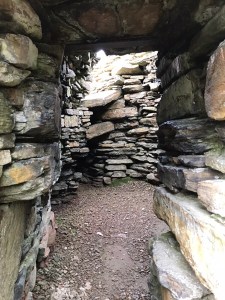
Ten metres. It’s a long way up for a drystone wall… though the full height of the cental broch tower is long eroded. Newly educated at the grinding wheel, I worked hard to recall what the guide had said: You build that big because you are important. The tower is domestic – being the ‘royal’ dwelling, but it’s also defensive; you can see for miles from a height like that, and Orkney has hills but no mountains. In addition, you can watch and manage those near to you – surveying the farmed land around. It was a really important place, concluded the guide, letting me leave my grinding duties and enter the historic site.
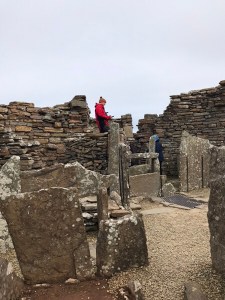
There are over 500 brochs in northern and western Scotland, but those with sizeable villages like Gurness are peculiar to Orkney and northern Caithness. The history of archeology is full of fortunate accidents that lead to discovery. The coastal storm that revealed Scara Brae being a very good example. The story of the finding of the Broch of Gurness is one of the best.
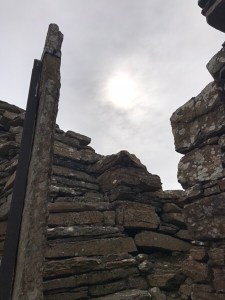
There had been a large mound (locally ‘knowe’ at Gurness, close to the shore, for as long as anyone could remember. One day in 1929, an Orkney Scholar, Robert Rendall, was sketching on the top of the mound when one of the legs of his stool slid into the ground. He dug to examine why the ground had given way and ended up uncovering the top of the staircase on the west side of the broch tower. There had been widespread interest in excavating Orkney’s ancient history and a series of donations enabled formal excavations, which began in 1930. It was soon taken over by the Ministry of Public Buildings and Works, under whose aegis it continued until the onset of WW2 in 1939.
A similar mound at Midhowe, on the neighbouring island of, Rousay, was excavated at the same time, and skilled workmen were shared between the two sites. For its time, the work was very skilled and disciplined. The result was a great achievement for the people of Orkney, who now had living proof of the ancientness of their landscape.
The work continued after the war and, in the 1950s, consolidation of the work took place. Loose and broken stones were secured in place and all walls were made safe. A set of concrete cliff were constructed to offer some protection from the unpredictable seas.
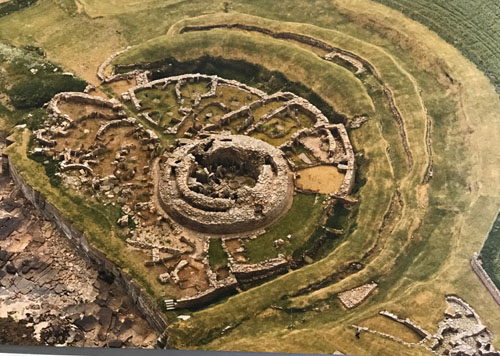
The picture below, taken from the site’s visitor board, shows the extent of the excavation, as it is today. On the left hand side you can see how close it is (and was) to the sea. The picture also shows the dominance of the central broch tower, with its twin, hollow walls and vast dimensions.
By about 100 AD, the broch and its village were abandoned. Successive failures in the structure reduced its size, and the remains were re-used by generations of later settlers, up to Pictish times, around 700 AD. The Vikings never lived here, but, in the 9th century, they honoured the site by burying a noblewoman, along with her grave goods.

Further information from Historic Scotland.
©Stephen Tanham
Share this:

The cat’s sudden appearance had startled Sunday. It took him a few moments to adjust; then he realised that the creature had been looking out of the window and not at him.
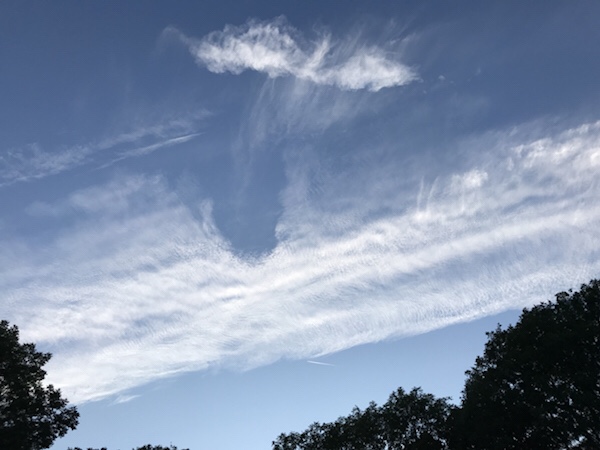
Sunday followed the feline gaze and found that a huge angel had broken loose from a high cloud and was expanding as it fell to Earth…
“Mow ” said the cat, suddenly closer to Sunday’s ear.
“Hush,” whispered Sunday, as he attempted to stroke the cat. But it had gone…
©Stephen Tanham.
Share this:

+ #Silenti, Child of Light, Consciousness, enneagram, esoteric psychology, Gurdjieff, Mystery Schools, Silent Eye School, Spirit, Spirituality
Principles of Fire (5): A Tribe of One
by Steve Tanham

They who set out to discover the twin meanings of the word ‘self’ must walk a certain path. The route to the deeper, real self lies only in the journey through the everyday self. Without this study – and its consequent effects – there can be no personal transformation.
We have to learn to look at ourselves with intensity if we are to begin to glimpse the false edges of what we take ourselves to be. There are many forces at work to guide and help us. This is not a journey that is taken alone. To paraphrase the ancient Kabbalists: The universe is awake to an awakening Adam. Our birthright is the state of full and inclusive consciousness, free from the accumulation of the personal past. What prevents this state of living is the power of that past…
The ordinary, everyday self is characterised by one word: reaction. To begin to examine ourselves, we begin by studying – with intensity – how we react. We react to pain, or the threat of pain, even though it is not present. We react to pleasure and the possibility of pleasure. Between these two poles our lives are strung out like a historical washing line. On this line are familiar garments, comfortable resting points in good or bad times; places we can reside and be at home with the history of reaction contained within. Many, such as those generated in our early months, are unconscious and very powerful. They can be positive (love) or negative (paralysing fear). With the latter, if seen in the light of adult discrimination they would lose their power; but to ‘sit with them’ is truly work and better accompanied.
Some reactions are more subtle. It is hard to think in an original way. Typically, each of us belongs to a kind of ‘tribe’, where the core values of that group of people are shared among thousands, if not millions, of other members. When we belong to a tribe we don’t need to think originally, indeed it is often dangerous to do so. We risk drawing attention to ourselves, and the ultimate sanction against such behaviour is to be ejected from the tribe. Finding ourselves alone is a dreadful thing. Some people fear that more than anything else in their world.
When we begin to watch ourselves on a daily basis, the very act of self-watching begins the generation of a different ‘space’ inside us. This new, differently-aware space is what brings the early results that can be so heartening to those beginning the Work. This new space is not part of the historic egoic structure of our lives, since its very existence is to watch and study how that structure operates and has formed. The techniques that begin the creation of this space are analogous to a person realising that, from the perspective of consciousness, the world is actually projected on to their eyeballs – like a movie – with no gap between the event and the reaction to that event. The egoic self is what reacts, instantly, to this projected world. The vast majority of such reactions are pre-programmed by the personal life history; in other words, they are not truly alive…
The five senses bring us the shape and behaviour of the world around us. Patterns in our personal history tell us, immediately, if there is danger in the encroaching environment, whether physical or psychological. At the most intimate level, these patterns reveal threats to our physical existence – that which threatens the body. We do not need to process the logic of a burn from a red-hot object; the automated mechanisms from our early childhood react for us. But there was a time when we had to learn it…
Beyond that, we have patterns of emotional recognition, which are largely automatic, too, but in a different way. I can bat away the approach of a wasp in Autumn, but I can’t do the same with a bad feeling; I have to think originally about its possible origins – including searching within ‘my self’. I might not want the effort of doing that. Instead, I could reach for an alcoholic drink or switch on a movie, allowing the bad feeling to pass. Sadly, avoidance teaches nothing, whereas a naked inquiry into the newly formed internal state can teach us a lot.
Beyond the emotions is the power of the intellect: that which learns by reason. This is the slowest of all; yet allows us to form patterns that deal with very deep and often complex concepts, such as how and why people lie to others and to themselves. Reason is clever, allowing us to out-think the life-forms that came before us; using the intellectual jewel of ‘what if’. And yet reason is wholly a thing of the brain, and so is conditioned by the entirety of our personal history.
These three ‘space helmets’ – each one inside the other, like the famous Russian Dolls – are the glass through which we see the world. But our conditioned consciousness does not look at the world, it looks, instead, at the movie being shown on the glass bubbles in which we live. Our egoic consciousness is nothing more than the sum total of our personal reactions to the movies… But, it’s worse: there is nothing inside those three helmets, except the history of themselves and the historic washing line of fear and pleasure.
The riddle of this is the story of our real existence – and our wonderful potential as fully conscious creatures, connected, in microcosm, with everything.
To be continued…
©️Stephen Tanham
Other parts of this series:
Part One, Part Two, Part Three, Part Four,
Stephen Tanham is a director of the Silent Eye School of Consciousness, a not-for-profit organisation that helps people find the reality and essence of their existence via home-based, practical courses which are low-cost and personally supervised.
His personal blog, Sun in Gemini, is at stevetanham.wordpress.com.
You’ll find friends, poetry, literature and photography there…and some great guest posts on related topics
Share this:

From Stuart
Share this:

Sue and Stuart’s journey through mystical Cornwall continues
Share this:

⦿
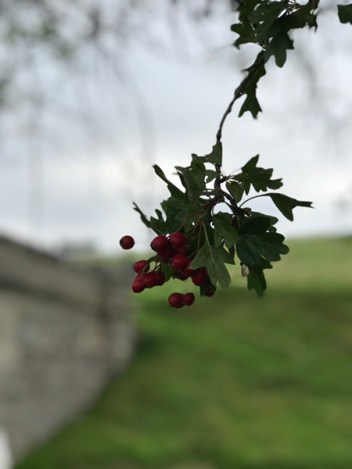
This berry ball, September’s song
Hangs boldly from the tree nearby
Unseen, till now, its blood-red tone
Displays the inner harvest of the sun
And radiance of the soft, enduring sky
⦿
Its fragile fullness tells a tale
Within this sphere new life responds
With readiness to live, then die
Red body hangs in space, an offered meal
For bird who with the seed absconds
⦿
Autumn orb of reddening gold
When life is ending, grant to me
As death returns my light to you
That hawks should feed upon my meal
Yet know the arrow that I bear flies free
⦿
©️Stephen Tanham
Stephen Tanham is a director of the Silent Eye School of Consciousness, a not-for-profit organisation that helps people find the reality and essence of their existence via home-based, practical courses which are low-cost and personally supervised.
His personal blog, Sun in Gemini, is at stevetanham.wordpress.com.
You’ll find friends, poetry, literature and photography there…and some great guest posts on related topics.
Share this:


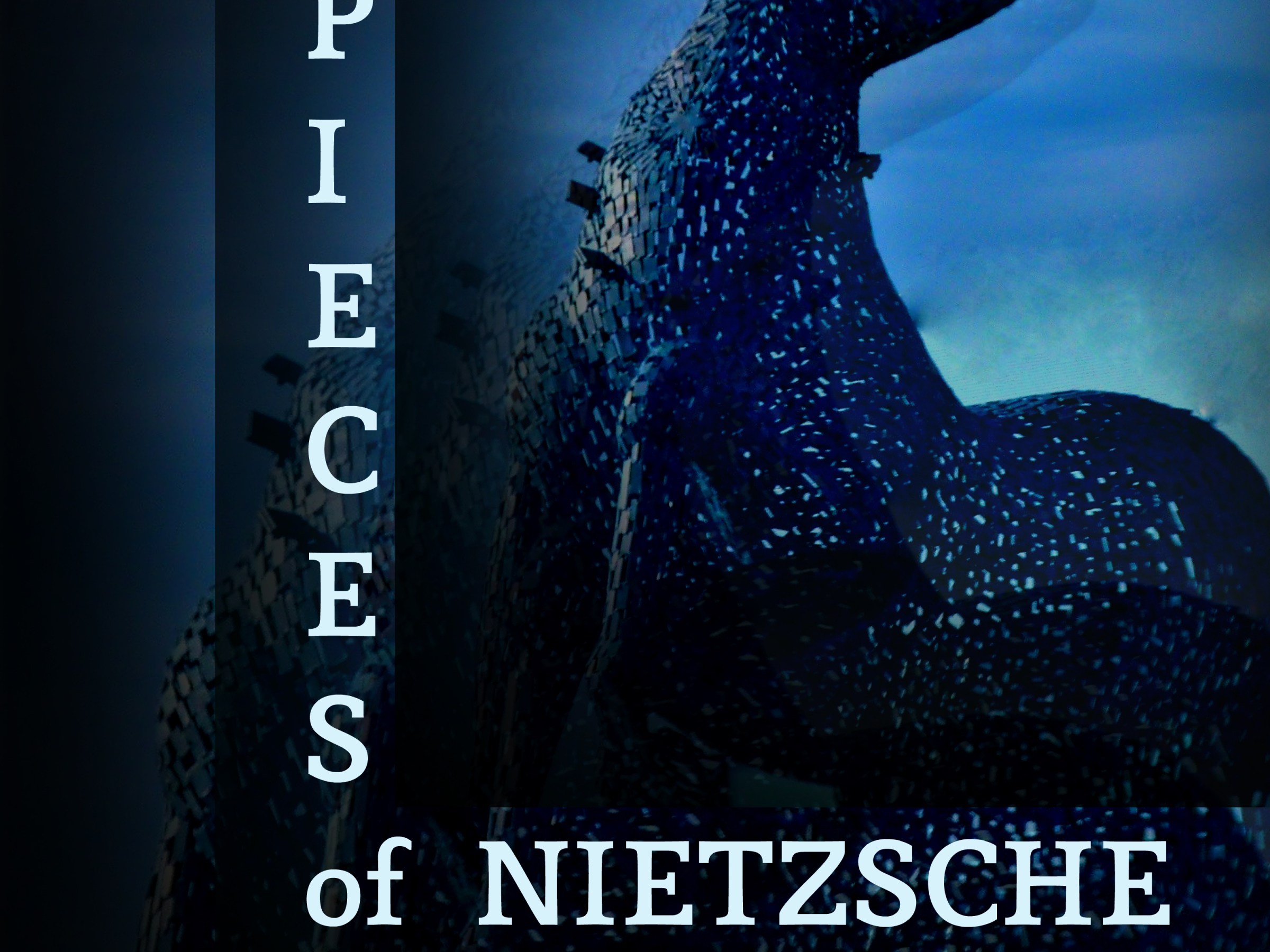
Stuart’s new book.

The question of value goes to the heart of who we are, what we are and why we think we are here… A tendency to make certain assumptions about our environment appears to be intrinsic to our nature, yet the meaningful existence we crave can only ever be granted by a ‘higher power’ which we now seem loathe to recognise outside of ourselves… We have always looked to those best qualified to answer our most fervent questions but what if they too have fallen foul of the ‘Auction-House of Things’… And what of the Beyond?
Friedrich Nietzsche, philosophical and psychological genius of the nineteenth century, in his book, ‘Beyond Good and Evil’, presaged the breakdown of the Western Aristocratic ruling elite and the irresistible forces that led to two catastrophic world wars. This new poetic interpretation of his master work teases out still relevant lines of thought for the reappraisal…
View original post 21 more words
Share this:

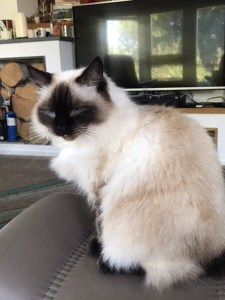
The Swedish chair looked very comfortable. He sat in it and rocked backwards. The mysterious tiredness swept over him, again. Had be been drugged?
He gave in to sleep… When he awoke it was still light, he was hungry, and there was a cat sitting on the footstool, looking at him…
‘Mow,’ said the cat.
©Stephen Tanham
Share this:

From Sue.


 Sun in Gemini
You must be logged in to post a comment.