
The lovely little town of Cerne Abbas holds a secret that is easily missed.
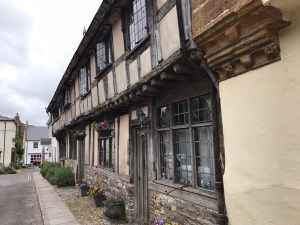
The idyllic streets, some with intact architecture from hundreds of years ago, are a delight. Although well-visited, it feels relaxed. The local people are friendly – something we have found throughout this gentle county of Dorset, filled with villages nestling into green and flowing hillsides.
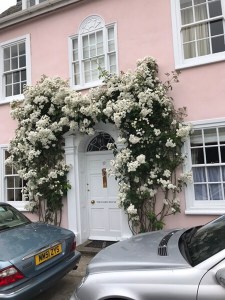
It’s the morning of day two of the Silent Eye’s June weekend, a period of reflection of the coming Summer Solstice, the longest day, the Feast of St John, the time when the ‘fullness’ of the light begins its decline.
Cerne Abbas has an ancient link to the idea of ‘fullness’. It is expressed in a well known icon of the town – the Cerne Abbas Giant. A mere ten minute walk from the main square you come to a viewing point from which this smiling mystery is revealed:
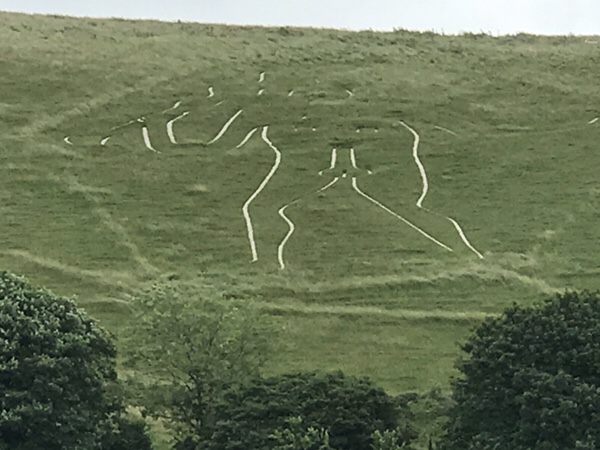
The giant’s main attribute is obvious. Proud and long, he struts his stuff with a warrior’s club in the right hand and a less certain set of objects in the left. What is he? No-one knows for sure. Even the date of his origin is disputed. An ancient tribal leader, perhaps, a figure very much like the original ‘warrior-saviour’ gods from Celtic times, such as Cernunnos, who ruled over the hidden treasures of the Underworld.
Whatever his meaning, the little town of Cerne Abbas loves him. The humour is shared, but the figure, and his link with a legendary past, has a serious connection with the psyche of this beautiful part of England, that goes far beyond the merely commercial.
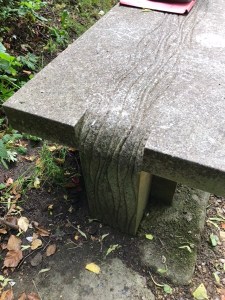
Cern Abbas has another secret; one you would miss if you weren’t shown it. Beside the church is an almost hidden path that leads down to a place of great beauty and significance, and we were planning to us this for a very special ceremony.
To be continued…
©Stephen Tanham
Share this:

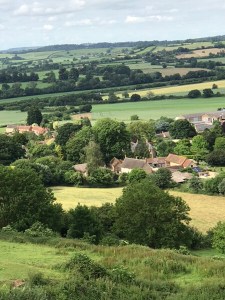
I’ll leave the detail to they who planned this : Stuart and Sue. But, some real-time photos and narration will give a flavour of the Silent Eye’s 2018 pre-solstice weekend, here in beautiful Dorset.

Dorset-based, yet our first journey was 18 miles north into Somerset, to the legendary South Cadbury site of the ‘Arthurian Castle, the site of an an ancient fortified settlement, and a place of great ‘earth-power’. We began at the lovely church of St Thomas à Becket. Not shown on the maps, and with a mysterious past…
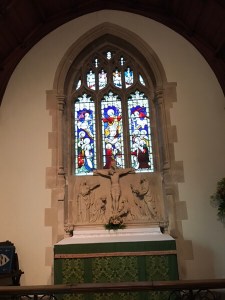
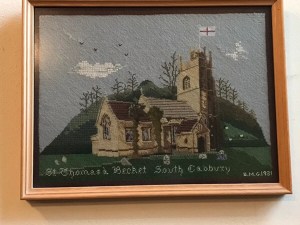
The locally painted picture, above, says it all… by the time this church was built they had learned the folly of imposing new building on places of ancient power, despite the traditional advice of St Augustine.
This one was built just below the hill; to coexist. And, what a hill…
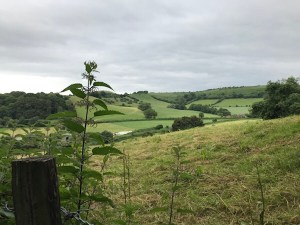
We climbed up Cadbury ‘castle’

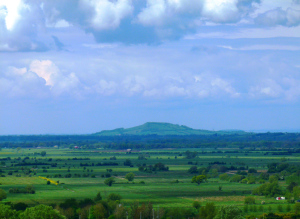
To find the distant north contained the Tor at Glastonbury – day’s walk away. A very special distance, that – the key to much of what would follow, as patterns on the land began to speak.

©Stephen Tanham
Share this:

From Stuart, as we gather for day two of the Dorset weekend

*
…”The why, is always the same.”
“In order to connect, or to make whole?”
“And in order to then participate in that wholeness.”
“Which is connection.”
“They call Glastonbury England’s ‘holiest erthe’.”
“Perhaps that is why?”
“Today, we look up to the night sky, and wonder, and dream of perfection.”
“Or, at least, some of us do.”
“Perhaps, there was a time when, at certain junctures in the sacred year, to participate in that perfection was just a days walk away?”
Share this:

+ #SE18Characters, #Silenti, Jewel in the Claw, Mystery Play, Mystery Schools, Spirituality, The Jewel in the Claw
Jewels in the Claw (viii)
by Steve Tanham

Continued from Part Seven.
He – the man with the packing cases – picks up his empty tea cup and begins to walk towards the small table near the entrance door of the large room in which the mystery play ran its course. It’s important that everything is cleared, he thinks; restored to how it was, pristine…
Laughing to himself, he realises that he is walking the edges of the square of what was the royal court floor, though nothing of it remains outside of his imagination…and the memories of nineteen other people who helped bring it to life.
This was her space, he whispers to the silent air, still reverential, still listening for her commands to those within the square of black and white, the world of polarity. That, moment…that moment when enough had been seeded by clever language and innocent moves within the squares. That moment when the Sovereign stepped forward, intellectually, to declare her intentions. His memory of that second is acute. He relives it, but as what? Is he the playwright, above the creation, but guiding it as director? No, his involvement is still too acute. Is he, then, William Shakespeare, a character that thinks he is a creator? Perhaps… Or, is he each of the characters, permitted to play alongside the actors, if in memory only?
Putting the cup down on a table top full of other used cups, he realises he is all these things, because he is alive, and graced with the evolving stories of life – both his and the life of the world in which he lives and writes. And, most importantly, that the lives of the other players came together with his, and his with theirs, and the result was beautiful.
Realising this, with a clarity that is shocking, he shifts from writer to playwright character, to Queen…
Robert Cecil, horrified and incredulous has just spoken.
“Your Majesty, the Jesuit is still in our presence!”
The Queen holds back the smile out of deference to her First Minister, and scolds the man with the folded hands, sitting, quietly, in the West of the court… with whom she is secretly delighted, though she would have let Frances Walsingham kill him, had Dr Dee not been so… upright. Few understand what being a Queen entails… the embodiment of purpose.
“Priest! I gave you leave–are you so eager to forfeit your life?”
The Jesuit stands. His quiet voice belies the fear he has generated in her world – but not in her. “Your Majesty, I mean no offence,” he says. “I have no home as such… My life is spent in the shelter of others’ homes, often locked away in dirty holes in the ground where I must wait out Lord Cecil’s men… And all this for the giving of the Mass to those that need it! Never have I plotted against the Crown, never have I sought to cause distress or fomented uprising against your government or your reign.”
The priest looks down at his own feet, shaking his head in disbelief that he is still here, mere yards from two of the Queen’s closest guardians who would run him through in a second, if permitted. But the small voice continues:
“A man I do not know has just saved my life – an honest man, in my opinion – and the image of Christ within me says: ‘Stay and risk what little is yours to help defend him.’ You did promise me safety if I became part of this gathering. I beg you to let me stay a while longer and see if I can earn a deeper contribution, here”.
The Queen watches through narrowed eyes as Dr Dee looks at the Lady Rab’ya, who looks at the priest. The Saracen woman knows what Dr Dee knows: that the essence of the whole chamber has changed… And The Queen knows it, too.
Robert Cecil is still standing, glaring at the Jesuit. His words are fully the equivalent of Frances’s dagger.
“Your Grace! I can take no more of this!”
The Queen puts as much gentleness into her voice as she deems proper. “Robert, you are a good man. Stay with me… my plans are only partly unveiled and I seek, before God, to do no harm to you or your causes.”
She watches as the twin forces within him wrestle for his soul: his desire to better his father in service to his Sovereign; and his need to kill the long-hunted priest. He breathes deeply but is not calm.
“I am a good man, Your Majesty; I would follow in my father’s footsteps. For years he hunted that man, who was protected by some of the richest families in your Kingdom! Now, I have him in my grasp and you want me to let him go!”
The Queen gathers the material of her royal dress, allowing a few more seconds to pass.
“Robert, I, too, fight with the legacy of my father – King Henry. They were dark times… When I was halfway to my third year, my mother was taken from me, to walk, mere days later, to her execution. Later, still young, along with my dear Dudley, I was thrown into the tower by my half-sister, Queen Mary… Just Dudley, me.. and the ravens, the three ravens…”
The ravens, the three ravens that will come to mean so much more in this chamber… She continues:
“Your father, Baron Burghley, and Frances’s father, Francis Walsingham, swore to protect and guide my young life… and they did… A debt I could never repay.”
She must tell it from the heart, now. Must bare some of the most hideous detail to help this young, gifted and determined man raise his eyes and see beyond vengeance.
“Your father once told me that he had calculated that the Tudor dynasty had taken the lives of more than fifty thousand people. He left me to draw my own conclusions. Must we forever feed this cycle of blood and terror? The mighty Armada is vanquished. Even Imperial Spain does not have the wealth to rebuild it.” Then, softly. “Robert, could we not, now, build on the peace, in matters religious as well as military?
Robert Cecil says nothing. He holds his head in his hands for a moment, then rises, still full of rage. He strides down the Outer Court’s passageway, stopping to glare at the Jesuit, then wrenches aside the heavy door of the court chamber, letting it slam closed as he leaves.
There is silence in the royal court. For a while, not even the Queen dares to speak.
Other parts in this series:
Part One, Part Two, Part Three
Part Four, Part Five , Part Six
Stephen Tanham is a director of the Silent Eye School of Consciousness, a not-for-profit organisation that helps people find the reality and essence of their existence via home-based, practical courses which are low-cost and personally supervised by email.
His personal blog, Sun in Gemini, is at stevetanham.wordpress.com.
You’ll find friends, poetry, literature and photography there…and some great guest posts on related topics.
©Stephen Tanham
Share this:


I have always resisted the use of the word ‘courage’ to describe people who are suffering. Suffering is horrible, but, alone does not equate to courage, though I have every sympathy for those going through it. The newspapers, tabloids in particular, have a habit of using ‘courage’ or ‘brave’ when someone is dying of cancer, for example. We need empathy, certainly, and a lot of love, but courage and bravery are something else.
On Friday 8th June, Edward Mills, aged eight, climbed one of the most difficult coastal features in the UK – the Old Man of Hoy sea stack on Orkney’s archipelago; becoming the youngest ever person to do so. His mother, Bekki Christian, has terminal cancer. Edward climbed with his coaches Ben West and Cailean Harker.
My photo, below, shows the frightening prospect of that climb. It was taken from the cabin of the Northlink Ferry to Orkney, during our trip there in April, this year.

The island of Hoy (see Northlink’s map, below) is a difficult place to navigate. There are few roads and to get to The Old Man from the main islands requires a ferry, car journey and a four-hour walk, each way. Young Edward had already made this walk, with his guides, before he started the climb on Friday lunchtime. The Old Man is 140 metres high and has been the subject of several historic televised features, starting in the 1960s when the BBC covered the first recored climb being made by some of the best climbers in Britain, including Chris Bonington. You can see some of the original reporting here.

Location of the Old Man of Hoy and Edward Mills’ climb.
Its was therefore a very difficult and courageous thing for a young man to do. Add to that the emotional situation of a dying mother and something remarkable was happening. It took Edward and his support team nearly five hours to complete the climb. They had to get back down as well, of course…
Edward knows his mother is dying. He and his father wanted to do something positive at this difficult stage in their family lives.
Edward is brave. He showed remarkable courage in undertaking this task at such an age, though he is an accomplished young climber. If, like, us, you wish to look at his full story, his JustGiving page is here.
I don’t normally circulate anything like this; but having recently sailed past the Old Man of Hoy, and shuddered at the prospect of climbing it, I thought it might be appropriate to ask anyone who would like to help Edward’s appeal to reblog this.
Thank you so much.
Share this:

Our midsummer weekend is rapidly approaching…
Share this:

Simple, beautiful writing from Sue.

They came from… well, we never did find out where. Their history remains a mystery, but everyone agreed that Percy and his lady were an odd couple to move into the village. He was a handsome specimen, always dressed in his best. Stately… that is probably the best word to describe his bearing. At first glance, he seemed arrogant, but he was friendly enough, when you met him in person, and always curious about everyone and everything. She, on the other hand, was much more timid, less colourful creature and very quiet.
You could meet them anywhere in the village, though I never knew them to leave it again once they had moved in. You would often meet one of them at the village shop or in the manor grounds… and the number of times I have had to slow the car to let them cross the street is beyond…
View original post 177 more words
Share this:

+ #SE18Characters, #Silenti, Jewel in the Claw, Mystery Play, Mystery Schools, Spirituality, The Jewel in the Claw
Jewels in the Claw (vii)
by Steve Tanham
Continued from Part Six.
The tea cup is empty, but he continues to hold it – lost, happily, in his reveries on the edge of what was the stage, the royal court floor… He looks down at the cup and then lifts it to toast the great lady from the Saracen world, an unfinished woman who surprised a Queen of England… or did she?
Why am I here? Lady Rab’ya Anouri, the ‘Saracen woman’ wonders, rising to the royal command at the first seat in the Northern face of the floor. A guest in a mysterious royal court, perhaps a literal court to try this downcast man, this former friend and astrological advisor to the Queen, now clearly disgraced… But, to subject his lovely wife to this! Elizabeth, they spoke of your beauty and your strong will, but no-one told me about the cruelty…
The Queen is speaking: “Lady Rab’ya, lift these proceedings with your observations on the nature of the exchange between Lord Essex and Sir Francis!”
Put your self-doubt to one side, the Saracen women thinks. Lady Rab’ya must rise to the occasion… or who knows what will be lost.
She knows that her husband, the Moroccan ambassador to London, needs her to be a key part of a successful outcome. But that task looks like it might involve an unforseen struggle of place and position. She breathes deeply to steady her nerves, in the manner the Sufi master taught her, and speaks in a clear and musical stream:
“In my experience of the Saracen world, Your Grace, such simple skirmishes are the prelude to a deeper struggle.” She feels this is the right tone and knows she must let the Queen paint her guest’s role on this complex stage of minds and hearts. There is no threat to her… yet all are subject to the whims of what she now sees is a Sovereign to be feared as well as loved.
The Queen looks pleased with her honoured guest’s response. Perhaps the slight nod of her head is to be their code of approval?
“Such wisdom, Lady Rab’ya. How you see through my simple ruses!
Lady Rab’ya senses the way in which she must respond, then bows before speaking.
“Not so simple, Your Grace. The sovereign who stood before the Spanish Armada, unafraid, controls a complex country using a deep and wise mind.”
Lady Rab’ya looks at Frances Walsingham and Robert Cecil, who also incline their heads in the same subtle gesture. They are secretive, these English, but they have a code… Learn it fast, she scolds herself. This is no place for a girl!
Letting the tension flow away with the next out-breath, she adds, provocatively, to her praise:
“And knows when to listen to wise counsel…”
It is, perhaps, an advance too far… But no…
The Queen nods her head slowly, moving on… then gazes into the newly defined ocean of the Court Floor, before speaking.
“Lady Arabella,” she says, directing her attention to the secretive Spanish lady rising to her feet near the end of the Southern face of the court. “you have served this island realm with much bravery in the name of peace between our Kingdoms, can you calm these waters?”
And so it progresses… The Saracen lady seats herself quietly, glad that she has passed the first test. But now that royal gaze has left, she can take time to study the accused–this John Dee, a Doctor of learning… to a very high degree, she suspects.
The Queen initiates a more complex move on this board of life and death. Sir Walter Raleigh is instructed to bring both his charges – Dr Dee and the Jesuit priest- to the East of the court floor. They stand a few feet from the seated Saracen woman, who studies both with the techniques taught her in childhood. Don’t see with reaction… dig beneath and find what provokes…take yourself away…
Sir Walter is uneasy. “Your Majesty, we await your command.” he says, involuntarily adding himself to the accused, though he knows this is unlikely to be the grouping. “You know that these actions place me in a position of great uncertainty…”
As are we all, Sir Walter, thinks the Saracen woman, watching The Queen, intently, while appearing to direct her gaze downward.
“Has it robbed you of the familiar, Sir Walter?” asks The Queen with a smile that freezes. “I know the chill of that! If I ask you to share it with me for a short time it is because I have deep need of your personal magic.”
At the word ‘magic’ Dr Dee stiffens, and pulls his tall frame straight, breathing courage. To Lady Rab’ya’s right, Mistress Dee shuffles her feet in anguish.
“Magic, your Majesty?” Dr Dee asks, in a voice that is shaky but filled with depth. “Am I to be tried for the practice of magic?” It is a brave thing to say, especially in one so clearly set up to be the victim… but perhaps he is not the only one?
The Queen studies the good Doctor with narrowed eyes. “Dr Dee, I am told your house in Mortlake is in ruins. How should I trust a man who could let this happen with the handling of magic?”
His home… the poor man’s home… Her fire sears, thinks Lady Rab’ya. Let me not find myself the wrong side of that flame…
Sir Walter Raleigh tries to help Dr Dee, but is dismissed. With me, the royal gaze hisses…
In her calm mind, unbidden, Lady Rab’ya sees the image of a knife…. It is The Queen’s, she thinks, and she means to have first blood…
“Your Majesty, why am I here?” This time it is the calm and rather small voice of the Jesuit, John Gerard; the most hunted man in England according to others… and then the court explodes with rage, with Robert Cecil, newly appointed First Minister to the Sovereign, standing and shouting abuse at the priest.
“You should not be here!” he rages. “You should be in the Tower where my father had you imprisoned and from which, in league with your Catholic friends – and the devil – you managed to escape!”
From the other side of the startled Queen, Frances Walsingham – her new spymaster – stands and puts her hand over the outline of a thinly concealed dagger, sewn into the fabric of her tunic.”Your Grace, let me end this torment for you, now. Loftier demands than the Jesuit’s traitorous life should occupy your mind – especially when you are so shaken by the vision you have seen!”
The Saracen eyes watch as Frances Walsingham and Robert Cecil are seated, leaving the silent Queen filled with quiet rage. The Sovereign prolonges the silence; then, from those fiery depths, she plucks a masterpiece of action. Directing all her attention at Dr John Dee, she asks, in an impossibly polite voice:
“Dr Dee, there is value in these arguments. Would you like to end the life of this priest, who my two most trusted statesmen say is a sworn enemy of England?” To add to the tension she directs Frances to hold the knife blade to the Jesuit’s throat.
The immobilised John Gerard, realising he has been tricked – and by the Sovereign – wails:
“But, Your Grace! You promised me safe passage through your royal court and…” He points to the court floor. “…across the seas!”
The Queen’s eyes are those of a cobra, fixed on its prey, though the prey may be bait.
“We live in uncertain times Father Gerard. Be grateful for uncertainties… they can become friends.” She turns to the former Royal Astrologer. “Dr Dee, Father Gerard’s life is in your hands. Condemn the priest, now, and I will have Frances execute him.”
Dr John Dee hangs his shaking head. “How can I condemn a man whose crime I do not know? Where is the justice in that, Your Grace? If the son and the daughter of your fiercest protectors consider him guilty, what is my part in this?”
It is a good answer, and only the hint of incoming gentleness in The Queen’s eyes causes Lady Rab’ya’s intense concentration to waver. Has she been wrong about this woman? Is there an intent at work, here, one whose depth would rival anything she has seen in the politics of the mighty Saracen world?
The Queen leans forward to point to the large bag of gold doubloons on the small table before her. “They are yours, Dr Dee, if you will condemn this priest. There is more than enough to rebuild your home in Mortlake and restore your English fortunes.
What did you do, Dr Dee? Thinks Lady Rab’ya.
Before his eyes, Dr John Dee is seeing a darker magic than any in which he has ever dabbled. With a single action he could restore his life to be as it was… perhaps. But it would not be his, and his soul would certainly not live there. All this Lady Rab’ya sees, resolving that she will help this man… this good man, despite the risk to her own position, and that of her esteemed husband; who now shouts in the back of her mind: headstrong woman, I did not ask this!
The silence condemns Dr Dee and frees the Jesuit, who is dismissed, with royal protection renewed, from the Court and from the presence of the head-bowed Dr Dee – standing like a chastised schoolboy in front of his Queen.
Mistress Dee is sobbing and it is perhaps this, thinks the Saracen woman, that makes them all miss the fact that the reprieved Jesuit has not left the court, but taken his seat again in the now-empty West of the Court floor.
Stephen Tanham is a director of the Silent Eye School of Consciousness, a not-for-profit organisation that helps people find the reality and essence of their existence via home-based, practical courses which are low-cost and personally supervised.
His personal blog, Sun in Gemini, is at stevetanham.wordpress.com.
You’ll find friends, poetry, literature and photography there…and some great guest posts on related topics.
©Stephen Tanham
Share this:


If, a decade ago, someone had described the present state of world power, politics and economics, I would have concluded that the picture painted was one of a dystopian fantasy.
For example, I am a passionate pro-European, believing that the stability and prosperity of Europe was hard-won by those who came through World War II, and vowed that the mistakes of the post World War I era would never be made again. They were people who saw that European countries, whilst speaking different languages, had far more in common than that which divided them.
The mistakes after WWI were seen, mainly, to be economic. Germany was humiliated and economically punished, leading to massive poverty for a nation of people, who, on an individual level, had little to do with the triggering of the war or its consequences.
After WW2, the Marshall Plan, driven by the USA, was designed to allow an economic rebuilding of Europe, based, not on punishment, but on reconstruction. Britain was bankrupt, having stood alone against the Nazi machine for too long before America joined the war, and would never again be able to afford its former ’empire’. America acted as ‘banker’ and financed the reconstruction – gaining wealth for its companies in the process. From a British perspective, an age was ending, and yet it did so within a relatively positive and ‘friendly’ arena. Russia had been an essential ally and the war would not have been won without its participation.
It was therefore a period of great change: one in which destruction preceded a cycle of prosperity – for the West, at least.
Today, we seem to be entering a much more frightening era; one in which there is no single vision to counter the negative forces of racism, radical religion and neo-fascism. Fascism may be a dated word but is still used, accurately, by those who have lived through parts or all of such a cycle. The elements of a ‘fascist’ cycle are always the same:
- A period of economic poverty or austerity is entered. This may last a decade or longer.
- The general ‘world-view’ is held in place by an educated elite, who control the political system, resulting in very little real change taking place, and the growth of the middle and upper classes, who are usually better educated and able to command higher pay. The upper levels of this society are prosperous and do not wish to see changes that would upset their share of the wealth.
- The resulting sense of resentment and ‘they’re not listening to me‘ is seized on by (usually) charismatic individuals – sometimes, just one person, as, for example, in the case of Mussoulini, in Italy.
- The populist leader(s) upset the political system and always take the country to the political right, attacking the media, and the middle class intellectual ‘elite’, generally ‘cleaning the place up’ while they accumulate power and destroy accountability.
- If they can get away with it, the mechanisms of state, including the law, are all made subservient to them.
- The banner of the ‘Authoritarian’, with its fine uniforms or suits, is seen to be the way forward, allowing the poorly educated and dispossessed to rally behind something they think they understand and which, as proof of its success, displays its ‘executed’ victims from the former elite layer. History later sees these as simply rivals for power among the elites.
Are we in such a cycle today, and, if so, what are the differences to the previous patterns?
The rich are getting richer. But the wealth of the super-rich is growing at a much faster rate than any other group – further removing the idea of merit from the mechanics of income.
There is much more subtlety in the present collapse of the social and political consensus of the old allied powers – those that arose, on both side of the Atlantic, after WWII. In Europe, we have the enormous damage caused by the narrow victory of Britain’s Brexit campaign (52:48 in percentage terms), and a country that feels like it’s in a state of (social) civil war. The division across the socio-economic boundaries showed that education played a great part in which side of the vote was chosen, with the working-class areas in the North and Midlands rallying around populist figures and newspapers who reduce complex economic situations to easy slogans – all these have been debunked, subsequently.
In the USA, I am told, the feeling of a ‘divided nation’ is very much the same. The right-wing ‘Tea Party’ politics, which used neo-fascist methods to reduce complex problems to hate targets have resulted in the empowerment of a small and very rich group supported by the political right. The President seems to have an agenda based upon the destruction of his predecessor’s achievements. The Christian right is in the ascendancy, and, using its published political blueprints, is intent on reducing the entitlements of the LGBT minorities, who are seen as having infected the society.
Fundamentalism exists in many forms…
The most worrying thing about these situations is the collapse of truth as a mechanism for comparison, evaluation and the all-important shaming. Truth has become a commodity which can be manipulated via the new voter-manipulation technologies, such as those developed by Cambridge Analytica using Facebook user data to get millions of custom messages to the general public, each one subtly targeted to appeal to a set of pre-conceived ideas – and prejudices – in the mind of the beholder.
All of this produces a very difference kind of bankruptcy; but one whose effects are far more insidious. If we really believe that all truths are there to be manipulated; that there is really no such thing as the ‘good’, then we have surely lost the bedrock of our societies – and their resulting weakness will rightly render them vulnerable to more vigorous – and brutal – civilisations.
Perhaps the most worrying thing of all is the general sense of detachment – as though what is going on is some kind of computer game… In that, we may have the heart of the problem: that we (and therefore our children) have simply become separated from what is actually happening to us. I suspect that, in truly cataclysmic upheavals, this has always been a central element that proceded destruction. None of us will want this, I am sure, and yet the weeds that will break through the foundations of our hard-won societies are all around us…
Or, perhaps, as the Hindu pantheon teaches, destruction is as vital to life as construction, and it is simply a matter of perspective, as the great wheel goes around… Certainly, the strong will survive. But, perhaps for the first time, we have a chance to mature the strength of truth back to the fighting force it once was.
Stephen Tanham is a director of the Silent Eye School of Consciousness, a not-for-profit organisation that helps people find the reality and essence of their existence via home-based, practical courses which are low-cost and personally supervised.
His personal blog, Sun in Gemini, is at stevetanham.wordpress.com.
You’ll find friends, poetry, mystical thought, literature and photography there…and some great guest posts on related topics.
©Stephen Tanham.
Share this:

From Sue…

“…am I missing something?” The frantic voice on the phone made it quite clear that he really hoped he was…
“There’s a grey ring with symbols on it. Turn it to the one with parallel lines.”
“Okay, done that.”
“Then, above where the ‘U’ shaped bit of red plastic is, there is a red slider. Push it to the right.”
“Whew… That’s got it. Thank you!” He hung up to deal with the piscine emergency and, while I threw on some clothes to go and join him, it occurred to me that this was a really useful example of one of the exercises we use in the Silent Eye to build awareness.
The gadget in question is nothing interesting, nor is it one I own, but it isn’t something I have to think about either; operating a hosepipe is just one of those things you do on autopilot. I cannot…
View original post 401 more words
Share this:

From Alethea, one of our Silent Eye graduates.

Last night I dreamt I was flying. I was in a sporting good’s store, and on my way to the check-out register, but let me back up a bit. Before I started flying, I had been with Ann and Margo, two characters from my memoir, A Girl Named Truth. Briefly, I was fourteen again, and I could overhear my two former friends gossiping about me. Instead of keeping silent, though, and internalizing my hurt, I spoke up. “I know what you’re saying,” I told them, “and I really don’t care.” And, truthfully, I didn’t. Something inside of me had changed. I had become detached from the weight of their words, realizing they did not define me.
As I walked away, my feet began to lift off the ground and I began to fly. Effortlessly, and with a joy that defies gravity, I navigated my way to the front of the…
View original post 413 more words
Share this:

+ #SE18Characters, #Silenti, Jewel in the Claw, Mystery Play, Mystery Schools, Spirituality, The Jewel in the Claw
Jewels in the Claw (vi)
by Steve Tanham

Continued from Part Five.
Sipping the tea, his hands clasp around the warm cup. The gesture reminds him of the way she took her husband’s arm, at the end of that first glimpse of what The Queen had in store for him. She, John Dee’s wife, Jane, never entertained the notion that she would not stand, shoulder to shoulder, with her foolish but magnificent husband as his life turned to face the incoming cannon-ball of the Sovereign’s will.
He looks at the place where chair N5 had been, with its quietly intense and magnetically humble occupant.
Jane Dee – Mistress Dee as the others referred to her – had visited Nonsuch Palace, before. As a former Lady in Waiting, she had been at the Young Elizabeth’s beck and call; and had been happy to be so. But this was different. This time, forced to be here by the force of the charges against her husband, she was in hell…
When she spotted the bag of gold coins on the small, ornate table next to the Royal throne, her heart had missed a beat. She knew they were intended for her husband, Dr John Dee; knew beyond doubt that they were a part – possibly just the first part – of a human process designed to crush his spirit… or something worse.
‘Spirit’ she whispers, suddenly frightened that someone had overheard her soft and ironic utterance; spirit was a bad word to use in the land of the persecuted alchemist…
Dr Dee’s lady raises her eyes, slightly, to look around her. To her right is the line of chairs in the West that contains her husband, their apparent gaoler – Sir Walter Raleigh, and the Jesuit Priest, whom she has heard spoken of as ‘the most hunted man in England’.
And yet, The Queen is playing with them all…. First she delights in the dancing entrance of the figures of the Royal Court, orchestrated by Lord Essex – or was it really Sir Francis Drake whose prize was stolen by the more senior Peer? She doubts that few have survived robbing Sir Francis of anything…. though, on the high seas at least, he has done his fair share of piracy.
Is she taunting them – The Queen? Is this whole masque about learning a new dance code to take then across the chequered surface? As she muses, the Queen uses the ladies Bess of Harwick and Blanche Parry to good effect; having them stage an impromptu dance immediately after the stiffly formal movements of the gentlemen – who ‘sought to lift the Queen’s spirits’…. And then there is the first hint of something deeper, as Christopher Marlowe, that most intellectually mischievous figure, prompts an emotional reaction from Her Grace:
“I find men are obsessed with rules!” says The Queen, disparaging the protestations of Essex and Drake. “Women are much more flexible in how they do what feels right.”
Sensing this breach, Sir Francis Drake seems equally determined to flush out the real motives of the Sovereign:
“But, Your Grace, you would be harsh on any man here if he did not follow the set ways of the Court!”
She smiles at that, recognising the practiced hand of strategy, allowing it to have life – as though she had expected–nay held in readiness, the prompt.
Just so, Sir Francis,” she says, through her smile. “It is an unjust world and women have few advantages – you would, therefore, expect us to use the ones we have!”
Sir Francis Drake bows, practices silence, and withdraws. Only Mistress Dee seems to notice the curl of his smile beneath the greying beard.
Shifting tack, The Queen plays games with sailors and soldiers as she spells out the real meaning of her statement; “Let all be sea, then…” The mock combat she has instigated invites comment of an almost legal level – as Lord Essex is ‘tried’ in the sense of being alive or dead at the bottom of the sea. Even Frances Walsingham, daughter of the – now dying – fearful spymaster; and Lord Cecil, deformed son of The Queen’s near lifetime First Minister, Lord Burghley, are asked for their verdict.
But this courtroom is not established to try these powerful and trusted people; it is established to try the man who now rises, on royal command, to his feet, to stand staring at the pot of gold towards which his unfortunate feet must now move….
Mistress Dee trembles with fear as her husband is escorted to what his wife senses will be his public death before The Queen.
But then, in the way of things of great power, the Saracen noble lady rises to her feet, also, and the world changes….
Other parts in this series:
Part One, Part Two, Part Three
Stephen Tanham is a director of the Silent Eye School of Consciousness, a not-for-profit organisation that helps people find the reality and essence of their existence via home-based, practical courses which are low-cost and personally supervised.
His personal blog, Sun in Gemini, is at stevetanham.wordpress.com.
You’ll find friends, poetry, literature and photography there…and some great guest posts on related topics.
©Stephen Tanham


You must be logged in to post a comment.