


Between dusk and dawn
Breezes murmur in secret shade
Winding sweet harmony
Through ancient earth’s
Wild sanctuary.
Forests rain roses
And night is beautiful
Beneath a soft, sacred moon.
Shining light on love,
You give me life.
Share this:

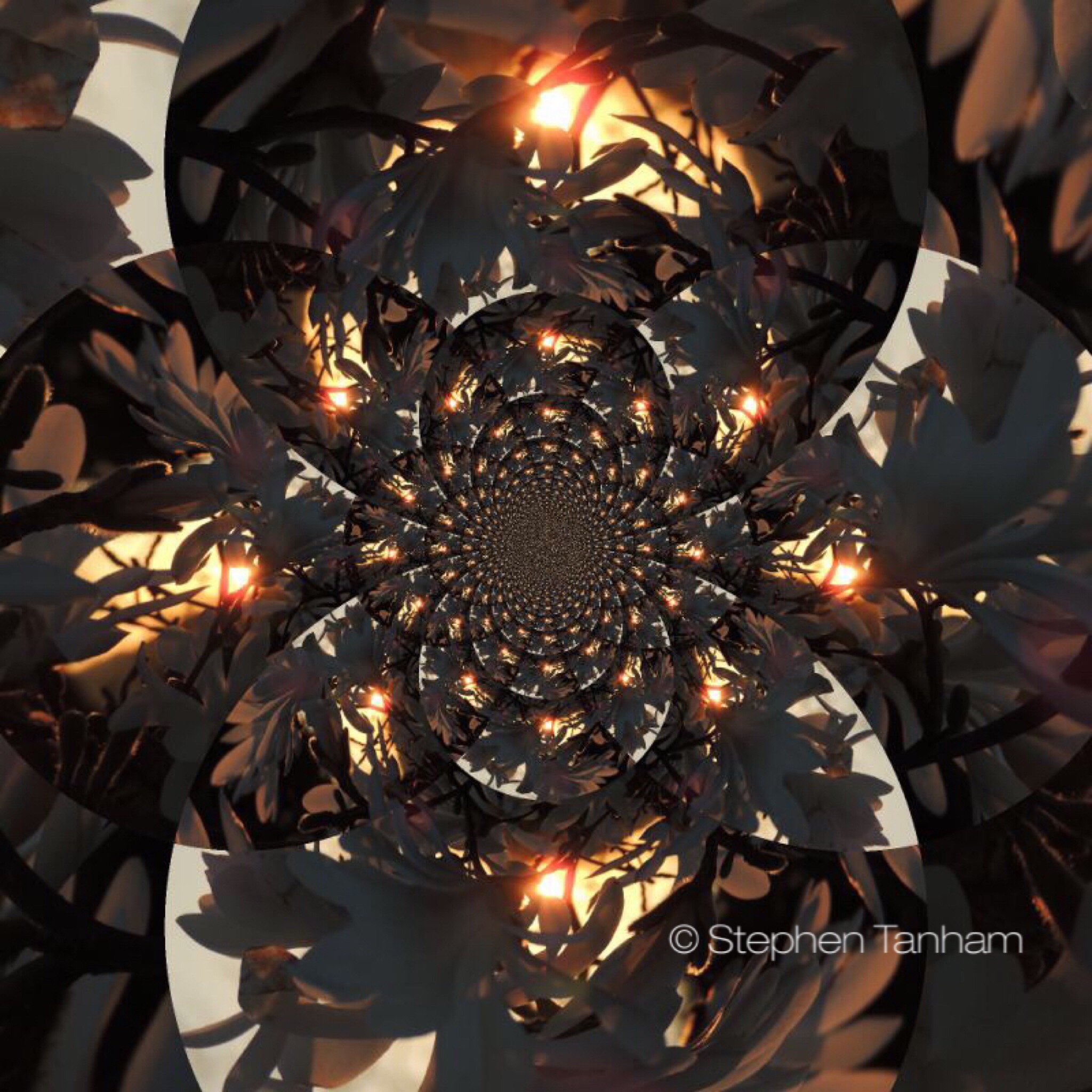
We live, increasingly, in an age of mistrust. It can be seen as cool, savvy, to doubt what we hear–an expectation of deceit in the ‘other’, as though trust belonged to the infant’s playground; something to be outgrown in the face of maturity in the world and in life.
As ‘humanity’, if such a concept is meaningful, we yearn for the true values of early childhood, where we could trust. To have to live in a world of its opposite is foreign to our natures and invokes one of our fundamental shared attributes – fear. Fear teaches us that mistrust is necessary to protect ourselves… and it is, until it comes time to be bigger than both.
Anyone who considers they are on their own spiritual path – and by that I mean simply a journey within themselves for the truth of their lives – encounters this lack of trust, sooner or later. Many, who have been working on themselves for a number of years, need to come up against this – often with the help of true friends, no matter how that looks at the time – before they can see that much of their lives is characterised by a lack of trust.
We build little islands within. We compartmentalise, thereby allowing mistrust to fragment what should be a whole nature…
It’s not as though we don’t have trust in parts of our lives; we have lots of it in family situations; and good, strong families are based on it. Only by showing a child that you trust them can you ever invoke that powerful sense of its loss when they do something that hurts its essential nature. This is an example of how the positive dynamic is so much more powerful than the accretion of the negative. Sadly, societies so often display the opposite.
Sadly – or perhaps, inevitably – politics across the world is increasingly based on lack of trust. The most powerful nations on earth can seem the most paranoid, and yet their civilisations grew from a history of trusted, social achievements.
How did this happen? My personal view is that we, as ‘cells’ of society, have, essentially, three natures. We have ‘the good’ and we have ‘the technology’; and, beneath them both we have the ‘fear’. The ‘good’ is, for the want of a more modern word, the ‘moral’ side of us – the goodness that the church used to address, back when we allowed moral considerations to belong to someone else. The ‘technology’ is the machinery, in all its forms, that we like to surround ourselves with to make life more comfortable and pleasant. The ‘fear’ side of our natures is what keeps the animal part of us alive. Our psychological side – the self that we worship in this age – only persists because of that animal nature’s ability to preserve itself as a base-layer. This is dilemma we face when we look at ourselves, honestly. We can dress it up in fancy terms, but, deep down, that’s what it is…
‘Comfortable and pleasant’ are what the ‘fear’ nature in us strives for. We want to be warm, we want to be clothed and fed, we want to exert ourselves less for more. These are not morally wrong things, they are what happens when the lower levels of our Maslow hierarchy gets a chance to surpass its fear and mistrust.
Two things happen as we rise up this hierarchy of needs: we get more comfortable, which takes us away from the rawness of experience; and we develop technology – and sell it to lots of other fearful people. At the group level, some of the technology removes the other, threatening people, before they can do it to us… Mistrust can be a very effective weapon for the ‘fear’ nature, but it’s by no means a spiritual quality – though it can be a great catalyst…
To cut through any of this requires that we do two things: we need to re-learn the value of the ‘good’. We don’t need religion to do this, though there’s nothing wrong with finding it there. Secondly, we need to believe that we can extend that sense of personal good into our societies; and to do that means we need to be prepared to face the terrible arsenal of technology that has done what all intelligent machines do – protect itself at all costs. At present, there is very little belief that human good can achieve this. But, that is an illusion. ‘There is nothing more powerful than an idea whose time has come’, to quote Victor Hugo.
In a wonderful act of synchronicity, my smartphone has just beeped with an updated message. I’m following a blog about the ‘olden days’ in my home town of Bolton, Lancashire. It was a very working-class place, but it had good aspirations and some very good schools. One of the respondents to the blog has just replied: ‘Yep, that was us… happy days, true neighbourhood – all one big family.’
It was true. Life was poorer, very much poorer, but the neighbourhoods were much closer – often intrusively so. Education and technology have ‘raised’ many of us out of that world – but only in the prosperous western world.
We can’t go back. The kind of nostalgia that so infects the elderly end of some counties’ populations is a useless emotion. But we do need to find a way to believe in goodness, again, and then to trust in its power…
The deeper spiritual journey is marked by a stage where real, inner trust is essential – indeed, is an attribute of the developing soul. And, collectively, that is a fire which will test what we are truly made of…
©️Copyright Stephen Tanham.
Share this:


Summer struggles into Life
So many leaves to feed
Through soil still cold and branches bare
She fructifies their need
⦿
Her power is fullness, often missed
Rotation is her pride
But neither spring nor golden fade
Describe her yearly tide
⦿
A human barefoot on a beach
The water briefly kisses
He smiles – high water marks his mind
The greater truth he misses
⦿
When mystics speak of higher things
It is no more than seeing
Profound, the change of view is glimpsed
And takes us deeper into meaning
⦿
But Life which wears creation’s eyes
Perceives both edge and centre
Thus seeing what could not be seen-
By nature; now his mentor
⦿
No straight-line marks the journey back
For he must learn his art
In taming mind which thinks itself
To be the greater part
⦿
This tiny bubble self reflects
Reactions I think free
But stepping through this veil of film
Reveals they don’t belong to me
⦿
Where golden mirror’s glow is seen
There is no edge to Being
And little me is swallowed up
In greater Self’s revealing
⦿
This summer gold must be refined
And taught in present tenses
To see the Truth and speak its name
And open our defences
⦿
And at the end what can I lose
What dread of that unseen?
For only me fears that abyss
For I, as we, have always been
⦿
©️Copyright Stephen Tanham 2017
Share this:

Share this:


Sky tree bears strange fruit
Proximity masquerading
Imposter leaves, left.
©Copyright Stephen Tanham 2017.
Share this:

Share this:

Share this:

Ali’s anticipation of our coming workshop…

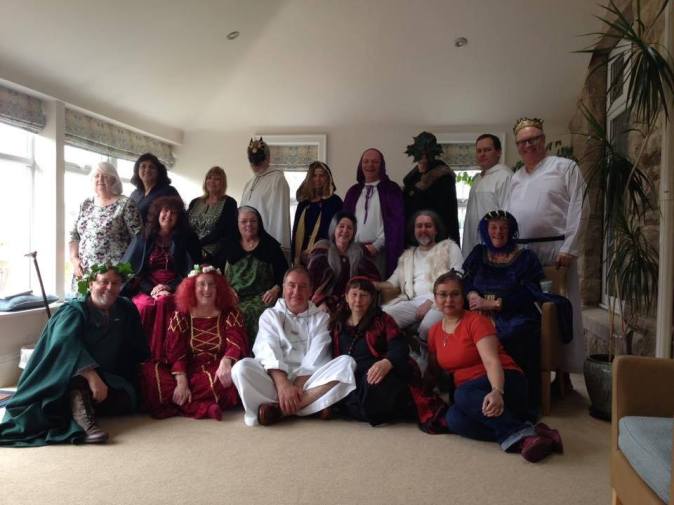 The Silent Eye School of Consciousness, a Modern Mystery School –(https://thesilenteye.co.uk/) – was born in April 2013, after its three Directors (Stephen Tanham, Sue Vincent – https://scvincent.com/ – and Stuart France) had laboured long and lovingly to bring it into the world.
I already knew Steve and Sue from Ritual with Purpose and Gathering of Light weekends run by Servants of the Light – and, when I heard about Silent Eye, I was keen to come along, witness its birth and meet up with friends both known and, at that point, unknown.
That first April very much set the tone, and the tight seal of friendship, upon subsequent ones – and, no matter what’s going on in my life, the end of April is always bright upon my calendar and the workshop booked and ready.
I am trained in ritual magic. I have also been a member of…
View original post 419 more words
Share this:

+ #Silenti, Consciousness, esoteric psychology, Mystery Schools, nature, Silent Eye School, Spirituality
Intimate Flames – #Silenti
by Steve Tanham
What is it to be intimate? The touch of a lover’s hand or lips, perhaps? Two bodies locked together in desire for a common fulfilment; the intellect muted while the emotional and sexual energies dance their own bolero?
We generally associate intimacy with the body, but it’s not always so, and the exceptions can point the way to something much deeper…
The body has its own wisdom, and lives by an organic truth. We can play all sorts of games with our minds, but a bodily ‘state’ is just that – an undeniable and persistent experience that has no form outside of its representation as pleasure or pain. As such it exists at a level beyond misrepresentation.
The ability to move, especially two beings together – like when we dance – might be considered another physical aspect of intimacy, and certainly forms an abiding part of physical passion.
Can we move beyond the physical and retain intimacy? Can intimacy also be exchanged around a dining table, when the pressures of the day give way to a sudden sharing of moment? Or at a meeting with a close, but non-sexual friend, one that we might not see for another decade or so?
Encounter is a good word to set the scene for real intimacy. It implies something new in that meeting of body, heart and sometimes mind – although our usual level of mind can introduce as many problems as it seeks to solve.
We might substitute encounter for what happens in this intimate context; yet how can there be anything new from two organisms that have shared much, before? We could have said ‘different’ and our minds might have felt more secure. Mind can understand different – it builds its picture of the world – our lives – out of differences…
The essence of these kinds of intimacy lies in their potential for opening a new level of awareness – even if that lasts only for seconds or less. In that moment we can glimpse a far more peaceful, harmonious and ‘speaking-to-me’ level of life, as though a liquid nectar has poured from another world into this one.
The deeper level of ‘speaking-to-me’ is not an experience, it is a certainty. There is no room for doubt in one who finds it. The finder moves from possibility into knowing.
Many kinds of love can point the way. Some of them, like the moment of orgasm, are brief, though wonderful. Others are calmer and longer-lasting. Mysticism is founded in the the personal unveiling of the deep intimacy of something behind the self. Many words have been used to describe the qualities of what is found, yet all are doomed to be approximations. Words come from the mind, and the mind is incapable of experiencing what is known without reason.
Only the heart, understood fully and not the subject of romantic trivialisation, will take us there. This is true meditation. To follow that path is to take the openness and trust that normally accompanies physical intimacy and offer it, internally, to that which lies above the mind and is wedded with the heart. This state, if spoken of at all, is referred to in hushed or symbolic terms. One of the best of these is what the Sufi mystics have called ‘The Beloved’.
There is a deep mystery about the beloved that can only be found through a personal journey. She has always been present. She waits; and the only key that will open her chamber is that offering of love, trust and presence spoken of above.
We may think that we already possess these qualities, but life, in its development of the personality, takes the ‘brilliance’ away from our existence – it becomes more important to be secure than to be occasionally touched by the inner parts of who we really are. A certain resolve is needed to re-learn the essential qualities, and then refine them from the darker clay that the outer ‘us’ has become. It’s not an easy journey, but it is mapped out, in many reliable forms, including the Silent Eye’s three-year correspondence course.
We might liken the quest for this deepest of intimacies to the re-finding of a ruby jewel, given by Mother to us in childhood, and which was subsequently lost. For years we searched for it, gradually surrendering to the fact that the vague and fading memory of its glory was all we had left of what was once so precious.
And then, one day, we enter a room in a strange and quiet inner state, to find a drawer in an old cabinet whose existence we had forgotten. Inside is a glowing red jewel, more intimately connected to everything in our lives than we could possibly have imagined.
From then on, the journey becomes one of the heart rather than just the mind, though the mind also finds renewal in the ruby rays, allowing something special to happen to its nature, too…
©️Copyright Stephen Tanham 2017
Share this:

Share this:

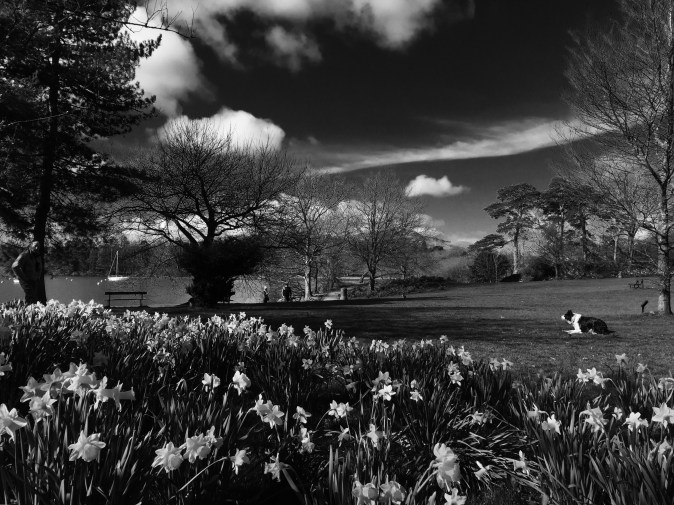
When the war is over will we go down to the water, again?
Was it like this, for Rene and Georgette Magritte
Did they walk in the park by the lake and smile
And hold hands while their world went to hell
Should we put scratchy records on the dusty machine
And dance in our underthings, or maybe something more
While the hissing records play?
⦿
How did they get so scratchy, those old discs?
Did we forget to get them out and wash them
And show our youth the glory of the covers
Did we not show the younger ones the joy?
Or, maybe, the younger ones already know
And the scratchy records are just scratchy, older people
Who have no time for what has not yet passed.
⦿
When the war is over will we go down to the waters, again?
©Copyright Stephen Tanham 2017


 Sun in Gemini
You must be logged in to post a comment.