
Share this:


How apt! Is broken life
Supported on your precious stone?
Axes point eternally
©Stephen Tanham, 2016.
Share this:

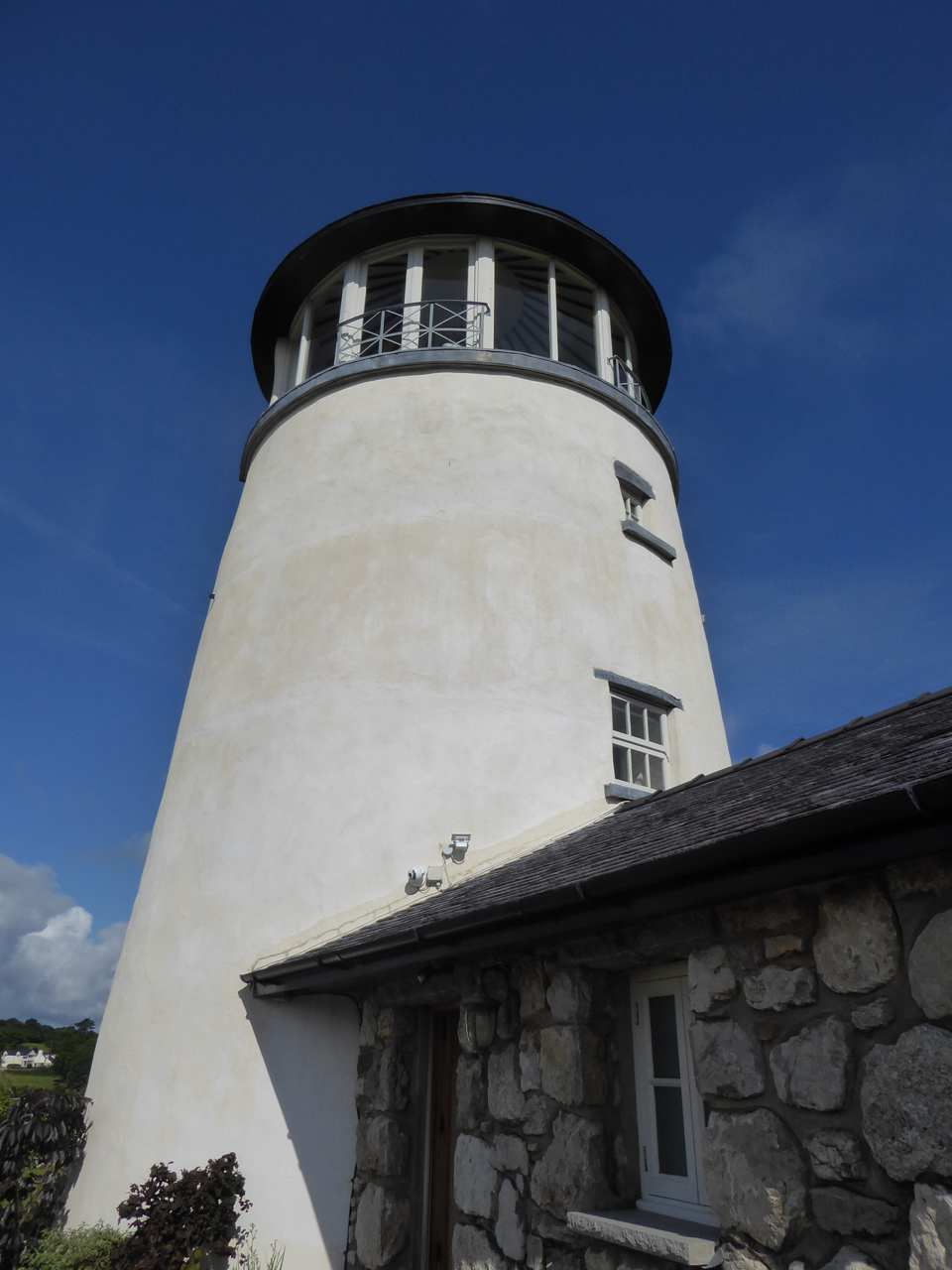
High Life in a Windmill
We take our ‘wanderings-in-a-landscape’ weekends seriously at the Silent Eye! Last year, for our December pre-winter solstice weekend, the two organisers–Barbara, (my cousin), and I, dragged a dedicated group of folks up the rain-sodden slopes of the West Pennines in Lancashire to visit the ruins of what had been a glorious landscaped garden created by the founder of the Lever Brothers soap empire – now Unilever.
It rained all day on that Saturday, and, when we got to the top path, it blew a gale… December is like that. We tell those attending, please come equipped!
The day was saved by good planning – a pre-arranged (early) Christmas lunch at one of several pubs and a carefully (pre) parked, large car with which to rescue most of the drowning folk!
Learning from this, the ‘North-West team’ decided that it would be good to spend a couple of preparatory days in the geography of our chosen spot for the December 2016 pre-solstice weekend, – the island of Anglesey, last refuge of the Druids…

We thought it would be good to invite our long-suffering other halves and make a two family event of the planning trip. Bernie, my resourceful wife, embraced the challenge of where to stay with her usual enthusiasm and skill, and found us a… windmill.

No ordinary, windmill, this, mind, but a superbly converted dwelling capable of housing four people in great comfort, and lovingly converted over several years by the owner, Justin, who now rents it out, along with a nearby tower and a cottage.
He’s a man who appreciates the potential of fabulous views, as you can see from the above photograph of Puffin island – taken at full magnification from the ‘lounge’ which is at the very top of the windmill.

The location is near Beaumaris, on the north-east corner of the island of Anglesey, which, itself, lies off the north-west corner of Wales, separated from the mainland by the tumultuous Menai Straits – notorious for their high-speed tidal flows along its five-mile length. It’s a very beautiful place–and full of ancient history…

Above: the Menai Straits in the distance, with Snowdonia National Park beyond. Taken, with a long lens, from the top of Justin’s Windmill.

The downstairs of the windmill comprises just three rooms – a small but beautifully furnished, modern kitchen; a bathroom; and an alternative approach to dining.
Welcome to the ‘three-quarters’ dining room.
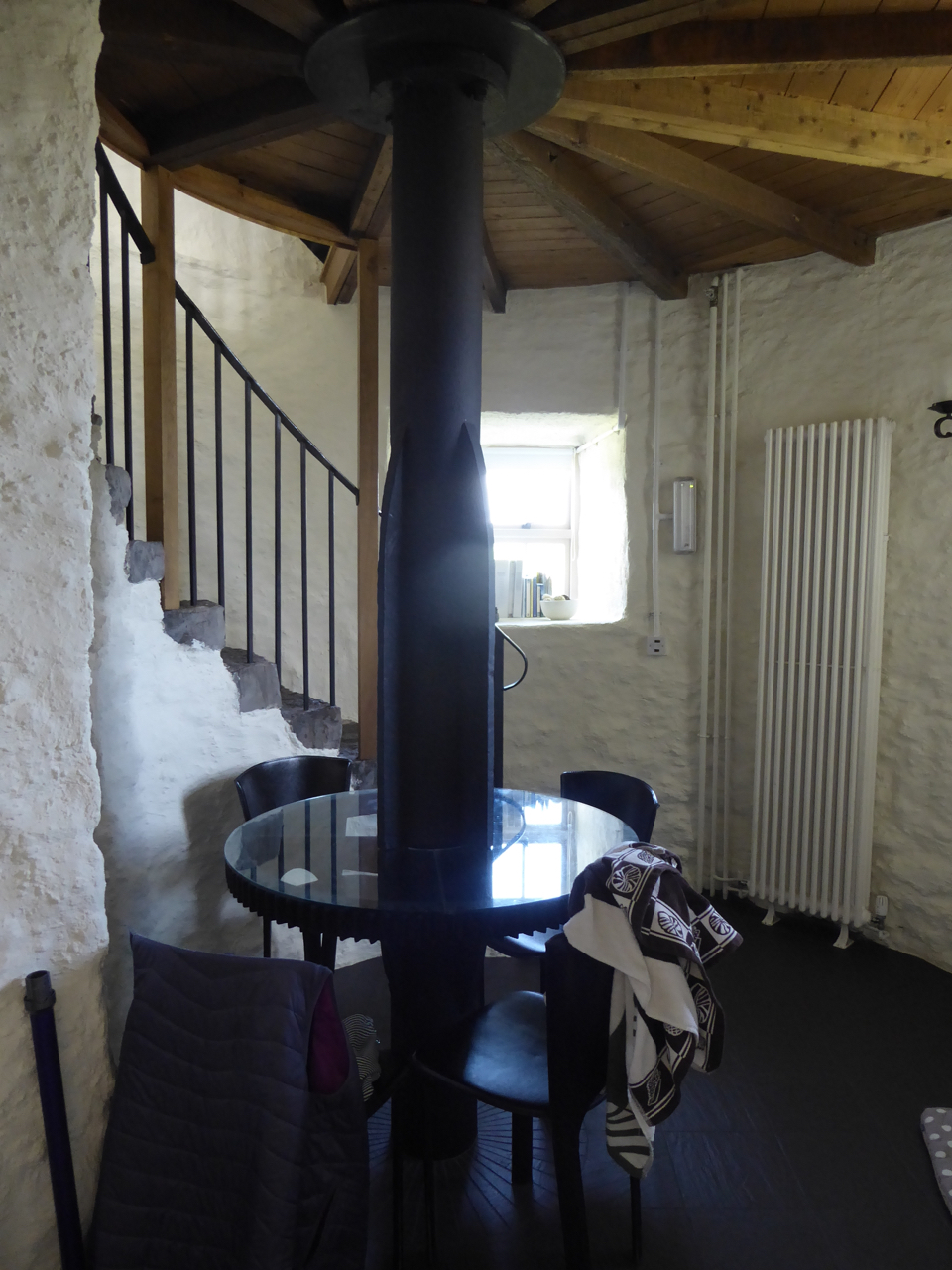
I will explain… The old iron shaft that transmitted the wind power from the windmill’s sails still runs down the middle of the structure. The whole building, of course, was really a giant grinding engine.
The circular glass dining table is built onto the black shaft (see above) with the gears still visible beneath its surface. If, as we were, your party is four people, when you sit down to eat – or drink wine, three of your party are visible to each other and the fourth is completely invisible behind the solid, black mass of the iron shaft…hence ‘three-quarters’ dining…
Stairs… Did I mention stairs? The central function of the windmill is delivered by the dark, iron shaft running through the centre. Human ascent and descent is via stairs – an inhuman number of them; “Your own built-in Stairmaster,” said Julian, handing us the keys… hmmm.
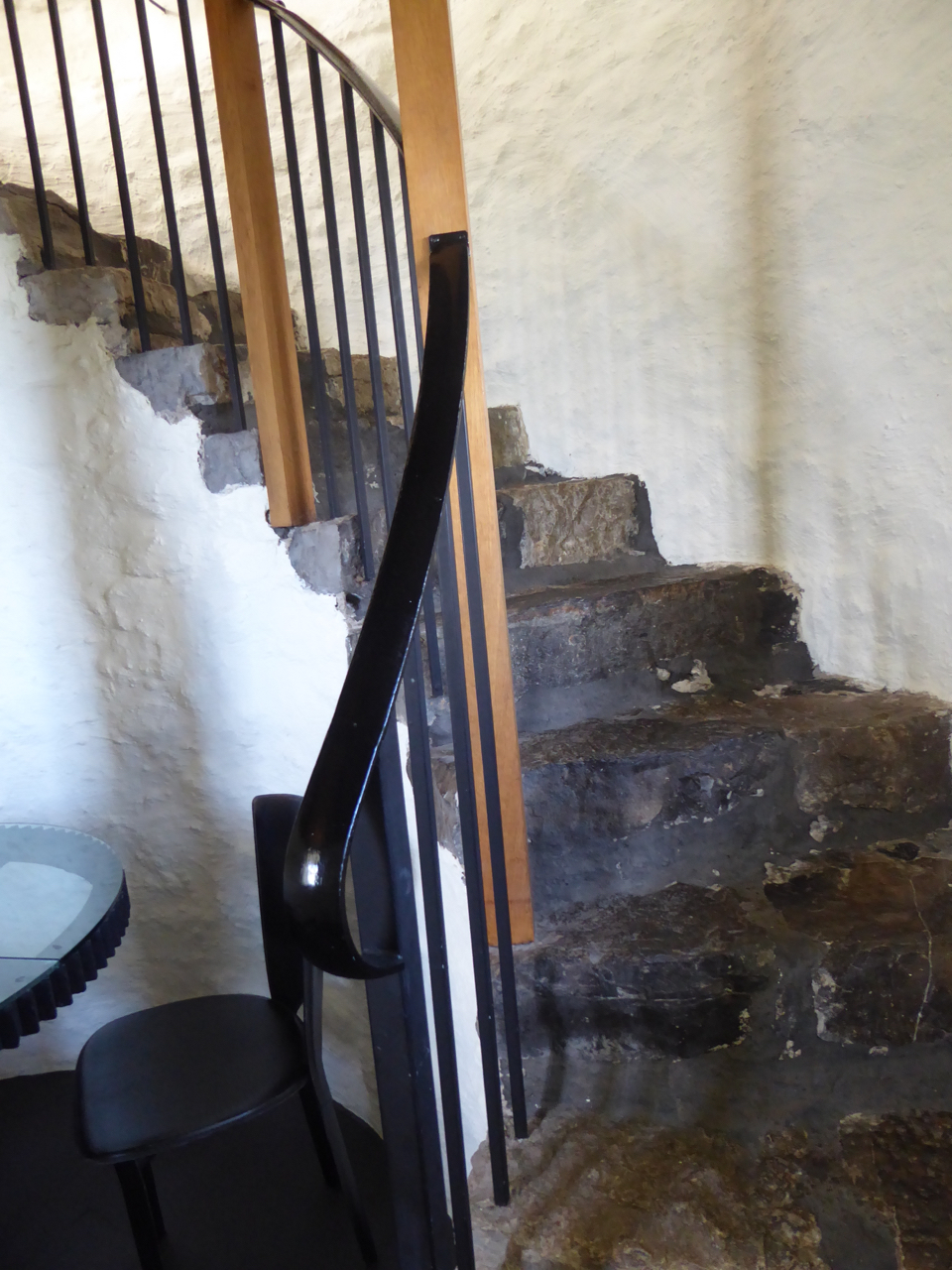
The never-ending stairs begin as a flight of the original stone steps which curl from just beyond the three-quarters dining table and lead to the first bedroom, which occupies the whole of the first floor. In fact, this room has two functions: one, to sleep two people, the second, to connect the floor above, with the floor below… So, if you’re if you’re in the bedroom floor above, and you need the bathroom during the night, you need to wave at the nice, sleeping people in bed as you pass through… and hope you don’t disturb them!

Upwards, then… To the second floor, via more stairs, of course:
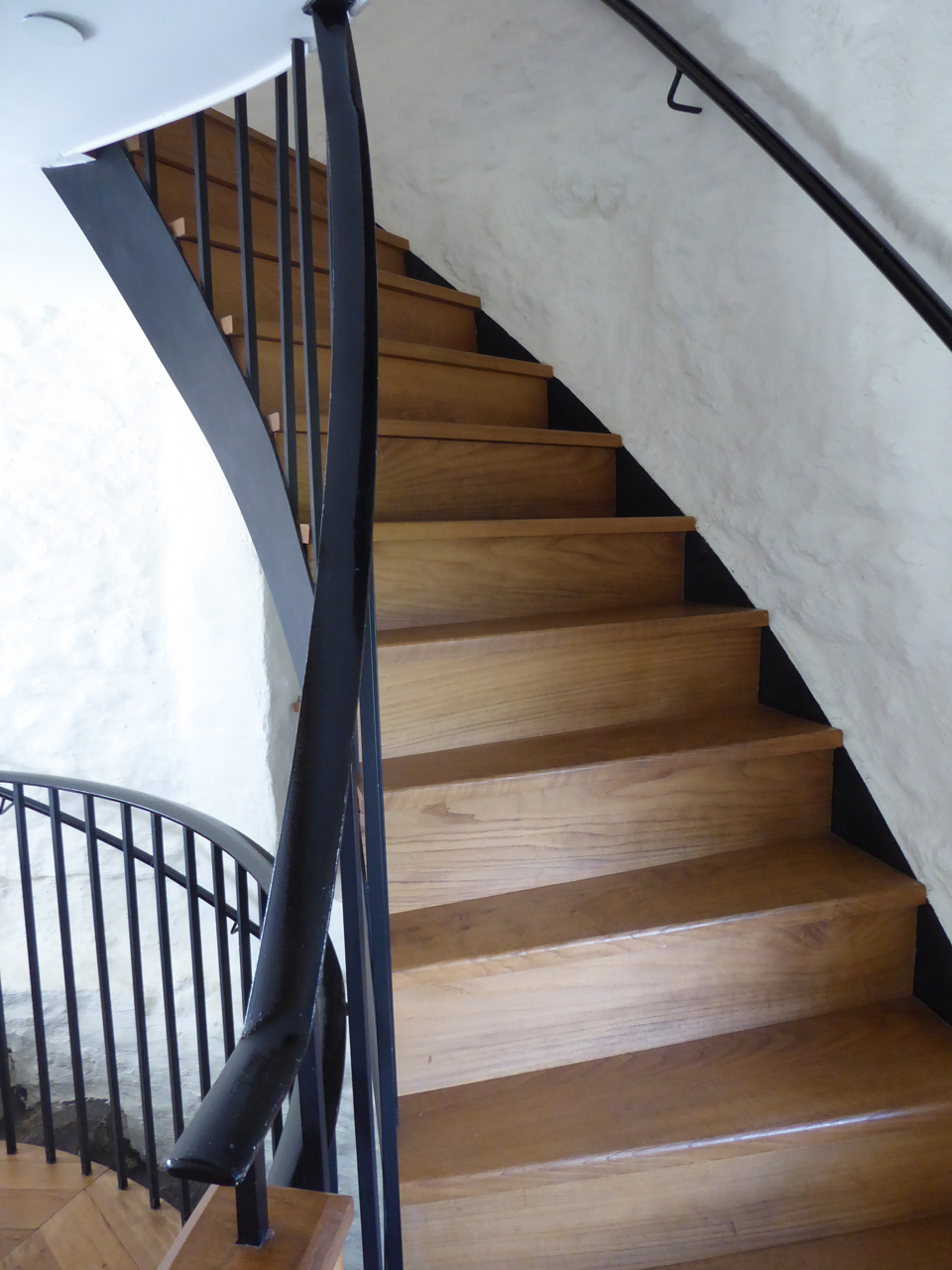

Similar layout, same problem for anyone passing through and upwards from the kitchen or bedroom below. Having said that, you do get used to vertical communal living after a while.
More stairs…
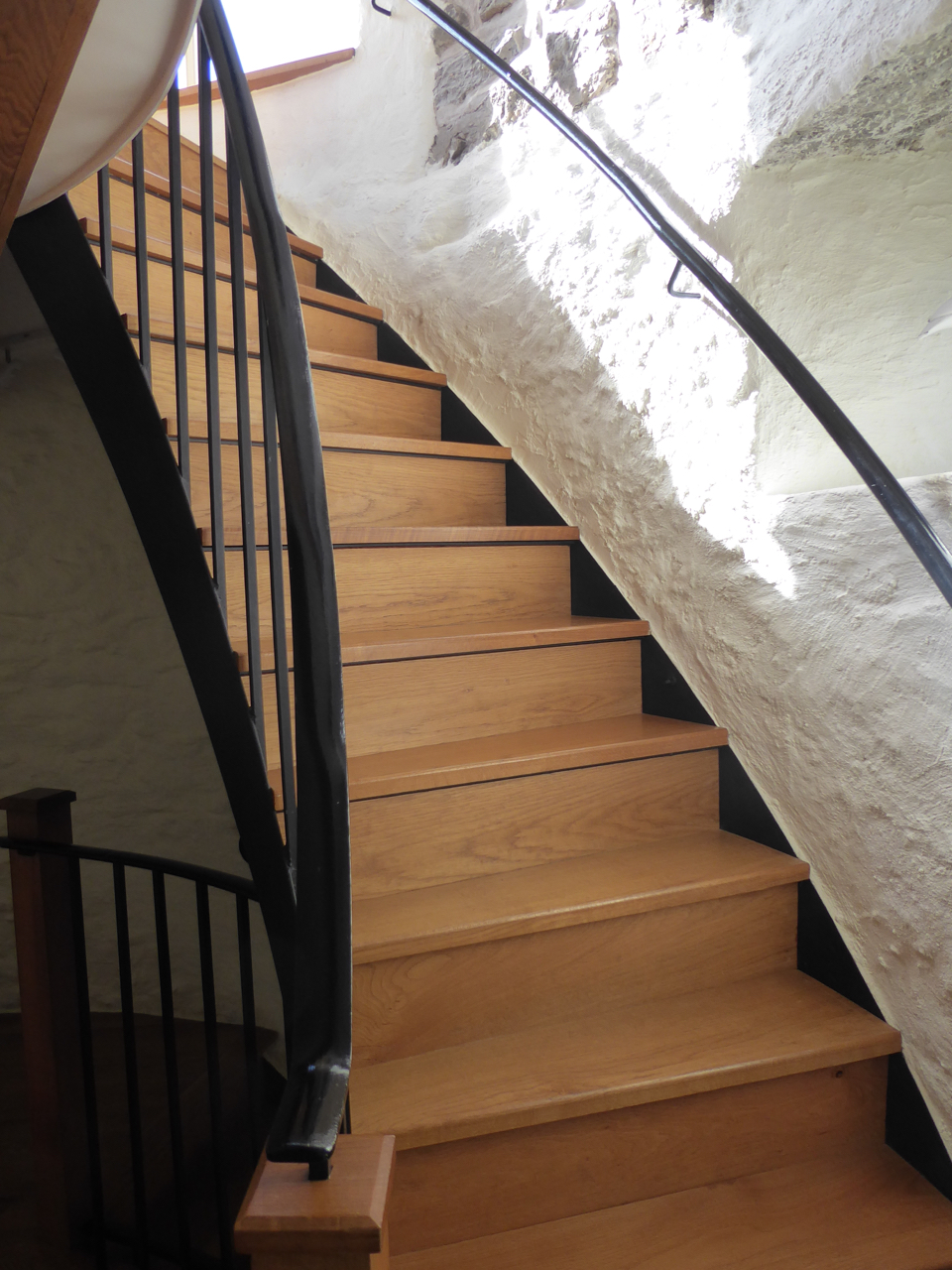
At the top of which, mercifully, lies the superb loft, or ‘crow’s nest’ as it became known during our short visit.

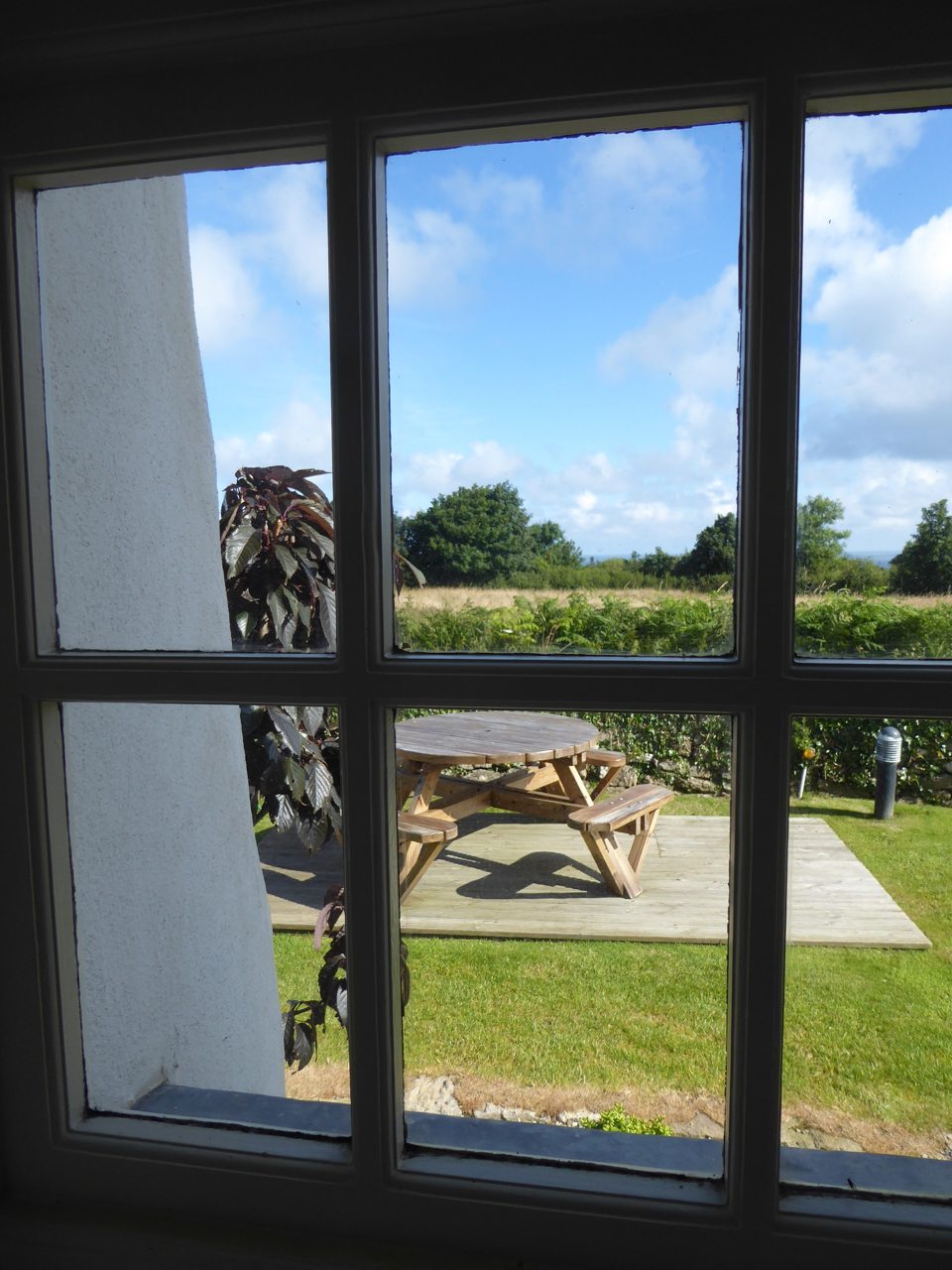
The wonderful conversion didn’t end with the inside of the place. The outside has a very neat garden and… a hot tub, capable of seating four in perfect, bubbling comfort – even under the stars!
And yes, we did enjoy a couple of (plastic) glasses of wine in there, before the end of our short trip.
But what about our research into Anglesey’s ancient monuments? We had a very full day, even if it was mainly in the July rain, exploring sites for our December visit. We are preparing a separate post on that topic, which will be published later this week, under the workshop’s title, ‘Of Ash and Seed‘.

Of Ash and Seed will explore what it feels like to know that the peaceful existence of your family and tribe is coming to an end; that you are the custodians of an ancient and revered way of interacting with all life in a landscape you love.
Do you simply surrender and die, or can you do things to encapsulate and preserve what you know, passing them in a different form to those that may follow when your physical presence is gone? Based on the true, historical story of the Roman Army’s extermination of the last of the Druids on the island of Môn – present day Anglesey.
Put it in your diary and come and join us!
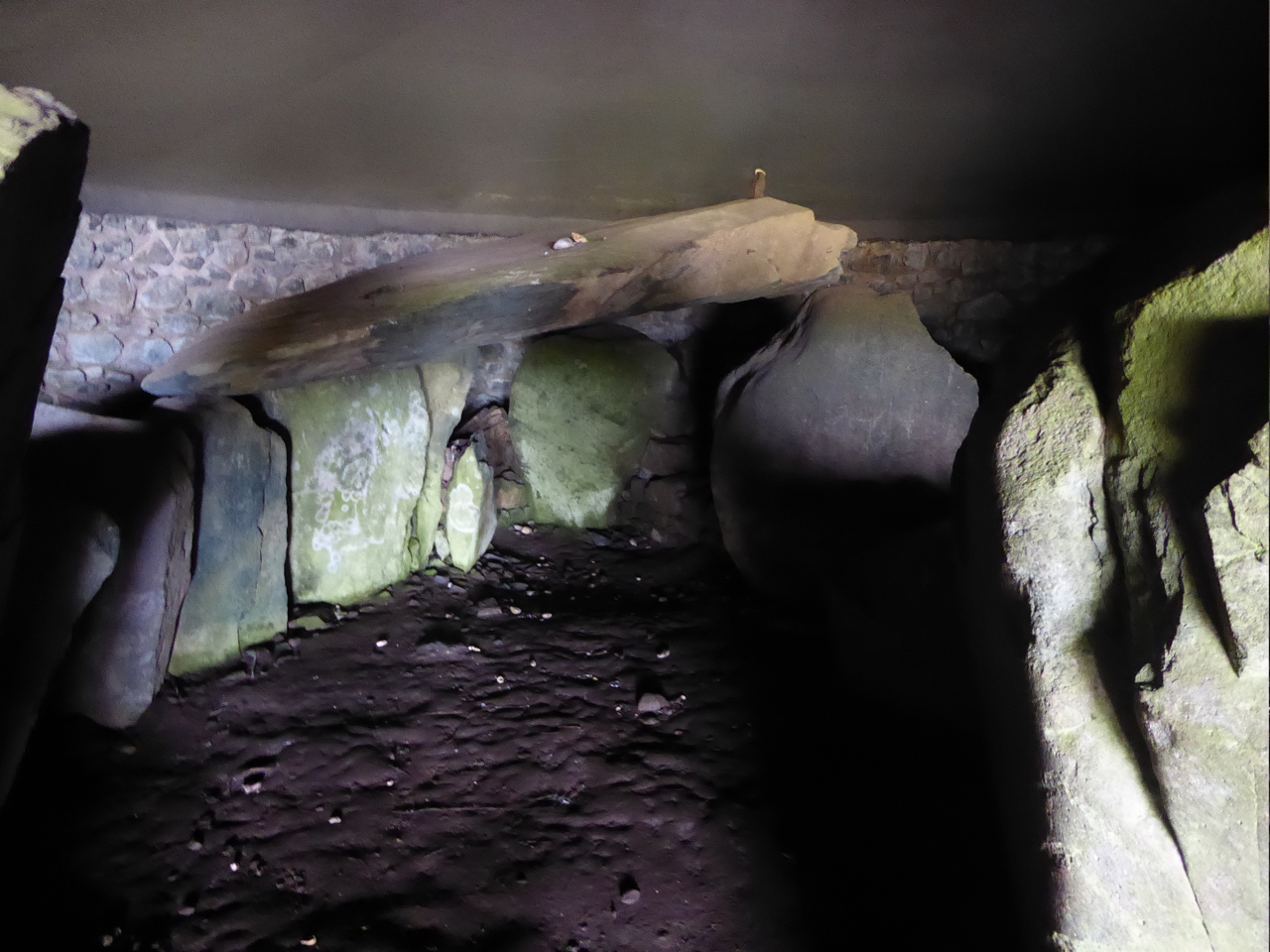
The dates of this exciting journey of exploration will be the weekend of 2-4th December, 2016.
You can find more details of the windmill by clicking here.
©Copyright Stephen Tanham, 2016.
Share this:

A beautiful and heart-warming narrative from Sue.

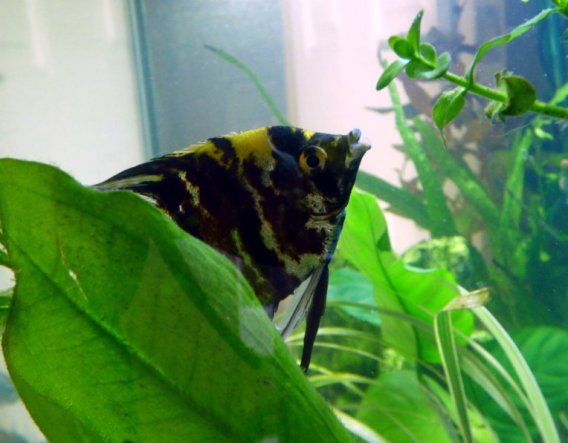
I’ve inherited an aquarium, for the second time. The first time it was a gift when a friend’s husband passed away…she needed to re-home the fish and, knowing my younger son had a keen interest in them, she gave the tank to me. My son however, had unexpectedly acquired a lovely little flat and moved out. Which left me with a huge aquarium of which the dog did not approve.
The dog too was a recent acquisition at that time. My elder son had decided an assistance dog might be a good idea, so Ani had come into our lives. He too had found a lovely home and moved out, but the small dog had remained with me. You may detect a pattern developing here. My younger son, rather liking the tank and in the interests of appeasing the confused canine (who thought it her duty to protect me from…
View original post 821 more words
Share this:

Share this:

It is a long time since I joined the crowds in France to celebrate a national holiday, but I remember the wonderful atmosphere and gaiety when I took my small son to watch the blooming of fireworks in the night sky, when the ideal of ‘Freedom, Equality and Brotherhood’ was proclaimed and reaffirmed across the land.
I cannot begin to imagine what it must have felt like to see lives, ideals and loved ones maimed and murdered on such a night. My own experience does not bring me close to such horror, though I have endured the interminable, rending heartache and the waiting for news when my child lay near death through an act of senseless violence.
It doesn’t matter ‘why’, though many will cry that word into the night, begging for an answer that will never be enough.
It barely matters ‘who’… the perpetrator can no longer cause harm…
View original post 320 more words
Share this:

Come and join us on an magical adventure in the landscape…


*
They care for her needs, which are few enough… goat’s milk and berries, bread and herbs…fur for the cloak and boots she wears against the cold through the long nights of vigil by the stones.
They keep their distance, coming only to the Guardian.
She speaks to none else who do not seek.
Very different this life from her beginnings in the bright, fire-lit halls of lore and music… but it is life and she serves the Clan of the Raven.
*
 *
*
Laying her hand on the great mound she walks through the cairns to the home-place to warn him of their coming. Bending low she enters the house, low roofed and sturdy, lined with stones piled between the circle of uprights, a special burial at its heart, capped with stone.
*
 *
*
He had gone back, her Guardian… under cover of night… dangerous work…to bring her their…
View original post 149 more words
Share this:

Share this:


Whispers in the West – part three
After the group’s successful ascent of Carningli (panorama shot above), the second day of the Silent Eye’s Whispers in the West weekend continued, with a short, further car journey to one of the historic highlights of the trip – Pentre Ifan.
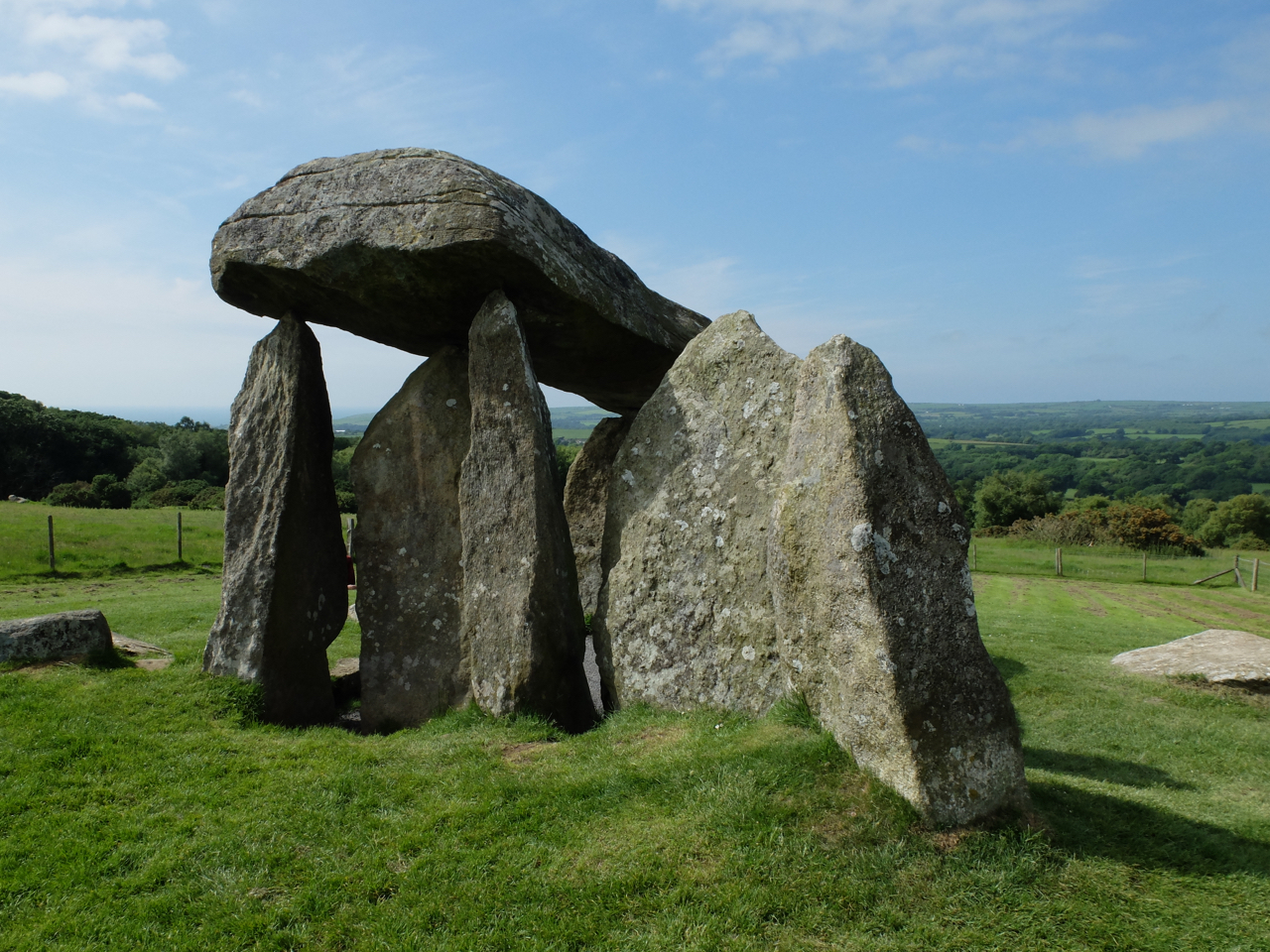
Pentre Ifan is the best known, and because of its height, the most impressive megalithic monuments in Wales. It is believed to be the remains of a chambered tomb for the communal burial of the dead, which would have been used, continuously, for some period before being finally sealed for good. The tomb was erected in the Neolithic age, perhaps as early as 3.500 B.C.

The burial chamber itself was once partially covered by a great cairn (see schematic, below), extending well to the rear, but the stones have long since been removed; so it now lacks its original covering.

(Schematic taken from a partial photograph of the CADW information board at the site)
Pentre Ifan is classified as of the Portal Dolmen type, with the front of the chamber composed of three large uprights set in an ‘H’ formation – though here it is placed, unusually, at the centre of a curving facade of slabs, in line with the design shown in the schematic.
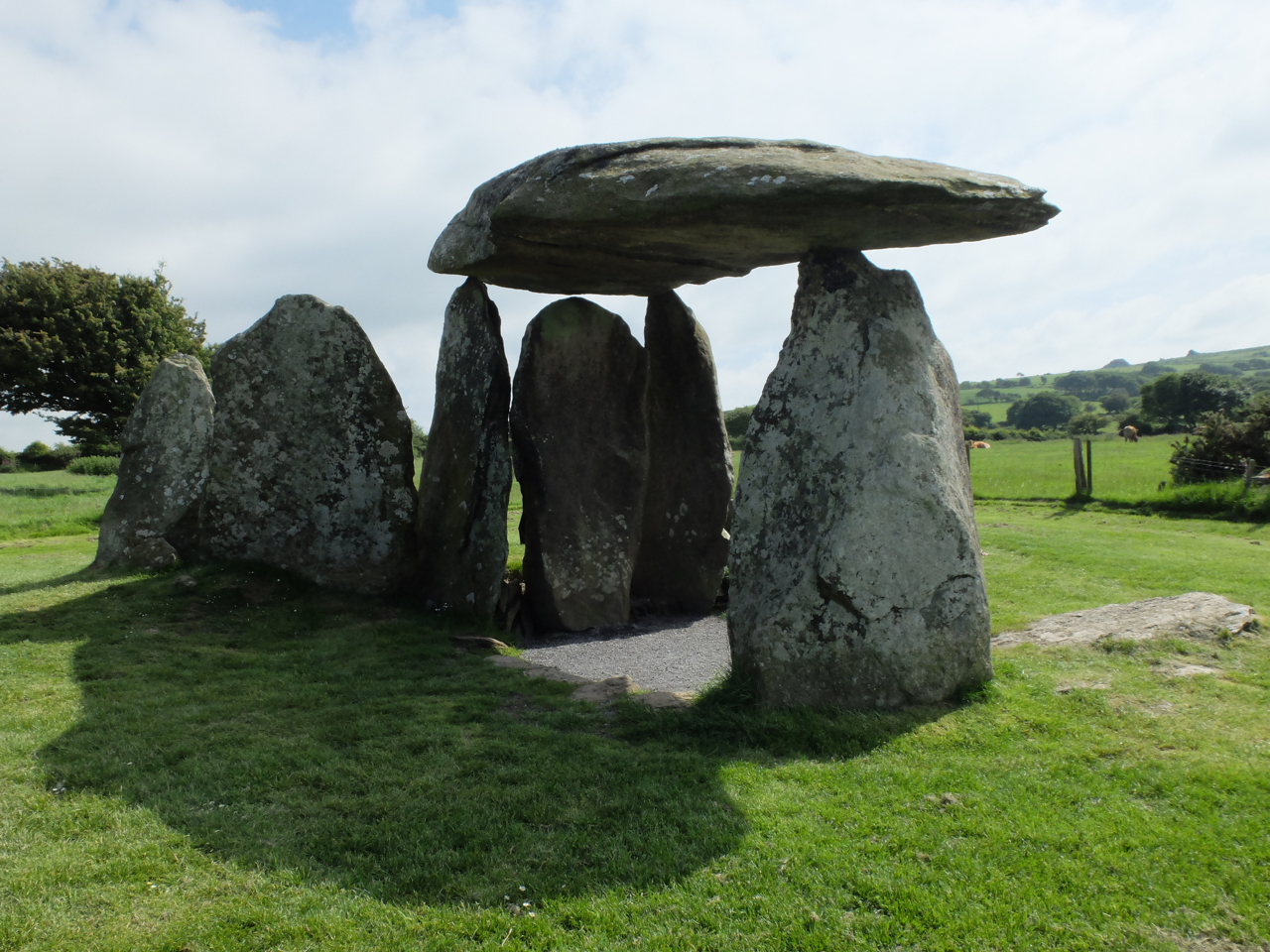
The enormous capstone, nearly 17 feet long, weighs over sixteen tons and is supported on just three stones, as can be seen in the above photograph. It is believed that the juxtaposition of supporting and non-supporting stones was part of the design of the dolmen.
The weather continued to be wonderful, as you can see from the photographs. Beyond this, though, and the fact that it was now late afternoon, there was a very peaceful atmosphere about Pentre Ifan. It is a very beautiful and spiritual place. No-one in our party wanted to depart…
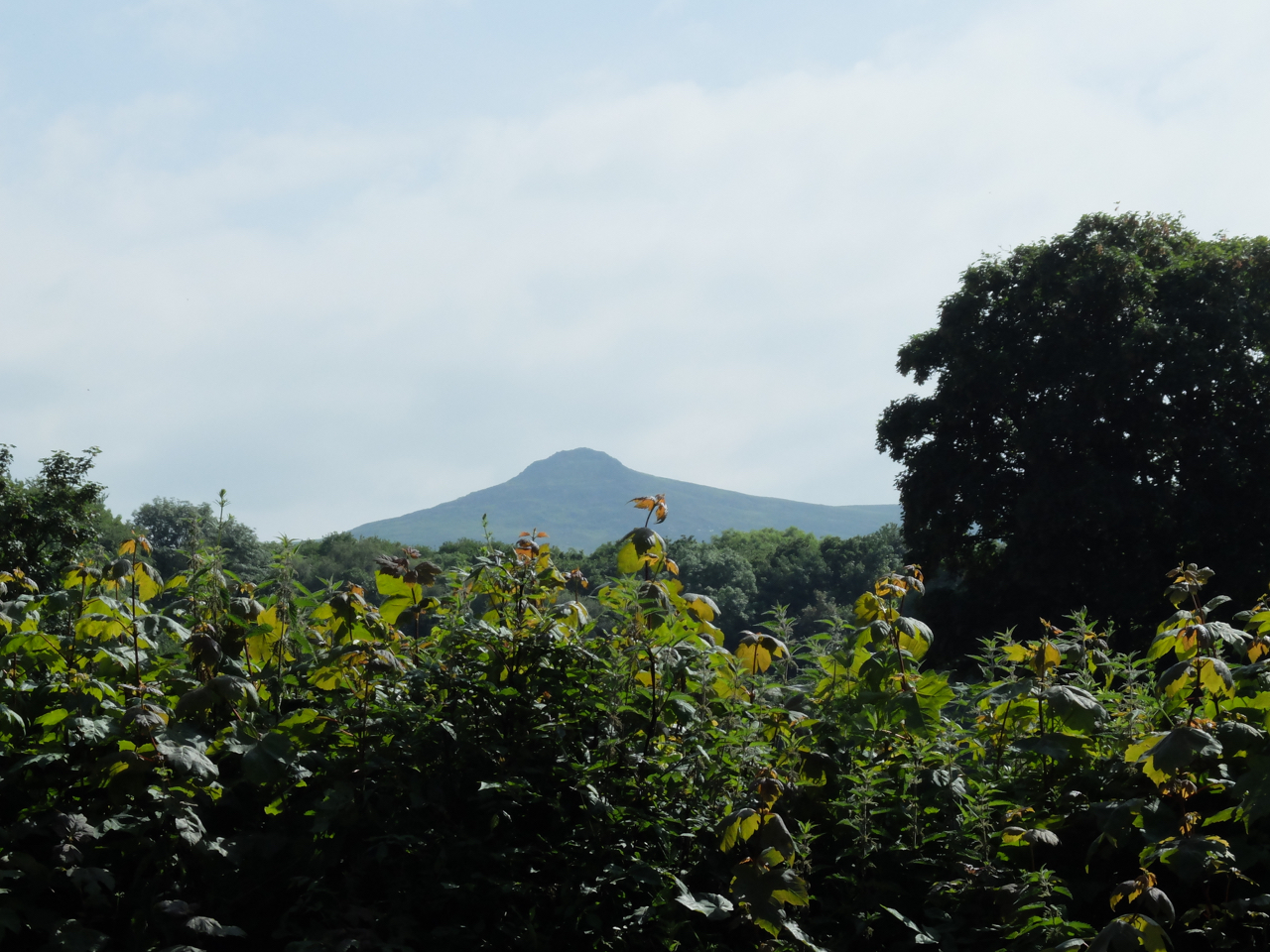
In leaving, we took one final look beyond the perimeter hedge, to see the now-familiar shape of Carningli, mountain of the angels, from which we had just come. Seen from this angle, you can see how high it is, and how it dominates the land around.
And then it was back in the cars for a short journey into a very beautiful valley to the north of Pentre Ifan to see St Brynach’s church in the lovely village of Nevern.
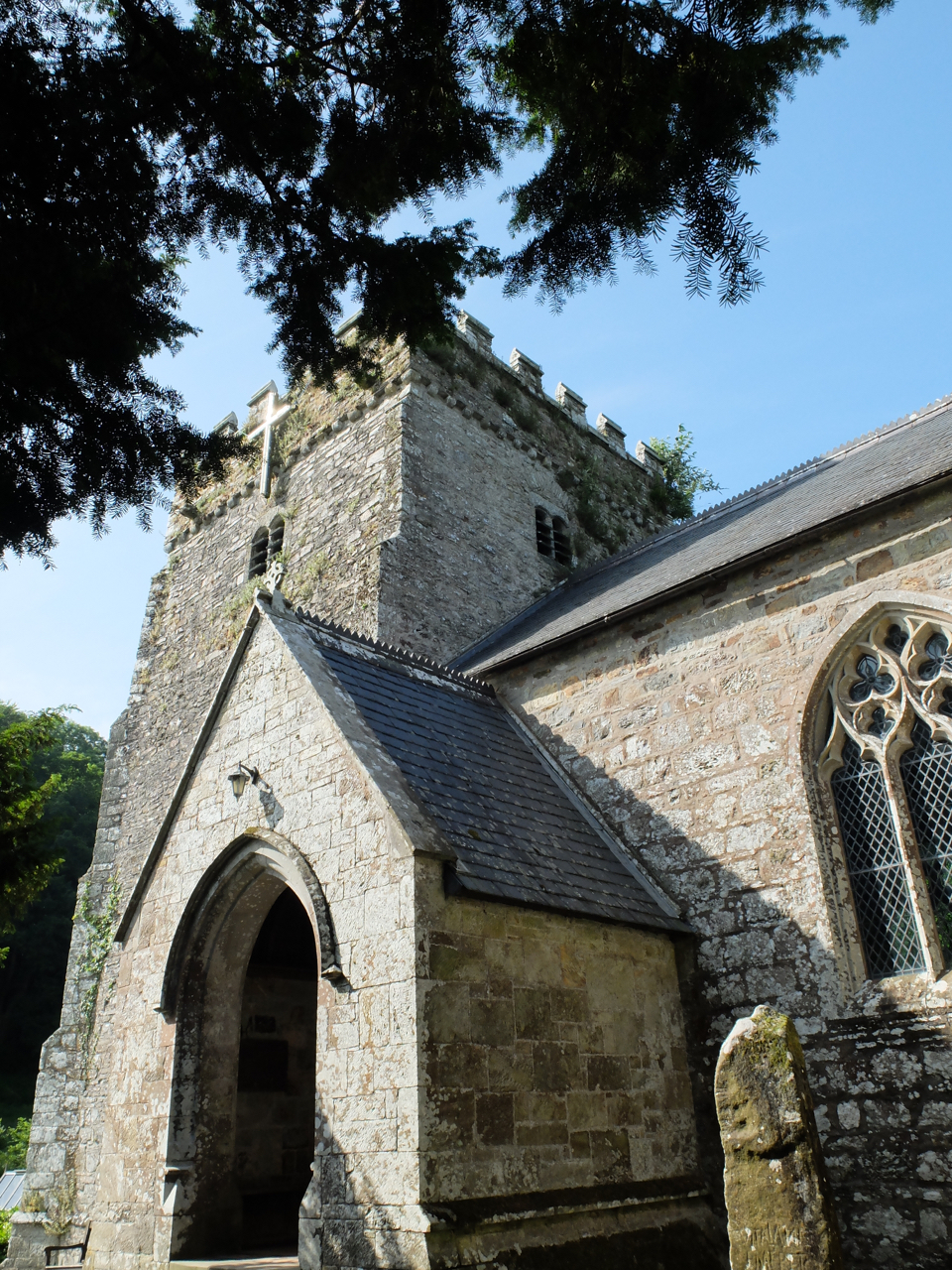
The church is most famous for one of its many yew trees, near to the gate, which is called the “Bleeding Yew”. The yew tree is about 700 years old, which is extraordinary in itself.
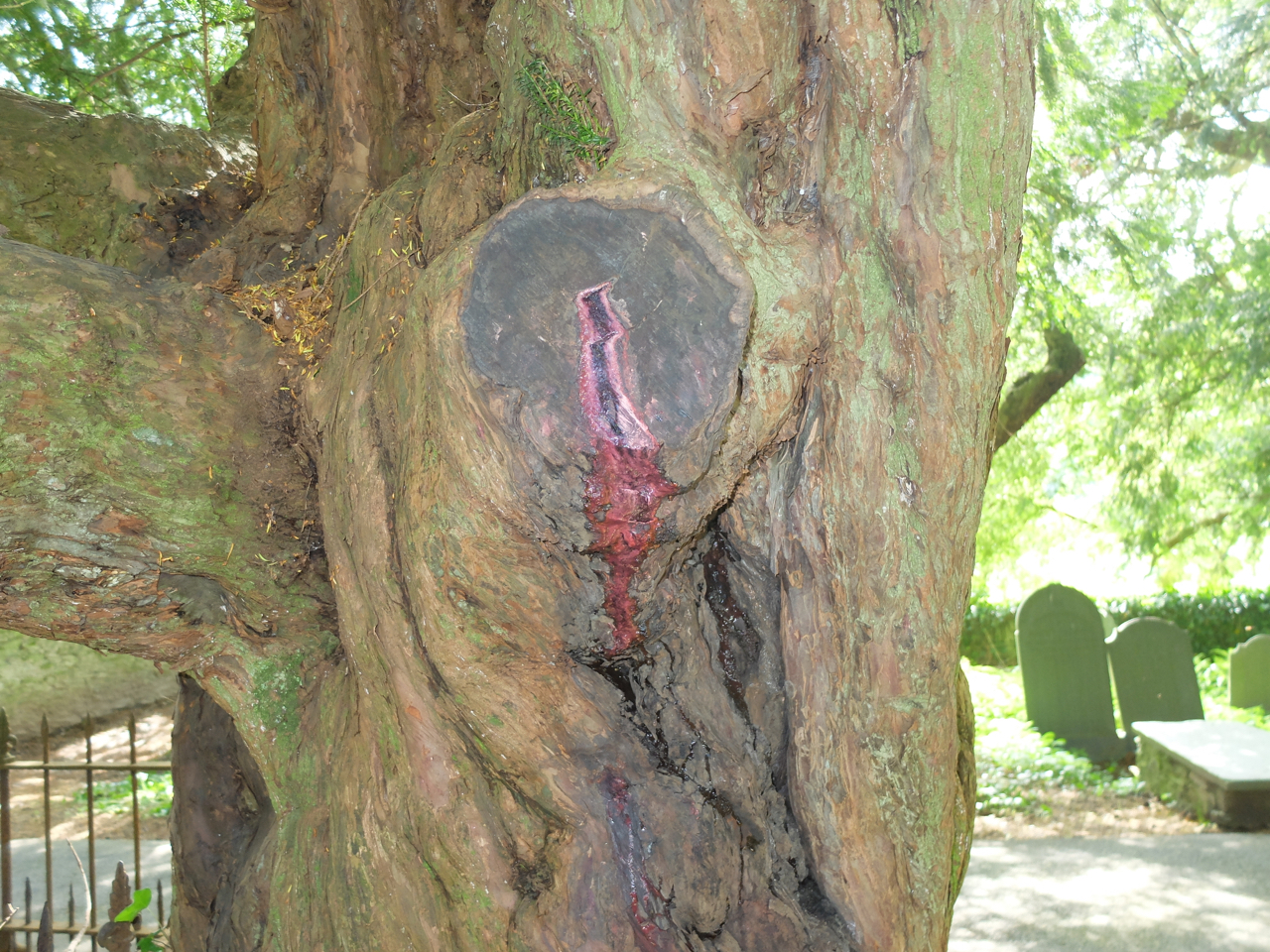
It has a red sap running out of it which has the consistency of blood – though it dries pink rather than brown. Trees are known to ‘bleed’ when their internal flow structures are exposed, but, according to local legend, St Brynach’s bleeding yew has been in that state for hundreds of years.
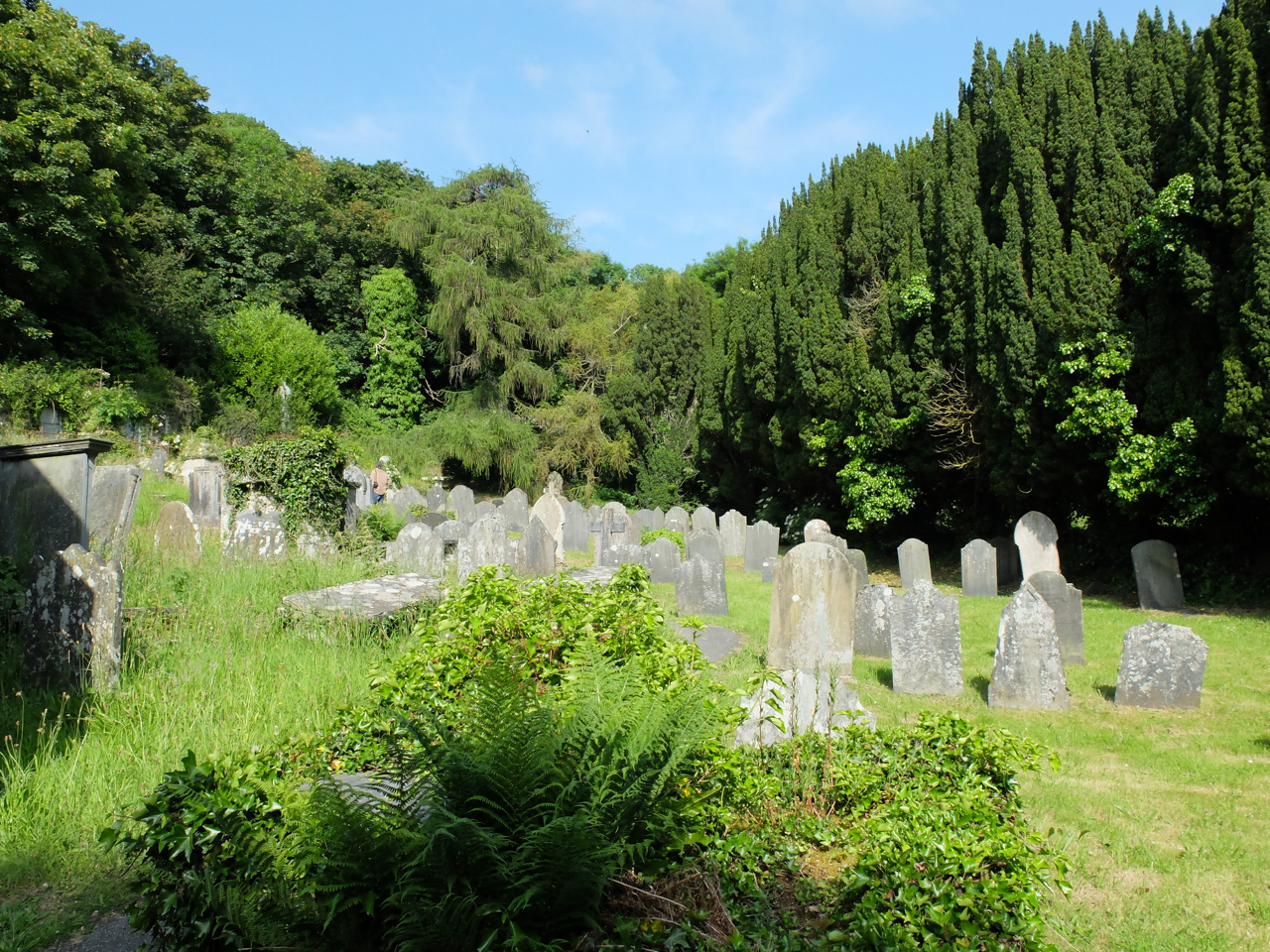
There are many myths about why the Nevern yew tree bleeds: some say that as Jesus was crucified on a cross it is bleeding in sympathy. One myth says that a monk was hanged on this tree for a crime of which he was innocent and the tree is still protesting the injustice. There are many other stories, but the church and its surroundings have much more to offer than just the Bleeding Yew.

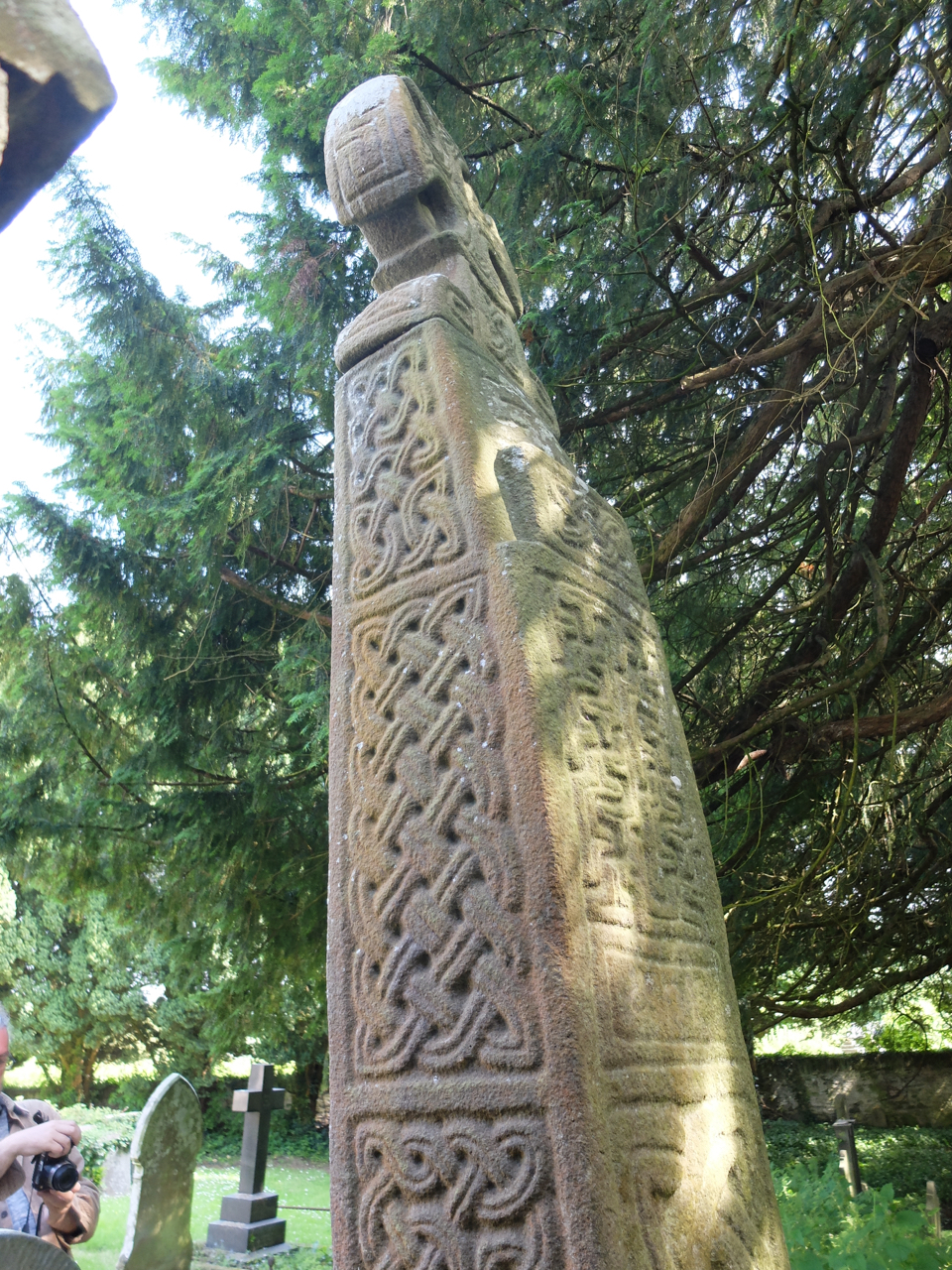
Further up the main path to the church is a large and dominant Celtic Cross, carved with the familiar Celtic knot-work pattens seen elsewhere in western Europe.
The cross is one of the most perfect examples of ancient Celtic stone carving in all Wales. The total height is thirteen feet and the cross is two feet in diameter at its thickest point.
Experts date the cross as late 10th or early 11th century. The four sides of the cross are carved with geometric interlacing patterns.
The West and East faces have inscriptions. One is Ans, meaning Dominus, latin for Master. The other is not as certain, and could be the word for Hellelujah.
Language is major feature of the inside of St Brynach’s church, which unashamedly celebrates the Celtic history of the land around it. The famous Nevern Ogham Stone, which has inscriptions in both ‘Celtic – Ogham’ and Latin, has been laid as the lintel of one of the windows in the south side of the transept.

The photo shows the Ogham lines cut into the corners of the stone to form words. There is even a notice showing you how to use the stone to write your name in Ogham – assuming there are sufficient letters.
And with that, our time in Nevern had come to an end. It had been a long and wonderful day of discovery and we were due to have an early dinner at the Sloop pub in Porthgain, on the twenty mile return journey to St David’s.
Lizzy had arranged things so that we would just have time for a slight detour on the way there to have a very special glass of Welsh cider at a place called (locally) Bessie’s pub in Cwm Gwaun. The valley which houses Bessie’s is well hidden and I would not have liked to find it on my own! Having said that, the village was delightful and full of friendly local people, sitting on their doorsteps in the early evening sun, who smiled at our band of weary travellers and waved us towards Bessie’s – the only pub in the valley.
And the cider? Well, if you get chance, have a pint of Black Dragon if you’re passing through these parts. ‘Nectar of the Gods’ springs to mind…

The final part of this series of posts will conclude, next week, with our Sunday morning walk to St David’s Cathedral, via the coastal footpath and St Non’s clifftop church and shrine. St Non was the mother of St David.
The Silent Eye runs four such weekends per year; in April, June, September, and the start of December. Apart from the main April workshop, which combines mystical drama with teachings, they are very informal occasions, but a good way to meet some of the names and faces from the Silent Eye School of Consciousness. Everyone is welcome – we simply wander in a landscape and get to know each other.
The formal teaching programme of the Silent Eye School is a three-year correspondence course, studied at home and in the individual’s daily world, with personal supervision via email, and workshops. The teaching programme is based on a guided journey through the spiritual layers of a nine-pointed figure called the Enneagram (below). The Silent Eye is a not-for-profit organisation and charges as little as possible for its work.

The Silent Eye’s version of the enneagram.
You can find details of the forthcoming events for the year on our website.


Share this:


Warm Purrings Banish
⦿
Warm purrings banish
Pale July’s dark, endless rain
Skilled fingers thrill
⦿
©Copyright Stephen Tanham, 2016.
Share this:

Share this:

Stuart’s take…


 Sun in Gemini
You must be logged in to post a comment.