

In response to Sue Vincent’s blog:
Thursday Photo Prompt – Look Out – #writephoto
https://wordpress.com/read/feeds/3193846/posts/1081481498
They never remember my name; I mean Lissrack isn’t much of a moniker, is it? But I know theirs… and, through the tiniest cracks I’ve watched them trudge across these sodden moors and hills for many years, now. I mean just look out there at it! Eternal damp…rain, bloody rain…
They like stone things, churches, burial mounds, circles, that sort of thing, but even when it’s right in front of them they can’t see the wood for the stone, so to speak. I’ve dreamed the word Lissrack at them a thousand times, but do they listen? I suppose the notion of a winged stone monster is difficult to envisage. But they’ve got ships made of metal that don’t sink, so what’s the problem? Think laterally, little darlings!
Who do they think did the deeds that inspired all those grotesque figures on their precious churches? Their forbears were all fleeing from us, that’s who! till we did the heavy breath thing, and petrified the lot… a few of them are still in there – in the oldest of their buildings of course.
Lissracks… we’re very old, so old that we got bored with the eternal Derbyshire rain and decided to hibernate. A thousand years, we thought, should see it cured; but that sleep was wonderful, and it looks like it’s been a bit longer! Still, who’s counting… and the rain’s exactly the same as it was back then, LissJoy said it would be, smart little flocker.
The little ones’ language isn’t hard to grasp, not when their bipedal speaking has been the substance of my dreams for much of that time – we can hear when we sleep, you see. Our dreaming is watching you – and listening. Mind, it’s changed a bit, your tongue; but difficult? No. They should have tried Neolistics! Ha! Get your grunting gear around them syllabubbles, I say…
I’ve grown fond of them really, these two intrepid stone-hunters – and they never give up. They’ve just gone past, again, trudging along in the mud in wholly unsuitable footwear… and I bet they’re wearing wool! In this day and age, I ask you! Can’t wait to try on some of that Lycra or even a GoreTex shell or two! No more sodden feathers for me…
Should be quite a surprise when I start running down the valley after them on my three legs, pretending I can’t fly! Makes a fantastic and scary thumping noise. At the last minute, I will, of course, soar above their fleeing figures and caw my name as I circle them.
Bet that helps them remember in future…
Hawks, pah! Bi-fluffs! Wait till they see what four wings can do.
Nearly there now… couple more pecks at the last of the stone egg and I’ll be free. Born again…
And then we’ll see…
©Copyright Stephen Tanham, 2016.
Share this:

Share this:


Whispers in the West – part two
The second day of our the Silent Eye’s Whispers in the West weekend began with relief – that we didn’t have to drive all the way across South Wales, again, to reach the town of Newport – our starting point for day two.
There are, apparently, many Newports in Wales, but only one of them, some twenty miles up the Pembrokeshire coast from our base in St David’s, has this nearby:

It stood alone on what looked like the cliff edge, dramatic and serene. In the brightness of a warm June day, with azure skies, we walked forwards in respectful silence… to look at ‘Samson’s Rock’.

Carreg Samson is five thousand years old… quite a thought, when you consider that its capstone, five by three metres and a metre thick, has rested for a considerable part, if not all, of that time on only three of the six standing stones, which vary from one to two metres tall.
I hadn’t realised until recently, that most of these Dolmens (or Quoits, as they used to be popularly known, although this, technically refers to the capstone, alone) were, at one time, buried, sometimes with enough of the stone visible to form an entranceway. The land has eroded or been excavated around them, yet their fundamental construction was so strong that they remain stable, like stone creatures from a distant age, to tantalise us in our search for their deeper meaning…

It was as hot day, and we were beginning to thirst for a coffee, at least, so we played a game, with Barbara supervising of how many Silent Eye weekenders can you fit into a Quoiter pint stone glass… sorry, couldn’t resist it!

Lizzy had structured the day very carefully, to give us all the best the coast and the nearby hills had to offer, and we had to leave the serenity of Carreg Samson and its idyllic location for our next Dolmen, just along the coast.

Carreg Coetan Arthur is a neolithic chambered tomb, or dolmen, of the same age as Carreg Samson, which sits in its own little ‘park’ within a holiday village built during the late 1980s. According to Lizzy’s carefully prepared notes, its significant location is obscured by the hedging, but it stands a few hundred metres south of where the river Afon Nyfer enters Newport Bay; and just over a mile north of the hills of Mynydd Carningli, towards which the dolmen seems to be orientated.

It consists of four uprights, and is not much taller than a person. The remains consist of four uprights, only two of which support what appears to be a precariously-balanced, wedge-shaped capstone, which is tilted backwards. There is little trace of any of the original cairn material that once covered the stones.
We stopped and stared, admiring what Stuart had named “Little Bear” before taking as many photos as possible before being shunted out of the way by the next group of visitors.
Lizzy’s plans for the day were unfolding, beautifully, and Carningli, the mountain of the angels, beckoned, as the next item on our agenda.
But that coffee would have been nice… And, as fate would have it, we were about to get one, but in a rather unexpected way. Lizzy suggested a short stop in the small town’s centre and we set off for a nearby car park, in three cars, around the tight streets of Newport’s main road. Sadly, I took a wrong turn and we lost sight of the lead car and ended up doubling back before concluding that we were lost! We had noticed, on our detour, that there had been a sign to a beach car park nearby. The two lost cars turned down this road, reasoning that we might be easier to find in such a location, and we emerged onto a car park next to a very scenic beach with a… tea room across the road!
Well, we reasoned, Lizzy wouldn’t have wanted us to go thirsty in our confusion, and, if we stayed put, there was a good chance she’d find us…
Half an hour later, guzzling tea, coffee and cream and jam scones in the garden of the tearoom, and not looking anywhere near guilty enough, we were ‘found’ by our guide and brought back into the convoy to begin our climb up to the Angels of Carningli.

Carningli doesn’t rise up like some of the stone masses of Snowdonia, but it does dominate the landscape for miles around; and it is accessible with ordinary walking gear with about a thirty minute climb, as the car does a lot of the work for you.
We began the climb, with everyone aiming to reach the top. Ages and fitness levels always vary on these occasions, so it’s wise to constantly check that everyone’s okay. By the time we had reached the plateau below the rocky summit, it was obvious that there were very determined people intent on conquering that peak, perhaps doing something they had not done for a many years.

It was a wonderful spirit and got us all to the top – with considerable pride on the faces of those who had had to work the hardest.
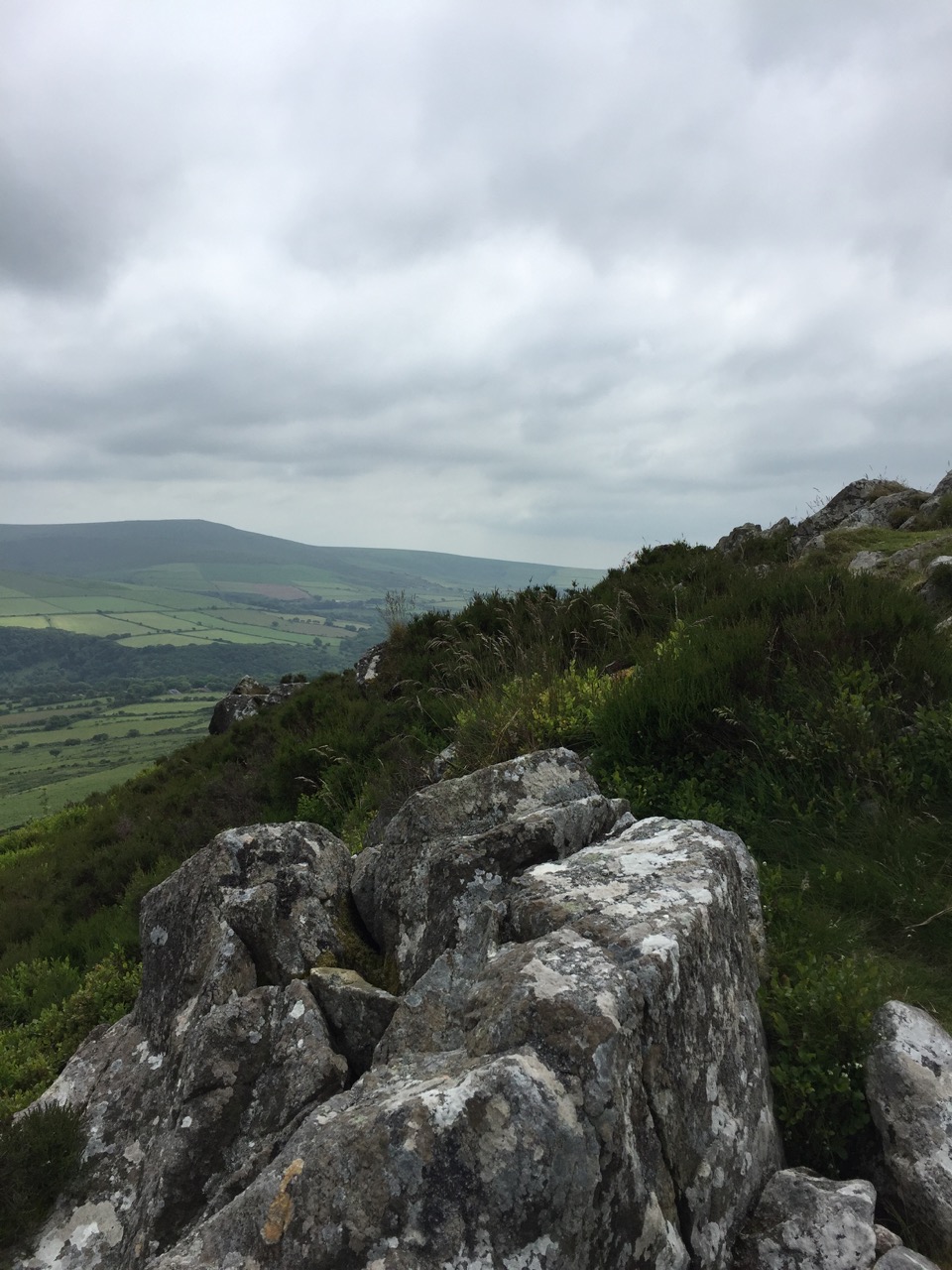
The top of Carningli is very rocky and we had to pick our way carefully to a stable ridge from which we could all look down at the glorious views of Pembrokeshire’s countryside and coast.

In this magical spot, the verdant countryside is as beautiful as the lovely coast.

We had climbed Carningli with an additional goal in mind: to hold a distant healing vigil for one of our members who is facing a severe illness. Chris, one of the weekend group who had to work the hardest in the climb, revealed he had a secret goal – to take back a small rock for our suffering friend, ‘charged’ as it were, with the spirit of that shared moment.

It was a very beautiful, lofty, interlude, and we were glad that Lizzy had urged us to make the climb – the views, alone, were worth it. We came down from the peak of Carningli the direct way, which was somewhat challenging, but we all finally emerged back at the car park and began to dream of a promised cider in a little village that lay close by.
But, first, we had an appointment with another Dolmen – one of the best in Europe; and a wonderful church in a very special valley… So Chris had a lie-down on the grass, instead…

More to follow in the story of this amazing day… quite a bit more, actually…

The Silent Eye runs four such weekends per year; in April, June, September, and the start of December. Apart from the main April workshop, which combines mystical drama with teachings, they are very informal occasions, but a good way to meet some of the names and faces from the Silent Eye School of Consciousness. Everyone is welcome – we simply wander in a landscape and get to know each other.
The formal teaching programme of the Silent Eye School is a three-year correspondence course, studied at home and in the individual’s daily world, with personal supervision via email, and workshops. The teaching programme is based on a guided journey through the spiritual layers of a nine-pointed figure called the Enneagram (below). The Silent Eye is a not-for-profit organisation and charges as little as possible for its work.

The Silent Eye’s version of the enneagram.
You can find details of the forthcoming events for the year on our website.


The Silent Eye runs four such weekends per year; in April, June, September, and the start of December. Apart from the main April workshop, which combines mystical drama with teachings, they are very informal occasions, but a good way to meet some of the names and faces from the Silent Eye School of Consciousness. Everyone is welcome – we simply wander in a landscape and get to know each other.
The formal teaching programme of the Silent Eye School is a three-year correspondence course, studied at home and in the individual’s daily world, with personal supervision via email, and workshops. The teaching programme is based on a guided journey through the spiritual layers of a nine-pointed figure called the Enneagram (below). The Silent Eye is a not-for-profit organisation and charges as little as possible for its work.
The Silent Eye’s version of the enneagram.
You can find details of the forthcoming events for the year on our website.
Share this:

Share this:

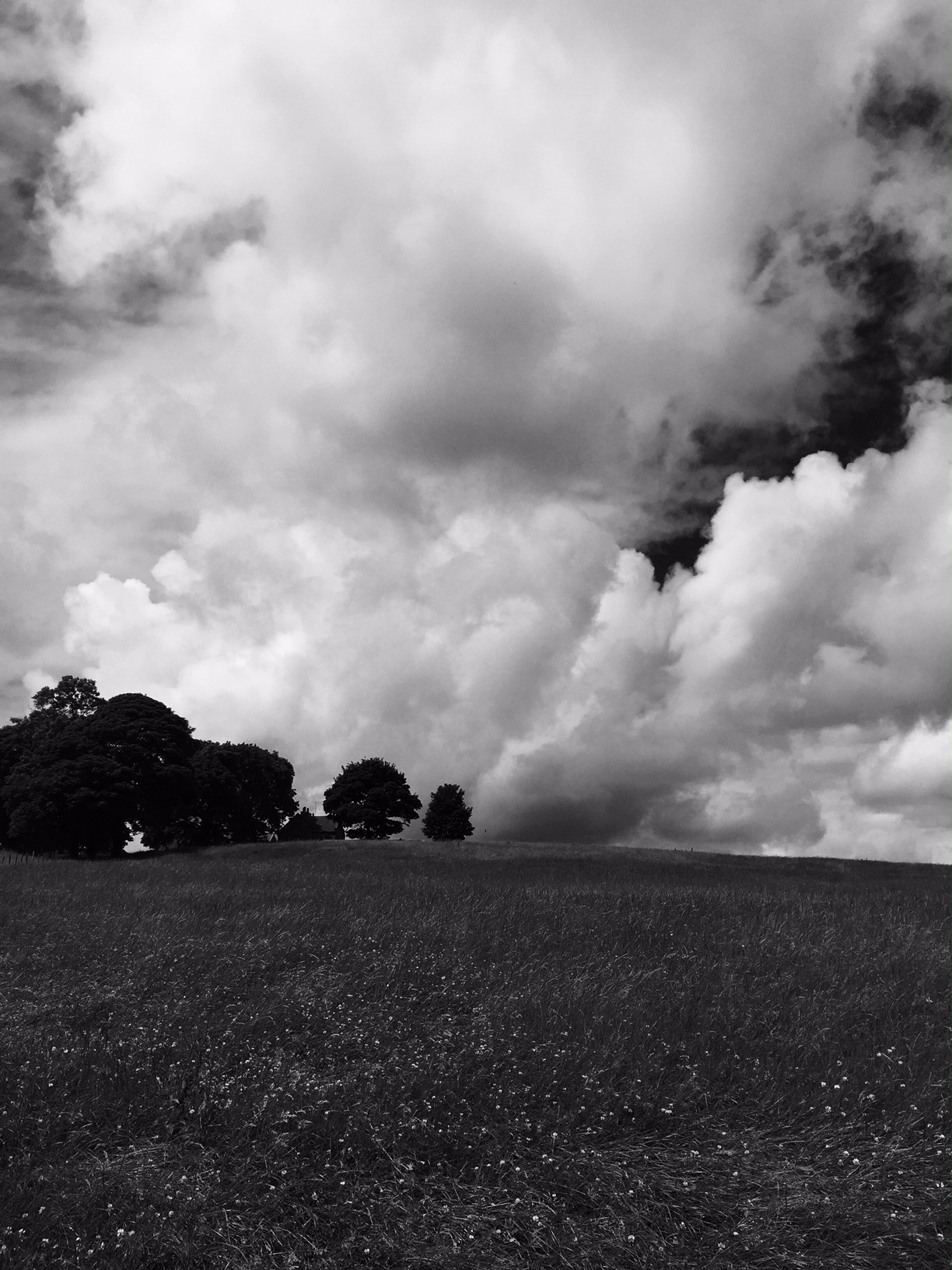
Intense Swirling Steam
⦿
Intense swirling steam
Consumer of the last wood
Glowing dots remain
⦿
©Copyright Stephen Tanham, 2016.
Share this:


Lost Island
In response to Sue Vincent’s Thursday photo prompt.
Lost Island – #writephoto
A first the waves moved, playfully, over his ankles.
Then they became more insistent, as his body resisted their pressure. “No,” his body spoke for him. “This can’t be happening!”
He strode deeper into the sea that had turned on him, tightening the muscles of his thighs and buttocks as he fought against the waves that engulfed; the currents that bore, the warm liquid of love turned purposeful and resistant…
“Nooooo!”
And then he was swimming, taking sobbing breaths to reach her, drowning out there, somewhere… “Help me!” he screamed at the sky, wet with his frothing, salty spit and the drenching of the high waves that forced him back, relentless, denyers of habitual will. Something bigger, his mind moaned, coming face to face with the reality of depths he had never envisaged in the shallows.
And then there was no horizon, as even the vision of her was taken away by the rising waves, whose single song was, “Back, back…”
At the end of it all he lay, sobbing and half covered with wet sand, as the last of the waves left him, unharmed if broken, stripped of elegance, of will, of might; leaving only his given right to be, which contrast would have been a thought of great depth, had he not been so angry.
But strength was gone, and so useless sobbing was the only vent by which the outraged lava of emotion reached the surface of his wet skin on the wet sand on the wet beach.
And the soft breeze blew and caressed his skin, but he did not know it.
And then he saw it on the horizon – his horizon. The dark line of the rising distant island at the limit of watered vision. And with an implacability that froze his soul and made what he had been shiver, he realised that he was, forever, overdressed for where she had gone…
Share this:


Images and Text from the Silent Eye Workshop: Whispers in the West…
 Above it all…
*
 Aries in Ochre…
*
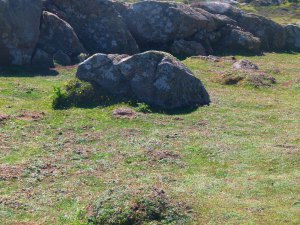 Seal Calf Grazing…
*
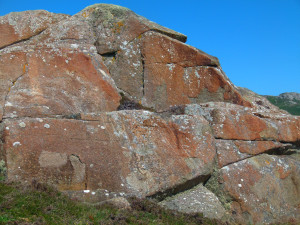 Provocatively Pensive Environs…
*
 Plundered and Strewn?…
*
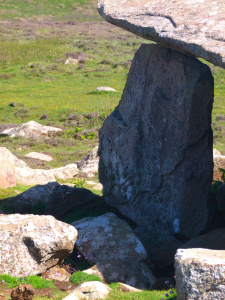 Last Support Standing?…
*
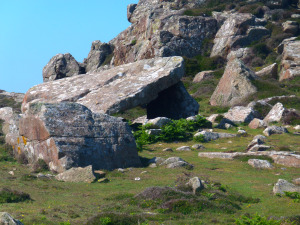 Under Watchful Skies…
*
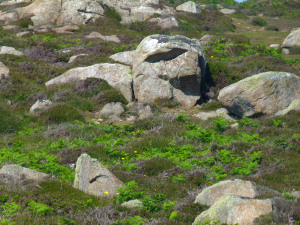 The Fallen Idol…
*
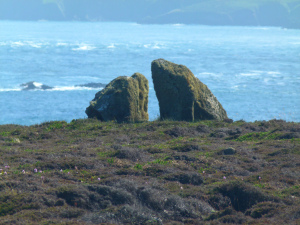 A Conspiratorial Coastline…
Share this:

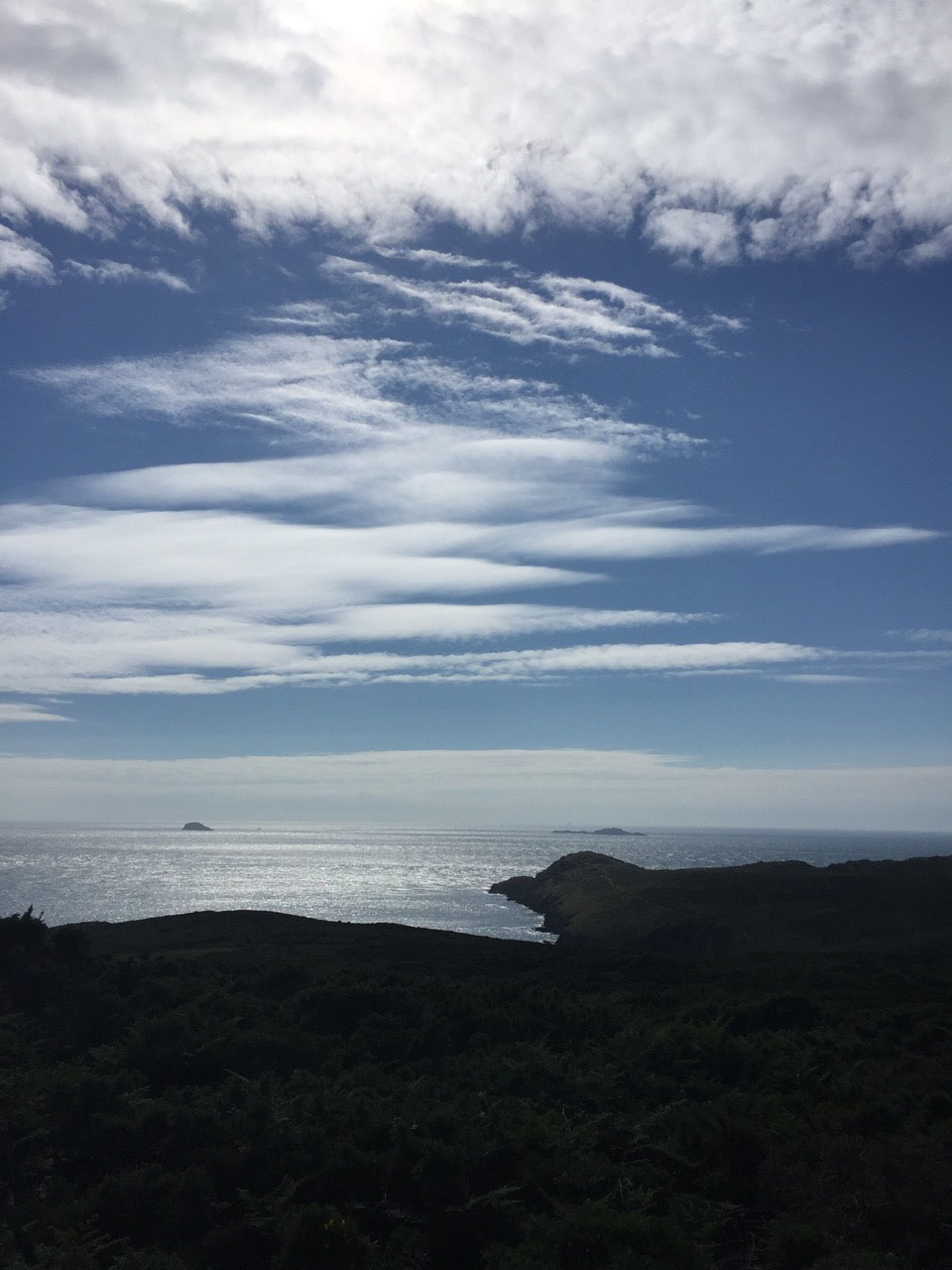

Whispers in the West – part one
It was early on Friday afternoon. Lizzy, one of our Companions in the Silent Eye, had assembled us for the start of three days of delightful discovery on the western fringes of Pembrokeshire, centred on the lovely town of St David’s, home of one of the most remote cathedrals in Britain.
As promised, we met, on the car park above Whitesands Beach, for coffee and…ice cream. The weather was hot, the air clear and the sky blue – perfect conditions for the opening walk on what was to prove an adventurous and wonderful weekend.

The ice-cream reluctantly finished, we resisted the quite reasonable demands for another and set off along the cliff path that leads to the distant vista of St David’s Head.

The town of St David’s gets its name from the patron saint of Wales, who was a Welsh bishop of Myryw (now renamed St David’s) during the 6th century. He is believed to have been the son of a high-born nun–Saint Non, and the grandson of Ceredig ap Cunneda, King of the ancient land of Ceridigion – now part of Pembrokeshire. Other, more dramatic tales say that the lady who became St Non was raped by a local prince and bore the resulting child as her own, bringing him up to take his place in history, despite the trauma of his conception.
We will return, in the final post, to the Chapel of St Non, in its idyllic setting close to the ocean beyond the present town of St David’s; and to the magnificent Cathedral of St David’s.
This part of the Welsh coast is one the the most beautiful places in Wales, and has that ‘other worldly’ feel about it which marks out secret gems of landscape that stay in the heart, forever. It is also the home of some of the most ancient stone structures in Europe.
We reached St David’s head after about an hour of walking. The cliffs are very steep and we were advised to ‘look the other way’ as we rounded curve after curve on the high path – with the dark blue of the ocean a long way below.
Arriving at the headland, we did what a group of Silent Eye folk often do – go very quiet… in the face of the beauty of what lay below, and its ancientness.

Much of the rock in this part of Wales is volcanic in origin, and is over 500 million years old. In the distance, off to the south-west, can be seen the rocky islands of Ramsey, Bishops and Clerks several miles out to sea.

On the section before the headland we had passed the remains of a stone-age settlement.

In a recent post, Stuart and Sue raise the very interesting question, “Why would anyone want to live here, in such an exposed place?”
Our historic research duo have carried out extensive work on such ancient sites and gained their own insights by being sensitive to the land’s own story. This journey to a deeper perception of natural surroundings is well-documented in their books.
After a suitable time for personal exploration and meditation, we picked our way, carefully, back over the rocks to take a slightly different path in the direction of a distant hill – Carn Llidi (which turned out to be closer than it looked). After a short way, we stopped in surprise at the sudden emergence of Coetan Arthur, a Neolithic burial chamber (A dolmen in this case) dating from about 4000BC. It has a huge capstone almost 20ft wide, which is supported by a side stone over 3ft tall. It was almost certainly built this way, with one end resting on the ground, as what is known as an ‘earthfast’ megalith.
This use of ‘Arthur’ is not related to the Arthurian tales, but linked to an ancient use of the world ‘Bear’.

Approaching these ancient sites, it is difficult not to feel an immense sense of respect and reverence for what the builders crafted. We know very little of their full purpose, though burial of the ‘long bones’ of key individuals seems to have been a common element.
Although they may look crude by today’s standards, the sheer ‘presence’ of these stone megaliths may be a result of the fact that they used rocks of certain size, shape and proportions that were ‘found’ naturally in the earth, thus giving a specialness to their placing. As Sue and Stuart explain, such stones were the very ‘bones’ of the ancient earth and revered as part of a living body that sustained all life.
 We would struggle to recreate them, today. One of the smallest, the capstone of Coetan Arthur weighs 4.6 tons. It is believed that it was created to mirror the nearby peak of Carn Llidi, which was to be our next compass bearing for the final leg of the afternoon’s walk.

For my part, I am always taken by the importance of these structures as ‘keepers of time and place in the cosmos’. The were usually oriented east-west, though there are exceptions. They were placed in relation to other stones in the landscape which gave the positions of the sun at the four key points of summer and winter solstice (maximum and minimum days), and spring and autumn equinox (equal night and day).
The passing of the year would have been of great significance to our ancient forebears. The cycles of planting, fallow, growth and harvest were key to their survival and they had to know where they were in the year. There was, undoubtedly, a deeper aspect to it all; in that they felt an intensity of relationship with the sky above them, as well as the air they breathed, the water they drank, and the ground below, in which all foods, apart from meats, grew directly; and meat was dependent upon vegetation in the greater cycle.
Their connection to the natural world, and its cycles, was therefore part of their deepest experience – so much so that people like the Druids were a specially trained layer of their society whose role was to honour and deepen the understanding of this relationship of mankind (observer; man and woman) to that which was observed and whose deepest secrets (untouchable but capable of being seen) were painted in the geometry of the night sky.
It is here that proto-science and mysticism met, adding, nobly, to each other’s cause… in fact, in those times they were indivisible, and the spirit of mystery pervaded the sacred search for knowing…

The final leg of the walk (though not of the day) was to take the path over the hilltop of Carn Llidi and back to join the road to the lovely Whitesands beach.

One of our number sprinted off to gain the actual peak, but the rest of us were content to amble along the high road and take in the scenery.
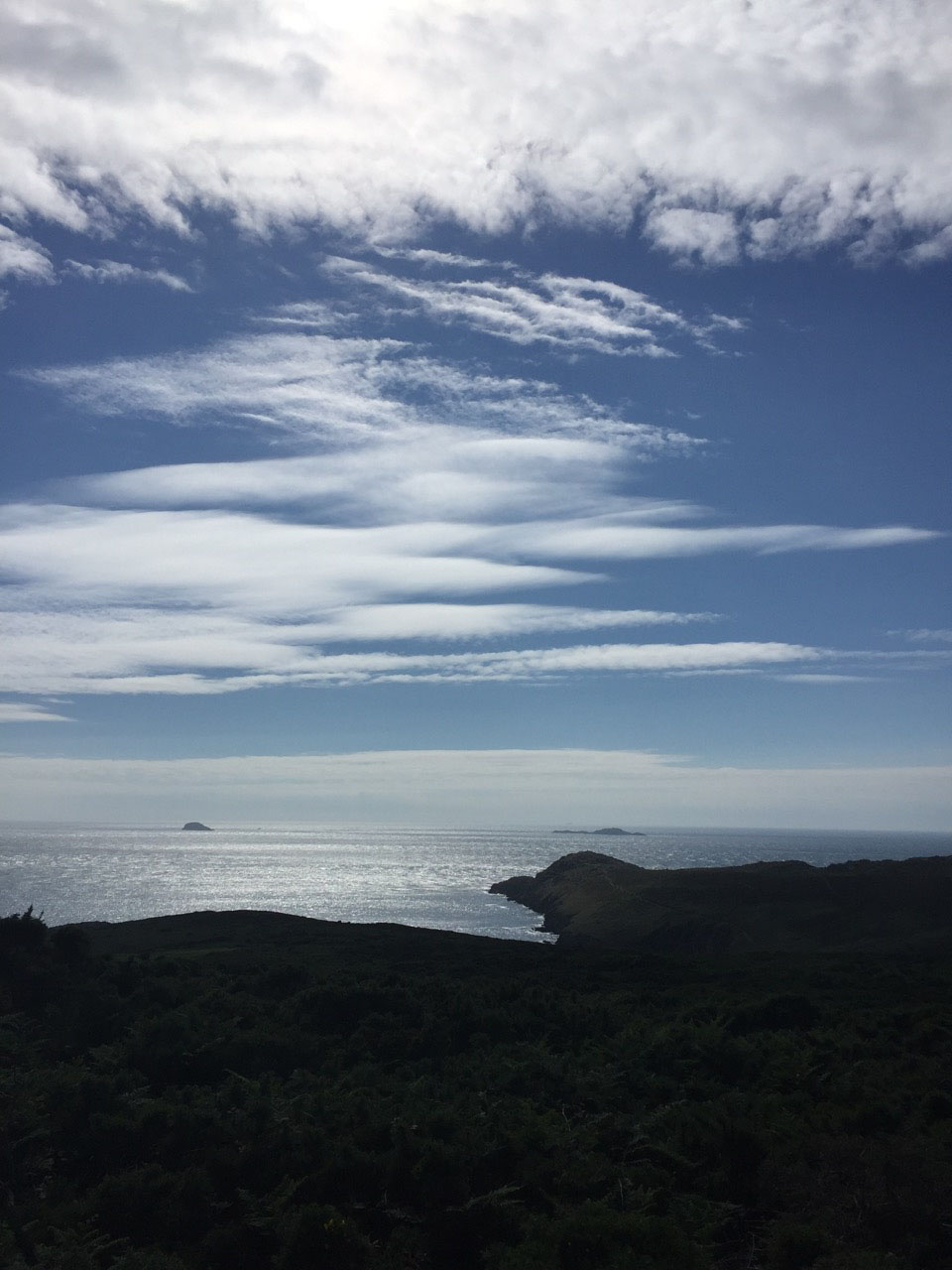
The day had been perfect and what finer way to cool the feet than to take off the boots and paddle in Whitesands bay…

Then it was time to return to the hotel to change, and a gentle walk into St David’s to have a pub dinner at The Bishop. All in all, the perfect Day One of our Whispers in the West weekend.

More to follow…
The Silent Eye runs four such weekends per year; in April, June, September, and the start of December. Apart from the main April workshop, which combines mystical drama with teachings, they are very informal occasions, but a good way to meet some of the names and faces from the Silent Eye School of Consciousness. Everyone is welcome – we simply wander in a landscape and get to know each other.
The formal teaching programme of the Silent Eye School is a three-year correspondence course, studied at home and in the individual’s daily world, with personal supervision via email, and workshops. The teaching programme is based on a guided journey through the spiritual layers of a nine-pointed figure called the Enneagram (below). The Silent Eye is a not-for-profit organisation and charges as little as possible for its work.
The Silent Eye’s version of the enneagram.
You can find details of the forthcoming events for the year on our website.
Share this:


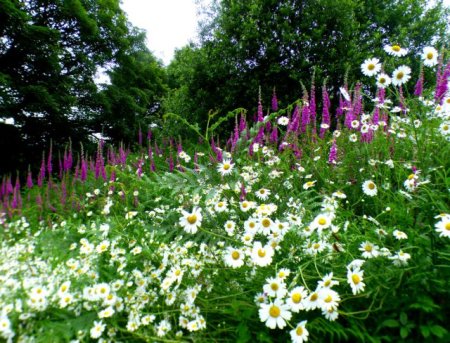
I want to have a cold tonight
And if you think I’m mad,
I have a real good reason…
The alternative’s too bad.
*
My head is really aching
And my eyes are awful sore,
The box of tissue’s empty
And I haven’t any more.
*
I’ve taken antihistamines
Because I thought I should
But even double dosage
Hasn’t done a lot of good.
*
I’ve checked the first aid cupboard
And there’s nothing useful in it.
I’m feeling pretty miserable
And sneezing every minute.
*
My nose is sore and tickling
It drives me up the wall…
So why would anybody
Want to have a cold at all?
*
I’ve just moved to a rural place
Surrounded all in green
With fields and grass and wildflowers
As pretty as I’ve seen.
*
And, as my nose is just as damp
As that of a retriever…
If I don’t have…
View original post 8 more words
Share this:

Just had to…
Share this:

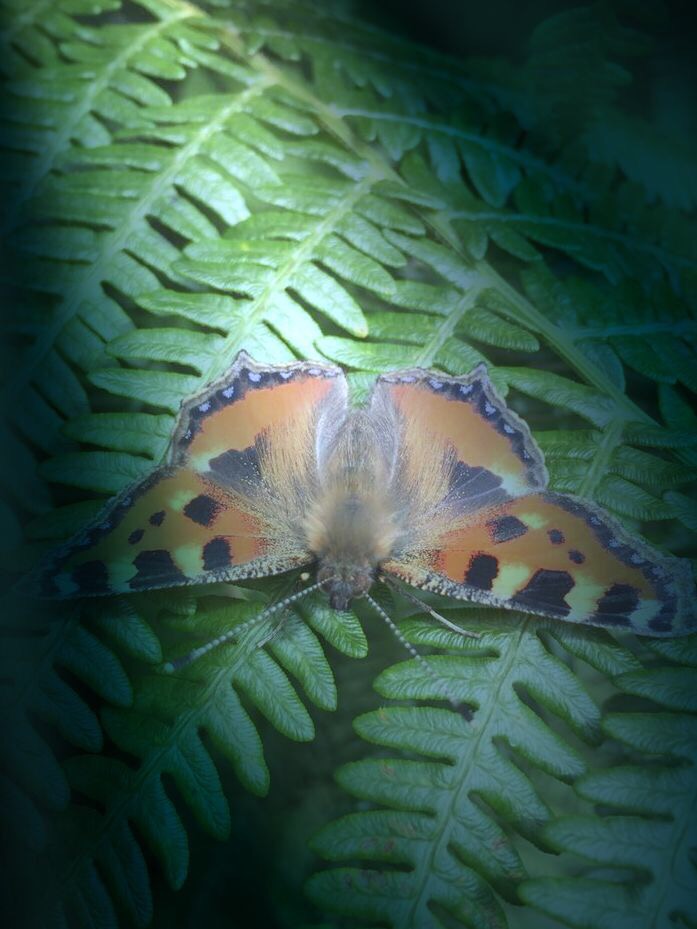
Gaily, you tell me
With perfect fragile beauty
Fear not, self-dissolve
©Copyright Stephen Tanham, 2016.
Share this:


Well almost…quite loosely speaking.
Very loosely speaking.
And no, it’s not a new quiz show. And nor are there any prizes. A tumulus is an artificial mound.
And a natural mound is what?
One that isn’t man made.
Has it anything to do with tummies?
Possibly… Not.
Oh!
Six tombs in one week isn’t half bad though…
We’ll be getting a reputation for morbidity.
And on the seventh day…
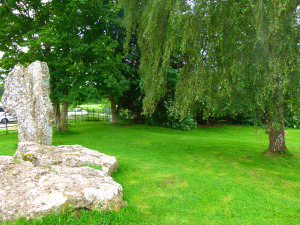
On that day once, somebody quite famous said that if the ruins of Ancient Greece weren’t ruined no one would pay them much heed…
The notion of being ‘quite famous’ tickles me. It’s like bragging about having once seen the Pope in order to prove your spirituality.
…I sometimes feel exactly the same about our tombs.
A lot depends on whether or not they’ve been opened…
Ah, but the Gates of Pluto must never be unlocked, Little Grub.
Why ever not?
View original post 492 more words


 Sun in Gemini
You must be logged in to post a comment.