
More ‘make you think’ stuff from Stu…
Share this:

Wisdom from Running Elk

 Attic Table Tennis
Woke up this morning to the sound of birds in the attic. Your actual birds in your actual attic, that is.
I’m often asked what a particular animal or bird “means”, in the mistaken belief that every encounter with the animal kingdom is necessarily a message from Great Spirit. In this instance, the message was fairly clear: “There is a hole in your roof big enough to allow birds to get in… might want to consider blocking that hole up.”
But this isn’t good enough for some folks. They’d want to know what type of bird it was, how many were there, what direction does the hole face… as if every minute detail of the encounter adds further, hidden layers of significance. We must accept that, sometimes, there are no hidden layers. It is what it is. Nothing more, nothing less.
To peer further risks madness. Stopping…
View original post 251 more words
Share this:

Beware, Britain, thus vision of healthcare could be just around the corner…
Share this:


History and Mystery on Caldey Island – Part Four, Two Ships
There were two ships on that day, each of them spoke of other dimensions…One completed our journey back from Caldey, in a way that could only be seen as symbolic. The other was the vessel called St Illtud’s church, whose foundations, and, perhaps some of the contents, had carried the ancient wisdom of the sixth century and beyond, so that we could gaze on it today with something approaching wonder.
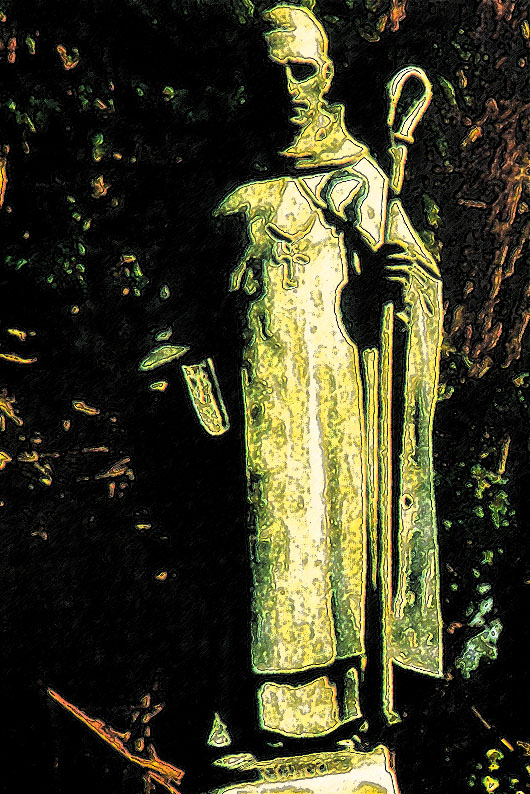
St Samson, the first Abbot of Caldey in the 6th Century.
St Sampson (above) was the first Abbot of Caldey island. He established the 6th Century Celtic Christian church, and later, its monastery, on the site that is now a ruin, apart from the outbuildings which form the perfume factory and the church of St Illtud.
The latter is mysterious home of everything talked about in this post. St Illtud was the founding ‘father’ of the Celtic church in this part of Wales, and his personal influence spread as far south as Brittany. It was fitting and generous, therefore, that the Cistercian fathers who took over Caldey’s Benedictine Monastery in 1930 should re-name the original church of St Mary, which stood on the site of Samson’s monastery, St Illtud’s.
(the previous posts have discussed the history of worship on Caldey, see the foot of the post for fast links)
There is a growing interest in Celtic Christianity. Many see joy in its directness of worship and its sexual equality, and much spiritual vitality is seen in its art, such as the wonderfully ‘illuminated’ Lindisfarne Gospels. Celtic Christianity, derived from the Eastern Christian tradition and heavily influenced by the Desert Fathers, was heavily oriented towards the works of John the Evangelist, which are widely seen as the most mystical of the of the Gospels.
To quote from Andrew Dunn, an authority on the role of Celtic thought within modern Christianity:
“The Johannine emphases on the presence of God among us, the Word made Flesh, the Spirit who has come in Jesus’ name, the risen Lord speaking to his Church and drawing it, and all believers, into union with him (“Abide in me and I in you . . . without me you can do nothing”1) – all moulded the Celtic way.”

The Lindisfarne Gospels, an example of objective art Source Wikki Commons
Celtic Christianity flourished on the fringes of Britain – particularly in the West, coming here from Ireland, and, prior to that, from the Eastern Church via Brittany, where there were training schools for early priests who would spread the word of the original church.
The Synod of Whitby, in 664 A.D., marked the official end of the endorsement of what we now call Celtic Christianity. It was gradually replaced by the Roman view of how Christ’s life should be viewed and emulated. But the Celtic Christian faith did not die out quickly, instead, it went underground, and continued to flourish for hundred of years in those Western reaches that had given it its early life.
Prior to all this, the people we now view as the original ‘Celts’ had been quick to adopt it. In their turn, the descendants of these people were keen to defend it, seeing in it a vital link to their forebears’ beliefs that nature was the ‘Second Book’ and that an understanding of the Divine Feminine was key to finding the ‘spirit’ in the world.

Rome took a different view and, even today, wrestles with the results…
When great beauty is expressed as spiritual art, as it has been from time immemorial, it presents the observer with an experience, rather than a seen thing. In the Silent Eye, we honour many of the ideas of the philosopher Gurdjieff, including his statement that such art reaches inner parts of our consciousness because it is objective – that is, it speaks an exact truth which is beyond the filters of belief, thought and prejudice applied by the subjective ego.
To create objective art requires that the ‘artist’ bring it into existence with this purpose in mind; and that such creators are then assisted by the innate power of truth in a creative process that can easily be seen as religious, but which can be described in many other ways, too, including those used by mystics. The inner cores of the world’s religions have always stressed that there is only one truth – and many windows through which it may be viewed.
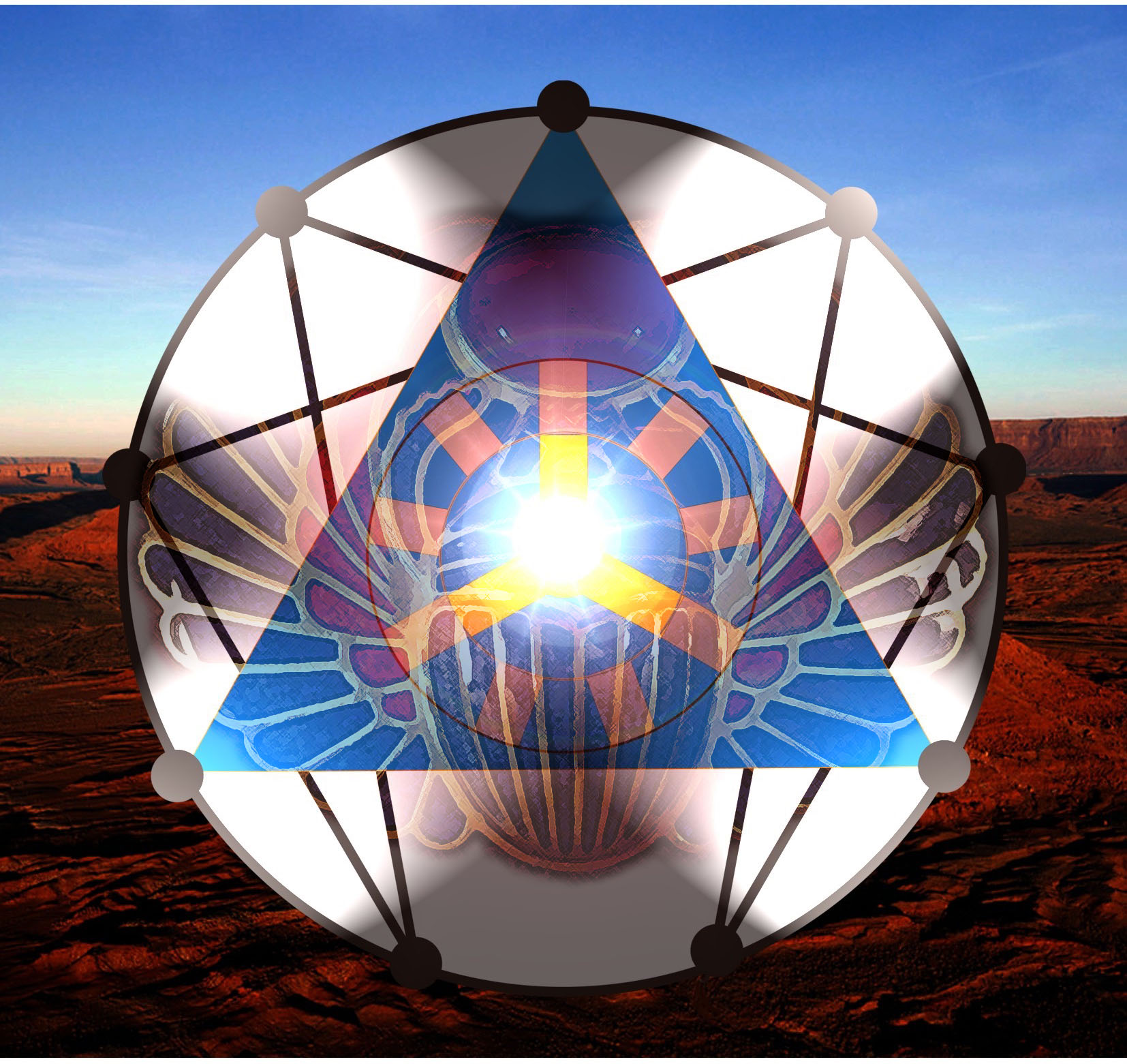
In the Silent Eye, we use the ‘stations’ of the enneagram as, firstly subjective, and latterly, objective windows by which the evolving soul can come to gaze on the beauty of its origins…
There are three wonderful elements of St Illtud’s church that speak of what I have come to think of as its spiritual ‘playfulness’ of purpose. One is the Caldey Stone, with its Ogham script, introduced in the last post; the second is a set of plaster engravings which depict very early Christian images; and the final one is a magnificent stained-glass window of St Illtud, himself – but with a very mysterious subtext…
We will consider the Caldey Stone in this post and conclude the series next time with a look at the other two.

As far as is known, the Caldey Stone was dug up in the old priory grounds in the 18th century. Local records from the time quote and elderly islander, ‘Ned of Caldey’, as saying that other inscribed stones had existed on the island; but none have ever been found.
The ancient Ogham script was used by the Druids and comprises a series of notches on the edge of the stone. The Caldey Stone, which has both Ogham and Latin inscribed on it, has been translated in several ways. One of the most respected experts, Professor Burkitt, translated the opening words as “With the sign of the cross, I, Illtud, have fashioned this monument.” This interpretation would date the Latin text to the time of St Illtud, who died in around A.D. 535.
But the Caldey Stone is only a single artefact. Around the lower parts of the walls of the Sanctuary in St Illtud’s sit over twenty plaster reproductions of ancient Christian art, and some of these are very enigmatic, indeed…

Previous parts of this series:
Part One, Part Two, Part Three
Share this:

Powerful memories…

A fictionalised account of the hillside rite from the Land of the Exiles workshop 2014, extract taken from Doomsday: Dark Sage.
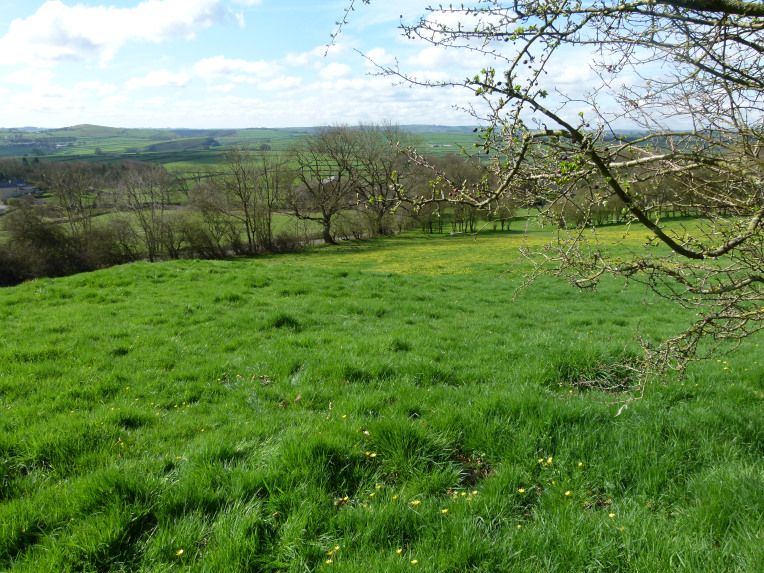
The seeing stone is chill against my spine as I wait for the dawn.
Their shades are close this night.
They are Wakeful.
I hear their whispers on the wind as the shift comes and I find them across the ages.
…She paints his eyes, smearing shimmering colour across the lids with gilded fingers. They work in silence in the yellow false-light. Garbed in black, they are not themselves. I feel them, yet something else overlays them, shadowing forth into the world; latent, coming, but not yet…not yet.
He leaves the place where she did not sleep; she looks into the cold surface that hangs like ice upon the wall, seeing other souls not her own. She is many, she is Three. I look through her eyes, as she…
View original post 977 more words
Share this:

Anyone using Microsoft Windows be aware…

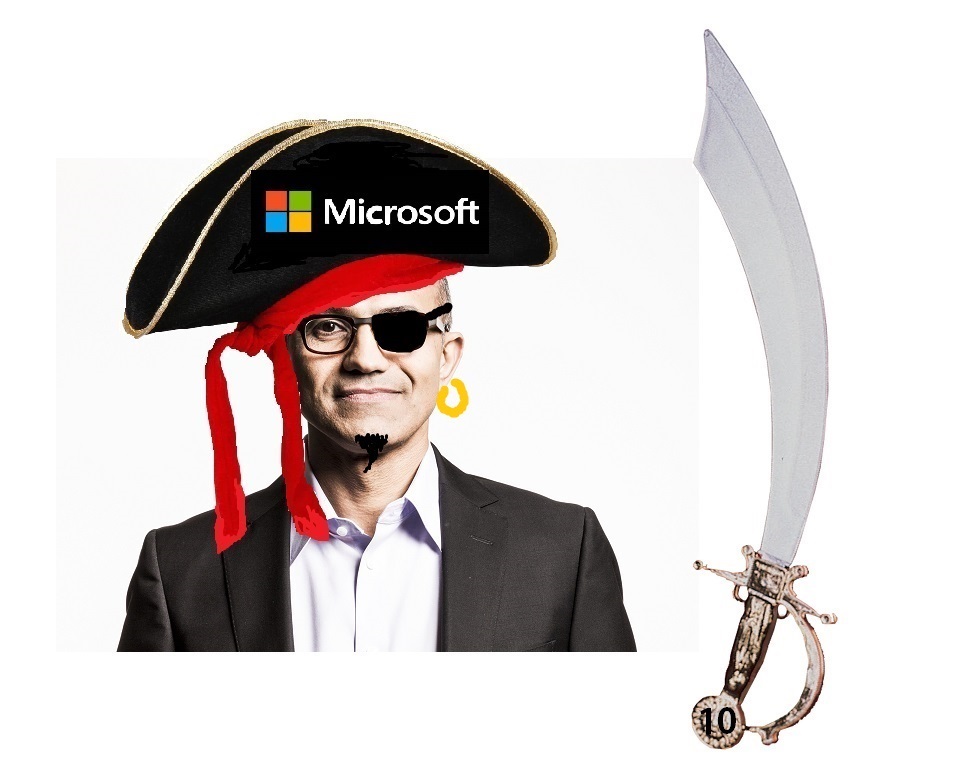
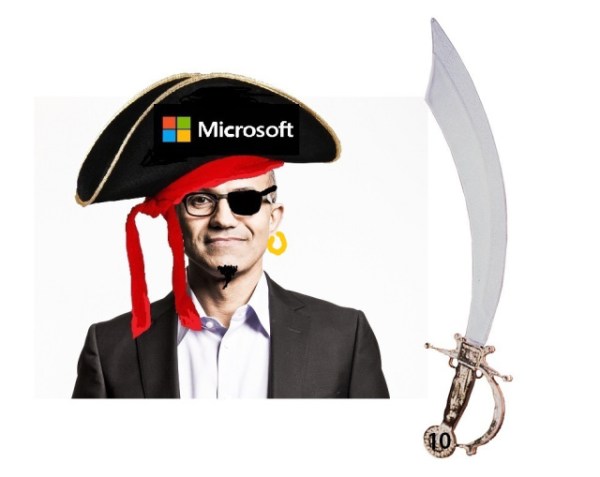 Photo of CEO Cap’n Satya “Microbeard” Nadella (the blackguard) courtesy of Microsoft. Though ’twere embellished a wee bit.
Look sharp, mateys! If yer ship be flying the flag of Windows 7 or 8, batten down the hatches and prepare to repel boarders. Cap’n Microbeard and his bloodthirsty band of pirates be sailin’ the interwebz’ stormy seas.
A co-worker turned on her computer last Monday morning and was hailed with a message congratulating her on upgrading to Windows 10. Shiver me timbers! We be sailin’ with Windows 7 on all the computers in our office and I don’t aim to change me allegiance – not now, anyways. Maybe later when all of me programs are compatible, but maybe never. That’s fer me, the captain, to decide. Leastways, it should be.
Microsoft thinks differently.
Their Windows 10 upgrade icon is stuck faster ‘n a barnacle to every ship in our armada, and…
View original post 885 more words
Share this:


The Hushed Portal
In response to Sue Vincent’s
Thursday photo prompt – Still water… #writephoto
⦿
The dark wall at which you have been staring opens
Breathing,
You breathe for calm and hold its presence
Knowing,
That something truly new is happening
Happening,
As your skin happens, now tingling as a child’s might
Your child,
Not as given birth, but as born anew, from within
Within,
As, matched into the moment, you rise, seeing
Seeing,
As thought and memory drop away, leaving only Being
Being,
Which maps itself, and guides your trusting feet
Walking,
Walking through the portal to the impossible beach
Walking from beach to the spit of dark land
Narrowing,
Narrowing your walk as your stride ends the land
Feeling,
Feeling the new waters lap your toes, ankles, thighs
Laughing
Laughing as dying fear is washed away in endless, depthless joy
Smiling,
Smiling with the joy of sunrise
Smiling with the joy
Smiling with
Smiling alone
Never alone again
⦿
©Stephen Tanham 2016
Share this:

+ enneagram, esoteric psychology, Haiku, Mystery Schools, Mystical poetry, Silent Eye School, Spirituality
Arty Tuesday – “Hiding in the Leaves”
by Steve Tanham

“Hiding in the Leaves”
Third in a series of Tuesday Art pieces.
Feel free to share or re-use, but kindly leave the notice intact to help
the Silent Eye School.
Share this:

Share this:

Sue’s moving words…
Share this:

A deep observation of nature from Sue…

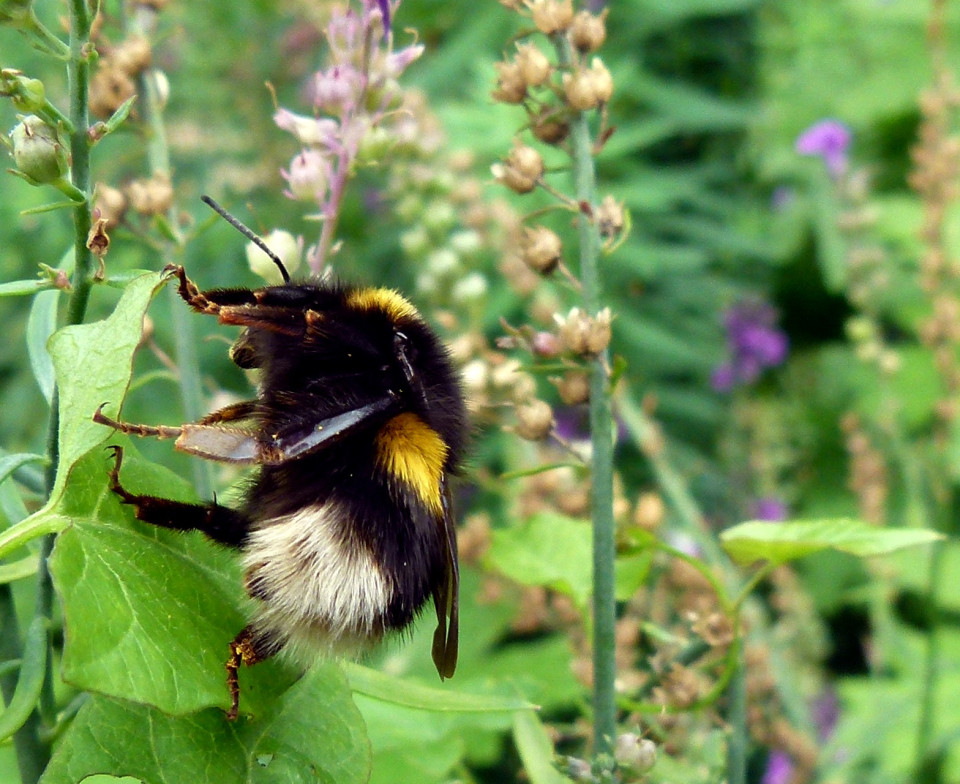
I have fairies at the bottom of my garden.
No, I haven’t lost the plot. Yes, they do look rather like bees, bugs and butterflies. Outwardly at least. But actually, in the reality I have chosen for them, they are fairies. They are creatures of earthly impossibility. Creations, it seems, designed almost to prove that the impossible is possible… and its unlikely realisation a truly magical and beautiful thing.

I wrote about butterflies once, how their journey through life, from mobile stomach to beauty incarnate, speaks to me of our own journey and the transformations we undergo as we travel through the changing landscape of the years. You could be forgiven, musing on a summer day, enveloped by the warm-honey fragrance of a buddleia covered in their painted delicacy, for wondering if their mere existence serves a higher purpose… that of simply Being There, to make us think and…
View original post 607 more words
Share this:

Beautiful and courageous words from an empowered Ali.

https://dailypost.wordpress.com/prompts/fork/
I have come to a fork in the road. It is dark, unknown, frightening. But adrenaline does not discriminate, does it? It is triggered by fear and excitement equally – and the bodily sensations are identical.
So, this fork releases floods of chemicals into my system. I look at the trees – tall, tightly-packed, apparently impenetrable – and the ghosts of childhood monsters howl and screech all around me. I peer at the uneven surface and am assailed by the fear of falling, of catching an ankle, of being wounded and vulnerable. I hear twitterings and strange animal noises in the thick undergrowth and my hair stands on end at the thought of huge predators waiting to add me to their evening meal. The uncertainty, the lack of maps and signposts, brings on a crisis of terror almost existential in its reach: What if I am lost and can…
View original post 595 more words


 Sun in Gemini

You must be logged in to post a comment.