

History and Mystery on Caldey Island – Part Three, Ancient Suns
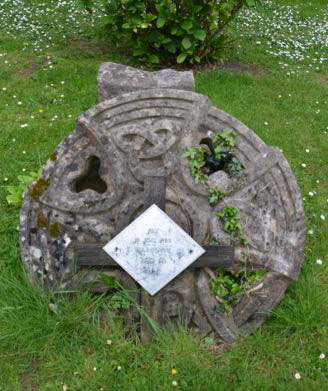
I had to crouch down to get the shot of the ancient sun, above. These wonders of ancient history occupy a very quiet and almost hidden place on Caldey Island, one I had stumbled across eight years ago, when we paid our first visit here. Then, the twenty or so plaster (reproduction) engravings were simply white and dusty and looked very neglected. Since then, someone has lovingly decorated them in red and gold.
They were the reason I had come back to Caldey. I remembered the chill of delight that ran down my spine as I first bent down with my camera, brushing dust and cobwebs off the old stone. Now I was back – and someone else had been back, too; someone official; with an intent to preserve…
But let’s take this one step at a time; and return to where we left off: the eastward side of the main Abbey buildings.

St David’s church stands outside the main Abbey enclosure. The Cistercian monks carry out their devotions in their own building, known as the Abbey Church. This was built by the earlier Benedictine monks in 1910. The Abbey Church is the eastern edge of the monastery cloister and was the first part of the Italianate-styled complex. The exterior has changed little, but the interior is far removed from its grand initial design, which burned down during a catastrophic fire in 1940. Today it is a very plain place, but no less sacred for that…
Visitors to the island may sit, quietly, in the viewing gallery, above the main church, to watch any one of the services which are strictly observed, beginning with Vigils at 03:30; then Lauds at 06:00; Concelebrated Mass at 06:45; Terce at 08:50; Sext at 12:15; Vespers at 17:30 and finally, Compline at 19:35.
Between these devotions, the monks work, rest, study and, occasionally, eat. They are vegetarian.

The Abby Church from the visitor’s gallery

The museum’s photograph, above, shows a service in progress.
Descending from the Abbey buildings, back to the common below, the path intersects a track that crosses over the raised spine of the island.

The steep, central road, with Tenby in the distance.
The climb takes you into what feels like a much less cultivated part of Caldey, ending on the headland at the place of the Caldey Lighthouse, beyond which there is only the ocean and… Devon.

Caldey Lighthouse… and beyond, on the horizon, Devon

But, about half way up the steep track, on the Western side, there is something remarkable…

A bank of once-tended gardens, with two of their own small lakes, marks the edge of a former area of cultivation.

An old stone circle – presumably a copy, but who knows? – lies, overgrown at the edge of a set of what look like grandly facaded farm buildings… and they are; but once, they were something else, something very different…

Not just an old farm…

The spire gives it away…
The spire gives it away – as a former church. But this complex of stone buildings, which for centuries has been used as a farm and, latterly, as the island’s perfume ‘factory’, is the site of the original 6th century Celtic Monastery which once went by the name of Our Lady Mary’s, and is now known, in honour of the saint who sponsored the original Celtic Christian presence on Caldey, as St Illtud’s Church.

St Illtud’s Church
Entering this very special place, you can feel the necessary division between the life of the Abbey, and its focus on the Cistercian Rule; and the more ancient worship of the Celtic Christian world.

The Caldey Stone with its Ogham Script edge
St. Illtud’s Church is built on the ruins of the 6th century, original Celtic church and its monastery. Many believe that elements of the original buildings were incorporated into what survives. The most famous artefact, mounted on the wall for all to see and, delightfully, touch, is the Caldey Stone, which contains the ancient Druidic Ogham script (above).

There is also a mysterious stained-glass window (more next time on this) that links the once-Celtic church to the Arthurian legends; and finally, there is that remarkable set of plaster reproduction designs that someone has so wonderfully kept alive to remind us of the most ancient of Christian thoughts and symbols from an age which remembered the teachings of two thousand years ago…
(to be continued)
Previous parts of this series:
Share this:


 Expansion, sculpture by Paige Bradley
“Empty your mind… empty yourself…you are nothing and nowhere… just floating in the embrace of the universe…” It is a nice idea and one I have heard at the start of many a meditation… and in meditation, such a vision has a place. As a way of living, it is not particularly practical though. Someone has to walk the dog, take out the trash and clean the bathroom… and a person wafting through life being ‘nothing and nowhere’ is unlikely to be getting down and dirty with a scrubbing brush or chasing a recalcitrant hound across a muddy field.
It is such concepts that, for some, consign the whole idea of spirituality to the odd corners of life. It becomes a pastime, something to ‘do’ in spare moments or with a group. It isn’t reality, is it?
For many others though, it is…
View original post 706 more words
Share this:

Share this:

Share this:


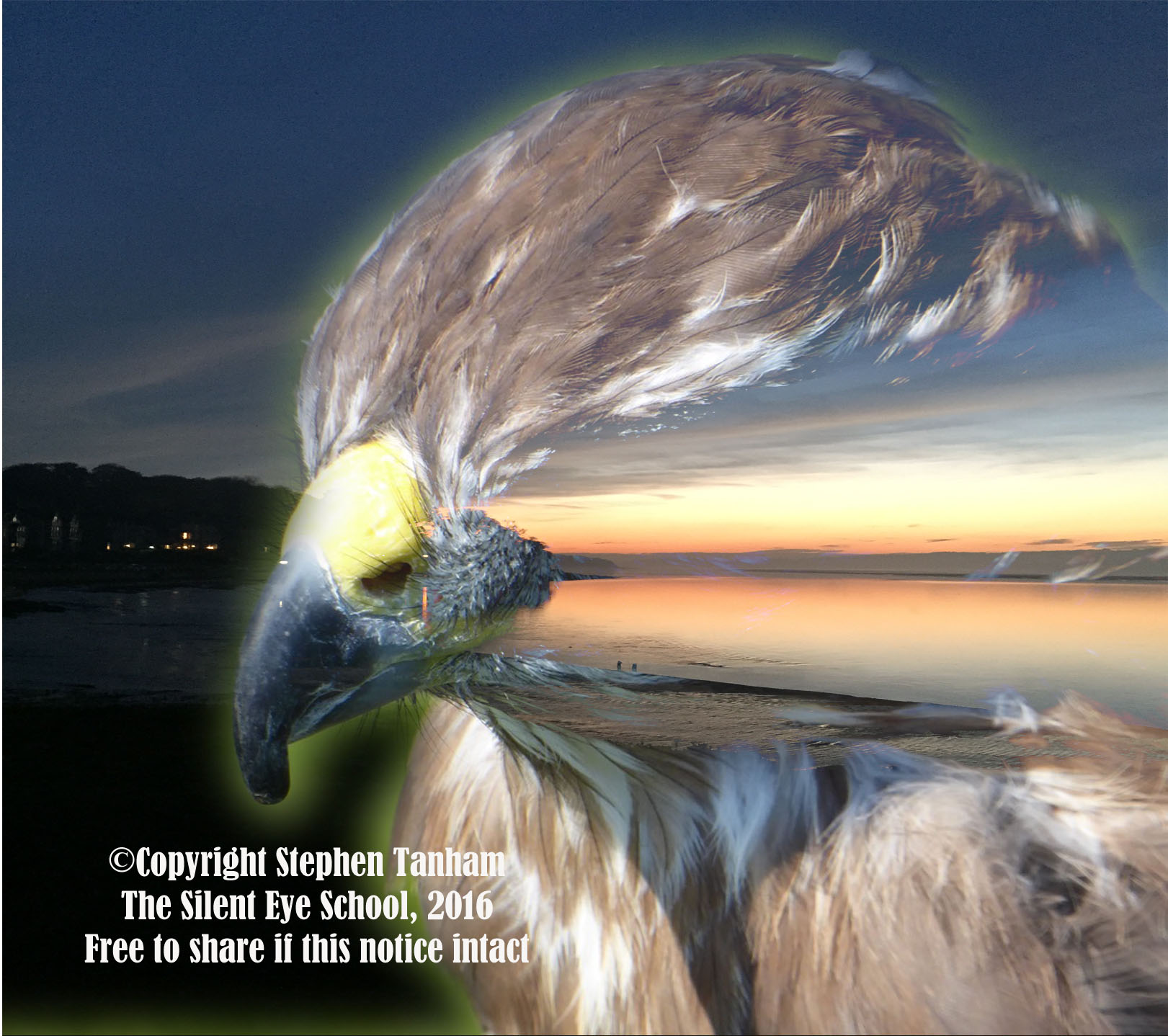
“The Seen”
Second in a series of Tuesday Art pieces.
Feel free to share or re-use, but kindly leave the notice intact to help
the Silent Eye School.
Share this:

Share this:


Sue, Stuart and I have been nominated for an award at the forthcoming Blogger’s Bash lunch in London on the 11th June. The nomination is for the Silent Eye and is under the category of “Most Inspirational Bloggers”.
We don’t know which kind soul has done this, but we’re very grateful…
Amidst the very talented blogs out there, we probably stand very little chance of actually winning anything, but every vote counts…
So, a big thank you to that unknown and wonderful friend… just for nominating us; and a huge cyber-hug for anyone who votes for us.
Also, Sue’s eldest son, Nick, whose courageous journey back from the effects of his horrific attack several years ago has been well documented in Sue’s journals, is nominated for “Best Newcomer”
Click this link to get to Sacha Black’s WordPress page to vote.
Thank you!
Steve, Stuart and Sue
Share this:


History and Mystery on Caldey Island – Part Two, Layers of the Cold Eye

At the eastern end of the main complex of Caldey Abbey a stone stairway leads upwards to one of the most enigmatic parts of the island.
St David’s is the parish church of Caldey Island. This may seem a strange notion, given that the impressive Abbey is next door, but the island has residents and workers who are not part of the Abbey’s interior life, and their spiritual needs need to be met, too.

All the more strange, then, that parish church of St David’s is built on a small hill which has a remarkable and culturally-mixed history.
At first sight, St David’s church looks plain and in no way ancient. But looks can be deceiving. The main parts of the present building are Norman, but the foundations and, possibly, parts of the nave, are Celtic Christian in origin, dating back to the 6th Century A.D., the time of the first Abbot of Celtic Christian Caldey – St. Samson. Samson was a disciple of the renowned Saint Illtud, whose base was Llantwit Major, now a small town, approximately fifty miles east of Tenby on the coast between Swansea and Cardiff.
From the Llantwig Major Historical Society web page:
“Llantwit Major (in Welsh Llanilltud Fawr) is named as the site of the main church of Illtud, one of the founding Saints of the monastic settlements of the 5th century AD in Wales.”
“Illtud came to this sheltered valley of Hodnant in the last decades of the 5th century. On the Ogney Brook, a mile inland from the sea, close to the site of the present church he founded his monastery.
At its height this was a major centre for education and evangelism in the revived western church, its influence reaching through Cornwall and Devon to Brittany and beyond, led by the students and successors of Illtud, Samson of Dol, Gildas the Wise and Paul Aurelian. Of the nearly thirty churches dedicated to Illtud almost half are in Brittany.”
Saint Samson, as, first a monk, and latterly, the abbot, of the first (known) religious settlement on the island is therefore of considerable importance to the story of Caldey. His importance to the founders of the present Cistercian monastery was highlighted in part one of this series of posts.

St. Samson (c490-565), stylised representation
The Celtic Christian settlement of Caldey continued until the 12th century, when the island was, once more, abandoned – to remain so until the early years of the 20th century. Historians differ as to the likely cause. Some say that the Celtic Christian monks succumbed to the ‘savagery’ of the marauding Vikings. Others say that the later non-Celtic church exaggerated the Viking’s story for its own political ends and that the invaders were quick to settle and integrate within Britain’s ancient landscapes…we may never know.

It is believed that Caldey’s name derives from two Viking words: ‘Keld’ meaning ‘cold’; and ‘Eye’ meaning island.
All this history lies, unnoticed, beneath the upper structure of what is now St David’s (parish) church…and elsewhere on Caldey, as we shall see…

The surrounding graveyard of St David’s church consists of simple wooden crosses – said to perpetuate the traditions of the ancient pre-history of this iconic hill which has been used as a place of sacred burial since time immemorial. This may be linked to the legends that islands were considered by the Celts to be ‘liminal’ places linking heaven and earth… Today, we might interpret liminal as ‘neither one nor the other’, but in the most ancient of Christian traditions, it could equally be interpreted as ‘partaking of the higher and the lower, producing something more, between…’
Entering the church of St David’s, you are struck by the simplicity of the place.

Simple, pilgrims’ wooden crosses line the entranceway, technically, I suppose, the narthex. Entering the nave you are immediately in a very simple place, yet one not diminished by this. Plain wooden chairs vie for space with the venerable font.

Turning to leave the simple space, everything changes when you look up at the western wall, over the entrance, to see the glorious stained glass design, “The Tree of Life”, created by Dom Theodore Bailey in the 1920s – shortly before the Benedictine presence faltered, to be replaced by the more austere, yet ultimately persistent, Cistercians.

“The Tree of Life” by Dom Theodore Bailey, Benedictine Monk of Caldey in the 1920s
The final image to be mentally taken away is a painting depicting the Christ with his Crown of Thorns, created by Cistercian Brother Gildas in 2008. You leave, feeling that much about St David’s – like the rest of Caldey, is unseen, and only to be revealed by much effort…

Painting of Christ with Crown of Thorns by Brother Gildas, 2008.
(to be continued)
Share this:

Share this:

A very thoughtful piece from Ali

Sometimes a buddy can come in the form of a person met only briefly…
https://dailypost.wordpress.com/prompts/buddy/
The inchoate weeping continued for most of yesterday, and has resumed (to a lesser extent) today. I am letting my body do what it needs to release some of the huge build-up of tension and fear. Cathartic, if painful.
This morning dawned the golden-white brightness of forge-heated gold, a metallic sheen which seemed to slide off houses and trees and pool in the centre of lawns. My body was that weird combination of poker-stiff and trembling which betokens high nervous tension. I needed to be out.
Velvet Bottom was calling strongly. Jumble struggled to get into the boot and, in giving him a hand, I felt something give in my lumber area (a vulnerable spot since I wrenched it push-starting my Puch 50 way back in 1979). But, I was not going to let that…
View original post 676 more words
Share this:


“Coming Home”
First in a series of Tuesday arty pieces.
Feel free to share or re-use, but kindly leave the notice intact to help
the Silent Eye School.


 Sun in Gemini

You must be logged in to post a comment.