
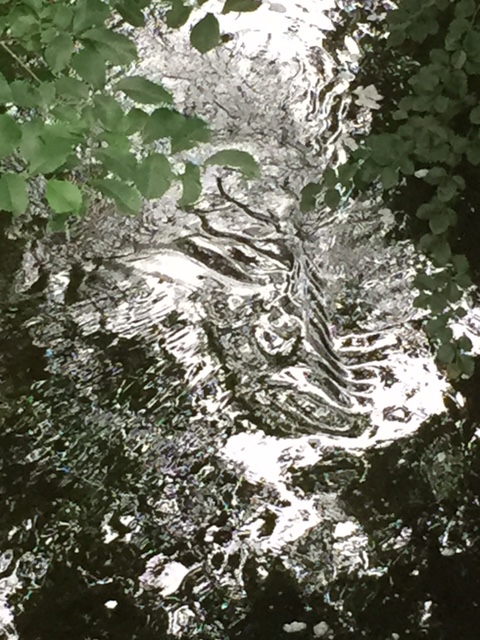
Inky Black
Beneath the vibrant greens
A ghostly figure forms
Half-seen
Whose
Inky blackness draws
A face from long-forgotten dreams
©Copyright Stephen Tanham words and image 2015
Share this:

One of Sue’s casual introductions to a so-deep meaning . . .
Share this:

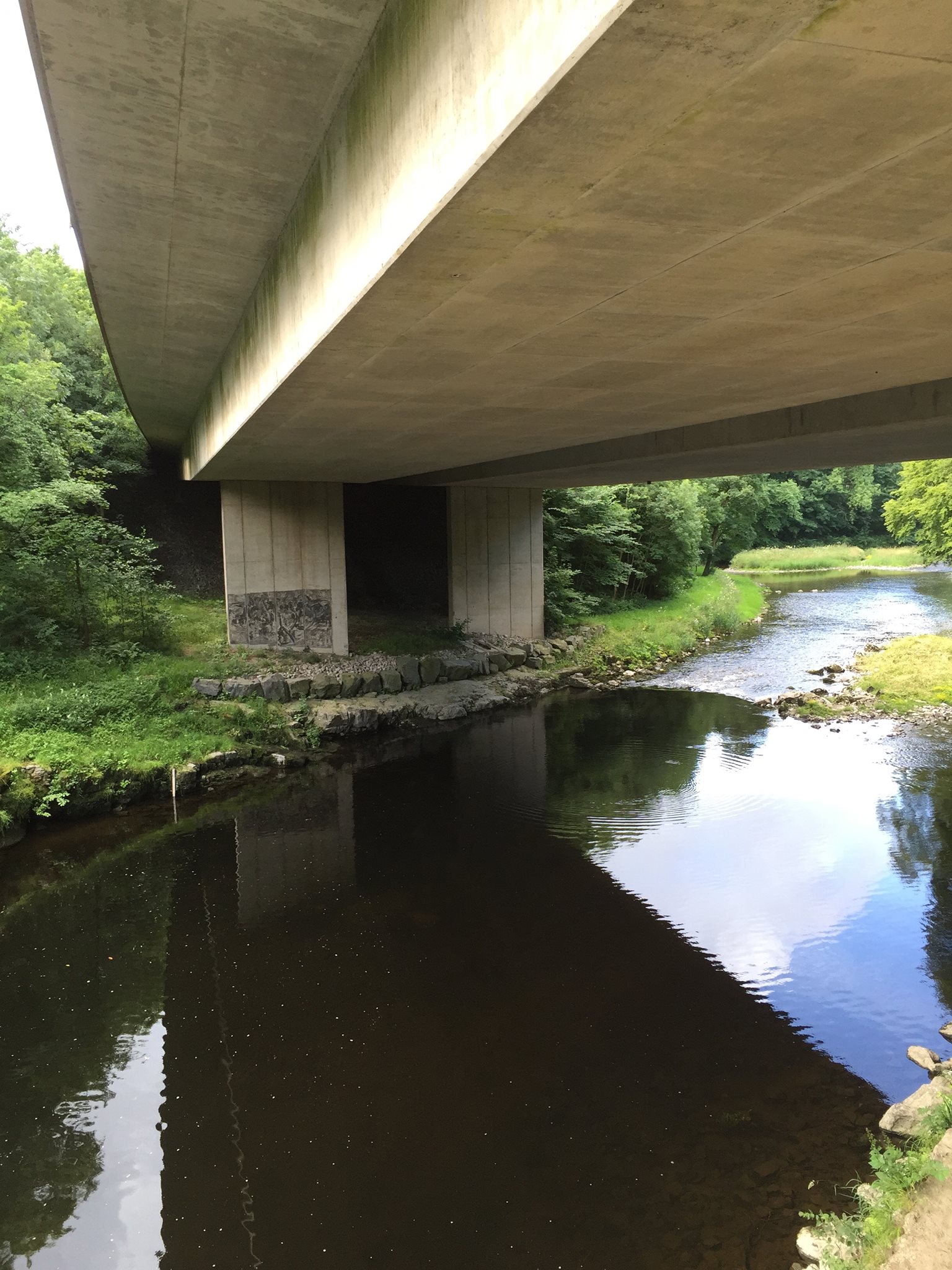
Bold lines drawn on my gentle curves
Hush noisy warrior
Come slowly with me
To the sea
©Stephen Tanham words and image, 2105
Share this:


There is a wall and, across the dark room, another wall.
I walk between them. Getting there – to the other wall – is the goal. What is in the middle is mere mathematics: five strides sees me across the old stone floor, and I practice so that my toe touches the far wall exactly on the fifth . . . the edges of the room are safer; I have no idea why . . .
Words come back. ‘It is as though I were dead.’ That came from a book, I think; one I had read recently. But, when I try to focus on the source, it seems to pull away, as though there were another reality that teased with its existence, but would not be grasped.
How long, now? How long have I been locked in here? One hour, maybe two? One pace, two paces, three . . . I stop at three, drowning in the exact middle of the dark space of the cell in Bakewell Jail. They can’t leave me here! Look, this is just a mistake, you don’t understand, we were only . . .
There is sound like the breech of an old rifle being loaded. The shutter mechanism in the ancient, heavy door slides back, revealing nine vertical slits of the face of the man I have christened Yellow Eyes. He looks in at me, then barks through the grill, “Back from the door – far wall.”
I was shown the drill when I entered; wearing the plain, grey prison pyjamas. They understand vulnerability in here; specialists I would say – very at home in an ancient backwater in deepest Derbyshire, where inspections are few and far between. I move back to stand facing the far wall and the key turns in the lock. Yellow Eyes enters.
“Present for you, m’lud.”
I hear him slap something down on the table. I’ve only been in here for a matter of hours, but already he’s used the term ‘M’lud’ several times. There’s a bitterness there, a bullying bitterness as though the stone we moved was his personal possession; and now he seeks his carefully crafted revenge in this, his kingdom, where I am imprisoned, on remand for our crime. I shudder at the thought of being under this man’s control, as his words fill my cell with his fetid breath and the image of a cruel smile that glistens around irregular teeth.
I turn to look at my ‘present’. I had asked for notebook and pen, to create a journal that would help me in this solitude. It isn’t there, but the small table, my only non-plumbing furniture apart from the bed, has several objects on it.
I need him to understand that I shouldn’t be here. “I really shouldn’t” . . . but he cuts me off.
“The Guv’nor checked it over,” he says, ignoring me and pointing at the torn parcel of brown paper on the small, metal table. “Seems your mother has sent you a parcel . . .” he sniggers. “Yes, we’ve checked, in case it was your accomplices, but no, it’s not – but don’t worry, we know you had help and we’ll catch them eventually; and anyway, we got to jail the ringleader!”
But no, they didn’t. Their six dark assassins of my freedom converged on the man stupid enough to go back for Wen’s air- rifle, with which she had expertly shot out the street lights around Bakewell’s All Saints Church. There’s your ringleader, I want to shout out . . . but I don’t. I don’t because something huge flies across the back of my consciousness, something that silences and invites deeper thought; something more real than anything in here . . .
Time seems not to have passed while I considered the implications of this. I stare down at the package. Its plain, white string has been cut in several places. There is something else beneath the parcel, something large and pale.
“And we thought you might like a copy of the local newspaper, M’lud,” he says. “Happy reading . . .” The sound is a chortle.
He says nothing more. Just turns and marches out, military like, slamming shut the heavy, steel door and turning the huge key in the old, but well-oiled lock.
Wanting to save the best for last, I first pick up the local newspaper, the Bakewell Gazette. There is something chilling about seeing your fate spread across the headlines in this way, something that speaks of a gateway entered into, a one-way turnstile to a spectator sport . . . and I’m the sport, it would appear . . .

———————————————————–<
Ben’s Bit is a continuing first-person narrative of the character created by Stuart France and Sue Vincent, which may bear some relation to the author of this blog, Steve Tanham, their fellow director of the Silent Eye School of Consciousness. In the latest of their books, Scions of Albion, Ben is arrested for his overly enthusiastic part in a mad escapade, and the other two are nowhere to be seen . . . For more, enjoy their Doomsday series of books, and the new series (Lands of Exile) beginning soon. Click here for details.

We were sitting by the river, though earlier than usual. The padded plastic-bottomed picnic blanket I had brought serving us well as a coffee base on the cold limestone, which was constantly made wet by the spray from the rapids in the adjacent river Kent. Neither of us seemed to mind the gentle mist. The thermos flask had been half emptied and we were enjoying our coffee. We talked, gently. To anyone passing over the nearby bridge, we would have looked a strange pair – Alexandra in her legal suit, albeit it with walking boots; and me in jeans and summer teeshirt.
The mood was gentle. Fear, the central characteristic of station six on the enneagram of personality, was not a topic to which we needed to add much drama: it had enough of its own.
“We are all afraid,” I said. “It’s just a matter of degree and what frightens us, most. But fear has a very special spiritual role to play for us, as well.”
She sipped some coffee, resting herself on one elbow. “And choice?” she asked. “You indicated last week that we choose a lot of our own fear . . .”
“Yes,” I considered my next words carefully. “We are really like a native American totem pole, one where the different figures are layered on top of each other.” I thought about that concept, and wondered whether that had been the original meaning of such sculptures. I dimly remembered other people having written about the idea. The lower figures would be nearer to the world of instinctive reaction – that which keeps us alive, certainly; but that which restricts the processes of higher thought and emotions until we have enough experience, and, later, trust, to build something greater on that hilltop.”
I pointed to a coiled length of old rope, lying half in the shallows of a quiet pool, well back from the torrent.
“Take that harmless snake over there,” I said. The rope was discoloured from its long journey downstream, and covered in enough green algae to look like a convincing, and quite large, grass-snake. I knew it wasn’t of course; but only because I’d been here with Tess, our collie, many times.
I could feel Alexandra tensing, even though I had said it was a harmless snake. “It’s not, is it – a snake, I mean?”
“We could go over and see?”
“We could, but I’d rather you tell me that it wasn’t!”
“But then you’d be relying on my reality, my experience; and not investigating your own.”
“Which is how most fear starts,” she whispered into the mist, standing up on legs that weren’t completely steady. I watched with growing admiration as she took two steps nearer to the possible green reptile. “I’ll go,” she said, half-turning back to look at me. “But will you hold my hand just in case I freeze?”
“Gladly,” I said. “I just won’t do anything to interfere with the vividness of your experience.” I stood and took her proffered hand. Together, we walked across the wet limestone. I could tell to the second the point at which her snake became an old rope. Her muscles unsnapped, fluidity returned to her body, and she began her customary laughter; but, this time, without the retributions.
“Did you know?”
“Yes. Didn’t think I’d expose you to a real snake, did you?”
“I didn’t know for sure . . .”
“Precisely – and in that authentic unknowing you became totally present to the moment, and explored it with power.”
She nodded. Pleased to have done this so well.
“Given that it wasn’t a snake,” I continued. “What were you frightened of?”
“What, who . . .” she mouthed, driven on by my relentless questions. She snapped her head up, straightened her back, and looked down on the rope. “Well, there were only three players – you, me and the old green rope.” She was still laughing – something we all do after an attack of fear. “And I’m not known for being frightened of old bits of rope; so It must have been me!” she said.
“Exactly,” I replied, “And there is a name for being frightened of ourselves, and that is anxiety. I paused to let it sink in. “Real fear – fear in response to a danger that is present, often has its own resolution built in to the problem. The brave bit is to see the problem fully, and therefore to be fully conscious to it; if possible, with no reaction at all – which I admit is easier said than done; but that shouldn’t stop us trying . . .”
“And the spiritual side of all this?” she asked
“All the inner traditions speak of a final act of coming face to face with fear, itself – not fear of an object – as the last act before a significant degree of illumination is given . . .” I paused before adding, “And remember that fear belongs only to the world of the ego, the personality – it has no place in the world of Being.
“And the importance of point six in all of this?”
“The dweller at point six, which we view in the Silent Eye as The Fugitive, is one whose life is lived on a volcano of fear, yet who is amazingly loyal and brave in action.”
“Sounds almost sacrificial?”
“Well, yes, in many ways, that’s how I view it, too, though the many excellent text books on the subject don’t dwell on that. Within the Silent Eye, we like to keep alive the ancient and magical ideas on such subjects, so I would say that sacrifice is a good concept to use, here . . .”
To be continued . . .
——————————-
Nine Deadly Sins with Coffee is usually published on Thursdays.
All images and text ©International copyright, The Silent Eye School of Consciousness, 2015.

Steve Tanham is a founding director of the Silent Eye School of Consciousness; a place of companionship, sharing and the search for the real in life, using the loving techniques and insights of esoteric psychology. He retired from a life as an IT entrepreneur to establish the School in 2102, and, having persuaded Sue Vincent to
Share this:


Beneath the lowering green,
the fallen branch splits
to copy the bend in the river
into which
its material will
slowly
dissolve
©Copyright words and image Steve Tanham 2015
Feel free to share but please attribute
Share this:

Another great set of photos from smackedpentax.
Share this:

I met Alexandra at the local station. She had agreed to spend an hour longer with me before getting the London train from Oxenholme, which serves the Lake District and has a direct link to the capital. She changed into her summer boots at the back of her car, and we walked the short distance to the local bakery, which had a tiny cafe, with excellent coffee. Grasping two tall take-away cups, we sat down on the metal chairs at the open front of the busy shop.
“Six,” she said. “I feel like we’ve been headed for type six for a long time?”
“Yes,” I replied, wondering how this would open itself out. “Six is the second most fundamental unfolding of the whole enneagram – from a personality or ego perspective, anyway.”
“And it has to do with fear?” She had been reading. That was no surprise, of course, but I knew that few books on the enneagram approached the topic from a truly spiritual perspective.
I sipped my hot coffee and burned my lip. “Ouch! – that will have to wait, possibly till we’re down by the gorge.”
“Gorge! I’m dressed for chambers, not mountaineering . . .”
“Don’t worry, there’s a road runs right by it.” I said. “A short scamper down through the forest and we’ll be on the flat limestone.”
I could see she was less than convinced. She had begun to fold the paper napkin that came with the coffee into a simple plane. I suspected the action was unconscious.
“Can you make boats, too?”
She looked at me, strangely, then down at her hands. “Yes,” she said.
“Will you make us one each?” I handed her my napkin and watched as her skilled fingers made light work of two small boats. They wouldn’t last long, but that suited my purposes.
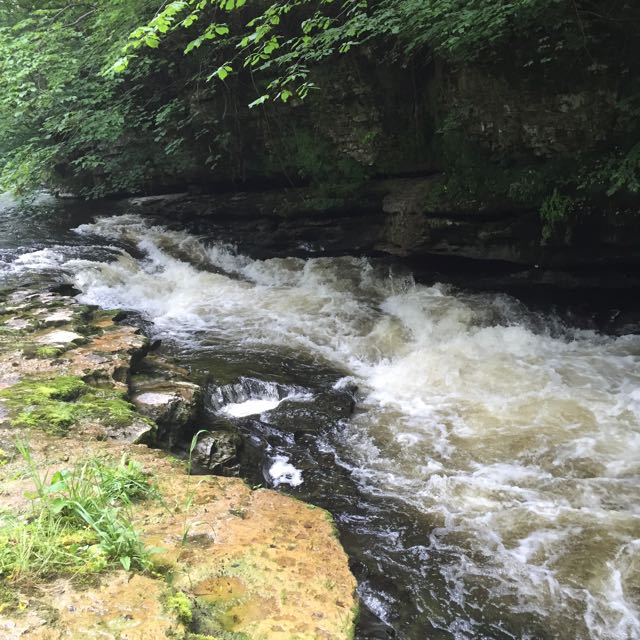
Fifteen minutes later we were standing by the river Kent, having just crossed it on the old footbridge that swayed as you walked its suspended length. She was still smiling from the rather scary experience; the Kent was quite wide at this point, and the water flowed slowly, gathering its forces for what was to come.
“This isn’t a gorge,” she said, looking around at the flat meadow with cows in it.
“That’s part of the fun.” I nodded. “You will be astonished how quickly the landscape changes.”
“A bit like life and the unexpected?” She was fishing; and cleverly.
“Exactly like that. Got the boats? – it’s time to release them into time . . .”
She took both of them out of the small rucksack she had taken to bringing when we met up for our ‘Monday madness’ as she termed it. “You’re wearing the wellingtons, I assume you’re going to launch them?”
I took the two small, paper boats and waded out as far as I could into the stream. Soon, the two boats bobbed away on the slow current.
“What now?” she asked, beginning to giggle.
“We run like fury!” I replied.
Seconds later, we raced across the old bridge like idiots, driving it to a frenzy of vibration. I could hear her hooting laughter as we charged up the small country lane before diving down under the fence and coming to a a halt at the edge of the limestone gorge.
“Wow!” she was breathless and still laughing, but astonished at the change of scenery.
“Wouldn’t think they were so near each other would you; the meadow and the gorge?”
Just then, I began to point upstream, to where two tiny white boats, half submerged, were about to enter the churning water of the torrent that fed into the gorge below. For a second we stared at them, before they were spun and sunk by the violent water, slipping past us a pale shadow of their former shape. Soon, they were gone. I took the coffees out of my shoulder bag. I had packed a cup holder and they were still relatively intact, if a little cooler.
We stood and sipped the coffee. “Shouldn’t we be sad?” she asked.
“What, choose to be sad?” I asked, smiling at her. “We’re having a perfectly lovely summer morning watching tiny boats swirl to their doom in the white water; why would we choose to be sad?” I paused a while, then said, “It would be like choosing to be fearful . . .”
Alexandra was looking perplexed. “But, isn’t that the point, that, in real life, the tragedy would be much more serious?”
“Of course,” I smiled. “But even then, the perspective we need is the one of the two people on the bank of life, watching the inevitable and drinking coffee and being happy – because to do anything else is just choosing sadness . . .”
“Little people on the boats would have been terrified?” she queried.
“But only when the water became a torrent – until then, they would have been enjoying a pleasant sail on a summer’s day.”
She finished her coffee. “I’m going to have to think about that,” she said, handing me the empty cup. “Can we carry this on next week – and come back here?”
“Of course,” I replied, taking her arm and escorting her up the muddy slope and to the car.
To be continued . . .
——————————-
Nine Deadly Sins with Coffee is usually published on Thursdays.
All images and text ©International copyright, The Silent Eye School of Consciousness, 2015.
Steve Tanham is a founding director of the Silent Eye School of Consciousness; a place of companionship, sharing and the search for the real in life, using the loving techniques and insights of esoteric psychology. He retired from a life as an IT entrepreneur to establish the School in 2102, and, having persuaded Sue Vincent to
Share this:

For those interested in the Silent Eye School of Consciousness, we have recently (July 2015) re-written our eleven-page overview about our Work. The images and text below are extracted from the downloadable PDF document, which is also indexed to provide fast links directly from your browser. You can download the full version of this by clicking below:
Silent Eye 2015 Gen BrochureV1AA

The Call of the Soul (Cover Page) – An introduction to the work of the Silent Eye School of Consciousness
“Have you wanted to wake up to a world in which you feel you really belong? A world where your experience of life makes perfect sense and you greet each day with both fulfilment and purpose? A world that recognises your unique beauty…. and offers you its own?”
A Modern Mystery School (Page 2)
‘A Modern Mystery School’ – It’s a simple statement, but it carries a powerful intent and a history of delivery with it . . .
“Your task is not to seek for love, but merely to seek and find all the barriers within yourself that you have built against it.” Rumi
In 2013 three people, Steve Tanham, Sue Vincent and Stuart France came together after decades of service to other mystical and magical organisations to create the Silent Eye School of Consciousness – choosing to establish it as a not-for-profit organisation . . . They believed it was time to create a new path – a synthesis of modern and traditional spiritual development that would speak . . .
Life seen as a river of consciousness (Page 3)
When we stop to think about ourselves, we can compare our lives to a river, flowing through time and events, from which we collect, and come to identify with, the memories of good and bad things. This collection of mental and emotional self-portraits becomes . . .
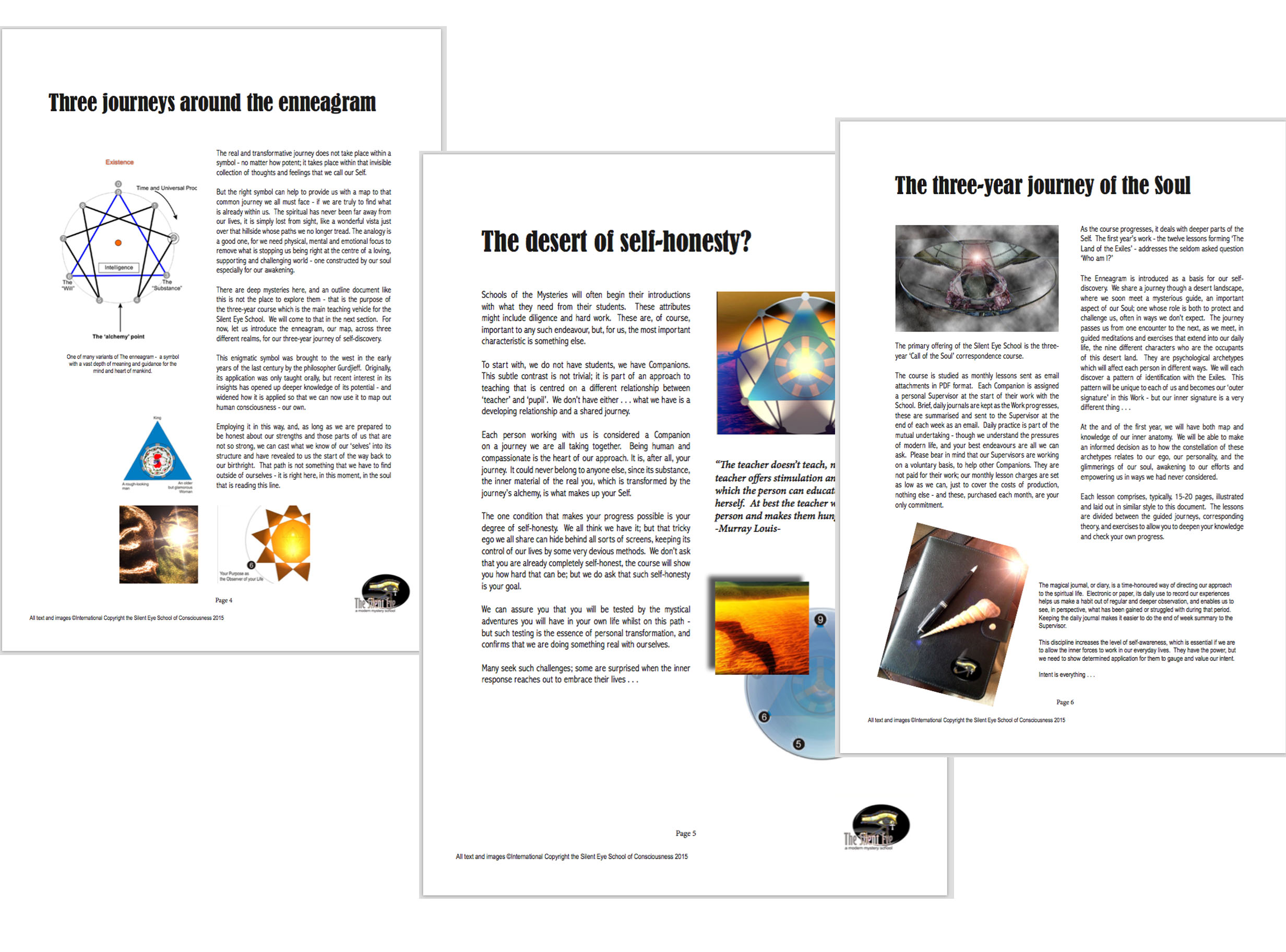
Three journeys around the enneagram (Page 4)
The real and transformative journey does not take place within a symbol – no matter how potent; it takes place within that invisible collection of thoughts and feelings that we call our Self. But the right symbol can . . .
The desert of self-honesty (Page 5)
Schools of the Mysteries will often begin their introductions with what they need from their students. These attributes might include diligence and hard work. These are, of course, important to any such endeavour, but, for us, the most important characteristic is something else . . .
The three-year journey of the Soul (Page 6)
The primary offering of the Silent Eye School is the three-year ‘Call of the Soul’ correspondence course . . .

The Land of the Exiles (Page 7)
The Land of the Exiles comprises the first twelve lessons of the Silent Eye’s three year programme – the First Degree. We can only begin a journey from where we are, now . . . This sounds trite, but is an essential consideration if . . .
The Exiles . . . and you? (Page 8)
A constellation of players, all arranged to bring you face to face with the outer aspects of your psyche. They will reveal to you the emotional, physical and intellectual parts of your being – and let you explore what should be happening inside your life . . .
Years Two and Three? (Page 9)
We can only say a little about the second and third years of the Silent Eye’s correspondence course. The further journeys follow the same learning process, moving deeper into the . . .

From Learning to Being (Page 10)
The intent of the Silent Eye is to provide learning through experience. Four times a year, as close to the Solstice and Equinox points as we can practically make them, we host a cycle of gatherings . . .
Reaching out – across geographies (Page 11 – final page)
We know the spiritual journey can be isolating. Only a few people share the dedication that the path requires. The School has students from across the world, some of whom live far away from the support and friendship of like-minded people. This is why we took a decision to use social media to create a feeling of community where fellow Companions can meet . . .
Download the full, internet tagged document by clicking the link below.
Silent Eye 2015 Gen BrochureV1AA
Share this:

Some beautiful Derbyshire thoughts and pictures from Sue Vincent
Share this:

Sedburgh is only half an hour away from us, here is a lovley photo tribute from smackedpentax
Share this:

Alexandra was picking her way along the shoreline at the edge of the bay, probably cursing me. She was clutching a printed copy of the email I had sent her, asking that she bring sensible footwear – for which, these days, she read ‘boots’ – and allow a little extra time. The note closed with my offer of bringing the coffee.
I had a short time remaining before she would find me. I closed my eyes and summoned up ‘Rocky’ – my short name for the Silent Eye’s archetype of point five of the ‘outer rim’ of the enneagram. Along with Sue and Stuart, I had developed these figures of the mind to illustrate the dominant principles of the outward-facing aspects of the nine-pointed ‘truth machine’.
Not that everyone wanted to know the truth . . . you had to learn to love it for its own sake; for the stony path could be sharp and painful to tender feet shorn of their usual worldly footwear. But the School wasn’t about comfort, though we didn’t seek, deliberately, to be without it; it was focussed on those determined souls who wanted to dig into the fertile soil of their own lives . . . and see what else might be capable of growing there.
Alexandra was in an unusual position: we had been friends for many years, so, although she could have simply enrolled as a student and studied via the Silent Eye’s correspondence course, my partners in the School judged circumstance to have brought her and (collectively) us together – and that allowed direct teaching, via our brief meetings, in addition.
I looked back along the beach trail to where she was rapidly narrowing the gap between us. She still couldn’t see me, which was part of the setup; though I could view every step of her progress. Soon, she stood below my rocky perch at the end of the path, staring out at the retreating tide and looking bewildered.
“Ahem!” I coughed from above, in what I hoped was a friendly fashion.
She smiled and looked up, “Oh you’re there – being a Type Five, no doubt!” She gazed up at me, watching me admire her intellect.
“Well, yes, actually . . . so, since you seemed to have grasped my methods, tell me, from what you see, something about fives . . .”
She looked up. “I’m looking up at you,” she said. “So there’s got to be something about position in this? – I know, you’ve placed yourself above me, using your knowledge of this place.”
“And why would I do that?” I asked. “Am I preventing you from coming up here, too?”
Alexandra examined the short and steep path that would reunite us, but then noticed that I occupied the only natural seat at the top of the scramble.
“Hmm,” she said. “No, but the path is. Not much chance of sharing a coffee up there!”
“So, I’ve located myself above your world, in a singular position, is that it?”
She scanned the rock, again, looking for clues in the rucksack I had set down on a ledge in the dark rock, just to the side of me. She found none.
“Are we having coffee at all?” she asked, reasonably, still digesting the tableau.
“You not only covet my high and secure place, you want to have some of my coffee, as well?” I made it sound as accusatory as possible, though I was starting to grin by the time the words were out.
I pressed home the point, knowing it would leave me bordering on ‘Mr Nasty’, again, “Why should I share some of my hot coffee with you?”
The dual assault of isolation and meanness looked like it had begun to irritate her.
Rejecting that road–so recently endured, she took a breath and triumphed by laughing at the situation. “Okay,” Another deep breath. “So you’re frightened of me,” she said. “So frightened that you don’t even want to open that flask and share some coffee – something that would bring us closer together and make you share more than just the coffee.”
“Ouch . . .” I said, softly, feeling Rocky’s control of the moment slipping away . . .
She smiled up at my crumpled face, taking fuel from her growing triumph. “You want to be separate from the world. You want to keep everything you’ve got!” I smiled and her face burned with the truth of that revelation. “You’re a Fear Type, and your reaction to fear is to shore up your massive mistrust of the world – your world – by locking yourself away in a clever place from which you can engage with the world just as little as you want to . . .”
She was breathless. I looked proudly down on her flushed and breathless face. Then, she did something uncharacteristic – she crouched, cat like and scanned the rock face, looking for footholds and talking to me in an hypnotic way, as though fixing her prey with the words.
“In doing this, you keep the world from doing what it does best . . . evolving you!” She sprang at the rock face. I had started to slide off my rocky seat, to rejoin her below, but now, she was coming at me like a tigress. It was my turn to freeze, as, like a professional climber, she scaled the vertical distance between us and forced herself into the space that was only secure for one.
“My turn,” she said, triumphantly. “My turn to play the force of Life . . .” She reached for the flask, then she held onto my arm to pour the coffee, forcing me to brace us both against the stone to avoid a painful tumble.
For the next few minutes, we stayed like that, until the small coffee cups were drained, and my cramping muscles could take no more.
Some time later, we walked back along the edge of the sand. I didn’t need to say anything at all. She had risen above the world of reaction and found a jewel of real action in the moment; and she and I both knew that the world had changed. . .
——————————-
Nine Deadly Sins with Coffee is usually published on Thursdays.
All images and text ©International copyright, The Silent Eye School of Consciousness, 2015.
Steve Tanham is a founding director of the Silent Eye School of Consciousness; a place of companionship, sharing and the search for the real in life, using the loving techniques and insights of esoteric psychology. He retired from a life as an IT entrepreneur to establish the School in 2102, and, having persuaded Sue Vincent to


 Sun in Gemini
You must be logged in to post a comment.