
From Stuart. Also see The Stone and the Pilgrim (2) for the context

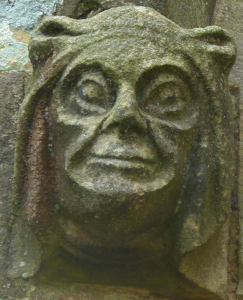
*
… At this his relations were sore amazed; not for that they believed
that what he said to them was true, but because they thought that
some frenzy distemper had got into his head; therefore, it drawing
towards night, and they hoping that sleep might settle his brains,
with all haste they got him to bed.
*
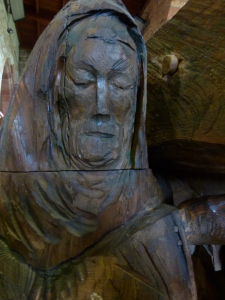
*
But the night was as troublesome to him as the day; wherefore,
instead of sleeping, he spent it in sighs and tears.
So, when the morning was come, they would know
how he did. He told them, Worse and worse:
he also set to talking to them again; but they began to be hardened.
*
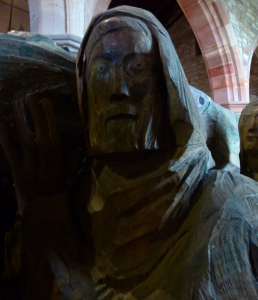
*
They also thought to drive away his distemper
by harsh and surly carriages to him; sometimes they would
deride, sometimes they would chide, and sometimes
they would quite neglect him.
Wherefore he began to…
View original post 118 more words
Share this:

From Sue…
Share this:

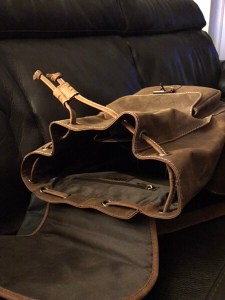
Sunday went back into the house. On the settee where he had slept was a new leather backpack.
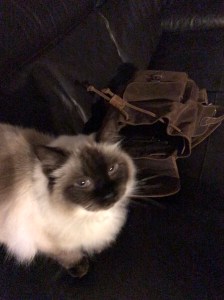
As he gazed at it, suspiciously, the cat appeared, again…

…And proceeded to wriggle itself into the bag…
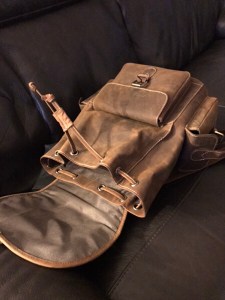
Until not even its tail could be seen.
“Mow?” said Sunday, confused.
©Stephen Tanham
Share this:

+ #Silenti, Ancient Landscapes, Consciousness, esoteric psychology, Silent Eye School, Silent Eye Workshops, Spirituality
The Stone and the Pilgrim (3)
by Steve Tanham
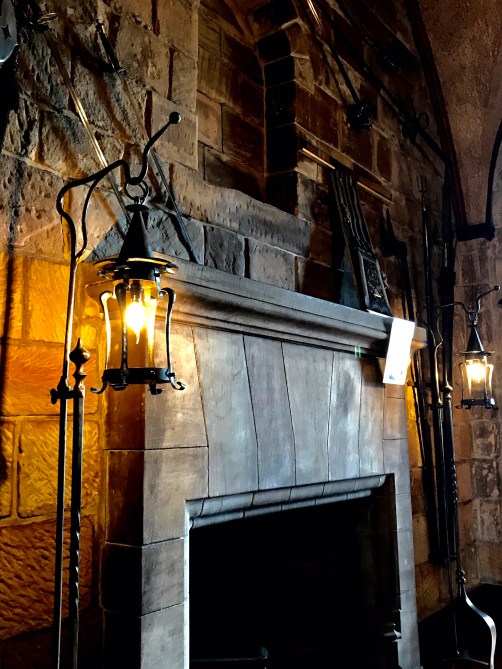
“It’s all about tea-rooms, with you, isn’t it!”
It was said some years ago, and there was anger in it – just a bit – but she was right. We both collapsed in a heap of laughter on each other’s shoulder a second later.

There has to be humour in these weekends. They can be very intense – not by imposition, but by personal choice. When those attending, particularly for the first time, see the effect of a group of fellow adventurers working with the landscape, it can become infectious. We’re not just here as tourists, though that’s great fun and part of it, we’re here to experiment with consciousness – in a loving and lovely way. If that doesn’t harmonise a group, nothing will.
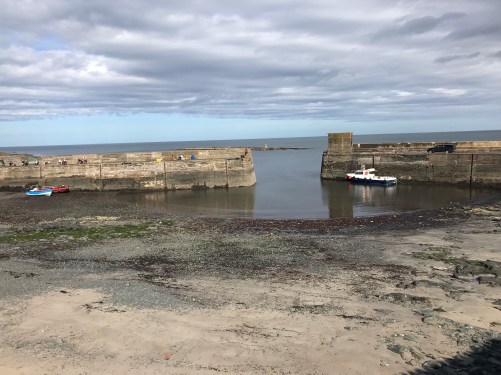
It is all about tea-rooms, but that’s a generic term… A charming gastropub on a rocky promontory just outside the harbour of one of the most charming of Northumberland’s seaside villages will do just as well… especially when one of their specialities is crab soup. It’s not a chowder (I love chowder). It’s better than that….

Saturday lunch time 15th September, 2018, the middle of the second day of the Silent Eye’s ‘Castles of the Mind’ workshop. Some of those attending are still quiet from the intensity of being in Bamburgh Castle with rather different motives than most tourists, though our respect for the place was not in doubt.
There is a degree of mystery about why we’re here, in the Jolly Fisherman, Craster. Everyone remembers the dramatic opening to the weekend on the beach, under a fabulous leaden sky. The guide pointing north across the white fringed, green-blue sea to the distant but clear image of Lindisfarne – our eventual destination, and the conditioning force behind us becoming pilgrims for these few days.

The line between Bamburgh and Lindisfarne does not include Craster; this tiny harbour village, famous for its picture-postcard harbour, smokery and one of Northumberland’s most famous coastal walks is some distance south.
The crab soup arrives, complete with a huge chunk of granary bread; the whole thing served on a wooden platter. I’m in heaven. The aroma, alone, tells me that my memory of the planning trip some months ago was accurate…it really is that good. I’m one of the drivers, so a weak lager shandy has to accompany it. It’s quite enough. We arrived in separate cars. One of the Companions suggest he had done an impromptu magical invocation on arrival at the over-full car park (the only one in Craster). It must have worked, because three cars left as we rounded, somewhat desperately, the last corner of the parking places. I think he’s serious…
We eat. Minds come back to the simple and connective process of the body’s food…and we begin to talk. Those present sense the exact nature of the location and its place in the planning of this rather intense day.
“We’re in search of something, aren’t we?” The car park magician asks.
We are, indeed…

Having examined, in the most perfect evening light I can remember, the splendour of Bamburgh Castle as seen from the beach; to venturing into its depths and its splendour in the morning just finished, we have begun a process of individual alchemy. We used the landscape to ‘cheat’ the ego from the beach, visualising the whole of it from the outside. The portcullis visualisation allowed us to ‘steal’ into that egoic lower self and seek (or at least request) the finding of an emotional ‘key’ – different for each of us. Entering the castle this morning allowed us to fulfil that part of the the quest: to venture inside the stone that we cast as hard and defensive shell of ourselves – grown in reaction to our lives, just as the castle grew in response to the need for organised defence of its existence.
Those within it become ‘royal’ in the process, just as our reactive self claims royalty over our lives. Tearing ourselves free of the castle’s comforts – because the call of the Pilgrim was greater – we find ourselves having crab soup and bread in a haven above a rocky and black shoreline…
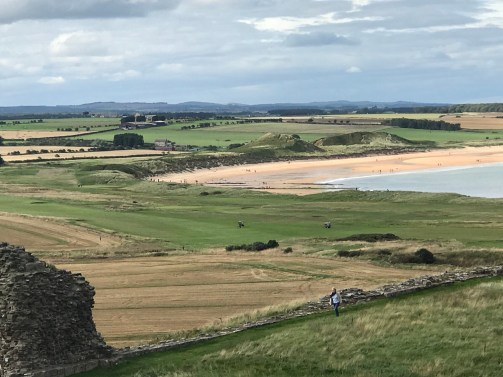
What’s going on?
Well, the path outside that’s waiting for us is not just a journey along this savage but beautiful shoreline. Halfway to Embleton’s golden beach it passes something that haunts everyone who sees it…
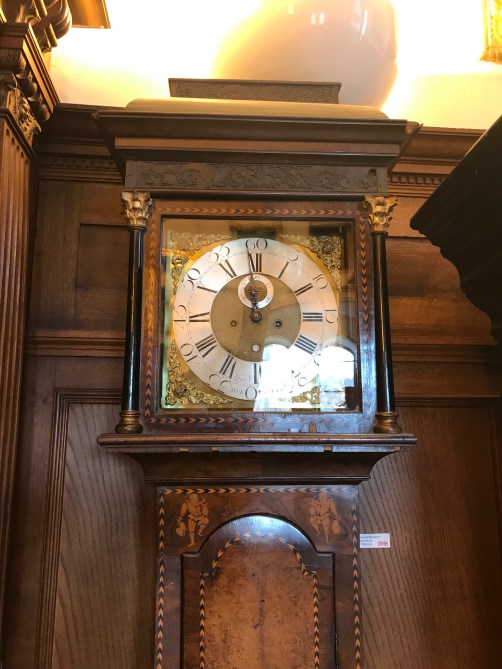
The clock is ticking… That something, that ghost on the headland, and its significance in the Silent Eye’s weekend is where we’re going. And the soup is finished….
To be continued.
©️Stephen Tanham
Other parts of this series:
Stephen Tanham is a director of the Silent Eye School of Consciousness, a not-for-profit organisation that helps people find a personal path to a deeper place within their internal and external lives.
The Silent Eye provides home-based, practical courses which are low-cost and personally supervised. The course materials and corresponding supervision are provided month by month without further commitment.
Steve’s personal blog, Sun in Gemini, is at stevetanham.wordpress.com.
You’ll find friends, poetry, literature and photography there…and some great guest posts on related topics.
Share this:

From Alethea in response to Sue’s weekly #writeohoto challenge.

 Photo Credit: Sue Vincent
The structure was created by a more modern hand, but the transport was real. A hallway to the Hypogeum opened within his mind as his feet traveled the corridor. Each pillar marking a lifetime passed or yet to come, covered by shadows broken by light. Not the false light ensconced above. No, they had turned that off before they pushed him inside. He could feel the warmth of the womb closing in around him, but also its darkness. The pulse of the Mother-heart pumping memories through his blood. Her cord feeding, but also recording life before it is taken away. The circle felt endless, the space within infinite. Fear pushed the shroud further over his forehead, closing the eye. They had warned him this might happen in some form. The fist of the ego-mind closing the light of the heart is something he knew all must face. He…
View original post 88 more words
Share this:


Rested, the group of pilgrims gathers on the Saturday morning beneath the vast presence of Bamburgh Castle. The castle was restored to its present glory by the 19th century munitions entrepreneur and inventor William Armstrong. Lord Armstrong bought it from the Crewe trustees in 1894 for the sum of £60,000 – a fortune then. He went on to spend a further one million pounds creating an iconic English castle which would be used as a convalescent home for ‘well educated people who had fallen on hard times’.
Armstrong’s descendants still own and use Bamburgh Castle, though they have other dwellings. too. They are very much a part of Northumberland’s life and social hierarchy.
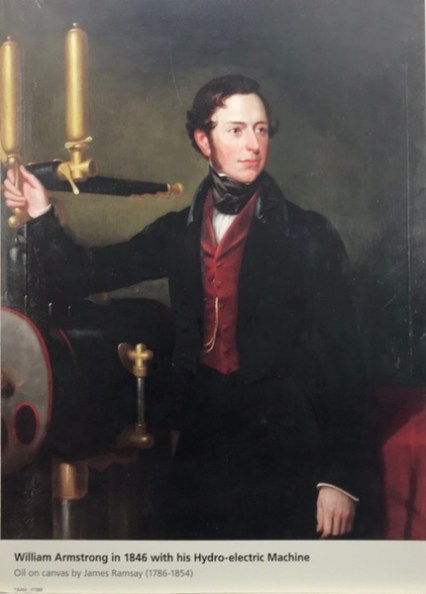
The portrait above was painted in 1846 and hangs in the museum within the castle walls which is dedicated to his work.
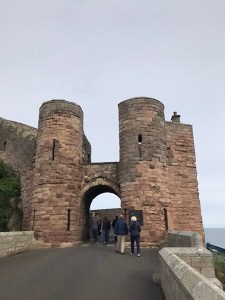
But we are not here for history. We are here to engage with the now, in a way that invokes the surroundings as a metaphor of our ‘interior’ state.
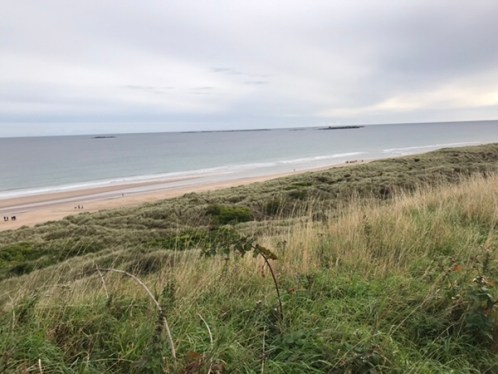
Seen from the beach the previous evening, the castle was the embodiment of protection… but also, possibly, conformity and obedience. Its structure is heavy, fixed. Whatever ideas gave rise to its creation are reflected in its unyielding stonework. The way it has grown and evolved is an accurate parallel to how the egoic self arises and dominates.
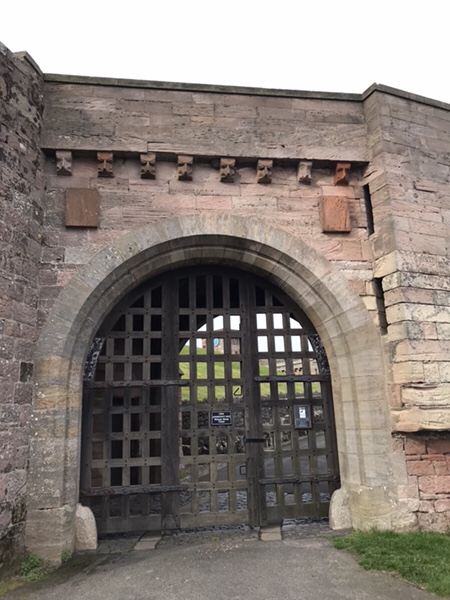
On the Friday evening, In our minds, we created an image of a portcullis being raised, and a mental journey into the castle to locate a symbolic key that would epitomise our pilgrim’s journey from here to Lindisfarne. But we know that things will happen when we pass inside its walls…
Psychologically, we will be transformed from being free but vulnerable, outside; to being safe but caged, inside. It’s not a new dilemma. The very first cell of biological life created that polarisation – that duality. From then on, the vehicle of life – the final product of organic chemical organisation – would thrive, but only inside the container which allowed protection and persistence… The world of consciousness changed at that point- becoming dual: the in-here and the out-there.
Sea bacteria became plants. Plants became fish. Fish became land and sky animals and finally, mankind emerged. At each stage, nature built on the best of what had gone before, while still allowing diversity in all its glory. The castle supports and protects ‘the best’. The inheritance of its wealth and prestige mirrors the DNA that allows life to endure in a cellular world, but only in a material sense.
We pass through the heavy wooden door and are assimilated into the interior of the ancient building. From here, even as group leader, I cannot speak for any of my companion’s experiences. Each is here to experience for themselves; each will or won’t find a key emotional space within the castle.
The first of the two ‘small rooms’ is unimpressive. Weapons and paintings hang from plain, white walls. There is no connection here, no sense of a powerful emotion related to our weekend’s quest, no test for the pilgrim…. it is spartan in its ‘feel’.
It is only in the next room that I discover that these two ‘small rooms’ were once part of the kitchens, which explains their plainness.
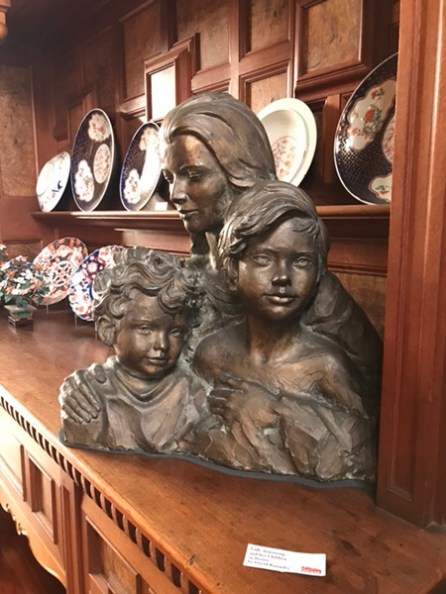
The connecting corridors and staircases wind into the centre of the building. The ancient is mixed with the familiar and familial, such as this bronze of Lady Armstrong and her two children, crafted by sculptor and film maker David Rawnsley, who, earlier in his multi-talented career, had produced the famous wartime naval epic ‘In which we serve’. The film was based upon the life of Earl Mountbatten. A warship would make another good model of the egoic self, I think to myself…
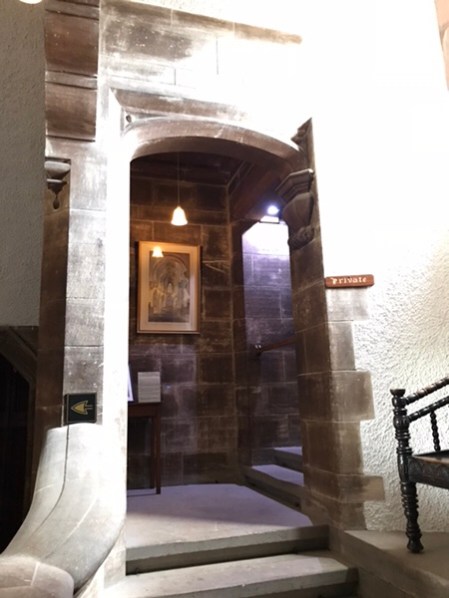
And then the nature of the interior changes. It becomes obvious that we are approaching a different part of the castle; one with very different functions.
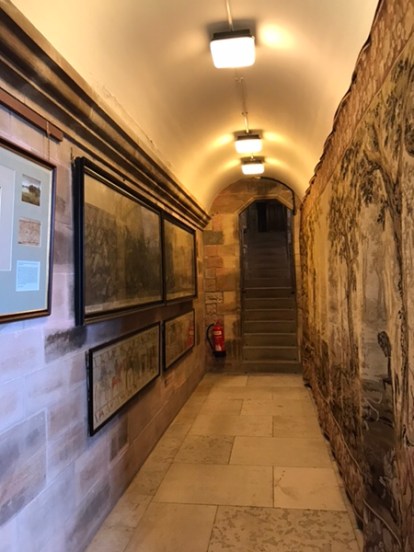
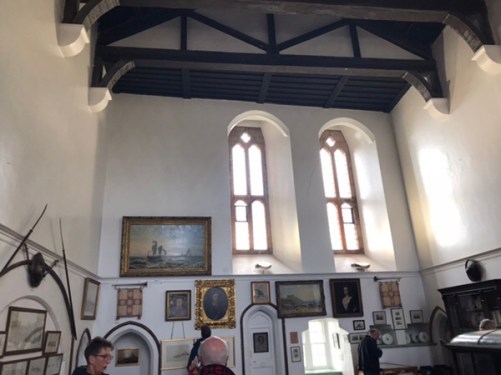
The stone is somehow grander. The lustre is the wood deeper. The final flight of stairs is steep and heralds a dramatic change of perspective as we emerge into the King’s Hall.
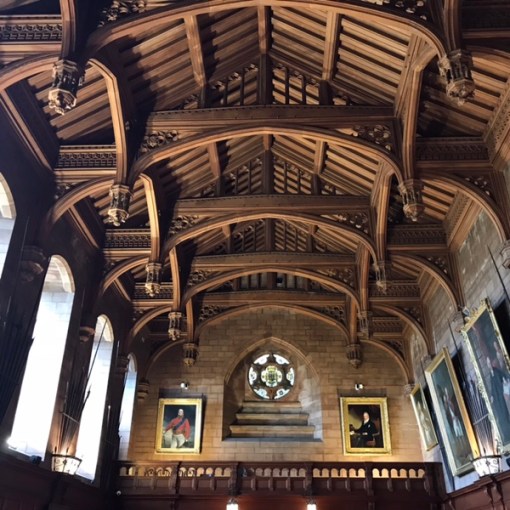
The roof of the great hall is what first catches your attention. The false hammer beam ceiling is made from Thai teak. The King of (then) Siam was a close friend of Lord Armstrong and is said to have personally helped with the intricate carving. The King’s hall has served as the main ballroom and function suite since Edwardian times. It contains a minstrel’s gallery to house the musicians.

The austerity of the previous two rooms is replaced by a physical and emotional warmth. This is a place you want to be. Though only the ‘best’ would get that right, of course. It is ours for a few minutes. Within that time we need to decide its significance in the scheme of the weekend.

‘I’ feel very at home here. The opulence speaks of a place evolved to suit the needs and the feelings of a ruling class. That is not how I feel about myself, of course, but I can appreciate the effort and skill that has gone into its design. There’s little here that is new; it’s all traditional – and of very good quality. The sheer height of the ceiling casts a sense of ‘freedom’ about the place. We who live in low-ceilinged, modern houses forget how special this feels.
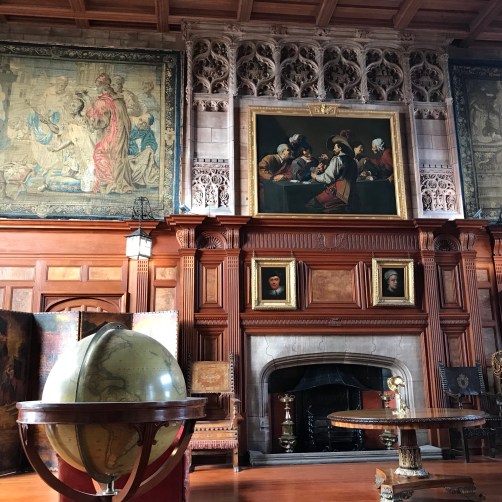
And then it hits me: how far in mind I am from the spirit of the group on the beach, the previous evening; how I have indentified with the quality of the contents in the hall. And there, now plainly visible, is the slow undermining of the search for the real Self that such luxury promotes. It’s quite natural to want to be comfortable, to appreciate quality things, but the purpose of this weekend is to make visible the working of the egoic self and its (literally) trappings.
Smiling, I do a little nod to the power in the room and leave…
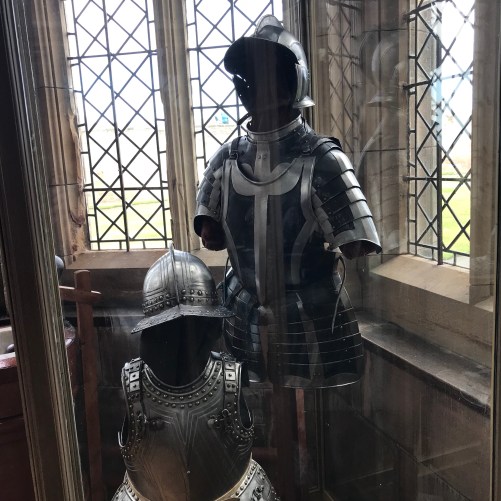
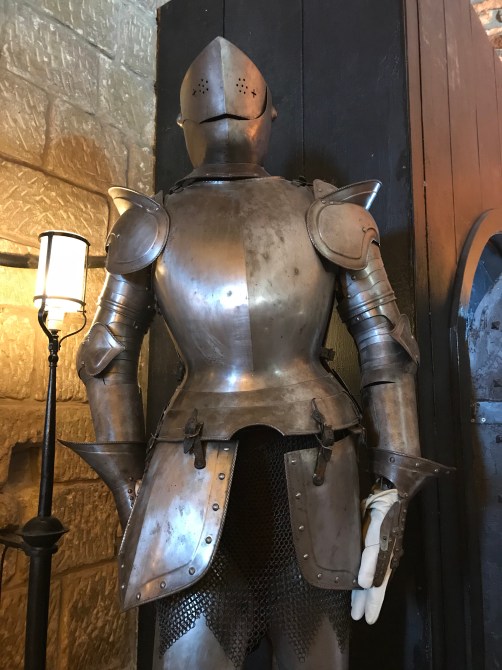
The two martial figures, devoid of real content, couldn’t be better placed. Their presence is almost threatening: “Look, we’ve tried it the nice way, but you’re being stubborn.” They seem to say. “Just turn around and embrace the opulence… forget the other nonsense…”

Seen with a ‘normal’ eye, it’s just dark humour. But we don’t do these things to see with normal eyes; we try to see differently. Here’s a classic case: the finding of a key, the resolution to ‘leave it behind’ and then the act of running straight into authority. That’s exactly what the ego does to us when we challenge its position at our centre. It has a scary counterpart in the ‘superego’ – an internal authority figure that mimics someone in your life – like your mother or father; someone whose standards you can never live up to.
But the suits of armour have another attribute that fits them well with our search for metaphor: they may look fearsome but they are empty… And, in particular, they have no centre of being. They are just a shell, grown in reaction to life to protect us. But what protects also imprisons…

Now, my time is nearly up and I’m on a mission to leave, to get out of there. I have one more thing I want to do, and that’s outside the main body of the castle. I walk quickly though the remainder of the rooms on the higher level, looking for the exit staircase to the lower corridor.
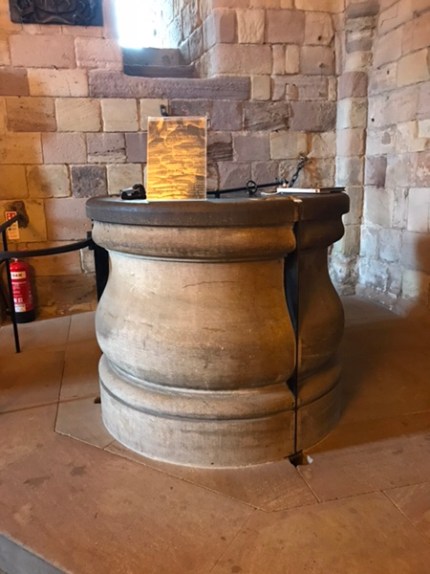
But, just before the staircase there is a well – a very ancient well, mentioned in the History of the Kings of England and dated 774 AD. It is nearly 44 metres deep and two metres wide, and was cut through hard rock to reach the water-bearing sandstone, below, giving the castle its life-sustaining water for over a thousand years.
Suddenly, my subjective day has a very special connection with the objective world ‘out there’ and my hand slides over the wooden cover in a gesture of gratitude as I take the staircase and leave the castle.
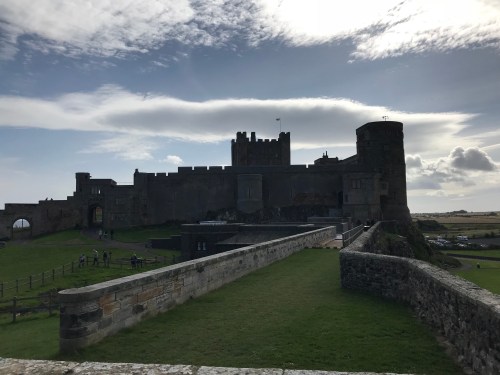
At the far end of the interior grounds of the castle is a raised platform on which sits the old windmill. From it, I know I will get a view of the whole structure – just like being on the beach. For long minutes I stand and look back, restoring the perspective of the evening before. Then, conscious that the others will be gathering outside the halls, I walk to join them.

Stuart, one of my fellow directors of the Silent Eye School is there, already. He is sitting in a reproduction of the ancient royal throne of Bamburgh, reconstructed from a fragment found on the site. Behind him, the companions of the weekend are gathering after their own interior experiences. Whenever we can, we open such moments to any kind of reading or spoken observations. Poetry or prose is a popular choice. Stuart has on his knee a copy of Pilgrim’s Progress…
We gather and listen… It’s surprisingly apt.
To be continued.
©️Stephen Tanham
Other parts of this series:
Stephen Tanham is a director of the Silent Eye School of Consciousness, a not-for-profit organisation that helps people find a personal path to a deeper place within their internal and external lives.
The Silent Eye provides home-based, practical courses which are low-cost and personally supervised. The course materials and corresponding supervision are provided month by month without further commitment.
Steve’s personal blog, Sun in Gemini, is at stevetanham.wordpress.com.
You’ll find friends, poetry, literature and photography there…and some great guest posts on related topics.
Share this:

From Stuart…
Share this:

From Sue…
Share this:

Some of the Silent Eye’s forthcoming weekends…

Full Circle? – Finding the way home…
Penrith, Cumbria
Friday 7th – Sunday 9th December, 2018
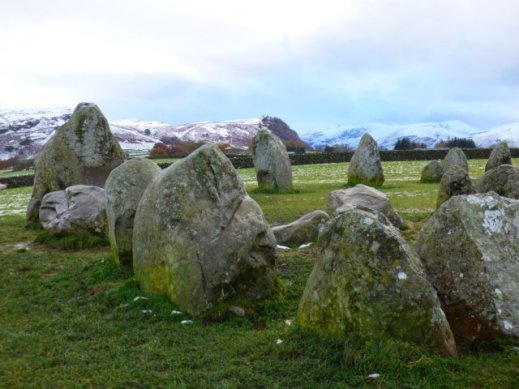
Home. It is an evocative word. The images it conjures are different for each of us, yet few other words touch heart and mind in quite the same way. Birth and death, laughter and love, longing, fear and aspiration… the cycle of human life plays out within its walls.
For many, there is another ‘home’ beyond the physical confines of this world. That too may seem different for each of us and the path to its threshold is shaped by dreams. Few places illustrate this as clearly as Castlerigg, an ancient stone circle ringed by mountains and one of the most spectacular sites in the country.
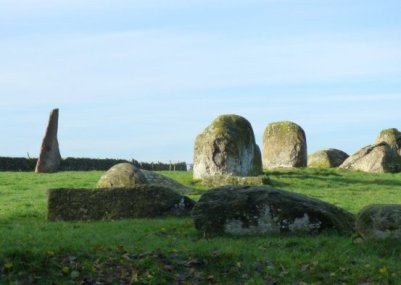
The people who have walked this world before us have left traces of their lives and belief, written in stone upon the landscape. From church to stone circle…
View original post 481 more words
Share this:


Late Friday afternoon, 14th September. A group of travellers arrive in Bamburgh, Northumberland. Their intention is to invoke a landscape.
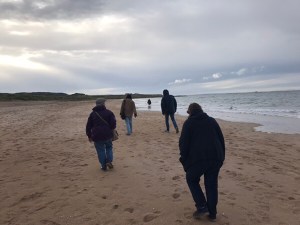
The meeting place is one of the hotels in the village of Bamburgh, but the first destination is that liminal place: the beach – and what a beautiful place it is…

The beach here sits between two worlds, yet is part of both. The huge and dominating presence of Bamburgh Castle to the west, and the pure white line of the sea’s breaking surf to the east. A shaded charcoal sky offsets the bright landscape, giving a perfect light for photography.
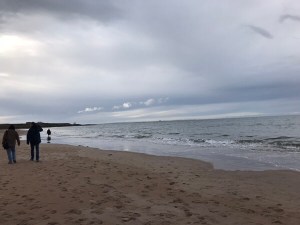
Close to the castle, the guide brings the group to a halt. To the north, just visible against the grey of the evening sky, is the rocky outcrop on top of which sits Lindisfarne Castle. The guide points…
“Our weekend will take us from this beach to that traditional and historic place of pilgrimage,” he says. “The blood we carry will hold the twin energies of breath, and food, to power our limbs. But we are to be pilgrims of both blood and stone.
He points to the castle…

“The stone is heavy, but our bodies will not be weighed down, because the stone we will carry will be of the mind… which is far heavier than any physical burden.”
The guide watches while the group absorb this sentiment. There is always a moment of transition between tourist and spiritual visitor. The liminal beach provides it – and everyone feels it. As though rising from the wet sand, a spirit of unity holds them, gently; a shared quest for the weekend embraced and accepted..
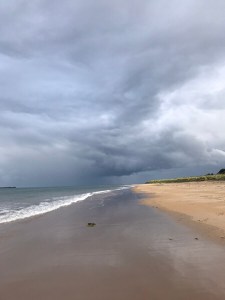
The guide walks them forward to draw level with the castle. As though adding a water blessing – quite common for these workshops – the sky darkens and the party are deluged. There is no going back, though, and the guide points to a dark aperture high in the castle ramparts; a portal through which they will pass, tomorrow.
“In your minds,” he says, against the force of the rain, imagine the castle is the whole of your egoic self – your personality – seen from an external point of view.” He pauses. The rain lashes down. “For one moment only, you may raise that gate and see yourself in a truly objective way…”

The others lift their wet heads and focus on the dark shape high in the walls. Each enters their own castle of stone, looking for a key… In the first of many pilgrim silences.

The lashing rain is test enough. The guide turns the group round and towards the sea, where they turn, again, to walk back as close to the waves as they wish, even barefoot within the waters…
The rain ceases as quickly as it came…
On the horizon the Holy Isle of Lindisfarne beckons… but that is to come. For now, the nature of stone and blood require deep thought.
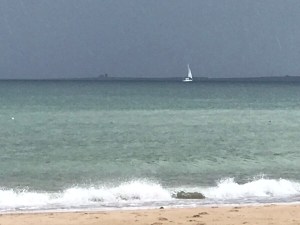
He points out to sea. “Later, we will speak of ships, but first we need to consider the different natures of the castle’s stone and the ocean’s waves; both of the world of form but very different in their roles in our worlds.
It has begun well…

Later, arriving in the little port of Seahouses, two miles away, there is a double rainbow so bright it lights up the waves on the sea.
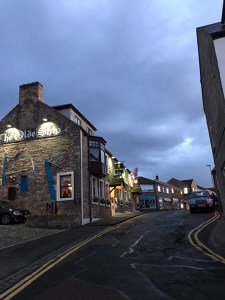
The new pilgrims are in good humour. A birthday is being celebrated. Each is warmed by a drink. Then Seahouses provides its famous fish and chips… and does not disappoint. Later, after a nightcap, it is time to retire, and to take the spirit of the beginning into what follows.

To be continued.
©Stephen Tanham.
Stephen Tanham is a director of the Silent Eye School of Consciousness, a not-for-profit organisation providing low-cost, distance-learning courses with personal supervision.
Share this:


Inspector Sunday watched as the angel fell to Earth, directly over him, its form becoming a cloud of vapour hissing around him.
He turned, seeing tiny, glittering eyes everywhere.
“Mow,” said the eyes.
“Are you here to help me,” whispered Sunday.
“Mow,” said the cat, regrouping.
©Stephen Tanham
Share this:

+ #Silenti, Child of Light, Consciousness, enneagram, esoteric psychology, Gurdjieff, Mystery Schools, Silent Eye School, Spirit, Spirituality
Principles of Fire (6): A Tribe of Two
by Steve Tanham

“Your task is not to seek for love, but merely to seek and find all the barriers within yourself that you have built against it.” Rumi
Jalaluddin Rumi was a 12th century Sufi mystic, whose approach to the ‘real’ was remarkably modern. This should not surprise us. Anything spiritually true will have that immediate and familiar ring about it – the sense of a homecoming, something ‘just there’ beneath the surface of our consciousness.
The Sufis knew that there is no need to use an overly ornate symbolic system to describe the psychologically-real in the human being; most of those that do were created, in times of religious persecution, to enable teaching in secret. Today, there is the danger that they become the tools of egoic gurus who use them to veil the truth, rather than light a path to it. This is not always true, but is a danger for those new to a path, who might not know the difference.
In the previous post, we examined how the primary behaviour of the egoic self is to react. Rumi’s quote, above, is directly related to this. Distilled, his words describe a self that has has built a shell around our essence – something that dwells in ‘love’. Love was the language of the Sufis: the seeker becomes besotted – intoxicated – with the discovered presence of what seems like another being inside themselves. Only much later do we see that we are the reflection of it and not the other way round…
The power of the shell that blocks out the interior love from our true Self is the power of reaction; the world ‘painted on our eyeballs’ from the last blog. The egoic, worldly self must constantly identify with reaction to life in order to maintain its illusory position at ‘the centre’. In the words of the Buddhists: there are two ways of looking at clouds passing; the first is to say “I see clouds passing”, the second is to say “Clouds are passing – there is consciousness of this.”
Nothing is lost in this, save the grip of the egoic self. Clouds are still passing; but, in the second example there is an implied, deeper relationship between the one who was the observer and the thing observed. One of them has vanished – making the world whole, again.
Our world is one of relationship. Our bodies are instruments for receiving the electro-magnetic signals that give notice of change to consciousness. The world is my relationship to everything within it – in particular, other people in my life. In part three of this series we spoke about ‘projection’; an unconscious externalising of what ‘I am’ as though projected onto a screen. When we fall in love, we see the other as the object of our adoration, but, really, we are projecting a very beautiful and inner part of us onto the perfect screen of sympathetic person. This does not diminish love; far from it. The love felt from the other person shows us the power of love to shine an other-wordly ‘light’ into our lives. When we project on someone else in this way, we are bypassing the rigid egoic shell that keeps us imprisoned in this world of reaction. Because this intense feeling is seen in the person of another, we are free to see it without our internal ‘commentary’ – a process that would reduce it to a regurgitation of our own egoic story.
When we look at a tree, we immediately get that voice in our head that names the tree, and we begin commenting on the nature, condition, habitat and a thousand other descriptions of ‘this beautiful, living thing in front of me’. As soon as that internal dialogue – based entirely on our history – begins, we have lost the moment of beingness with the tree. It doesn’t need to be a tree. An orange, apple, painting or a thousand other things could work just as well. As an exercise, gaze round for a few minutes each day and watch how quickly the internal jabbering switches on. Then try to ignore it, as though dismissing an unruly child… hold that feeling, that brief moment of being free to see things as they are, and without fear of losing the defensive commentary.
If we do not observe ourselves well, our world will be full of that confusion, projected outwards. If we know ourselves well, we can, day by day, draw into that knowing a certainty that our role is to ‘be with’ the world. This state of being happens in stages and needs to be accompanied by a systematic journey around our selves, beginning at the egoic level. Surprisingly, this is not a chore. it is an exciting adventure, with a considerable degree of humour and emotion along the way. Above all, from the first minute, it feels a lot more real that what is happening now…
With each bit of the defensive barrier taken down, more of the real – more of Rumi’s love – will come through. We do not need to invent, nor even visualise it. Its nature is to be; we need only let it in. It was there long before ‘we’ were.
To be continued.
©️Stephen Tanham
Other parts of this series:
Part One, Part Two, Part Three, Part Four, Part Five,
Stephen Tanham is a director of the Silent Eye School of Consciousness, a not-for-profit organisation that helps people find the reality and essence of their existence via home-based, practical courses which are low-cost and personally supervised.
His personal blog, Sun in Gemini, is at stevetanham.wordpress.com.
You’ll find friends, poetry, literature and photography there…and some great guest posts on related topics


 Sun in Gemini
You must be logged in to post a comment.