

*
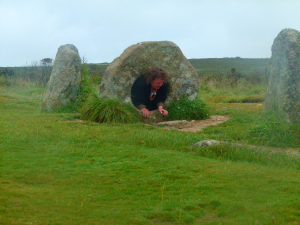
Well, it didn’t take us long to get there did it?
But let’s ponder a moment
what this structure could mean…
We could call the two flanking uprights,
Summer and Winter,
or Night and Day,
or Them and Us,
and it would not really matter which was which.
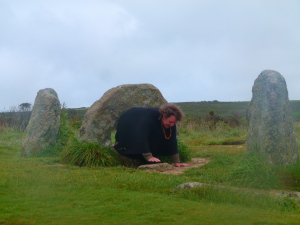
If we did that though, what would we call the holed stone?
*
Share this:

From Sue.
Share this:

+ #Silenti, Ancient Landscapes, Celtic Christianity, Consciousness, Fear, mystical travel, Silent Eye Workshops, Spirituality, Understanding Fear
Pilgrims of blood and stone
by Steve Tanham

The blood: the Life that flows through us, taken in as breath, fresh each second, flowing out to be renewed in the world of nature; natural, given.
The stone: the fixed structures we rely on to ensure persistence of that life-force made flesh. The riddle, the contradiction – the mystery… beginning with that most profound and persistent structure: the body…
There is no more beautiful a coastline in which to explore the mystery of our being than Northumberland. The beaches are wonderful, the climate is usually mild late into the Autumn. The mellowness of September will be perfect.
This former Kingdom in its own right is rich in history; ancient and modern. Yet, it remains unvisited by most. Look on a map and you’ll see how it’s lovely hills and coast form a separate realm between England and Scotland.

( Image above: Northumberland – an ancient Kingdom between England and Scotland. (Google Maps))
The castle or the fortified tower is capable of being used as working symbol of the way we guard against life; and Northumberland is full of such treasures. They mirror its history, from the ancient political and religious roots to its lawless centuries when gangs – land pirates – roamed, unchecked, in the times of the Border reivers.

(Image above: the fortified Tower – about which, more later….
Pilgrims have always come this way, drawn by the Holy Island of Lindisfarne. We, too, will be drawn towards its mysterious and ancient shores, the birthplace of English (Celtic) Christianity. But, before we make that last odyssey across the causeway (or sands, for the adventurous) to that final island of the soul, we will make other journeys along the edge of the land, journeys that use coast and castle to explore the seemingly contrasting nature of survival and spirituality.

(Image above: the castle on the far point of Lindisfarne. Taken from the Tourist Information board)
Day One: Friday 14th September, 2018
To begin our journey as pilgrims of blood and stone, we will gather, in the late afternoon, of Friday 14th September, in the lovely village of Bamburgh – home to the world famous castle of the same name. The Victoria Hotel will host us for tea, coffee and cakes while we make introductions, meet old and new friends, and discuss the plans for the weekend ahead.

(Image above: The Victoria Hotel, Bamburgh village – our Friday meeting place)

After this, we will do what pilgrims have always done; we will walk, in essence, beginning the symbolic part of our journey to the Holy Island of Lindisfarne. One of the finest beaches in Britain is a few minutes away from Bamburgh village, and we will continue to set the scene by strolling and considering the splendour of Bamburgh Castle, seen from the shore.

During the walk, we will share thoughts and readings on the themes generated by the idea of Castles of the Mind – our name for this Walk and Talk workshop. We will ask the first of several questions, questions designed to shape the weekend from an emotional and spiritual perspective. All our answers will be unique; there is no right or wrong, they simply reflect our experiences and our aspirations.
The geographic base for our weekend is the lovely fishing harbour of Seahouses. We will retire there after our beach walk at Bamburgh

A stroll around the harbour will help us work up an appetite for that most important ingredient of any trip to Seahouses: their world-famous fish and chips. Other dishes are available…

To finish our Friday, we will retire to one of several sea-facing pubs to relax. Tomorrow will be a busy day…

Day Two: Saturday 15th September, 2018 To begin the Saturday, we will drive the short distance to Bamburgh Castle and tour this famous landmark, known as the King of Castles. Bamburgh is the royal seat of the kings of Northumbria and is still a family home–though no longer to kings… The admission price is £11.00 per person and, as with the entry fee for other locations, is not included in the Silent Eye’s booking fee.
The guided tour will tell the story of Bamburgh’s many incarnations over the centuries, from Anglo Saxon Royal palace to its reconstruction in the Victorian period by inventor and industrialist Lord Armstrong; to whom it was the vision of a perfect castle. From the guidebook:
“Our vast and imposing walls have witnessed dark tales of rebellion and bloodshed, spellbinding myths, millionaire benefactors and ghosts who love Bamburgh Castle so much, they never want to leave.”
After this, ghosts permitting, we will take refreshments in the cafe, then gather on the ramparts overlooking the sea and consider the second of our discussion questions:
We will then drive a few miles south, along the coast, to arrive at the beautiful fishing village of Craster.

Craster is very compact, and easily explored. A short walk up the hill is the Jolly Fisherman pub, famous for its seafood dinners and ‘light’ lunches.

This will be followed by a relaxed walk along the dramatic cliffs of the coastline between Craster and Embelton.

A twenty minute walk will take us to the haunting ruin of Dunstanburgh Castle, which stands on a remote headland. Dunstanburgh became a key stronghold during the early fourteenth century; a tumultuous period in English history. Relations between King Edward II and Earl Thomas of Lancaster had broken down. Earl Thomas had begun the construction of the castle in 1313, very possibly as a provocative symbol of his opposition to the King. The Earl mounted a rebellion, but, when it was defeated by King Edward’s forces, he was arrested before he could reach the safety of his intended fortress.
Earl Thomas was executed in 1322. Dunstanburgh Castle passed, eventually, to John of Gaunt, who used it to defend against the Scots, converting the twin-towered gatehouse into a keep. During the Wars of the Roses, it was the scene of two sieges and eventually fell into Yorkist hands. Today, it survives as an impressive ruin, but visitors speak of how its ‘presence’ lingers in the memory….
Dunstanburgh Castle is operated by English Heritage, with reciprocal honouring of National Trust memberships. Admission is £5.40. Concessions are available.
At Dunstanburgh, we will consider our third question, then, we will drive a few miles east, to visit one of Northumberland’s least-known historical gems: the Preston Pele Tower at Ellingham.

Northumberland, has a bloody history; largely because of its position as one of two border counties between England and Scotland. Few places convey the vivid fear and caution of the past as well as the Preston Pele Tower. The tower is owned by Major Tom Baker Cresswell and is privately managed. It was constructed in the 1390s when warfare between Scotland and England was at its height. At the time of the battle of Agincourt, there were 78 such pele towers in Northumberland. Among its owners was Sir Guiscard Harbottle, who was killed at the battle of Flodden in 1513 – the conflict that brought Mary, Queen of Scots to the Scottish throne.
By the 16th century, the rest of England was enjoying peace and prosperity. But, in the Borders of Northumberland, raiders, known as ‘reivers’, crossed freely though the area, ravaging and looting. This led to the continued use of ‘tower dwellings’ among the well-off families. The idea may sound attractive – and we could say reflects today’s ‘gated communities’, but the intact interior of the Preston Pele Tower, with its reconstructed rooms, shows how primitive such living had to be.

The Preston Pele Tower (and gardens) is privately owned, and admission is a very reasonable £2.00.
The extreme nature of this isolation illustrates the power of fear to drastically change lives. With this in mind, we will carry out a mystical and psychological exercise related to our coming arrival in Lindisfarne on Sunday.
There are no refreshments at the Preston Pele Tower, but an early dinner will be booked at the nearby Pack Horse Inn in Ellingham.

After the long day, and our early dinner, we will retire back to Seahouses for a possible nightcap before retiring for the night. A very special Sunday morning awaits…

Day Three: Sunday 16th September, 2018
Our final day is a physical and spiritual homecoming. Our pilgrimage is to end on the Holy Island of Lindisfarne, which can be reached (subject to the tides) by car, over the causeway. Lindisfarne can also be reached on foot, across a three mile stretch of marked path over the sands. We will consult on the day, and if there are those who wish to make the final journey a true walking pilgrimage, then we will arrange for one or more cars to be left at Lindisfarne so that the walking is one-way only. Be prepared to be very sandy/muddy if you wish to walk! Having said that, to arrive at a place of pilgrimage after a degree of ‘hardship’ is an entirely appropriate thing.

Lindisfarne needs little introduction. The monastery there was founded by an Irish monk, St Aidan. Aidan had presided over the monastery at Iona, off the west coast of Scotland. He was sent to establish the Lindisfarne community in the year 634 AD, and remained there till his death in 651 AD.
The holy island of Lindisfarne has attracted pilgrims for hundreds of years. It is a fitting and beautiful place to end the Castles of the Mind weekend. The village comprises:
- a large car park; the first major feature you come to, having crossed the tidal causeway.
- Two main streets, one of which leads to the crossroads and, beyond, the excellent museum; the other involves a fifteen minute walk to the far end of the island where the castle is situated.
- There is also a meditation garden, which we may use if time permits.
For ease of finding, we will meet at the Oasis Cafe, which lies on the road from the car park.

The castle is currently undergoing work, but the visitor centre within it is open. The walk down from the village is well worth the views of the beaches and the headland on which the castle is built.
If we have worked our collective intentions well, we should each feel a certain ‘presence’ when we arrive on the island of Lindisfarne.
To conclude our weekend, we will remember the bravery of the early fathers of religion, such as St Aidan, who set sail into the complete unknown to establish their faith on distant shores. We can, perhaps, have little understanding of the depth of that faith; but we can, in our own ways, recreate that ‘setting off’ into the unknown – without fear.

Our final gathering will be a powerful and moving close to a wonderful weekend. Why not see out the end of the summer in style and join us…


Castles of the Mind workshop
Weekend of 14-16 September 2018.
Location: Northumberland
To join us on our Castles of the Mind weekend email us at:
rivingtide@gmail.com
Or Click below to
Download our Events Booking Form – pdf
Enquiries: rivingtide@gmail.com.
We’d love to have you with us. You can find our more about the Silent Eye School of Consciousness here.
Weekend Costs
There is a charge of £50.00 per person. All other expenses, such as accommodation, food and entry charge for the sites visited, are the responsibility of those attending. Meals are usually taken together in a local pub, and the costs shared.
Stephen Tanham is a director of the Silent Eye School of Consciousness, a not-for-profit organisation that helps people find the reality and essence of their existence via home-based, practical courses which are low-cost and personally supervised.
His personal blog, Sun in Gemini, is at stevetanham.wordpress.com.
You’ll find friends, poetry, literature and photography there…and some great guest posts on related topics.
©Stephen Tanham
Share this:

From Stuart

*
…Well, if they did,
they also intended us to work for it.
*
Part of our problem proved to be scale.
What we call a lay-by is large and well marked.
What they call a lay-by is more of a ‘passing-point’…
And on a fast road, is easy to miss,
or pass-by, which we did,
at least three times whilst actively looking for it.
*
Another part of the problem
is sign-posts disguised as fences.
Cunning that.
Anyone would think that they do not really want visitors to find
Boscawen-Un…
*

*
But as we were about to discover,
some experiences are well worth working for.
Share this:


Every July, for the past few years, the lovely and ancient Lancashire seaside town of Heysham (He-sham) has been invaded by Vikings…
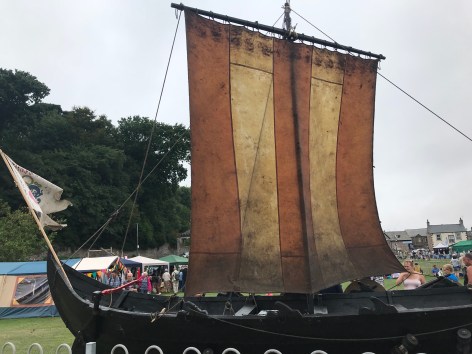
They come in their hundreds, bearing their weapons, tents and tools… and with their families. They sweep in from the ‘sea’ and set up camp on the grassy hollows of the playing fields, where their fires soon fill the summer air with the aroma of meals cooking.
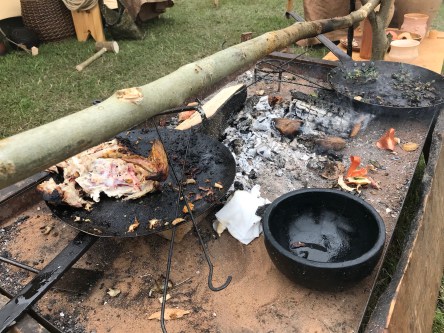
Their children, polite and beautifully dressed, dance around the merry hordes, and strange and magical things happen, like a lady carrying a lost kitten, needing a home…

Some of the things they bring are comically-fearsome; but only because our minds do not know their inner history, written in the ancient legends.

Their elders are wise, regaling all who will listen with stories, history and good humour. But they are ever protective of their own, and their children, in whom they sow the seeds of living peacefully within the world of sea, and nature. They are not here to conquer, the blue elder explains, merely to settle, undisturbed, for a time and a tide.
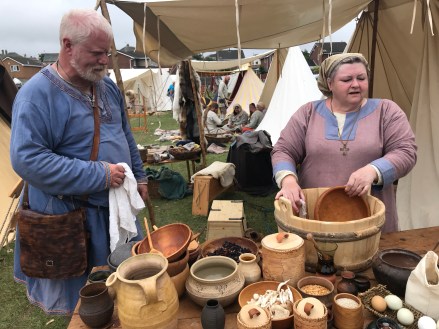
Together, the man and woman wash the dishes. We wonder how they manage, but, of course, hot water, in limited quantities, is always on hand from the fire.

Their craftsmen are busy, carving wood, forging metal and weaving garments. Their work is paced, gently, to be part of the breathing of the landscape. They always find time to stop and chat. Behind each is a humble canvas dwelling which will be their home for the few days they are here. They are a proud, yet gentle people..

This is not their real home, they are visitors. But they are at home in this land and take their rest close to it.

Some rest on blankets on the open ground, others shelter from the sun beneath the sail-cloth tents, which are their only dwellings for the time in Heysham.
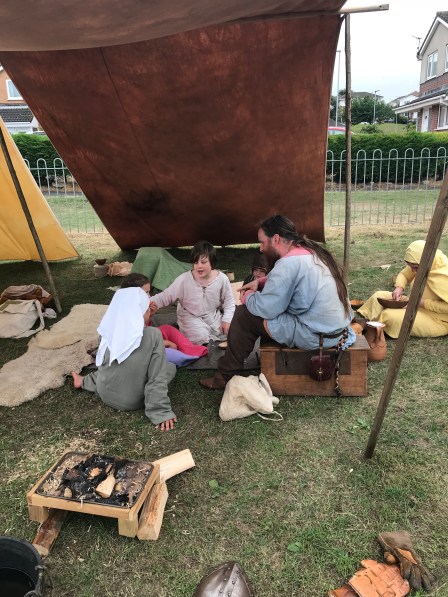
The midday meal over, families gather together, and stories are told. The children fall asleep beneath the gently flapping fabric. Father returns to his wood-turning wheel
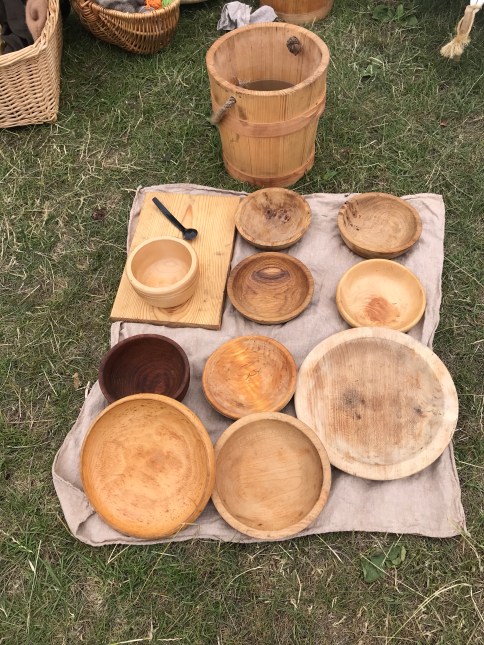

Some of the craftsmen make jewellery. One of them, resting after the midday meal, asks us, with a twinkle in his eyes, whether we are Saxon or Viking, before rising to show us his wares…

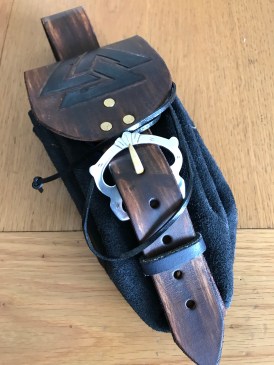
My eye falls on a beautifully made belt-pouch. We are always on the lookout for good theatrical props for our Spring Workshops in Derbyshire, so I buy it. The quality is really good. The Viking couple who made it suggest that I make sure I feed the leather, in return, he says, it will it will serve me for many, many years.
Our time with the visiting Vikings of Heysham is nearly over. We return to a few friends we have made to say our goodbyes. They have shown us their symbolic lives, opened their ‘homes’ and allowed us to share in their closeness to this adopted land. Soon, their ships will beckon, and the sea will, once more, be their home.

Passing back to the Barrows cliff path, we walk through the floral landscape of Heysham’s old streets.
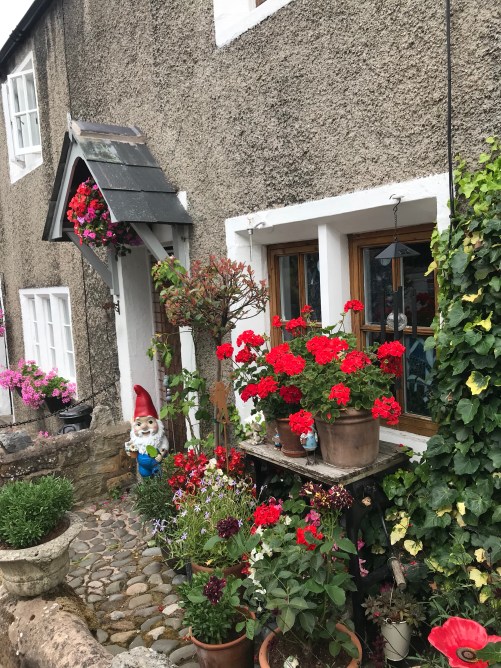
Even here, the Viking festival is honoured.

Heysham is very conscious of its history – going back to Anglo-Saxon times.

The ‘Spirit of Heysham’ wall plaque depicts the small town’s historical legacies, including the 8th century hilltop chapel of St Patricks, and the beautiful, oceanside church of St Peter’s.
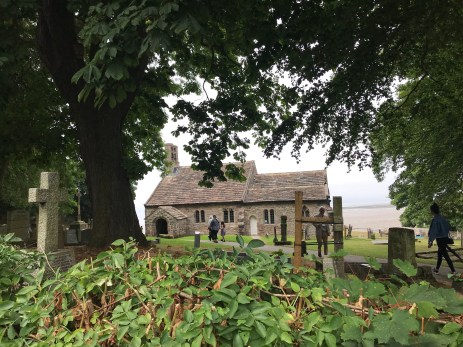
We climb the Barrow’s steep footpath, and look back, one last time, on the village of Heysham and the much older chapel of St Patrick on the cliffs, with its mysterious ‘graves’.

The Viking festival is held very year, in mid-July. Entry is free… It’s a lovely and cultural day out.

Notes:
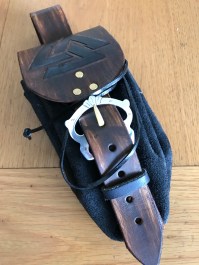 Viking belt pouch – vtaccessories@yahoo.com
©️Copyright Stephen Tanham.
Share this:

*
After our pre-historic village and our cause-wayed isle,
we return to Lands End, ostensibly, to at least,
again, consider ‘doing-the-touristy-thing’…
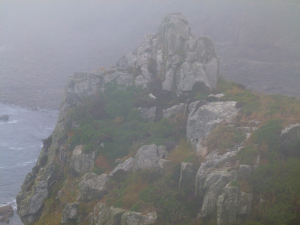
Only to find that our dragon has been dining out on pea soup
and that the parking charge would in all probability be wasted…
*

*
We know that Carn les Boel is on the coast
and that from there Lands End is visible,
but whether Lands End would be visible in this,
even from Lands End, is another question altogether…
Ballowal Barrow presents itself as a convenient ‘half-way house’,
which is at least sign-posted, so we head for that instead.
*
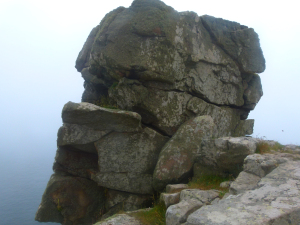
‘It’s that way’…
*
Share this:

Share this:

Share this:

From Jan…
Share this:

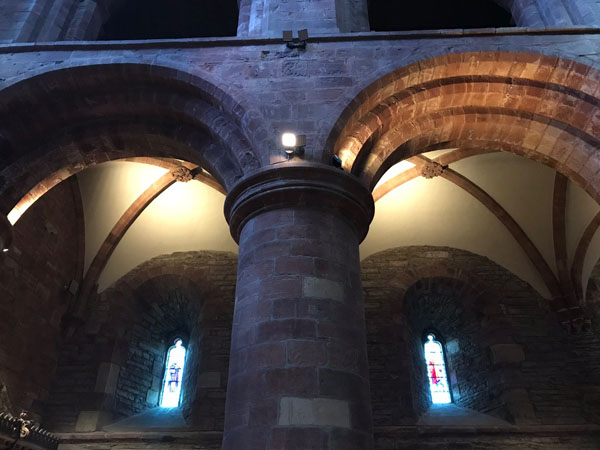
We could be in any of the great cathedral cities of Britain. If someone took off the blindfold and asked, we might say Salisbury, York, Lichfield or the wonders of Durham Cathedral. The latter is significant, because they who built Durham came here to add their skills…
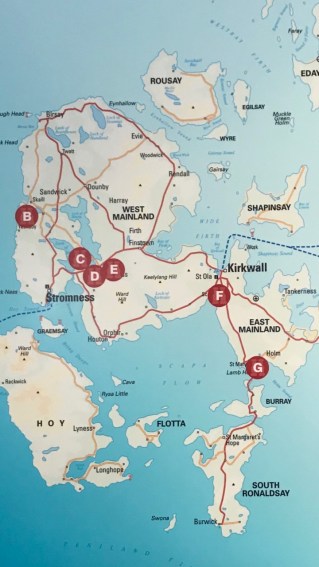
We are in the capital of Orkney – Kirkwall (reference ‘F’ in the Northlink Ferry’s map, below), in one of the most splendid cathedrals I’ve every visited. And yet this town of Kirkwall, the commercial centre of the archipelago of Orkney, has a population of only 10,000 people. The rest of Orkney is compact, beautiful, and infused with a sense of ancient mystery. So why is this magnificent building here, so far from the rest of British ‘civilisation’?
It’s a story involving Earls…
Aha! I thought to myself, upon hearing this – some medieval outpost of early Britain, strategically important – as it was to be, a thousand years later, during WW1, when the British fleet was based in Scapa Flow. But these were not English earls; they were Vikings, albeit Vikings who had adopted Christianity.
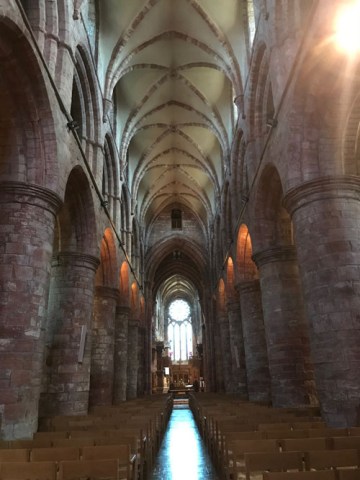
St Magnus Cathedral is referred to, historically, as The Light in the North. It’s not hard to see why when you stand in the west and look along the nave towards the chapel in the East.
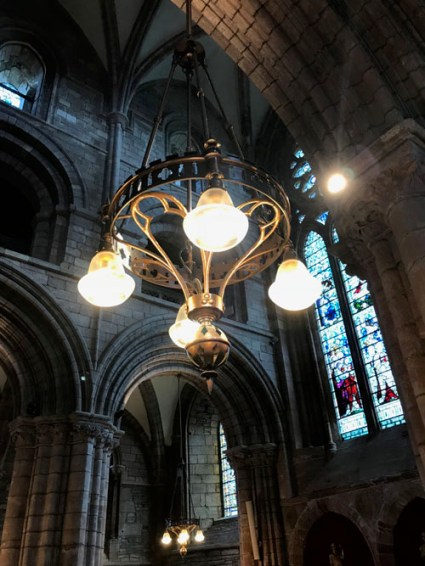
The Earls of Orkney were from Norway, and had settled in these fertile islands, as part of their vast and successful expansion. Modern Stavanger is a mere 300 miles to the East – no problem for a nation with the seafaring expertise of the Vikings. The Old Norse name was actually ‘Jarl’, rather than Earl; and the two terms only became synonymous during the 15th century when, under the Sinclair family, control passed to mainland Scotland.
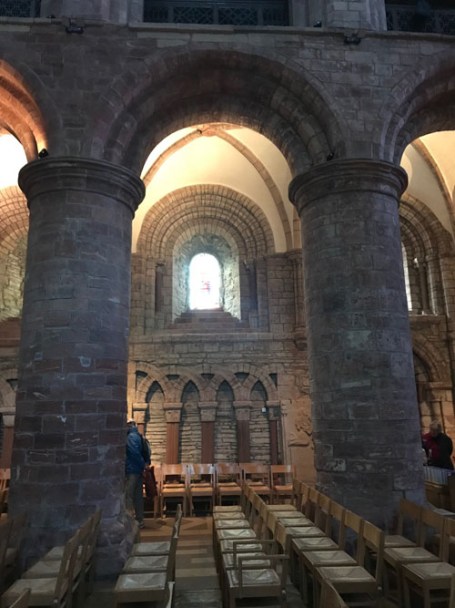
Until that time, the ‘Jarls’ of the combined territory of Orkney and Shetland (Norðreyjar) had a great deal of independence and local power. The office of Jarl of Orkney became the most senior rank in medieval Norway except for the king himself.
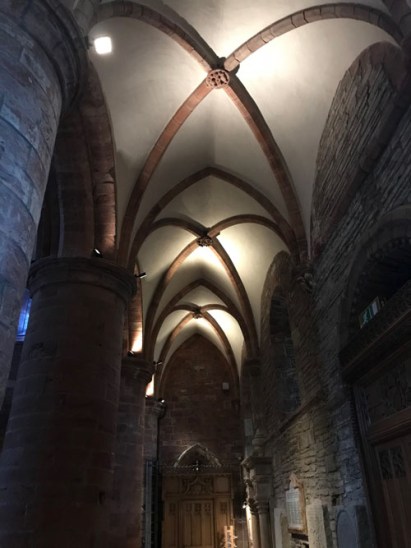
Magnus Erlendsson was the Earl of Orkney in the early 1100s. He seems to have been a very spiritual man, which many contempory Norwegians saw as a weakness. Magnus once refused to fight during a Viking raid on Anglesey, staying on his ship, praying and singing psalms.
He shared the Earldom with his ambitious cousin, Hakon. The two men fought a series of battles, damaging the land. To settle this, it was agreed to hold a council of peace on the Orkney island of Egilsay. Each Jarl would bring only two ships, containing unarmed men. Hakon broke the agreement and arrived with eight ships, each fully armed. On his orders, in an act of humiliating barbarity, Magnus was executed by Hakon’s reluctant cook, using an axe.
Magnus prayed as the axe was swung towards him… He was buried at Birsay, in the north-west of the Orkney Mainland (see map, above). Over time, stories of miracles associated with the royal grave began to circulate. During this time, Hakon’s reign seems to have been blighted by misfortune.
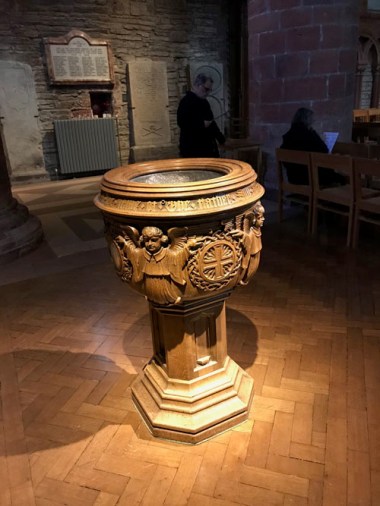
Eventually, Magnus’ nephew, Rognvald, came from Norway to claim his uncle’s Earldom. He promised the people of Orkney that he would build a ‘great stone minster’ in honour of his uncle; and that he would turn it into a place of pilgrimage.
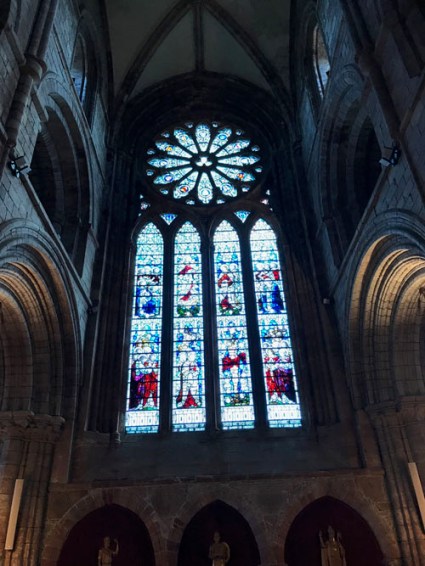
The Cathedral was founded in 1137 and inaugurated as part of the Archdiocese of Nidaros (now Trondheim) in Norway. Orkney became part of Scotland in 1468. A few years later, the cathedral was given to the people of Kirkwall by King James III.
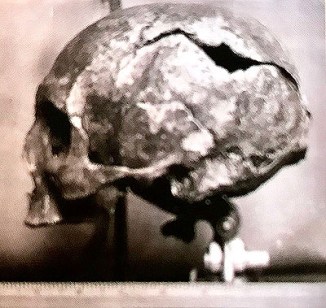
(And early photograph of St Magnus’ split skull, now interred in the cathedral)
After the Scottish Reformation in 1560, the cathedral was used for Protestant worship. Nowadays, it belongs to the people of Orkney. It is maintained by the Orkney Islands Council. It has a Church of Scotland congregation and can be used, by arrangement, by any Christian denomination.
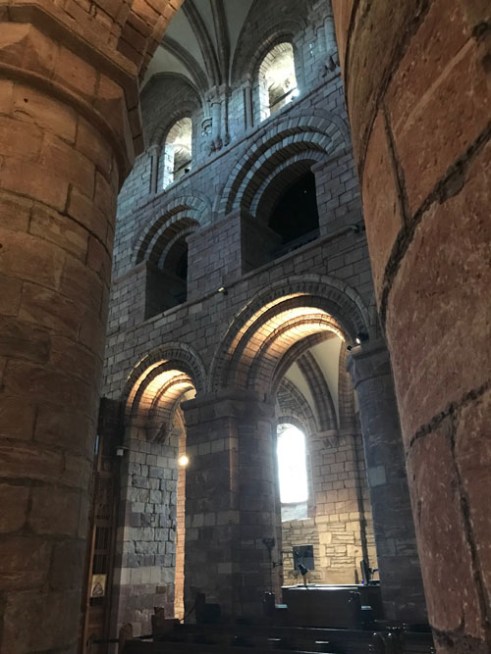
Restoration work took place in the 1850s and again, following a large bequest from Sheriff George Thoms, during 1913-1930. Because of its great age, the cathedral structure is constantly monitored for stability.
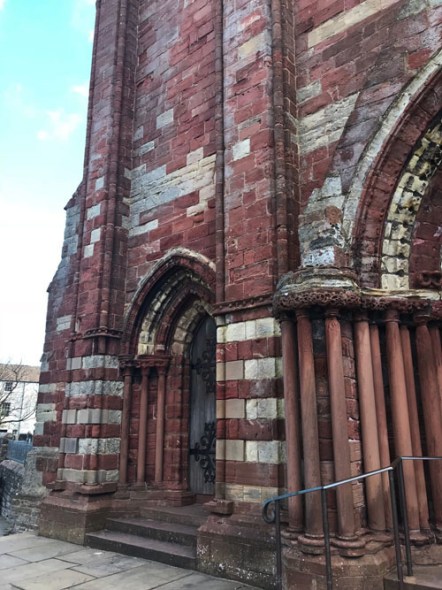
The exterior of the building shows off the local sandstone, from which most of the cathedral is constructed.
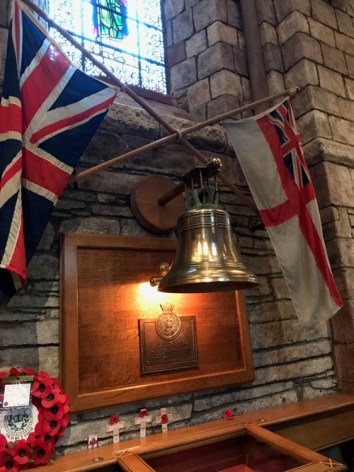
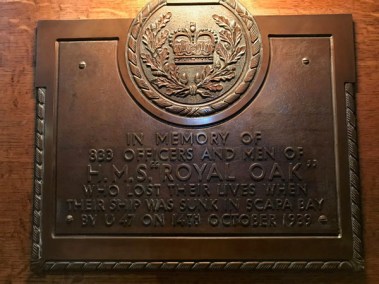
The north choir aisle is home to the brass bell from HMS Royal Oak, the battleship sunk in Scapa Flow in 1939. The case holds a Book of Remembrance to honour those who died. The pages are turned every week by the cathedral custodians.
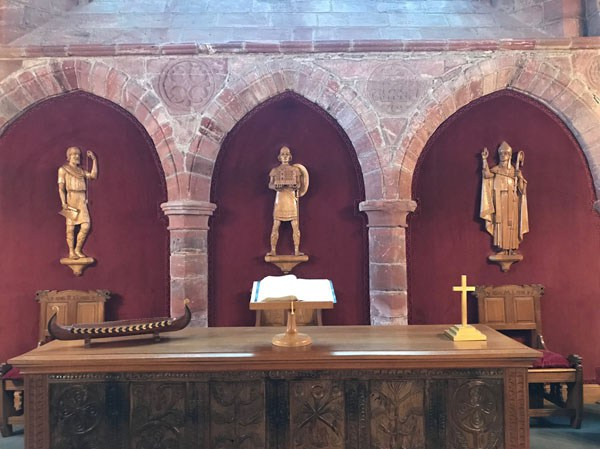
The chapel at the east end of the building is dedicated to St Rognvald, the founder. It was redesigned in 1965 by the Orcadian artist Stanley Cursiter. The wooden communion table and lecterns, incorporating medieval panels, were made by a local craftsman, Reynold Eunson. The left figure is Rognvald’s father, Kol Kalisson; the right is William the Old, Bishop of Orkney when the cathedral was built.
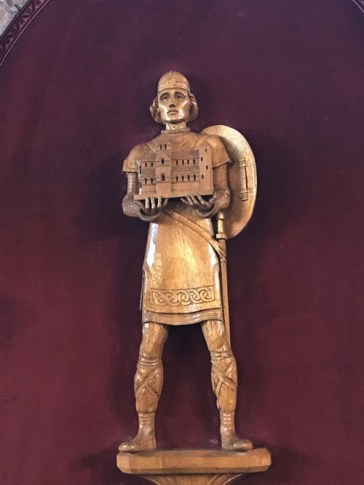
The central figure is that of St Rognvald, the founder of the cathedral. He is seen holding a model of the original cathedral building.
The right side of the chapel is home to Dr John Rae, a resident of Orkney, who worked for the Hudson Bay Company, which explored the Canadian Arctic. He discovered the vital Northwest Passage, enabling the shipping of goods between Europe and northern Canada by a much shorter route. His remains are buried in the cathedral’s graveyard.
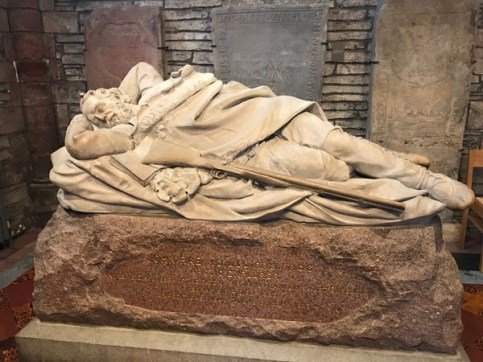
Sadly, the chapel area was being used for a lecture, which meant I could not get close to:
- The cathedral’s oldest gravestone, thought to date from the 13th century. Its golden sandstone face depicts a carved ‘morning star’ symbol and a sword, possibly indicating a crusader or a Templar Knight. Initials P and C were added at a later date, according to the guide leaflet.
- The chapel also contains some of the oldest carvings, including dragons, a small hooded imp, and a squatting female Sheela-na-gig. At the top of a column there are two Green Men, ones with distinct foliage coming out of his mouth – a deeply mystical symbol and one emotionally linked to my personal past…
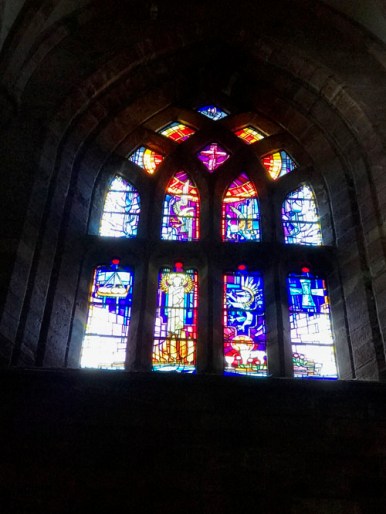
The majority of the present stained-glass windows were designed by the Glasgow artist Oscar Paterson. They depict a variety of saints and biblical figures, as well as characters from Orkney’s Norse past.
I have, therefore, many reasons to go back… something I look forward to very much.
Other parts of the Orkney series:
Stephen Tanham is a director of the Silent Eye School of Consciousness, a not-for-profit organisation that helps people find the reality and essence of their existence via home-based, practical courses which are low-cost and personally supervised.
His personal blog, Sun in Gemini, is at stevetanham.wordpress.com.
You’ll find friends, poetry, literature and photography there…and some great guest posts on related topics.
©Stephen Tanham


 Sun in Gemini
You must be logged in to post a comment.