
Share this:

From Jan…
Share this:

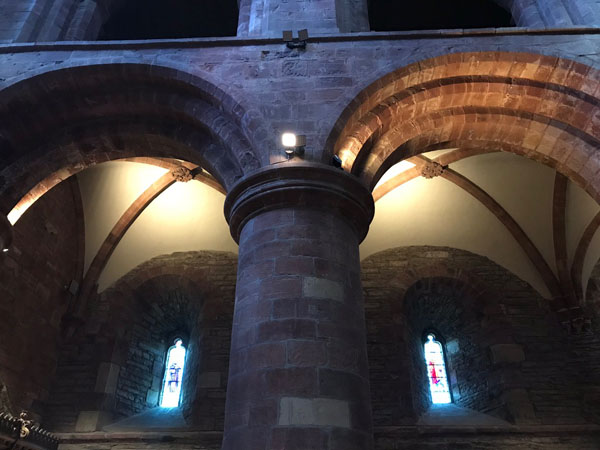
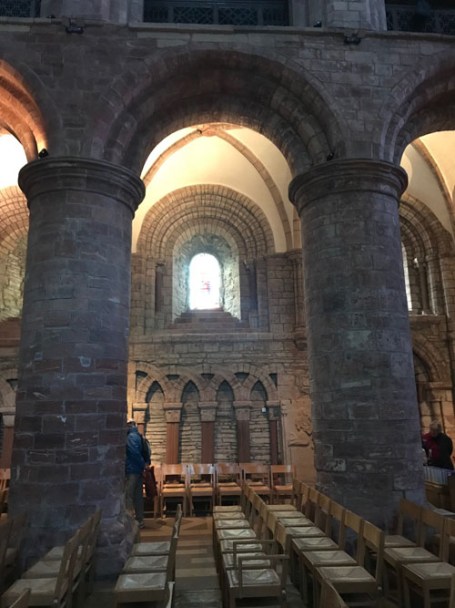
We could be in any of the great cathedral cities of Britain. If someone took off the blindfold and asked, we might say Salisbury, York, Lichfield or the wonders of Durham Cathedral. The latter is significant, because they who built Durham came here to add their skills…
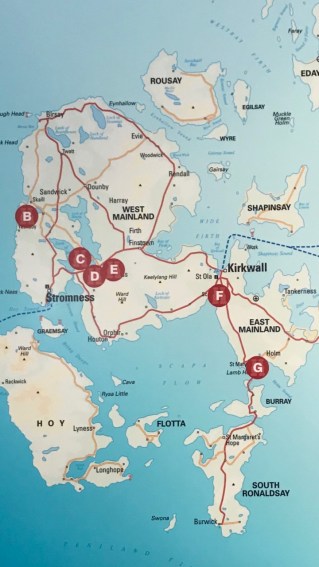
We are in the capital of Orkney – Kirkwall (reference ‘F’ in the Northlink Ferry’s map, below), in one of the most splendid cathedrals I’ve every visited. And yet this town of Kirkwall, the commercial centre of the archipelago of Orkney, has a population of only 10,000 people. The rest of Orkney is compact, beautiful, and infused with a sense of ancient mystery. So why is this magnificent building here, so far from the rest of British ‘civilisation’?
It’s a story involving Earls…
Aha! I thought to myself, upon hearing this – some medieval outpost of early Britain, strategically important – as it was to be, a thousand years later, during WW1, when the British fleet was based in Scapa Flow. But these were not English earls; they were Vikings, albeit Vikings who had adopted Christianity.
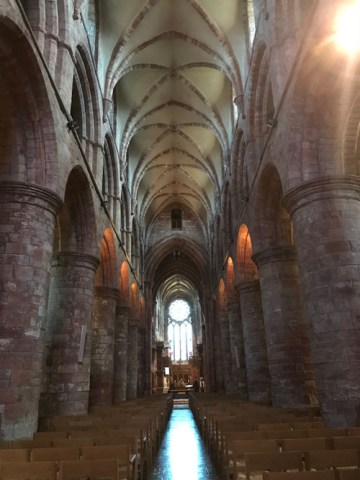
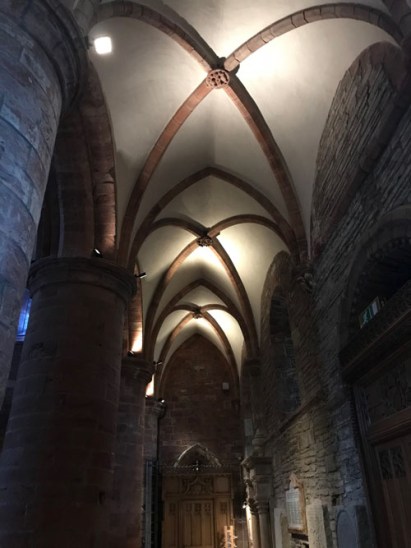
St Magnus Cathedral is referred to, historically, as The Light in the North. It’s not hard to see why when you stand in the west and look along the nave towards the chapel in the East.
The Earls of Orkney were from Norway, and had settled in these fertile islands, as part of their vast and successful expansion. Modern Stavanger is a mere 300 miles to the East – no problem for a nation with the seafaring expertise of the Vikings. The Old Norse name was actually ‘Jarl’, rather than Earl; and the two terms only became synonymous during the 15th century when, under the Sinclair family, control passed to mainland Scotland.
Until that time, the ‘Jarls’ of the combined territory of Orkney and Shetland (Norðreyjar) had a great deal of independence and local power. The office of Jarl of Orkney became the most senior rank in medieval Norway except for the king himself.
Magnus Erlendsson was the Earl of Orkney in the early 1100s. He seems to have been a very spiritual man, which many contempory Norwegians saw as a weakness. Magnus once refused to fight during a Viking raid on Anglesey, staying on his ship, praying and singing psalms.
He shared the Earldom with his ambitious cousin, Hakon. The two men fought a series of battles, damaging the land. To settle this, it was agreed to hold a council of peace on the Orkney island of Egilsay. Each Jarl would bring only two ships, containing unarmed men. Hakon broke the agreement and arrived with eight ships, each fully armed. On his orders, in an act of humiliating barbarity, Magnus was executed by Hakon’s reluctant cook, using an axe.
Magnus prayed as the axe was swung towards him… He was buried at Birsay, in the north-west of the Orkney Mainland (see map, above). Over time, stories of miracles associated with the royal grave began to circulate. During this time, Hakon’s reign seems to have been blighted by misfortune.
Eventually, Magnus’ nephew, Rognvald, came from Norway to claim his uncle’s Earldom. He promised the people of Orkney that he would build a ‘great stone minster’ in honour of his uncle; and that he would turn it into a place of pilgrimage.
The Cathedral was founded in 1137 and inaugurated as part of the Archdiocese of Nidaros (now Trondheim) in Norway. Orkney became part of Scotland in 1468. A few years later, the cathedral was given to the people of Kirkwall by King James III.
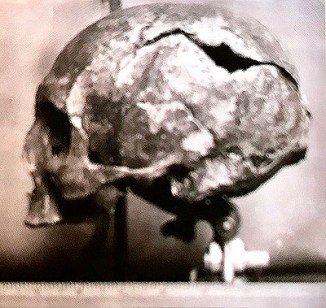
(And early photograph of St Magnus’ split skull, now interred in the cathedral)
After the Scottish Reformation in 1560, the cathedral was used for Protestant worship. Nowadays, it belongs to the people of Orkney. It is maintained by the Orkney Islands Council. It has a Church of Scotland congregation and can be used, by arrangement, by any Christian denomination.
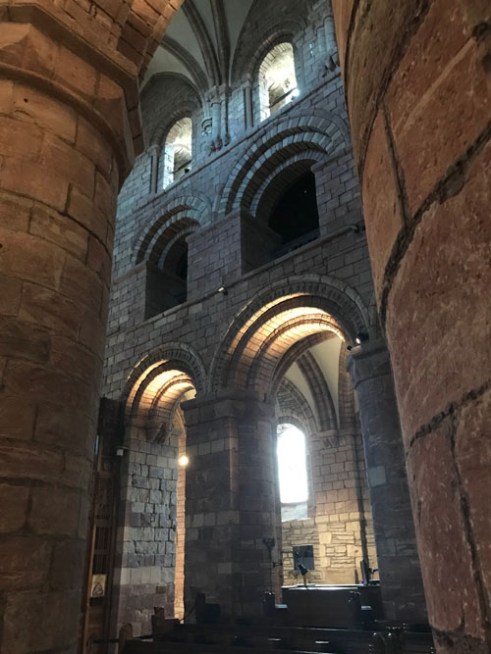
Restoration work took place in the 1850s and again, following a large bequest from Sheriff George Thoms, during 1913-1930. Because of its great age, the cathedral structure is constantly monitored for stability.
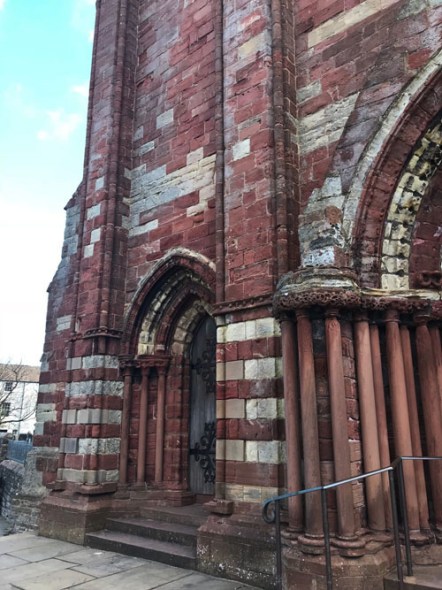
The exterior of the building shows off the local sandstone, from which most of the cathedral is constructed.
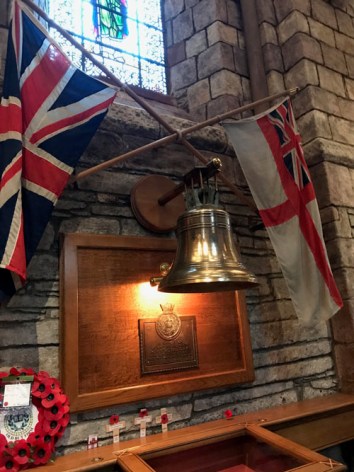
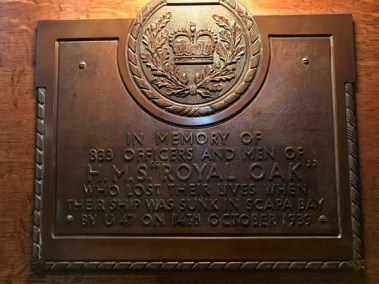
The north choir aisle is home to the brass bell from HMS Royal Oak, the battleship sunk in Scapa Flow in 1939. The case holds a Book of Remembrance to honour those who died. The pages are turned every week by the cathedral custodians.
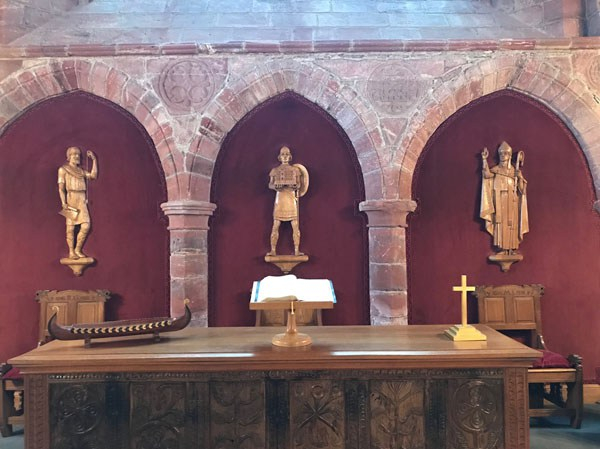
The chapel at the east end of the building is dedicated to St Rognvald, the founder. It was redesigned in 1965 by the Orcadian artist Stanley Cursiter. The wooden communion table and lecterns, incorporating medieval panels, were made by a local craftsman, Reynold Eunson. The left figure is Rognvald’s father, Kol Kalisson; the right is William the Old, Bishop of Orkney when the cathedral was built.
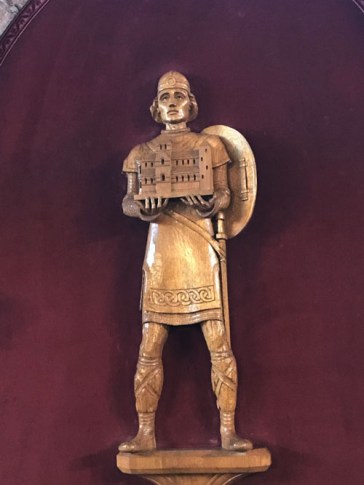
The central figure is that of St Rognvald, the founder of the cathedral. He is seen holding a model of the original cathedral building.
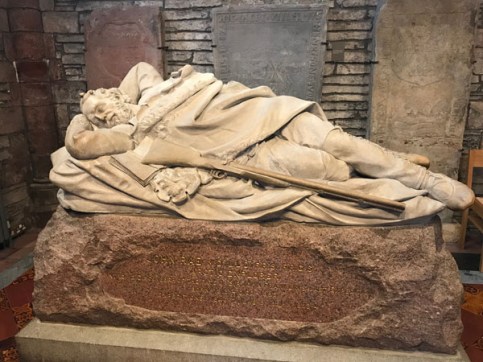
The right side of the chapel is home to Dr John Rae, a resident of Orkney, who worked for the Hudson Bay Company, which explored the Canadian Arctic. He discovered the vital Northwest Passage, enabling the shipping of goods between Europe and northern Canada by a much shorter route. His remains are buried in the cathedral’s graveyard.
Sadly, the chapel area was being used for a lecture, which meant I could not get close to:
- The cathedral’s oldest gravestone, thought to date from the 13th century. Its golden sandstone face depicts a carved ‘morning star’ symbol and a sword, possibly indicating a crusader or a Templar Knight. Initials P and C were added at a later date, according to the guide leaflet.
- The chapel also contains some of the oldest carvings, including dragons, a small hooded imp, and a squatting female Sheela-na-gig. At the top of a column there are two Green Men, ones with distinct foliage coming out of his mouth – a deeply mystical symbol and one emotionally linked to my personal past…
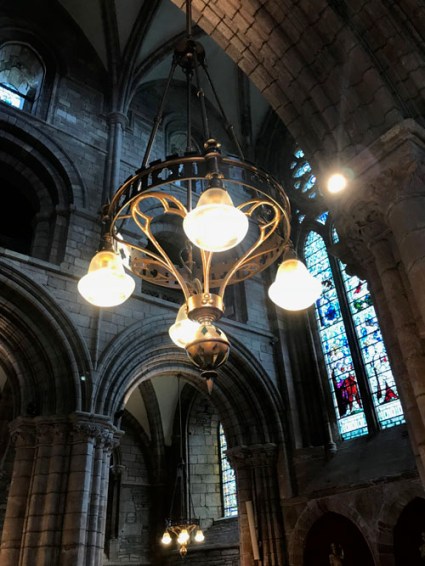
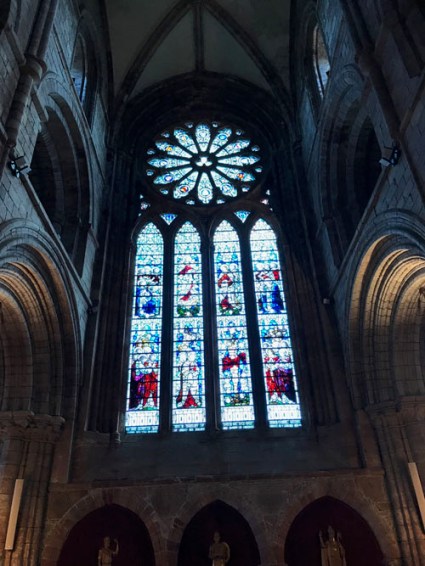
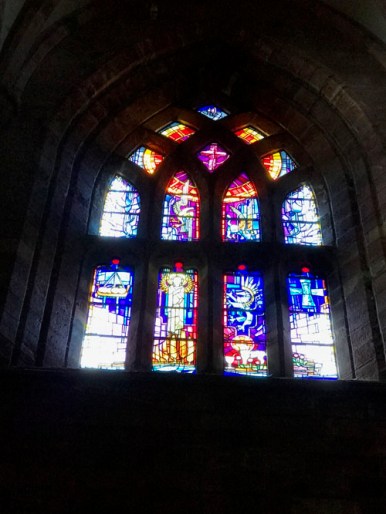
The majority of the present stained-glass windows were designed by the Glasgow artist Oscar Paterson. They depict a variety of saints and biblical figures, as well as characters from Orkney’s Norse past.
I have, therefore, many reasons to go back… something I look forward to very much.
Other parts of the Orkney series:
Stephen Tanham is a director of the Silent Eye School of Consciousness, a not-for-profit organisation that helps people find the reality and essence of their existence via home-based, practical courses which are low-cost and personally supervised.
His personal blog, Sun in Gemini, is at stevetanham.wordpress.com.
You’ll find friends, poetry, literature and photography there…and some great guest posts on related topics.
©Stephen Tanham
Share this:

Share this:

Jordis is new to blogging. Here you can read a very spiritual and joyous story of her sister’s passing…
Share this:


➰
In the gold-washed glow on green
Of July’s vivid evening blue
I watch your spinning fall to earth
➰
Through softer air than day’s has been
Your path to ground is freshly spoken
The soil-drawn spiral just for you
➰
Entranced, enspelled, entwined
My sight conceives of your conception
In six seconds of descending grace
➰
Stephen Tanham is a director of the Silent Eye School of Consciousness, a not-for-profit organisation that helps people find the reality and essence of their existence via home-based, practical courses which are low-cost and personally supervised.
His personal blog, Sun in Gemini, is at stevetanham.wordpress.com.
Here, you’ll find writing, mysticism, poetry and photography… and some great guest posts on related topics.
©Stephen Tanham
Share this:


Our penultimate church was in Batcombe… these days a small and straggling hamlet, seemingly in the middle of nowhere. There has been a church on the site of St Mary Magdalene for nigh a thousand years and very possibly more. It stands in a green valley, far from enough people to make a congregation seem barely feasible.

The church boasts a tower taller, in proportion to the rest of the single-celled building, than many grander churches we have seen. Indeed, the first impression you get when you arrive is of the height of the tower and the isolated beauty in which it stands.

The church is a simple one, with the main entrance still being through the base of the fifteenth century tower, and leading to a nave and chancel. It is a long, narrow building and lacks both ornamentation and stained glass. It is vaguely unkempt, appears almost abandoned……
View original post 859 more words
Share this:

Maiden Castle… from Sue.

Our final site of the official weekend workshop was Maiden Castle, an enormous prehistoric structure just outside the Roman town of Dorchester. We gathered in the car park beneath the hillfort and began the climb to its gates.

The name, Maiden Castle, is of debated origin, with some scholars taking it to mean an impregnable or unconquered fortress, while others look to the old Brittonic language and see it as mai-dun, the great hill. Perhaps it is both, but for our purposes, the site was definitely well named and large enough to be the virginal bride of a Giant.
 Aeriel view of Maiden Castle; image from photo of information board.
The human occupation of Maiden Castle goes back over six thousand years to the Neolithic era, when the hilltop was cleared of woodland and a causewayed enclosure was built. Finds suggest this was a place of gathering for ritualistic…
View original post 671 more words
Share this:

Share this:

A very special poem from Jordis…
Jordis Fasheh is a Companion of the Silent Eye. When we brought the School to birth at our very first April workshop, Jordis was the first to walk through the portal and has been held in our hearts ever since.
At the Jewel in the Claw workshop, Jordis embodied the role of Lady Rab’ya El Anouri, a Sufi mystic with a dancing soul. Inspired by her experience of that role and by one of the meditations in the course, she wrote a poem to capture where she is now. Jordis writes, “My studies with The Silent Eye; Steve, Sue, Stuart and all our lovely companions have had a profound and positive impact on my being present, alive and at one with Who I Am.”
I asked her permission to share her poem here.
 Image~ Jordis Fasheh
The Dancer
moment within moment
ever present,
breath within breath,
with ever evolving joy…
View original post 46 more words
Share this:

Sue’s post on Crop circles in Dorset and a beautiful video shot from a drone…

Although the hexagram was the main ‘pattern in the landscape’ that we had come to investigate… with a little help from the Giant on the hillside… there was another pattern that had been intriguing our companions… that of the crop circle that had recently appeared on the hills opposite the Giant.
We had no luck in finding it with the scant information we had that morning, but the girls had been doing some research of their own, and it was no surprise when they bounded into the pub, looking as pleased as punch.
 Crop circle below Hackpen Hill, Avebury
Trawling the internet for pictures and asking the locals, they had, between them, located the circle and two of them had gone in search of it on the ground. They had found the field in which the crop circle had gone down but had been unable to find anywhere…
View original post 1,062 more words
Share this:


There was a feather on his pillow when he settled down to sleep that last time. He had no idea where it had come from. If it was time to die, so be it…
Always the same beginning to the dream; the swim to the hidden beach on the Greek island, the beautiful sun blazing down on his naked body–far from the world he had left when he plunged into the water and began the half-hour’s crawl.
That much had been real, though the recurring dream gave it a new quality. When his world had come crashing down, when all meaning had seemed lost, he had gathered up his meagre savings and taken that last minute holiday to the tiny, poor place on the Greek island; its white rocks reflecting the sun amidst the glittering, dark blue of the Mediterranean sea.
On that far sand, he remembered actually falling asleep and waking to see the patterns in the bright rock face above him, though upside down to his normal vision. He had renewed his climbing as an act healing for the breakdown; a form of living therapy that absorbed him and took his febrile mind away from its imagined woes…
Upside down and with his climber’s mind, he had seen, clearly, the foot and handholds in the rock. Most would have missed them, but the strange perspective seemed to emphasise their position, their do-ability. And then, above the visible way-markers – far above them – the opening of the dark cave, set midway along the cliff face. For a second he had glimpsed the tiny outlines of vertical rocks set as pillars in that mysterious elevation. But, when he blinked, he couldn’t see them any more.
He remembered, then, the regret at having to swim back, the now sunburned skin left foolishly unprotected. Hauling himself out of the water on the familiar beach, next to the room in the old villa that was his home for a while. A short walk to his towel, trunks and tee-shirt and he was back in the small square with the two tavernas, sipping cheap Greek wine and washing its appalling refreshment down with bottled water and a feta salad. How hungry he had felt, then.
There were other naked people on the beach, but none of them headed for the hidden place beyond the headland. Perhaps no-one else had seen it as he had?
The return to ‘civilisation’ had been hard. He had been granted sick leave by his company, who were keen to see him fully recovered and back ‘in harness’. But then his health began to decline in a way that seemed unrelated to the mental breakdown.
He would wake each night, his whole body dripping with the sweat from the dream. It had become a nightmare. Always, it would go the same: he would be climbing that cliff in the intense heat, his wet fingers only just holding on to the sharp and unforgiving rock. Each night, he would get farther up the cliff face.
And then, last night, he had pulled himself over the final ledge, and lay, panting with wet effort, on the cool floor of the cave.
For a while in the dream, he just lay there, turning his head and marvelling at the fact that there actually were two tall rocks set as pillars to support – and mark – the entranceway. The soft sound of knowing feet walking slowly on dusty rock made him raise his prone body and gaze into the black of the cave. Half-revealed by the light, a man in a simple white robe looked down at him. In his right hand he held another white garment… and then it all faded… and he knew he had one last choice. He could shake himself awake, and die in bed, or he could stay…
He chose to stay. The gentle figure stood before him, offering the second robe. He tried to rise to his knees but other hands held him pinned, forcing his mouth down into the ancient dust of the place. He fought, but knew there was symbolic meaning here. He let them. They moved his head, firmly but gently, till the image of the dust of the earth filled his senses… they let his head rise.
He tried to see them, but they were shadows, sliding around the space. The one before him – the gentle one – lit a candle. His mind seized on the image and he tried to move forwards towards it, but the two other had his kneeling body fast and he was not able to move. What was the meaning of this? He used all his strength to push to his feet, and, this time, they did not oppose him – but kept hold of his arms. His feet pushed against the cold rock floor, and, together, the three followed the tiny light of the candle, so that it didn’t fade, but grew brighter as his efforts overcame the dark resistance.
Ahead, the candle had stopped moving. He knew this was important, and pulled those dependent on him towards it. The first monk now stood before a small table; and had placed the white robe over a number of objects whose outlines protruded like an Alpine snow scene. Part of the robe was pulled back to reveal a bowl of herbs, some unknown fruit and a stone goblet of what looked like water. Kind fingers fed him the herbs. They were bitter-sweet but focussed his consciousness. Then came the fruit, which washed away the taste of the herbs. At the end came the water – like liquid kindness. He gulped it down, but it was pulled away too soon. There was a feeling of truth about the water, a simple honesty about what really was, a revealing of what lay beneath everything.
For a second it all made sense; what they were doing to him. They had shown his his own life in miniature. From the simplest awareness of the dust; the very stuff of the world to be, as he grew from infant to child to man, becoming ever more aware of the ‘world’ around him. Seeing that he had seen, the first monk pulled the robe away from the remaining objects beneath. He gasped as he saw the precision of the model, carved by hand in stone to reflect the simple village bay from which his swim had begun. Every detail was exact, it was as though he were looking down, like a great bird might, on the place he called home.
The robe was placed over his head. It felt strange to have clothes on, again. The whiteness of the soft material seemed to have a life of its own. Now the two hands urged him backwards, creating enough space for the first monk to place the candle between the table-top tableau of the world and himself. What did that mean? For a fraction of a second his vision seemed to spin, to take the light of the candle and turn it into a million threads of woven world...
And then he knew… knew that he was seeing seeing… That he had stepped backwards and unhooked something he thought was inseparable. The eyes that watched propelled him towards the growing light of the cave’s entrance. He knew where he was going, but fought the organic fear as he was rushed, faster and faster – and still backwards – towards the high and empty space outside the mouth of the cave.
The eyes were full of love. As the hands said goodbye, they watched while time stopped and he turned, turned in way that no human flesh could achieve; but that was natural and perfect for the wings of a soaring hawk.
Stephen Tanham is a director of the Silent Eye School of Consciousness, a not-for-profit organisation that helps people find the reality and essence of their existence via home-based, practical courses which are low-cost and personally supervised.
His personal blog, Sun in Gemini, is at stevetanham.wordpress.com.
You’ll find friends, poetry, literature and photography there…and some great guest posts on related topics.
©Stephen Tanham


You must be logged in to post a comment.