+ #SE18Characters, #Silenti, Jewel in the Claw, Mystery Play, Mystery Schools, Spirituality, The Jewel in the Claw
Jewels in the Claw (v)
by Steve Tanham


Continued from Part Four.
Kind hands pass him a hot tea. He sits on the edge of what was the Royal Court, sipping and watching the ghosts… Many kind faces came to life in this, now-unstructured space – but it was heavily structured then… It takes but little effort to re-animate its dancing atoms…
Sir Francis Drake is a clever man. The naval mastermind who out-thought and fought the Spanish Armada detects that things in the Queen’s Royal Court are not exactly as they seem…
To start with, The Queen, herself: undoubtedly physically strong – though she pretends not, perhaps? – She seems vulnerable, even fragile, in the face of the effects of the terrible Tilbury vision: ‘The drowned man and the ghost with the white face’. What is he to make of that? Elizabeth, the person, is known to be both clever and resolute; never failing to show courage in the face of adversity. Look how she rallied the land-troops at the Kent Fort, when the clever Spaniards had re-grouped at Calais, ready to invade England with overwhelming force, the day after…
Drake smiles, knowing he and Hawkins’ strategy had rendered the Armada captive within the harbours of Calais, and that the fireships had devastated the frozen fleet, sparing the Sovereign from defeat, humiliation and execution.
Their hopes had all died that day: the King of Spain; the boasting Palma, admiral of the Spanish fleet; even the Pope, who had seen in Philip the perfect executioner of the excommunicated queen. All shattered asunder, like the bits of Spanish wood still being washed up on the shores all around the Isles of Albion and Ireland. Walsingham’s spies reported that King Philip now lived in isolation, his kingdom unable to muster the force, nor the will, to create a restored fleet… and if they did, could they really count on a Catholic God, whose force – sweet nature, herself – had turned on the Iberian forces with such vicious effect?
Much had died, but some things had been born; and Drake knew that this mysterious chamber was linked to that purpose: the refinement of the newly empowered.
Sir Francis smiles. There is no doubt about his place, here, in this strange ‘courtroom’ of the mind… and heart. He knows that he and Sir Walter Raleigh are on a par in terms of trust. He is not so sure about others in the gathering…
But there is no doubt where his duty lies, and he had been quick to suggest a partial remedy to The Queen’s malaise.
But now, ready to speak, on the edge of the chequered court, Essex – all powerful Lord Essex, beats him to it.
“Your Majesty! We seek to lift your heavy heart,” says the Second Earl, smiling at The Queen in way that infers an intimacy that he may or may not possess, yet clearly wants to display.
Drake knows when to play his part, knows when to be passive, when to bite the tongue and polish the small Toledo stiletto, on the inner fabric of his fine tunic. Bowing his head, slightly, to acknowledge Essex’s primacy, here, he adds his weight to the request that they may lift the spirits of The Queen.
“Your Grace, will you permit us all to enter the Royal Court with a touch of levity?
The Queen smiles.
“Had others asked, I would have refused, Lord Essex,” she says. “But as you and Sir Francis are two of my most trusted subjects, I feel inclined to permit this… You may… but with caution! You may not yet know the rules of this place, but I do…”
The pair, having created it over a jug of ale the previous night, propose a simple entrance of dance movement. Elizabeth loves dancing, though her years have slowed her down, a little. The well-dressed twosome posture, as though a couple, and take three exaggerated steps to the middle of the court. The Queen’s eyes light up with the jollity of the moves: respectful but gay. Her lips smile their approval.
Once at the centre, the pair make a series of quick moves within the middle set of four squares that see them one place forward… and reversed, right to left. They look to the Sovereign; all is well. Four diagonal steps later, they reach their respective corners of The Queen’s fearsome floor and drop into the safe space of the inner court, their goal accomplished.
The Sovereign is pleased. She motions for all who wait in the shadows of the West to follow suit. The heavy spirits of the previous day seem vanquished. Soon, a full complement of players follows the steps and stands ready to be seated, as The Queen wishes.
She wishes.
Sir Francis is a little late in being seated. He has seen the heavy bag of gold coins on the small table by the Sovereign’s throne. Drake has his suspicions, and looks, quickly, as he sits, to the back of the Court – the West. There, another man, also slower in his descent than the rest, has spied the bulging bag of coins. Seated, Drake focusses on the familiar edge of the one visible flash of gold. A Spanish doubloon glitters in the bright sunlight coming from the high windows of the chamber. Drake looks one last time at Dr Dee and, his eyes passing those of the ever watchful Sir Walter Raleigh, at the mysterious and mute Jesuit priest.
What deadly game is this, Your Majesty? the sailor with the fearsome intellect muses. He dares not even think – lest his thoughts and face betray the knowledge – of his own mysterious training at the hands of the now-accused John Dee. What dreadful fate within this day’s remit links the priest, the mysterious former royal astrologer, the burgeoning bag of gold… and, mercifully, excludes, at least so far, himself?
Other parts in this series:
Part One, Part Two, Part Three
Stephen Tanham is a director of the Silent Eye School of Consciousness, a not-for-profit organisation that helps people find the reality and essence of their existence via home-based, practical courses which are low-cost and personally supervised.
His personal blog, Sun in Gemini, is at stevetanham.wordpress.com.
You’ll find friends, poetry, literature and photography there…and some great guest posts on related topics.
©Stephen Tanham
Share this:

Continued from Part One
And now we should go back to an older time – a much older time – to flesh out the story of the islands of Orkney, north-east of the Scottish mainland.
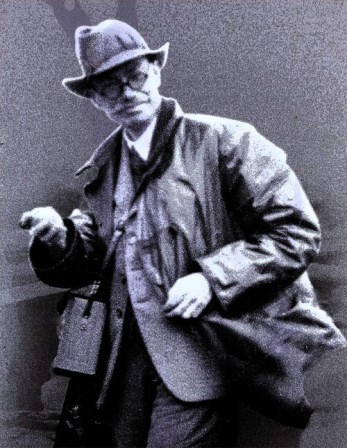
The man in the picture is Gordon Childe. It’s 1927. He’s the newly-appointed Abercrombie Professor of Prehistoric Archeology at the University of Edinburgh. The photo shows him emerging from the first formal excavation of an ancient settlement named Scara Brae.
He’s an Australian and a Marxist, though his knowledge and insight have gained him an international reputation for other types of revolution. The depth of his understanding of ancient peoples is the reason he has been appointed to oversee the work at Scara Brae by the conservative Edinburgh establishment. He’s not frightened of proposing things that upset his fellows in the field… and he’s about to propose something truly shocking about Scara Brae…
Scara Brae lies on the West Mainland of Orkney (see map, below – location ‘B’) – a place that hosts one of the densest concentrations of ancient sites in the world. The remains of the ancient village are on the very edge of the sea in Skaill Bay. Here, the enemy is climate: high winds and storms batter this beautiful archipelago, passing quickly, but capable of doing great damage. There are (almost) no trees on Orkney; a result of the constant winds.
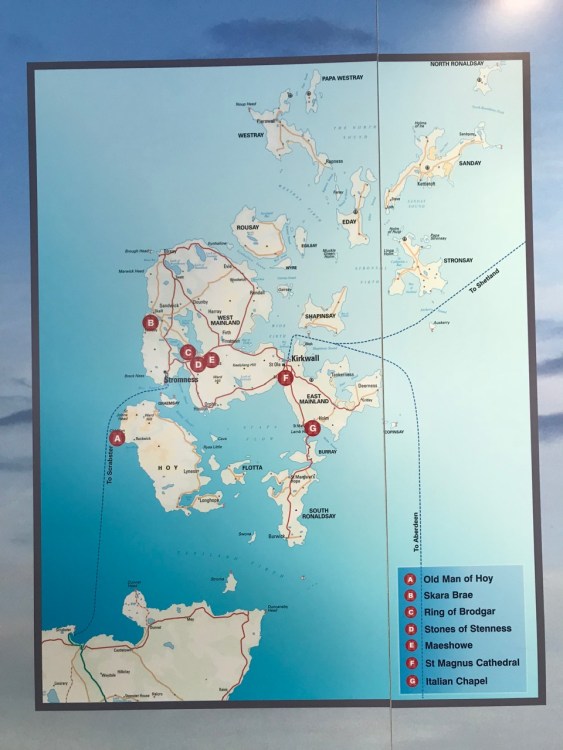
The location of the Orkney islands, off the North-East coast of Scotland
In 1850 a great storm blew away some of the sand and earth covering what is now the Skara Brae site, exposing several intact dwellings of what were, then, considered to be Pictish remains dating from the latter half of the first millennium AD.
William Watt, was the owner and occupant of Skaill House – still considered the best example of a manor house on the islands, and which is now a museum.
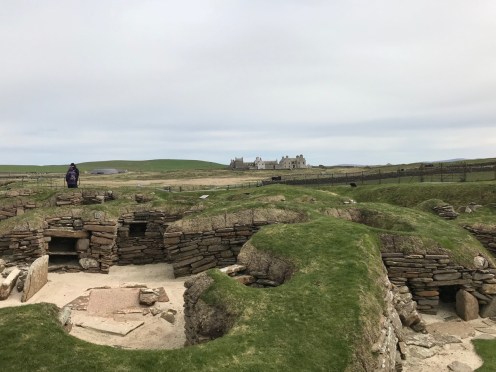
Part of the site, with Skaill House in the distance.
Watt carried out an investigation of what had been revealed. This was before there were any legal requirements for how such treasures should be excavated. He explored the two dwelling that had been revealed by the storm and removed many objects from the site. Unfortunately, he left little documentation of his work. In 1861, James Farrer, who was an archeologist and had discovered the burial chamber at nearby Meashowe, (see later post in this series) undertook his own investigations. Sadly, he, too, left little in the way of records.
When Professor Childe was appointed, the site had been exposed to the elements for seventy years. But, by then, the Scottish authorities had created a formal programme (which became Historic Scotland) to document and protect their ancient treasures. It was into this resurgent movement that Gordon Childe was appointed. He made an immediate impact, proposing that the coastal village of Scara Brae should not be dated to Pictish times (around 700 AD), but rather to the Neolithic period, around four to five thousand years old.
Scientific dating methods have proved him right, but there was controversy and even outrage in the mainstream press at the time. Some of this would have been due to him being Australian (the ‘what does he know’ type of comment) and also his well-known Marxist views on society. Nevertheless, Childe stuck to his conclusions, though he did his best to share the logic of his deductions. He became a popular figure–helping to promote archeology as a science having far greater implications that had previously been thought. It is ironic that, in the photographs at least, he resembles an early ‘Indiana Jones’ figure. The subsequent importance of Scara Brae is recognised in its being named a UNESCO World Heritage site – one of only a handful of such places.
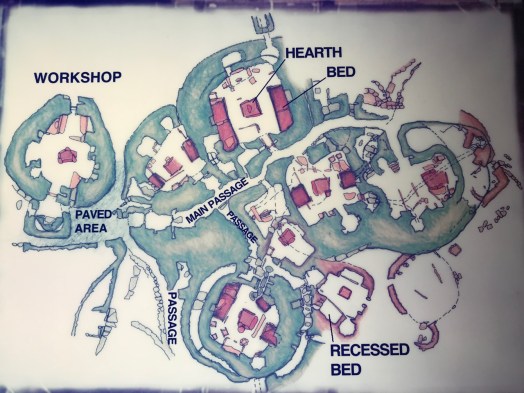
Scara Brae comprises ten houses set into the earth, near Sandwick; clustered together and linked by passages. The site is located next to the sea. The seafront has been reinforced to prevent further erosion. It is thought that there may originally have been hundreds of such dwellings in this location – all connected by an intricate system of shared living. It offers a glimpse into the lives of our shared ancestors from a time before Stonehenge was built…
Orkney offered the perfect home for the early agricultural settlers who came to farm here. Despite being on a line with Stavanger in Norway, Orkney has a relatively mild climate. People we met – all very friendly – said that, if there is bad weather, it blows over quickly. The islands also benefit from the Gulf Stream, which brings warmer water to its abundant shores.
Wind is the enemy, and is the reason there have been few trees here in recorded history. But that brings its blessings, too: the land was always fertile, and forests did not have to be cleared to create a farming landscape. The original Orkney peoples became expert in using stone for building, rather than wood. They also used it for furniture… We benefit from that in that, at least at Scara Brae, we can see the the more or less complete dwelling, and – uniquely – can see the actual furniture used by these families, five thousand years ago… This is what makes Scara Brae unique; we can form a real picture of how they lived and what they treasured.
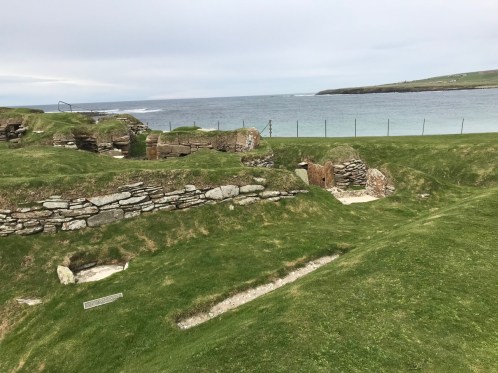
Everywhere you look on Orkney, you see the sea. We who have roads everywhere forget the importance of sea and rivers to earlier civilisations. The Orkney archipelago is a sheltered network of natural waterways and it is safe to assume that the original peoples were expert sailors, as well as farmers.
The visitor centre is excellent, and provides a complete reproduction of the most complete dwelling so that you can be prepared for what is later seen from the walkways.
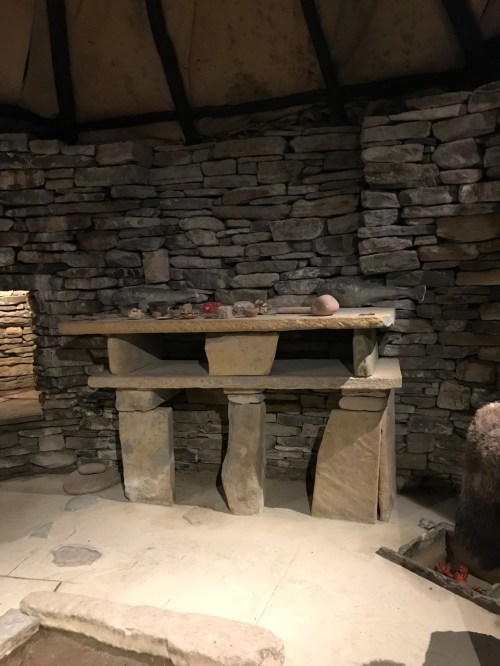
The edge of the central hearth and the ‘sideboard’ shared by all the houses in Scara Brae
Apart from one building, which is considered to be a workshop, all the family dwellings are remarkable uniform. They are partially sunk into the ground to give shelter and warmth. The walls between the houses are filled with ‘midden’ a mixture of shells and organic refuse which provides insulation.
Each house has a central hearth (see picture above), partly-recessed bed chambers, and, astonishingly, a toilet chamber – connected to a central flushing system! All the houses include a ‘sideboard’: a piece of furniture on which the families’ prize possessions, and possible tools, would be displayed. This shows a strong cultural ‘norm’, something that bound the villagers together into a shared and protective identity. These were peaceful and creative people. It’s no exaggeration to say that you can still ‘feel’ their presence in this beautiful place, which has been so lovingly protected and exhibited for all to see.
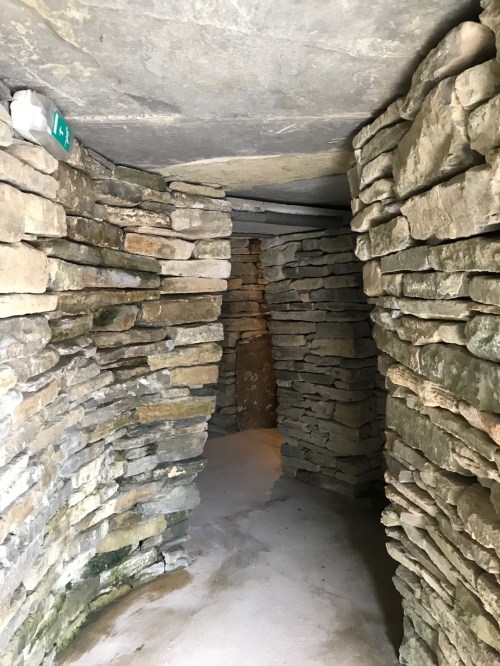
The visitor centre reproductions of ancient life are exact
Each house had beds, located in separate chambers, though open to the central fire in the hearth.
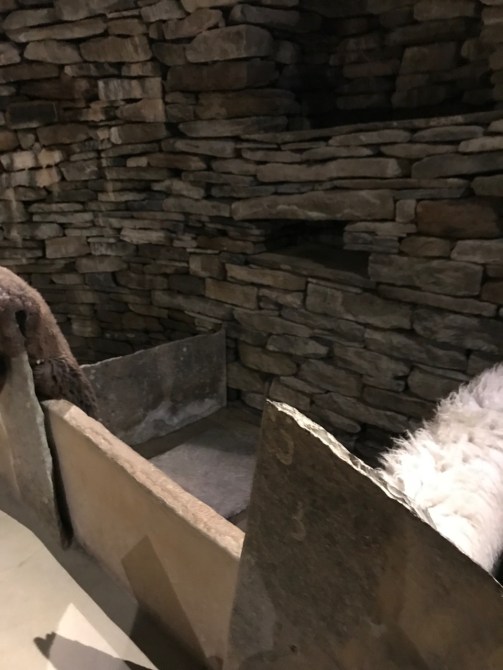
The separate bedchambers
The roofs were constructed using a mixture of wood, cloth and skins. This reproduction shows how they are thought to have looked.
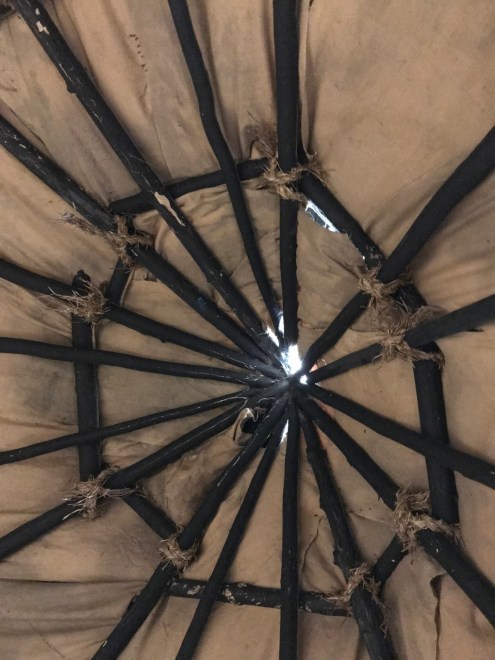
It is only when you walk the few hundred metres from the Visitor Centre to the actual settlement that you realise how effective the former is…
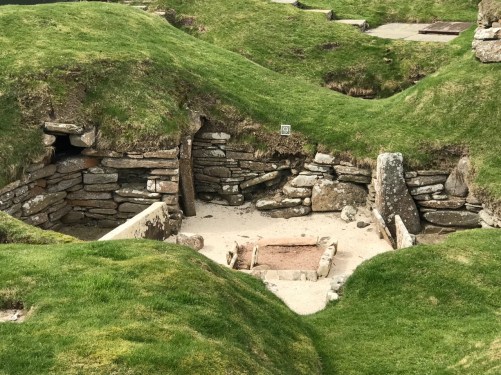
Everything is now seen in context. The hearth, the bedchambers and the stone sideboards are see with clarity and you get that amazing inner feeling that you are actually sharing the homes of ancestors from an astonishing five thousand years ago.
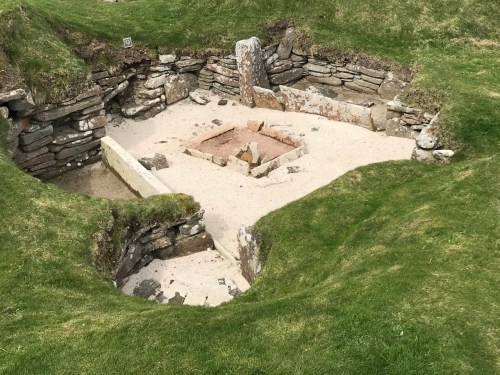
Orkney is a very beautiful place. Its beauty is not just in the landscape, but in its living history. There is no better example of this than Scara Brae. Much of that is down to Gordon Childe and the adventurous and open mind he brought to the task of revealing its true past…

One of very few trees we encountered on our trip
By the time Stonehenge was built, the Scara Brae site had been abandoned. No-one knows why. That his wonderful piece of ancient history survived so intact is a miracle. But, Orkney has that special feeling about it; and the idea of miracles fits well, here.
Link to Historic Scotland’s website.
Stephen Tanham is a director of the Silent Eye School of Consciousness, a not-for-profit organisation that helps people find the reality and essence of their existence via home-based, practical courses which are low-cost and personally supervised.
His personal blog, Sun in Gemini, is at stevetanham.wordpress.com.
You’ll find friends, poetry, literature and photography there…and some great guest posts on related topics.
©Stephen Tanham
Share this:

Stuart builds the key ‘images’ for the Spring Workshop next year: ‘Lord of the Deep’
Share this:

+ Blogger's Bash Blog Competition 2018, Blogger's Bash, Wordpress Annual Blogger's Awards ABBA,, Bloggers Bash Blog Competition
How we nearly got to the 2018 Bloggers Bash
by Steve Tanham

On Saturday, 19th May, I left Kendal in Cumbria, and nearly got to the Blogger’s Bash in London….
Barbara, one of our Silent Eye colleagues, had stayed overnight with us so that we could catch an early-ish train. Bernie drove us to catch the 08:30 departure to London from our local Oxenholme, Lake District station. The day was perfect – with hot sun and blue skies forecast for its duration. Barbara is new to blogging, and very much wanted to be there to meet the world she wants to join. I had promised her that there would be many encouraging folk present to help her take that first step into new technologies.
There were two minor complications: the royal wedding of Prince Harry and Meghan Markle was taking place in Windsor, west of London; and the FA Cup Final between Manchester United and Chelsea was taking place at Wembley… There were several friends who said we were plain crazy trying to do this, but we’ve always done our best to support the Blogger’s Bash, created by Sacha Black and her team some years ago. Blogging is an important part of what we do, individually and as the Silent Eye.
The first hint of chaos came when we boarded the train. A large group of friendly, but, shall we say, celebratory, football fans had reorganised the seating – not physically, as in moved the train’s furniture, but ‘logically’ as in who was sitting where… Our reserved seats had been subsumed into a general melé of noisy but friendly banter. We persevered, eventually finding a pair of seats in a quieter part of the train.
So far so good…. We arrived, on time, at London’s Euston Station, as did about a million other travellers.
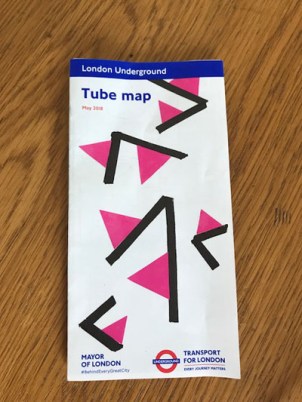
We had to make our way to Chiswick, where the event was being held at a local pub, the King George IV, which had a conference room at the rear. Having spent many years working at least two days per week in the City, I am familiar with the tube, at least in its central regions. However, my knowledge of the tube lines out towards the west – and Heathrow, beyond, was limited to straight runs to the airport, itself.
We needed to get to Turnham Green tube station, which is on the Piccadilly Line. Simple enough, said my TfL App, 31 mins and counting:
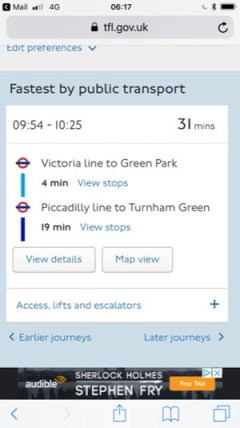
Fighting the hot crowds, we dutifully changed, at Green Park station, for the Piccadilly Line. It was just after eleven so we knew we would be a bit late, but long-distance allowances would be made…
However….
When we followed the signs down to the Piccadilly Line westbound platform, there was no mention of Turnham Green as a destination on the big board. In desperation, given the time, we asked two people if they could make sense of it, but neither could help us get to the missing station, as they were not native to London and just there for the day or on holiday. Eventually, suppressing a rising sense of panic, we crossed over to the other platform, where there was large map of the whole Tube network. With delight, we located Turnham Green… which was shown as being on the District line!
We dashed back to the westbound platform and fought our way onto a train, figuring that we could switch lines at South Kensington. When we got off at South Ken, we were dismayed to see a large sign saying that all Westbound trains on the District line were cancelled.
(Shades of Hofnung: “at this point I must have lost my presence of mind… for I let go the rope…” – apologies to anyone for whom this means nothing…)
A rotund but helpful member of the TFL platform team directed us back onto the train we had just got off… but which was just leaving, saying, “They’re stopping at Turham Green because of the problems with District.”
In total silence, and now sweating profusely, we boarded the next westbound train, which limped along at about ten miles per hour, presumably due to the congestion and line of damp people considering suicide…
Eventually, we arrived at Turnham Green in splendid sunshine and blue skies with a lifting mood. Asking directions, we spied the main road ahead and knew the venue lay just around the corner.
My companion, Barbara, happened to glance at her watch. It was 12:30. It had taken us two hours on the Tube to get there, and the agenda showed that the Bloggers would be breaking for lunch, to re-convene at 13:45. We looked at each other and picked a wine bar. We have planned on going out for lunch, but it had come to us.
We ate chicken and drank white wine. Towards the end of this revelry, Barbara said that, based on the worst case of the return leg mirroring some of the speed of the outbound, if we worked backwards from the – fixed – time of our return train to Cumbria, we would have to leave at 15:00. That would mean entering the Bloggers Bash late, making our apologies, staying for a mere hour, then making our apologies, again, as we left…
We didn’t… we had some more wine, instead and, despite the wine, the sunshine and the blue skies, looked glum.
We would like to apologise for our proximity and yet lack of attendance. We’ll try not to to do it again.
For anyone who doubts the veracity of this far-fetched tale, I present the receipt for the lunch below…
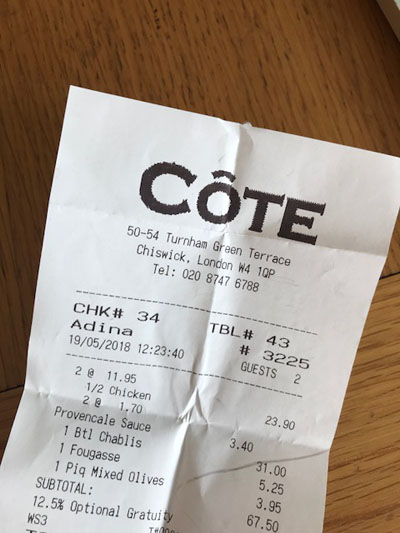
Our congratulations to all those who:
a. Made it to the Bloggers Bash.
b. Won something.
Stephen Tanham 4B. “Must try harder”
p.s. Our return train was delayed 45 mins at Preston, due to points failure. Bit of a C minus day, really… sigh.
Share this:

+ #Silenti, Mystery Schools, Silent Eye School, Silent Eye Workshops, Spirituality, The Jewel in the Claw, Tudor Lifetimes
Jewels in the Claw (iv)
by Steve Tanham

Continued from Part Three.
The line of packing cases is nearly complete. The man looks down at the three chairs in the East, one white, one purple and one red. The symbolism of the outer two was plain: the Tudor colours, central features of the royal Tudor Rose – the white of House York merged with the red of House Lancaster. Queen Elizabeth had inherited a peaceful kingdom, but those who built it lived in times that were anything but peaceful…
The middle chair comes alive in his mind; the Queen in the fullness of her power, prepared and majestic, older in wisdom than most in the Court… but vulnerable in her own way. The dream… the dreadful dream.
Was its recall connected with the mysterious and currently invisible Count Mortido and Countess Libido? It does not matter – what matters is that when Act One was drawing to its close, with the court chairs of Dr Dee, the alchemist, and John Gerard, the hunted Jesuit, mysteriously restored to face her, the Queen, released from the frozen state like the rest, rose to her feet, troubled only by the memory of her vision at Tilbury.
All is sea, now. She has declared it so; the chequered floor – in which they all must learn the new rules of survival – is watery. Emotion perhaps, or water of a magical kind, a water associated with the coming into existence of things called and named. The Royal Court is its name, but navigating it is not as simple as the black and white squares would suggest.
There are soldiers here, powerful peers of the realm such as Lord Essex; and there are sailors, such as Sir Francis Drake–placed in polar opposition to Essex. Both are champions, respectively, of their faces of the sixty-four squares. The sailor may have the advantage over the solider, but only within the boundaries of the now-watery square of squares… There is, perhaps an invitation there, for one who would be brave enough… or foolish.
It is the vision at Tilbury that holds their attention: “The speaking, white face and the chained man drowning. So vivid, so other-worldly.” the Queen says. And then she pauses, gazing into the squares, looking more lost than at any time since her imprisonment in the Tower as young woman. There, she had only the company of Lord Dudley and the ravens to ease the terror of imprisonment by her cruel half-sister, Mary.
Something was begun then, but she will realise its significance only later in the play, when fates beyond even the power of Count Mortido and Countess Libido play their unseen cards…
Sir Walter Raleigh, once so impetuous, now the Champion of the West of this chamber, sees his moment – not to rise in the Queen’s favour, for he knows that his presence is already predicated on the fact that he had the Queen’s complete trust. How does he know this? Because she has made him gaoler and custodian of the two seemingly condemned men: Dee and Gerard; former royal astrologer and hunted priest.
When the Queen looks across the Royal Court from the East, it is Raleigh’s eyes she seeks. He answers the call. Rising and striding towards the throne, unbidden, but welcome.
“Majesty, forgive me!” He offers his arm, she takes it and they turn to face the West. Everyone in the silenced court rises, ready to bow at the Sovereign’s passing.
“I doubt there is a royal rule you haven’t broke, Sir Walter!” But it is said with fondness, though, heaven knows, they have quarrelled in the past…
Raleigh sweeps his free arm across the image of the Court Floor. In quiet tones, as though only they two are present, he asks, “What is this ‘sea’? How may we cross it?
“We must all decide what it is, together, Sir Walter.” replies the Queen. “I have learned much about the wisdom of groups of people when faced with extreme difficulties. There are many patterns woven in these simple squares – and I may not have seen them all…”
She pauses and looks sad. “The lives of Dr John Dee and the Jesuit John Gerard may depend on it.”
Raleigh is keen to advance the moment. “Extreme? Their lives in danger! Majesty, this chamber is more than it seems!”
The Queen shudders, remembering that second visit to Tilbury, place of dark visions. The process that is the Royal Court is set on its course. She can leave it to sail. Tilbury is what worries her most…
“As was the woman from the sea with the white mask, Sir Walter… the woman with the question that made a Queen shudder.”
Raleigh, speaking for them all, asks, “Majesty? May we know that lady’s question, dream stuff or not?”
For a long minute, the Queen is still, then she says softly, “In icy tones, dripping with the salt of the sea, she asked me, “Whose face do you wear…?””
As they leave the chamber the Raven Song plays… The silence of the others is more than royal respect.
Other parts in this series:
Part One, Part Two, Part Three
Stephen Tanham is a director of the Silent Eye School of Consciousness, a not-for-profit organisation that helps people find the reality and essence of their existence via home-based, practical courses which are low-cost and personally supervised.
His personal blog, Sun in Gemini, is at stevetanham.wordpress.com.
You’ll find friends, poetry, literature and photography there…and some great guest posts on related topics.
©Stephen Tanham
Share this:

Sue on the year ahead…

“You busy?”
I flick the phone onto speaker, my hands are otherwise occupied. “Just a bit.”
“What’re you up to?”
“Sticking pasta in a beard.”
There is a long silence on the other end of the phone…
“Could you repeat that?”
“You probably heard me right.”
“I’m pretty sure I didn’t.” His startled tone makes me laugh. “Whose beard?” I can practically picture my son’s thoughts… he sports a rather magnificent beard of his own these days. Then I hear the shift as the light dawns. “Isn’t it a bit early for that?”

No, it is not too early, and even if it were, it would be worth it to have had that conversation. The annual workshop is barely past and we still have eleven months till the next April workshop, so yes, we have plenty of time to gather, make and play with props and costumes. We shouldn’t actually…
View original post 358 more words
Share this:

From Sue, who cares…

“Robots to look after elderly in care homes…”
That was the only bit of the headline that I saw as I dived out of the shop this morning on my way to work. As a carer. Granted, the implication was that this was a futuristic premise… a possibility yet to manifest… but even so, I was, I admit, entirely and immediately judgemental… and that was before I had time to come home and do a bit of research.
Once I had, I was fuming.
To be fair to those who think this is a wonderful idea, they do not, as yet, intend to replace actual carers with robotic artificial intelligence, though I get the feeling that is only because the technology is, as yet, insufficiently advanced or affordable. One of these robots costs more than I, and many carers, will earn in a year. But it is not some forward-looking…
View original post 849 more words
Share this:

Share this:

+ #Silenti, Mystery Schools, Silent Eye School, Silent Eye Workshops, Spirituality, The Jewel in the Claw, Tudor Lifetimes
Jewels in the Claw (iii)
by Steve Tanham
Continued from Part Two
The man with the packing case pauses as he passes the place that was the East, the place from which the Queen began her direction of proceedings in this, her favourite palace of Nonsuch, in 1590’s South London.
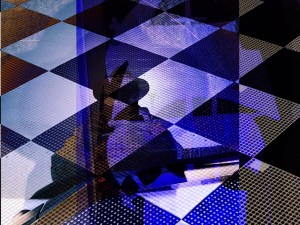
There is little left of the ritual-drama space now. Just the mental image of the chequered floor that was the Royal Court and the seats around it. But the square framework still contains that magical feeling of somewhere that has been declared and established as a place of working…
Ritual is a frightening word to some: pop-fiction has seen to that. To others, whose focus is beyond the egoic, it means a created place of loving and intelligent energy, self-discipline and intent – an intent focussed on the common good and the creation of a space in which collective work on the self – on each self, may take place. When this intent is sustained over a weekend, in a five-act drama with deep characterisation, the effects are electric…
There have to be catalysts, the man thinks, smiling and eyeing the top two chairs of the rows of five in the South and North. Some got it straight away, others saw it a little later…
Either side of the Queen, but not on the threefold Royal Dais, there were two characters that could not be seen… well, not initially. And, here, there are two realities which dovetail – for the sake of the story, but also because creation does that; presents different perspectives according to our ability to understand.
Christopher Marlowe understood; saw what his friend William Shakespeare had created, saw the two levels, if not the third, for life must enter its creation to be truly fulfilled… and understood, immediately, that the fearsome and painted Count Mortido and his lady, Countess Libido, were bigger than the play, and yet involved with it, like the highly coloured threads in a Persian rug, woven into the whole, yet capable of being ‘read’ individually if one knew how to follow the weave and see why it was laid down the way it had to be.
Marlowe knew that of the five chairs in the South and North, only four on each side were seen…
His smile – he, the man with the blue packing case – becomes the living stage once more, and the minds of twenty others remember, perhaps wistfully, as they pack to leave the little village of Great Hucklow, where remarkable things happen…
Unseen by most, the Count and Countess walk from South and North to meet across the Court Floor and let their loving hands link, then they step apart and to the West, away from where the Queen will be… but is not yet.
As they descend from the East, the place of power, Mortido, the Lord of Change and therefore Death, and his sister-wife, Libido, Count and Countess, loosen their grip on each other, no-one except possibly Marlowe and a woman waiting in the wings sees the sadness of this. Soon the figures of Death and Life are stationed at the far corners in the West – the place of emotion, water and the setting sun. There, they form a portal, glaring at the players as each is called by Marlowe… until the Queen raises her head from the shadows and takes the power from Marlowe, crossing into the court unmarked by the Lord and Lady of Death and Life; for Queens have deep power too, as have all marked out willingly or otherwise to serve the purpose of evolution in its slow spiral of civilisation.
The Queen crosses the floor alone, followed, as we have seen, by Frances Walsingham and Robert Cecil, the twin children of greatness.
But the Count of Death and his Lady are not finished with their opening… their nature is, inevitably, to dabble in mankind’s doings. No sooner do they see the plight of the reversed Dr Dee and the reluctant Jesuit Gerard than they are on their feet, suspending ordinary time with their great call, “Let the mists descend…”
In the time beyond human perception, they again descend the Court Floor, now filled with royal power and intent, and break into the sleep of the victims, raising them and reversing their chairs so that both face East, as they should.
Some might say the Queen is distracted by other concerns, others that the Count and Countess threw fairy dust over her as they established their power over the proceedings – even in the face of Royal presence.
This may get complicated…. but only necessarily so. Meanwhile, Dr Dee, former astrologer to the Queen, and John Gerard, the most hunted man in England, now face the East, the quarter of power, and both tremble at their presence in this, the most dangerous place they could be – facing it.
Other parts of this story:
Stephen Tanham is a director of the Silent Eye School of Consciousness, a not-for-profit organisation that helps people find the reality and essence of their existence via home-based, practical courses which are low-cost and personally supervised.
His personal blog, Sun in Gemini, is at stevetanham.wordpress.com.
You’ll find friends, poetry, literature and photography there…and some great guest posts on related topics.
©Stephen Tanham
Share this:

It ends beneath the ground; it always does. The bones of soldiers buried in fine ceremony, though the organic memory passed long before the corpse was glorified. Collective kindness crumpled by division in the face of another despot whipping up the many faces of our unhappiness.
But, perhaps, not always…
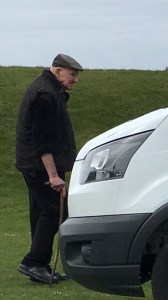
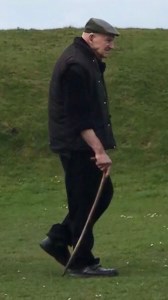
His name is Johnny Claude. He’s ninety-eight years old – the oldest man on Orkney who was born there.
The Historic Scotland guide for the Battery at Hackness, on the Orkney island of Hoy, had just talked us through the old man’s extraordinary life when his subject crossed the Battery courtyard behind us faster than anyone that old should be able to do… Glimpsing his movement, I turned, my camera phone poised, and caught the guide’s eye: yes, that’s him; take it quick, he doesn’t linger.
He had a stick, and used it with great skill. Somehow, it reminded me of the heroic artifice all around us: the Hackness Battery and the Martello Tower, with its state of the art gun – well, state of the art for 1812, the period when the fort was constructed on the strange and fascinating island of Hoy.
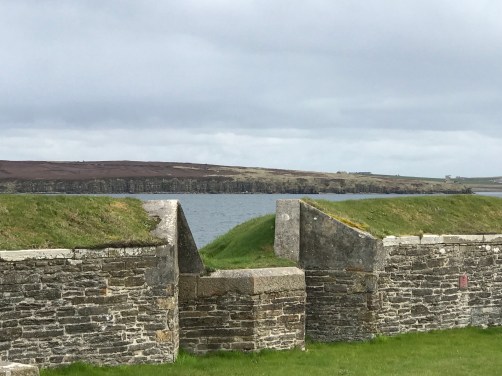
The mention of 1812 might have set you off humming Tchaikovsky’s overture of the same name, which, as we’ll see, is very apt.
The sea in front of the Hackness Battery might have triggered other associations of a military nature: Scapa Flow… though this part of it is known as Longhope Sound. One day in 1812, the guide says, there were over a hundred ships just off this stretch of coast. Every one of them seeking sanctuary; every one of them safe because of the presence of this naval battery and its ability to reach into space.
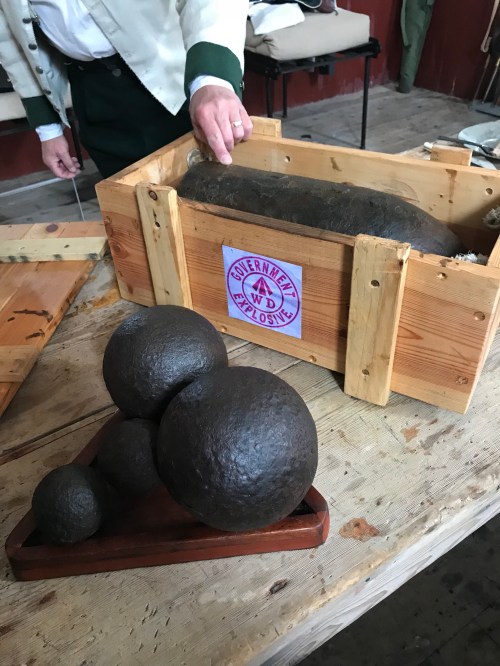
What reached into space was the presence of long-distance munitions: the kind of physics that blows apart large sailing ships. Graduating from the solid, spherical ‘shot’ shown above to the more complex spinning explosive ‘shells’ (in the box), the power of the impact became increasingly sophisticated as the years passed. Even in 1812, the heaviest of the shot – 24 lbs and very difficult to lift by hand – could be propelled over a mile with high accuracy from the battery. The gun at the top of the Martello tower was even deadlier. The additional forty feet of the tower allowed it to be more accurate and added a half mile to its range.
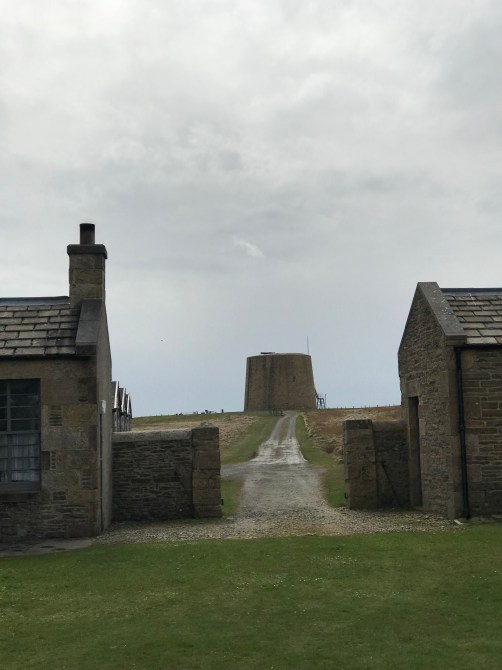
Johnny Claude has been here all of his life. Born in 1919 on Hoy, to a father who had bought part of the old Battery for the family home, he eventually enlisted and was based on Hoy in his late teens as part of the gunnery crew. His life had escaped the horrors of the First World War, but was imprinted by service, here, in the second. He never left.
Even his story was a hundred years after the rise of Orkney’s naval importance; something we find strange to understand now, when Orkney is seen as a place remote and ‘up-there’.
Up-there was one of the most important places in the ancient world because its open and deep waterways – like Scapa Flow – linked the North Sea with the Atlantic… and way beyond. In no other place could you gain so much distance simply by turning your ship. This story does not begin with the Napoleonic threat in 1812; it is the story of Orkney’s entire history. To begin to grasp it, you have to stand on one of the high places and look across the vastness of its waterways… They are also some of the deepest in the world.

The Battery at Hackness was established at the end of 1812, in response to the threat of naval invasion of Britain by Napoleon. We readily call to mind the threat from the Nazis during WW2, but, a hundred years prior, the French forces posed just as deadly a menace from closer at hand.
Napoleon dominated Europe, and was intent on starving Britain to its knees. The only surviving trade to the East was with the Scandinavian ports, who saw in Napoleon as big a threat as Britain did. Orkney sat at the crossroads of that lifeline of trade – and its protection was paramount.
The seaways of Scapa Flow are unique, and that Britain possessed them was vital to the country’s survival; something that continued right up to WW2, and carries on today with the fishing and submarine fleets. The two hundred ships sheltered in the sound off Hackness in 1812 were there for one reason only: the fort could protect them, and there was nothing Napoleon could do about it…
Beyond the Battery is the Martello Tower. Had a French frigate made it into Longhope Sound, its guns could have damaged the lower levels of the battery – though it would have taken great accuracy. But the Martello Tower, with its 24 pound gun and mile and a half range was indestructible, and one of most formidable defensive ‘machines’ ever constructed in the age before electronics.
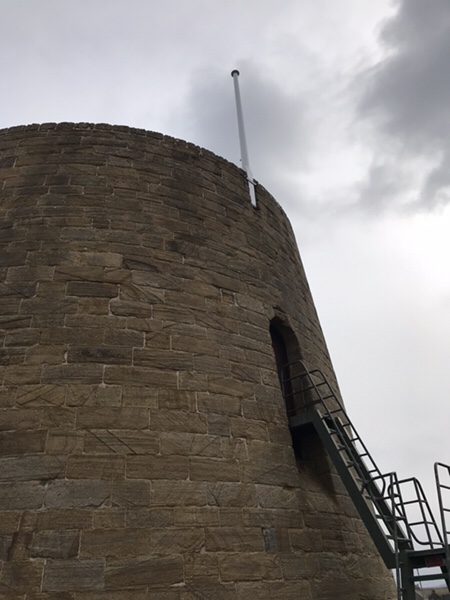
The British forces did not invent it. Martello towers take their name from Martello Point in Corsica. In January 1794 two small cannon mounted on a coastal round tower beat off an attack by two British warships with a combined firepower of 106 guns. The navy learned from that, taking the basic design and commissioning the best engineering minds to refine the idea into an impregnable, if small, fortress.
The secret lay in its shape.
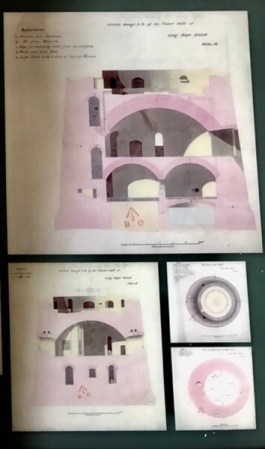
Photo of Historic Scotland’s information board
Seen in cross-section, from above, (lower right panel, above) it was oval in construction, with the sea-facing walls being a staggering 4.2 metres thick. The entrance was via an iron ladder to the second floor.
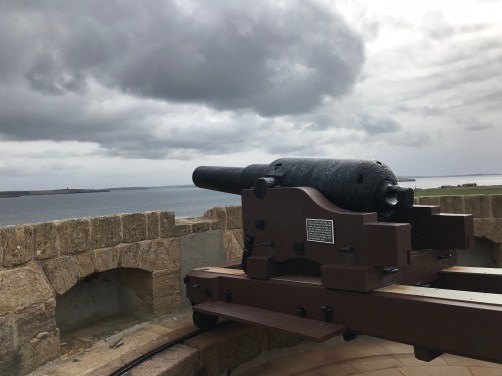
The gun was on the roof, which also was shaped to be a giant rainwater collector that fed a basement tank, using a filtering system. It was thought the Martello towers might be besieged, so the gunners had to be self-sufficient.
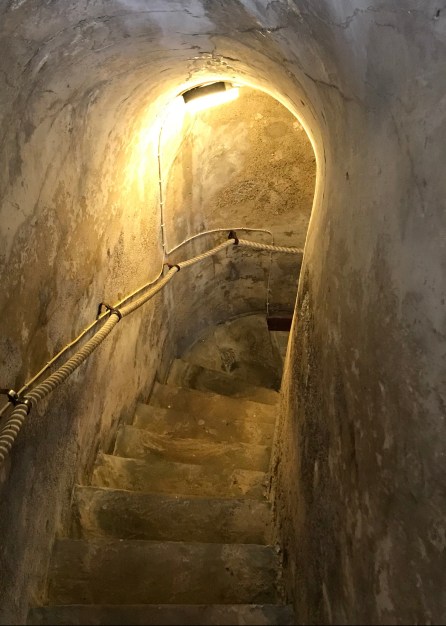
The gunpowder was stored in a carefully isolated chamber on the lower floor, reached from above, and entered only when wearing special clothing to prevent ferrous sparks.
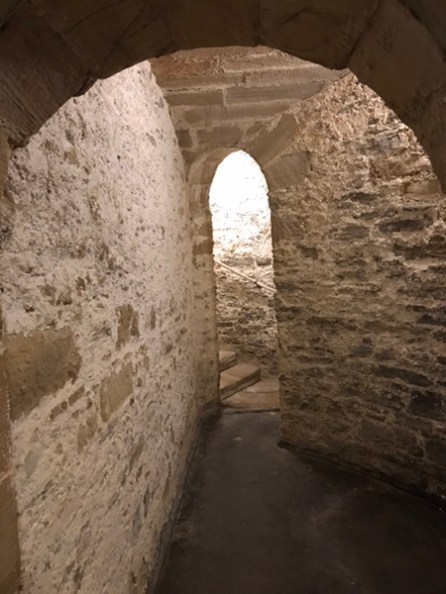
The gun and its support structure on the roof had been designed very carefully. Such a powerful weapon had a strong recoil, throwing it sharply backwards when fired.
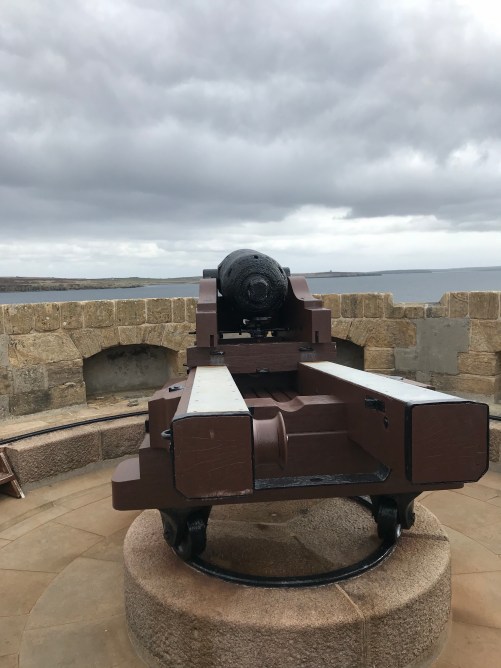
The mounting rails were angled upwards, behind the gun, absorbing the recoil energy as the gun climbed the gradient. At the end of the recoil, the gun locked itself in the elevated position, allowing easier re-loading of the shot or, later, explosive shells. The whole mechanism was mounted on a strong cast-iron ring set in granite which allowed it to be accurately aligned with its target. All of this was based on mechanical principles and the mathematics of the time. It was a masterpiece of defensive design.
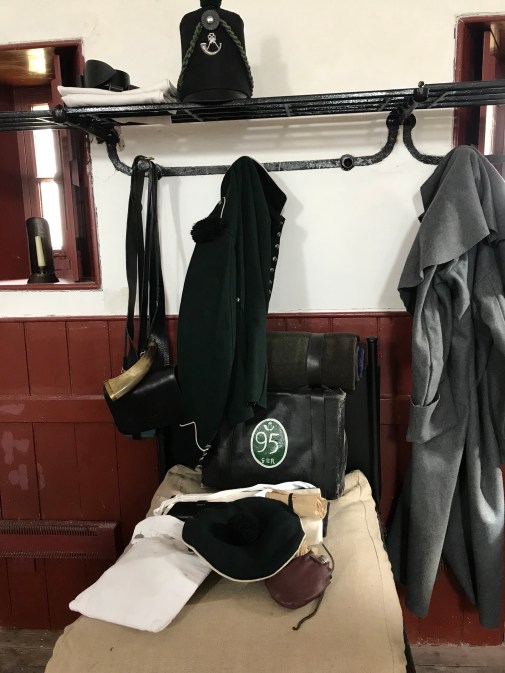
Life in the Battery was primitive by today’s standards. But many, like Johnny Claude, served out their time here and even chose to stay on in Orkney.
Like his father, Johnny went on to marry a local girl and had several children. His father had purchased a section of the old Battery barracks in the 1920s, and Johnny inherited this for his own family. The photo shows him walking from the door of his lifetime home. His wife died some time ago, but this old figure is still wedded to this special part of Orkney.
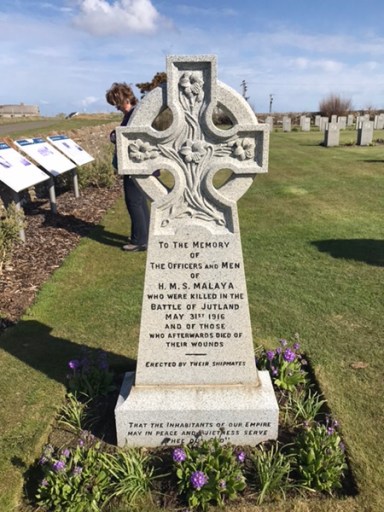
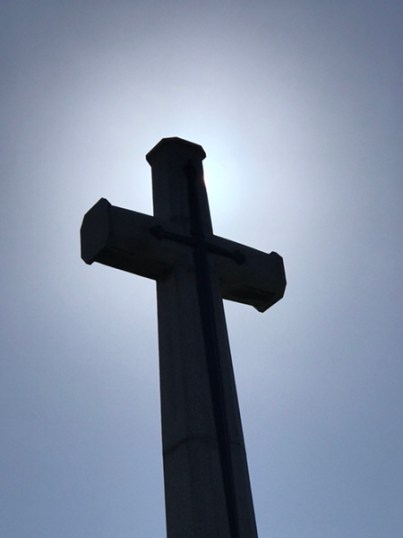
There are many military graves on Hoy. The tall cross of the opening image marks the centre of an immaculately-kept combined services graveyard. But none of the graves contain the remains of those whose life was the Battery and Martello Tower.
It was never used in anger…
So potent was its fire, and so secure its design and position, that not even Napoleon dared risk an attack on Scapa Flow. Ultimately, it was an instrument of peace, not war. The fact that it was wholly defensive may say something about its effectiveness; and its longevity.
The presence of this very special old man of Hoy who holds so much of Orkney’s living memories is testimony to that.
Stephen Tanham is a director of the Silent Eye School of Consciousness, a not-for-profit organisation that helps people find the reality and essence of their existence via home-based, practical courses which are low-cost and personally supervised.
His personal blog, Sun in Gemini, is at stevetanham.wordpress.com.
You’ll find friends, poetry, literature and photography there…and some great guest posts on related topics.
©Stephen Tanham
Share this:

From Stuart France…
Share this:

Behind the scenes…
by Steve Tanham
Sue’s lovely summary of what we do each Spring!

It is an odd thing to put on a workshop where ritual and drama are mixed. Odd, but old… theatre has its roots in the sacred drama of ancient times. Even the rituals of the Church have a theatrical element, blending light, song, the glamour of embroidered vestments and the fragrance of incense and oil. These things combine to capture the imagination and emotions, lifting the heart and mind above the humdrum cares of the world and turning them towards the greater Light of the spirit.
None of these dramatic elements are strictly necessary. Turning the mind and heart towards the divine, whether in prayer, adoration or meditation, needs no company. The spiritual journey is ultimately one we must take alone…and yet, we may have company along the way.

It is perfectly possible to access the spiritual realms without any help at all, just as it is perfectly possible to…
View original post 764 more words


 Sun in Gemini
You must be logged in to post a comment.