
It is, after all, only one day…
Have you ever re-assembled a day into a different sequence? Been so involved with its contents that the threads seem to weave themselves, again… and differently.
But it is only one day… and at the halfway point she will be waiting; waiting near the red tower where we will meet for the first time. And then the torn thread of ninety-seven years will be re-woven… for real, not just as a story.
It’s early October, 2017. It’s also AD 440 on a rocky cliff top towards which we are walking; and it’s 1914, and a picture from my genetic past rises, again, in my consciousness and returns to haunt me…
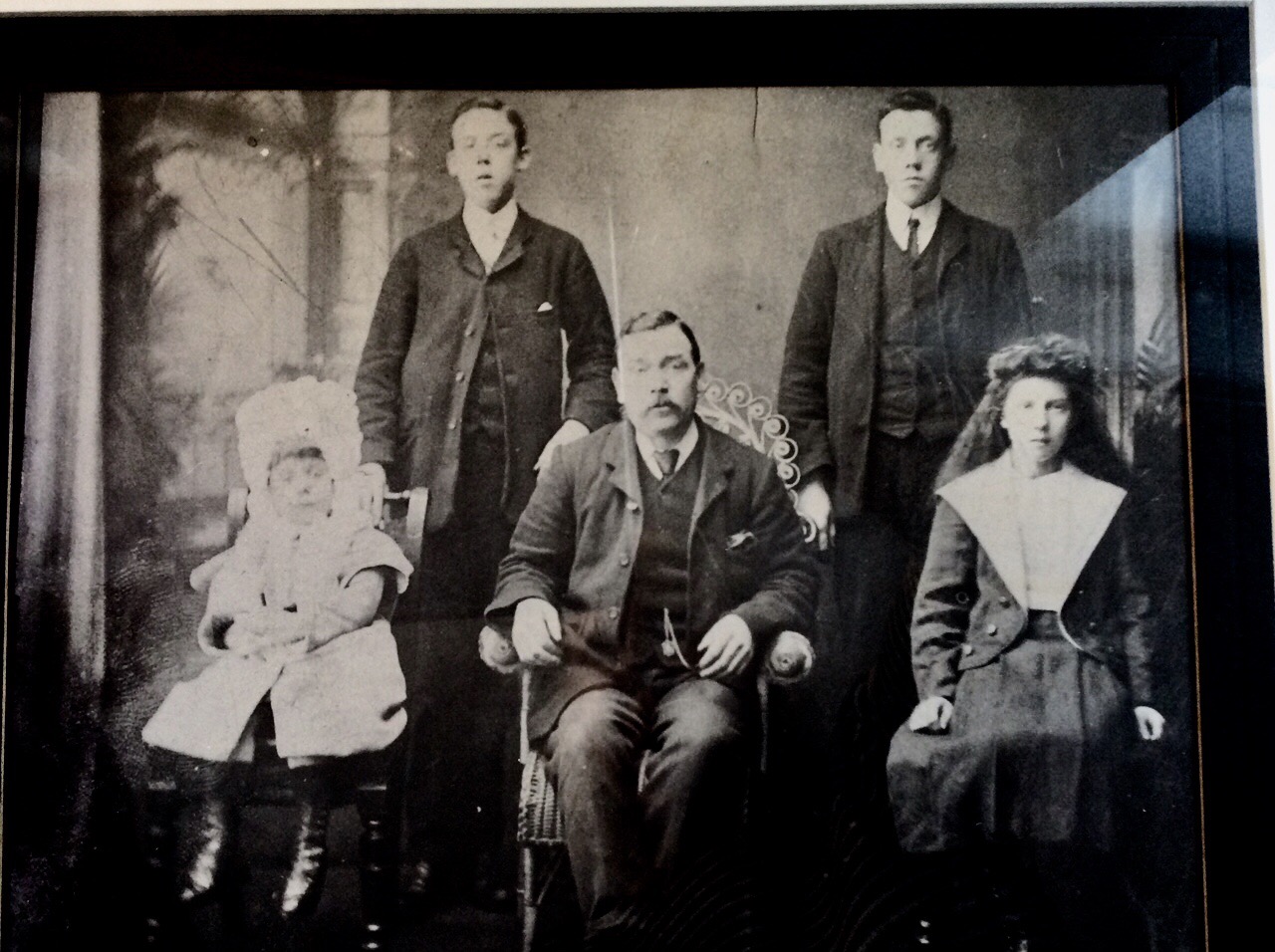
She’s very young, the girl in the black and white family photo. Her feet don’t touch the floor, on the adult chair. She stands out as much younger than the rest of them. She is my paternal grandmother, and her name is Elizabeth.
We know the island of Anglesey quite well. Even from Cumbria, it’s a relatively easy journey, courtesy of the northern M6 and the A55 dual-carriageway that follows the North Wales coast right to the bridges over the beautiful Menai Straits.
We’re having a short break near Cemaes Bay, which is located at the top of this historic and fascinating island.
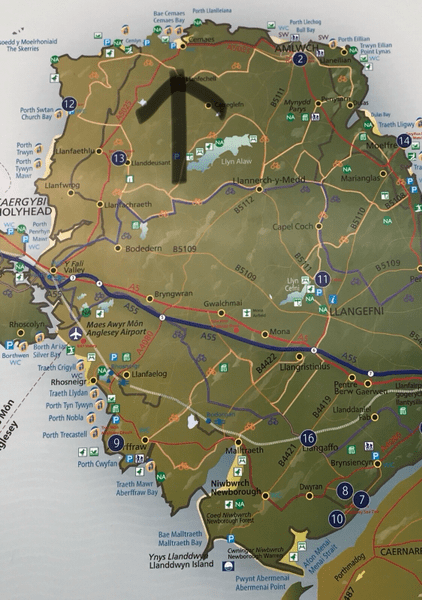
My annotated Anglesey photo (above) from the tourist information board at the tiny seaside village of Camaes Bay shows the location of this beautiful stretch of coast, which boasts that it is ‘the most northerly village in Wales’.
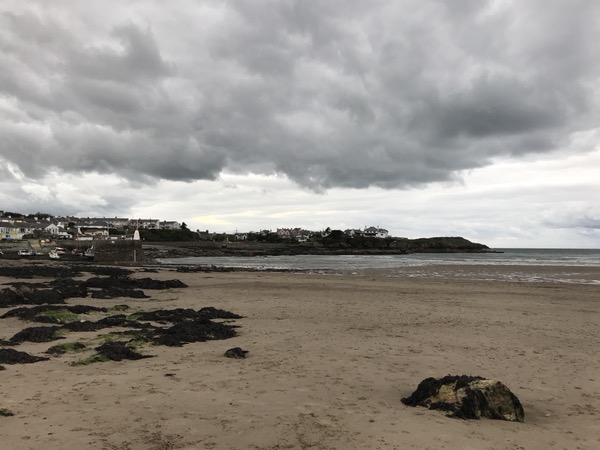
We had planned our trip carefully. It was to be a day of two halves, with very different agendas. The lunchtime and afternoon were to be spent on the reuniting of two family threads that have been separated by a near-hundred year gap, about which more later…
The morning was ours to fill, and we had our eyes on the nearby clifftop church of St Patrick’s; a place we had read about but never visited.

The beautiful bay of Cemaes is well known. Less celebrated is the ancient tiny church on the adjacent headland of Llanbadrig, and its founding by no less a figure than St Patrick, the father of the first Christian communities in Ireland and the west coast of Scotland
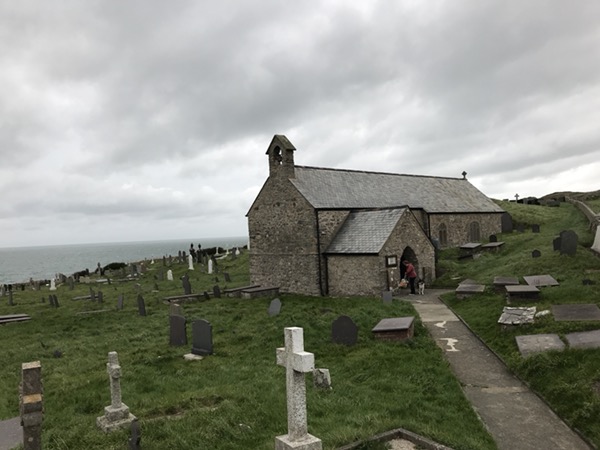
According to local legend, in AD 440, Bishop Patrick, as he was known back then, was on his maiden voyage from St Columba, on Iona, to Ireland, in order to bring it into line with Christianity – empowered by holy orders from Pope Celestine.
As often happens with the Patrick of legends, his voyage was ravaged by storms. The ship was driven towards the brutal coastline by the notorious Anglesey winds and shipwrecked onto the rock of Middle Mouse – now called St Patrick’s island, where he was marooned.

Above left: the tiny rock of St Patrick’s Island, formerly Middle Mouse.
He clings to the rock that, later, he will find is called Middle Mouse, though they will rename it. His coarse robe has taken on so much water that it’s seen him nearly drowned. Only by tearing at it was he able to squeeze between the jagged, black rocks that held him captive, while the breakers pounded him to a bloody mess. But he’s alive… nearly naked, frozen, bleeding and weeping. But alive… In the boiling sea, splinters of wood flicker into focus as he scans the waves for signs of they who brought him here, steered a course from Iona until the waves turned to salty mountains risen from the blackest nightmare.
But alive…
The photograph is taken; the photographer is thanked and dismissed. The members of the family – minus mother, Maria, who believes that cameras steal your souls – leave the family room. But not all of them… Stephen gazes down at his youngest sister, tears forming in his eyes. How difficult it is to know he will see her, again. She will not turn to look at him. She knows that the most precious person in her world is leaving. He is going to war; he and his fine engineer’s mind and his self-taught and fluent French.
(Continued in Part Two)
——-
Stephen Tanham is a director of the Silent Eye School of Consciousness, a not-for-profit organisation that helps people find the reality and essence of their existence via low-cost, supervised correspondence courses.His personal blog, Sun in Gemini, is at stevetanham.wordpress.com
©️Stephen Tanham
Share this:

A really beautiful post from bridgesburning… and relevant to many of us.

The strangest thing happened yesterday and the thought of it stays with me today. I visit frequently and regularly with a dear relative who suffers from dementia. The kind of dementia doesn’t matter, it all translates to the same thing. Inability to communicate, to understand, to know.
I read once that someone asked an old man why he went to see his wife in the nursing home every day when she suffered from such severe dementia that she did not know him. He replied that yes she did not know who he was, but he knew who she was. I think of that so often.
Anyway, I am pretty much the only person who visits this dear soul and I do it because she is family, we have a long history and because I love her greatly. Her degree of dementia varies from day to day. Sometimes she knows who…
View original post 530 more words
Share this:


Most people are familiar with the Big Bang. It’s a name adopted by the scientific world to describe the origin of the universe, a point of ‘singularity’ at the centre of the original black hole where everything, including space and time, came into existence.
Wikipedia defines it as:
‘The initial singularity was a singularity of infinite density thought to have contained all of the mass and space-time of the Universe before quantum fluctuations caused it to rapidly expand in the Big Bang and subsequent inflation, creating the present-day Universe.’
Except it didn’t…
Not everyone agreed with the idea of the Big Bang. One of its chief opponents ironically gave it its name: Professor Sir Fred Hoyle. The ‘big bang wars’ of the 1950s onwards were very bitter, as an outspoken Yorkshireman battled with the Cambridge establishment, of which he was a member, though he eventually resigned, saying it was impossible to work with the politics, there.
Hoyle was a brilliant astro-physicist who had objected to the idea that the universe had a start point. He argued that nature never did that; that time was a subjective thing and that everything should continue to be set within the understanding of Einstein’s laws, which required that time and space didn’t just disappear… or appear. The counter-theory, which had the weight of historical opinion behind it, was named the ‘Steady State’.
With the discovery of the cosmic microwave background in 1965, which showed that something like the Big Bang had happened billions of years ago, the tide turned against Hoyle and his ‘Steady State’ colleagues. This was despite the fact that Hoyle had previously showed that the heavy atoms needed for human life originated, not in the primordial big-bang soup, but in the suns of local solar systems – a kind of stepping down of cosmic matter and energy to originate life within the stable realm of a sun, which then nurtured that life as it gave up its own… in the form of radiant energy.
Professor Sir Fred Hoyle was excluded from a Nobel prize that included his main co-worker at the time. The reason was never given, but speculation was rife that the Nobel committee was uneasy with Hoyle’s multiple pastimes, including his creation of various science fiction books which dealt with intelligent and benign aliens.
Hoyle left Cambridge for the more liberal pastures of the American academic life, eventually retiring, with his wife, to the hills above Ullswater in the Lake District; not too far from where I’m writing this blog. He continued to oppose the Big Bang but was to far from its mainstream of thought to attack it.
In contrast, the Big Bang continued its roller-coaster of success, tracing the origin of the Universe back to millionths of a second after its creation…
…until the past few decades, when insurmountable evidence began to accumulate that you could not actually trace this creation scenario back to its absolute origin, at all.
Like most people, I had no idea that the Big Bang train had come to a halt, and yet what follows has apparently been known for four decades… That hunted singularity where space, time, and all the matter and energy within began did not exist.
The trail, as you approach the singularity where everything breaks down, is something like this: it becomes too hot for atoms to form; there is so much energy that matter and antimatter pairs can form; individual protons and neutrons break down into a quark soup and the heat and densities are so high that the whole Universe becomes denser and fits into the inside of a single atomic nucleus that we would recognise, today.
Finally, this collapses to a single point that occupies no space at all – a singularity at which the very laws of physics run off to infinity and everything breaks down. This was the ultimate vision of the Big Bang – the origin from which everything exploded outwards and forwards in time.
It’s sobering to think that nearly everything except that last instant has been confirmed as true. The three problems are: (1) that the Universe is perfectly uniform in background temperature; yet hasn’t had time to be so; (2) Has no curvature at the extremes, despite extensive searching; (3) There is no high-energy wreckage from these earliest of times…
The answer, put forward in 1979 by a theoretical scientist named Alan Guth, was stranger than science fiction. Instead of a radiant mixture of the highest energy particles at that singularity, there was no singularity and there were no particles. All that would become the Universe was bound up in the fabric of space, itself.
In space, itself….
This has been described as form of ‘vacuum energy’ which subsequently causes the Universe to expand at an exponential rate, without the need for a Big Bang, at all.
No-one really knows what this means. But it matches the ancient Hindu picture of eons-long expansion and contraction far more than it matches the Big Bang.
Professor Sir Fred Hoyle died on his beloved hills near Ullswater in August 2001. I would have loved to hike up those hills to tell him that, while he wasn’t exactly right, he wasn’t wrong either…
For more information I can recommend this excellent article on Medium, by Ethan Siegel:
Stephen Tanham is a director of the Silent Eye School of Consciousness, a not-for-profit organisation that helps people find the reality and essence of their existence via low-cost, supervised correspondence courses.
His personal blog, Sun in Gemini, is at stevetanham.wordpress.com
©️Stephen Tanham
Share this:

From Stuart: more detail than my earlier post and some fascinating observations…

Our first stop next day was a place where mysterious stones, a Celtic saint and a link to one of the best-known legends of the British Isles all come together in a village churchyard. It took a bit of finding, but at least the weather was a little less vicious than the day before. We were still going to undergo the ritual cleansing of the rain-gods though. We had no idea what we were about to see. We could have done a bit of research and snooping, but I, for one, was enjoying this mystery tour and was happy to go where we were led, enjoying the surprise of revelation.
Walking into the neat and well-kept graveyard of Midmar Church, I glimpsed a suspicious looking standing stone around the back and wondered if it was an outlier of a stone circle. We tried the door of the little church, but…
View original post 972 more words
Share this:

Share this:

Share this:


Within the hidden monocrown
Distance dominion fades
There live shapes
Hidden to
Eye
©Stephen Tanham
Share this:

 Easter Aquhorthies. Image: Paul Allison CCA2.0
There were many merry meetings in Inverurie, bringing a golden glow to the afternoon that belied the grisaille of rain and wet stone. We were greeted outside our meeting place with fierce hugs from a lady we love dearly and who has been much missed over the past couple of years. Inside, there was the wonderful surprise of finding the Canadian contingent, and we had soon filled a fair proportion of the tea-room with laughter and conversation… there was a lot of catching up to do.
When all members of the party were assembled or accounted for, we set off for the short drive to our first destination. The circle sits on a hillside above the town with a small parking area a few minutes’ walk from the stones. By the time we arrived the steady rain had turned into a lashing downpour. I…
View original post 1,183 more words
Share this:


(Continued from Part three on Sun in Gemini)
The spiritual, stripped of the trappings of religion, is a search for the real. We may protest that we already live lives that are real. It is one of the hardest and yet most profound jobs of a magical or mystical school, such as the Silent Eye, to show, as gently as possible, that this is not true…
The real is what is in front of us, but the way we see that is conditioned by our lives to that point. Young children see what is. They live in the real, but, other than see they can do nothing with it, because the slow climb to adulthood and outward ability is ahead of them. The conditioning, which is an essential part of all our lives begins then, when the first reactions to life are felt – often very vividly. A process begins in the infant soul; a process that develops a psychological self-for-the-world.
By the time we achieve adulthood, this self-for-the-world has crystallised into a largely mechanical set of beliefs and opinions. This hard shell, completely necessary for our survival and success in society, is what prevents us seeing what is in front of us – the real. But the process is, thankfully, reversible, in the sense that, when the climb to success loses its sparkle, and we long for something lost and deeper, our adult self can gather enough resolve and personal power to use where it is as the fuel and map for the journey back…
This is the job of the ‘mystery schools’, and has always been so. Six thousand years ago, the priestesses working within the Neolithic stones of East Aquorthies would have understood this. The role of a priest or priestess has always been to open the gates of the real – in gradual stages that do not overwhelm those in their charge. It’s not an exact science, in that each person is different and must be treated so. It is a deep responsibility, done for the benefit of the Companion on the path, and not for the ego of the ‘guru’.
The path of the real is demanding and wonderful; but, sooner or later, it will bring you to a different relationship with what’s in front of you…
It’s Saturday morning, the main day of our Scottish weekend Maiden, Mother, Crone. We’ve left Midmar behind, nestling in its beautiful, green valley. Allan has carefully kept the convoy of cars together, not wanting us to separate, again. We are now in Cullerie. The Historic Scotland notice board describes it thus: ‘This bronze age sepulchral stone circle of eight boulders, excavated in 1934, encloses an area on which eight small cairns were later constructed. 1800-1200.’
What’s in front of me, between our group and the stones in the near distance, is a wolf…
I don’t differentiate between dogs and wolves. No matter how designer-breeding has altered their appearance and size, they are all wolves. Apparently, they chose us; they chose to be useful companions around our campfires because we we good at things, and their chances of survival were better with us, than trying to eat us.
The sheepdog from the farm next door clearly has a job he loves: he guides visitors into the stone circle, his stone circle. On one level, that’s cute but not remarkable. On another, and particularly in light of what was to be revealed in the next few minutes, he’s showing us that Kissing Wolf is missing, and he searches for those who understand the hole in the circle that was.

The eight stones are bronze age–at least two thousand years later than the wonderful circle at East Aquorthies. But that leap in technology is not the only surprise; the women have gone. Cullerie represents a sacred circle presided over only by men. The age of the moon-priestesses had ended. What happened to set that in motion is lost in pre-history. The other shock about Cullerie is what hits you as you approach it: there is a deep sadness and wrongness about the place, at least compared to East Aquorthies. Something dreadful happened here; something that led to the burial or re-burial of the cremated remains of a group of treasured souls within the ‘protection’ of the circle.
From Allan’s handout: “The interior had been levelled prior to the erection of the stones and later the ground was burnt all over by setting fire to piles of willow twigs. On the area so consecrated eight small ringed burial cairns were built, five of which yielded burnt human bones and charcoal, one scrap of pottery, and three worked flints. The finding of oak charcoal in five of the cairns, and hazel charcoal in one other, would indicate not all deposits were contemporary.”

What caused this? We will probably never know. An earlier robbery at the site removed any of the artefacts prior to 1934. But there is still a great sense of fear about the place. It could have been widespread crop failure leading to starvation; or disease, or it could have been an invasion of a hostile tribe intent on overrunning the native culture, as must have been common in those fragile times. It could have been something entirely different and darker… Whatever happened, the protection offered to the burnt bones of those interred here, seems to have worked – they were left undisturbed; ironically… until our own times.

Some of the group left the site early; they were too affected by its sad and dark atmosphere. I stayed until the end, watched by the wolf. His final gesture was to walk me back towards the car, collecting the stick that I threw for him. His eyes were loving and bright; he loved the company. Barb had her own dog with her. Our collie was several hundred miles away, but she would not have minded me sharing her packet of treats that I found in the car’s boot…

To be continued…
Other posts in this series:
Part One, Part Two, Part Three.
Stephen Tanham is a director of the Silent Eye School of Consciousness, a not-for-profit organisation that helps people find the reality and essence of their existence via low-cost, supervised correspondence courses.
His personal blog, Sun in Gemini, is at stevetanham.wordpress.com
©️Stephen Tanham
Share this:


*
It is not until one sees a stone-circle in a kirk-yard…
*

*
That one realises the difference in outlook…
*

*
Between the ancient and the modern…
*

*
The one, is open to the heavens…
*

*
Whilst the other, is closed to the elements.
*

*
Share this:


Reblogged from Not Tomatoes:
I have been thinking about harmony and unity. About how, over the course of hundreds, if not thousands of years, we have moved away from the circle to form the line.
I have been thinking about the quest of the individual striving for purpose by trying to get at the head of the line, not realizing the line is an illusion.
I have been thinking about how we are birthed into human form to explore this illusion, but not to hold onto it. For there is nothing to hold onto. No hands to join your palms.
Last Friday, in my continued quest to learn the mysteries of the land near where I live, I visited the Mt. Kearsarge Indian Museum with a friend of mine. The museum, founded by Bud and Nancy Thompson, several years after Nancy taught my third grade class at Canterbury Elementary…
View original post 115 more words


You must be logged in to post a comment.