
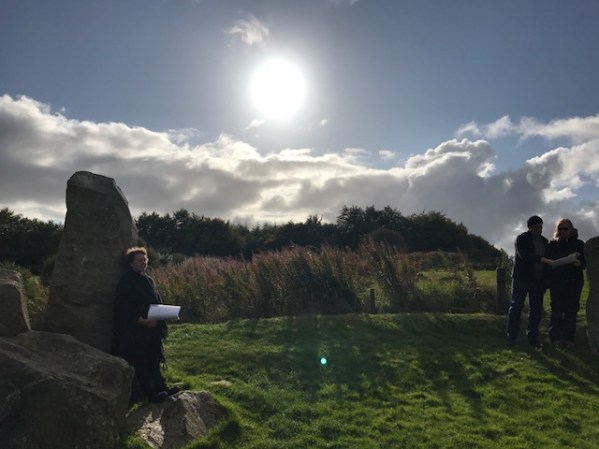
(Continued from Part One on Sun in Gemini)
The rain has abated… for now.
After the morning of the second day, we return to East Aquorthies to have more revealed to us by our guide, Allan. The morning had contained a visit to another stone circle which had drained and saddened us all. The details will be written up in the next post in this series. The key thing was that, a few miles away and two thousand years later than the construction of this first stone circle, the women had gone…
This is not a linear telling. Sometimes, deeper things emerge and make sense when you reconstruct them out of sequence. The shamanistic spirit will often tell them out of sequence… you only realise why, later.
There is also the matter of cycles. We can only digest so much in one go. Understanding is greater than knowledge and moves at its own, rythmic rate. The trivial can easily be digested, for it contains no nutrition for the soul. The deep and truly connected experience has an intense emotional component as well as the facts of its skeleton. The two make up a body. If that body is conveying the real – the definition of the spiritually-connected – then a very different experience results.
The priestess women had gone…. But not here. Here in the East Aquorthies stone circle, we were in a space that was at least four thousand years old, and Allan, our guide, was about to reveal some little-known facts about its real nature.

I took my place from the day before–the place with the small marker stone where the spiritual history said the ley-line’s female component came into the circle from the giant woman’s breast now revealed as the mist finally cleared on the western hills. I am skeptical about such things, too many people accept without experiencing; but, the day before, my right side had burned with an energy I had not felt, previously.
Not long afterwards I had taken a simple photograph of several of us wet with the streaming rain. In one half of the photo, reproduced below, there is clear image of the circle’s Maiden Stone, and a maiden’s face on it, together with a wolf. She is smiling and looks about to kiss the wolf…
The disconnected parts are beginning to form a whole, a whole that our guide is guiding…

He hands out a hand-drawn diagram of eight points which have an exact mapping to the celestial geography of the circle. For the Sun, they show the summer and winter solstices – the rising and setting positions of the Sun on the longest and shortest days. For the Moon, the marked positions of the stones’ alignments show the extremes of the southern moonrise and moonset; and the corresponding points for the northern equivalents. It’s a map of where to find, using the stones, the boundaries of the seasons and the light that goes with them.
“Forget what they told you at school,” he says, ensuring we were awake. “They said the sun rises in the East and sets in the West. Rubbish…”
It’s hard not to grin when he does this. You know he’s speaking from a position of great knowledge. You sense that this professional man, whose career is centred on exactness, is about to say something precise. His shaman staff is white and quite short–a contrast to his own considerable height. He points it at a position in the South-East, where the horizon is hidden behind a cluster of young trees. “On the winter solstice, that’s where the sun rises.”
He moves his stick a relatively short distance across the imagined range of hills in the distance. “And that’s where the winter solstice sun sets…” he nods his head, remembering the yearly dearth of sunlight on that day. “…it’s a very short day, here in northern Scotland”.
“And because of that,” he continues. “the cycles of the moon were very important, indeed.” He pauses to survey the temple of the goddess encircled by his guests. “This is a temple of the moon…”
You could hear a rain drop falling.
I remember the ancient word for the sun and the moon: they were both referred to as luminaries. A luminary shines. Only thousands of years later would science reveal that the light of the Moon was a reflection of the Sun’s. A moon whose incredible rotation meant that, though it was rotating, it kept exactly the same face presented to the Earth at all times. For mankind’s living memory and deeply beyond, the ‘man in the moon’ has looked at life on Earth, while spinning once every twenty-four hours. For these ancient women priestesses, whose spiritual home this was, there were two suns…
With two suns, you could hunt at night, when the night wasn’t cloudy. This was a culture that knew two worlds.. intimately.
Maiden, mother, crone, the name of the Silent Eye’s weekend workshop… in the Maiden stone directly opposite me across the circle, Kissing Wolf is smiling.

(Above, from part one: Four women…. yes, four–and one wolf. Look carefully. Allan had to show me what the camera had captured)
To be continued…
Stephen Tanham is a director of the Silent Eye School of Consciousness, a not-for-profit organisation that helps people find the reality and essence of their existence via low-cost, supervised correspondence courses.
His personal blog, Sun in Gemini, is at stevetanham.wordpress.com
©️Stephen Tanham
Share this:

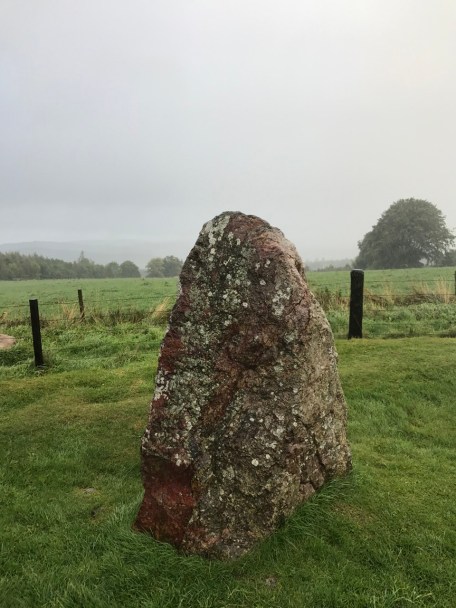
It was wet in the stone circle; so wet that Allan, our guide to the ancient monuments of this wonderful part of North-East Scotland, remarked that his belly-button was actually ‘filling up with water’.
The comment has been immortalised in Silent Eye history, and songs about it will will be sung around soggy campfires in the years to come, one suspects…
It is, of course, at moments like this that the Silent Eye’s dedication to the investigation of higher consciousness, past and present, is tested to its limits, but, with a gentle giant like Allan in charge, easily triumphs over the elements, though there is now ample evidence, as Stuart was later to remark, that several of us have graduated to be rain gods.
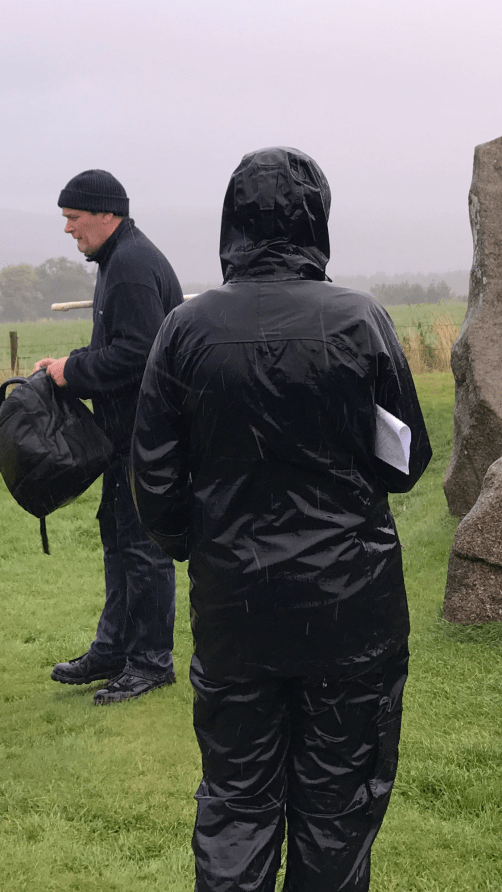
That’s Allan on the left… It would be churlish to point out that he is somewhat less apparelled to deal with the usual Scottish deluge than the slim lady hermetically sealed in walker’s neoprene nearer the camera. There is a tradition among some in the Silent Eye that one can ‘feel’ the essence of a place better in a frozen and/or sodden state than safely tucked into a Barbour jacket with hat and long boots, watching the curtain of rain dripping off the brim with a certain smug satisfaction.
I admit to not being of the former tribe, unless it’s mid-summer, and confess to the dry grin of the latter, though I have been known to offer souls dying of exposure many a spare hat and coat from the depths of my car’s boot.
But then, sometimes there are dreams, and it’s all different.
I digress…
East Aquhorthies does not easily roll off the non-Scottish tongue. I had to say it as ‘east aqua-worthies’ for two days before I got it to flow by dropping the linguistic training wheels of the ‘a’. It’s the name of a recumbent stone circle, so-called because of a single large stone set horizontally on its edge in the south-west arc of the circle.
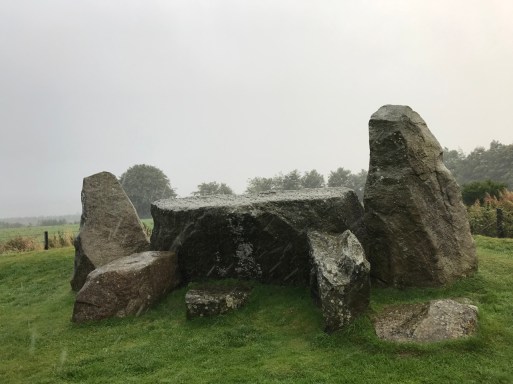
Allan, our guide, has asked us to walk around the circle until we find a spot with which we are either happy or unhappy. Its a very clever move, it’s the kind of direct language that wakes you from the normal sleep of everyday consciousness. Unhappy? What can he mean?
Awakened and in our chosen spots, we look back at him standing near the recumbent stone, which, he explains, is of a different type of rock from the rest of the eleven stones. The recumbent comes from a nearby mountain, the place of an ancient hill-fort, (invisible in the mist) whose shape resembles a conical breast – coinciding with ancient traditions that this circle, this temple, is a place of women…
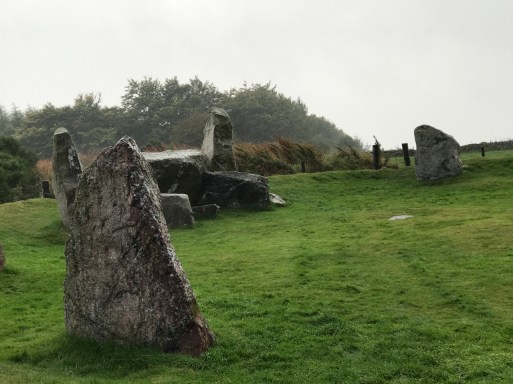
(Above: the marked ‘energy’ spot lies in front of the recumbent stone. Next to that is a smaller circle which marks the origin of the whole place as a single grave)
I’ve chosen a small stone, one that marks more of a gap in the ring than anything else; but it called to me, so here I am. As I settle, a small glow begins down the back of my right side. From ankle to back, I feel like that half of my body is glowing.
Allan gives me ‘that’ look and asks, through the curtain of rain, if I’m comfortable. I am, if a little energetically so, and I tell him. He calls me forward and asks me to stand on the marker stone in front of the recumbent, asking if I would prefer to be there. I feel no need to leave my little stone, which is practically a gap in the circle of the eleven.
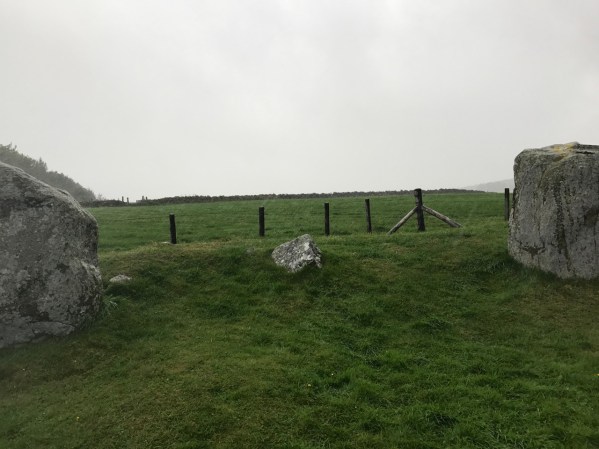
(Above: the writer’s ‘place’ in the circle – not one of the eleven vertical stones, more of a gap)
I walk back and re-take my place. The glowing intensifies, but I haven’t told anyone yet. Such things do not normally happen to me in stone circles. Allan is smiling up the slope at me and points over my shoulder at where the conical mountain is hiding in the mist.
“You’re standing on the point where the ley-line comes into the stone circle,” he says. “Where I am is the place where it infuses the whole circle with its energy.” He laughs.
I wish I had said something about the heat in my right side, but I tell it now. Allan grins at me, nodding, and tells me that the energy burning into me is the female current and that there are twin lines of male current that flow around the site but not into it. This is well and truly the place of the female.
Allan points to the smaller marker in front of the recumbent. It’s just a small circle in the grass. “A girl was buried here,” he says. “Just a single grave… and two thousand years later they built this temple on the same spot.”
In my head I do the sums. The stone circle is Neolithic, so that’s four to five thousand years old. If the original grave was created two thousand years prior, that’s a very long time ago. Allan tells us that this circle is one of the most intact in the world and has remained as it was designed for at least four thousand years. That’s back to Jesus and the same time interval beyond. We all fall silent as it sinks in.
“It is the place of the priestesses,” he explains. “The men really had no role here.”
Our weekend is named ‘Maiden, Mother, Crone’.
Here, in this most ancient and intact temple of the ancient and wise women, it has begun…
Later, the rain drives us away and I take a final few shots of us all, drenched but still smiling as we prepare to leave. I put one of them on Facebook. The day after, Allan comes to me, excitedly and asks if I know what I have photographed. I don’t, so he points out that that I should study the women I have photographed, below:
(Above: Four women…. yes, four–and one wolf. Look carefully. Allan had to show me what the camera had captured)
To be continued…
Stephen Tanham is a director of the Silent Eye School of Consciousness, a not-for-profit organisation that helps people find the reality and essence of their existence via low-cost, supervised correspondence courses.
His personal blog, Sun in Gemini, is at stevetanham.wordpress.com
©️Stephen Tanham
Share this:


Reblogged from Not Tomatoes:
It’s not easy for me to self-promote my first published book, which I have held close for so long. Yesterday, a friend on Facebook asked me how long it took me to write my memoir, and I told her a partial truth. That I started A Girl Named Truth ten years ago, nearly to the day I hit the button to birth its release on the night before my 44th birthday two weeks ago. This is true, but the journey leading up to putting the words on paper is perhaps what is most significant, for it is a journey of silence. A journey that started at my birth.
Even when I was a young child, I knew what I wanted to do with my life. Some may call this lucky, but it is also a bit of a curse. Putting words onto paper, even in journal…
View original post 267 more words
Share this:

Share this:

+ #SE18Characters, esoteric psychology, Jewel in the Claw, Mystery Schools, Silent Eye School, Silent Eye Workshops, Spirituality, Understanding Fear
Magical Man at the Dawn of Science
by Steve Tanham

The Elizabethan age considered itself scientific, indeed the word ‘science’ was used to mean ‘knowledge’. The so called Age of Reason was a much later term applied by historians of science to broad-brush the slow ascent of experimental-based knowledge. What we now call science originated from the attempts to separate the observer from the method of experiment; a method that would employ only the intellectual functions to arrive at a repeatable conclusion, backed up by numbers – the mathematics of quantity.
In so doing, the kind of knowledge that became ‘science’ cut itself off from any intimacy, religious or otherwise, that mankind had felt towards the cosmos – his home – for thousands of years. It is said that the average Elizabethan farmworker would have known the heavens much more intimately than most of us do, today. For them, it was life and death, planting and reaping – and a warning of things to come, like the winter. Occasionally, it also contained dark portents…
A clear night sky was a boon, and immediately synchronised them with their year; a cycle that fed them, if they were lucky. We can imagine the relationship with such a sky. It would be a constant living book, in which was written their own life-story as well as that of all life on Earth.
Perhaps the loss of this intimate relationship was a necessary step. Man turned inwards and began to calculate, rather than see. Intimate vision gave way to accuracy – but only within the mind–self-referentially. Emotions, valued in the artist, were not considered useful in the men of science, who, by a nineteenth century built on the foundations of the Elizabethans, were beginning to create a psychological ‘truth’ for mankind that required only the authentication of numbers, having ‘achieved’ a separation from the essential ‘quality’ of something. Qualities could only be experienced; they were not susceptible to numbers, and therefore suspect and unreliable. The idea of ‘humanness’ was to be, quite literally, taken out of the equation. In their eyes, what watched an experiment was not the observer, it was the ‘truth’.
The result of this has been a loss of wholeness in our numerically-dominated lives. The Church began to lose its grip as absolute arbiter of truth. Many would say this was no bad thing; that much abuse of position masqueraded as divine authority.
The Elizabethan age, like the Medieval period before it, was founded on qualities, and the undisputed authority was the Church. Henry VIII’s schism with Rome did not diminish the Church’s authority, it just replaced Rome with something centred in England, freeing up the wealth of the plundered monasteries for the royal purse in the process.
After a period of intense psychological trauma, including being incarcerated in the Tower of London, the young Elizabeth I inherited this world. She found herself at an unchosen crossroads in the story of England (and Ireland). Women, even potential queens, were not allowed to go to university, but, in a gift to her life to come, she had been tutored at home by the best the age could offer. She was said to be able to correct the Greek of the country’s best scholars…
Hers was one of the best minds of the age, and she sought after truth where it would further her constantly precarious existence. This search, though, had its boundaries. There was a world view that the age adhered to rigidly. This natural order was predicated on biblical dogma, backed up by a tapestry of cosmology, mathematics and logic that had dominated thought for an astonishing fourteen hundred years.
The highest degree of study was Theology, which been passed down from its (known) origins in the work of Pythagoras, via Plato, then Aristotle; and widened into a God-centric cosmology by Ptolemy. The universities (all religious in nature) had this at their teaching core, and Aristotle was their unchallenged authority. It was the core of the advanced mind, and everything else derived from its foundations.
Strangely, magic was rife in Elizabethan times, and was not seen as threat as long as it did not challenge the consensus. A belief in the physical existence of angels came from the Bible, so the supernatural was implicit. Magicians were those who could navigate the frontiers of knowledge – ‘science’, and forge extensions to it for the common good. Alchemists were of this ilk and much respected as the chemists of their day, though they operated in a way that we would now view as magical. Their approach to such lore was an intimate one. They knew that their own ‘inner worth’ was as much to do with a successful outcome of a process as the rules of engagement with the secrets of nature.
Dr John Dee was such a man. His life was self-documented in his (often very personal) diaries. He was the Queen’s astrologer, in an age when the profound connection between the heavens and life on Earth was an self-evident fact. Each person was born with a certain configuration of the heavens above them. This imprinted their character for life, though moral evolution was part of the picture, too. A later Alchemical reference painted the process of birth as a journey in which ‘the heavenly wanderers kissed the soul on its descent into incarnation’. A very beautiful concept…
The heavenly wanderers were the seven planets visible to the naked eye: Sun, Moon, Mercury, Venus, Mars, Jupiter and Saturn. Within the Aristotlean world-view, they were organised into concentric crystal spheres which rotated around the Earth – exactly what the heavens appear to do. Saturn was the farthest. The Earth had been placed, immobile, by God at the centre of these crystal spheres and was the recipient of all their influences in its ‘sub-lunar’ centrality.
Everyone had their place – it may have been a humble one, but it was inclusive…
The telescope didn’t arrive until the early 1600s, the time of Galileo, who did not invent it, but was the first to point it at the sky and make serious astronomical observations – including the discovery of the Milky Way, sunspots and Jupiter’s moons. For most of the Elizabethan age, the naked eye, back up by a calibrated cross, was the only way to study the heavens. Even with this limitation, Kepler had shown how disciplined observation could be revolutionary, as the disciplined observers began to question the Earth position at the centre of a religious universe.
Although the ancient Greeks had postulated the idea of a solar-centric universe, the idea had not gained ground in the face of the continual refinement of the Ptolemaic world view, which required complex ‘epicycles’ to explain such things as the planets’ periodic retrograde motion – a time when their path against the map of the heavens appeared to reverse.
All this was about to change…
Nicolaus Copernicus published two works, beginning in 1517, which challenged this worldview, establishing the Sun as the centre and (to pacify his critics) throne of the planets. With the later work, De Revolutionibus, which was not published until after his death, the seeds were sown for a revolution in the astronomical, and eventually, theological order. It would take a further century for this to unravel, confirmed by Galileo’s telescopes, which rendered the new model self-evident, but the literal earthquake had begun. Such theories made little difference to day-to-day life, but the appearance in the sky of several major comets and eclipses did. People began to wonder if their world was well and truly changing. The puritans welcomed this, believing that the Apocalypse was approaching…
Queen Elizabeth I could choose, to an extent, how she reacted to these changes in the natural order. She was not only well-educated but surrounded by wise and learned advisors – including Dr John Dee, her astrologer, mapmaker, mathematician and, later, alchemist. William Shakespeare, born thirty-one years after his queen, came into a world where the new view of the natural order was already rocking the established worldview – the words ‘Breaking Glass were a popular sentiment – and its religions. Leading thinkers were also beginning to question the fundamentals of mankind’s character, and to wonder to what degree a person could take responsibility for their own evolution. This did not reduce God’s involvement in their lives, but it did increase their own responsibilities. Such thoughts could border on the revolutionary, and Shakespeare’s characters trod a fine line on his stage:
“Men at some time are masters of their fates:
The fault, dear Brutus, is not in our stars,
But in ourselves, that we are underlings.”
Shakespeare: Julius Caesar
Copernicus’ findings had done something else; something that changed the way the average man would come to consider their own lives – No longer fixed at the centre of the divine crystal spheres, he had set the Earth in motion…
Can we, in a weekend, ‘become’ Elizabethans? Can we live a microcosm of their world, with its intense politics, set against this backdrop of changes in the natural order. Our story is told in retrospect, through the eyes of the dying Shakespeare. Looking back, he can tell a very different tale of the threats to the existence of his now departed Queen….
This is our task for the Silent Eye’s spring workshop 2018: “The Jewel in the Claw’. The jewel is the emerging spirit of tolerance that Elizabeth, the self-styled virgin-queen, engendered; the claw is the nature of the forces of ignorance that still plague us in the twenty-first century every bit as much as they did in 1588, the year that the mighty Spanish Armada was defeated by a combination of English naval courage and our equally fabled weather; and Elizabeth I finally achieved a degree of security.
The Silent Eye has produced dramatic mystical workshops since its inception in 2013, but this is a break from tradition, and will stick closely to the formula of an actual Elizabethan production, letting the acts of the play tell the deeper story. There is no formal audience, of course. We, the players, play to each other, and in doing so invoke the desired depth of psychological and spiritual interaction.
If you’ve never been to such an event before, don’t be over-faced by this heady agenda. There are always new people joining us, and we take great care to ensure they are comfortable. We do not expect our ‘actors’ to learn their lines! We all read from scripts – as though doing a final rehearsal, but the atmosphere is truly electric and you will find yourself working to bring your character to the greatest life you can give them! You will also find they stay with you for years afterwards…
Above all else it is always fun; and every year, come the Sunday farewell lunch, those attending do not want to go home and end that living link with a body of experience and aspiration that they have helped create…
We can honestly say that the workshops become a living thing, formed and sustained in the minds and hearts of those attending. Come and join our ‘merry band’ and you’ll want to come back.
Places are still available for ‘The Jewel in the Claw’. 20-22 April, 2018. The average price is approximately £250, fully inclusive of all meals and accommodation. You will struggle to find a better value weekend, anywhere.
The weekend workshop will be held at the lovely Nightingale Centre, Great Hucklow, near Buxton, in the heart of the Derbyshire Dales at a wonderful time of year – the spring.
You can download the pricing and booking form here:
Image: Composite of original artwork by the author plus a portrait of Dr John Dee courtesy of Wikipedia, CC by 3.0, Public Domain.

Stephen Tanham is a director of the Silent Eye School of Consciousness, a not-for-profit organisation that helps people find the reality and essence of their existence via low-cost supervised correspondence courses.
His personal blog, Sun in Gemini, is at stevetanham.wordpress.com
©️Stephen Tanham
Share this:

Well, assuming that my poorly car actually escapes at some point today from the mechanics who are holding her captive, and nothing else decides to go wrong, screw up, fall sick or explode… including me… I’ll be heading north shortly for the Silent Eye’s autumn event.
It is always touch and go getting to Scotland. The first time we attempted the trip, we ended up in Dorset instead. The great coffee pot explosion had stopped us in our tracks and I couldn’t go anywhere till the bandages were off. The second time, we did actually manage it… though taking our ‘summer holiday’ in January pretty much guaranteed that we would be turned back by snow just short of our hoped-for destination…and that was without the warning lights taunting us from the dashboard of the car. I’m hoping it will be third time lucky!

There will be hills and ancient stone…
View original post 125 more words
Share this:

Share this:

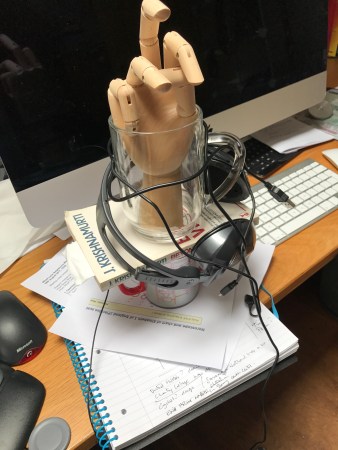
I hope I hide it well…but that can be a dangerous and naive presumption. I’m at my best when convergent; and yet the divergent part is essential to the inclusiveness of the creative process.
I’m rambling on in a manner that is plainly self-indulgent, so let me explain…
It’s what I’ve come to think of as the ‘duff desktop’ that I’m musing about. The ‘non-duff desktop’ is what I briefly achieve when I clean up my writing desk; at the end giving it that swish of spray polish to add the all important smell of cleanliness to complement the pristine sense of clean space, of creative potential. At that moment, I look down and say to it, and myself, ‘And you are never going to look that bad, again!’
It’s as though I am scolding the simple wooden surface – implicated in the inevitable regeneration of the nests of paper scraps, books with ten bookmarks, fourteen pens, five notebooks of various sizes, electrical chargers and USB connectors, bills and bank statements; all of which rise, organically, from the ruin of my last ‘non-duff desktop’.
The regenerate piles, with better genes than Daleks, rise triumphant from the wooden battlefield no matter how strong my resolution…
What is it?! One would think that the sheer joy of having that creative space cleared would propel the discipline needed to keep it that way! But it doesn’t; so I am reduced to humbly considering the flaws in my character that result in this mis-match of intent and performance.
It’s all about the horizontal, really. The essential bits could all be stacked vertically if I could devise a pigeon-hole system large enough and stable enough. It would, of course, look ridiculous; and would confirm my flawed character and borderline insanity to any visitor to that hallowed space – ‘Marvellous, Steve, is it an art installation? Or perhaps a political statement?’
I would cringe behind my thin-lipped smile and take the beating… Ouch.
Where was I? Oh, yes, the horizontal. My theoretical vertical stack is not the solution, but the horizontal is the problem. We love the horizontal because, in theory, that flat space lets us see everything at once. All the logically-linked chains of ideas and sources of inspiration lie before us, connected in a way that only our genius can fathom… if we could just remember it, three weeks on.
The vertical tidy can be implemented in hundreds of virtual ways, of course, and I’ve lost track of the file, spreadsheet and folder structures that I’ve created over the years to solve all this.. which just emphasises the culprit. Mea Culpa...
Time is the other problem. The reason that I can’t find that must-have quote about William Cecil, Queen Elizabeth I’s Chancellor – needed for the next description of the Silent Eye’s April Workshop, the Jewel in the Claw, is that we’ve done a hundred dog-walks, eaten a fair few meals and dealt with a dozen family crises since I put it there… if I could just remember where there was. It shouldn’t be difficult, since it is, literally, under my nose…somewhere.
So, beyond a cursory and pre-doomed shuffling of the heap, I don’t bother looking. Instead, I swing my chair around to face the computer screen, again, and let Google do the hard part.
‘I’ll fix it at the next clean-up,’ I resolve to myself, aloud and through tight lips, as I key in ‘William Cecil famous quotations’.
Sigh.
—————
Stephen Tanham is a director of the Silent Eye School of Consciousness, a not-for-profit organisation that helps people find the reality and essence of their existence via low-cost supervised correspondence courses.
His personal blog, Sun in Gemini, is at stevetanham.wordpress.com
©Stephen Tanham
Share this:

Share this:

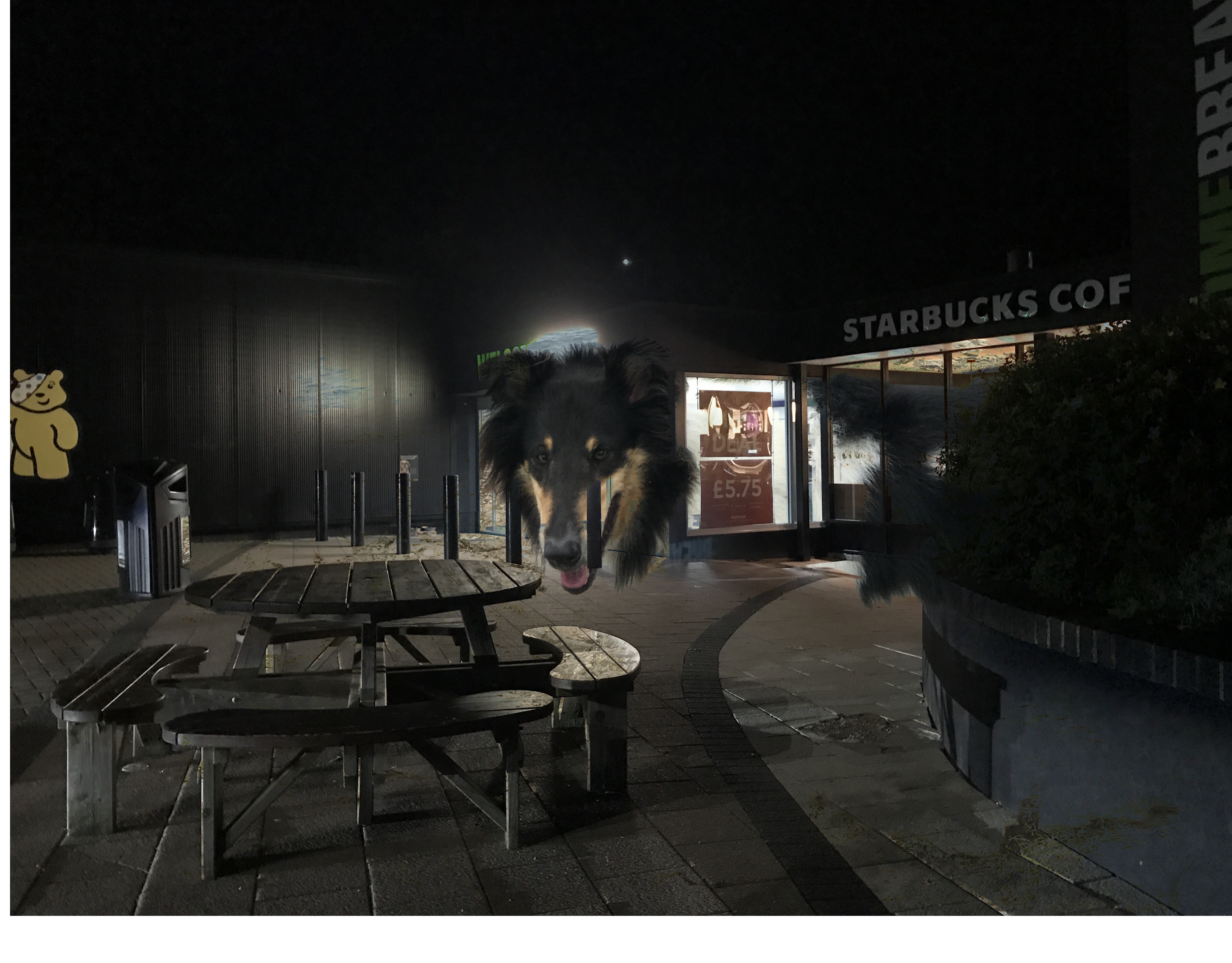
It’s two and you, two dogs and it
The hidden light that powers the grit
Of rubber spinning in the night
➰
Beneath the blazing arc-lights’ cold
No warmth escapes the darkened scold
Of coffee, burgers, brands unsold
➰
But we, Night Nomads, are unclean
As hounds, will reave your tables, mean,
With hunger and disease will you demean
➰
We won’t, of course, though banned within
We’ll sit outside and freeze our skin
And dream of home and that which lies within
➰
Of discipline and love, much do we know
The golden eyes, adoring, show
As fur and skin and distance flow
➰
Within these cut-loose tarmac places
Our outstretched love fatigue displaces
As worship follows drivers’ stony faces
➰
Hungry, cardboard-coffeed, quiet and cold
Our Nighttime Nomads, young and old
defeat the miles to morning, gold.
➰
For us…
©Stephen Tanham
Share this:

Share this:

So poignant…
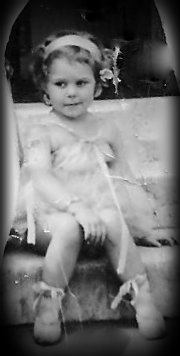 Mrs Howe. How on earth I remember that after so many decades, I do not know… but that was the name of my headmistress on my very first day at school. I can still ‘see’ her in memory… can see her in assembly, holding up the vases she collected for the school… could still describe her office, where we sat and read to her, one by one and where, every Christmas, the glittery wings were affixed to the archangel. It is probably the only time in my life I have been angelic… but it took me years to stop picturing Gabriel as a girl.
I started school at four. Before that, there was nursery school, when I was going on three and I remember that too. I remember my grandmother waving us off, that very first day and telling me to be a good girl. The raised beds, like hospital…
View original post 340 more words


 Sun in Gemini
You must be logged in to post a comment.