
Somewhat disappointed in myself for last week’s late arrival, I am here early, to give me time to chat to Rose. That darling lady, who runs the tea room, has watched and supported our craziness for some time.
Craziness? I don’t really think so … though, when I get off that train in London each Monday, and stiffen back into my world – what I now think of, in a dramatic reversal of attitude, as my other world – I feel I’m entering the real craziness; and that this gentle, if often dramatic probing of life and truth is the reality …
I’ve changed in all sorts of ways, some of which I haven’t told John about. I want him to notice, and I’m sure he does, but, I’ve toned down my formal dress and made plainer most of my accessories. In this there is a slight emulation of his simplicity – though I know that, in his former business world, he would have shared the crisp uniforms of indulgent excess … He’s never asked me to do this, but it’s a kind of respect for the transition he must have gone through when he walked away to do ‘his thing’ as he often puts, it; smiling mischievously at me.
Looking at the time, I finish my friendly conversation with Rose and pick up our coffees from the counter. I refuse her kindly offer of help, and take them to the small table in the sea-facing corner – the place of our meetings. He arrives as I put down the steaming mugs.
“Morning Alexandra,” he says, softly. Giving me a peck on the cheek.
“Morning John.” My smile is a beam. Life is good.
He launches straight in, “Hercules–Heracles, we decided, didn’t we? How are you getting on with him?”
I consider my response carefully. I’ve been doing my homework and it’s thrown up more questions than answers. “Twelve …” I let it hang in the air. I know it’s important.
“Ah yes,” he says, not mockingly. “Twelve – a fascinating number … four times three, and three times four.” He sips his coffee, watching me; and then, when I say nothing, he does one of his time-stopping things: he picks up three small packets of sugar from the bowl in the middle of the table, tears the heads off two of them in an exaggerated gesture, and smooths out the deliberately spilled contents across the inset glass top of our small, round table. The remaining packet he keeps in his left hand as he sips his coffee.
I can’t see her, but I know that, behind me, Rose is planning his slow death …
“Show me twelve …” he says, flickering his eyes at me, snake-like. For a second, I wonder how many other nieces in the world are treated like this? I stare at the surface of white sugar. What does he want? Do I write the numerals 12 in the crystals? No, he wants something deeper than that. I hold my chin in my hands, staring the sugar, while doing my best to empty my mind, letting the moment speak; enabling something that is already there to reveal itself … within that calmed now, it does, and with a smile, I draw a near-perfect circle in the white sugar.
I look up and he nods. “How many now?”
“Not twelve …” I’m teasing him; and enjoying it. “But it could be twelve – or as many as you want there to be … the circle is infinitely pliable, after all.”
“Good answer,” he says, nodding down at the sugar. “A cycle of perfection and completeness, then, no matter how big its circumference?”
“Like the year – having twelve months and then beginning again …”
“With the four seasons?” he asks, reasonably.
Something tells me to draw a equal-armed cross in the circle. I do so, dividing it into four quadrants. “Spring, summer, autumn, winter …” I say.
John leans forward to hover his hand anti-clockwise over the newly quartered circle. “And who else might work here?” he asks.
I look down at the symbol I have drawn. I imagine it divided into the full twelve, with the quadrants superimposed as they are. Something pulls me to the answer.
“Why … astrologers, I suppose? They share the use of a seasonal circle, don’t they?”
“They do indeed,” he replies , then adds. “In a greater and a lesser sense,”
“Greater and lesser?”
“The twelve periods of the year, which we know as the signs of the zodiac; and the long ages of the evolution of life on Earth, which is known as the precession of the equinoxes, which takes twenty-six thousand years to transit the whole zodiac and just over two thousand years to transit each of the signs.”
“The Dawning of the Age of Aquarius …” I hear myself saying, smiling at a memory of a song from my uncle’s own youth that he used to sing to me as a child.
“Indeed,” he says, also smiling,”Though, in truth and mathematics, it has yet to dawn.”
“We’re still in the great age of Capricorn?” I ask, keen to show off my pub quiz sequence of the signs.
“Almost …” he fights a kindly smile. “Remember that the greater cycle goes backwards, so, if Aquarius is next, then we are in the age of …?”
“Oh, I see – so that would be Pisces?”
“Yes.”
“The age of the fish,” I add, grasping at some of the deeper pub facts.
“And the fish was one of the key symbols of?”
Suddenly it hits, me … This is not just an intellectual exercise. What he’s starting to describe is the happening of events on a vast scale, something like the wave that we discussed so long ago, that provides great energy and superhuman challenges … and the effects are repeated, at smaller and smaller scales as the same laws empower and challenge the evolution of more and more detailed forms of consciousness.
I cannot help say the word he’s expecting, “Christ …”
“Christ, a figure that some would call The Saviour of the Age … an age that is now coming to an end.”
I think of a single vast circle, containing within it many other circles which share the same sectors – the same seasons of energy and challenge as deeper evolution is urged forward. I think of all the circles centred on the same point in the middle, of a rippling outwards to form the ‘space’ within which it all happens, and then a return home to the centre, each circle playing its essential part, each circle as important as any of the others, despite its apparent ‘smallness’. He watches, perfectly still …
“So you lead with twelve … and Heracles?” He lets the silence be the question. Into that perfect space comes the sentiment for which I’ve been fishing.
“So the twelve labours are the generic – the cosmically derived – labours we must all face on the way to a higher level of consciousness?”
His reply is tinged with humility, “It is my belief that they were constructed that way … but the only way to test that is to bring them to life – your life …”
I sit back to think, and finish my coffee. While I am doing this, he leans slightly forward and asks, “What did Hercules do to deserve his labours?”
There are many answers, depending on the bias of the historian involved, but they all agree on one thing.
“He killed people close to him …”
He leans closer, and whispers, “In one very wise version, he killed his teachers …” He lets it hang in the air.
“Killed his teachers?” I sit there, mute. The thought of killing one’s teacher is appalling … and then I see, between the stark words, that there is another meaning to this. I want to share it with him, but he’s stood up and gone to fetch a pan, brush and wiping cloth from Rose, who is grinning at the counter, pleased at his seeming contrition.
When he comes back, I’m ready. In his hand, alongside the cleaning tools, is the remaining bag of sugar. I take it from him and look deeply into his kind eyes.
“Independence,” I say. “My journey and only mine …”
Matching his earlier violence, I rip the head off the sugar and pour it onto the drawn circle, scattering my symbolic atoms into the space of creation, freeing them from all conditioning patterns.
He says nothing, just bends to plant a kiss on the top of my head, then hands me the pan and brush.
“Your first labour, then …”
———————————————————–
Nine Deadly Sins with Coffee is usually published on Thursdays.
All images and text ©International copyright, The Silent Eye School of Consciousness, 2015.

Steve Tanham is a director of the Silent Eye School of Consciousness; a place of companionship, sharing and the search for the real in life, using the loving techniques and insights of esoteric psychology. He retired from a life as an IT entrepreneur to establish the School in 2012, and, having persuaded Sue Vincent to . . .
Share this:

Don and Wen continue their off-beat, but informative, dialogue …
Share this:

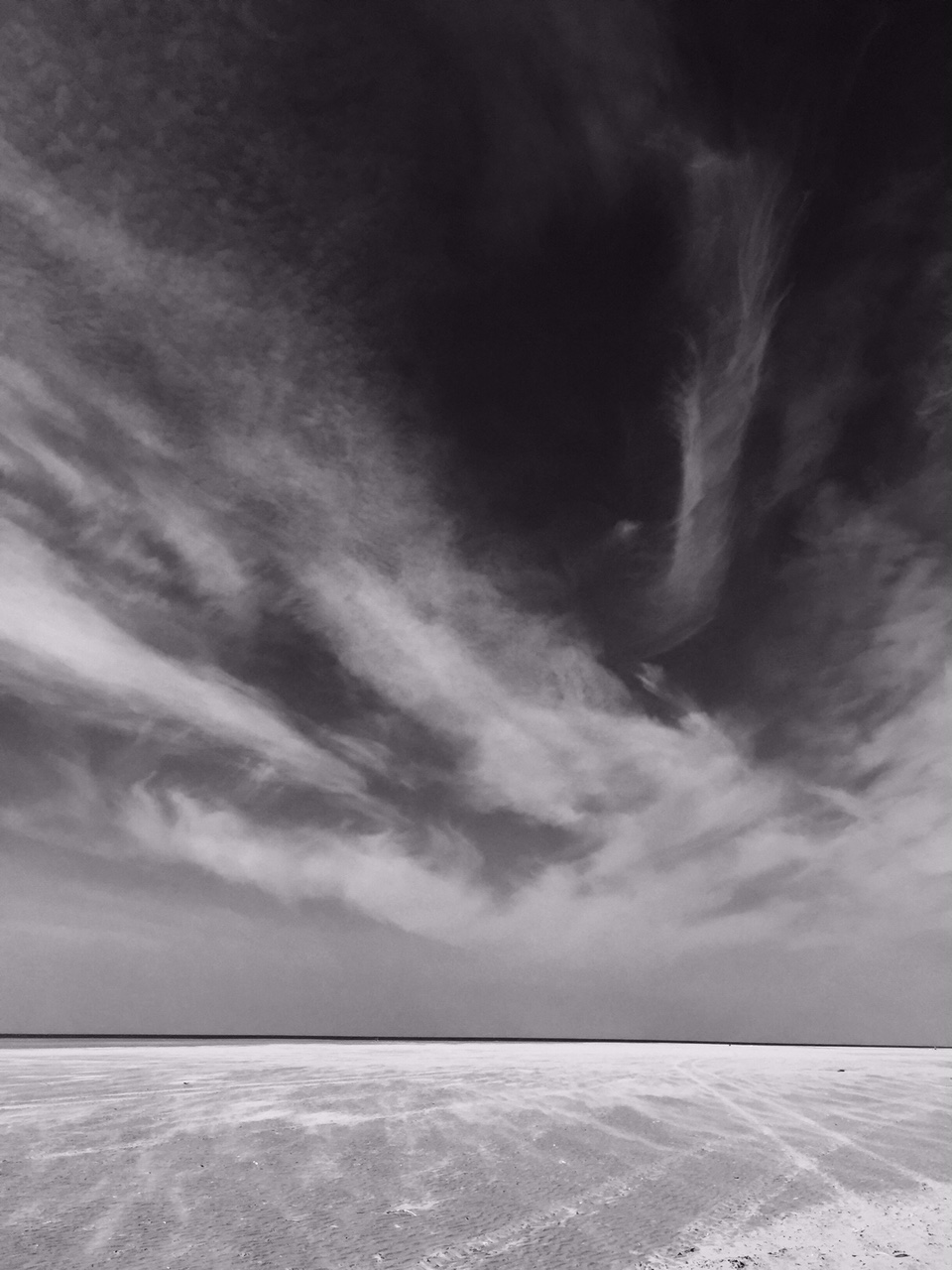
Don’t think that you
have seen this edge before
Don’t count the times
your boots
have walked
and crunched upon
its sands
Don’t try to catch
the sleek caress
of countless grains of dust
Blown on a wind
that never
kissed your face
before
But now demands it must
And,
walking tall,
stare into space
between the sky and land
And suffer Geb’s distress
At lust and longing
for his Nut
and know
eternity’s demand
So dare to stride
between the lines
and with each passing mile
leave past behind
To gain a place
just out of time
to hang
in timeless space
a while …
Lost in the vastness
of that sky
embrace your tiny fall
and by your truth
the reach of self
in spinning
sees it all.
©Image and words, copyright Stephen Tanham 2015
Share this:

A post to celebrate Sue’s birthday …. Happy Birthday, Sue xx

A little while ago, Sally Cronin invited me over to Smorgasbord for an interview. The piece Sally crafted, with the depth of her personal research was a real eye-opener for me about how an interview could be done.
Yesterday, Sally reposted that interview, taking me quite by surprise… You can read it at her blog by clicking the link here.
You can also read about Sally too… when she guested on my blog and named herself as a Black Sheep….
As for me, I shall simply say, thank you very much, Sally!
… and as for me, I have birthday cards to open that run to double figures… and yes, two does count as double figures… and a new book to be getting on with, if I am allowed… 🙂
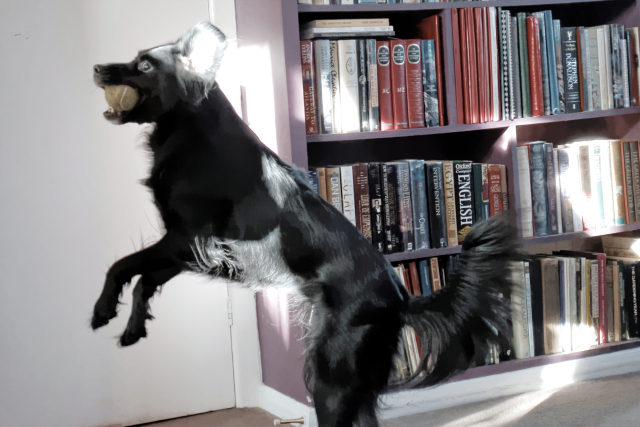 Photo of Ani by my son, Nick Verron
Share this:

+ Ancient Landscapes, Bakewell Jail, Ben's Bit, Doomsday series of books, esoteric psychology, Silent Eye School
Ben’s Bit, part 8 – The Shimmering Hand
by Steve Tanham

“I’m not your enemy, Ben …”
Miss Goodnight looks calmly back along the line of my gaze which is focussed on the beautiful skin of her throat, where my second attempt to generate the flush of passion has just failed miserably.
“I would really like to get to know you better,” she says, unconsciously running the capped end of her fountain pen over her bottom lip, as though using a lipstick. I stare, fascinated at its movement – it would be comic were it not accidental.
“You would?” I ask, realising that I have to be present to this encounter and not treat it with the shield of passive-aggressive contempt I have been cultivating.
“Yes,” says Miss Goodnight. “It might even help you …”
“How would that work?” I try not to sound cynical.
She stands up and walks around the interview room. The heels are low but nevertheless still click on the old stone surface as she comes to stand behind me. But, once again, Miss Goodnight is not doing this to taunt, she simply is this person. Grasping this, I realise that I may have to revisit my former opinion of this woman, though not my view of her relationship with Dr Grey, the nature of which I remain certain.
“You’ve seen the state of Dr Grey?” she asks. “He’s a man on the edge – and that’s supposed to be you …”
“And how would you getting to know me better help our situation?” I ask, changing the subject.
“Our interests could be aligned?” she says. “Don’t presume to know me and I won’t make the same mistake with you …” She leans over me from behind. The perfumed contact might be intimate, but, curiously, remains professional.
“An ageing eccentric and amateur philosopher, with delusions about the importance of ancient stones?” then she whispers. “But you’re not, are you? It goes a lot deeper than that, doesn’t it?”
This is all going too fast. I can feel the sand shifting beneath my feet; can feel my fingers slipping of the brick rim of Dr Grey’s tower, again.
“Play a game with me,” says Miss Goodnight, clicking around the front of the old table and sitting with her chin on knitted fists. “Tell me the last philosophical thought you were working on, alone in your cell?”
“Some sort of psychiatric ‘no time to think’ test?”
“If you like …”
It’s time to lose her.
“When you’re forced to watch, most of the time – and think, of course – you can study watching. Do we have to have an observer for that ‘watching’ to take place?” I pause, watching her deadly green eyes follow this … not a flicker … “Or have we completely forgotten what the ancient priests knew well – that in the true act of seeing, we actually cast off the cell around us, with all its historic burdens, and come face to face with nature’s power, whatever our circumstances …”
Her reply, when it comes – when the soft, red lips have folded slightly and moistly against each other, while she takes care not to waste it – is surprisingly clever.
“But you’re only in here because of historic burdens?” There’s a wickedness about the eyes, she’s daring me to interpret her response as being flippant … so I say nothing; look cooly back, allowing the intelligence behind those newly respected eyes to make the next move, which she does with a genuine smile, not one that contains duplicity.
She reaches over the table and, in a gesture that I know would get her sacked, places her hand over mine. “Nobody wants this; not even Dr Grey …” her eyes narrow slightly at the mention of his name. “But it’s just digging itself in–this crazy situation!” she pulls back, realising that the use of the word ‘crazy’ is inappropriate. “We need to find a path out of this, even if it is a narrow thread that leads through darkness.”
There is a cracking sound inside my head. I was not expecting kindness – especially the sort I might not be able to count on in the future … She might just be a lot cleverer than me. Hunched across the table, still staring at where her soft hand lay over mine, I begin to sob, and the sobbing goes on and gets deeper and deeper until my whole body is shaking and I’m falling into blackness, again, and this time it’s a long fall. The last memory of the interview room is the blurred reflection of my monotone prison pyjamas in the polished, but scratched, black surface of the bolted steel table; and thinking how poor they look in comparison with her beautiful suit … and then my head hits the resistant steel desert.
In the long falling tower there is a process; a stripping process. The tower has become the act of watching, but now, it takes on a deeper symbolism, because I am aware of every second of falling through it. There is no ‘me’ towards which I am falling, and with this, the paralysis of fear literally drops away and I begin to see my descent; though, actually that’s not true, the descent is seen – the distinction is everything – the seeing does not belong to anyone, or rather, it belongs to everyone, but most certainly not to the huddled grey figure that thought he owned the watching.
It is as though I have another set of eyes, of all the senses, that don’t need to belong to me, but see with a purity that I have never known. They see without choice, they see an infinity of potential with which engagement is a matter of will or rightness at a different level than Ben. I wonder if such engagement will break the magic, but, suddenly the image of the stone comes into view, and Ben, damn him, returns to grasp at it. We fall into a meadow of brightness, running across long, green grass by a lake towards the stone, behind which is what looks like the sun. But it’s not the sun. The sun is high in the sky. The glow around the stone envelopes it like lapping flame. As I draw closer I can see that the glow is a figure, one calling to me from the the place of the stone but which is not the stone, itself …
I reach out to take this supportive hand. The fingers glide through the space occupied by the other and suddenly there is a room, a beautiful room, with a black and white floor and the most subtle lighting. Two tall pillars, light and dark, form the backdrop of a dramatic triangle towards which I am moving, and soft, exotic fragrances fill the air. Opulence …there is opulence all around me; wealth and power. The shimmering, outstretched hand is genuine in its desire to help.
Just a little further, Ben, thinks the new voice, just a little further …then, here, drink this …
“Drink this,” says the concerned voice of Miss Goodnight, née Golding, cradling my bruised and awakening head, and pushing a plastic cup of cold water onto my lips. “For God’s sake drink this!”
Somehow, my head is on her breast. I can feel the warmth through the expensive tailoring.
But hers was not the hand that shimmered …
<See index below for other parts of this story>
———————————————————–< to be continued-
Ben’s Bit is a continuing first-person narrative of the character created by Stuart France and Sue Vincent, which may bear some relation to the author of this story, Steve Tanham, their fellow director of the Silent Eye School of Consciousness. In the latest of their books, Scions of Albion, Ben is arrested for his overly enthusiastic part in a mad escapade, and the other two are nowhere to be seen . . . For more, enjoy their Doomsday series of books, and the new series (Lands of Exile) beginning soon. Click here for details.
Index to Ben’s Bits:
Part One, Part Two, Part Three, Part Four, Part Five, Part Six, Part Seven
Sue Vincent describes her and Stuart’s perspective on Ben’s imprisonment: Part One, Part Two
The Doomsday Series of books by Stuart France and Sue Vincent
The Silent Eye School of Consciousness – a modern mystery school.

Share this:

Sue’ s masterly camera, again.
Share this:

Stuart weaves a deeper tale …
Share this:


I was late into the coffee shop that Monday morning. My black briefcase was stuffed with information about the Greek myths that I’d printed from the internet. There was a lot on the net about the Labours of Hercules – or Heracles, to give him what I assumed to be his rightful name.
He was sitting at our usual table; two lattés in front of him, one of them half drunk, the other half cold. He smiled as I appeared in a whirlwind of apologies.
“Sorry,” I blurted out. “Nothing simple …”
He got the drift. “Morning Alexandra. One of those days where a series of small disasters conspire?” he said.
It was the perfect description, but I refused to go into detail. Our meetings were brief enough, without wasting time on trivial things. I looked across at his calm face. I had known him for a long time and our relationship had spanned many incarnations – from friend of the family to the present state of ‘mystical teacher’; a title he had always resisted, saying that he was simply sharing a journey.
“Particularly now,” he said, out of the blue, in the way he could, sometimes. “You were, perhaps thinking about the changing relationship we enjoy and our new agenda?”
I took a deep breath. Sometimes, there was about him a sense of timelessness, as though the ‘now’ were filled with something far bigger than he was. Not that he cut a particularly imposing figure, anyway. He was of medium height and had lost most of the hair on the top of his head. The skin on the back of his hands had started to wrinkle with age and he didn’t walk with the same spring in his step that I remembered from my teens. I supposed he was a perfectly average sixty-year old; but inside me, I hadn’t wanted that; hadn’t wanted him to age, since I had always looked up to the sort of person he had been to me – someone who was that bit different; someone who would cut through the sort of trivia that the rest of the world seemed to enjoy, and describe how you were feeling in a simple word or two – as he had just demonstrated.
“The Greek Myths?” he asked quietly. “You wanted us to explore the possible deeper meanings of the Twelve Labours of Hercules?”
“Heracles,” I interjected. “Hercules is an unnecessary westernised change.”
“I agree,” he said, easily. “Let’s use Heracles, then. I can see your homework–“ he pointed at my bulging briefcase. “–it looks like you’ve done a fair amount of research?”
I was both pleased and irritated by the mountain of information in the bag. “I have, but it’s all facts; whereas I have the feeling that what you want to steer me towards is of a different order to mere facts.”
He sipped his coffee and answered gently, “So tell me what’s wrong with facts?”
I thought carefully before answering. There was something fundamental to the understanding of myths in what was wrong with facts. “They don’t represent understanding,” I said. “Something else has to happen to facts to turn them into understanding.”
“Why don’t we just learn understanding?” he asked. It sounded such a reasonable question.
“Can you teach understanding?” I asked.
“You tell me – can you?”
I thought about this. What was the difference between the two? Education was filled with the cramming of facts into young heads; exams were all about their regurgitation. Did that produce understanding? I thought not; understanding was about something different, something ‘higher’ that used a working of the facts to produce something more fluid; more powerful.
“You can transmit facts,” I said, triumphantly. “You can’t transit understanding – that has to be earned by an alchemy of the consciousness which uses facts as fuel …”
He widened his eyes and smiled, “I’d say that was a very good answer.” He paused and seemed to be listening to the moment, again. “So what does understanding have to do with myth?”
I was on the trail of something. We could both feel it, even if he already knew what it was. I tried to find words that would express this glimmer I had glimpsed.
“Myth is like a machine – a living machine that works with the layers of the mind associated with understanding and wisdom.”
“I would agree,” he said. “It’s a bit like having a language that describes a language.”
“I’ve met that in the law,” I said. “There are constructs that are referred to as a meta-form whose job is to hold anything that belongs in that form.”
“A bit like an equation in maths?”
“Exactly so,” he said, smiling. “Though that might frighten most people!”
“Yes …” I thought back to the struggles I had endured with maths; and yet the concepts were so beautiful when you grasped them.
“But we don’t need to be that rigorous with myth,” he said, finishing his coffee. “We just need to ensure we speak the same language as the originators …”
“So what now?” I asked.
He looked at his watch. “So now you need to leave to catch your train.”
I groaned and looked at my own watch – an expensive Cartier in black and gold. He was right. In my intensity of thought, combined with my late start, I had run out of time. I slurped the rest of my coffee – now luke warm, and picked up the heavy briefcase.
“Facts are like that,” he said, looking at the overstuffed case under my arm. “It’s much better to carry understanding. That way, you can deal with any fact …”
I looked down at my uncle John. Since my father had died, prematurely, in my mid-teens, he had always been there – but never before like this … we were entering a new phase of working together in this unexpected realm. I leaned over and planted a quick and cheeky kiss on the bald top of his head. “Next Monday?”
He looked up, warily, laughing at my affection, but not wanting it to be misinterpreted. “Most certainly,” he said. “wouldn’t miss it for the world …”
———————————————————–
Nine Deadly Sins with Coffee is usually published on Thursdays.
All images and text ©International copyright, The Silent Eye School of Consciousness, 2015.
Steve Tanham is a director of the Silent Eye School of Consciousness; a place of companionship, sharing and the search for the real in life, using the loving techniques and insights of esoteric psychology. He retired from a life as an IT entrepreneur to establish the School in 2012, and, having persuaded Sue Vincent to . . .
Share this:

Nick’s heroic ride to Brighton

I was up at four this morning. The sky was clear, the moon bright…my son wide awake and gearing up for a long day ahead when I arrived at his home. We loaded up the bike in the dark with its huge bag, filled with the things he will need for the next couple of days and his walking frame. The van arrived at six and I wished him luck… banned from either start line or finish as Nick set off for Clapham Common and the London to Brighton Cycle Ride. He was going it alone.
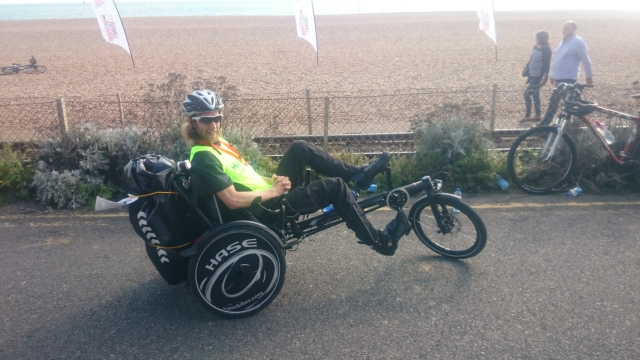
I heard nothing until around 5pm…by which time I gathered he was about ready to book into his hotel having completed the London to Brighton cycle ride, raising funds for Headway, a charity supporting brain injury victims and their families… a ride of some 54 miles (87km), which includes the challenging ascent of Ditchling…
View original post 98 more words
Share this:


Ben’s Bit, part 7 – Heels in the Night
The sound began one night; an insistent tapping entering my dreams, making me think of leaking pipes and other failing elements of the old infrastructure of Bakewell’s ‘improving’ jail.
When it continued, my thin sleep on the thinner mattress came to an end, and I lay with ears straining in the total blackness as the insistent clicking grew louder. It stopped outside my cell door and for a second I wondered if Yellow Eyes was playing some sort of trick on me; but the slats in the door’s inspection grill did not flick open–as I half expected–instead, the clicking noise started, again, diminishing in volume as the perpetrator moved away, down the stone-flagged corridor.
The following night it was repeated at the same time, with exactly the same pattern. To a man there is something special about the sound of a woman’s heels; but it is an incongruous and threatening sound in the middle of a prisoner’s night when a hard-won sleep should be at its deepest.
That had been two days ago. Now I am seated across the old metal desk from Dr Grey and a very smart young woman of indeterminate age; but probably early thirties. She has shiny jet-black hair that flows over her shoulders and halfway down the back of her designer pinstripe jacket.
Dr Grey has a zealous look in his eyes. “Good news, Ben!” he says, opening his clenched palms in an expansive gesture, and indicating that there is something coming for which I should be grateful. “I have been assigned an assistant to help with my work on your … case,” he continues.
“What exactly is my case?” I ask, in a voice which is surprisingly moderated, given that my heart is hammering.
“Well, Ben,” he leans forward as though I am part of the conspiracy. “We …” He nods to the attractive woman at his side. “… are pretty sure we can get you out of here on a charge of being psychologically,” he pauses for effect. “shall we say … disturbed.”
I nod at him, giving the impression that I consider this dubious expediency to be a good thing. “And your lady friend here–miss Goodnight?” I’m proud of this; and it’s a direct hit … the skin of Miss Goodnight’s throat flushes, telling me far more than I expected to discover.
Dr Grey furrows his brow more than is needed to dismiss the intimate suggestion. “My lady friend?” The fingers drum, noisily, on the metal surface. He’s very good at it and my smile is not the response he is looking for. “Oh no, Ben. Miss Golding is a research assistant at a nearby University,” he says, as though this precludes the other.
Miss Golding, recovering quickly, holds my eyes like a snake; copying Dr Grey’s concerned nod with perfection.
Order restored, except in the eyes of the madman, he continues, “She’s studying for her Ph.D. in criminal psychology. Your case will form part of her project experience, and may even become its core.” The fingered drum roll fires up again. Miss Golding looks pleased at the star billing and its audio track. “I think you’ll find she has a brilliant mind.” says Dr Grey, sitting back and letting his assistant’s genius seep into the room, along with her expensive perfume.
“And she’s a very attractive woman,” I say, genuinely. And then I add, searching for the sensitive spot, “You must enjoy your work together?” Before Dr Grey can manifest his anger I add, “All this for a relocated ancient stone?” I lean forward and drum my own fingers in a poor imitation of Dr Grey’s rolling punctuation. “Isn’t that a bit over the top?”
The Doctor takes a deep and calming breath. ”Oh, you misunderstand us, Ben.” The subtle shift of possession is not lost on me. “This isn’t about the stone at all,” he continues. “It’s not even about why a respectable businessman would be motivated to shoot out the church lights in a peaceful Derbyshire town, then steal a cherished piece of the town’s history …” he pauses,watching me visualise the forces stacked against me in this close-knit place. “.. it’s about what else that strange person with a penchant for firearms might do …”
My jaws are locked with the anguish of the trap. The air-rifle which was the cause of my capture does not belong to me; and I suspect Dr Grey knows that; but this moment of dread has been, once again, created to bring me face to face with the consequences of maintaining my silence. But it’s been done like this to emphasise that the alternative is already underway; that the bargaining stage is well and truly over …
In desperation, I reach for a diversion, “I thought you were speaking of getting me out of here?” My tone has become flat – he smiles at the change and takes a breath to compose something important. But the air is cut by the scalpel that is the precise and subtle voice of Miss Golding.
“We are, Ben,” she says. “We’re working on a plan to get you relocated to a much more comfortable place …”
It’s a masterpiece of psychology; right down to the blade of the word ‘relocated’ – pushed, silently between my ribs. Relocated – The word I used in describing how we, no, idiot, don’t even think ‘we’–how I moved the stone back to its rightful place.
But Dr Grey is furious at the intrusion of his assistant. Something has gone wrong with their carefully choreographed double act. She looks at him, flushes–differently–and is immediately silent.
“We have many good reasons for wanting to see you moved, Ben,” says Dr Grey, clutching at a reasonableness that is long past its sell by. I can tell his changed tack is a reaction to Miss Golding’s intrusion, which has revealed a dispute about something of which I’m ignorant, but now partially aware. Surprisingly, Dr Grey throws some light on it, “It’s embarrassing for the town to have you imprisoned so visibly in its heart, like this – it makes us seem Victorian in our attitudes to justice . . .” He means punishment, of course, but the double-speak provides the right word, automatically …
“I’m very happy to be released …” I offer, with genuine humility. “I have no love of this place, either, and my martyr streak is non-existent.” They are listening, but with a hopeless look in their eyes, as though they, too, have become pawns in a bigger game.
This is confirmed when, after a long silence, Dr Grey says, “We have our orders, Ben. We can’t stop the process now. Whatever unexpected friends you may have, the processes of the law … and mental health, must be seen to be followed – no matter where it takes us all.”
. . . . . . .
Back in my cell, lying on my single piece of furniture, I think about that phrase ‘We have our orders’. We all have our orders; we all have to conform to a ‘normal’ pattern. Yet the lives that result from that acquiescence are the multi-storey blocks of the mass ego; the fractured attempts to make society work, despite everything in the inner nature of mankind being revolted by it. Conditioned revulsion describes how we live, sheltering behind domesticity to take us out of the howling gale …
I have no idea where I’m going. A simple act of reverence for an ancient artefact; blindly following the lead of Wen, our chief assassin of the normal … An action that spoke so clearly to the three of us has, seemingly, kicked away the foundations of my life. What really happened on that night, which now seems so long ago – and from where did those dark figures appear–to take away my liberty, seizing the air rife which I had risked all to retrieve? Too many questions, and only the darkness to ask …
Women and fools … it’s harsh, and I wouldn’t give the breath of life to the words; but I can’t help thinking it. But even the bile of that unworthy sentiment won’t prise open my lips … and yet it would appear that, beyond my long-gone friends, I have others … and powerful enemies, too. I sense that the latter know they must strike quickly and put me out of interference’s way.
There are no heels in the night as I fall asleep, but I have seen that look in her eyes; the chance to make a name, and I know they will be back … the part of me that watches everything without judgement smiles at the name I have given her: Miss Goodnight. I think it will stick.
Something very deep in me has not yet been threatened. Something very deep, which reminds me of the ancient spiral surface of the stone, is watching …
How can you watch yourself?
<See index below for other parts of this story>
———————————————————–< to be continued-
Ben’s Bit is a continuing first-person narrative of the character created by Stuart France and Sue Vincent, which may bear some relation to the author of this story, Steve Tanham, their fellow director of the Silent Eye School of Consciousness. In the latest of their books, Scions of Albion, Ben is arrested for his overly enthusiastic part in a mad escapade, and the other two are nowhere to be seen . . . For more, enjoy their Doomsday series of books, and the new series (Lands of Exile) beginning soon. Click here for details.
Index to Ben’s Bits:
Part One, Part Two, Part Three, Part Four, Part Five, Part Six
Sue Vincent describes her and Stuart’s perspective on Ben’s imprisonment: Part One, Part Two
The Doomsday Series of books by Stuart France and Sue Vincent
The Silent Eye School of Consciousness – a modern mystery school.
Share this:

I can only add my support to Sue’s heart felt post …

This is my granddaughter on Wednesday, face down on the floor, sleeping peacefully… safe, loved, exhausted by giggling.
Another photograph of a small child, face down on the floor, made the news on Wednesday. Face down in the sand, washed up on a beach, his smile forever extinguished.
His name was Aylan. Five other children, including Aylan’s brother, Galip, are known to have died in this one incident where refugee boats capsized.
2,500 people are known to have died in an attempt to reach safety this summer alone.
The politics shouldn’t matter. Race, faith, economics.. shouldn’t matter. The fact that such horrors have been going on, not just for the past four years with this one crisis, but since mankind began to call itself ‘civilised’… that matters. That we, who dare to think of ourselves as ‘humanity’, should allow or ignore the needless, terrified deaths of children… that should matter.
View original post 157 more words
Share this:

Stuart takes us deeper into the verbal labyrinth…


 Sun in Gemini
You must be logged in to post a comment.