
In Part One we looked at the anatomy of relationships, in a general sense. We considered how the birth separation from our mother sets off a chain of reactions that strengthen us – as individuals in the world – but isolate us in a bubble of self, from which we form more distant relationships, perhaps only really opening ourselves to our world and others a few times in our lives…
Does our self’s journey hold an invitation to do more than this? There is a contradiction in our lives: the developed sense of self protects us from, among other things, emotional hurt. But it also ‘numbs’ the quality of experience, since everything is seen with reference to this self rather than being experienced for what it is.
Philosophers have always postulated that there is a world ‘out-there’, but that we abstract it within the mind and so deal only with a copy of reduced intensity; our minds filled with ‘routines’ that recognise a situation and replay what we historically feel about it.
In this way, we live in the past rather than the present. It’s a sobering thought…
To consider that there might be something that ‘is’ beyond the ‘me’ is challenging. The me has been carefully nurtured into our maturity so that we have fortress of self, where only what we choose can reach us – in the sense of affecting us. Even those choices become habitual, resulting us being almost machine-like, though few of us are brave enough to contemplate that.
There are various methods to loosening this barrier of self and world. One of the simplest is to learn to look again. Consider an object; say a flower. Let yourself look at it in the habitual way, but then go back, a second later, and look again. Deliberately pick out details that you missed in your usual cursory inspection. The changing hue of colour, the fragrance, the nature of the flower’s centre… Make them all vivid and challenge your mind’s usual perception.
With a little practice, you will be able to literally ‘lose yourself’ in the flower or whatever object you’ve settled on. Traditional approaches to consciousness state that we create an internal representation of the flower in our minds. The flower has reality – it’s really ‘out there’, but our consciousness of it is largely historical. Our look-again flower has much more vividness than before.
At this point, we face a challenge: do we content ourselves with the brightening of our world by doing more of the look-again process? Or do we plunge much deeper into ourselves to discover some startling truths about the very nature of awareness, itself.
In the third of this series, next week, we will look at the journey into our own truths… and where that lives.
End Part Two.
©Stephen Tanham 2022
Stephen Tanham is a Director of the Silent Eye, a journey through the forest of personality to the dawn of Being.
http://www.thesilenteye.co.uk and http://www.suningemini.blog
Share this:

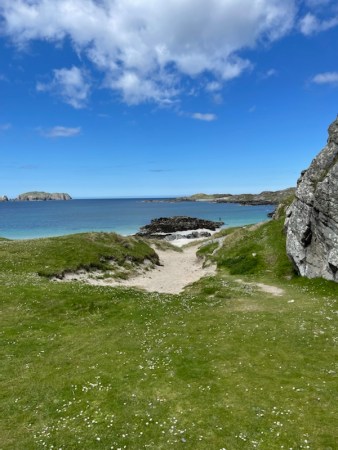
Our two-week trip, ending in the Hebridean Island of Lewis, was coming to an end. The following morning, we would be on a ferry from Stornoway to Ullapool, then a fast route directly to Inverness, where we could pick up the main A9 to Perth, stopping in a travel motel, before setting off early for Cumbria and home.
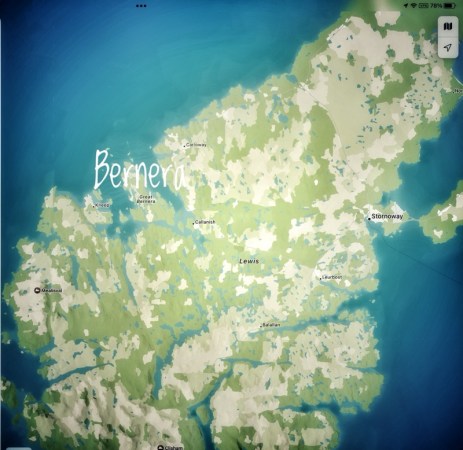
We decided to spend our last day in the Western Isles (we had adopted the native name for this beautiful place) exploring the island of Bernera. Two of the party had a specific interest in the story of the Picts, a tribe of skilled and artistic people who settled across northern Scotland in the period 200-800 AD. We were intrigued to find that a Pictish settlement had been uncovered and excavated on Bernera.
We hadn’t taken the title ‘Isle of ‘Bernera’ too seriously, but, arriving at the long stretch of ocean in our path, the dramatic presence of two bridges, one built in 1953, the other recently, brought home to us the changes made to life by such structures…

The two bridges literally cross the Atlantic- a part of it – and say so on their notice boards!
Having ‘crossed over the Atlantic’ we now stood on Great Bernera, looking back at the ‘mainland’.

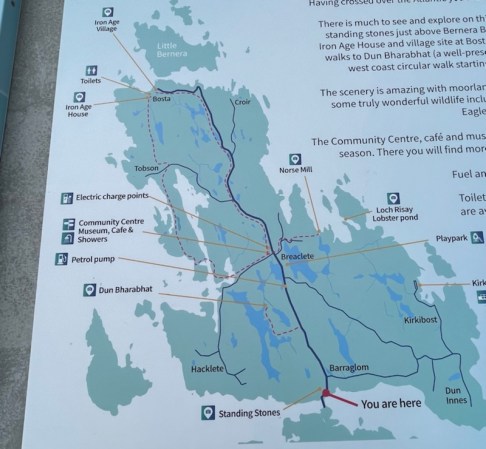
The welcome board gave a helpful greeting:
‘Having crossed over the Atlantic you are now standing on the beautiful island of Great Bernera. There is much to see and explore on this small island, starting with the unique semi-circular standing stones just above Bernera Bridge here at the southern end, and ending with the Iron Age House and village site at Bosta Beach in the north.
Along the way there are marked walks to Dun Bharabhat (a well-preserved small broch), the renovated Norse Mill and the west coast circular walk starting at the Community Centre and going via Bosta.
The scenery is amazing with moorland, lochs, coves, hills and cliffs to find and watch out for some truly wonderful wildlife including Otters, Seals, Dolphins, Golden and Whitetailed Eagles and many bird species.
The Community Centre, café and museum are centrally located and are open during the summer season. There you will find more detailed information on places to visit on the island.’
Once on the island of Bernera, we headed for the small village of Bosta, (see map, above) on the north coast and opposite the smaller island of Little Bernera. Beyond here is only the Atlantic Ocean.
We were here to see the ancient Pictish village, but the first thing we noticed was the quality of the many beaches; even better than those at Uig!
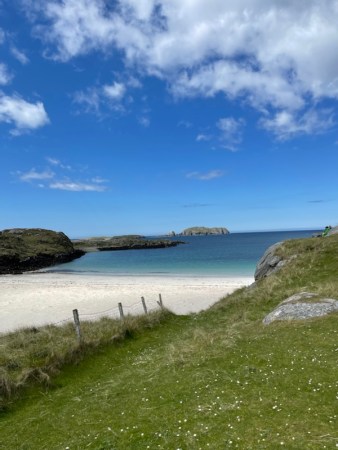


The Labrador and the Collie loved the beaches. Getting the ‘Lab’ out of the clear blue sea was a challenge. Tess the Collie is more of a paddler…
Then it was time to make our way along the path to the Pictish village we had come to see…
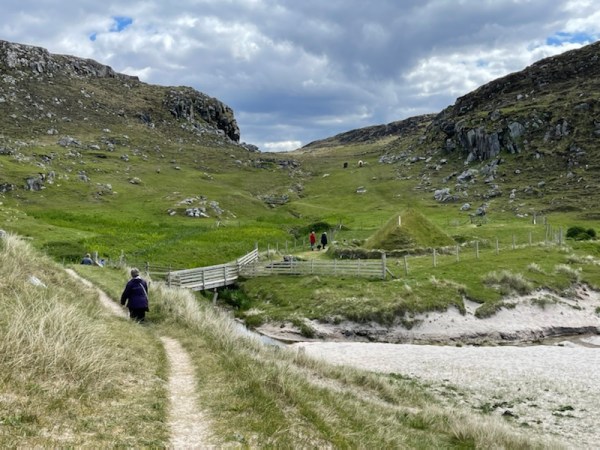

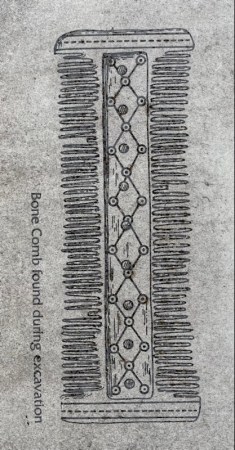
The Pictish house that can be visited is a reconstruction based upon what is known about the tribe, plus artefacts found at the site.
The guide explained that the Picts’ closeness to nature is helping archeologists understand that style of living, which may prove useful to mankind’s future!
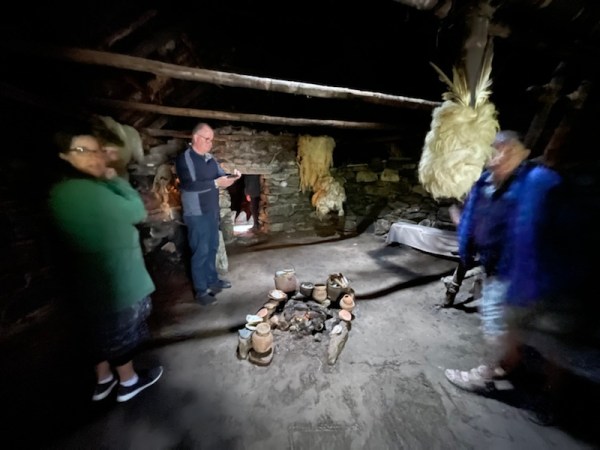
The reconstructed house is made in such a way that you can see how it was built. Certain sections are left bare to emphasise this. The house is a reconstruction of one of the late Iron Age ‘jelly baby’ houses excavated nearby. It was built using the techniques that were available in Pictish times. The excavation site is not yet open to visitors.

No physical evidence of the design of the original roof survives. The style of the roof was dictated by the shape and strength of the walls. For this reason they were built high, so the roof could be kept simple. Also, high walls, surrounded and banked by earth, would keep the interior warmer in the winter.
The dividing walls between the two ‘cells’ of the interior would have been too weak to support a superstructure. The ridged roof found in Pictish houses of later periods is a major departure from the circular roofs of the wheelhouses and brochs of the earlier Iron Age, and a precursor of the traditional ‘roof’ was we know it.
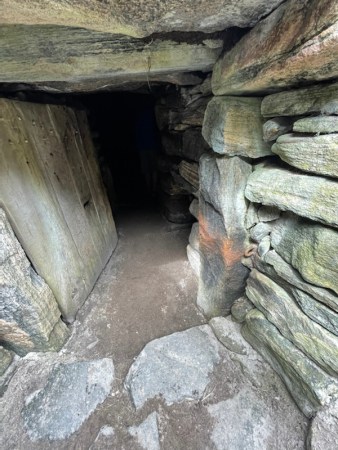
The entrance passage was curved to break the strength of high winds and sloped from ground level to the interior floor level. The purpose of the small secondary chamber is unknown. The main living space may have been subdivided into living and sleeping areas. The small space may have been used by the women for their work.
The central hearth is aligned north to south. This may have been for practical or ritual purposes. It is not known if there was any form of lighting. The summer nights are very long, the winter darkness can be total. This was – and is – a place of beautiful extremes… Parts of the roof may simply have been lifted – or not – to suit each day.
The ridged roof is a major departure from the circular roofs of the wheelhouses and brochs of the earlier Iron Age, and a precursor of the traditional blackhouse roof.

Soon it was time to go. We had spent half our time on the wonderful beaches, and the dogs were delighted and sleepy. Tomorrow would see the start of our long journey home.
©Stephen Tanham 2022
Stephen Tanham is a Director of the Silent Eye, a journey through the forest of personality to the dawn of Being.
http://www.thesilenteye.co.uk and http://www.suningemini.blog
Part One: https://suningemini.blog/2022/05/24/a-poolewe-diary-1/
Part Two, https://suningemini.blog/2022/05/31/a-poolewe-diary-2/
Part Three, https://suningemini.blog/2022/06/06/a-poolewe-diary-3-the-loch-on-the-back-of-the-oats-box/
Part Four, https://suningemini.blog/2022/06/14/a-poolewe-diary-4-once-upon-a-time-in-the-far-north-west/
Part Five: https://suningemini.blog/2022/06/21/a-poolewe-diary-5-over-the-minch-to-lewis/
Continuation onto the Hebridean Island of Lewis:
A Hebridean Diary: Part One – Impressions of Lewis
A Hebridean Diary: Part Two – Long Road to Uig
A Hebridean Diary: Part Three – Of Coats and Kings
A Hebridean Diary: Part Four – The Drowned Lands
A Hebridean Diary Part Five – When power is unchecked
This is Part Six the final post in the series.
©Stephen Tanham 2022
Stephen Tanham is a Director of the Silent Eye, a journey through the forest of personality to the dawn of Being.
http://www.thesilenteye.co.uk and http://www.suningemini.blog

Share this:

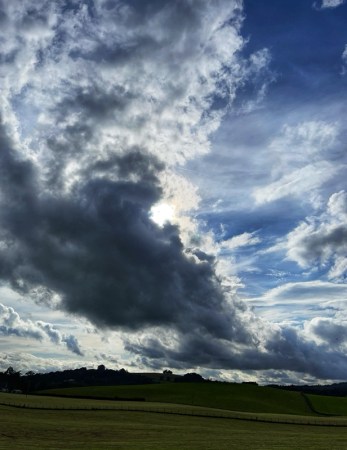
Norfolk and Cumbria are both famous for having ‘big skies’. I’m sure there are others, but over the years, I’ve had the best summer sky shots from these two places – each one vast in its own right.
August has long been my favourite month for shooting photos of such splendour. The one above was taken near where we live, on the edge of Kendal, Cumbria.
There’s nothing remarkable about the photo, but I love how it shows the sheer scale of the cloudscape, stretching from the horizon to nearly overhead.
©Stephen Tanham 2022
Stephen Tanham is a Director of the Silent Eye, a journey through the forest of personality to the dawn of Being.
http://www.thesilenteye.co.uk and http://www.suningemini.blog
Share this:

+ #Silent Eye, #Silenti, Consciousness, esoteric psychology, Magic, Mystery Schools, Powers of the Mind
Defining Relationships (1)
by Steve Tanham
We treat the word ‘relationship’ casually. We don’t mean to – we probably don’t know we are dealing with one of the most fundamental parts of our existence. If we could see the full implications of the idea of relationships, we might be better equipped to see how much symbolic ‘gold’ there is in them.
To consider this, we should step back and examine how we come to have any relationships at all…
Relationships, as we know them, exist because of certain assumptions we make from our early years onwards. We are born into a world where an unthinkable separation is happening, The mother that has nurtured ‘us’ as part of her, must, for our own future, distance her body from ours; connecting us, instead, with warmth and sustaining milk as substitute for a shared existence.
Our lives in the world begin with a biological separation, and, though we are not conscious of it at the time, there is already a duality which, until we mature, spiritually, will never equal that former unity.
This is tightly related to the mystery of the feminine principle and its power in our consciousness and our relationship with Nature.
If I didn’t have a strong sense of ‘me’, there would be no-one else with whom to have a relationship. Because I am certain there is a me, and that this me is separate from everything around me, I create an other, which is not-me.
From that point on, I live in a world which is largely body-centric – the body being the identified boundary between the me and the other.
The adult has fixed this into a world-view. The child, however still lives in a world where there is magic…
That magic is part their sense of connectedness with ‘out there’, which is seen as far closer (particularly emotionally) than the adults’ picture where ‘me’ ends with the edges of the body- or the body of a lover. For the adult, the majority of ‘food’ for the soul comes through the senses and the intellect, leaving a chasm of ‘hunger’ at a deeper and unconscious level of the self.
Early psychologists, like Carl Jung, made much of this archetypal ‘diving feminine’, and its part in each of us in the shape of the anima and animus.
But not everything begins in the body.
‘I’ have the keenest senses to tell me what are my thoughts, emotions and hungers – all of which have a self-evident nature, and what are the secondary things that emanate from the world around me – the other.
Much of my education in life is about learning the logic of how other things affect me, in-here, from sources in the apparent out-there. There is great wisdom in investigating these channels of perception and finding the truth about what we actually know of the out-there objects, and what is the automated result of our world-picture…
The generic ‘relationship’ has a central part to play in our understanding. It could be said that having any relationship has the capacity to put the magic back into our world-view… That is, if the relationship is explored to the full, in a spirit of self-truth.
End Part One
©Stephen Tanham 2022
Stephen Tanham is a Director of the Silent Eye, a journey through the forest of personality to the dawn of Being.
http://www.thesilenteye.co.uk and http://www.suningemini.blog
Share this:

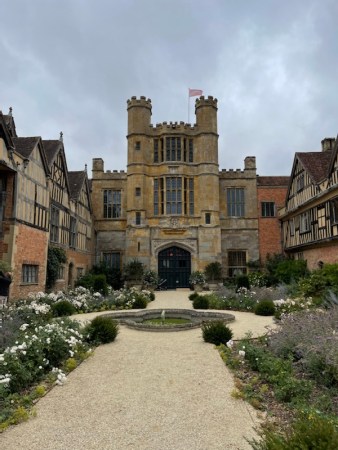
Coughton Court in Warwickshire, fifteen miles from Stratford-on-Avon, is the ancestral home of the Throckmortons, one of the UK’s oldest catholic families and a place of great intrigue during the time of religious persecution. It still possesses some of the best concealed ‘priest holes’ in the country.
It also boasts a beautiful walled garden, worth visiting in its own right…
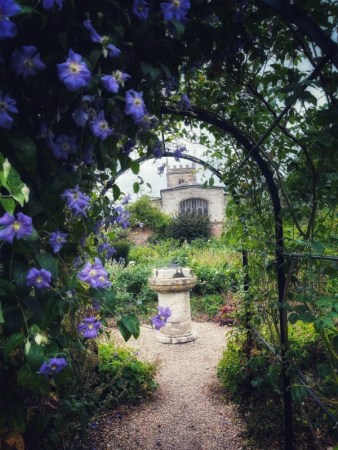
The name Coughton (pronounce “Coat-un”) is believed to mean a settlement or farm known for the hunting of game birds. I’m no fan of the hunting-shooting-fishing brigade but I can separate out the experience of the beautiful gardens from such traditions.


It is believed that there was a medieval house on the site when John de Throckmorton arrived in 1409 to marry into the de Spiney family. Since that time, Coughton Court has been home to the Throckmortons, one of the UK’s oldest catholic families and a major name in the City of London’s development as one of the world’s most important financial centres.

Coughton Court still has many of its original features including its flamboyant sixteenth-century gate tower. It is one of the last remaining Roman Catholic houses in the country to retain its historic treasures, housing one of the very best collections of portraits and memorabilia of one family from the early Tudor times.
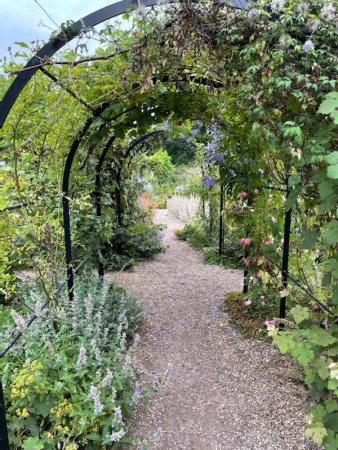
Alongside family items on display, there are pieces such as the chemise reputedly worn by Mary Queen of Scots when she was executed and a bishop’s Cope, with intricate needlework, believed to have been worked upon by Catherine of Aragon.
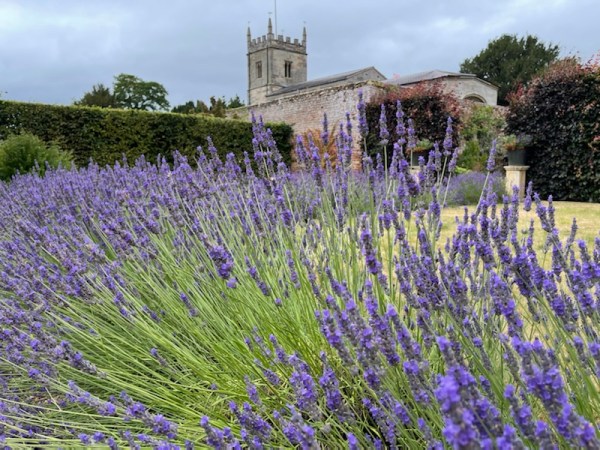
I will do a separate post on the interior of the house. We were so impressed with the gardens, I felt it was worth a photo-tour, if only to show the best of the photos taken on the day.
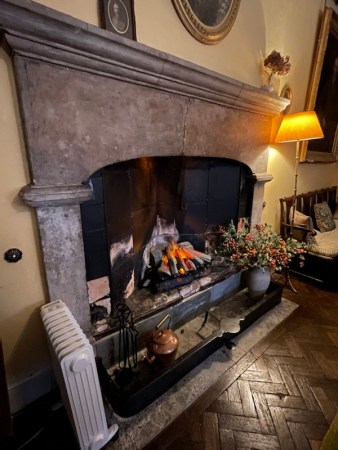
Coughton Court was gifted to the National Trust in 1946 by the Throckmortons, the family continues to live there, extending a staggering six centuries of unbroken tradition.
©Stephen Tanham 2022
Stephen Tanham is a Director of the Silent Eye, a journey through the forest of personality to the dawn of Being.
http://www.thesilenteye.co.uk and http://www.suningemini.blog
Share this:


We’ve known each other for just over a decade, though the oak has lived for at least ten times that.
It’s a tree and a very special place in the landscape. It’s conveniently at the end of our shorter dog-walk, so I get to see it in all seasons. This time of year is mellow, and the colours in the landscape reflect that.
Soon, we will enter the pre-autumnal days, and the full and deep greens of summer will fade and die – a poignant time of year.
Nature’s round…
But the oak will still be here. And we’ll still be talking to each other at the farthest point of walking the dog.
©Stephen Tanham 2022
Stephen Tanham is a Director of the Silent Eye, a journey through the forest of personality to the dawn of Being.
http://www.thesilenteye.co.uk and http://www.suningemini.blog
Share this:

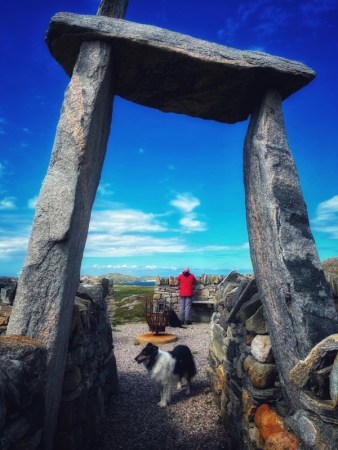
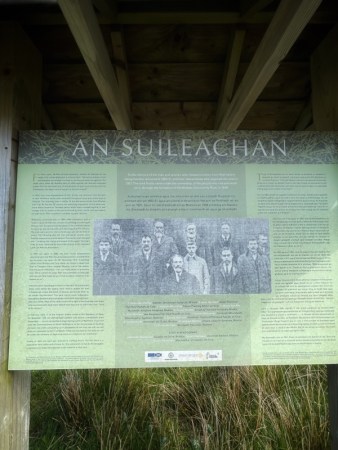
From the road that curls around the small hills on the way to the beach at Reef, in the Uig district of Bhaltos, it looks like a large cairn. The second time we drove by we saw the noticeboard and stopped to take a closer look.
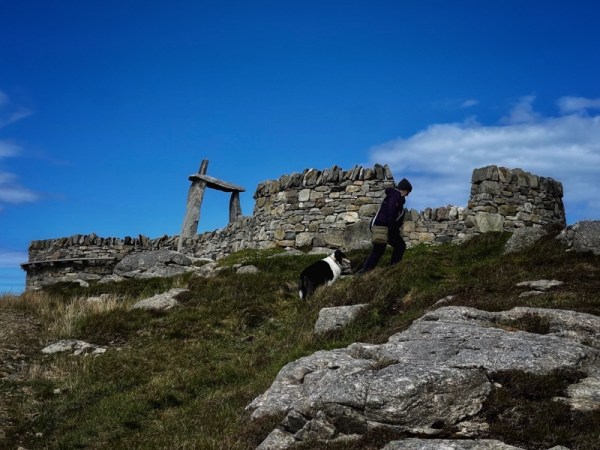
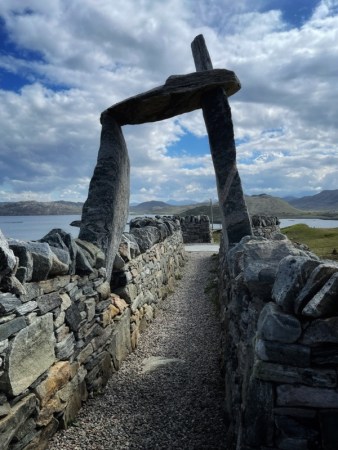
We climbed up the path to find a beautiful and touching monument on the hilltop, whose design was not visible from below. It was surrounded by views on all sides. Two things strike you, immediately: The isolation of the hill, itself; and the ancient connectedness of the people to this place – suggested by what looks like a giant tau-cross, but is based upon a stone construction method used in Neolithic times.
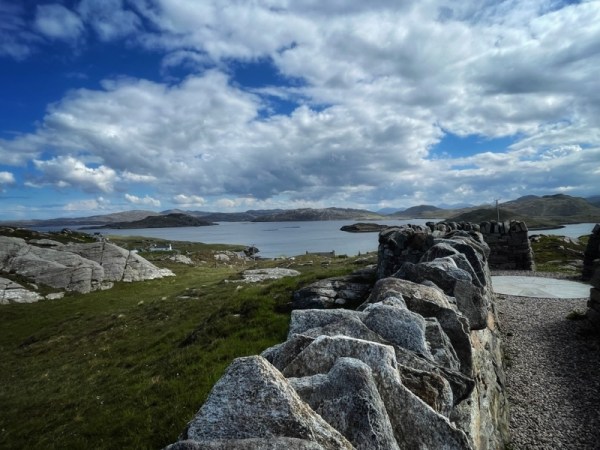
The curse of constant rain seemed finally behind us. We had become more relaxed and able to take in the beauty of the lochs, as in the view from the monument’s hill, above.
The Highland Clearances are well known as a dark period in Scotland’s history. They were the evictions of a significant number of tenants, many of them small-holding crofters, in the Scottish Highlands and Islands, mostly in two phases from 1750 to 1860.
The goal of the rich landlords was to replace humans with sheep, which were more profitable than the small rents charges to the farmers, whose only real assets were their culture, small-scale farming skills and love of the land. The crofters had lives, jobs, songs, families and folklore… and this was the only landscape they’d ever known.
A group of them refused to leave.
The notice board reads:
“To the memory of the men and women who resisted eviction from Reef before being forcibly removed in 1850-51…”
For three years, ending in 1850, 28 Reef families peaceably resisted all attempts by the estate of Sir James Matheson to remove them:
We had no arrears of rent and therefore we refused in a body to do this and stood out against it for three years, when Mr Scobie’s (the factor) term of office expired…”
The ‘factor’ was the man who enforced the land management and the will of the landowner. The following entry shows both the honesty and the naivety of the crofters:
We naturally expected justice from the next factor but, on the contrary, he took up at once the work his predecessor had begun and at last got us forcibly evicted”
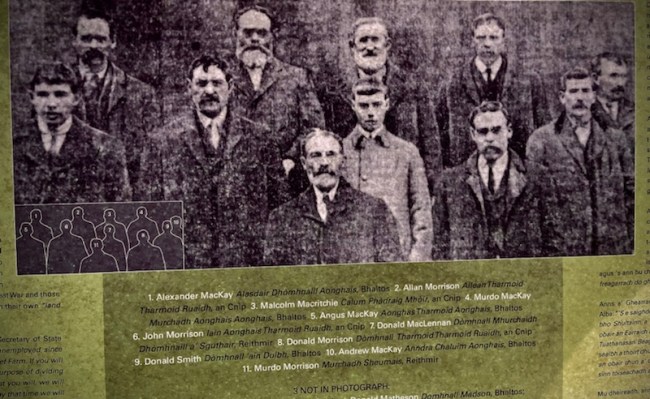
In 1850, they were dispossessed of their homes and removed from the land of their ancestors. Some were scattered throughout the Isle of Lewis and others sent as far as America.
The following year a further fourteen families were evicted from Bhaltos and Cnip. By the late 19th century, the remaining population of this peninsula, in the district known as “fourteen penny lands” were crowded together in two villages with no access to the land surrounding them, which had been deliberately added to large farms. Those crowded onto the single village included 31 squatter families, who owned nothing.
The resolute resistance continued and, in 1884, HMS Assistance, with a force of up to 100 Marines, arrived in Loch Roag to arrest eight Bhaltos men accused of placing animals on the offshore islands for grazing, not paying rents and ‘deforcing’ Sheriff’s Officers.
The men were sent for trial to Edinburgh and served time in prison. The following year ten men and seven women were fined for separate but similar actions. The women were charged with “mobbing and rioting and breach of the peace” and their fines, 5/- (shillings) each, were paid by the London branch of the Highland Land Law Reform Association, an influential organisation that was fighting for fairer land rights to reflect usage as well as ownership.
In 1891 and again in 1896, the Deer Forest Commission recommended that Reef should be scheduled for re-settlement…but no action was taken.
On 28th November 1913, 15 landless squatters from Bhaltos and nip drove the farmer’s stock fromReef to Timsgarry Farm. Alasdair MacKay, one of the raiders, told the parish Policeman:
“You can have plenty of prisoners now. We’ve waited too long. Reef was promised us long ago and now we have made up our minds to take it, whatever may happen to us.”
Interdicts were issued against them in February 1914 and when these were defied the raiders were cited to appear for trial in Edinburgh where the Court of Session sentenced them to six weeks imprisonment. This gave rise to much indignation throughout Scotland and a campaign led to them leaving prison after two weeks. Most of the raiders went off to fight in the Great War and those who survived came back more determined than ever to claim their own “land fit for heroes.”

In February 1920, 11 of the original raiders wrote to the Secretary of State for Scotland:
“We are demobilised soldiers and sailors unemployed since September …. we are compelled to begin Spring work on Reef Farm. If you will send the Commissioners of Small Holdings to us for the purpose of dividing the farm into crofts and putting us in possession as we trust you will, we will delay our operation to the 1st of March. If they are not here by that time we will be under the necessity of beginning work as a means to our livelihood”
Finally, in 1921, the land was restored to crofting tenure. The fact there is a population here today and a future for this community is due to the struggles undertaken by those who secured a just outcome at that time. As so often happens, the right outcome is fragile and often hangs by a thread.
The monument ‘An Suileachan’ was commissioned by the Bhaltos Community Trust and designed by artists Will Maclean and Marian Leven. It was constructed by island craftsmen – the stone circles by John Crawford, the iron brazier by John Macleod and the woodwork by John Angus Macleod.
The An Suileachan memorial is only seen in its full extent when you are on the high level. There is a central path that links two separate areas. At the central point of the path is what we named the ‘Tau gate’. You have to pass through this to see both ‘faces’ of the structure.
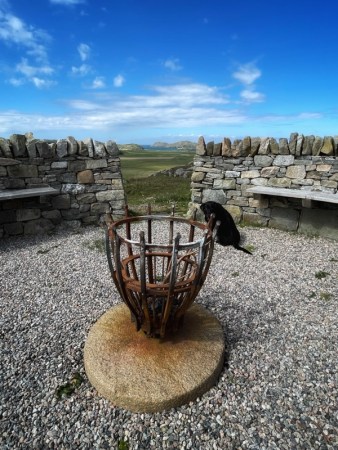
At the seaward end is a brazier, a beacon that gives off heat and the light of warning and preparedness.
At the landward end is a circular stone plaque around which are carved the names of all those brave souls who were evicted from Reef by the second ‘Factor’. In one sense, the light and heat of the brazier-beacon highlights and protects them. They did not know that the great wrong done to them was to be corrected by friends and relatives after their deaths – to the great benefit of their community.

Their only weapon was the sense of truth and rightness they felt in their cause. A rightness much like the Biblical story of David and Goliath, where the monstrous apparent power of the giant is overcome by the simple stone of truth…
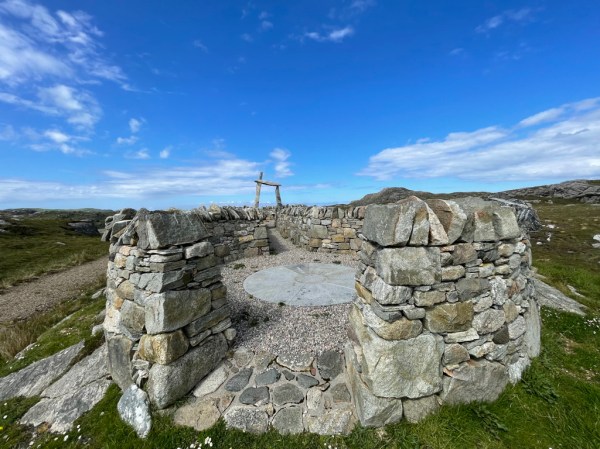
We can only aspire to such courage. You can tell in the quality of the monument how precious the memory of those brave souls is…

Part One: https://suningemini.blog/2022/05/24/a-poolewe-diary-1/
Part Two, https://suningemini.blog/2022/05/31/a-poolewe-diary-2/
Part Three, https://suningemini.blog/2022/06/06/a-poolewe-diary-3-the-loch-on-the-back-of-the-oats-box/
Part Four, https://suningemini.blog/2022/06/14/a-poolewe-diary-4-once-upon-a-time-in-the-far-north-west/
Part Five: https://suningemini.blog/2022/06/21/a-poolewe-diary-5-over-the-minch-to-lewis/
Continuation onto the Hebridean Island of Lewis:
A Hebridean Diary: Part One – Impressions of Lewis
A Hebridean Diary: Part Two – Long Road to Uig
A Hebridean Diary: Part Three – Of Coats and Kings
A Hebridean Diary: Part Four – The Drowned Lands
This is: A Hebridean Diary (5) When power is unchecked
©Stephen Tanham 2022
Stephen Tanham is a Director of the Silent Eye, a journey through the forest of personality to the dawn of Being.
http://www.thesilenteye.co.uk and http://www.suningemini.blog
Share this:

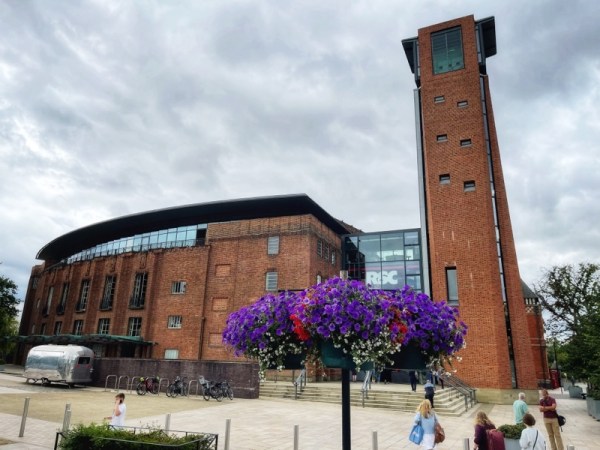
“You might wonder,” said our guide. “Why the Royal Shakespeare Company (RSC) would spend £112 million on a completely new interior for its world-famous theatre, only to leave in place these scruffy wooden boards…

Looking at me, he continued: “Do you realise, Sir, you are treading the same boards that creaked beneath the stage shoes of Lawrence Olivier, Richard Burton David Tenant and Dame Judi Dench…”
We all looked to our feet, standing on the hallowed wood, feeling amused but unworthy…
We were enjoying a long weekend near Stratford-on-Avon; soaking up the delights of Warwickshire in late July. The theatre is always a treat, but the RSC creates experiences you never forget.
This to be followed by an afternoon performance of Richard III – all three hours of it. A cracker of a day, and the weather was beautiful, so an ice cream by the river was on the cards…
Part of the agenda of this visit to the RSC was a ‘behind the scenes’ tour of the restored Art Deco building and its support services, such as costuming. Another was a glimpse of the new Swan Theatre exhibition: a permanent treasure trove of acting memorabilia.
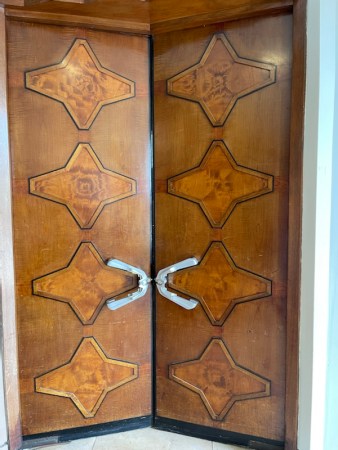
These will be visited in a short series of posts to come. But first, it wasn’t only the stage boards that were up-scaled to serve the new building; the entire Art Deco fittings of the previous interior were carefully worked into the design. The classic bar room doors were cleaned and polished to their original glory.
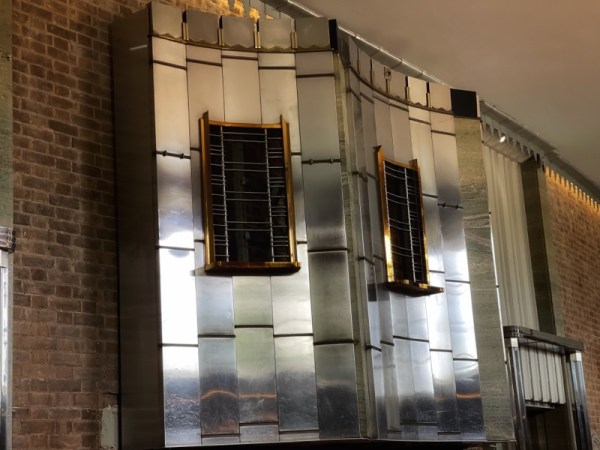

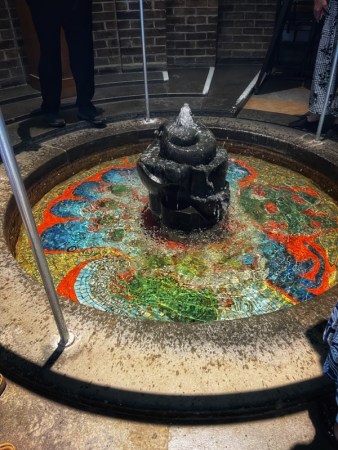
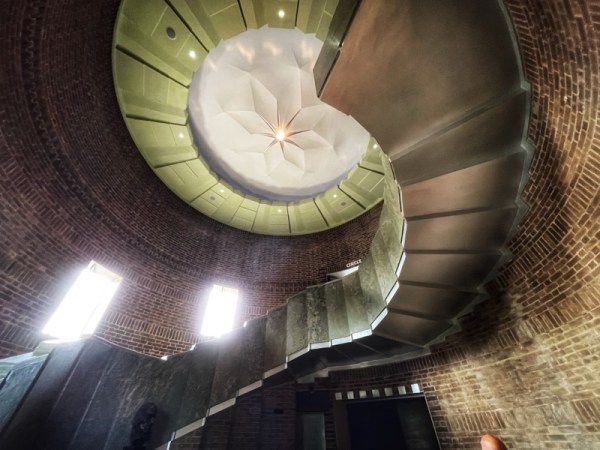
At the far end of the entry gallery is the cafe, and beyond that one of the original ‘fountain and spiral staircases’ so popular in the 1930s.

©Stephen Tanham 2022
Stephen Tanham is a Director of the Silent Eye, a journey through the forest of personality to the dawn of Being.
http://www.thesilenteye.co.uk and http://www.suningemini.blog
Share this:


We were visiting Stratford: a tour of the backstage side of things, then a matinée of Richard III. It’s a play I’d never seen, and very much wanted to.
An excellent production nearly three hours long left us desperate for coffee. We left the RSC theatre and headed into the centre of town.
We passed this amazing motorcycle on the pavement opposite a restaurant. It was too clean to have been ridden much, but what a delightful sight…
©Stephen Tanham 2022
Stephen Tanham is a Director of the Silent Eye, a journey through the forest of personality to the dawn of Being.
http://www.thesilenteye.co.uk and http://www.suningemini.blog
Share this:

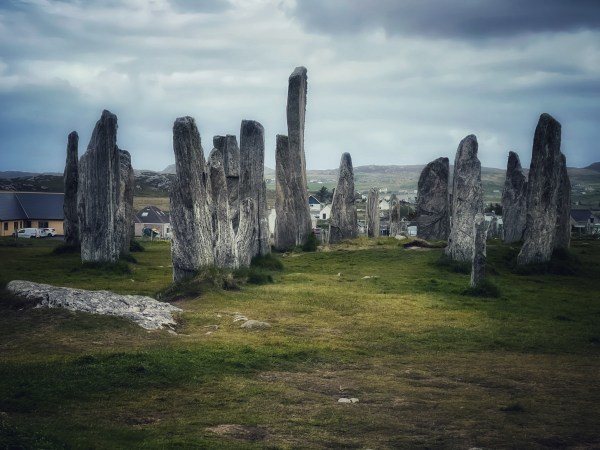
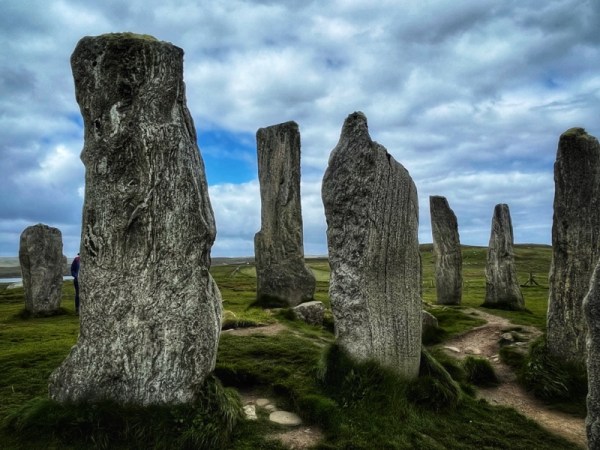
We had wondered about the real nature of this landscape. On this our third day on the Hebridean Island of Lewis, we paid a long-anticipated visit to Callanish, the place of the famous stones – though the main site is not a stone circle. There, I came across a sign that perfectly described the rather barren landscape all around us.
The sign read: Welcome to the Drowned Lands…
Welcome to the Drowned Lands:
Following the last Ice Age, 14,000 years ago, the sea level rose, giving us the rather barren landscapes of the lochs and drowned valleys of the Western Isles – the local, and preferred name of the Outer Hebrides. They were, quite literally, drowned by the melting ice, having been crushed and worked by the glaciers.
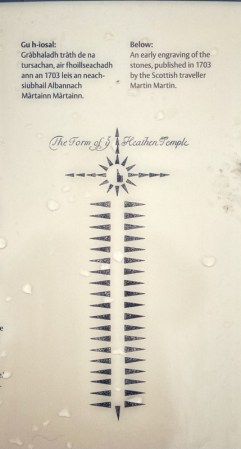
The Callanish Stones are an arrangement of standing stones – but placed in a cruciform pattern with a small central stone circle at the cross point.
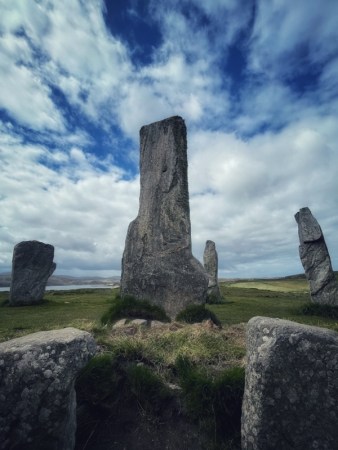
They were erected in the late Neolothic era (new Stone Age – 8000-3000 BC) and were a focus for ritual activity during the Bronze Age, 3300 BC – 1200 BC. This immense age means we have little understanding of their beliefs and spiritual methods, but we know that following nature in the form of the seasons, and studying the movements of the heavens were central to those beliefs. The cycles of crop planting and harvesting were likely to have been central to their myths.
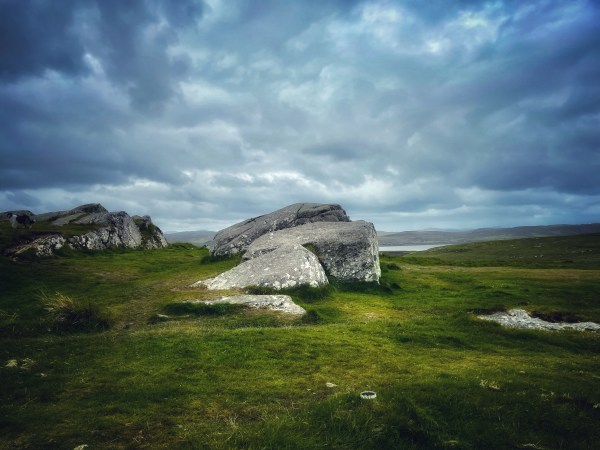
You arrive at the site via the famous visitor centre – sadly closed on the Sunday we visited for religious reasons…something amusing about that! The ancient stones are obviously not looked upon as sacred places…
To be continued next week…
Part One: https://suningemini.blog/2022/05/24/a-poolewe-diary-1/
Part Two, https://suningemini.blog/2022/05/31/a-poolewe-diary-2/
Part Three, https://suningemini.blog/2022/06/06/a-poolewe-diary-3-the-loch-on-the-back-of-the-oats-box/
Part Four, https://suningemini.blog/2022/06/14/a-poolewe-diary-4-once-upon-a-time-in-the-far-north-west/
Part Five: https://suningemini.blog/2022/06/21/a-poolewe-diary-5-over-the-minch-to-lewis/
Continuation onto the the Hebridean Island of Lewis:
A Hebridean Diary: Part One – Impressions of Lewis
A Hebridean Diary: Part Two – Long Road to Uig
A Hebridean Diary: Part Three – Of Coats and Kings
This is Part Four – The Drowned Lands
©Stephen Tanham 2022
Stephen Tanham is a Director of the Silent Eye, a journey through the forest of personality to the dawn of Being.
http://www.thesilenteye.co.uk and http://www.suningemini.blog
Share this:

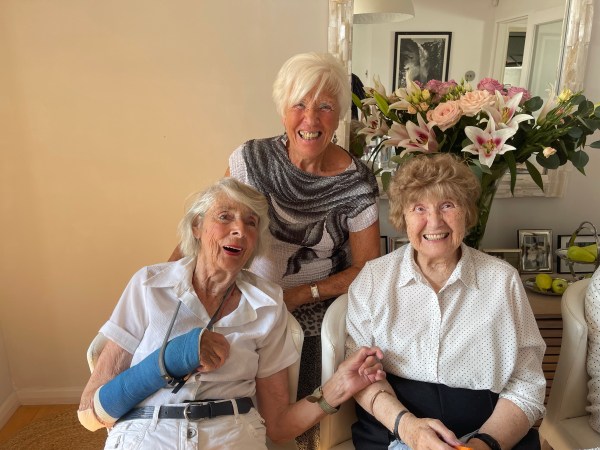
Lower left – my mother, Barbara; lower right – Doreen, whose husband has just died, and top – Mavis, the eternally youthful dancer)
The funeral of a much-loved ‘uncle’ from my childhood meant I had to take my 92 year old mother from the care home in Morecambe down to the old home-town of Bolton… in 30 degree heat. Mum has multiple heath conditions and the logistics are always a nightmare.
In addition, she has recently had a fall on the promenade and broken her wrist – you can see the cast in the photo.
The joy of the day was seeing these three ladies reunited – despite the sad occasion – for the first time in several years.
There used to be four of them. Louise died last year, but the remaining three – who coined the name ‘Golden Girls’ – have stubbornly refused to give up the ghost, despite all being challenged, health-wise.
All bar the elegant lady, top-left, who has just exhausted her last dancing partner and is looking for a replacement…
I can forward names…
Despite the sad occasion and the searing heat, the Golden Girls had a wonderful day, and send their love to anyone here who knows them.
©Stephen Tanham 2022
Stephen Tanham is a Director of the Silent Eye, a journey through the forest of personality to the dawn of Being.
http://www.thesilenteye.co.uk and http://www.suningemini.blog
Share this:


So high above this Lakeland landscape, it’s difficult to imagine its industrial past; in particular, how an army of labourers toiled here, competing with an impossible deadline to deliver a vital transport link between Preston and Kendal.
It’s 1819. The industrial revolution is in full swing.
But this wasn’t the railway. This was prior to the coming of steam. The labourers were navvies – mainly Irish workers whose job was to hew out of the ground the new watercourse that would allow the shipping of goods over long distances at low cost. Coal and gunpowder were the primary commodities related to this high landscape.
This was the birth of the local canal, though it was not the first to be built. The official name was ‘navigation’, which is where we get the name ‘navvy’ from.
They were powerful things, navigations. They required an act of parliament to establish; then a small army of navvies to live and work in tented villages along the route as it grew.
All by hand and shovel and sweat. With horse and cart to take away the spoil.
They were a huge success… but for a mere twenty years. Then came the canal’s slow decline. Too slow and the cargo volume was too limited – compared to the train.
The railway was cost effective and far easier to build… You could ride on the land rather than digging up a boat’s worth every few yards.

Follow my eye in this shot and you’ll see a distant stone bridge at the end of the fence-line. That’s one of the bridges to ‘nowhere’, as we call them; the only proof that the canal was ever here…
Except in those householders that bought their part of the canal (in the 1960s) and converted it as part of their property. Farmers filled it in to restore the original fields. A few householders turned it into twin-level gardens.

Only at the ‘bridges to nowhere’ can you glimpse life as it was. It makes a wonderful footpath, and the views from this section (which was said to be the boatman’s favourite) are stunning.


©Stephen Tanham 2022
Stephen Tanham is a Director of the Silent Eye, a journey through the forest of personality to the dawn of Being.
http://www.thesilenteye.co.uk and http://www.suningemini.blog


 Sun in Gemini
You must be logged in to post a comment.