+ #Silenti, Consciousness, Esoteric Meaning of Myth, esoteric psychology, History, Journey of the hero, Photographic techniques, Photography, Places and Prose, Psychology
Theatre of the Mind
by Steve Tanham

Once a month, on the evening of the third Sunday, the Silent Eye hosts a zoom-based get-together on the internet. People join us from across the world.
The purpose is to share our (and others’) explorations of the mystically-oriented life; hence its name: SE-Explorations.
In the comfort of our own homes, those who might be curious and those who seem to have been curious all their lives, get together to exchange insights and ideas for the practice of what is simply a journey into the deeper parts of our selves.
This is not an academic pursuit… The complex and shrouded language of the past has done little to point the road to the soul, a path that is startling simpler and more personal that history’s priests of all colours would have us believe…
Our zoom meetings begin with a simple opening ceremony. We light a candle and quieten our minds to be in tune with our shared purpose and each other across the planet.
This Sunday’s exploration was a virtual guided ‘walk’ of an unusual nature…
Guided meditations are familiar things, these days. The one at the heart of our meeting used a different formula: guided images.
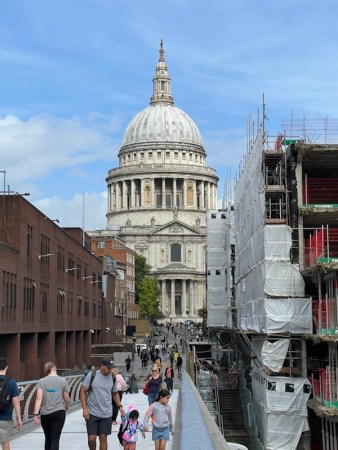
We envisaged being in London, next to St Paul’s Cathedral. We imagined being collected by our guide for a journey: a woman who seemed familiar, yet none of us could say why…
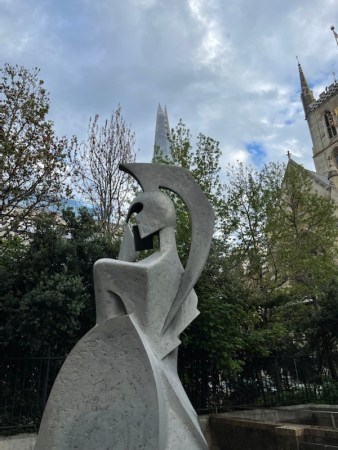
Shall we follow her now?
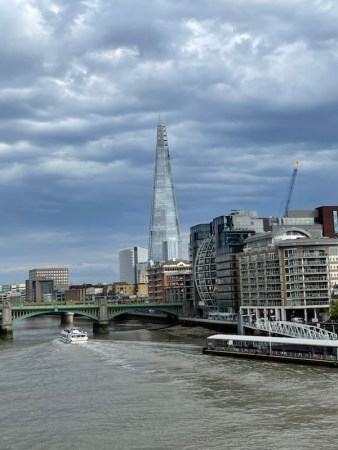
She takes us along river path towards the financial district. We begin to think there might be some significance in this choice as a first stage. Perhaps the heart of the City is symbolic of the importance of the material world, with its focus on monetary values and the rigid ideas of success and failure?
Ideas that often leave the creative and sensitive soul feeling cold and abandoned…
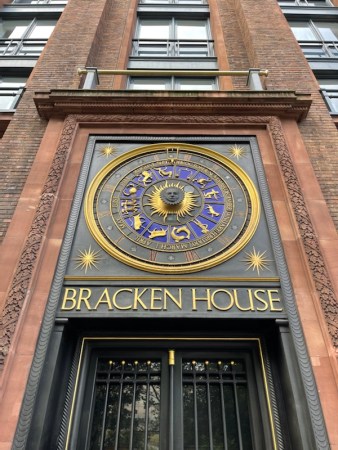
With each step, we feel we are coming closer something different. She points to the river, asking us to remember it.
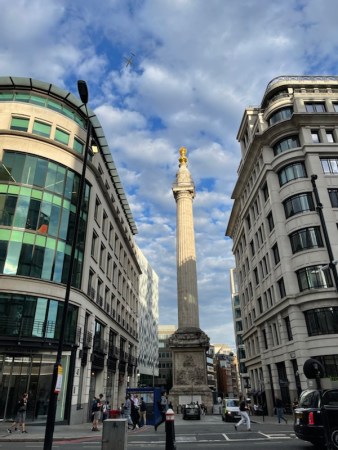
The closely-packed buildings represent history, too. We can be so defined by history – societal and personal, that we have no means of expressing ourselves in terms that are deeply us, and of the now.
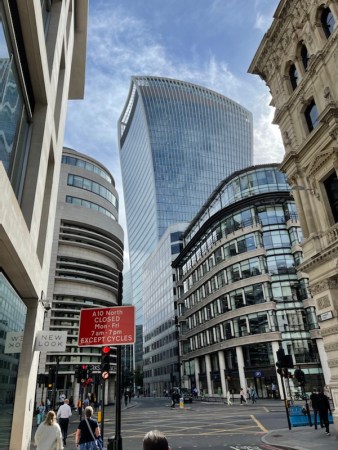
Finally, we come to a strangely shaped building whose upper floors appear to lean out, over the world.
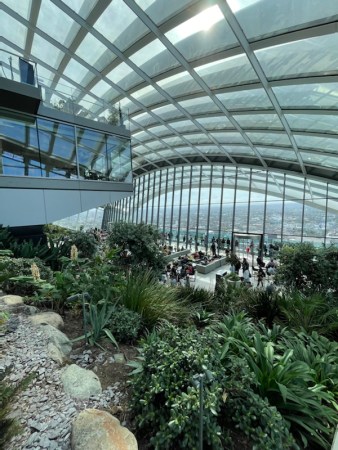
It’s not so much a building, more a state of mind… and beyond. The lush garden looks down on the whole of London. We can choose to look at anything.
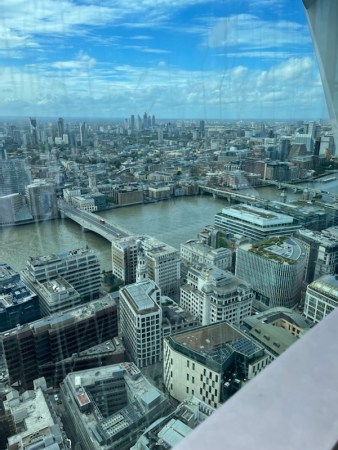
The guide points to St Pauls, in the distance. She also asks us to consider the mighty river, the Thames. She tells us it represents time and that our personal evolution happens in time…
She invites is to consider whether we would voluntarily enter the world of time in order to advance our selves; to enhance our souls with experience of the world – the Creation.
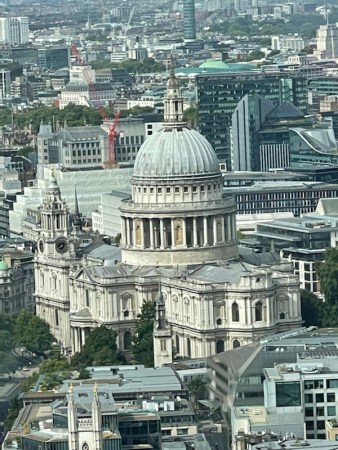
She looks around at our eyes… we seem willing to do this. She leads us from this high place, where we can see everything but are part of nothing…
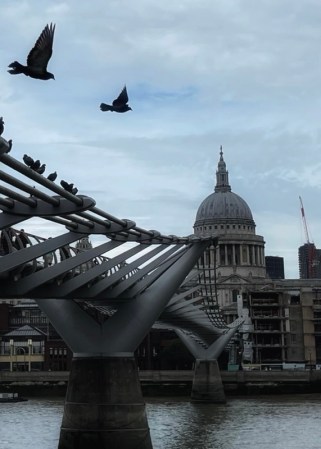
We descend and regain the riverbank, this time turning to cross the mighty river of Time, and emerge on its other bank – entered into life, to find a strange building before us.
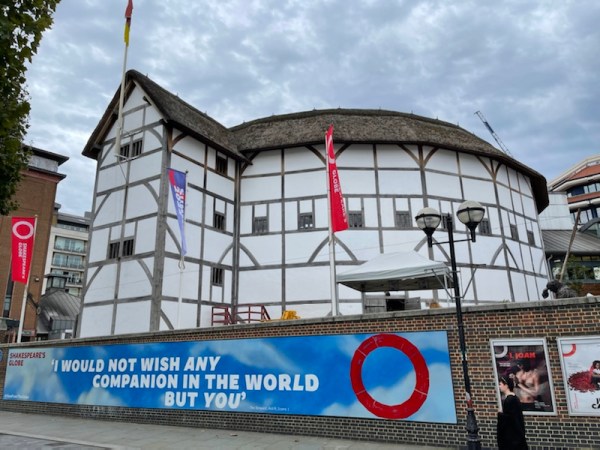
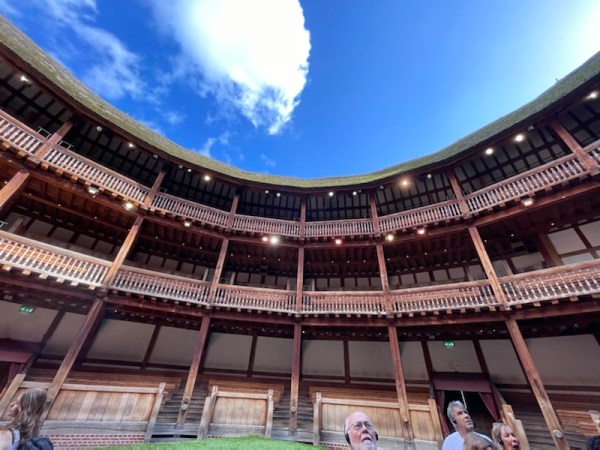
It’s a reconstructed theatre from the Elizabethan period. Its name is Globe, and it is a microcosm of human evolution.
We enter…
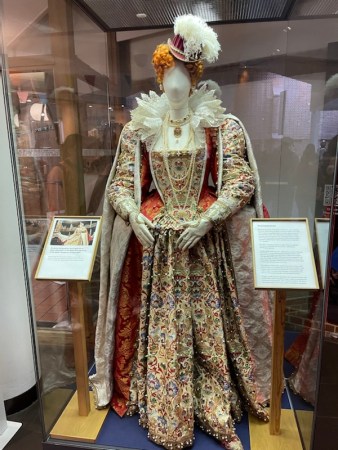
Inside are examples of the parts great actors have played, here. They were praised for their ability to assume the personality of those whose lives or stories they enacted. In some cases, too well – thinking themselves the actual character they played!
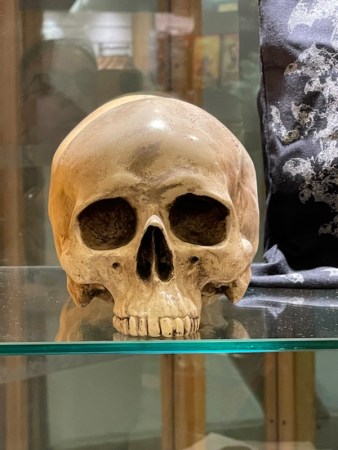
Acting can have far-reaching consequences… And not all the plays staged here have happy endings…
The guide asks if we are ready to ‘take the stage’ and we follow her along the curving corridors and past the ‘cheap seats’ – the ‘penny stinkers’ where the poor and tradespeople came to see the afternoon performances and wonder at the many kinds of life other people led.
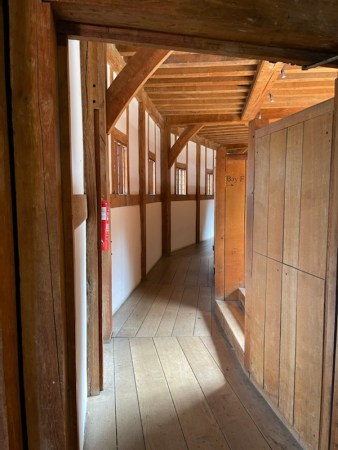
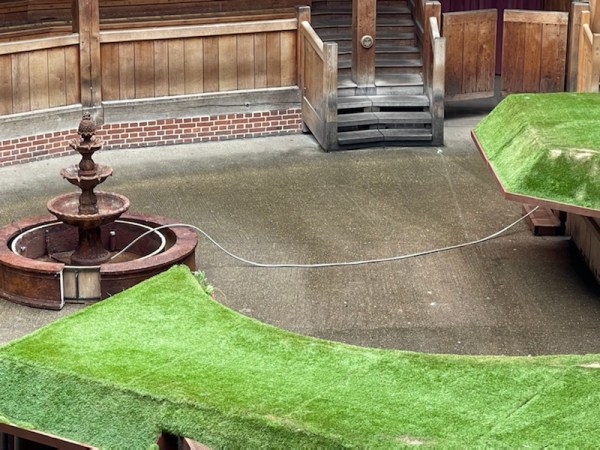
And the we are suddenly ‘in the arena’… and the light is bright. All around us the world of this Globe is alive. Directly ahead of us is a huge platform over the main stage. This was for the rich and titled of the day, and, though they could not see the stage below, they achieved their purpose – which was to be seen in their splendour. Perhaps little changes…
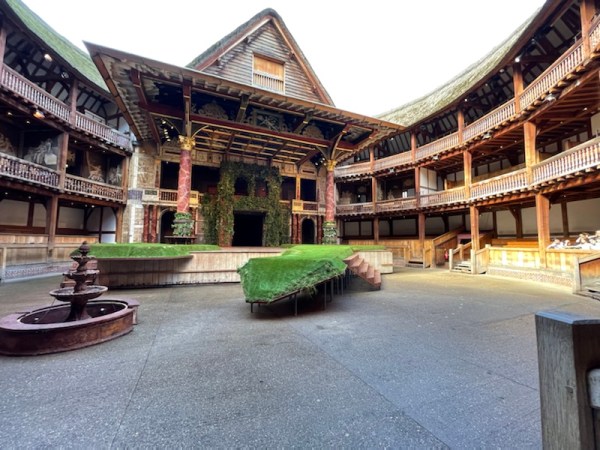
The splendour of this concept of ‘theatre’ is brought home to us; the power of rendering life as drama, and finding writers and actors powerful enough to become the characters they portray.
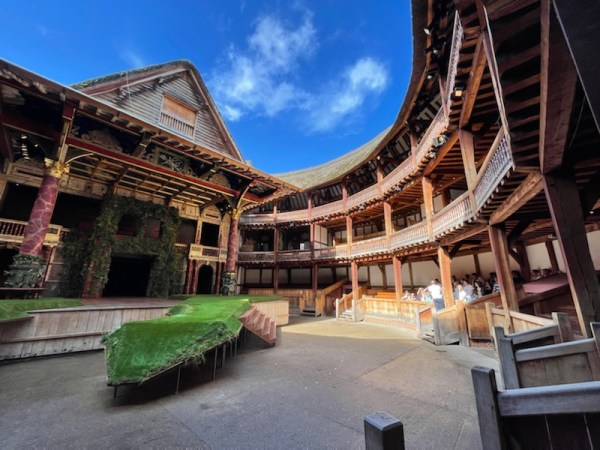
And now the guide ask us if we are ready to take our place in this stream of time and play our allocated parts?
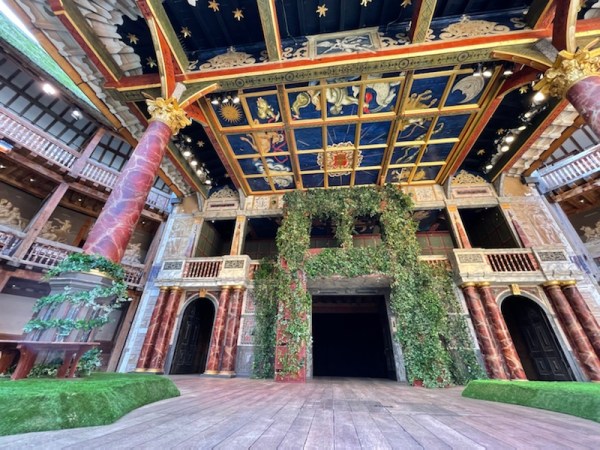
We climb, one by one, onto the central stage and she gives us our character parts. We study them and immediately feel an identity with them. Soon, our parts are all we know.
One man, last to climb the stairs, is taken to one side by the guide. In hushed tones – which we hear but then immediately forget – she tells him, “Your role is to waken the actors when they have finished the play and show them that they were never the part they played, but something much more conscious of the world…”
A few actors have even awakened, joyfully, while playing their parts…
The Silent Eye holds SE-Explore meetings every month, on the third Sunday, at 8:00 pm, London time.
We would love to have you join us, even if you simply want to be there and watch what happens.
Email us at Rivingtide@gmail.com. We’ll send you a link.
You’d love it!
©Stephen Tanham 2022
Stephen Tanham is a Director of the Silent Eye, a journey through the forest of personality to the dawn of Being.
http://www.thesilenteye.co.uk and http://www.suningemini.blog
Share this:

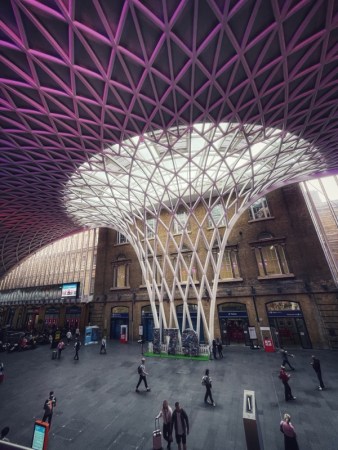
We know very little about King’s Cross Station. Our rail journeys to Cumbria always begin at Euston Station, a fifteen minute walk away.
A journey via Leeds gave us the chance to pass through this venerable part of Britain’s infrastructure, and I immediately noticed the roof. My first thought was that it had been designed by the same architects as the roof of the British Museum – Foster and partners.
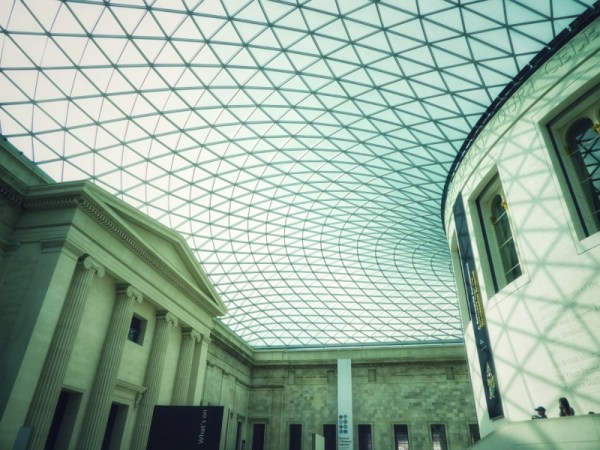
But there seems to be no connection. In fact, upon further reflection, one is a lattice support structure and the other a roof… One is made of thick steel tubes and the other…. Is not.
Photography is like that. You focus on one aspect and forget the ‘big picture, so to speak…
On to the next!
©Stephen Tanham 2022
Stephen Tanham is a Director of the Silent Eye, a journey through the forest of personality to the dawn of Being.
http://www.thesilenteye.co.uk and http://www.suningemini.blog
Share this:

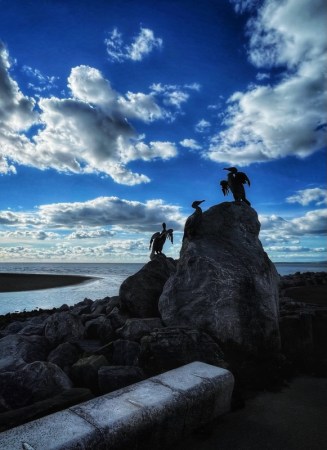
There’s a strange object near the end of Morecambe’s long Stone Jetty pier. From a distance, it looks like a large piano…
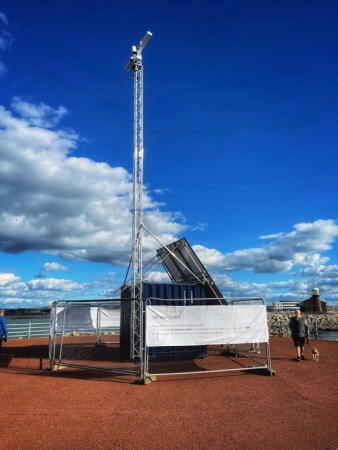
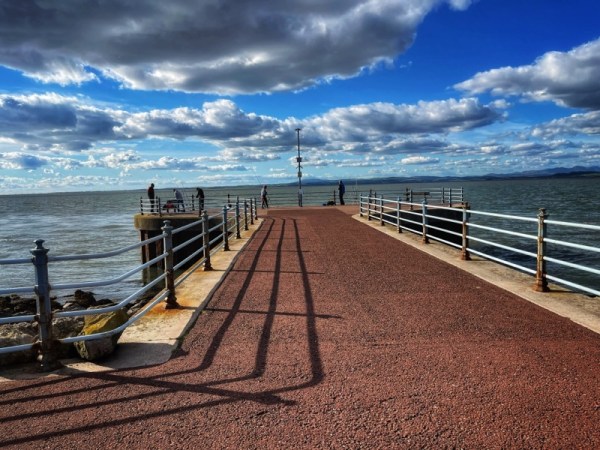
Beyond it is only the sea, so, really, it’s stuck out in the middle of Morecambe Bay. It’s actually one of two new radar stations designed for detailed analysis of the intense tidal flows of these parts – some of the largest in the world.
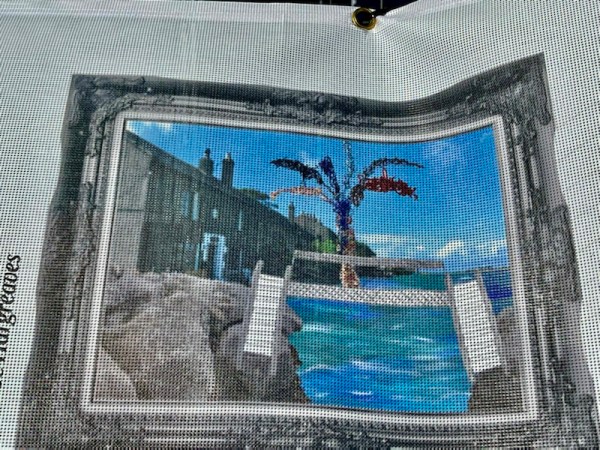
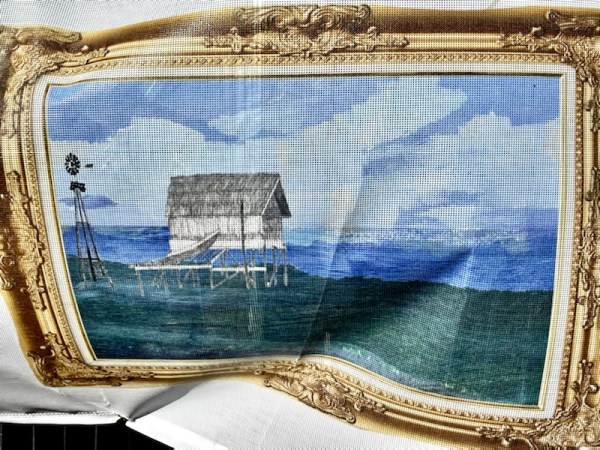
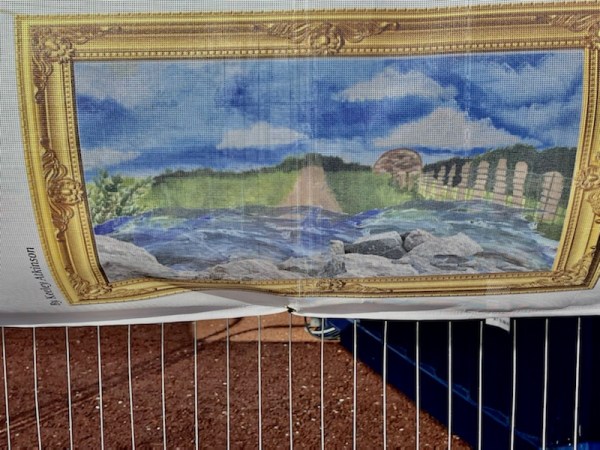
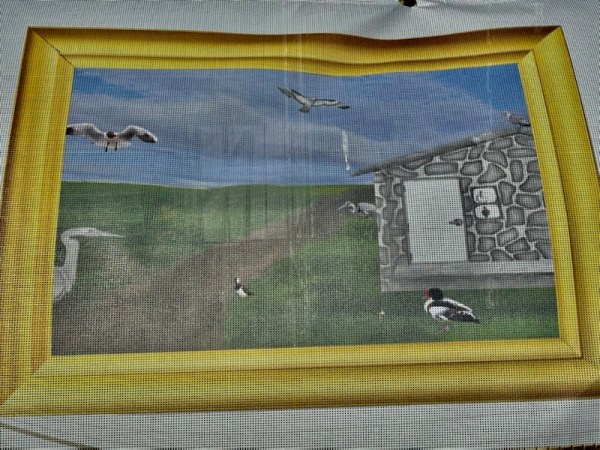
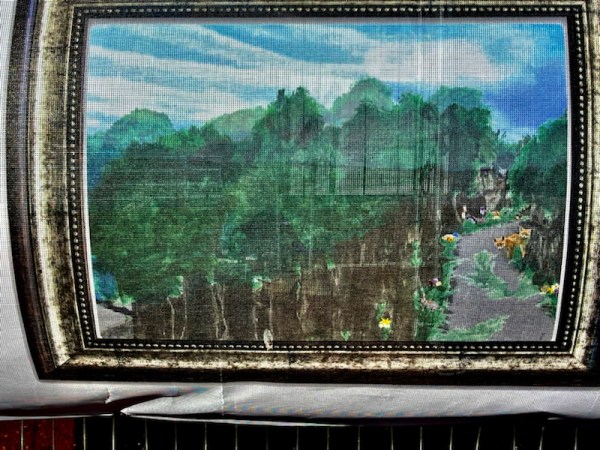
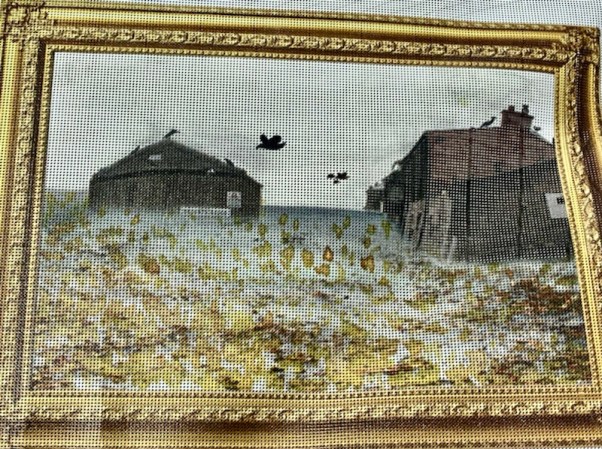
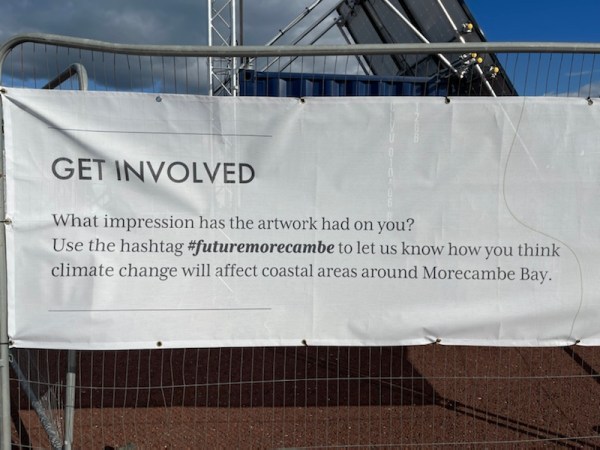
The strange object turns out to be a mixture things: there is the shiny new tidal radar station, but its protective fence is also being used as a temporary art exhibition to show the ecological work of local students of Lancaster and Morecambe College.
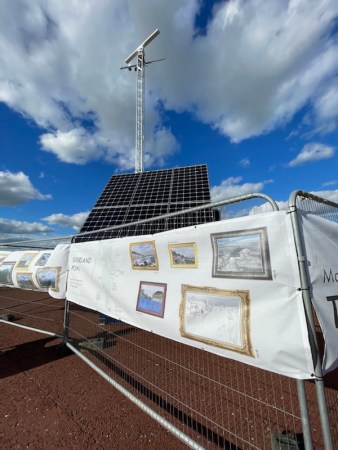
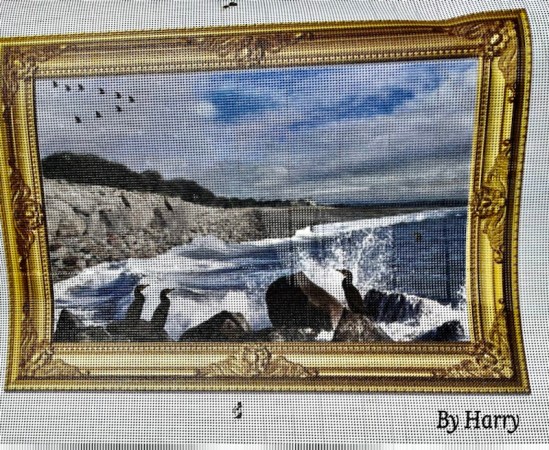
The picture have been printed onto a fabric sheet that wraps around the fencing, so their rendering is subject to breeze distortion.
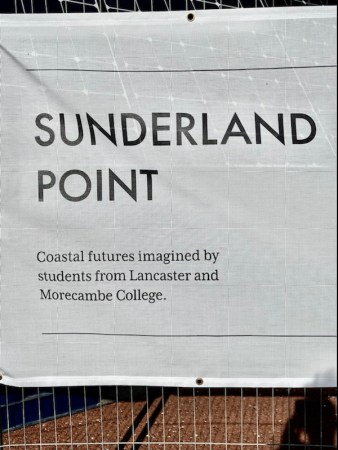
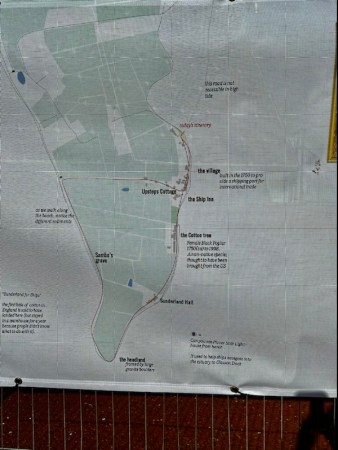
The project set the challenge of painting likely results from rising water levels and selected two areas of the Morecambe Bay Area: Sandylands, not far from the pier, and historic Sunderland Point, once a bigger port than Liverpool.
Various age groups were encouraged to enter, as indicated by the sophistication of the images.
©Stephen Tanham 2022
Stephen Tanham is a Director of the Silent Eye, a journey through the forest of personality to the dawn of Being.
http://www.thesilenteye.co.uk and http://www.suningemini.blog
Share this:

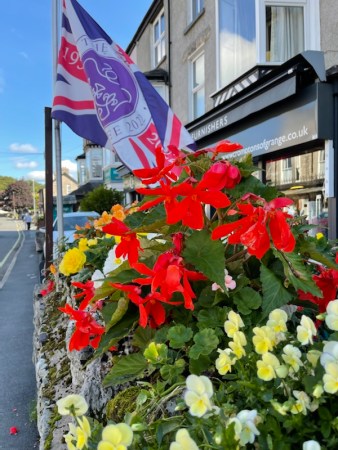
I was born the year after Queen Elizabeth’s coronation, so it’s fair to say she has been ‘with me’ all my life. Like many of us, I have known no other monarch.
The rarity of this situation is worthy of reflection, as is the very notion of royalty in our high-tech age. Are they simply symbolic figures, animated from our past? Or might there be something deeper, something that only shows its inner face at times of unpredictable – but special -significance.
Our politics are ‘rotten’. Corrupt and self-serving, they have been lured far from the ideal of universal representation that they were designed to deliver to all of us. The simple statistic that 90% of the wealth belongs to 10% of the population speaks for itself, regardless of the platitudes from those in the entitled cluster.
Against this decline, we might expect the importance of the Queen to be diminished; and she might well have agreed, as she wrestled with a sniping press on an almost constant basis, not to mention the undercurrent of ‘republicanism’ that would sweep away the very idea of a ‘royal’ having any importance in our modern world.
And yet, this remarkable woman, small in stature, yet tall in resolve, stayed true, through the seventy years of her reign, to the service of the country and the people she loved.
In life, we might have found her remote. In death, she showed us how a life lived in constant resolve and principle releases at its end an energy that causes us all to think we may have been dreaming; that there is in the British soul – and those across the world who still view her in the same way – a nobility that has nothing to do with physical kings and queens, yet is epitomised by this very special one.
And in that we perhaps see the paradox: that there is something deeply significant about the idea of Queen, King, Prince and Princess that is above the human vessel that contains it.
These deeply ancient roles are holders of intent and true nobility – a nobility that we all share in potential.
When a great one like Elizabeth II leaves us, the scales drop, briefly, from our eyes. When the public respect and grief becomes the vessel; dare I say the grail of her life, distilled into a few short days, it gives us time to pause and not only say thank you, but to whisper,
“Oh… I had forgotten that this was still a living thing…”
©Stephen Tanham 2022
Stephen Tanham is a Director of the Silent Eye, a journey through the forest of personality to the dawn of Being.
http://www.thesilenteye.co.uk and http://www.suningemini.blog
Share this:

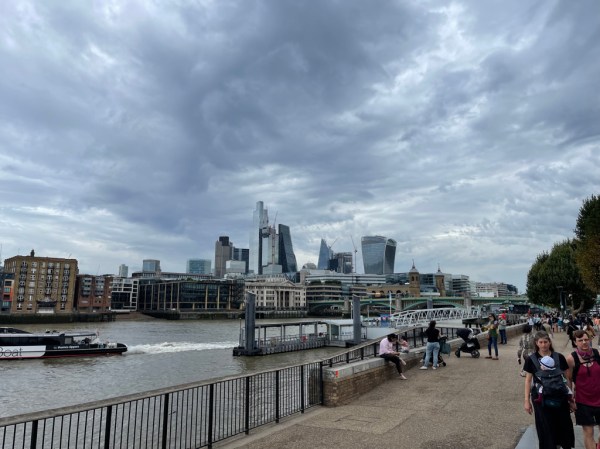
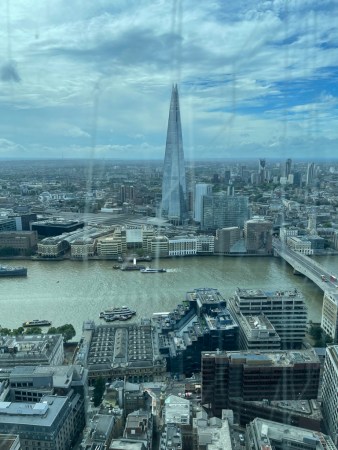
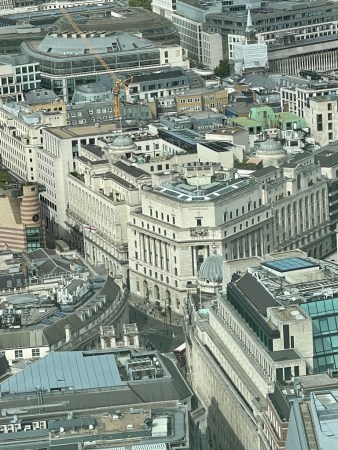
At the end of the summer each year, we try to spend a few days in London. The South Bank is our favourite haunt. The opening photos of the city’s financial district, above and below, were taken from a point adjacent to the Globe Theatre, overlooking the Thames, and looking northwards.
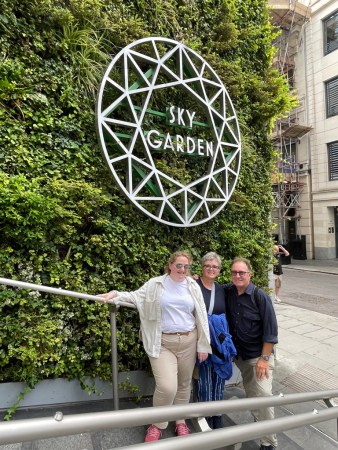
This year the trip was set up by our goddaughter, Karen, who had booked a special ‘no-cost’ excursion to visit the Sky Garden, atop the controversial tower block on Fenchurch Street, close to the Bank of England – see photos above and below.
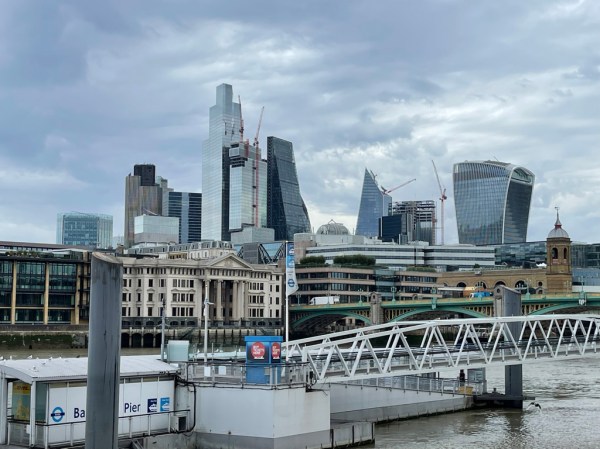
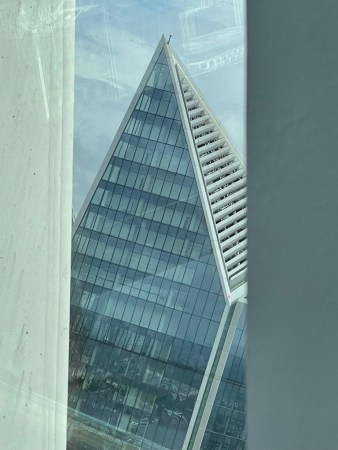
The odd-shaped tower block – background right – is the building in question. Its name is simply The Fenchurch. It’s also known, irreverently, as the ‘Walkie- Talkie’. Those who remember the first generation of mobile phones may want to add a third moniker…
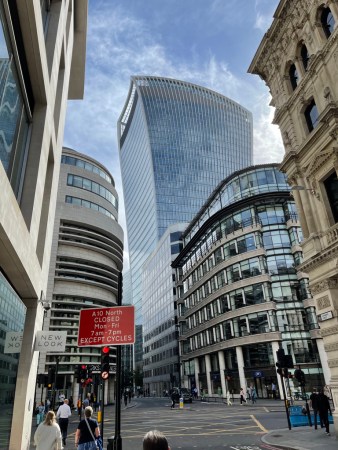
Despite this, the Fenchurch holds a delightful surprise on its rooftop, as Karen had discovered.
But it’s a long way up!
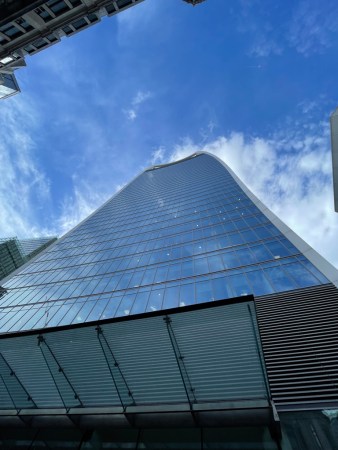
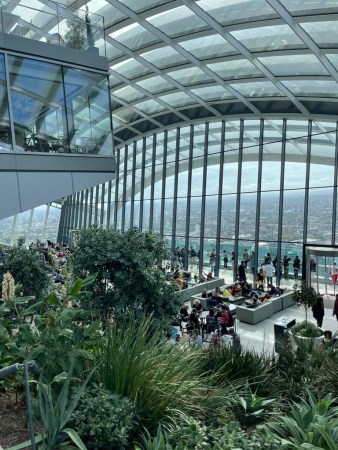
Designed by architect Rafael Vinōly and costing over £200 million, 20 Fenchurch Street features a highly distinctive top-heavy form which appears to burst upward and outward. The entrance floor and 34 floors of office space are topped by a large viewing deck on three levels. A bar and restaurants are included on the 35th, 36th and 37th floors; these are open to the public but with restrictions, and only via bookings.
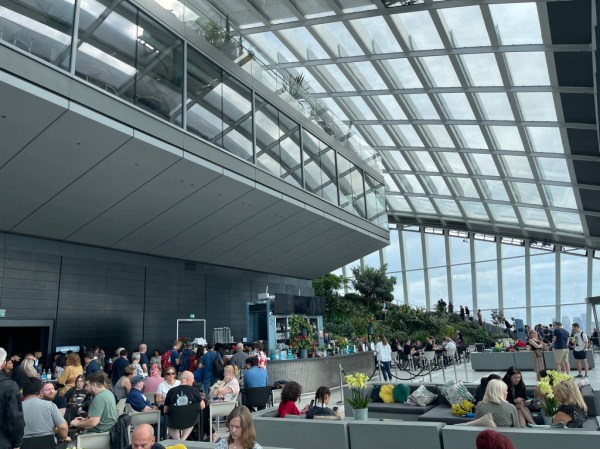
When you exit the lift, you enter a world filled with light and with breathtaking views all around.
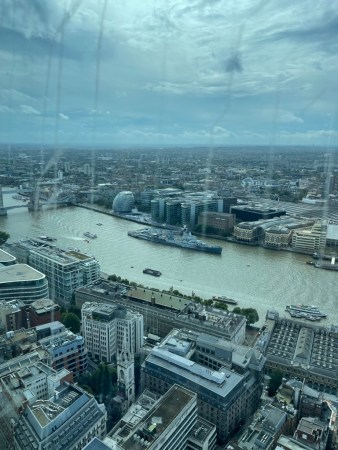
Construction was begun in January 2009 and completed in April 2014. From the visitor perspective, the jewel of the building is definitely in the crown… But the only way to appreciate that is to share the views:
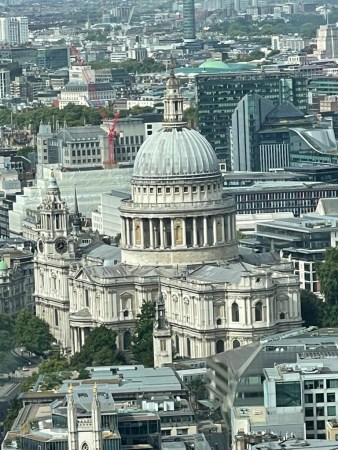
The tower block was originally proposed at nearly 200 m (656 ft) tall, but its design was scaled down after concerns about its visual impact on the nearby St Paul’s Cathedral and the Tower of London.
It was subsequently approved in 2006 with the revised height but even after the height reduction there were continued concerns from heritage groups about its impact on the surrounding area. The Secretary of State for Communities and Local Government, Ruth Kelley, called in the project for another public enquiry.
The project was consequently the subject of a public inquiry; in 2007 this ruled in the developers’ favour and the building was granted full planning permission.
In 2015 it was awarded the ‘Carbuncle Cup’ for the worst new building in the UK in the previous 12 months. Architecture can be a savage business!
In 2013 Paul Finch of the Design Council CABE said he regretted supporting the project during the public inquiry, saying that the developers “made a mess of it” and were architects of their own misfortune.
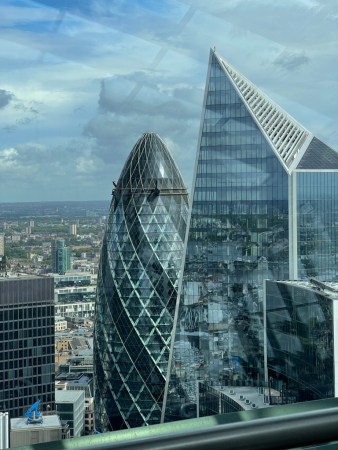
Strange times… But then opinion has always wavered… Being there, on the top floor amidst all the natural light, you can only see the beauty of the conception. We loved it…
(Note: some of the historical text in this blog was sourced from Wikipedia)
©Stephen Tanham 2022.
Stephen Tanham is a Director of the Silent Eye, a journey through the forest of personality to the dawn of Being.
http://www.thesilenteye.co.uk and http://www.suningemini.blog
Share this:

+ #Silenti, Ancient Landscapes, Consciousness, English Lake District, landscapes, Photographic techniques, Photography
Back lane to the river
by Steve Tanham

It is said by local historians that if Kendal had not fallen prey to the soulless developments of the 1960s, the town would now rival York in the historical interest offered by its venerable streets – and its living links with long-disappeared ways of life…

There are numerous alleys that lead from the town centre to the River Kent. It’s fascinating to walk these and realise you are travelling an ancient route that now offers a hidden and alternative way down through the town.

The variety of stone dwellings and offices is large and seemingly organically mixed – office next to house and so on, down the gradient. A delightful change to the rigidly organised zoning of modern design.
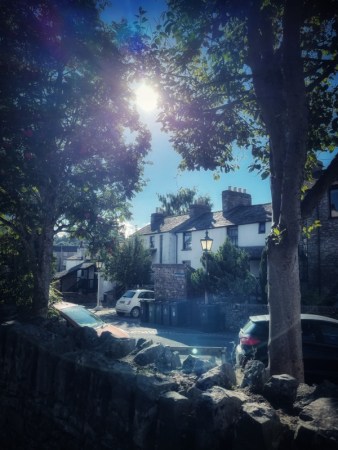
The day I took these shots, it was beautiful weather: still warm but a hint of Autumn’s freshness on the breeze. The feeling of nature enjoying the fruits of the Summer and beginning to rest…


So many questions are raised by signs, new and old… There are plaques for historic locations, but most simply challenge the eyes – and mind – to be creative and have fun…

The first glimpse of the shining River Kent emerges at the base of the slope, the site of the oldest of the several bridges that cross the rivers and create a patchwork of curling roads that are confusing (to say the least) to the casual visitor…

But finally, we stand above the full width of the River Kent, looking upstream, back towards the fells of the Kentmere Round. In the middle distance is the new footbridge to replace the one destroyed in the devastating 2015 floods.
©Stephen Tanham 2022
Stephen Tanham is a Director of the Silent Eye, a journey through the forest of personality to the dawn of Being.
http://www.thesilenteye.co.uk and http://www.suningemini.blog
Share this:


We could imagine ourselves as a leading actor in a play. There are other actors, but we have something unique… The play is written around our character.
We are the only performer who can describe the play from the inside – our ‘inside’. We infer that others can do this, but we have a unique perspective on our view of the play. We have no idea whether their description of the play-from-the-inside is anything like another’s.
From childhood, we learn language: a means to describe our experience, and hopefully share it accurately. We only have language – and perhaps art – to achieve this sharing.
This reliance on language as sharing the world takes up a major part of our attention, and therefore our mind. Our mind is the part of our identity that faces the world. Our mind can do other things, but our upbringing has focussed it outwards.
Our world is the picture painted by the senses. There are thoughts and emotions, too, but they don’t have the reality of the things brought to us by sight, smell, touch, hearing and taste. These relate us to the history of all life on Earth.
When we decide that enough ‘outwards’ is enough, we can summon the will to break the chains of attention that lock us into the script of the play.
If we do this, we might notice that what we thought of as ‘us’ is not singular but plural. It comes as a surprise to learn that we actually inhabit all the characters of the play, to different degrees. They all affect how the play moves through its stages, but we don’t share the same affinity with each of them.
It may take us many performances of the play to get to know each of the characters well enough to find out where our ‘home’ character is. We discover, often with a shock, that there is a central character that we remember ‘being’.
We step back into this central character with more power and authority… but our boldness gives us the will – and now the power – to challenge the whole thing. Why are we in a play? Who wrote our script?
With an internal noise like ripping curtains, we gaze around the theatre to see the smiling patrons. Casting aside the months of learned script, we stop speaking and walk to the edge of the stage, asking:
“Who am I?”
The lone figure in the crowded audience rises to their feet. They stride towards the steps and up onto the stage, facing us with a heart that glows. We have no choice but to embrace them; we have no desire to do anything but embrace them.
“I’ve been looking for you for a long time,” they say. “You’re the part that forgot its actor…”
Within that embrace, they spin us around, and our opened mind and heart recognise the same shining eyes from everyone in the theatre…
The play has ended. But a new one has just begun…
©Stephen Tanham 2022
Stephen Tanham is a Director of the Silent Eye, a journey through the forest of personality to the dawn of Being.
http://www.thesilenteye.co.uk and http://www.suningemini.blog
Share this:

+ #Silenti, Christianity and modern mysticism, Consciousness, landscapes, Photographic techniques, Photography
The Endurance of St. Paul’s
by Steve Tanham

There was a time, not long ago, when my livelihood – and that of 25 other employees of the software company I established in the late 1980s – depended on our continued involvement with the plans of some large city institutions such as the Bank of England, Euroclear and various of the high street banks also headquartered in the (old) City.

For a company based in Manchester, it was an achievement we were deeply proud of.
It was a world I retired from nearly ten years ago, beginning my work of a more spiritual nature with the foundation of the Silent Eye, and joined soon after by Sue and Stuart.

I still enjoy coming back to London, but the old feeling of being at home there has diminished. London was always a world hub of finance, and fast moving. You could be out of date in a year, never mind a decade.

The weather was kind, and we were able to walk most of the way to the Docklands Light Railway (DLR), via which we were headed to the stunning ABBA Voyage ‘concert’.

Coming back on the Central Line tube train, I reflected on the warmth I used to feel when passing the magnificent St Paul’s Cathedral – Christopher Wren’s masterpiece. Although vast, it somehow contained a welcome for the human and his/her scale.

A short detour on the way back from the concert and we were able to revisit it – in darkness, of course, but floodlit.
There was nothing but welcome in that venerable old stone.


I smiled the short distance to our hotel. Some things were, wonderfully, the same…
©Stephen Tanham 2022
Stephen Tanham is a Director of the Silent Eye, a journey through the forest of personality to the dawn of Being.
http://www.thesilenteye.co.uk and http://www.suningemini.blog
Share this:


A complete accident this, though it looks like the figure in the right hand aperture was staged…
I have no idea who she was.
Kendal Castle; home to prominent members of the Parr family, whose daughter, Katherine Parr, remarkably survived the Tudor monster – Henry VIII.
Perhaps that’s her ghost, smiling in the late summer sun, reminding us that even the darkest fates can, occasionally, be sidestepped…
I’ve processed the colour and some of the texture to match the mystery!
©Stephen Tanham 2022
Stephen Tanham is a Director of the Silent Eye, a journey through the forest of personality to the dawn of Being.
http://www.thesilenteye.co.uk and http://www.suningemini.blog
Share this:

In parts one , two, and three, we looked at the relationships we build with the world and each other. We saw that we don’t really know anyone else, fully; rather, we have an image of how they are, how they react, what are their likes and dislikes. In other words, we have a historical figure that bears the name of our ‘other’.
We are never dealing with them as they really are – now.
Some people, hearing this, feel trapped in a bubble of ‘self’. But that is not the way to consider this, at all!
If our ‘bubble’ contains those with whom we are having relationships, then it also contains our world… our whole world. The higher truth is that we are already connected with everything we need.
Whatever is ‘out there’ is not what it look like from ‘in-here’ In-here is entirely an accumulated product of how we have reacted to the world from our birth onwards. This vast ocean of reactions forms itself into our personality – our egoic nature, in the psychological sense.
Our personality lives in the mind, like a suit of armour. Its contents are what our ‘self’ looks up (in microseconds) to decide how to react. In effect, it’s instantaneous because the often-needed routines are kept ‘warm and ready’. Much of this is handled in language within thoughts. We run intense ‘chats’ with ourselves in complex situations. Some people actually talk their thoughts out, aloud.
Social conditioning helps us suppress this, but a visit to anyone with advanced dementia will show what happens to such ‘babbling’ when the social conventions are dropped – or decayed.
In previous parts we hinted at a single technique that will help correctly align us in relationship with the world — with the Universe of our ‘world?’
Within this quest, we found that the only truth of any value in understanding and changing our world and its relationships, is our own. It doesn’t matter what rules the world lives by, they wont change us. What will change us is dedicated living by what we consider to be our truth.
The first step – and the bravest. Is to say to our world:
“I don’t really know you…”
With this simple step, you will – if you mean it – break all previous conditioning and expectations. You will stand on the edge of a new world, one empowered only by your own truth…
Now, can start by adding:
I’m going to challenge all my assumptions…
From that moment on, every time you make a value judgement: ‘it’s always rubbish…’ challenge it. Ask if it’s really rubbish, or whether you have projected how you feel as an habitual pattern onto the ‘screen’ of this experience. The most important result of this is that you:
Allow it to be different, this time!
Our real goal is to see through the movie that is our view of the world, and know that it’s really only the screen and the moving colours and shapes of light that we are seeing – and reacting to…
When we see this movie for what it is, we begin to realise that what gives it life is the me, the Self. And that’s when we become empowered to change everything….and at the same time form the most powerful relationship of all.
End Part Four and series…
Previous posts:
©Stephen Tanham 2022
Stephen Tanham is a Director of the Silent Eye, a journey through the forest of personality to the dawn of Being.
http://www.thesilenteye.co.uk and http://www.suningemini.blog
Share this:


I’ve been clearing out my study. I’m a hoarder, and it’s an essential process once every year or so…if I’m honest, occasionally two!
At the bottom of a yet another box of ‘memorabilia’, I found this.
Back in the day, when I was a Computer Science student at Wolverhampton Polytechnic, I had very little money. My dad had bought me a decent stereo with a twin-tape cassette deck. My music collection comprised 90% cassettes, borrowed from other people’s vinyl albums and ‘taped’ (copied, in analogue format) onto these flexible little fellows.
I loved the artwork of albums in the 70’s. I used to ask to take the loaned albums into one of the department stores that had a ‘Photo-me’ booth. There, I would hold the vinyl cover up to the camera to get my own image, which would then be sellotaped onto the cassette’s label.
How the world has changed…
Now, most of the time, we don’t own music – just the right to access it…
Looking back on this memento from so long ago, I felt a great sense of loss of the ‘closeness’ we had to music, back then – and its preciousness. I remember having an album of Crosby, Stills and Nash as a Christmas present. All that seems to be lost in this on-demand world.
Still, a happy memory at the bottom of that box. Think I’ll keep this one… Mind you, just the one…
©Stephen Tanham 2022
Stephen Tanham is a Director of the Silent Eye, a journey through the forest of personality to the dawn of Being.
http://www.thesilenteye.co.uk and http://www.suningemini.blog
Share this:

+ #Silenti, Consciousness, English Lake District, Lake District, landscapes, Photography, Places and Prose
Fading summer wine
by Steve Tanham

One of the most poignant moments of the year is the last week of August. There comes that first sense of ‘chill’, plus the heavy dew on the morning grass.
We find the best way to deal with this is a bottle of white wine, taken just as the warmth of the afternoon has begun to ebb.
We spend the time it takes to sip the wine recalling the high points of the summer, thanking it for restoring us and fortifying our bodies against the ordeal of the coming winter.
©Stephen Tanham 2022
Stephen Tanham is a Director of the Silent Eye, a journey through the forest of personality to the dawn of Being.
http://www.thesilenteye.co.uk and http://www.suningemini.blog


You must be logged in to post a comment.