

With bright May light streaming through the window, there’s little to match the exuberance of living green and glassy blue as it splashes across the bathroom’s pure white.
It’s a riot of gorgeous colour and a moment that might be brief, so I step out of the shower and still dripping, grab the iPhone…
I’m glad I did. Seconds later, the latest heavy cloud covered the light and the world sank back into this eternally cold ‘spring’.
Later, I used the softening effect in Lightroom to finish the image.
©Stephen Tanham
Stephen Tanham is a Director of the Silent Eye, a journey through the forest of personality to the dawn of Being.
Share this:

It’s like a beautiful, glittering kite, flown high and above the regular considerations of our lives; and yet this part of us, long recognised by psychology, has the potential to transform us into people of being, rather than reaction…
(750 words, a five-minutes read)

When we are children, we have to be seen. By this, I mean that special feeling when your parents see you shining at something and radiate pride in what their child is doing.
The young child, hungry for this feeling that is essential to the development of their self, demands constant attention with trivial things. Over time, these become refined, as the youngster comes to appreciate the quality of the seeing – the energy it brings to their developing being.
The child begins to understand that when this is mixed with something real, something that brings achievement in the world, the eyes of the parents radiate a special energy of appreciation, knowing their child is showing the first signs of adult achievement and self-discipline.
Some children never get this. Their glittering kite, flown constantly and increasingly desperately for the parent’s seeing, goes unnoticed, as yet another aspect of play. The parents are too involved with their own lives; too wrapped up in the set expectations they have for their offspring to see the reality of what is played out before them. The child’s real identity is never acknowledged, though their existence may be comfortable and even luxurious.
For children whose kite is never seen, the string gets longer, they let out more and more of it so the glittering object rises higher and higher, barely visible… only seen by the child, itself; but at least protected.
Psychology calls the kite the ego-ideal. It is part of the set of self-states that we form as we explore our relationship to the world. Later, we may come to understand it as our world, but that requires that we grasp a deeper level of reality.
In terms of Freudian psychology, which was the foundation for so much else, the growing sense of a ‘reality of me’ has the building blocks of ego, id, and superego. The ego is what we think of ourselves. The superego is the constant sense of ‘should do’ that sits on our shoulders and nags us to be better. The id is the wild energy of our being that is suppressed ‘below’, like dark fire, ready to erupt and ruin our place in society.
The young science of psychology was shocked to find that the ‘self’ is capable of dividing itself to form separate self-states, but it does; such is its power and importance – a strong and stable ego being the main goal of modern psychology.
So where does the kite, the ego-ideal, fit into this? In the heart of the Superego there lives a single attribute based on us – our identity – rather than the imposition of expectations. It is the best of us, and, seen or unseen, it represents our metaphorical sword, our armour, even our wings, because it has never lost its connection to our real Self, the one we are born with, but which, through lack of recognition, seldom gets to grow and bear its jewelled fruit in our lives.
We all know people who have that certain energy of being. They may not be wealthy, but they have a naturalness of expression and a bigness of soul that carries them, shining eyed, though life. These have never lost their connection with who they are. By accident or nurturing, they have protected and refines their selves so that they can express what is within them.
Psychology usually stops there… but spirituality doesn’t.
And, at the end of that other journey, we can feel the emergence of a completely new us. Stronger and more real than anything we could have imagined.
That kite, because it is real, can become the seed of a new level of being. We can pull it down from the high blue sky in which we have kept it safe, and explore its reality. We can let its true energy spill over into the rest of our lives as we contrast its presence with that of lesser things. We can choose to look and find other aspects of our real selves because we know the taste…
Perhaps then, walking along the beach of our lives, we can come across other little children flying their lonely kites; and help them see the reality of what’s on the end of that fragile string…
©Stephen Tanham
Stephen Tanham is a Director of the Silent Eye, a journey through the forest of personality to the dawn of Being.
Share this:

+ #Silenti, English Lake District, landscapes, Mystery Schools, Photographic techniques, Photography, Seasons, Four Seasons, Spring, Summer, Autumn, Winter,
Seeing with Clouds
by Steve Tanham
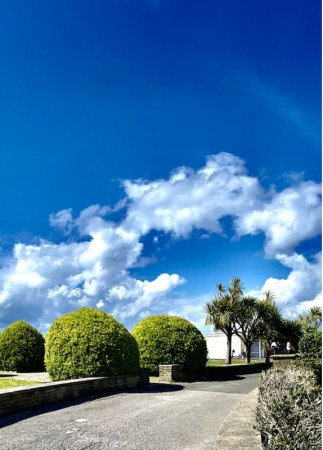
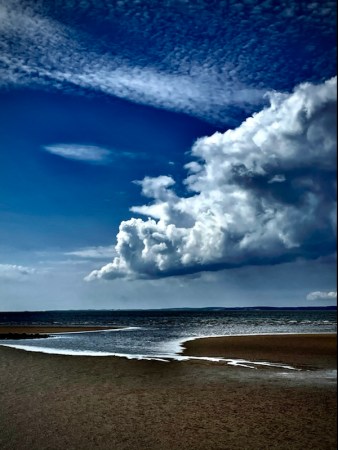
In clouds, I find endless joy and food for both emotion and meditation. People often say, humorously, “You seem to be able to get clouds to do things for you!” I’m not sure that’s the case, but I am sure that I have an affinity with the sky and with the formation, shape and movement of these wonderful entities – and that has altered my way of seeing.
As a photographer, I’m always looking… and that’s the key. What’s out there is the same, but, because I’m watching on a subconscious level, the things that will be of interest come to my attention and ‘alert me’ to take a closer look.
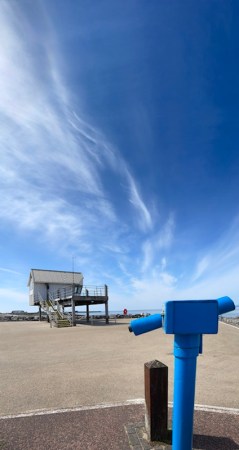
Also, I’ve found I don’t ‘look’ with ordinary consciousness. What I’ve discovered I do, after years of taking such photos, is ‘constantly scan’ for a certain symmetry, a certain harmony, a pleasing sense of proportion or an unusual mixture of colours. But I don’t do this with the conscious mind. My regular attention will suddenly be alerted to the potential of another shot for reasons I’m not initially conscious of.
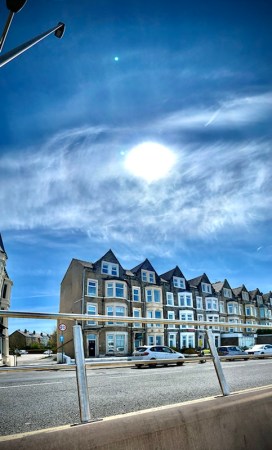
And it’s not just clouds. I’m constantly looking for the visual experience of the beautiful and the unusual. Even an ordinary line of buildings can, with the right light, become a object of fascination. My wife, Bernie, has become used to me darting off – often with the collie in tow – to try out ‘that shot, over there!
The shot may be fine as it is, or it may lack what a thought I saw when I had that flash of potential. For the latter, I will later use the iPhone’s editing suite of ‘sliders’ to see if I can restore what I felt when I first saw it. I’m not trying to take ‘purist’ photos; I’m looking for a combination of technology and art.
It doesn’t always work. Of the hundreds of thousands of photos I’ve taken, only a few hundred have been notable successes. We are lucky to live in a digital age where the rejects are simply deleted from the computer, instead of the former piles of expensive prints, laboriously dropped off and collected from the local photo processing store.
©Stephen Tanham
Stephen Tanham is a Director of the Silent Eye, a journey through the forest of personality to the dawn of Being.
Share this:

+ #Silenti, Consciousness, enneagram, esoteric psychology, Gurdjieff, Mindfulness, Silent Eye School
A kindness of belly, heart and head
by Steve Tanham
There are ancient techniques that describe the gentle coordination of belly, heart and head to make the self a peaceful place. In this short article, we discuss a modern approach to their use…
(1000 words; a five minute read)
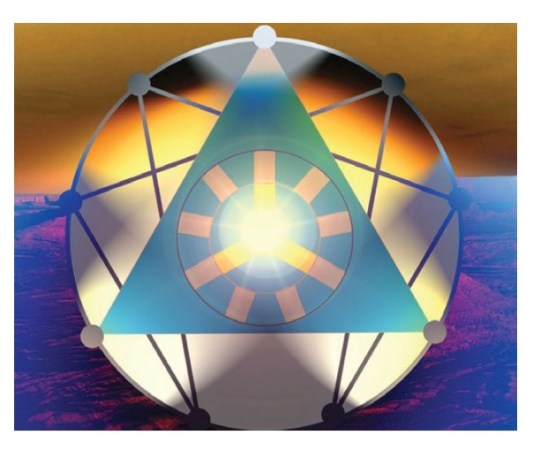
The philosopher G. I. Gurdjieff rose to prominence in the first half of the last century. This enigmatic Armenian created a no-nonsense system of self development that incorporated the ancient wisdom of how to observe and balance belly, head and heart.
Modern schools of mystical self-development, like the Silent Eye, have carried on this work. Here, we present a simple technique for the balancing of ‘gut-reactions’, emotions and intellect; something of great value in these times of upheaval and shifting identities.
It’s relatively easy to locate these three ‘centres’ of self-activity in our physical makeup. The belly, or ‘gut’ can be thought of as centred in the stomach, a place we are all familiar with, if only through the needs of eating and the occasional upset through tension.
Even a few minutes of sending gentle kindness to this part of us may ease present tensions. Once discomfort is removed, continuing this may also being up associations of the gut with our instinctive reactions to life. These are there to protect us. They have been with us for a very long time.
There is a problem with how they fit into modern ‘civilisation, in that the fight or flight reaction they engender may, literally, have ‘nowhere to go’ in our modern lives, thus leading to a draining of our vital energies.
Test your own gut, now. Is your stomach in a knot? We may find we live that way most of the time. Awareness is everything in such self-discovery. When we are aware of this tension, we can, by continually returning to it for a few seconds of loving presence, reassure it that it need not maintain that tense vigilance. That makes it sound like we are dealing with a separate ‘being’ within ourselves… and, in many ways, this is true. These three powerful centres have a high degree of autonomy, designed to free up the composite ‘self’ and let it perform higher functions. We will return to what these might be, later in this article.
Now we move up our spine and come to the heart region. A simple question will suffice: are we feeling any love? Not just for our partner, if we are lucky enough to have one, but for others in our life and our care. How about pets? Those who have cats or dogs know the unconditional love which which they gaze up at us… That kind of feeling is a good one to take inwards at this stage.
We can easily bring that feeling into our heart centre. If it’s not already present, then we know that our regular life may be colder in this regard than we would like. With this awareness, bring love into your heart, now. Add it to the calm and now purposeful belly, letting each of these two centres be acknowledged and appreciated for the magnificent work they do for our ‘wholeness’.
Now we move up through the throat and neck into the head, the traditional seat of thought and the mind. The gut is associated with our instinctive powers. The heart has a vast potential for nurturing relationships, caring for others, and extending our actual presence out into a group of people… or even into the world. The heart can radiate kindness, and doesn’t need a target; it can just BE.
The head centre is slightly different. It has a complex role to fulfil. The brain filters our experience so that we are not overwhelmed by its intensity and the sheer volume of events. The mind learns what parts of that flow are connected, making pictures of concepts that can work for us like an army of sensing machines. Test your own head now… is it a mass of buzzing, whirling concerns? What might its other functions be?
One in particular is of the greatest value… and sadly, largely forgotten. The head centre allows us to remember ourselves. Gurdjieff called it ‘Self Remembering’, and stressed how essential it was to the truly balanced human.
At first, this sounds trivial. We react by saying, “Of course I know myself, I don’t need to remember it all the time!” But this is not the heart of the matter. In the constant exercise of filtering the world, we have forgotten what lies at its centre – our selves. We can never truly know the external world. But there is a place of calmness in the middle of that engine of perception, and when the attention is, gently and kindly, directed to it, the busy and noisy world drops away in the fascination and power of what we had forgotten…
Perhaps we can can try that now? We don’t have to enter a meditation, though that is perfect when we can. We simply have to remember the ‘me’ in the middle of the storm of our thoughts. When we do, we may feel the immediate engagement of the gut, as it wrestles itself into tension to protect us from all the demons that are associated with our ‘present’. Tell the gut that we are engaged in something higher, and that we will return to its vigilance in a moment. Let it melt, with a feeling of gold and the gentle colours of the sunrise…
Now return to the head and the self, again. Find the place that is simply you. Don’t judge or quantify it… just find it, and hold your loving gentleness on it. The spinning world is a reaction; a complex set of millions of responses to which we have granted a fixed reality.
The real world is not so. Its is inextricably linked to how and, in a mystical sense, where, we are…
The the journey of true reality begins with that self within. Find it again, and, this time let the heart centre engage with the feelings of green and pink, climbing like roses to embrace the head in a sea of calm attention, devoid of the noise and any sense of panic. Let the roots of that rose wrap around the tensions of the gut and, in the centre of the head, let the rose flower bloom, as our inner eye is lost in the rapture of its petals…and its fragrance and value.
Welcome home….
Share this:

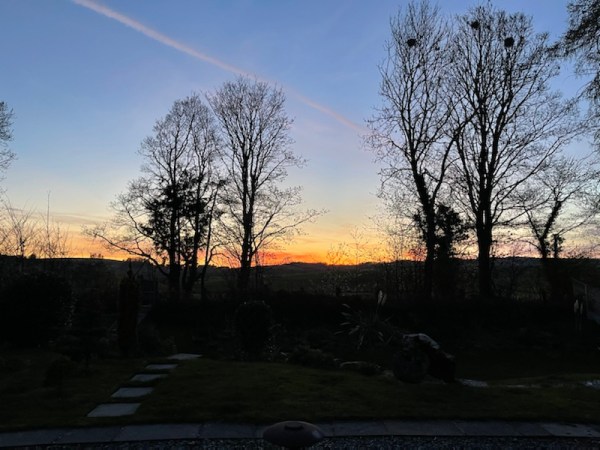
When days roll, heavy hearted, by
And dusk has turned a darker hue
Where breathing’s choked and not so free
I rest my back on bark of old ash tree
And whisper words into electric blue
Discovering solace in the sky
©Stephen Tanham
Stephen Tanham is a Director of the Silent Eye, a journey through the forest of personality to the dawn of Being.
Share this:

Continuing our look at the potential for ‘still light’, as introduced in last Sunday’s blog. As well as direct light, with its morning or evening shades, shadow patterns can be deeply subtle, and convey a tongue-in-cheek mood. (400 words, a two-minute read)
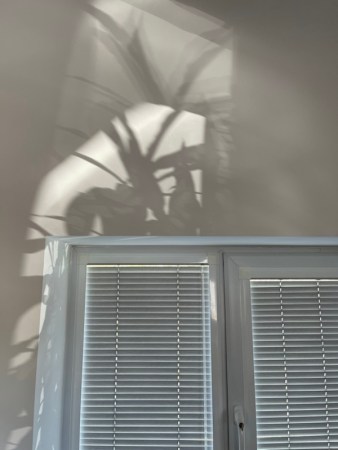
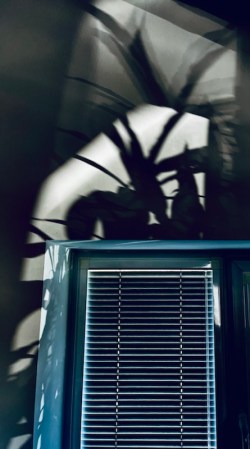
A large Dracena plant is located near the garden-facing window of our living room. On spring and summer mornings, it casts evocative shadows that have a potentially sinister side! I had an idea that the image could be used as the basis of, say, an emailed invitation to a pizza afternoon in the garden – we’ve recently bought a table-top pizza oven and are trying not to burn everything…
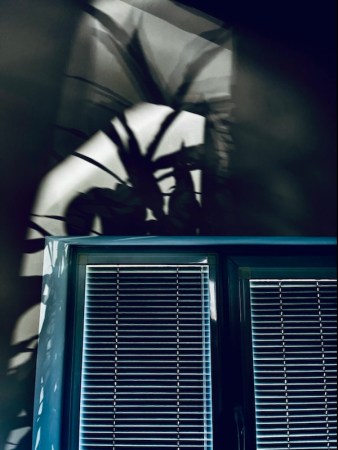
The first step was to render the shadows at a deeper level of contrast, plus lower brightness – something most phone cameras will do without the help of any external software. Just bring up the photo, select the edit tools and play with the light setting sliders until it looks right. Press yes, and you get something like the above…
Then I noticed that the double-width Venetian blinds, which had looked good to the eye, didn’t have ‘pleasing proportions’ in the photo. Cropping is simple – again just on in the iPhone – but deciding where to make the crop is the key. When I’d finished, I liked the ‘vertical’ look of the piece.
The final step was to add some lettering. For our made-up pizza party, I wanted to invoke the slightly ‘James Bond’ feel of the blinds and the now-darkened plant shadow. Perhaps it suggested a former-era colonial party somewhere exotic? I needed lettering to suit that.
I have a simple App called Pixlr, which does this kind of thing well, letting you play with text before you commit to it being embedded in the image.
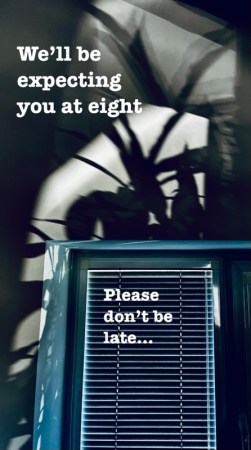
The finished image has that tongue-in-cheek level of menace that I was looking for. Having fun is what it’s all about!
©Stephen Tanham
Stephen Tanham is a Director of the Silent Eye, a journey through the forest of personality to the dawn of Being.
Share this:

Today will be the funeral of our dear friend and fellow Director of the Silent Eye, Sue Vincent. Many words have been said over the past two weeks… Today is a simple goodbye for a few family and friends.
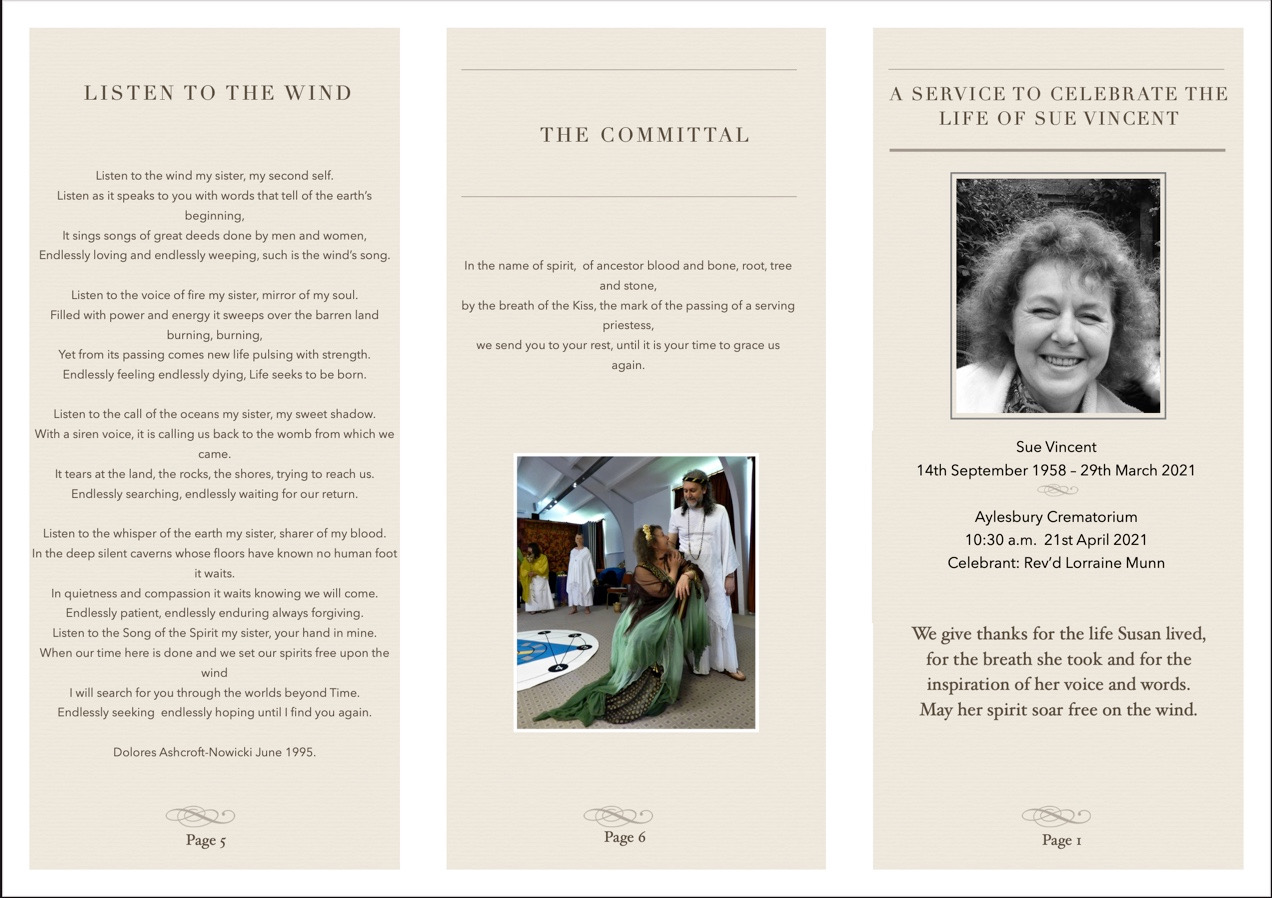
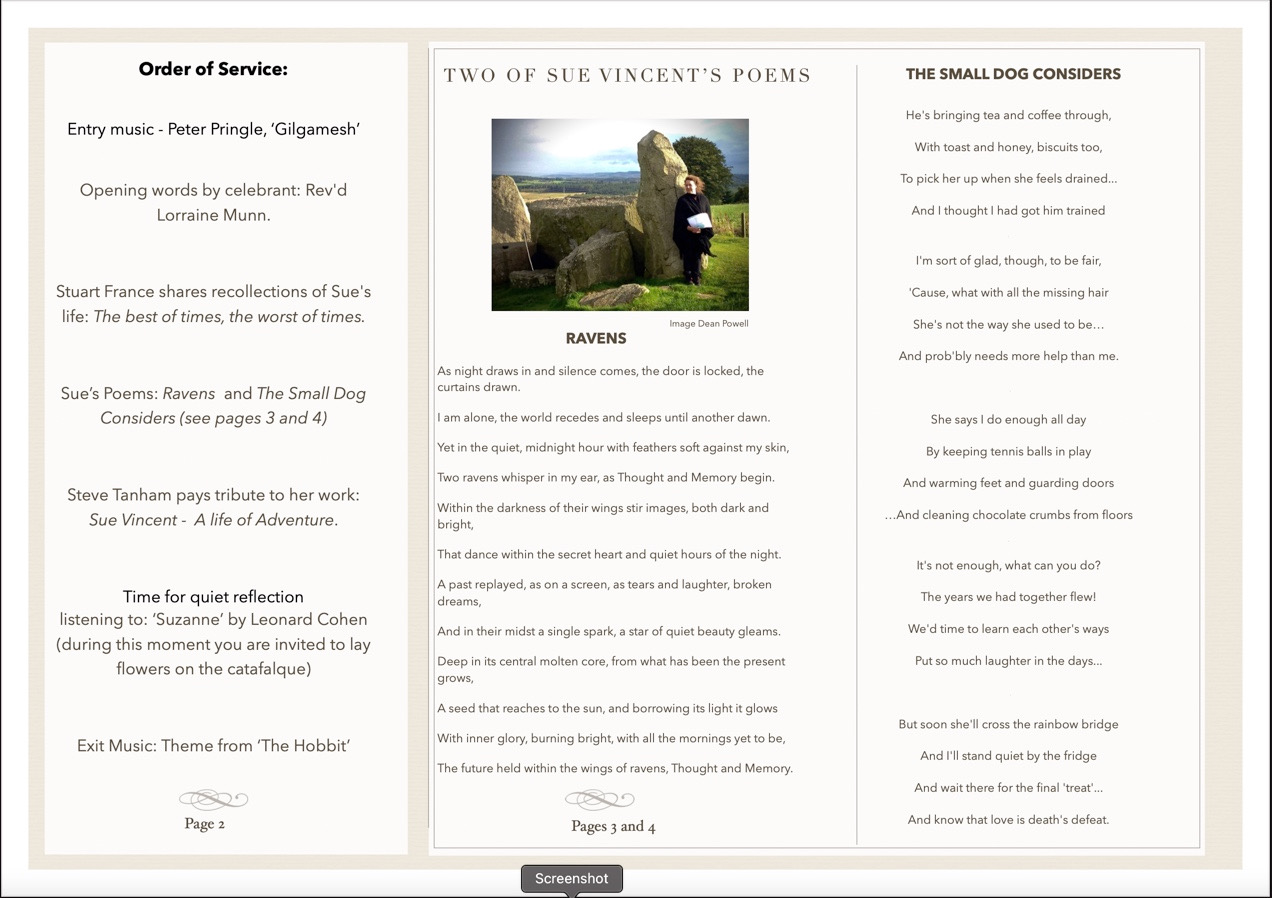
For those who might wish to know what is happening today, we include, above, the two pages of a simple tri-fold ‘Order of Service’ document, that we have produced, ourselves, for distribution at the Crematorium in Aylesbury. As you can see, many people have contributed content for this. The Celebrant is an old friend and fellow light-worker, Lorraine Munn, asked by Sue, prior to her death, to conduct this. There is also a poem by Dolores Ashcroft-Nowicki, Director of the Servants of the Light. Two poems written by Sue feature in the programme.
In honour of Sue, this will be our last post of this week.
Thank you to everyone who has written or commented to share our sadness. Being a mystical school, we know that her spirit has entered the world of pure Being, free from pain, and able to begin its new existence.
To this spirit, we and many others send our undying love. She will be held in our hearts and long-remembered.
Stephen Tanham, Stuart France
Directors, the Silent Eye School of Consciousness.
21 April, 2021.
Share this:

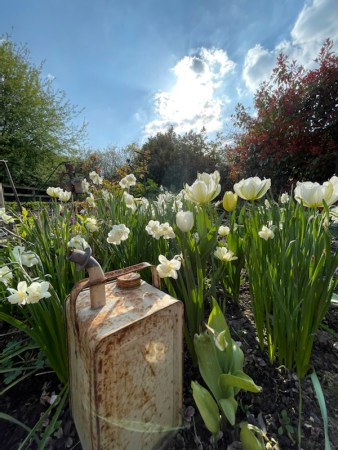
And tomorrow we will gather
Within this garden country, rich with life
To gaze, inside, upon your memories
And tell stories of your laughing fullness
➰
Outside our garden guest-house
I found this quiet group
Of faded, used-out artefact
Held close in tulips’ embrace
The whole, sun-wrapped
And I thought of you.
➰
©Stephen Tanham
Stephen Tanham is a Director of the Silent Eye, a journey through the forest of personality to the dawn of Being.
Share this:

I think of it as ‘still light’, adapting the idea of still life; a style that originated centuries ago in the world of the painted image, and went on to influence the early years of photography…
(240 words. A two-minute read)
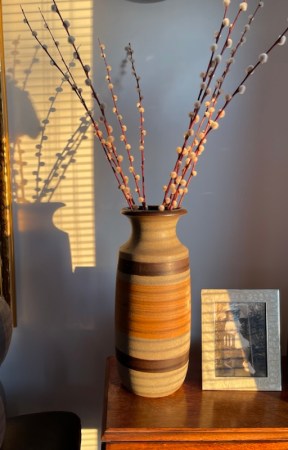
The big idea of still life is to have an intensity of quietness, whose arrangement may also carry a hidden message; ranging from political to moral… or something entirely new.
With still light, I don’t deviate from this much, but look to the direct effects of light to add to the forms to be viewed and, hopefully, photographed.
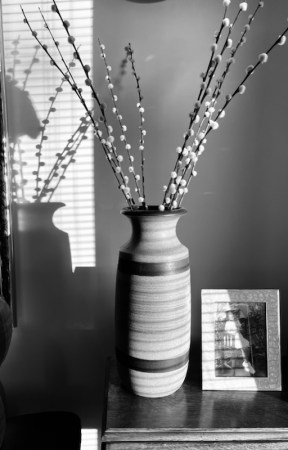
The best shots are usually sympathetic to monochrome treatment. Tone and contrast are important factors in choosing the original subject.
An image can be changed, completely, by cropping. The eye and the mind can see parts of an image, subconsciously, which may not be immediately rendered by the photography.
But you know it was there….
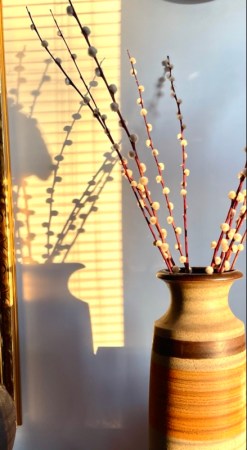
A little trial and error reveals it, and the image springs to life, as glimpsed in the original moment.
©Stephen Tanham
Stephen Tanham is a Director of the Silent Eye, a journey through the forest of personality to the dawn of Being.
Share this:

Our five senses may not be five at all… It turns out we have far more capabilities than we thought…
(800 words; a seven-minute read)

We all have our favourite concepts of physical capability – breathing, flexibility, strength and such like. But what if the power of our senses extended far beyond what we know? This is not about the historic idea of a sixth-sense, though that can be entirely valid. I’m referring to the kind of synthesis that enables things to work together as a ‘whole system’, in the way that the science of Emergence has shown us that ‘mere matter’ can become self-organising and apparently exhibit ‘intelligence’; the very same way that the first protein-based RNA molecules formed into life-repeating chains and gave rise to our DNA, the very substance of life’s persistence…
In a age of fast-paced scientific discovery, we are learning that what we think of as our separate senses are capable of ‘raising their game’ so that they become the basis of new levels of feeling and action in the world.
Philosophers have long postulated this; and psychology has shown us that, though it is often hard to see what others are thinking and feeling, we can train our senses to enable us to ‘see’ into the bubbles that are their worlds – with much deeper empathy.
The model of the five senses I wrote about in last weeks’ Thursday blog is derived from no less a figure than Aristotle. Though easily understood, it has been shown that the five-sense model of consciousness undervalues and underestimates how and how far the human being can ‘sense’.
I learned about the advances in this field from an article in the British Psychological Society’s online magazine. This is free to subscribers and offers frequent insights into how the science of mind and behaviour is progressing. A recent edition showcases an article from author and researcher Emma Young. She writes, ‘We have many more than five senses – here’s how to make the most of them’, she discusses such mechanisms as Proprioception – the sensing of the location of our body parts in space.
We take this for granted, but try closing your eyes and extending a hand or leg. You can no longer see the limb, but your mind has a good idea of where it is. The accuracy of this sense, known as ‘proprioception’, is vital to our physical wellbeing, and saves us from what would be frequent injury without it.
To get an idea of how automatic this skill is, try closing your eyes and walking around a familiar room – much as a blind person learns to do – and you will find a very different ‘self-process’ is engaged.
Emma Young references how Covid has eaten into the degree to which we make use this extra sense. She suggests we use artificial exercises, such as making up stepping-stones from mats placed in the garden or home. This will replicate the under-used activity of proprioception and help restore this hidden but vital part of being alive. The benefits go further, and according to recent American research, such exercises actually stimulate working memory in the brain.
The problem with our eyes is that they are open all the time. We depend on them too much – a sentiment no-doubt echoed by Shamans of all ages, who have always taught that we can have total knowledge of things only by embracing them as both the ‘now’ and as vividly alive in a holistic way – allowing the higher consciousness mechanisms to engage and ‘self-organise’ at a level above the individual senses.
If it is safe to do so, try moving around your house with your eyes closed – or even blindfold! Who does not remember the intensity of consciousness generated by the child’s game of ‘blind man’s buff’?
One of the levels of synthesis available to us is the result of the body’s vestibular system, used by our minds to establish both balance and the sense of being located and homed inside a physical body. We take this for granted, and it is undoubtedly one of the ‘senses’ that make us feel settled and calm. But many people faced with unusual conditions – such as undergoing surgery – report ‘out of body’ experiences that may relate, directly, to the suppression of the vestibular self-locating mechanisms that are fundamental to our normal consciousness.
Emma Young references the particular efficacy of exercises that move the head, such as Pilates, or Tai Chi, in addition to any action that challenges our balance, such as walking along a rope placed on the floor.
It has been demonstrated that psychological well-being is greatly assisted by the correct use of our eyes, in the sense of what kind of light we ‘take in’ at differing times of day. Bright and ‘sunny’ light is really good for us in the morning; while the more restful evening should be bathed in muted, soft lights, and we shouldn’t stimulate our senses by using computer screen before we go to bed.
Research shows that an acute sense of smell – such a that possessed by wolves – is still with us, despite evolutionary fears that we have lost such capability. We just need to begin using it, again. For all we know, much our society’s depression may come from ‘tech smells’ that have a semi-poisonous effect on our lives. “If you see a rose,” says Emma Young, “stop and smell it…”
Apparently a ‘fishy smell’ improves our critical thinking; and people who are more sensitive to smell have better sex lives…
Emma Young goes on to talk about our ability to ‘inner-sense’, including our own heart-beat, without the use of external devices. I remember an exercise from my youth where we had to use the second hand of our watches to time a six-second period and count the heart beats by placing a finger on the back of the wrist. Multiply the result by ten, and you have your heart rate.
With a little effort (and I’ve tried this) you can feel your heartbeat quite easily simply by ‘listening within’. If you add the second-hand technique, you can measure it… or you could just bask in its magnificent presence and thank it, knowing that some day, it will have finished its loving and dutiful job… to carry our outer ‘self’ through the continuity of life.
———————
References:
British Psychological Society’s weekly online digest:
Emma Young’s article
©Stephen Tanham
Stephen Tanham is a Director of the Silent Eye, a journey through the forest of personality to the dawn of Being.
Share this:


We were sitting on the M6 motorway. The car was stationary, as it had been for the previous thirty minutes. Ahead of us was the next junction, within sight, but closed off. Beyond that there was a wall of standing traffic. The motorway was closed but we – the stranded – were still on it.
The fourth ambulance came screaming up the thankfully empty lane next to the central reservation. It had been closed for resurfacing; a miracle, really, given the likely mayhem that lay ahead of the wall of silent cars in front of us.
More for something to say than any real content, we began to talk about how it had been ‘one of those days’ and how we were always unlucky in trying to pick the fastest queue for checkout at CostCo, the place from which we had just come, only minutes before hitting the brakes at the sight of the wall of cars and trucks going nowhere.
We do a lot of our monthly shopping there. Like most warehouses, it’s not pretty, but it is functional, and allows us to buy in bulk, rather than shopping every weekend. The collie and her need for lots of exercise usually dictates the nature of our days. We’re probably a lot healthier than we would be without her. We’d rather spend our time dog-walking and writing than shopping. So CostCo serves us well.
Our chosen queue, moving efficiently when we switched to it, had proved the very opposite in the few minutes afterwards. I knew how sensitive the northern M6 would be to peak traffic, and we were about to enter that period of almost exponential build-up. I had muttered under my breath; eager to be checked out and on our way back to Cumbria.
Now, sitting on the vast tarmac strip that is a modern motorway, we could see movement. Two of the traffic policemen were removing the barriers to the exit road – an escape that would at least allow us to find another route home. In less than a minute, we were moving and driving up the ramp, from where we could see the carnage that had been just around the shallow bend of the carriageway.
And then the revelation struck me. At 70 miles per hour we would have been at what had become the crash scene a few seconds ahead of where we were. In other words, we would have been in the middle of it…
Switching queues, with our usual dismal result, might not have been bad, at all. The wrong queue had, quite possibly, saved our lives.
©Stephen Tanham
Stephen Tanham is a Director of the Silent Eye, a journey through the forest of personality to the dawn of Being.
Share this:

+ #Silenti, Consciousness, landscapes, nature, Photography, Seasons of the year, Seasons, Four Seasons, Spring, Summer, Autumn, Winter,
Turning Tides
by Steve Tanham
There are some moments when you just know that a seasonal tide is turning. It’s not often that they are capable of being recorded.
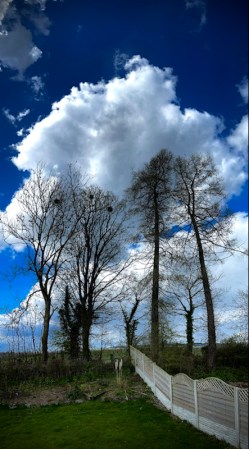
This morning, I stepped out of the house, carrying the recycling, to find the brightest, most energetic cloud I’ve seen for months. It was ‘climbing up’ the sky behind the larch trees and seemed to be accelerating in a way unrelated to the rest of the atmosphere.
We’ve had a week-long Arctic blast here in Cumbria. This northerly ‘spike’ made every day feel somehow still and frigid, requiring outer clothing that had already been stowed away for the warmer months.
But this cloud spoke of a change; a resurgent spring energy that would restore the balance.
Sometimes these things are fanciful. Sometimes not… To my accepting eyes the cloud wore the garment of the new, the restorative.
This time, I was lucky. I had the phone/camera in my pocket.
©Stephen Tanham
Stephen Tanham is a Director of the Silent Eye, a journey through the forest of personality to the dawn of Being.


You must be logged in to post a comment.