
There’s a saying in Cumbria; you don’t get the real spring till it’s fooled you, twice…
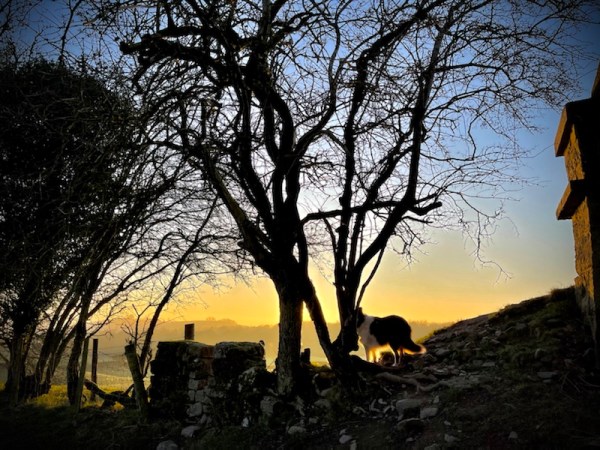
But you do get the sun; and its increased energy brings real life to the natural colours in the landscape and the sky.
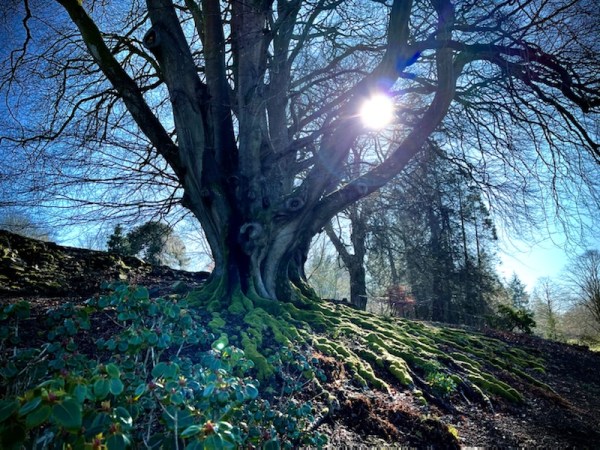
Below: One of the great trees on the shores of Lake Windermere has a large network of half-exposed roots which look magically green in the bright March morning sun.
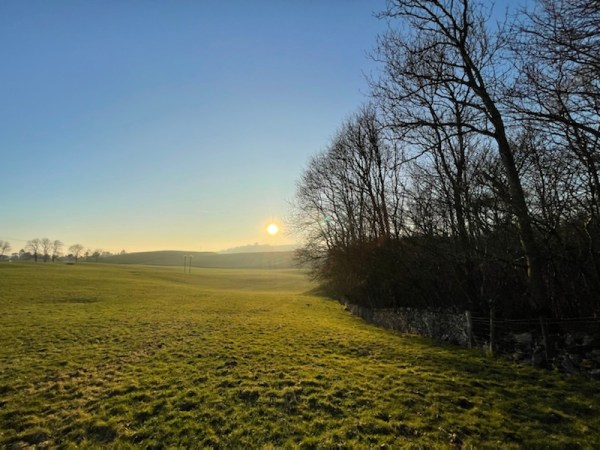
The final shot, below, was taken just before the sun dropped past the western horizon. The change from sunset to twilight is rapid – the final moments before providing rich, saturated colours and contrasts.
©Stephen Tanham, 2021.
Stephen Tanham is a Director of the Silent Eye. A journey through the forest of personality to the sunrise of Being.
Share this:

New evidence from the past two years’ work on Orkney has revealed breathtaking perspectives on the nature and importance of the finds at the Ness of Brodgar…
(1000 words, a ten-minute read)
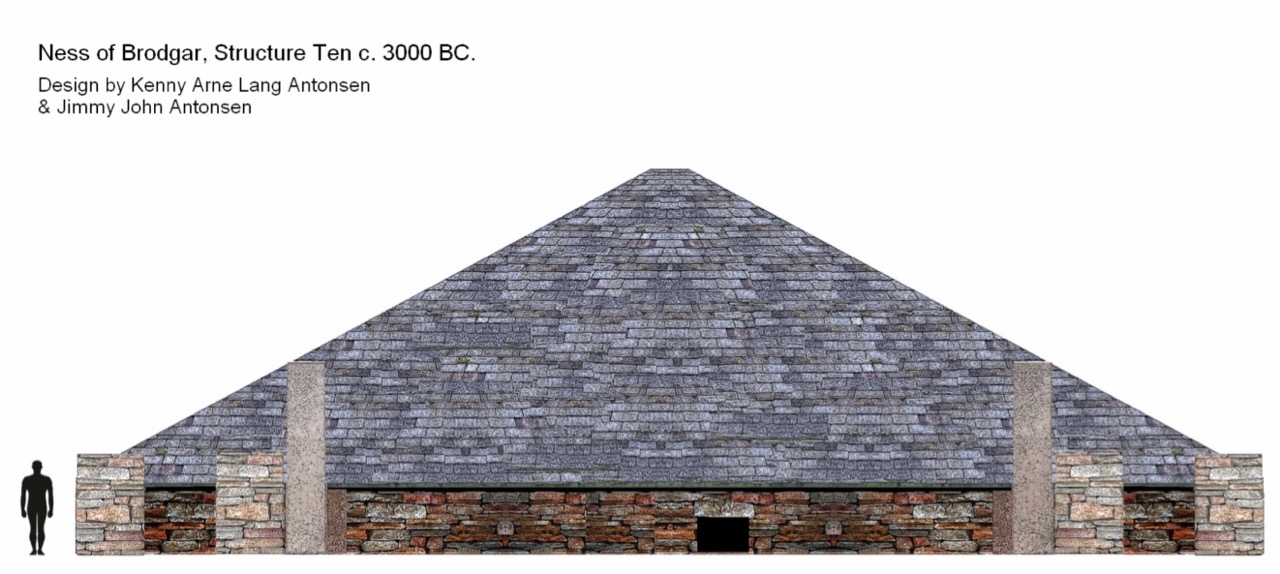
(Above: technical reconstruction of Structure 10 and its dramatic ‘pyramid’ roof on the Ness of Brodgar by Kenny Arne Lang Antonsen and Jimmy John Antonsen)
Staring, breathless, at the TV, desperately trying to keep notes, I was clutching my pencil so hard, it began to splinter…
There was a silence among the archaeologists and assorted technical specialists grouped near Structure 10 on the Ness of Brodgar World Heritage Site; the kind of silence that follows feverish activity and intense speculation – most of it expectantly negative…
We are a cautious species. If we long for something that might change the world, and hope it might happen, we prepare ourselves to be wrong.
The group of intense people were waiting for a phone call regarding a date. A diving team had drilled a ‘time-core’ into the base of the shallow sea that is Loch Stenness, north of the tiny strip of land that houses the Ness of Brodgar site. Extensive ‘geophys’ (basically radar for archeological work) had revealed a sunken island in the middle of the loch’s basin, and the surface had revealed the shape of a natural stone circle.
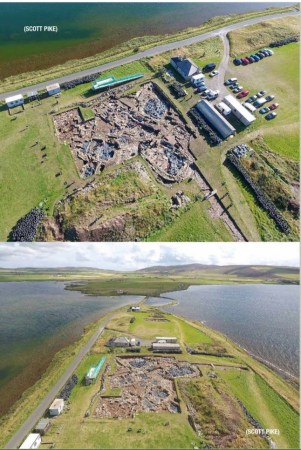
In revelation after revelation, the story of what was likely the world’s first ‘common culture’ had come together, centred on the Ness of Brodgar, an impossibly narrow strip of land north of Stromness, on Orkney, seven miles north of the tip of Scotland.

Older than the Great Pyramid, the nearby Ring of Brodgar had been dated to a time in the Neolithic period when the tribes of hunter-gatherers had settled in fertile lands, creating the first permanent settlements and beginning what we today call a common culture.

I was watching the BBC’s ‘Britain’s Ancient Capital: Secrets of Orkney’. If you follow my blogs, here and on Sun in Gemini, you’ll know that Orkney and its ancient history are a favourite topic. Other relevant posts from the Silent Eye’s 2019 workshop on Orkney are listed at the end of of this piece. The BBC programme features, amongst others, Neil Oliver and Chris Packham, two well-know authorities in their own fields; together with the dedicated team excavating the Ness of Brodgar each summer.
Chris Packham had just shown how the presence of the Orkney Vole was really an interview with a time-traveller. He revealed that, thousands of years ago, the non-native vole species had arrived from Belgium, not by itself, but carried and bred as an eaten delicacy by the farmers who originally populated Orkney, five thousand years ago… Meat-eater or not, you’ve got to admire the science…
Back to the waiting crowd at the Ness of Brodgar. Neil Oliver read out the results of the core’s dating. The researchers had dared to consider that the presence of the natural stone ring had been the ‘first stone circle in Britain’… and therefore something that inspired all the rest. Archaeologists have long puzzled how such structures sprang into existence ‘fully formed’. Finding the first would have been a seminal moment.
The documentary had already shown that Orkney was the place from which all other stone circles in Britain had originated; following a development that would move south through Scotland and the rest of Britain, and culminate with Stonehenge, in Wiltshire – considered to be a masterpiece of the art, but now dated at least three hundred years after the Ring of Brodgar.
Neil Oliver looked realistic but sad as he reported the data had shown the sunken ring feature was thousand of years older than needed to fit the possibility; millennia before the ‘spiritual farmers’ who came to settle and create this outstanding culture of the Stone Age – with villages such as Skara Brae amazingly intact, including the interior of their houses.

You could feel the disappointment in the team. But so much had already been uncovered and proved – including a reconstruction of how the Orkney people, finally leaving their beloved archipelago, crossed the deadly Pentland Firth to reach the mainland near present day Thurso. And all this in boats made from tree branches and waterproofed hides.
The series reached its final few moments with Neil Oliver and Chris Packham visiting a now-deserted island, off Hoy, to ‘feel’ what an abandoned land was like – They found that the cattle left behind, thirty years prior, had not only survived, but, in seven generations, had reverted back to their genetic forbears in order to reorganise and survive, alone.
But then it was back to the Ness of Brodgar for the final sentiments. So much has been achieved; so much revolutionary ancient history uncovered. Orkney had been placed as the ancient capital of Britain. Who would have thought a place so far north could have been such a cradle of civilisation!
And then…
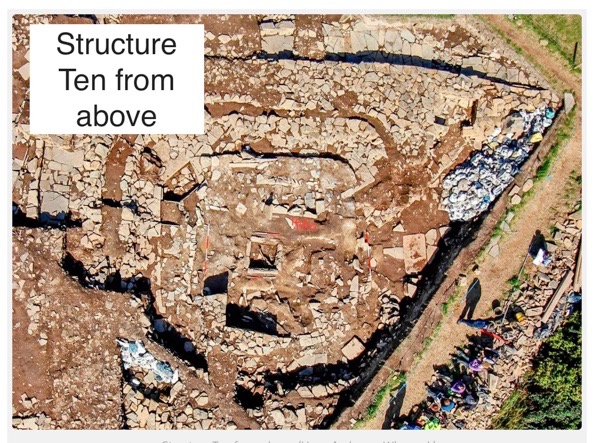
And then, as the archeological team were pulling over the vast tarpaulins that would protect the site through the coming winter, they stopped to show the latest and strangest find. Located in the deep earth below Structure 10 (the pyramid-roofed ritual centre of the complex) was a long, thick slab of stone on its side. Further examples of this strangely aligned stone revealed a random layout, clearly not a part of what had been constructed above it.
The camera pulled back to show the face of the Site Director, Nick Card, calm and unruffled, as he had been through the three programmes. “We think they’re full standing stones that have been laid on their edges,” he said. “As though the whole of this Ness of Brodgar complex had been built above the first stone circle… which, of its type, it might well be.”
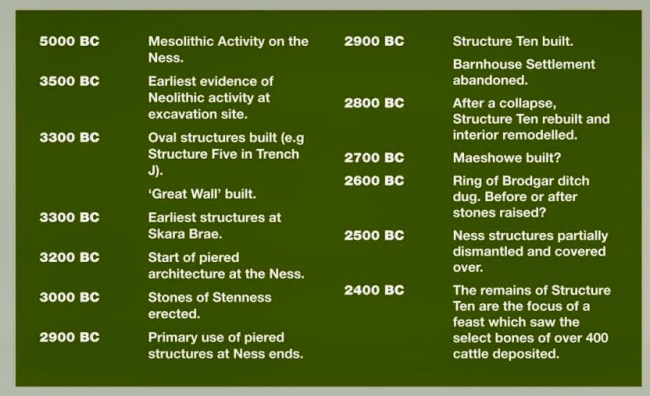
The dig had run out of time and weather. It will take another season of careful excavation to confirm that possibility. But, bearing in mind that the Ness of Brodgar has been re-dated back to at least 3,500 years BCE, They may already have found the indisputable heart of the relationship between the stonemasters of ancient Orkney and their beloved sky…

To be continued.
Other parts in this series:
Part One, Part Two, Part Three, Part Four, Part Five, Part Six, Part Seven, Part Eight, Part Nine – end,
The preceding Pictish Trail weekend blog posts:
Part One, Part Two, Part Three, Part Four, Part Five, Part Six, Part Seven, Part Eight, Part Nine
©Stephen Tanham, 2021.
Stephen Tanham is a Director of the Silent Eye – a journey through the forest of personality to the sunrise of Being.
Share this:

It shouldn’t be happening. Bowness-on-Windermere swans are notoriously aggressive, and yet these two are approaching me as though I were another swan.
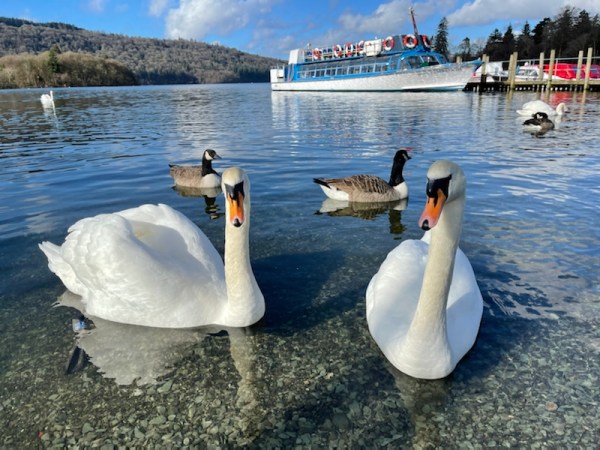
I’m not, obviously. But I am in the water with them. Why this is taking place needs some explanation…
We live a short drive from the shores of Lake Windermere. Our collie needs a decent daily walk, and the park areas around Bowness are ideal. There’s only one problem – the mud, especially in the winter. Winter walks, here, need a robust pair of wellingtons, often well into the spring.
The first part of the walk over, we headed along the shore, past the ferry point and up the slope towards the Costa Coffee shop; one of the few places open in the town- but only for take-aways, of course.
Returning with our coffee, we settled on one of the benches to watch the birds: mainly geese and several of Windermere’s beautiful but deadly swans.
And then I noticed a potential photograph, and remarked to myself that one would need to be a few metres into the water to do it justice. Looking down at my feet, I realised that I was equipped to do such a thing. I asked Bernie to hold my coffee, and to the surprise of several passers-by, waded out into the calm lake.
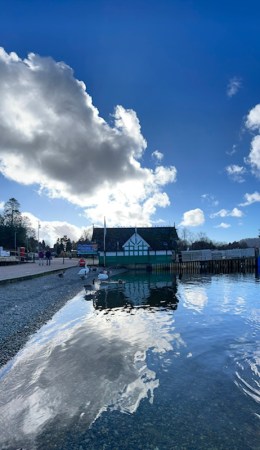
The first image was disappointing. I realised it needed a ‘vertical panorama’ to make a full mirror of the cloud formation that had drawn my attention. It’s quite an athletic operation when you’re practically knee-deep in icy water. But it was worth it.
Hearing a noise behind me and still holding the camera at arm’s length, I turned. Two large swans were approaching me, fast and stealthily. My first reaction was: “Well, if I’m going to get attacked, I might as well have the photo that goes with it…”
But they didn’t. They stopped a couple of feet from my wellies and stared at me, peacefully. It took me a few seconds to realise that my presence in the water had somehow reassured them. They escorted me to the shore and my laughing wife with her surfeit of coffee. I don’t expect ever to get a shot of swans like that, again, but I’m glad I got this one!
I’ll not be pushing my luck, though… I’ve seen them steal cheeseburgers from children… Mine, a long time ago.
©Stephen Tanham, 2021.
Stephen Tanham is a Director of the Silent Eye, A journey through the forest of personality to the sunrise of Being.
Share this:

There’s something special about the two week period when one season blends into another, particularly winter into spring. This liminal period is capable of showing us the subtlety that winter lacks…
(200 words, a two-minute read)

Something wonderful happens to the winter sky towards the end of February – there is a weekend during which the light energy doubles – it’s the largest upward gradient in the year. We all feel it; people start saying “spring’s just around the corner!” For the photographer, the new energy fills the landscape with a different kind of contrast.

The colour of stone is brighter, seeming to give off light, again. The sky is deeper, as though full of the energy promise to come. The first flowers rise through the cold and greet us. How could we not feel alive?

It’s a brief period in which the fractal shapes of trees are still fully visible. But, mere weeks away, the view through them will be obscured by a tapestry of vibrant green. Life is coming…
Stephen Tanham is a Director of the Silent Eye, A journey through the forest of personality to the sunrise of Being.
All images by the author and copyright.
©Stephen Tanham, 2021.
Share this:

Some beautiful and poignant reflections from Sue…


There is a place the heart calls home, I think, for each of us. Sometimes we are lucky enough to live there. Sometimes it simply lives within us and pulls at the heartstrings, calling us. It may be the place you were born, a place you were happy, or a place that takes hold of your heart and begins a romance that lasts a lifetime long.
These are the places where the innermost self touches the heart of the land and Mother Nature herself reaches out to us, drawing us to her, teaching us her ways and letting us listen to her heartbeat as we lay our head upon her breast in silence and wonder.
For me, it is that ancient range that forms the backbone of England, the Pennines. These weathered hills run northwards, separating East from the West, rising in Derbyshire and running to the end of England. But…
View original post 860 more words
Share this:

I am the child of two loving parents. One gifted me a living background in philosophy and mysticism; the other gave me the gift of verbal conceptualisation… talking.
(1500 words; a ten minute read)

My father passed away a decade ago. We’re still clinging on to mother, who at 91, is robust only in her ability to talk. She is in our care for the foreseeable future and I would like nothing better than that she passes away gently, in that state of being loved and cared for… if not always understood.
Neither of my parents had a clue about the sciences, yet I, despite being a moderate folk-singer in my youth, I eschewed the rock star dream and headed for a Computer Science degree, achieving it after four years (the old-style ‘sandwich course’) of struggle at a Polytechnic in the north Midlands.
I was not a gifted student, but I could talk. Also, I noticed I could explain complex things quite well – finding analogies, new words and metaphors, not to mention humour, to make the complex comprehensive and… fun. I was a vice-president of the local Student Union – a natural fit with talking, I suppose.
Only one of my lecturers understood fun, and I cherish his memory. He knew I wasn’t a good student, and that my final grades were not going to rocket me into a starring role in the emerging world of computing. Remember, this was 1977, and the world of business computing was an exciting (and brutal) frontier.
My fun-loving lecturer called me into his office one day. There, opened on his old, metal desk, was a huge centre-page advert placed by a well-known American computing company named ‘Burroughs Computers’.
“Look at the headline,” he said. “They need a thousand graduates in computing to sell their computers… Looks a good package, too.” He rocked back in his chair. “Be a tough first year of survival, mind you…”
He leaned forwards, placed his giant hands on the desk and fixed me with his dark eyes, suddenly full of ice.
“Now get out of here and make something of that wonderful ability to talk!”
Two months later, clutching my degree certificate of under-achievement, I sat down in the cold kitchen of our greengrocer’s shop in Bolton and began to ring every computer company with a office in Manchester. Fifth on the list was a German company called Nixdorf, with a regional office in Sale. Minutes later, the office secretary put me through to the branch manager. I recognised a scouse accent, and the friendly but challenging voice that, bluntly, meant business.
“Why the hell would I be interested in a grubby ex-student like you? Did I mention I hate students,” he snarled, in a passable likeness of John Lennon on a bad day. I tried not to be sick with tension – which resulted in my first ever example of the fabled sales technique: the ‘power of silence’. In truth I was choking, and had taken my head as far from the phone as possible.
A door in my consciousness opened. I actually heard the ‘crack’. A rush of blood to the head and lungs and then: “Because I can talk well,” I said, clearly and slowly. I sounded calm… I wasn’t.
All I could hear was his laughing. “Bloody hell, I can‘t fault that,” he laughed. “Be here next Monday morning at 7:30. Let’s see if you can get up, as well as talk.”
He put the phone down. “Bloody hell”. I copied it to myself. My best and worst attributes in the same adrenaline rush.
I was there at 07:25 on that Monday. My orange VW Beetle, part financed by my Dad, but now my own responsibility, was parked discretely behind the office… out of the way.
I stood by the door, but not blocking it. Not overly familiar but not looking like a ‘bloody student’ either. I stood aside as he passed me. He issued a small but rueful-sounding Good morning, injected with a tiny degree of irony. Nothing else.. But he let me see his smile as he swung the door open.
I got the job. The first year didn’t go according to his plans, as I was courted and, frankly, seduced, by a divorced senior lady systems analyst who had a sporty BMW. She toyed, elegantly, with my affections and other things. She was great and we had a lot of fun, but it wasn’t learning the day job. The Branch Manager tried to warn me off. Headstrong, I wasn’t listening.
Of such things are harsh lessons made…
At the end of the year, with little sales success, I knew the manager was ready to fire me. I sank into a depression. It wasn’t that I wasn’t trying – I hadn’t let the high-octane fraternising frazzle all my brains. It seemed that no-one would take me seriously – out there in the boardrooms where people brought expensive computers. Was I just too young? Had my ability to talk failed me?
That evening, I had a pub meal with a new friend I had got to know through working in my parents’ shop. I liked Ian a lot. He had a tough but humorous, no-nonsense manner and he liked BMW cars – though he couldn’t afford one. He had been a chef, but had swapped it for a job as a salesman in a catering engineering company which made high-end industrial cookers. I was explaining my imminent demise and he was listened, deeply, reading my face. For the past few months, over several evenings, he had coached me in the nitty gritty of ‘selling the person, not the product’. He finished his drink, but continued the silence.
I went to the bar for the second round of drinks.
“Do you know,” he said, as I set the drinks down. “that selling is the only profession that gives free consultancy?”
The sentiment was new to me at the time. It hit me like adrenaline. “Look at all your training,” he continued. “Four year computing degree; ‘sandwich-course’ during which you gave up your summer holidays to work in industry. Smart, well spoken… “Whereas, half the people you are selling to are dull, imagination-less lickspittles…”
It was the first time I’d heard such sentiments. Looking back, they were designed to fire me up, but much of the sentiment was true. You had to learn to value yourself if you hoped to sell anything. I knew that, I just hadn’t ‘actualised’ it. Later, I found a better word for that.
“What are you doing tomorrow morning?” he asked, sipping his beer.
I drank mine, conscious of the importance of the day to come. “Final attempt to close the deal at a wholesale Painting Suppliers in Salford. My last chance.”
He looked at me, eagle-eyed. “What are your chances? Really?”
I drank some more beer. “Not brilliant – but there’s a nice BMW in the car park.” I’d noticed that there was definitely a correlation between that and what kind of reception we…. I… got.
“German company and all…” I continued. And the Operations Director’s a nice bloke and gets me a coffee.”
“Good,” said Ian. “Then use it. Make it count. If you’re job’s on the line, give it your all!”
Mr Johnson, the Operations Director, was a man who combined warmth and acute intelligence. His office was classy but minimalist – quite avant-guard in Salford. He watched me, intently, as I worked to summarise our proposals, and tell him why now was the right time for him to sign the deal. I felt I’d done a good job and sat back, ready to use my new friend, the power of silence to its best effect.
After twenty seconds of total, mutual silence, he rocked his chair back and let me have a half-smile.
“Steve,” he said softly. “I like you… The financial director likes you. We think we have an honest soul, here. Someone who will work with us to deliver this… beyond the selling.”
He let his chair rotate forward so his arms could lie on the desktop, and fixed me with eyes that contained a different sentiment to any he had displayed to that point. I knew something completely new was about to happen in my life.
“Now let me tell you how you’re going to sell this to us…”
In those few seconds, my entire world changed. It was the beginning of the sense of worth, related, solely, to my-self. Mr Johnson was going to instruct me in how to use that because he felt I was was worth it. That sense of worth – in this adult context – was dramatic and life-changing. I’ve never forgotten it… I’ve never wanted to. I think of it as ‘unshakable mine’.
It was only years later that I realised it had a spiritual dimension. One of the key stages in our individual development is to realise that each human has a great importance to the cosmos. This is something that can trigger a fundamental change in ourselves – and link us more closely with everything that is creative in life. We are all born with amazing potential, but we have to realise our relationship to the world we live in: The whole, vast universe of it… and ‘little us’. A Little Us that carries a spark of something almost beyond belief. But the journey to that realisation is the story of how we get there, in a weird and wonderful paradox, full of divine humour and discovery.
Finding that deep sense of self, beyond the ordinary egoic concept, is central this journey.
A week later, as promised to the Nixdorf Branch Manager, the deal was signed. It probably wasn’t the thing that saved me. My outspoken boss had fallen out with one of the senior managers in Germany and had resigned… The man who took over had warmth and had seen the effort I was making. I lived to fight – and learn – another day.
Next week, in the final part of this series, we will pull together the threads through these posts, and summarise the truly ‘big picture’ of Self-development.
Other parts in this series:
Part One, Part Two, Part Three, Part Four, Part Five, This is Part Six.
©Stephen Tanham, 2021.
Stephen Tanham is a Director of the Silent Eye, A journey through the forest of personality to the sunrise of Being.
Share this:

A loving journey with a mother’s dementia… and occasional humour. Part Two
(This post is 1000 words, a ten-minute read)

The photo, below, shows my final attempt at an ‘ark’, as we came to call them: a place of refuge in times of extreme storms. The idea of the ark was born of the need to direct my mother to a point of safety and temporary sanity when the storms hit.

The refuge from the storm, the ark, was the presence of money. Just a small amount of money – typically, ten or twenty pounds. Enough to buy bread, milk and a few other staples to tide her over before I paid my next visit. The phone call, often in the middle of the night, told the familiar story: “Steve, I’ve lost all my money!” Then, there would be a pause. “And I’ve looked everywhere… It’s been stolen, again.”

The ‘thief’ was my brother, poor soul. It was obvious, her mind said, he was the only other one with a key. A year before, the thief had been an old friend who lived nearby. This kindly lady had offered to keep an eye on the house when we took mum away that year. We lent her a key, which, from my perspective was a secure and reassuring thing, only to find that mum had turned on her and decided she was ‘unbalanced and vengeful’.
Anyone with experience of the elderly and dementia will recognise the pattern. When you love someone, dearly, it’s a tragic thing to witness, but then your deeper caring – beyond the sentimental, kicks into action, and you realise the need to devise something clever to help solve the situation.
We changed the locks to prove that she was safe. She accepted the logic and slept well for a week or two. Then my brother ‘started stealing from her’. Looking back, that should have been obvious: he had a key, too…
I have a key, of course. But I’m the trusted one… for now. One day, when all else is dim, I’ll be a thief, too.
You can watch all this from a spiritual perspective, too. It’s vital to do so. What the poor ‘self’ is going through is the inexplicable theft of ‘itself’. No wonder it’s so traumatic. No wonder its shrinking world is populated with thieves.
At first, we tried a small handbag for her cash, with a space reserved for it on the bookshelf, behind one of her favourite CDs. “I hate handbags,” was the response… She didn’t use, it, instead putting the notes and coins, loose, into her coat pockets. After I had taken her out for the day, I’d find a twenty pound notes on the floor of the car, sometimes on the pavement outside the car.
Eventually, we gave up on any idea of a portable ‘container’ for the money and decided that a safer place to put it in the house would suffice. Bernie and I live sixty miles north of mum’s home in Bolton. My brother is much nearer. We couldn’t be there in a hurry, but she was always visited at least once a week. My brother used to make it twice, but he’s now a ‘thief’, and not welcome.
The storms began to happen. At first we didn’t see the pattern, just the crying in the night on the telephone when she woke up to find that her ‘stuff’ had all been moved around by a malign presence. Oh, and all her money had gone, again: fifty-ish pounds at a time. Later, we found out that what had been moved around were small things like her medical supplies (she has a stoma). Sobbing, she would tell me that it was the work of the person she now called simply ‘the thief’. He was not hurting her, just trying to make her miserable with his malice and mischief.
It was the kind of paranoia that goes with vascular dementia. There was no cure… just some advice with the worst of what to expect.
My brother finally had it out with her, pleading, uselessly, that she see where ‘this’ was all coming from. She spent a half hour spitting vitriol about his whole life. He’s still deeply affected by the call. Cut off from her and unable to help us, except when mum’s not there. Dementia is more vicious than you were expecting. It’s the real thief in the night, the one that steals minds and pasts.
The Auden pamphlet was the last throw of the dice. Hidden in a different part of the house each time; a place that only I knew. I could direct a panic-stricken mother to the location of ‘the ark’, knowing there were both spare keys and a couple of small denomination notes. Enough to get her through to my next visit. We made sure there was always enough in the fridge to feed her though the week.
It worked for three weeks. Then, one morning, when her regular cash from my last visit had been stolen, again, she rang up, desperate. I directed her to the location of the ark… but when she got to it, that too had been pilfered. Keys and money gone, she said. Such a determined thief.
She’s with us, now. There was no choice in the end. She’s warm and fed and safe. No-one’s stealing anything from her, anymore. But when you explain the contrast between this and her former existence she just smiles and says of the thief, “Ah, but you don’t know him like I do.”
The thief and his wife have spent two weekends cleaning out the mess of her Bolton home as much as they can. We’re waiting for a social service assessment of her from the Cumbria authorities.
She has a new, local, doctor. The former Bolton doctor was brilliant and a real friend. “Tell them that I said your mum needs 7×24 care,” she said to me. “Don’t take any nonsense. I had to do the same with my own dad. It’s dreadful, but you need to stay sane. Let me know if I can do anything else to help.”
Most of the time, mum’s very happy. She paints and watches programmes on BBC iPlayer, especially those about astronomy. She loves it but doesn’t remember any of it. She broke her lower spine falling out of bed a week after moving in. I’ve told the story in the first of these blogs. She can walk again, now, but only short distances. It will take months for her to recover her mobility… if ever.
It’s a journey we’ve long known was just around the corner. We’re all living longer and our brains are decaying before our bodies. The journey is shocking because you keep looking into those eyes you love and assuming that some deeper level of handholding plus logic will make some small difference. But it seldom works.
The handholding does, though… always. Sometimes, a held hand can reach beyond time and place and circumstance and outrun unreasonableness.
And be remembered…
Other parts of this series:
Part One, This is Part Two.
©Stephen Tanham, 2021.
Stephen Tanham is a Director of the Silent Eye, A journey through the forest of personality to the sunrise of Being.
Share this:

Winter is a natural fit for black and white photography. The essence of a good monochrome shot is strong contrast, aided by subtle mid-stones. The low winter sun lends itself to that mix – as long as there is any sun, at all…
(460 words; a four-minute read)

The power of the high-end mobile phone camera has provided the means to carry out sophisticated photography – and post processing – in our pockets.
We can now take a shot, see it in high definition, and modify its light levels and other attributes before we sit down for that well-earned coffee.
But all that power doesn’t necessarily lead to a better photograph.
Not that long ago, monochrome images were considered more artistic and illustrative of emotions. We can learn a lot from the early pioneers of photography.

Aspiring photographers would buy a manually-loaded reel of dedicated monochrome film, and be thrifty about how many shots they took. Today, we can reel off hundreds and simply ‘throw away’ most of them.
There is the assumption that we can default to taking colour photographs, and convert the ones that suit to black and white. This works against the principle of good monochrome photography, where careful composition, with black and white in mind, is essential.

Colour conveys ‘feeling’ that we all share. In the above shot, and in the opening photograph, the colour is replaced by subtlety of tone, as the eye follows the graduation from dark to light.
One of my favourite subjects for monochrome images is Art Deco. We are blessed in the north-west by having the restored Midland Hotel, on Morecambe’s seafront.
The sole survivor of a former era, when the British seaside, fed by the extensive steam railway network, was ‘all the rage’, the Midland is a beautiful example of the curves, shapes and shadows of that heady period. Here, the low winter sun, setting at the end of an afternoon, floods the promenade with light, casting dense and finely-graduated shadows along the curving sections of the building.

The Midland Hotel is a complete time-capsule in many respects. Much of the original Art Deco interior is also intact. I hope to devote a dedicated blog, or even series of blogs to it, when the present restrictions are removed.
My final image, below, is not actually monochrome. I like to experiment with the digital removal of colour in a just-taken image, to examine the impact of a near-monochrome image. This washes out most of the colour, yet leaves key hints of its presence. At first glance, it looks black and white… but the tiny amount of colour remaining draws the eye.
Sometimes, less is more…

©Stephen Tanham, 2021.
Stephen Tanham is a Director of the Silent Eye, A journey through the forest of personality to the sunrise of Being.
Share this:

One of the ancient mystical traditions that has turned out to be startlingly modern is that of the Sufis. We may be familiar with Sufi thought in the form of its often quoted poetry, such as that of Rumi, or the Rubáiyát of Omar Khayyám, the ‘Astronomer-Poet of Persia’, whose work became widely-read in the west, following its translation by Edward Fitzgerald in 1859.
(900 words; a ten minute read)
The Sufis used the wine glass or wine jug as a subtle motif. The delicate glass may be filled with any liquid, but water or wine features in many of the teaching tales. We take such a vessel for granted, but it merits closer investigation…
The glass is fixed. If we try to insert something hard into it, like a stone, it will break. But if we pour a liquid into it, the result is harmonious. What actually happens? The liquid takes the shape of the glass, filling every cavity to such an extent that the two are practically the same… But we know they are not; the obliging liquid has taken on the shape and contours of the container into which it has been poured. If the wine were white and not red, it might be difficult to even know of its existence. The glass, though more ‘basic’ in its nature, is necessary for the wine to exist in a drinkable form. If the glass is finely made, it reveals the depths of beauty in the shimmering wine, and even allows reflections of the world back to itself.
Let’s imagine our wine is beyond ‘white’ and has a mercurial quality that makes it look silver…

Our silver wine not only fills the vessel, it also reflects the colours, lights and shadows of what flows through the glass from outside, but reversed. They become an imprint of each other, but the silver wine is fluid and flexible, whereas the glass is fixed and brittle.
If the glass is scratched or dirty, the light being reflected from within the vessel is less bright than it could be. But our silver wine still needs the holding power of the glass if it is to remain effective in the world of solid things. It is the glass which collects and transmits the light from the ‘outside’, giving the glassy material all its life, and the silver wine half its life.
In our continuing exploration of the nature of self, we can use this Sufi image to great effect, especially if we make it a bit more sophisticated. Let’s bring our glass alive… and give it feelings and the ability to react, making it it an engine of perception, reaction and response to the physical world.
Our new glass is evolved. It is made of the substance of the world, whereas our silver wine is from another place. To function in the world, the silver wine needs the cooperation of the glass, allowing its will to be guided by the sparkling liquid within.
Our new glass is imbued with the power of reaction, in the form of like and dislike to everything it experiences. The silver wine within the glass does not need to like or dislike; it is completely at peace with whatever happens, living in an ocean of wonder and reflecting it. But its life is now so closely mirrored with the glass, that it begins to absorb the reactions that the glass experiences to the outside world. It remains dutiful to the glass and its perceived world, but knows it could do much more for the glass than just receive and reflect its life. But the silver wine cannot function in the world of the glass without its container…
The only chance the silver wine now has for a greater life within the glass is for the outer vessel – the glass – to get to a point where it knows that it has tired of its reactions to the world and needs to get back to the limitless and unjaded level of life that is the silver wine’s inner vitality – a world the glass knew well when it was young and the silver wine had just been poured into it.
The glass represents the reactive life of the personality with its body, informed by its brain and will. The experience of the world passes through these and forms the life of something in the glass that is the mirror of the silver wine. This is the self, and it is only ever a lesser reflection of the shining inner liquid.
In mystical learning, we work to move the seat of the consciousness from the glass to the silver wine, quietening the reactive self, and allowing the consciousness to have dual centres, each used within its own realm.
We can take this exercise deeper by making it into a meditation. We first imagine that there are two worlds, one filled with light and fluidity, the others more bound by physical laws of form. We then imagine two streams of life meeting up, one as an inherited form being blown, beside a furnace, into a beautifully curved wine glass; the other becoming the finest silver wine and being poured into the beautiful glass. Together, they have the potential of perfection, but only the glass keeps the wine composite, whole and drinkable.
The analogy is ultimately limited, but contains some deeper symbols hidden in the story. At the right point these can speak directly to our own ‘silver wine’ triggering far-reaching events for both glass, wine… and the ultimate wine-lover.
Other parts in this series:
Part One, Part Two, Part Three, Part Four, This is Part Five
©Stephen Tanham, 2021.
Stephen Tanham is a Director of the Silent Eye, A journey through the forest of personality to the sunrise of Being.
Share this:

I’m partial to stations… especially those that have history. The Victorian railways were a magnificent achievement, and changed British society in far-reaching ways.
(600 words; a five minute read)

During the late 1950s, and early 1960s my grandparents in Bolton used to take me for days out to the seaside.
We never got as far as Grange-over-Sands, the lovely town that nestles at the eastern end of the English Lake District’s peninsulas. My father first brought us here in one of our long distance days out sometime in my early teens. By then the ‘swinging sixties’ were in full swing. We had previously been on a two-week (static caravan) holiday to St Ives in Cornwall, and everywhere I subsequently visited was judged against that childhood perfection.

But Grange made an impact. Its natural features were framed by hills that swept down towards the sea, yet seemed held back by the solid combination of long promenade and twin railway tracks – tracks that would take you all the way to Barrow-in-Furness… or even up the entire Cumbrian coast to Carlisle.

The railways station is a classic. The information board states it boldly: The railway created Grange. A century before even the idea of a road linking north-west England with Scotland was dreamt of, Victorian day-trippers would take paddle steamers from bustling Morecambe, across the bay, to arrive in Grange for afternoon tea. They would stroll through the beautiful park before re-boarding their boats to return, filled with delight at their exciting and well-filled Sunday outing.

The railway wasn’t long in developing this potentially lucrative route; linking the coast and the main line to Lancaster, Preston, Liverpool and onwards to London. Grange boomed.
At first, Grange had only a wooden hut to serve as a station on what was then a single track line. The Furness Railway Company took over the line and doubled the tracks, engaging Lancaster architect Edward Paley to design the present station, which opened in 1872. The company also built the adjacent Grange Hotel, designed by the same architect.

John Brogden, a celebrated civil engineer and resident of nearby Holme Island, was commissioned to design the promenade and park that would frame the station, using land that had been a muddy swamp. The result was a centre that attracted both holidaymakers and new residents . Grange’s population exploded, growing from 200 in 1861 to 1700 in 1881.

Grange was considered ‘genteel’ compared with other northern resorts, but eventually followed the same decline after the death of the ‘railway age’. It was saved by the growing popularity of the Lake District as a place to live, not just visit. Ironically, this was made possible by the presence of the M6 motorway only twenty minutes’ drive away. Many people commute from here into the major towns and cities, sixty or more miles south.

The town is now a rare example of a self-sufficient community. A variety of individual shops have survived and prospered. We live a twenty-minute drive away, on the edge of Kendal, but our preference for everyday fresh food shopping is Grange-over-Sands. The promenade and large park at its end also provides our collie with good walks.

©Stephen Tanham, 2021.
Stephen Tanham is a Director of the Silent Eye, A journey through the forest of personality to the sunrise of Being.
Share this:

Winter landscapes involving water are plentiful, but water can be a tricky subject to photograph. The eye is much more subtle than a camera lens, and we have to help the camera overcome this…
(200 words, a two-minute read)

Watery landscapes can look pale and ‘flat’ if you let the standard camera settings take charge. The lens is doing what it’s supposed to, but our eye takes in more than is being photographed. A good way around this is to take the shot, then use the built-in editing suite to increase the contrast of the subject, then the richness of the colours. Finally, use the saturation control to reduce the ‘overcooked’ shot to the level of colouration you want. Many photographers have their own ‘look and feel’, achieved in this way as a signature style. This isn’t altering the photograph, just a fine-tuning of the levels of light that are already in the image.

If you’re in bright sunlight and near a river with a reflective bed, such as limestone, find a submerged feature and get as close as you can; holding the camera just above the water line. Wellingtons or even waders are great if you want to lift your shot to the next level….

Winter is a great time to experiment with light. Sometimes I like to break the rules and see what kind of ‘arty’ shot I can get. The final two examples, here and below, are shots that should not have worked, but did. The one above had too much of the sun’s brightness through the trees and on the fast-flowing water. By dramatically reducing the brilliance of the image, the water took on an inky texture, and the sunburst changed colour to complementary mauve.
In the final shot, I was in bright, winter sunshine, crossing the River Kent on the old suspension bridge and decided to take a ‘vertical panorama’, as in previous posts. Instead of moving from a level line upwards into the sky, I started the shot looking down into the water, then panned up the length of the river and into the sun. I expected the result to be a washout… but sometimes, wonderful and artistic things happen! With digital shots, it’s easy to take many and throw away most of them… The ones that remain will be worth the experimentation.

Stephen Tanham is a Director of the Silent Eye, A journey through the forest of personality to the sunrise of Being.
All images by the author and copyright.
©Stephen Tanham, 2021.
Share this:

As children, we lose ourselves in play and the toys or games that give the play structure: a skipping rope, chalk to mark out a court, balls to kick and control… perhaps, now, a computer to enter a virtual world. As adults we inhabit a different world, and the entanglements of our earlier years may pay us a return visit…
(1400 words; a ten minute read)
The big red ball was heavy. It was a toy for a large dog, and we didn’t have one, so I felt justified in what I was about to do. When you held it, there was strangeness to its mass, as though the density came from ‘another place’… Alien.
The only pet we had was a mangy old tom cat that my mum had rescued from an icy death one winter. I knew nothing of the world of dogs – my repeated requests for a collie falling on dad’s deaf ears… Looking back, I don’t blame him. I know, now, how much exercise those lovely creatures need… but it’s worth it.
Conceiving of the big red project had taken a while. The Norse legends, made modern in the context of an excellent book set in the sci-fantasy genre, had captivated me. I took the large meat skewer and set into into the middle of the glowing embers of the garden fire I’d been nurturing for the past hour. My personal ‘furnace’….
Both my parents were out… of course.
I watched the skewer glow red, then, slipping my dad’s ‘fix the underneath of the car’ gloves on, I picked up its curly end and approached the sold red rubber ball locked fast in its makeshift wooden cradle on the top of mum’s rockery.
There was an appalling hiss as the red-hot metal melted its way through the first two inches of dense, composite rubber. I had the good sense to avoid the life-diminishing fumes given off, and continued pushing. It soon became apparent that creating a passage through the exact centre of the giant dog ball was going to take several return visits to the fire… but, eventually, it was done, and I held it up to the sun in triumph, aligning the dark tunnel like a telescope.
I’d already constructed the rest of the kit. The new rope, bought from the local hardware shop as a scrap piece, was too large to fit through the hole, but perfect for the strength I would need. To get around that I had wound and tied a piece of string to its end so I could thread the smaller line through then pull the thicker length along the red ball’s axle tunnel.
The wooden handle, to attach to the two feet of rope, was a masterpiece. Carved by hand from a tree branch with my large penknife, then formed into a finer shape with a borrowed hemispherical file from dad’s toolbox. I had finished it off with hours of sanding, using a borrowed sheet of fine grade paper.
When I closed my hand around it, each of my clenched fingers slid into place with perfection. I threaded the end of the rope through the hole in the middle of the handle and tied the newly-learned knot, pulling the rope back into the upper part of the shaped hole so that it would not stand proud and interfere with the grip… and the all-important swing.
I took the mighty red ball in one hand and let it drop to the length of the rope. The impact jolted the handle, but I was ready. I still remember the smile as I swung the great weight round and round in the air over my head, so fast it began to swish and hum. Unexpectedly, my scorched tunnel had given my red beast a voice!
Nearly there… now I had to test it.
Raymond Barlow lived in a much older part of Ainsworth than we did, yet was a neighbour ‘over the back’ so to speak. The stone cottages were on the main road, but set back, and with huge rear gardens, most of which we allotments. At the far end of one of these, Raymond’s grandfather had made two wooden outbuildings with a tiny alley between and around the back of each. In a far corner, a solid wooden post was set into the ground, looking like it had stood there for millennia. My best friend and I used it for stone-throwing practice.
“Go on then, get it out!” he said, exasperated, when I arrived through the hole in the hedge that marked the terminus of the excellent secret path we had forged between the two houses – very painfully, for it was full of trees and shrubs with thorns and others pointed spikes.
I straightened my back and reached into the largest pocket of my anorak, pulling out the handle and letting the coiled structure reveal itself.
It was the first time I had ever seen him speechless. “Bloody hell,” he whispered.
Imitating what I hoped was a strong but silent Norse god, I took a step towards the post, leaving perhaps ten feet of throwing distance. There, I began to whirl the red ball of destruction around at great speed. In a practiced end-move, I snapped the handle down and towards its target, feeling the impossibly dense projectile whistle closely past my head on its descending curve.
It hit the post so hard it snapped the wood clean in two… I tried not to show my utter surprise… as delight filled me from the toes upwards.
“Bloody hell!’ Raymond shouted louder. We gazed at the severed spar. I stood and saluted.
“Let those who advance on Asgard beware!”
There was a new god in town. His name was Thor and he had a hammer that would shake your world… A far-away, but close in heart kingdom could sleep a little safer that night.
—————————
It’s all completely true, yet here’s a story with a deeper meaning. This is the most powerful memory I can muster to illustrate the principle of identification. Identification is a process that affects and forms most of our lives. The young Stephen knew he wasn’t Thor, of course; but then no-one was. The difference between what young Stephen was doing then, and what he had done, before, was that his new hero (and many identifications are with heroes) was a figure with profound values. The Norse Gods were good. They represented different aspects of us, though that was felt rather than understood at the time. In many ways, that fearful red ‘hammer’ was a ritual instrument, a thing forged and made, with the power of transformation gifted to of its worthy bearer…
The process of identification is one of the key areas where psychology and spirituality meet in entire agreement. What I identify with will change with time and circumstance. The more carefree stages of childhood – if we are lucky enough to have a stable family background – will see identification fixed on positive things, even if they are fantasy. As we pass from being looked after to looking after ourselves, to looking after others, the identifications can become more responsible and accepting, or more negative – descending even to anxiety and illness. Much depends on that first decade of encounter with reality.
In each case, the identification is a process of becoming fixed upon something, and that something is a projected image from ourselves. The thing identified with becomes us, the ‘me’. Its source may be unconscious, but it’s at the heart of who we are…
Much of the work done by psychologists involves gaining the trust of those they treat so that they can take them on an internal journey where the ‘light’ of adult understanding can be thrown on the less mature objects of fixation. The process is complete when the power is returned to the newly-balanced self, which, balanced, is free to grow, again.
A modern mystery school’s focus is not treatment, but exploration. The mystery school will create magical journeys in a landscape of the mind and the emotions in a way that is safe, mentored and discussed. Group meetings will examine, often with roles being played, how the self is built from such images, and their component identifications.
Identification can be a bad or a good thing. It passes us from stage to stage of our self, as we mature from fantasy to (hopefully) reality. The young Thor becomes the student, who becomes the junior in an office, where he or she has to redefine his very existence before becoming proficient in their chosen adult role.
Only at the end of this, at a stage of maturity in our lives, do we come to question the entire process of identification. We notice that despite all the power being with us, the objects of our identification can be limited and fixed. What happens if we refuse to have an identity which is external to this now-powerful sense of self that I know is mine?
In the next part we will go deeper into where this quest leads, and to the help that may lie a short way along that path.
Other parts in this series:
Part One, Part Two, Part Three, this is Part Four.
©Stephen Tanham, 2021.
Stephen Tanham is a Director of the Silent Eye, A journey through the forest of personality to the sunrise of Being.


 Sun in Gemini
You must be logged in to post a comment.