+ #Silenti, Consciousness, Face of Shiva, Politics and Power, Silent Eye School, Speaking truth to power, Wisdom
Wisdom breathes out?
by Steve Tanham

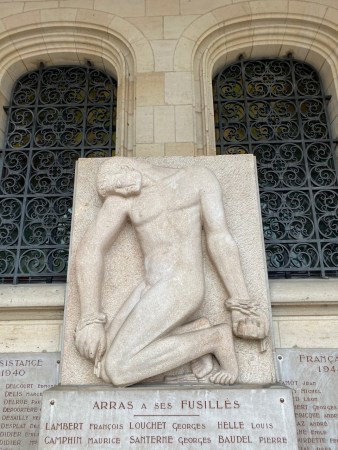
We seem to be wrestling with the recognition that an age is coming to an end, and that strange forms are filling the world with casual madness, behaving as though nothing hangs over, us; no piper calling for the line to the clifftop.
The word ‘wisdom’ is to be used cautiously. It is subjective. One person’s wisdom is another’s folly. And yet, looking back on a series of events, we can clearly see where something was ‘wise’. Perhaps we don’t see as clearly where something was unwise? Maybe we don’t feel good if our opinions were part of something that led downhill… we’ve all been there.
Wisdom implies a developed sense of consequence. The ‘wise’ woman or man has enough information to have formed a mental and emotional model of what happens in a given set of circumstances. They can play, with some success, the game of consequence, running events forward in their heads (and often hearts) to see what the pattern of results would be.
Emotions can run away with us. We can wilfully turn away from that small voice of learned consequence to embrace the rush of something wonderful, knowing that it has the potential for chaos, but makes us feel good at the time – especially when our lives are hard and we can see the opulence of others. To lash out is satisfying if you live in a state of constant struggle. These states can be, and are, exploited by those who can spend vast sums getting into our minds…
Information can be facts or opinion. The entire history of science has been a struggle to establish facts – repeatable, dependable… and sometimes ‘boring’ – but only because the truth is becoming complex; and black and white may be fun as revenge, but deadly when exploited by those who know their own wealth was built on the most subtle of decisions. But facts are the basis of truth, though the finer levels of truth involve a state of mind in which there is another kind of knowledge – or perhaps ‘presence’ would be a better term.
One fact is that we live in a complex world. A world so evolved in its social and political systems that solutions to societal or economic problems are, themselves, necessarily difficult. Ascending populist politicians are keen to present themselves as ‘disruptors’. Their ‘unique’ insight into tangled and emotive situations is popular with supporters when they pronounce that something should be smashed to make way for that which is self-evidently more vital.
Like the best lies, there is some truth in that. Throughout mankind’s comparatively short history, the idea of necessary destruction has haunted us. The ancient Hindu civilisation even codified this phase of a society’s changes by allocating it a god – Shiva, partnered by Vishnu, the preserver on the opposite side of the sentiment. The two were not at war, but rather Janus-like faces of the essential processes of ‘development’.
All these things are at the heart of how mankind thinks and feels about itself at present. No-one would deny that we are living through a period of ever faster change. The sense that no-one is really driving the bus is everywhere, just as it would be in a stock market, at times of market ‘peaks’ when traders know that things have gone too far, and instability is about to wreak its consequence, but the first to to lose their nerve will lose face and money if their caution is premature.
We have little idea how much of our society, our world, is build on confidence. Tumbling confidence snowballs like an avalanche. The landscape looks very different when the work of the falling ice and snow is finished…
An important part of any society is the idea that there are ‘elders’ of that civilisation. Elders, in this context, can be political or specialist. Either way, they will have gained this status through being wise in what they do. We could characterise the present stage of western politics by saying that we suffer from a lack of elders – at least elders in power.
Elders in a specialist sense are those who are genuinely experts; the kind of people you would expect a parliamentary enquiry to summon to assist. Their knowledge would be wide and their wisdom greater. Their approach would be characterised by an absence of self-interest, a sense of them having glimpsed another world, one in which the act of selflessness was inherent for the greater good.
There are pressures in modern society that have resulted in us facing new challenges, some of which are severe and from which we may not recover. In the opening paragraphs, we looked at how wisdom is based upon the mixture of knowledge and experience – leading to a developed sense of consequence. The societal structures that support these in a healthy society collapse if the fundamental respect for truth is eroded. For the first time, we face a barrage of populist opinion eager to rubbish facts as ‘fake news’. The consequences of this are dire, and may take whole generations to correct.
The way we communicate has also changed. The online world has given our children limitless access to the apparent glitter of ‘celebrity’, a world where you can be famous for simply being famous. This vacuous layer of society distracts from the real and important issues into which each new generation needs to be carefully inducted – if they are to contribute to the age to come with their fresh viewpoints and, eventually, mature wisdom. The world of celebrity, like that of media, is owned by billionaires who have their own agenda for how society should develop.
I’ve written, elsewhere, about the corrosive effect of social media when it encourages people to seek out the virtual company of those of like opinion. The ‘echo-chamber’ is well documented, and is the very opposite of that which fosters wisdom; in which the open exchange of views and experience is central to societal maturity.
We face many challenges, but the human species has proved resilient in the past. Let us hope that there is still enough wisdom extant in the planet to engender a spirit of unity to face what lies ahead.
As individuals and families, we need to look to our own values and invest, selflessly, in that which is true and that which endures in that truth.
Either way, our future is going to look very different.
©Stephen Tanham 2020
Stephen Tanham is a Director of the Silent Eye School of Consciousness, a not-for-profit teaching school of modern mysticism that helps people find a personal path to a deeper place within their internal and external lives.
The Silent Eye provides home-based, practical courses which are low-cost and personally supervised. The course materials and corresponding supervision are provided month by month without further commitment.
Steve’s personal blog, Sun in Gemini, is at stevetanham.wordpress.com.
Share this:

Sue, Red Kites…and a very different April weekend.

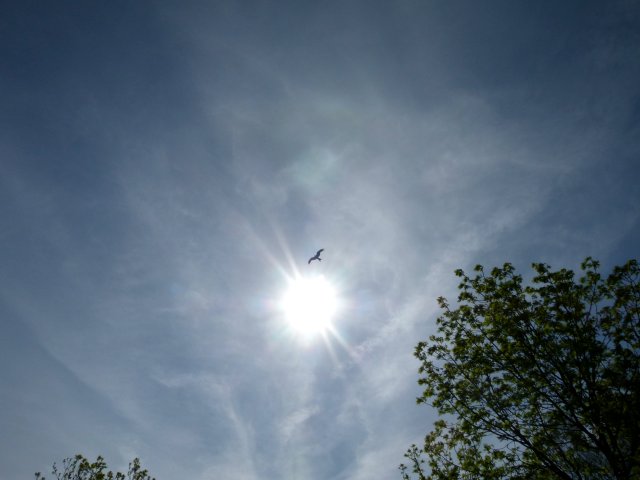
The red kites are teasing me again, circling low over the garden… until I grab the camera, disappearing in their typical fashion as soon as the lens is pointed skywards. They were at it all morning, yet all I managed was a blurry pic and a handful of distant dots in the sky as usual.
I love those birds and cherish an ambition to get a really good photograph of the great birds in flight, one of these days. I can get a clear picture when they have landed, but in flight it always seems that I click the shutter when they are head down, or in odd positions where it is difficult to see their majesty, or a blurred one eye to eye. The birds seem to smile at my naivety.
It reminds me of the incident with the feathers. When we first began following the kites all over…
View original post 654 more words
Share this:

From Stuart…

*
The traditional number of runes stands at twenty-four.
A colt has twenty-four milk teeth.
Sleipnir is a colt.
*
The runes are usually depicted in tablet form
as three rows of eight runes apiece.
*
The facts here tend to support the poetic thesis.
*
There is, though, an important distinction to be made.
‘Heaven’ is not here viewed as a navigable place,
which is how we might have been led to regard it but, rather, as a space,
that is, a ‘head-space’ or a state of consciousness.
*
The runes give access to this consciousness
through the process known as ‘divination’.
*
So, keys, yes but not on a ring or chain,
and ‘heaven’ is not somewhere we are destined
to arrive at or not but, rather,
a state mind, or realm, which can be accessed by all.
Share this:

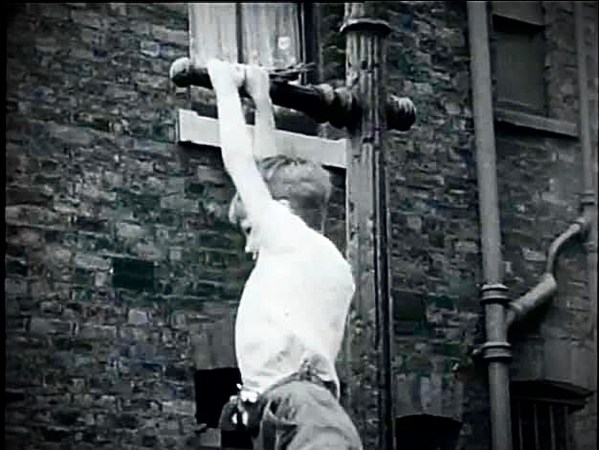
No thought of dirt as
Young fingers slid round iron
Rifled in straight and bitter verticals
To stop small boys ascending
Ha!
~~~~~~~~
The base to space so broad
We could propel those vital
First two feet, and then
With will, and strengthening fingers
And will, and tearing nails
And will, and iron conquered
Hang in space so far
From that ordinary world
Until, with screaming sinews
The blackened hands would
Reach, exhausted
And curling forearms
And sometimes ruined, red jumpers
Take the strain, as gravity reclaimed
It’s filthy child…
~~~~~~~
Not yet, the iron rang, descending
With secret pride. Not yet, then
Some fell… Some didn’t
Hanging in a line of spine
So straight the passing breeze would tease:
Look children! That joy and will
Have made a loving tangent to
The living Earth…
And then was gone, but watching.
~~~~~~~~
©Stephen Tanham 2020
Stephen Tanham is a Director of the Silent Eye School of Consciousness, a not-for-profit teaching school of modern mysticism that helps people find a personal path to a deeper place within their internal and external lives.
The Silent Eye provides home-based, practical courses which are low-cost and personally supervised. The course materials and corresponding supervision are provided month by month without further commitment.
Steve’s personal blog, Sun in Gemini, is at stevetanham.wordpress.com.
Share this:

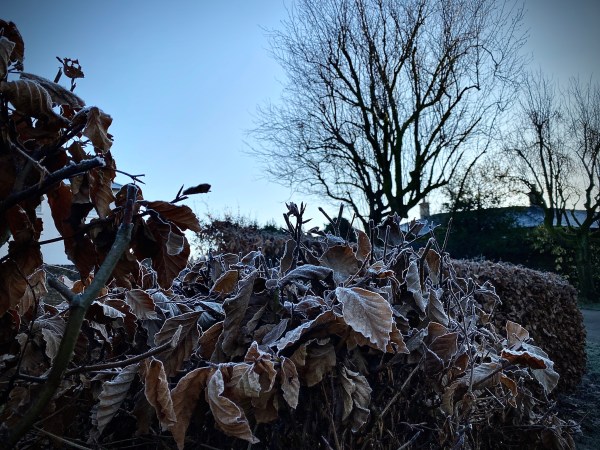
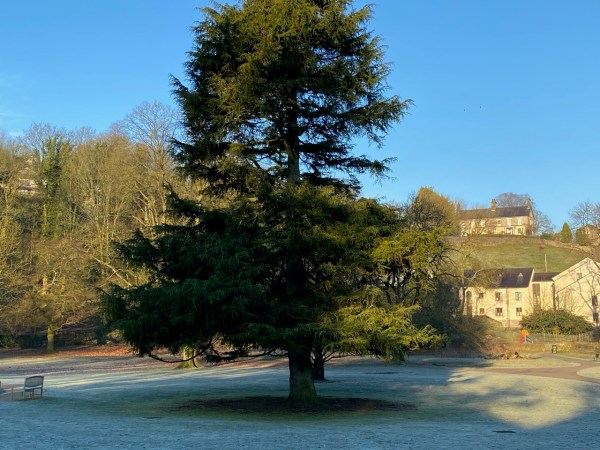
There’s a new park in Kendal. It nestles beneath the Fellside district. It’s an old part of the town that climbs to become one of the first fells on the way to Lake Windermere. The meeting of Lakeland fell and level park is dramatic and beautiful.
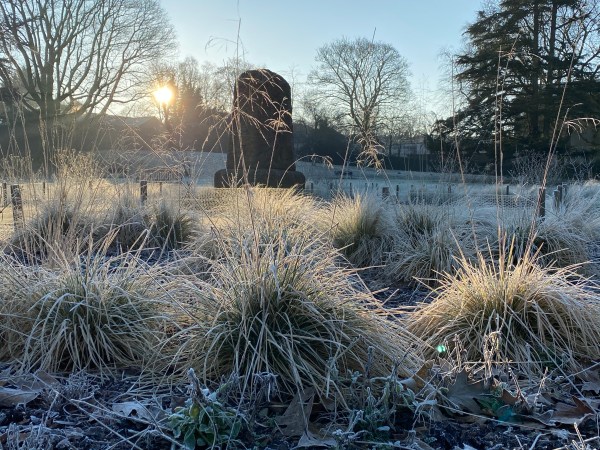
The centre of the park is circular, and filled with ornamental grasses, surrounded by shrubs.
Cold and frost are not always easy to photograph. But when there is a bright, morning sun climbing over the horizon something magical can happen…
©Stephen Tanham 2020
Stephen Tanham is a Director of the Silent Eye School of Consciousness, a not-for-profit teaching school of modern mysticism that helps people find a personal path to a deeper place within their internal and external lives.
The Silent Eye provides home-based, practical courses which are low-cost and personally supervised. The course materials and corresponding supervision are provided month by month without further commitment.
Steve’s personal blog, Sun in Gemini, is at stevetanham.wordpress.com.
Share this:

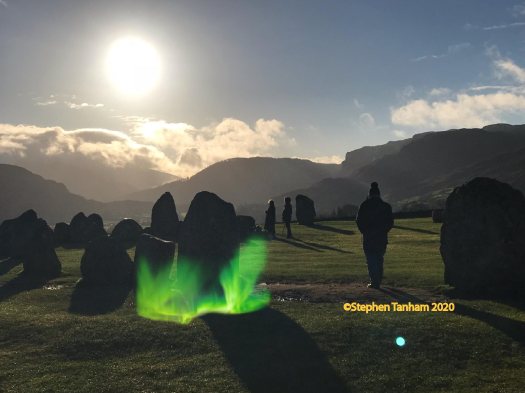
I’ve taken a lot of photographs during the past ten years, but none of them like the one above. Shot at Castlerigg Stone Circle, near Keswick, in December 2018, it depicts what I’ve called the ‘green flame’.
The photo was part of a set taken during the ‘Full Circle’ Silent Eye weekend. Sue and Stuart had created the weekend and were doing the detailed write ups, so I just filed the photos away without really looking at them. Recently, I was searching for a photo of Castlerigg to use on a blog, when I came across this… and just stared.
First reactions. It reminds me of ‘Kirlian’ photography, where subtle electromagnetic fields around living things are photographed using special cameras. But this is a stone circle, not a living thing.
Castlerigg – one of the oldest stone circles in Europe – is a place of intense ‘spiritual’ focus, and has been so for thousands of years. The presence of the ‘green flames’ would immediately be seized on as evidence of the paranormal by some… I’m open to its vital connections, but I prefer to remain objective about what else it might be…
Many photographs taken in bright sunlight contain chromatic aberrations. These range from mists or fogs, through shadows that look like ghosts, to single or multiple ‘orbs’ that fill part or all of the image with bright and colourful spheres. There are many more types of photographic interference.
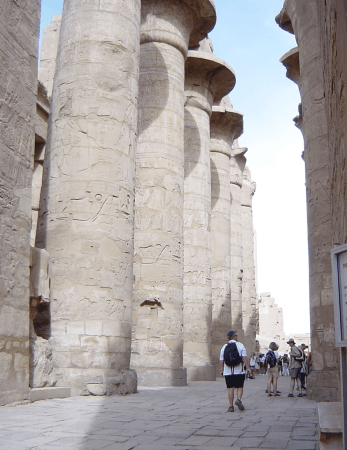
Years ago, in the hypostyle hall in the Karnak temples of Egypt, I took a shot with a flash in total darkness. When I looked later at the image, it was filled with the most gloriously coloured ‘orbs’ arranged in the space of the columned temple in a 3D progression. The photo is long lost to a system crash on my old PC, but I remember it well. At the time, I dismissed it as a pleasing set of orbs.
But when I saw the above photo from Castlerigg, I began to consider alternatives…
At first glance, the photo is so convincing that you wonder if it’s been manipulated in a computer application such as Adobe’s Photoshop. The green flames rising from the winter ground follow the basal contours of all the stones they appear to touch; even changing intensity from a white to green as they leave the earth and touch the stones. I can assure anyone reading this that the photo is completely unretouched, apart from my addition of the copyright to this low-resolution copy.
The green flames are transparent. They vary in ‘density’ and this allows us to see the stones and other features behind them. If I’d had the skills to do this in Photoshop, I’d be proud of the results…
Let’s consider the other side of the argument: that they are a satisfying chromatic aberration. The first thing to note is the position of the sun. It’s almost opposite the camera. It could be argued that this gives the potential for a mysterious accident of the light. But, in years of deliberately seeking this kind of filter to create background images, I’ve never seen any such ‘effect’ appear to wrap itself around a set of objects.
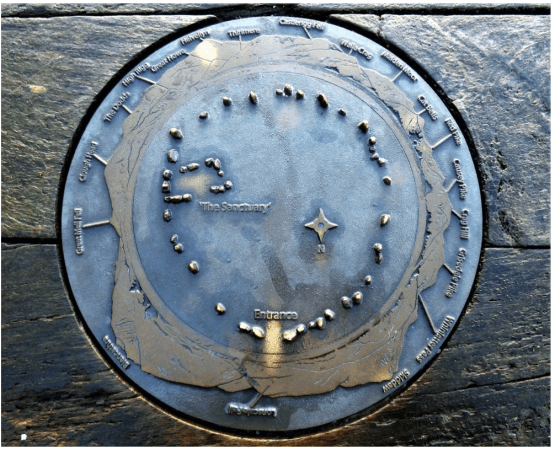
The green flame seems to be active with the leftmost of the two portal stones – and the small stone on the ground next to it. The portal stones are the entrance to the circle and the place of alignment with the midwinter sunset. The honouring of the shortest day and longest night was a celebration of the initiation of journey towards the light, rather than away from it, as at the summer solstice. It was a time of profound importance to the ancient priests.
I’ve gazed at the green flame photo for a long time. When I first started to do this it suggested itself as a good illustration of a pet theory of mine: that of the flickering present.
Imagine that each of us is a lighthouse, and our beams of light rotate, not to be seen by ships at sea, but to light up a landscape that is our world. Our brains assemble the flickering images and create something apparently seamless – our lives – from what is seen. Things that are dangerous or very beautiful require us to spend time studying the landscape so that we can spot their patterns in the future.
The speed of rotation of our lighthouse and the brightness of our light determine how well we can see the ‘reality’ of our existence – our ‘out there’. Certain phenomena are rarely seen and appear to be in the ‘wrong’ place in our world. We may call these ‘psychic phenomena’ and they may be frightening – the unknown often is, especially when we are taught fear of it by our elders or forebears. But such things may simply ‘be there’, but not often seen in our beams of light.
If the green flame is real, then I may just have got lucky with the microsecond timing of pressing the shutter, aided by the brightness of the sun opposite us in the sky. Certainly, I did not see the green flame at the time of taking the photograph. The green flame may be there all the time… or it may be present at periods of high energy related to its original use, during the Stone Age.
Or it may be an illusion, happily fitting into the contours of the stones in question.
Castlerigg is around 5,000 years old and is one of Britain’s earliest stone circles. Its 38 stones, some as high as three metres, have seen a lot of solstices… Whatever is in the photo, it’s in good company…
[For more information on the Silent Eye’s ‘landscape weekends’, click here]
©Stephen Tanham 2020
Stephen Tanham is a Director of the Silent Eye School of Consciousness, a not-for-profit teaching school of modern mysticism that helps people find a personal path to a deeper place within their internal and external lives.
The Silent Eye provides home-based, practical courses which are low-cost and personally supervised. The course materials and corresponding supervision are provided month by month without further commitment.
Steve’s personal blog, Sun in Gemini, is at stevetanham.wordpress.com.
Share this:


The A66 road connects east and west across northern England and runs through some of the highest parts of the Pennine Hills. Notorious for its severe winter winds that topple heavy wagons, it’s also very beautiful.
Here, at its western end, this fast road soars across the glacial landscape, up and down like a bird of prey, before dropping us onto a scene of such scale that the breath is taken away… no matter how many times you’ve seen it, before.
Ahead to the right are the Lake District peaks of Blencathra and, beyond, Skiddaw.
As if respecting our fragility in the face of such size, the highway finally curls left, spinning us gently into Keswick, where hobbits love, and the cafes are plentiful… with fish and chips if you’ve fled the dragon-vastness into hunger.
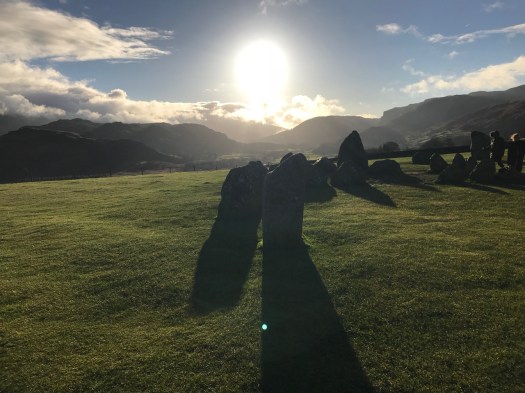
In a thousand different ways, you can be born again at the end of this ferocious road. On the hillside to the left of where this photo was taken lies the stone circle of Castlerigg, ancient beyond measure and watching…
©Stephen Tanham 2020
Stephen Tanham is a Director of the Silent Eye School of Consciousness, a not-for-profit teaching school of modern mysticism that helps people find a personal path to a deeper place within their internal and external lives.
The Silent Eye provides home-based, practical courses which are low-cost and personally supervised. The course materials and corresponding supervision are provided month by month without further commitment.
Steve’s personal blog, Sun in Gemini, is at stevetanham.wordpress.com.
Share this:


You took us to your window
To see the cliffs of dawn
Across the miles they shone like sheets
Hung on a washing line
We knew, you said, beyond the chalk
On scribbled boards you waited
And prayed that you were searching, too
For those who searched for you…
©Stephen Tanham
Share this:

From Stuart…


*
…Come together in this countryside, where so much has lately gone undone,
Come armed with wisdom and intelligence, together we shall utter the words of truth,
which heaven’s saints are wont to hear and they will come down amongst us…
*
…We are now clambering back into Wen’s low slung car. “I have much higher hopes of the next one.”
“Which is?”
“The Virgin of the Ridge… Twelfth-century construction or earlier… presence of wall paintings…”
“Sounds promising. The presence of wall paintings seems to be particularly germane, don’t you think?”
If the church sounded promising, it looks even more so when we catch our first glimpse of it, when cresting a rise in what appears to be the forested heart of the whole area.
The Virgin of the Grove perhaps… and on closer inspection, it does indeed stand upon an idyllic spot, another raised mound surrounded by trees and…
View original post 461 more words
Share this:


The town of Cassel, near Lille in Northern France, is shrouded in mist – the same mist that had accompanied our first ever visit to the World War One cemeteries of Vimy and Notre Dame de Lorette.

Six of us are slotted, snugly, into the mid-size people carrier bouncing at speed into the centre of Cassel. Behind us are a variety of warm coats that are going to keep us alive when we get out of the car. It’s freezing out there… and misty. It’s a biting cold that has followed us throughout our trip.
It’s all very French…

Christophe beats another driver to the one remaining free spot in the market square of Cassel and steps out, smiling at the cold. He slides on his thin coat. He’s our resident ‘action man’; a runner, swimmer and cyclist. The day before, he insisted on taking us to a long beach in northern Calais so that we could walk one of the family’s dogs… and he could swim in the sea… In mid-mid January, for heaven’s sake…
That brief cameo is amusing but doesn’t do him justice. He’s very intelligent and full of warmth. He’s a man of immense hospitality. Three years ago I didn’t know he existed. My wife, Bernie, discovered his family through the online Ancestry website. We had known the French side of the family existed, as my great uncle Stephen stayed in France after surviving the WW1… including the Battle of the Somme, whose site is only a few miles away. Christophe is his grandson.
Stephen married a French girl – the daughter of a baker in St Omer. They trained him up as (in their own words) ‘a kind of baker from Bolton‘, and he and his new wife prospered and had four children. We’ve visited Stephen and Adrienne’s grave. It was quite a moment.
Christophe is their grandson… and my second cousin. For over eighty years the two branches of the family were lost to each other. I’m hoping to write a book on the story and the amazing stroke of luck that led to the discovery of their existence.

Christophe and his mother, Mado, have brought us to Cassel as part of a day’s touring to show us some of their favourite towns in this part of France. The department of Nord lies in the far north of France, It was formed from the western halves of the historical areas of Flanders and Hainault, and the Bishopric of Cambrai. The nearest city is Lille -where the other branch of our long-lost family lives. The French Flemish dialect of Dutch is still spoken here, side by side with modern French.
The first thing to say about Cassel is that it’s a town on a hill – Mont Cassel. This is a flat part of France. At 176 metres above sea level, Mont Cassel towers over the surrounding countryside. Its peak offers a vantage point from which you can see all of the surrounding landscape… If the prevailing weather is not freezing fog as it was during our visit.
The main rock of the hill is limestone, capped with a harder outer layer of iron-bearing rock. This geological layering has made it an ideal base for military and social fortifications throughout its long history.
The hill was occupied during the late Iron Age by the Menapii, a dominant Belgic tribe who made their hill fort the capital of a vast territory extending from Calais to the Rhine. The Menapii fought against Julius Caesar, but the Roman governor of Gaul, Carrinas, subsequently quelled their rebellion, and the Menapii culture and territory were absorbed into the Roman Empire. The modern town takes its name from the Roman settlement, not the later middle ages fortification shown in the historic map, below:


But, first, Christophe wants to show us a different face of the hill in Cassel. The summit and its fortifications have long been re-purposed, and Christophe points us up a steep, cobbled path with some very strange concrete ornaments.

From the information board:
“The Alpin Stairs are a vestige of ‘rock-work’ architecture, typical of the end of the 19th century, like those at Buttes Chaqumont in Paris.
These pseudo-rustic architectural compositions imitate mineral or vegetable elements like stone or wood.’

I stare at the concrete forms. They are old and dirty; and it’s necessary to see beyond that facade to get to the spirit of their origin. The visitor board goes on to say that they were designed for two purposes: ‘to reflect nature and to remind visitors of the ‘atmosphere of the mountains’. In that latter sentiment, I can suddenly see what they meant… and with that comes a memory of another artist and architect of the time of the Art Nouveau movement – Charles Rennie Mackintosh.

At the top of the Alpin Stairs we come into the Jardin des Mont du Recollets (Garden of Remembrance). Normally, it provides expansive views over the plains of Flanders and, on a very clear day, the North Sea, but not today…

Historically, it was said that from Mont Cassel you could see five kingdoms: France, Belgium, Holland, England … and Heaven. We smile, ruefully and turn to examine the beautiful gardens.

Beyond the geometric beds, the pathway winds round a beautiful set of willow trees, frosted with the freezing fog. At this point the fog begins to add great beauty to the place..

The Kasteel Meulen is a real ‘Castle Windmill’ situated on the highest point of Mont Cassel on the site of the former castle. The original windmill, constructed here in the 16th century, burned down in 1911. It was replaced in 1947 by an 18th century windmill that was moved from nearby Arneke. The mill works and is still open to the public during the summer.

The garden also hosts an equestrian statue of Marshal Foch and the Monument of the three battles. Marshal Foch was the Supreme Allied Commander during WW1 and Cassel served as his headquarters between October 1914 and May 1915.

He moved his headquarters to Cassel to take advantage of its strategic position near the northern end of the Western Front.

From 1916-1918, Cassel was the headquarters the British Army under Sir Hubert Plumer. The town avoided major damage during the war, though it came under occasional shelling when the Germans advanced to within 18 kilometres during the Battle of Lys in April 1918, shortly before the end of the war.

We leave the Remembrance Gardens quietly. They are a place of great beauty and contemplation. We may never be back and it feels good to have spent time here…
©Stephen Tanham 2020
Stephen Tanham is a Director of the Silent Eye School of Consciousness, a not-for-profit teaching school of modern mysticism that helps people find a personal path to a deeper place within their internal and external lives.
The Silent Eye provides home-based, practical courses which are low-cost and personally supervised. The course materials and corresponding supervision are provided month by month without further commitment.
Steve’s personal blog, Sun in Gemini, is at stevetanham.wordpress.com.
Share this:


Like most bloggers, I enjoy writing. I also enjoy taking photographs – as many as my long-suffering wife, Bernie, can tolerate, on our travels.
One of my favourite styles of photography is black and white – particularly the high-contrast ‘Noir’ mode offered by modern cameras. I recently suppressed the urge to upgrade my ageing Apple laptop in favour of spending the money on a new iPhone II pro, the one with the three lenses, aimed at the more serious snapper… It is always with me, as it masquerades as a phone, too…

For the second year in a row, we travelled to northern France in January. It’s a touch masochistic, as the weather around the Pas de Calais region is nothing short of freezing at that time of year. But we enjoy catching up with our French relatives and the coldness of the climate is matched by the familial warmth and hospitality.
The French family is split between Calais and Lille. We enjoy both, but, last year, on an escorted trip up the coast, we discovered the Belle Époque seaside town of Wimereux, only thirty minutes from Calais. With no time to stop – our beloved French matriarch was cooking the family’s Sunday lunch! – we looked longingly at the beautiful streets and houses as we were driven past..

So, this time, between the visit to Lille, on the Belgian border, and the return to Calais, we booked a two night stay in what turned out to be a lovely B&B in the heart of Wimereux, within walking distance of the promenade and the shops. Visits to relatives can be intense, so the chance to unwind and just stroll was very welcome… We resolved that the car would stay where it was – parked right outside the B&B – and we would spend the two days walking… and, in my case, taking photographs to celebrate such a beautiful place.

The town was established during France’s ‘second empire’; a term that refers to the period of Napoleon III (1808-1873), who, seeking to emulate his illustrious forebears, changed France radically, centring the country on Paris and creating a sophisticated national rail network.

The train brought well-heeled visitors to Wimereux, resulting in a vibrant seaside town full of houses and other buildings in the sophisticated ‘end of century’ style. The town is proud of its heritage and looks after its historic buildings. Wimereux was originally a place of secondary residence for wealthy families from Lille and Paris, but has now become a residential suburb of Boulogne-Sur-Mer. It is visibly international, and attracts Britons and Belgians, many of whom have settled permanently.

The secondary title of this blog: Sodium Stroll, refers to the fact that all these photos were taking late at night under winter street lighting, which we used to call ‘sodium lamps’ – a reference to the metal used to give the yellow-muted light they provide. For my purposes, this light is ideal for capturing ‘mood’.
Mood is what I’m after, here…
Walking in the monochrome dark like this invites whimsy and reflection. The captions to the photos reflect that.
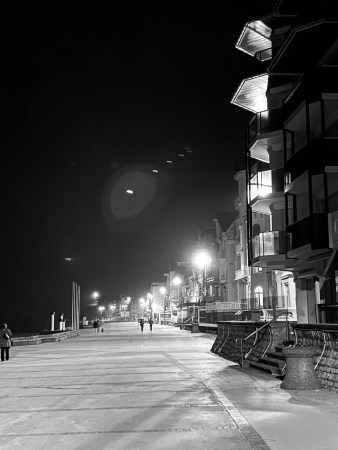
It’s bitter on the promenade, but most people we encounter take the time to stop and share the moment… We are all drawn by a certain something in this darkness.

The cold is becoming bitter. We decide to return to our B&B in a final circuit of streets.
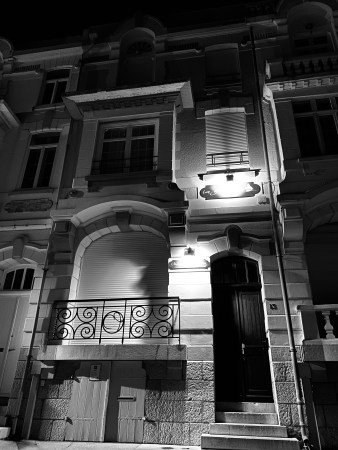
Along the way, I notice the ‘sodium light’ is throwing an effective and humorous shadow along the white walls. It’s an ideal end to the whimsy. One of my Facebook friends has dubbed this my ‘Harry Lime’ shot…. A reference to the 1949 ‘Noir’ film, The Third Man.

It was a very cold night… and, yes, that is my hat, made in Paris and bought in Lille.
©Stephen Tanham 2020
Stephen Tanham is a Director of the Silent Eye School of Consciousness, a not-for-profit teaching school of modern mysticism that helps people find a personal path to a deeper place within their internal and external lives.
The Silent Eye provides home-based, practical courses which are low-cost and personally supervised. The course materials and corresponding supervision are provided month by month without further commitment.
Steve’s personal blog, Sun in Gemini, is at stevetanham.wordpress.com.
Share this:


Sometimes you just get lucky. This is the mouth of the estuary at Arnside, Cumbria, where two of the abundant local rivers flow out into Morecambe Bay.
During the previous half hour, and further upstream, I had taken several shots on the tiny beach where we sometimes walk Tess, our Collie dog–and finish the day with the excellent local fish and chips.. With the light fading, we were turning the car around here in the tiny harbour, when the sky suddenly exploded with orange liquid.
I stopped the car and literally ran back to this, the best vantage spot, and took about twenty variants till the moment passed and night encroached…
©Stephen Tanham 2020
Stephen Tanham is a Director of the Silent Eye School of Consciousness, a not-for-profit teaching school of modern mysticism that helps people find a personal path to a deeper place within their internal and external lives.
The Silent Eye provides home-based, practical courses which are low-cost and personally supervised. The course materials and corresponding supervision are provided month by month without further commitment.
Steve’s personal blog, Sun in Gemini, is at stevetanham.wordpress.com.


 Sun in Gemini
You must be logged in to post a comment.