
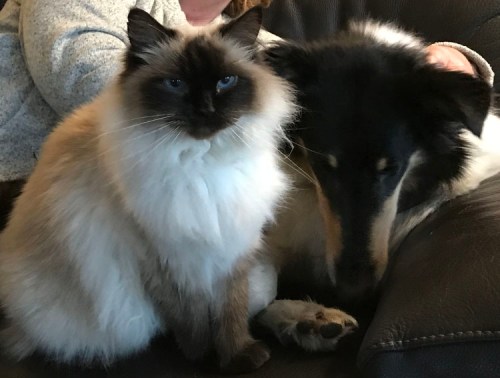
Misti : I’m bored
Tess: I’m staying asleep
Misti: I’m still bored
Tess: You’ve been running across the back of my settee for an hour
Misti: You’re so predictable…
©Stephen Tanham
Share this:

+ #Silenti, Consciousness, esoteric psychology, Mindfulness, Silent Eye School, Spirituality, Truth and Esotericism
Reality TV?
by Steve Tanham

It’s full of trivia and artificial things; things which have arisen in the name of entertainment. Everywhere you look there is a stream of mindless celebrities willing – some would say desperate – to eat tropical bugs to give themselves a chance of being famous, again. It reminds me of a sad film I once saw called “They Shoot Horses, Don’t They”.
There are also some of the best and most informative documentary programmes we have ever seen. Such a mixture, and, as usual, it’s a matter of personal choice – and a bit of effort…
Television. It’s changed a lot since I was a boy… Perhaps not all for the better. But it’s not the purpose of this blog to complain about the ‘box’. We are all entitled to our leisure time and to choose how we spend it. To me, there is a sense here of a ‘race to the bottom’ about a whole layer of modern entertainment. This seems to go hand in hand with a view of life as a comic strip, where there must be good guys and bad guys and violent resolutions. Superhero movies don’t help. The truth is complex. Resolution of problems always involves compromise. There is no black and white.
How about considering the humble TV in a different way: as a reflection of the mind and human consciousness, it’s an experiment that opens up a set of parallels that are fascinating.
The TV shows us a flat screen that our minds have learned to convert back into our native 3D. With a well made drama programme that we can be ‘lost’ in, the experience is a good approximation of being there. Children can be traumatised by scary TV programmes. Adults sometimes forget the degree to which they cannot separate it from reality. Only later in life do we see that the ‘scare’ can be switched off inside ourselves, but only if we ‘pull back’ from the flat screen experience and deny it its imaginative power. My wife still can’t and hides her face behind a cushion with really scary films…
In ‘switching off’ what appears to be present lies a mystical parallel. Can the television teach us to do the same thing with life, itself?
I’m watching a bunch of gym-obsessed twenty-somethings flaunt themselves on an island in the sun. The women are blonde and beautiful; the men shaped like Greek gods… But their conversation could be from a junior school. The whole thing is entirely artificial. I mutter under my breath and switch it over. It’s a documentary about plastic waste and what we are doing to our oceans. I care about this, so I sit down and watch, clutching my cup of tea. This is real… and painful. I wish the perfect sun worshippers were watching this, too. We could us their energies…
Can we, in life, switch over channels? To do this we have to find the equivalent of us being on our comfy chair and watching the TV. This is entirely possible and is one of the basic techniques that we teach in the Silent Eye School of Consciousness.
We need to, literally, push the world away from our eyeballs. Sound crazy? Well, the reason the world is painted on our eyeballs is that we identify with what we see. Like the child with the television, we can’t see the screen and ourselves at the same time. By developing this dual consciousness – which is the work of only a few months – we can begin to watch our own life as though it were a screen. In fact it is a kind of screen, one on which we project much of our existence. We see this as happening to us, but, really, we are happening to ourselves. At least at the mundane levels of life.
Once we begin to penetrate the understand of the ‘world as television’ we can start to look for the truly real…. and that is a very different journey.
©️Stephen Tanham
Stephen Tanham is a director of the Silent Eye School of Consciousness, a not-for-profit organisation that helps people find a personal path to a deeper place within their internal and external lives.
The Silent Eye provides home-based, practical courses which are low-cost and personally supervised. The course materials and corresponding supervision are provided month by month without further commitment.
Steve’s personal blog, Sun in Gemini, is at stevetanham.wordpress.com.
Share this:

From Stuart…
Share this:

+ #Silenti, Consciousness, esoteric psychology, Higher Mind, Mindfulness, Mystery Schools, Politics and Power, Powers of the Mind, Speaking truth to power, spiritual turning around, Spirituality, Tech, Technology
The Faces of Shiva (1)
by Steve Tanham

(Montage image by the author. See base of post for source of Shiva element)
Brahma creates the world. Vishnu sustains it so that it might achieve its potential. Shiva destroys it when its positive energy has been exhausted. The ‘world’ might be everything, or, for the initiate of old, it might just as well apply to anything created by the mind – large or small. In other words a system.
It should make us think…
The ancient Hindu triumvirate describes a deep and recurring motif in spirituality: that there must be a threefold process, which necessarily involves the sweeping away of that which has served its purpose; has ceased to support the structures it built to achieve its purposes; has ceased to draw upon the positive (expansive) energies that sustained its coming-into-maturity.
We could be forgiven for thinking that this ancient myth accurately describes what we are experiencing in the world economics, politics and technology.
At the heart of it is the question: does the ordinary human have any intrinsic value?
We take for granted that we have value – that human life has value. We are at the top of the food-chain. We are intelligent. We created machines that appear to think, at least well enough to solve problems. Yet we are surrounded by recent and powerful changes that are sweeping away the consensus of ‘human worth’ that have sustained our civilisations for centuries.
Even a decade ago, we could have counted on an unwritten agreement that human life had value among the powers that control. Now, I’m not so sure. On both sides of the Atlantic (and elsewhere) what was supposedly put to bed at the end of the age of Fascism (World War II and its surrounding periods) is being attacked by either ultra-rich or fanatical forces.
In Britain, we have a crumbling national identify, divided by the hatred generated by Brexit and the advancing power of the political ‘right’ whose vision sweeps away thirty years of social thinking. Thugs from the ultra-right have been empowered by Brexit’s implicit racism and feel justified in threatening and even killing members of parliament who promote social and inclusive agendas.
In America, there is a President who is adored or hated in seemingly equal measure; a head of state who openly rewards the super-rich – that one percent of the elite that owns ninety percent of the wealth.
This kind of approach is applauded by those who espouse the supposed ‘trickle-down’ effect of wealth at that top; yet detailed studies on both sides of the Atlantic have shown that the tricking down of such wealth is non-existent. Many of those who voted for Brexit admit they did it to ‘spoil the party’ of the better off.
On holiday, last November, we met and had dinner with an American couple from Arizona whose company we liked but whose values were very different to ours. The personal possession of guns was one of the issues, but we were able to discuss it in a friendly manner. I learned a lot – particularly from the man’s statement that the police were incapable of responding to armed burglary in time to do anything, and so anyone not armed was vulnerable… He was appalled when I said that, in the UK, I would be committing a serious criminal offence if was caught with a pistol in public. I won’t be – I don’t like guns, but it pays to listen to other people’s views…
We did not fall out. Both sides of the table listened, and we continued to understand each other in more depth. Most telling was what the husband of the couple said to me as we were preparing to leave. He said that we should not believe this ‘bullshit’ that the average American middle-class family was prosperous. In his view this entire layer of American society had become substantially poorer over the past twenty years – the period that the super rich had hoovered up the available wealth – particularly after each financial crash.
The same is true in Britain, where the supposed ‘middle-class’ has seen its prosperity whittled away by the politics of ‘austerity’ since the financial crash of 2007. As a close friend of mine – a very working class man – said, “None of the ****ing bankers were put in prison, yet we’re all a lot poorer through having to bail them out… and the rich seem to be a lot richer, despite this.” In our case, this rage came home to roost with Brexit – changing the face of Britain, possibly forever, and destroying an economic coalition of European countries that had prevailed since the end of WWII.
When I worked in IT (for a Californian company) it was often said to me, in confidence, that the Europoean Union was ‘too successful at international law and too principled…’ Food for thought.
Recently, I watched a documentary in which an American billionaire from Silicon Valley was interviewed on this subject. His opinion runs counter to most of his super-rich friends. He argued that the very wealthy had only to share a little of their wealth to make the whole economic carousel continue in its revolutions; but that they didn’t see it that way, and therefore it was likely doomed…
Everywhere we look there is destruction of the old and formerly stable way of looking at things.
Back to our ‘value of the human’ consideration. I used to think that we could only fix things if we addressed the following:
- There has to be a ‘society’. Former UK prime minister Margaret Thatcher famously said that ‘there was no such thing as society’ – prompting outrage at the time. Collectively, perhaps, we need to re-learn where society comes from and how its values stay strong. The Scandinavian countries seem the best at doing this, and they willingly pay the higher taxes needed to sustain it.
- We have to believe that politics both works and matters. To have politics we have to have real choices. If, say, a victory for either side in a two-party state actually results in a the same economy-controlled decisions, then that is not a choice – it’s a fake choice. Following WWII, Britain voted out an astonished Winston Churchill in favour of a radical Labour Party that proceeded to carry out an exhaustive and effective overhaul of British social provisions. That was only possible because there was belief that change could be achieved.
- There has to be education about the issues. Brexit is a case in point. Even hardline pro-Brexit voters now admit they had no comprehension of the complexity of what they were voting for. They may not want to change their minds, but they agree they were misled.
- Technology – particularly social media – needs to be brought under a unified regulatory structure, even if it means extending the present laws to accommodate the uniques. The abuse of this mechanism was widespread in the Brexit referendum – and in the last US election. An English software company – Cambridge Analytica (about which I wrote at the time) – was chased to ground and had to ceased trading, but that’s proving to have been the tip of the iceberg. The origin of some of the vast sums spent with the social media companies on these campaigns remains shadowy.
Today, I’m not sure that list is comprehensive. Much of what follows in these posts is about the gaps…
Our world is complex and it is international. Any attempt to turn the clock back to simpler days, like ‘little Englanders’ do, is doomed to swift and painful failure. The degree to which people’s prosperity is inextricably linked with the state of the rest of the world is a terrifying thing – unless you see it as part of an evolution of the human race; an evolution in which we are brought face to face with the real conditions prevailing in the rest of the planet – unable to ‘turn off the TV’.
Is the face of Shiva upon us? The speed with which these changes occurred, and is occurring; and the success of some of the most destructive forces suggests that, whatever you call it, something whose time has come is active across the planet. This may be a test of the present stage of humanity, or it may simply be an age of destruction. It’s happened before, but few learn from history.
In the next few posts, I will be writing about some of the most pressing topics around the subject of global power, economics and technology. Beginning with the degree to which western democracies are wide open to active and politically-sponsored online interference from hostile forces.
These are my personal views. I respect those of others who may not agree with them. If there is a way through these things we need to share views and talk a lot. If we don’t there may not be a future…
Please free to add your own comments.
©️Stephen Tanham
Stephen Tanham is a director of the Silent Eye School of Consciousness, a not-for-profit organisation that helps people find a personal path to a deeper place within their internal and external lives.
The Silent Eye provides home-based, practical courses which are low-cost and personally supervised. The course materials and corresponding supervision are provided month by month without further commitment.
Steve’s personal blog, Sun in Gemini, is at stevetanham.wordpress.com.
Images: The opening montage is by the author. The underlying image of Shiva is from Wikipedia under the licence detailed below.
https://upload.wikimedia.org/wikipedia/commons/4/4a/Shiva_cropped.jpg
Thejas Panarkandy from India – Murudeshwara Statue
©️Stephen Tanham
Stephen Tanham is a director of the Silent Eye School of Consciousness, a not-for-profit organisation that helps people find a personal path to a deeper place within their internal and external lives.
The Silent Eye provides home-based, practical courses which are low-cost and personally supervised. The course materials and corresponding supervision are provided month by month without further commitment.
Steve’s personal blog, Sun in Gemini, is at stevetanham.wordpress.com.
Share this:

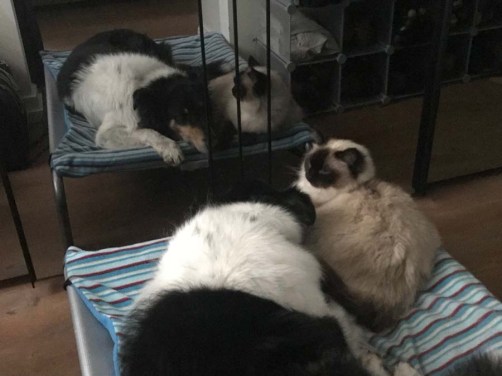
Tees : There are two of them…
Misti : There are two of us…
Tess: One of them is watching us.
Misti: It’s a mirror
Tess: What’s a mirror?
©Stephen Tanham
Share this:

+ #Silenti, Astrology, Astrophysics, Consciousness, esoteric psychology, Higher Mind, Mystery Schools, Silent Eye School, Spirituality
The rotating blade of meaning (8) – final part
by Steve Tanham

In the preceding parts of this series (see below for full list) we have seen how Arthur M. Young, inventor and chief engineer of Bell’s early helicopter design, was convinced that it was possible to construct a ‘map of human meaning’, a graphic figure that would show the relationships between the laws of physics and the observer in a new way.
In its experiments, science had always tried get rid of the observer; and yet it was the observer’s mind that constructed the experiment in the first place…. How odd, thought Young, to try to get rid of the core animating principle behind the whole thing!
His early confirmation of this came with a new analysis of the common forms of motion, starting with the idea of distance from a point, then examining the relationship between distance travelled and the time taken (velocity); then considering the rate of change of such velocity when more force (pressing the accelerator in a car) was applied to create acceleration.

Each of these could be laid out on a circle, with distance being at the right, horizontal point. Each of the others came into existence at a right angle – ninety degrees – to the previous. In parts two and three, we saw how velocity was distance (a straight line) divided by time; acceleration was distance divided by time squared (an area); and that there was something missing at the final point (the upper vertical), which would equate to distance divided by time cubed – a 3D cube – the foundation of our physical world.
As an engineer, Arthur M. Young knew that he had used formula that divided by things cubed in his control systems for the helicopters he designed. He realised that this was the point at which the observer interacted with the system, in the form of control.
His task was now to extend this circular mapping to integrate all the other equations of ‘motion’ in the greater sense. These included all the remaining formula used by physics to describe aspects of motion.
First, he had to reconcile the properties of ‘fourness’ that had led to the mapping of general meaning with the key mystical concepts of ‘threeness’
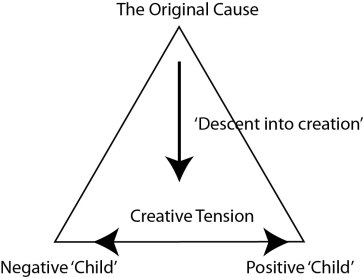
The diagram above shows the process whereby something of a ‘higher nature’, spiritually, divides itself into two ‘children’ in order to come into manifestation at a ‘lower’ level. This is a deeply mystical idea and is the basis of most of the world’s metaphysical thought.
The key to understanding this is the realisation that the ‘above’ does not entirely remain there, it ‘enters into’ its creation – the lower. Nothing is lost… in fact much is gained. The whole, the One, becomes Two, but does not lose its oneness, when seen at the original level. The result is Three… represented by the triangle, which can direct itself up or down. If down, it is in the ‘God-descending’ process of involution. If upwards, it is the planetary process of evolution.
The One undertakes this transformation only because it can extend itself in the process. The potential role for mankind is to bring this intent to fruition; matching the microcosm (us) to the macrocosm (the creator). To ‘God’, there is an involvement with the creation. Mankind has to learn first to ‘see’ God in the multiplicity of the world. To do this requires the undoing of much of our ordinary learning, based upon the desire be a living part of unity.
Sadly, it is beyond the scope of these few blogs to provide more of the mathematical and logical mapping that Arthur M. Young carried out. Many of the techniques were invented by him. He was seeking what he called his ‘Rosetta Stone of Meaning‘. We can, therefore, cut to the chase and show the finished thing:
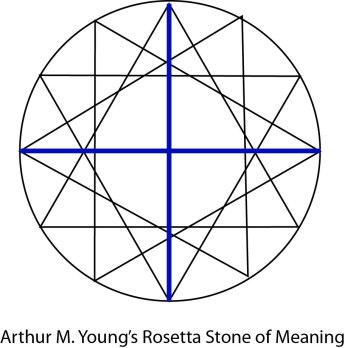
The figure comprises the original square cross of our original process of human meaning overlaid with four triangles. The result is twelve points on the circumference of the circle – exactly the number that astrology uses in its map of the year and the signs.
What had Arthur M. Young achieved with this reconciliation of physics, metaphysics and the place of the observer within both?
First and foremost, he had shown that our state as observer of ‘the’ world was not a single state, that there were incremental stages of consciousness corresponding to his maps of meaning. He showed that raw experience was the first product of our perception and that it occurred before our consciousness of anything. Whatever is ‘out-there’ has to register before our mind can begin to process it. After that, as the Rosicrucians often said, ‘mind assigns it dimension’. This produces a literal depth of perception that a different part of the mind can then categorise.
It does this so it can group like things, giving related sets of experience. As an infant (as discussed in Part 7) the most important of these is what will hurt us. The organism has to endure, and there are many things in the out-there that can hurt or kill it.
Over time, we confuse the two organic fear of survival with what we like and dislike. In this way our registered experience become confused with what is being ‘valued’ as good and bad – in the Genesis story this is the fruit of the tree of good and evil. Ultimately, there is no good and evil, only what is. But our personal growth demands we take the long learning curve to real knowledge of our place in existence: gnosis, as the ancient teachers named it.
Arthur M. Young showed us that our consciousness – that jewel at the centre of our organism, needs threeness and fourness to divide its ‘circle’ of meaning into twelve parallel aspects. Once these are known, there is nothing that can fall outside their realm. The totality of our existence is mapped into this glyph – and it is of great significance that this corresponds with the twelve-fold divisions of the wheel of astrology – the most ancient of the ‘power-glyphs’.
What is humanity in this picture? As organic beings, we are wholly of this planet. The good Earth lends us her bright materials, and the seed from afar takes root and grows. It’s highest function is to be fully conscious, and, within that, to use the inbuilt gradients to set a course for ‘heaven’. Many storms await, but captains are made of storms, not books on navigation – though the latter are vital if this life-layer of humanity is to learn to give its fullest love back to the globe that nurtured it.
Information about Arthur M. Young, 1905-1995
This series of blogs are based upon the book: The Geometry of Meaning, by Arthur M. Young. ISBN 1-892160-01-3.
Many of his talks are available on YouTube.
Previous posts in this series:
Part One, Part Two, Part Three, Part Four
©️Stephen Tanham
Stephen Tanham is a director of the Silent Eye School of Consciousness, a not-for-profit organisation that helps people find a personal path to a deeper place within their internal and external lives.
The Silent Eye provides home-based, practical courses which are low-cost and personally supervised. The course materials and corresponding supervision are provided month by month without further commitment.
Steve’s personal blog, Sun in Gemini, is at stevetanham.wordpress.com.
You’ll find friends, poetry, literature and photography there…and some great guest posts on related topics.
Share this:


(pixabay image by Natan Vance)
“And therefore…”
She was making fun of me; a fire in her eyes, and drawing circles on my skin after lovemaking, circles that burned with desire and brought me back to life in way that broke the fences of before…
“I’ll show you,” she said, rising from our newly-earned bed.
I stood, shivering in my expensive raincoat at the end of the street. Stood inside my chalked circle within which I’d be safe, she said, mocking with steel, walking to the end of the street, looking back at me.
The orb in that dreadful sky blinked as though waking. Its intensity followed her nimble form as she strode back toward me. The parallax broke the world… the impossible followed her down the street and towards us both.
The chalk circle burned into a ring of fire, its flames licking my skin beneath the frighteningly thin coat – my vanishing, single defence.
“With both feet,” she howled above the ringing of the orb, daring me to fail…
With scorched feet, I didn’t….
©Stephen Tanham
Written for Myths of the Mirror.
https://mythsofthemirror.com/2019/03/01/march-speculative-fiction-prompt/
Share this:

Alethea continue her Cumbrian journey…

The pulse of red spiral of light emanating from the Long Meg stone lasted mere seconds. As the stone returned to its outer stasis, I found myself catching my breath in wonderment. Had I imagined the red eye? I examined the place where it arose, and before me was a spiral, inlaid in the stone. Surely I had not, but what did it mean? I am not, by nature, prone to seeing the unseen with my eyes open. Each time it happens it feels like a rare and precious gift, and this was no exception. I had not expected to have a connection such as this at Long Meg. Rather, I had thought my moment was intended for Castlerigg.
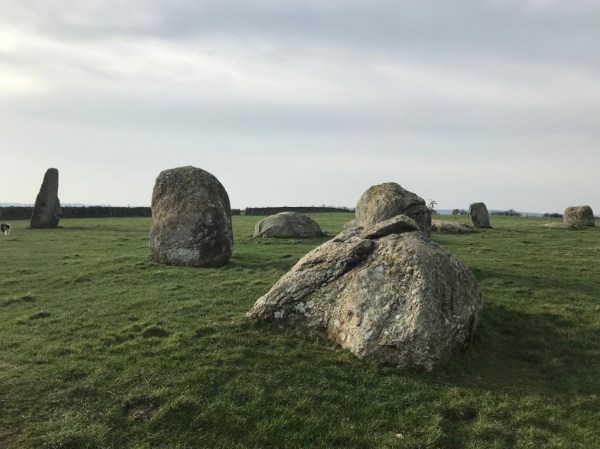 Long Meg looks over her daughters
Like with each visit to these sacred, ancient sites, I found the time passing all too quickly. Time that could not be spent with…
View original post 932 more words
Share this:

+ #Silenti, Ancient Landscapes, Ancient Sacred Sites, Celtic Christianity, Christianity and modern mysticism, Consciousness, esoteric psychology, Mystery Schools, Silent Eye School, Spirituality
The Keys of Heaven
by Steve Tanham

The Keys of Heaven – The last journey of St Cedd
It is the year AD 664. The coastal town of Whitby and its Abbey, under the control of the abbess who became St Hilda, are the setting for a Christian Synod – a court of doctrine established, on the face of it, to unify how priests cut their religious tonsure (gap in the hair) and what should be the correct basis of the calculation of Easter.
Trivial things? Perhaps to our distant eyes; but the Synod of 664 had a brutal undertone: its decision would determine a single Christianity for Britain – and would condemn the alternative to a slow but inevitable death.
King Oswiu was the host. His family typified the multiplicity of ‘faiths’ that predominated in those times. The Kingdom of Northumbria was the most powerful of the Saxon lands. Oswiu followed the Celtic Christian faith, whose evolution had seen it travel from Wales, to Ireland, to re-establish itself at Iona, in the Scottish islands, and thence to Lindisfarne in Northumbria. Celtic Christianity appealed to a population that had retained its pagan roots. The harmonic and nature-worshipping pagan faith was a strong Northumbrian weave over which Celtic Christianity added its intelligent, yet sympathetic monotheistic religion.
Under Pope Gregory I, (Gregory the Great) Kent had become the centre of an expansion in Roman Christianity. The Synod at Whitby drew scholars from Lindisfarne and Canterbury – and further afield. Rome was represented by the Abbot of Ripon – who became St Wilfrid; afterwards respected and hated in equal measure. The Celtic Christian case was made by Bishop Colman of Lindisfarne. Each had a team of scholars. Colman drew on the tradition of St John the Evangelist; Wilfrid, politically astute and a brilliant academic, drew on the teachings of St Peter.
One man present, equally accomplished, was what we would now call the ‘facilitator’. An outstanding scholar, Bishop Cedd, later St Cedd, had been raised and trained on Lindisfarne, yet his role could not afford to display bias. Torn in mind, faith and kin, the man who became St Cedd walked a treacherous path within the Synod that was to change everyone’s lives.
It is a story reminiscent of one of Shakespeare’s play, full of character, mystery and treachery; one in which the cleverness of argument came to supplant the lore of the land and the local history of the interwoven Christ.
In ritual and in readings, over the wild and wonderful landscape of what is now North Yorkshire, we will follow the last mental and emotional journey of St Cedd; from the pivotal events at Whitby to his premature death shortly after. The hills and beaches of Whitby will see us bring to life key events from the period, using an evolving (informal) ritual that will grow in energy and companionship until we approach our final segment on Sunday morning as guests in the Abbey of Ampleforth, where those wishing may take part in the Sunday morning service, run by the Benedictine monks, who offer a non-sectarian outreach programme in spirituality. Nearby is the mysterious crypt of Lastingham, the final resting place of St Cedd and the village that will host our last meal together on the Sunday lunchtime – prior to departure.
We may journey to our distant homes in reflection and marvel at the pivotal events we have considered.
The dates are the weekend of December 6th- 8th, 2019. The base for the event will be the North Yorkshire town of Whitby.
The cost of the event will be £100. This is an administrative cost, only, and will include a detailed and historic handbook for the weekend, sent as a PDF file. Those joining us are responsible for their own accommodation and food, though meals are generally shared in local pubs – and the bill apportioned among those present. You are assured of a warm and friendly welcome from a team that has built up a fine reputation for quality interactive weekends and workshops. We look forward to welcoming old and new friends, alike.
Demand is likely to be high, so please make your booking early. An email to:
Rivingtide@gmail.com is sufficient at this stage.
Images: The images of St Hilda’s Abbey, and St Cedd are from Wikipedia under CC0 licence. The other images are by the author.
©️Stephen Tanham
Stephen Tanham is a director of the Silent Eye School of Consciousness, a not-for-profit organisation that helps people find a personal path to a deeper place within their internal and external lives.
The Silent Eye provides home-based, practical courses which are low-cost and personally supervised. The course materials and corresponding supervision are provided month by month without further commitment.
Steve’s personal blog, Sun in Gemini, is at stevetanham.wordpress.com.
You’ll find friends, poetry, literature and photography there…and some great guest posts on related topics.
Share this:

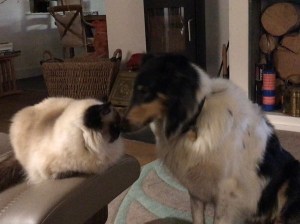
Tees (Dog): Now you’re asking yourself…
Misti (Cat): Did she fire five or six?
Tess: To be honest, punk, I don’t remember.
Misti: So now you want to know if I’m feeling lucky?
Tess: You make a rubbish baddie!
©Stephen Tanham
Share this:

From Ken


flakes of snow falling
as crocuses reach for light
this first day of spring
This haiku is my response to
Carpe Diem #1617 – the first day of spring.
March 1st is the first day of the meteorological spring.
Image source: pixabay.com / rhae
Share this:

From Alethea…
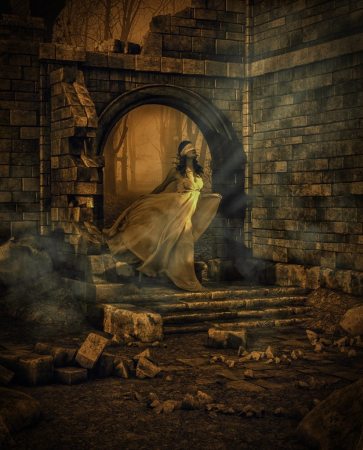 Photo Credit: Pexels
It had been easy to plan. Perhaps too easy. My husband’s forwarding of the airfare deal had led to another trip across the pond that had been pulled together quickly and nearly effortlessly. I had two sets of gracious hosts, an almost absurdly inexpensive flight, and dates that fit the family’s schedule as perfectly as circumstances allowed. My feathered seer had appeared to me in dreams, visions ,and physical forms, and I felt I had to go. The pieces had seemingly fallen into place of their own will.
Perhaps too easily.
Life, I have learned, rarely unravels before us in the way we envision it. I had felt the shift. The silence in the weeks before my departure, but had tried to ignore it. The plan had changed, but I wasn’t sure how.
The inevitable test began during the flight to London. I was sandwich in the…
View original post 362 more words


You must be logged in to post a comment.