+ #Silenti, Ancient Landscapes, Ancient Sacred Sites, myths and spirituality, Spirituality, Travel and people, Winter Solstice weekend
Hands of the Future
by Steve Tanham

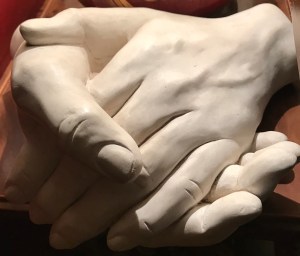
It was cold, very cold on that Friday… just five days ago.
Across the road, people were trickling out of the railway station and along the busy main road through Penrith. Three hours from now it would fill with commuters both leaving and arriving in the Cumbrian town on the main west-coast line to Glasgow.
But not yet…
“Full Circle: Finding the Way Home’ was the name of the Silent Eye’s weekend workshop. The town of Penrith its base for the three days; and the bitter Cumbrian wind was seeing it start in true local style. The land of lakes and mountains was mounting a traditional Winter welcome…
Nine of us had Penrith Castle to ourselves and I was standing by the English Heritage notice-board quite stunned by what I was looking at. The word ‘Cycles” had just taken on a quite different meaning, and I was staring at an astonishing piece of cyclic history in the cold quiet of a ruined castle.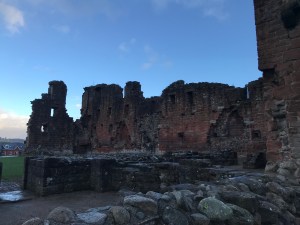
There is very little of Penrith Castle remaining, but the surviving walls delineate a modest fortification, likely built by Ralph Neville, who, at the end of the 14th century, was England’s chief defender against the Scots. He was granted the manor of Penrith in 1396, becoming Warden of the West March. A days’ march would take his troops to the border with Scotland, that forever foe… But, the history before me had nothing to do with the Scots.

Much of the castle’s interior construction was to do with comfort – something the freezing winds brought home to us on that bitter Friday afternoon. The English Heritage illustrations clearly show that the raised interior structure of stone and wood was devoted to the provision of sheltered ‘apartments’.
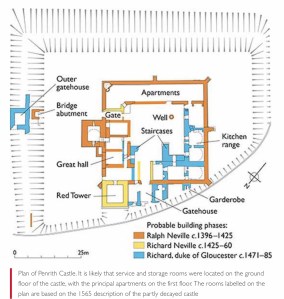
(Above – a plan of the interior of Penrith Castle as it was in the 15th century. ©English Heritage and photographed from their information board)
The castle is built on a high plateau which affords commanding views of everything around; but the highest point on the hill is actually 170 metres away. It is most likely that the location was chosen because it was the site of a former Roman fort, whose existing banks and ditches could be used in its construction.
In turn, and given its commanding position, the Roman fort may well have been built on the site of a more ancient settlement – possibly a pagan temple linked with the landscape.
One of the central aspects of the weekend – beautifully envisaged by Sue and Stuart – was to examine whether the so-called Ley Lines of energy that criss-cross the Earth’s surface – and are strongly associated with places we view as sacred landscapes – could be felt. It’s easy to be fanciful with these things; much harder to let go our ordinary sensitivity to a place and genuinely feel its effects without superimposing our subjective feelings.
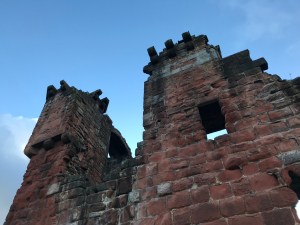
The castle demonstrated Ralph Neville’s powerful position over this wild part of what is now Cumbria. His son, Richard, began the improvements shown on the English Heritage schematic, but they were finished by another man, to whom the castle was granted in 1471. Richard, Duke of Gloucester (1452-85) is known to history as King Richard III…. His bones would eventually, and ignominiously, be found beneath a car park in Leicester. As Sheriff of Cumberland, Richard lived at Penrith Castle between 1471 and 1485, during which time the improvements to the castle were completed.
But, in the great cycle of history, Richard III, last of the Plantagenets, died in a place called Bosworth Field, after a battle with a Welsh upstart and his army. That upstart was named Henry; and he became King Henry VII of England – the founder of the Tudor dynasty and the father of Henry VIII.
I was standing in the home of the last ‘old king’ of England at the end of an era that had included the Wars of the Roses – a cycle that would be swept away by the energy and, often, barbarism, of the coming Tudor age. It was a vivid illustration of how our lives are governed by larger cycles, and that home can be a long way away…
Our Silent Eye Weekend had truly begun.
©Stephen Tanham.
Share this:

From Stu and Sue
Share this:

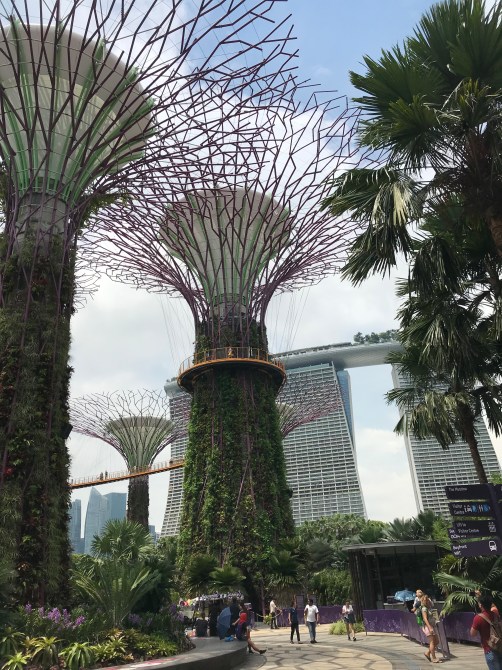
It is unlike anything you’ve seen before. If you were raised, like I was, on sci-fi, you’ll recognise the soaring structures that look like other-worldly trees; whose job is to be a framework for a vast array of green life embedded in the vertical lattices.
Those paintings were by Christopher Fosse, whose futuristic artwork graced the covers of many of the sci-fi novels of the 1970s and 80s. Yet, here, they are made real and carry a message far more important than most found in that genre: they speak of botanical science made hope…
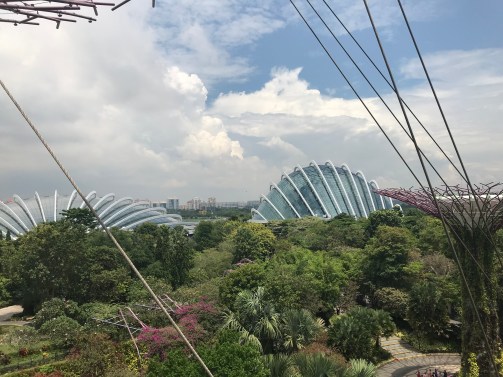
We’re at Gardens by the Bay, on Singapore’s southern tip. It’s a vast set of interlinked gardens and walkways with the combination of these ‘trees’ and two vast domes dominating the skyline. If you’ve been lucky enough to visit Singapore, you will know how ‘green’ the city is – in every way. The founder of modern Singapore, Lee Kuan Yew, is said to have transformed this tiny island city state from a third to a first-world country in a single generation. He did it with a brutal determination to take Singapore into a new future, and not have it left behind from the growth of his country’s near-neighbours to the north-east: Malaysia and China.
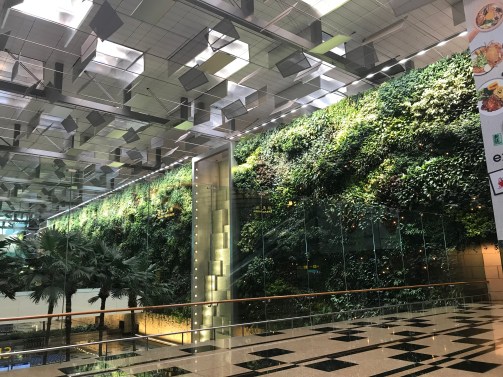
Even Changi airport is a garden…
One of the core components of Lee’s vision was that it would become a garden city, festooned with green wherever you looked. That vision was rigorously applied, though many would say that there are as many shops as trees… Everywhere you look there is greenery; but the vision comes to life in the most vivid way in the concentrated force of cultured nature that is Gardens by the Bay.
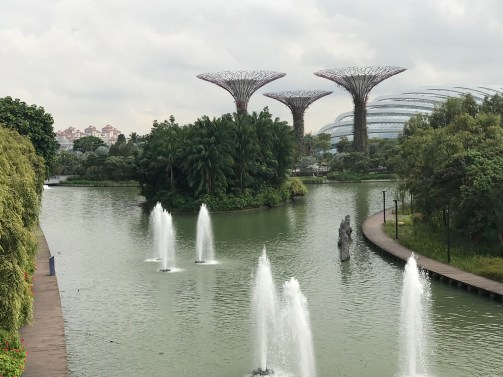
Gardens by the Bay is a nature park that takes up over one hundred hectares of reclaimed land in the central region of Singapore, next to the Marina Reservoir. The park consists of three waterfront gardens: Bay South, Bay East and and Bay Central.
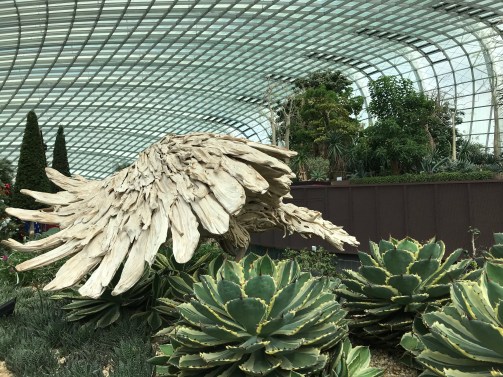
Singapore has a team of professionals who are responsible for the ‘greening’ of the city. This team became the core of a vast project to create this futuristic landscape which, on completion, would offer educational as well as botanical aspects. Singapore was already served with its traditional Botanical garden of world-renown, including the famous orchid house (see later blog). It was important to create a different ‘feel’ to the new gardens; one that would attract younger people to whom the story could interweave with the ideas of global responsibility in culturing and protecting ecosystems.
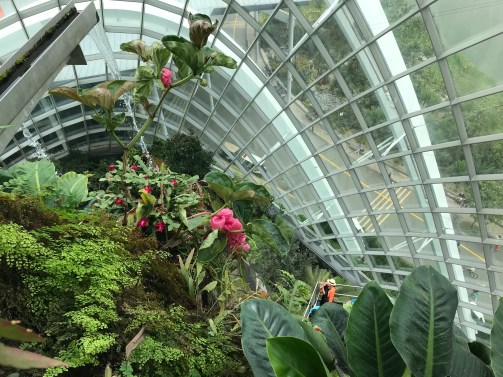
The team responsible were drawn from the disciplines of: landscape gardening, designers, horticulturists, arborists, engineers and plant specialists. Their goal was to create an environment for which all the people of Singapore – and their international visitors – would feel a sense of ownership. In this way the larger ideal of a ‘Garden Earth’ could be combined with the local objectives.
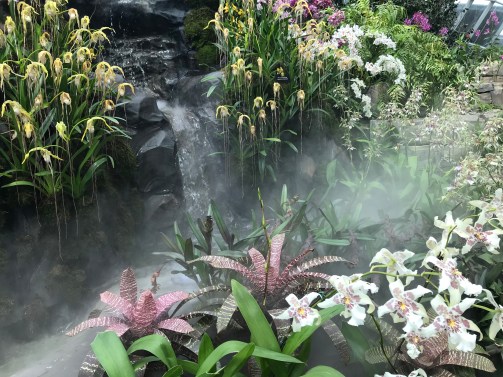
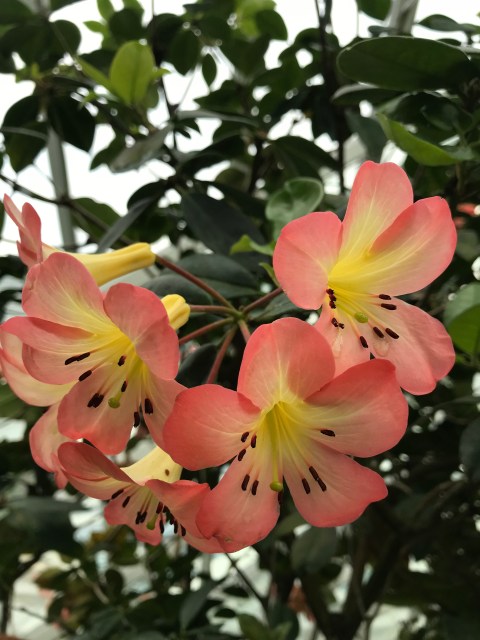
Botany and horticulture can seem boring to children, though their experience of green spaces is always one of delight. Gardens by the Bay sets out to change the level of involvement by presenting the plant kingdom in a new way, entertaining all visitors with sections devoted to habitats from all over the world, not just the tropical gardens of native Singapore – which is close to the equator. These habitats range from species in cool, temperate climates to tropical rain forests.
Having entered through the vertical space of the giant inverted cone structures – the Supertree Grove – the first of the giant domes, Flower Dome, lies before you, displaying the varied habitats, including deserts. The visitor ranges through gardens set at different heights, the design exploiting the vertical as well as the horizontal space.
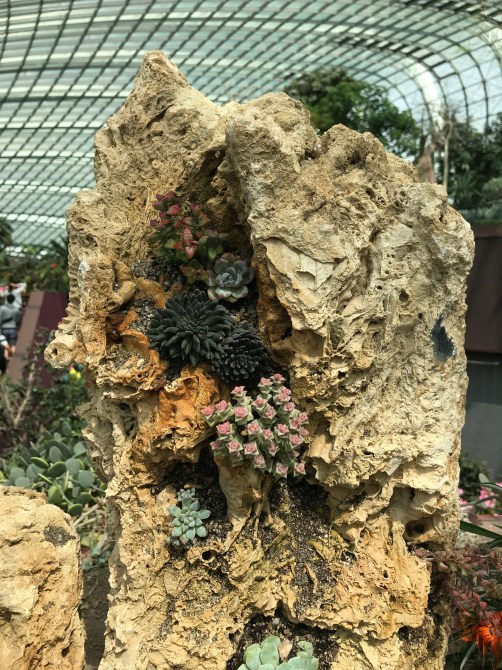
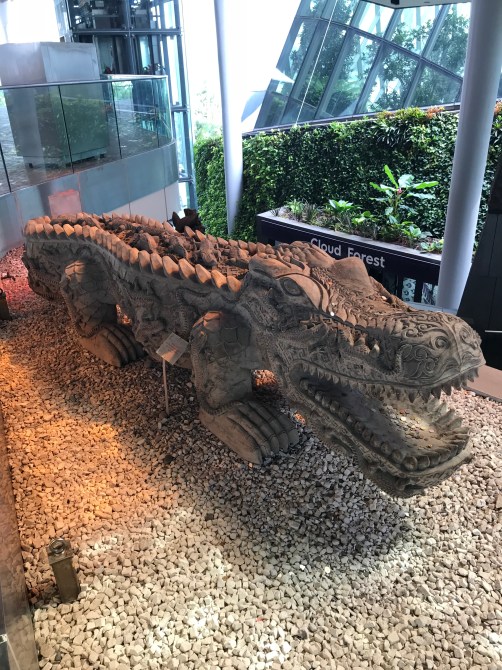
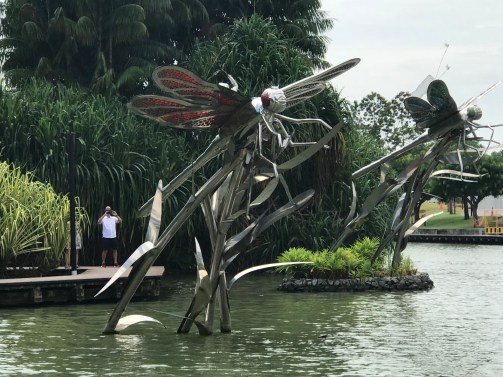
The personal journey is supplemented by the use of local cultural images – particularly animals that feature in stories across this part of Asia. Giants crocodiles and dragons lurk and fly through the walkways…
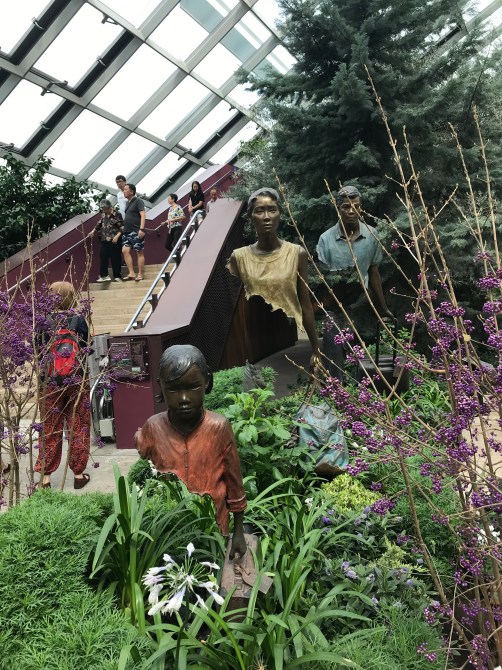
I found one particular feature of the Flower Dome very moving. It is called ‘La Famille Voyageurs’ (the travelling family) and was donated by Changi Airport. It consists of a family of international tourists who are visiting Gardens by the Bay as the last part of their holiday, prior to flying out. They are each carrying their wheeled suitcases, but parts of their bodies are missing… you can see through the spaces made. The symbolism is that Gardens by the Bay moves you so much that you end up leaving a bit of you behind… Such a lovely theme for an art piece.
You could spend a day in the Flower Dome, alone. But a dramatic experience awaits the visitor to its sister space: the Cloud Forest.
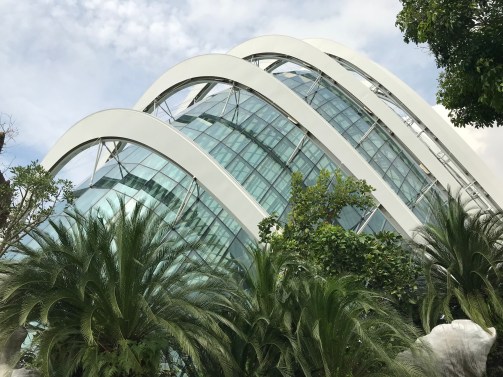
The Cloud Forest dome has a peculiar shape. It’s only when you get inside that you realise why…
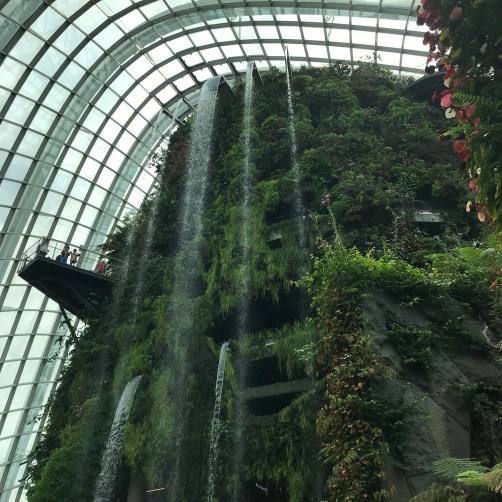
Look at the tiny figures on the left platform to get the scale of it! The whole dome is taken up by a rain-forest mountain. The concept is breathtaking…
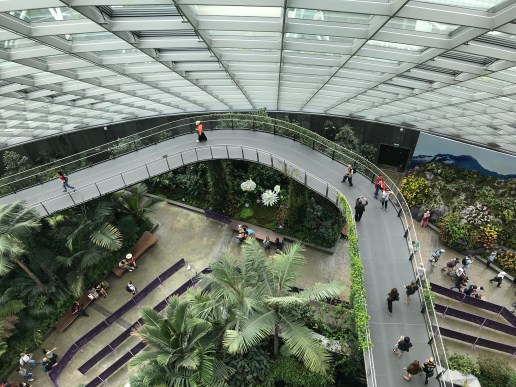
To visit the Cloud Forest, you take a lift to the peak (The Lost World) and follow the walkways down, curving around the mountain’s flanks as you descend. It’s an idea pioneered by Frank Lloyd Wright with the Guggenheim in New York, but the latter abandoned the vertical downward approach as it could not cope with visitor volume. Here, it works beautifully.
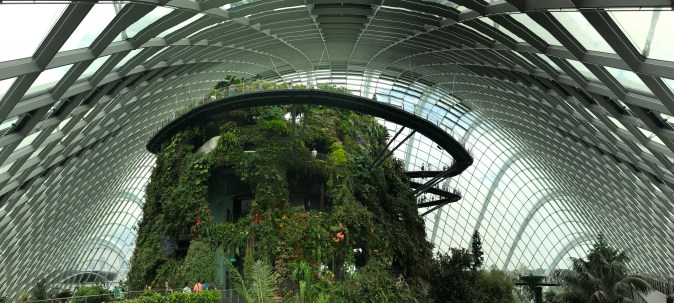
The rainforest is said to be the ‘lungs of the planet’. Within Cloud Forest, you see every aspects of them and their habitats, weaving in and out of the living forest at every level. It’s so very moving that, by the time you get to the lower levels, people are simply silent in contemplation of what they are experiencing…
A short blog is not sufficient space to describe the Gardens by the Bay. I have barely scratched the surface in this piece, but I hope to have conveyed something of its vision and splendour.
Soon we were walking back through the gardens towards the excellent, air-conditioned MRT Metro system to return to our hotel. As we left the park, I thought back to the sculpture donated by Changi Airport: La Famille de Voyageurs, by Bruno Catalano.
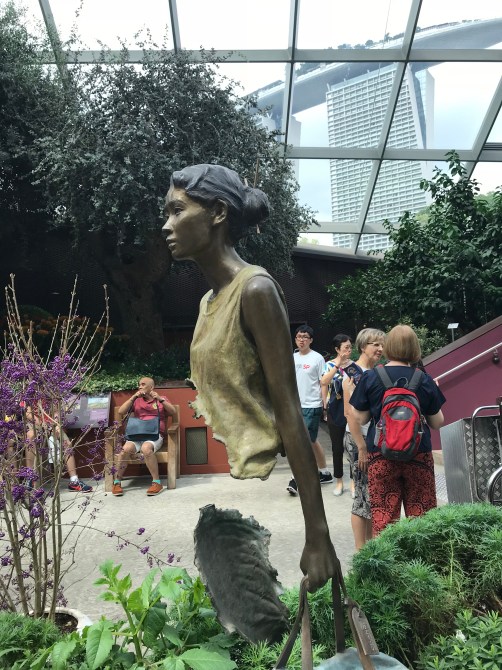
I love Singapore. I need little excuse to want to visit it, again. But the Gardens by the Bay are special and should be on every visitor’s itinerary. Part of me would, indeed, be left behind in this place, and I hope to be able to return, soon, to share again in the vision of this most inspired creation.
©Copyright Stephen Tanham.
Photos by the author.
Share this:

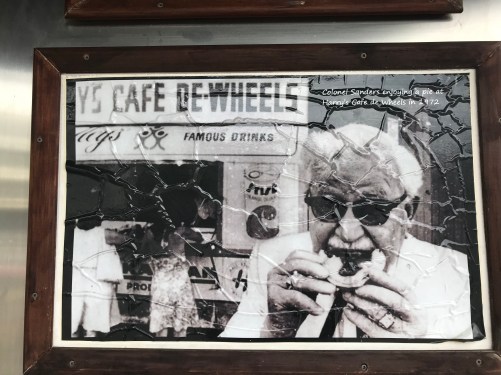
In the old black and white photo, the colonel is eating… a pie. He’s more associated with Kentucky’s fried chicken, but here it’s a pie. It was taken a long time ago (1972) and the iconic fried chicken man is clearly enjoying himself doing something different.
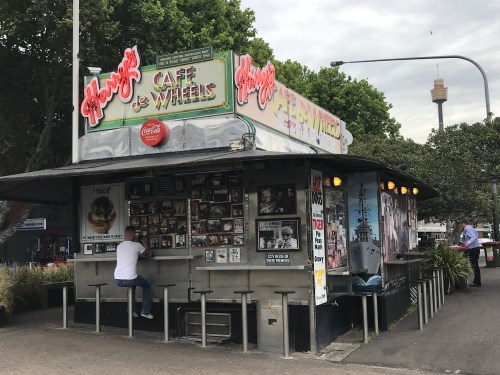
The Colonel’s faded picture is mounted on the silver walls of an amazing creation in front of us called Harry’s Cafe de Wheels… There’s a story to the name which we’ll get to in a moment. First, though, I have to convey something about the place in which this pie-selling time machine lives…
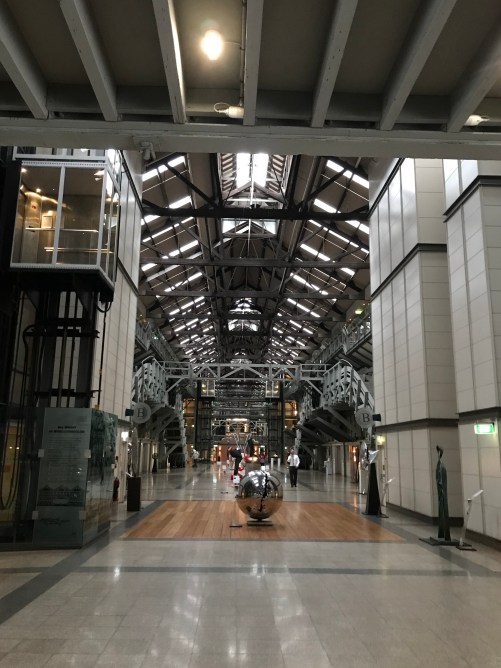
Imagine you’re eating your Harry’s pie on one of the bar-stools – the only furniture around Harry’s Cafe de Wheels. We’re located on one of Sydney’s secondary harbour fronts in the Woollomoolloo district. It’s a half hour walk from the bustling centre of the city and is famous for the historic dock that, in its heyday, shipped most of Sydney’s cargo and passengers.
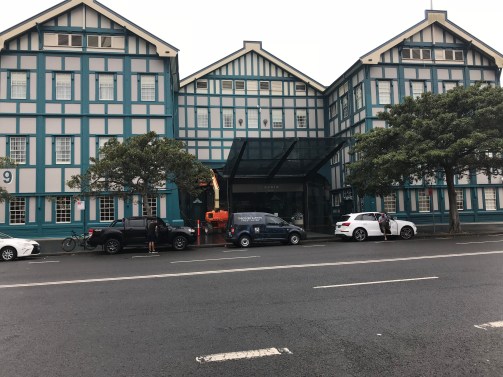
After much rancorous tussling by the local population, the huge Woolloomooloo dock was saved from demolition and restored into a trendy hotel, gallery and private apartments plus marina. We’re staying in the hotel part – the Ovolo – which is lovely, innovative and surprisingly inexpensive. But then you have to put up with the struggle to say that you’re “staying at the Ovolo at Woolloomooloo…”
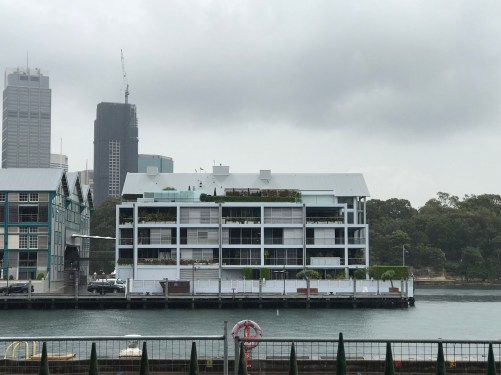
Russell Crowe lives here. At the end of the old cargo pier is a most expensive part of the waterfront, where the actor’s penthouse (below) is reported to have cost AUS$25M… Beyond his dwelling is a glimpse of the CBD – Central Business District; every Australian city seems to have one. Through the trees in the right foreground is a really good view of the Sydney Opera House, which will feature in other posts.
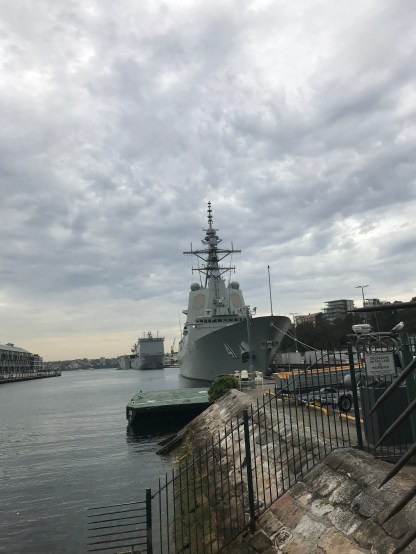
Harry’s Cafe de Wheels lies at the pivot between the restored cargo dock and the modern naval base. You can walk right past the base and round to the King’s Cross section of town, but photographs of that part of the base are prohibited.
It’s a miracle that the Woolloomoloo dock survived at all, but it’s an even bigger one that Harry’s Cafe de Wheels is still there. It’s not palatial, now, but, in the beginning, it was just a small mobile pie van, as the black and white photo, below – dated 1939 – shows.
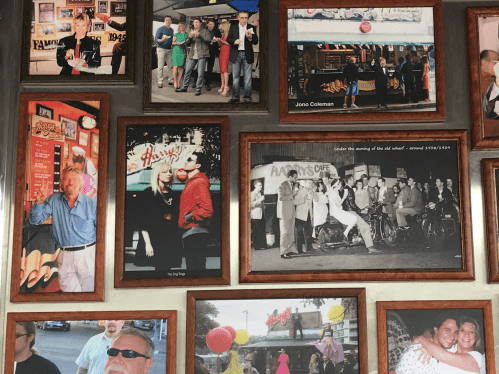
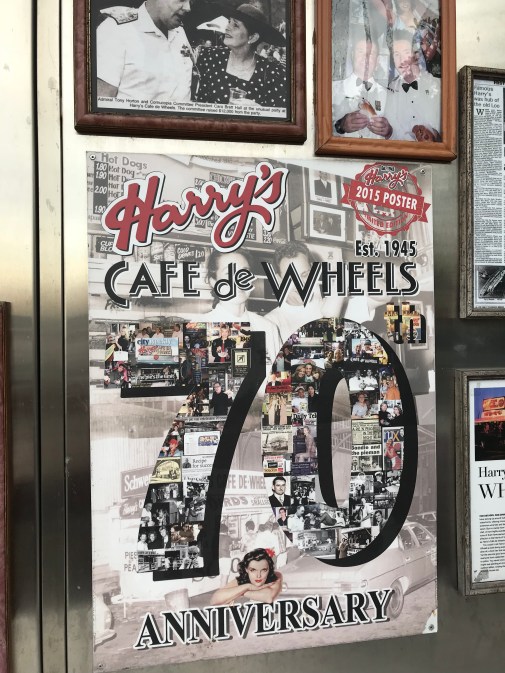
The longer it survived, the more famous it became. The new building was established in 1945, and has been feeding Sydney-folk and their visitors ever since. It’s not on the main tourist trail, and we only found it because it was next to our hotel – which we had deliberately chosen because of its off-centre location. In 2015, Harry’s celebrated its 70th anniversary.
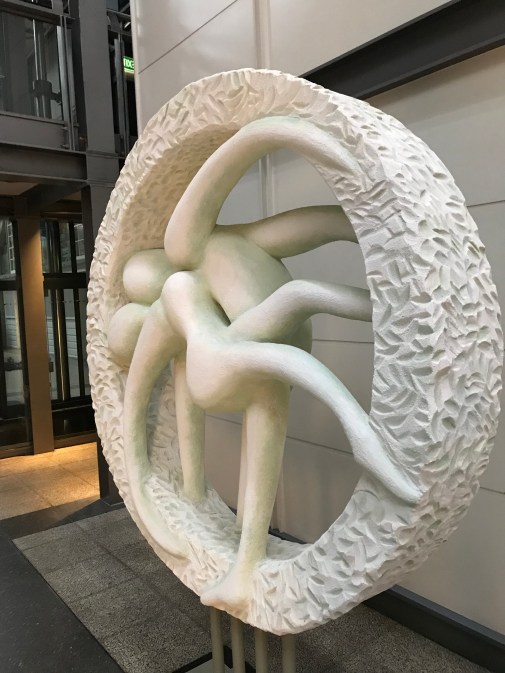
The old dock building, next door, also has space for regular exhibitions of art and photography. The piece below is by Ludwig Mlcek, and is titled ‘Ring of Passion’. It was one of about twenty such works within the expanse of the old wharf – shared with the Ovolo hotel and Russell Crowe.
For me, Harry’s Cafe de Wheels was the star of the show. Apparently, it still commands queues around the block on a busy Saturday night – often very late into night. In this hi-tech age, there’s something wonderful about that…
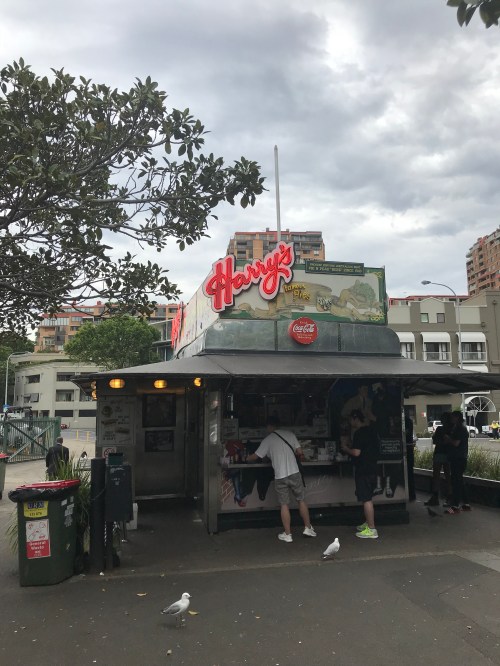
And the name? When the original street licence was granted, it was for a mobile cafe. So, when Harry upgraded his pie palace, it had to retain its wheels – even though it never moves. Harry added ‘de Wheels’ as an amusing qualification. No-one would think of threatening it now…
Of all the sights we saw in our visit to Australia and New Zealand, none stuck in my memory with such fondness as Harry’s Cafe de Wheels… and his pie was delicious.
Other posts in our antipodean adventure:
©Stephen Tanham
Stephen Tanham is a director of the Silent Eye School of Consciousness.
The Silent Eye is a not-for-profit organisation that provides distance learning courses for the deepening of self understanding.
Share this:

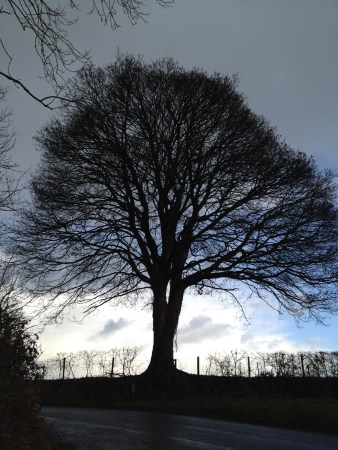
Returning home after a long trip, I am always taken by the sheer ‘energy’ in a British landscape. It may be adversarial with cold and rain, but it shakes the soul into a different kind of wakefulness.
The leaf-stripped trees are the most potent symbol of this for me. There, framed in total contrast, are living symbols of growth, of organic process, of four dimensions seen as one emotional rendering.
They will endure the Winter. Reduced to their raw being, they await the greening.
Everyone seems to love trees, and I love it that we do…
©Stephen Tanham
Share this:

From Jan
Share this:


Even from a distance, it separates itself from the landscape that gave it birth. After two hundred million years, its many faces continue to laugh at the sky – in the defiant way that large rocks often do… or perhaps it is long-lost love…
Its act of separation is not one of colour, for the hues are not dissimilar to those around it on that hard-faced dome above the Southern Ocean. Its perpetual difference is one of shape…

On a place where mature male kangaroos spring without warning from hidden gaps in the gumtrees that line the side of newly tarmaced roads – and will wreck a car doing any more that forty miles per hour – the Remarkable Rocks of the Flinders Nature Reserve occupy a liminal zone between the ancient and the modern faces of this place – Kangaroo Island – Australia’s third largest island, after Tasmania and Melville.

It is the way of Australia, that casual, no-nonsense approach to naming things, that renders this collective edifice of two hundred million years as merely ‘remarkable’. Yet that is their name – Remarkable Rocks, and has been for hundreds of years. No-one knows where the name came from, but my guess is that it originated in Aboriginal lore as something that was subsequently translated back into English.

Kangaroo Island separated from mainland Australia around 10,000 years ago, due to rising sea level after the last glacial period. You might imagine there were no human witnesses, but it may surprise you (as it did me) that the Aboriginal peoples date back an astonishing 60,000 years, so they would have actually experienced the gradual separation of what had become a shrinking peninsula from the mainland.
They left the island then, but not before naming it Karta (“Island of the Dead”). Their existence here was told in their stories, but has been proved recently by the presence of stone tools and shell middens. If you’ve followed the Silent Eye’s posts you may be familiar with the idea that such sites can be seen (and experienced) as not just honouring the ancestors, but as living links with them – places where communion with the collective ‘spirit’ of they who came before is possible. Carl Jung’s ‘collective unconscious’ is a good basis for considering a rigorous basis to such investigative beliefs.

They would have honoured its strangeness and gathered here to watch the sparks of their wise fires. For all we know, their spirits may gather now, flowing in from the surrounding greenery, to hold wise counsel when the bewildered tourists have gone home in their coaches and four-wheel drive cars. You cannot leave here without an intense feeling that you ‘missed something’. The inner laughter generated by Remarkable Rocks may well be designed to call you back, to be part of the commune-ity

The rocks share a process of origination with Uluru, which we were fortunate enough to visit on our last trip to Australian, two years ago. They were once a giant dome of molten lava, thrust upwards into beds of sedimentary rocks ten kilometres below the surface. The intense pressure and heat turned the sedimentary layers into hardened and crystallised metamorphic rocks. Two million years of erosion did the rest – leaving us with the other-worldly shapes found today.

You cannot stand here without being spoken to. Like Uluru, the giant rock in the centre of Australia, to which the Remarkable Rocks are related, these stones invite you to run, to dance around them, regardless of the dangerousness of the steeply shelving platform of basalt that tapers down to the sea – faster in its seduction than the wits of the unwary traveller. No fences or barriers prevent this; you are guided only by a small, written warning to be careful… Which leaves the raw danger untouched by laws of health and safety and invites you to dance around and through the strange shapes, with their curving hollows, sharing the danger as the price of Being here.

It was only as I was leaving that I had a flash of what was so compelling about the shapes of the Remarkable Rocks: they are like one of Salvador Dali’s surrealistic paintings. Once seen, you expect to turn another face of the rock and find a watch face, drooping around a ninety degree corner, moulded to the same magnetic override that shaped the rock on which it lies – its trivial purpose defeated by the incomprehensible age of that which supports it.

And, of course, you want these rocks, this place, to yourself… You want to watch its strangeness and come to terms with its shapes in solitude. I suspect that is seldom possible. Instead, an assorted cross-section of nationalities carry out their individual approximations to presence within the uncompromising shapes. It is playful and there is a feeling that there is no insult to the rocks in that play…. They have, quite literally, seen it all.

The Remarkable Rocks do something to the light. Again, like Uluru, they seem to drink it, allowing it to reflect different faces – different stories – from the vastness of their age and experience. It is impossible not to wonder how they ‘see’ the presence of the civilised men and women around them.

And then, we, too, have to go – urgently – to get to the tiny airport at the far end of the island that will take four adults and two young girls back to their home in Adelaide. I race one final time around the dangerous granite base, intent on taking with me the most precious of the emotions in the form of images. I want to be here…. This brief encounter was not enough. I will bridge the distance with heart and mind in meditation.
©Stephen Tanham
Share this:

From Sue

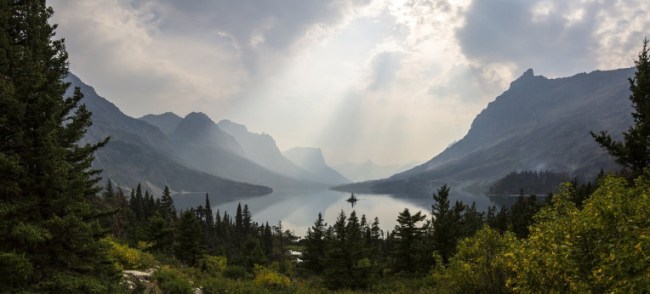 Image: Pixabay
“It is such a mysterious place, the land of tears.”
Antoine de Saint-Exupéry, The Little Prince
“Bebop died. I stayed with him. Said thank you.” He choked again. “Said goodbye. It was really emotional.” The voice managed to sound both surprised and a tad embarrassed, even through the evident emotion, and well he might. “…and then Arthur died too…”. There was a silent pause. I am fairly certain I heard a sniff. Bebop was his horse… not a flesh-and-blood horse, mind you, but part of a computer game my son had been playing for some time. Arthur was the character as which he had been playing. Oddly, I didn’t laugh. I could quite understand why he was feeling that way, even though, on the surface, it should have been funny. I have cried my way through too many books and films to laugh for such a reason.
The…
View original post 786 more words
Share this:

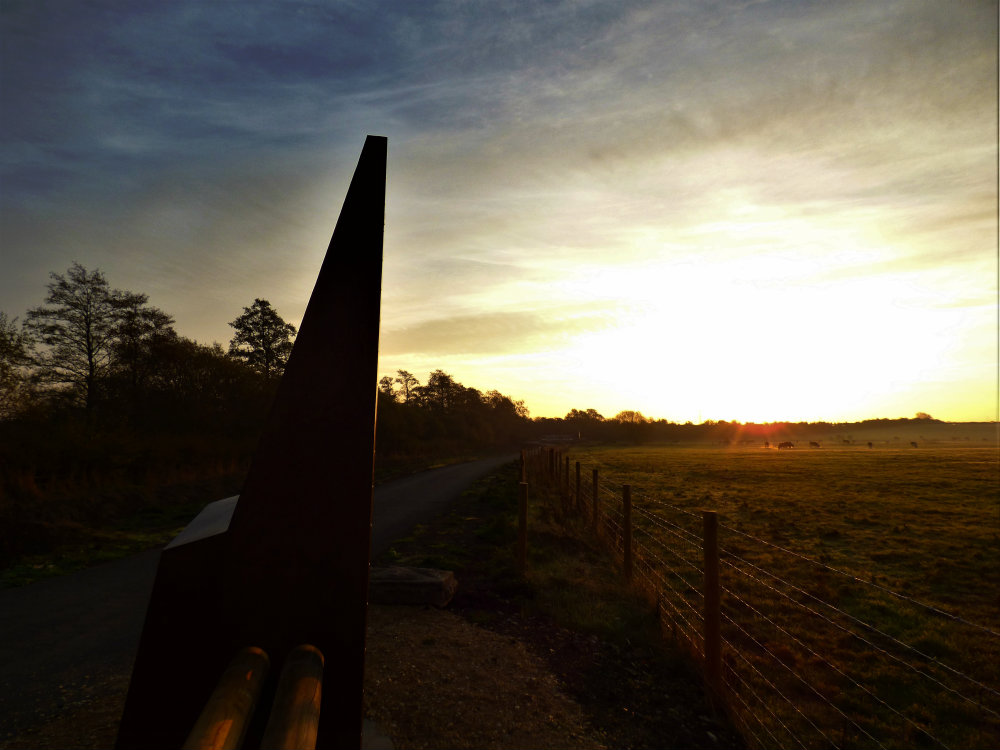
From Sue

A new footpath has been installed close to the village, running for a few miles through the silent, empty fields. One of its entrances gives onto the road I travel every day and I have watched with mild curiosity as the work has been underway.
The path is part of a walking and cycling initiative to connect the village to the nearest railway station and, hopefully, reduce the need for cars on the road. It follows the course of the old Roman road, which probably followed the course of an older track, thus continuing a tradition of travel along this route.
My interest was caught when I noticed the workmen had installed a sculpture or two, glimpsed through one of the gates and through the thinning leaves on the trees. Aha, I thought, a Pointy Stone! Even after millennia there is something about a standing stone guarding the…
View original post 652 more words
Share this:

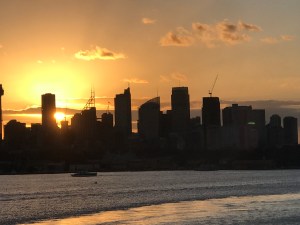
It could equally well be titled ‘The dark art of departure’, I suppose, but, in this case, it‘s not the act but the leaving which is dark…
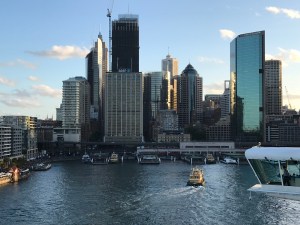
At the time of writing, we are about to leave Sydney, aboard a cruise ship: the Royal Caribbean ‘Solstice’.
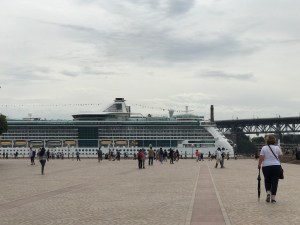
We’ve never been on a cruise ship before. It is only happening because two years ago, we booked a short cruise to the Norwegian Fjords which was cancelled at the last minute by the cruise company. We were due to depart the weekend after our main workshop of the Silent Eye’s year – the Spring event in Derbyshire. The timing was perfect; such events are very demanding, and the idea of a restful break in the glorious surroundings of Norway seemed perfect. In grim fashion, the man paid to break the bad news to us said that, basically, not enough people had died… Cruising, he explained, generally appeals to an older audience, and the organising companies have to take a statistical prediction as to how many cancellations they will get, due to severe ill health or death. Knowing this did little to help our mood, but Bernie soon found us a flight and hotel in the Mexican Yucatan, which enabled us, in consolation, to see the Mayan pyramids of Chichen Itza – a life-changing event I recorded at the time under the blog heading ‘Unexpected Shaman’.
We were compensated for the cost of the holiday and all consequent expenses: hotel in Southhampton, car parks and sundries… and… offered an additional free cruise of the same value anywhere in the world. We did query that there might be nothing to stop Celebrity Cruises from doing this to us again, but the man assured us we now had a direct link to him and that he would ensure that our next cruise definitely took place
So here we are….
Here is Sydney, a very lovely and friendly city. And only our second ever trip to Australia, where our son and daughter in law, both doctors, are bringing up their two young girls. We don’t get to see the grandchildren very often, and it’s hard to be a real part of their lives, but such a trip gives us the chance to be with them, play and laugh and fill the short but intense few days with the real, instead of the largely-artificial world of the ‘Skype’ or ‘Facetime’ call.
It occurred to us that we had the chance to combine the two; that we could fly to Sydney (instead of Adelaide, where they live) and then do our cruise, ending it with a flight to join them on a more local holiday. So the plans were made, and we are about to embark on a twelve-day sailing to New Zealand, ending in a flight from Auckland (where Bernie has a close school friend) to Adelaide to meet up with the family.
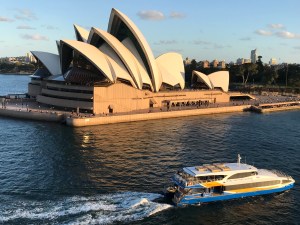
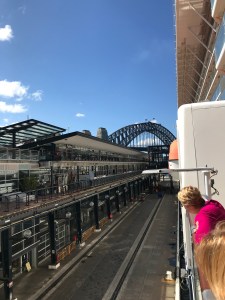
These few days in Sydney, following a flight from Manchester with a stopover in wonderful Singapore, have not been sufficient to scratch the surface of this city; but there is a compensating factor. The greatest attraction of Sydney is its harbour – or, properly its harbours, as the waterways are a vast complex linking the many nearby towns that supply it with many its daytime working population. The ferry terminal was allowed to be constructed right in the heart of the city; and show off these massive ships to perfection…
Now, we are on ours and, after a lengthy check-in, we are finally sitting, unpacked, on our balcony, looking down from a great height onto the very heart of Sydney. It’s a photographer’s dream, and my little iPhone has served me well in such situations before. Additionally, and, I like to think as some sort of karmic compensation, the sun is beginning to set, flooding the harbour with golden light.
We can feel the throbbing hum of the engines beginning their departure preparation. Then there is the most ‘perfect’ noise I have ever heard, as the Captain of the vessel gives the five minute warning signal. It intense, rather than just loud; it is a specially tuned sound that sounds like it comes from ‘the Gods’. I’m convinced that a few minutes of it, done as therapy, would drive any sense of depression from a soul… not that we are in the least depressed; but it carries that kind of ‘trumpet of hope’ feeling. Images of the Tarot card ‘The Last Judgement’ spring to mind… Whatever you were doing before it, you won’t be doing now.
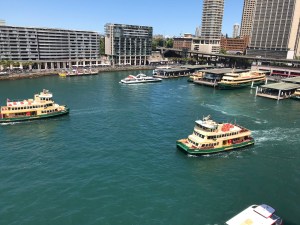
In response, and to show their defiance of this leviathan of the high seas, a dozen of the smaller (but very fast) local ferries scurry off their piers to get their hard-working passengers away before the idlers on the ‘Solstice’ begin their holiday. A boating fury to rival Henley on Thames ensures the then, with the earth-shaking second warning blast, the giant begins to slide, backwards, away from the key. I don’t know if you’ve ever seen the early Star Trek films, but, for their time they had masterly sequences of the Enterprise leaving the orbital terminal very, very slowly, before building up to ‘warp speed’ somewhere safely away from the Earth.
The slow initial departure of the ship Solstice is just like that, and about a million souls on Sydney’s Circular Quay are watching and smiling in the golden evening light.
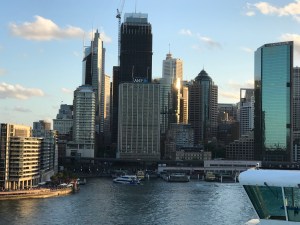
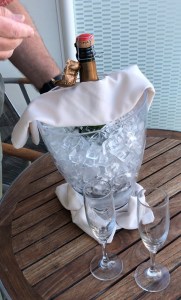
We can hear very little. With perfect timing, our steward has entered the cabin and presented us with an ice-bucket holding our complimentary bottle of champagne and two flutes. I can’t resist taking it out to the balcony and popping the cork – discretely – allowing us to toast the lovely city to which we are now saying goodbye. We may be back, but you never know. It’s a long way from home and we hate leaving our beloved cat and dog for so long.
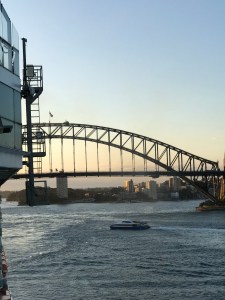
With the minimum of fuss, the huge ship slides into the main channel, still backwards. Then it begins to turn, bringing the Bay Bridge into full view. The light is now photographically perfect and I take as many shots as the rotating angle will allow. Then the vibration of the engines becomes even more purposeful and the Solstice begins to accelerate towards the open sea-still a full two miles distant.
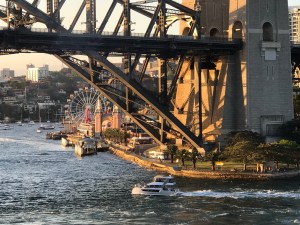
We navigate the twists and turns of the widening estuaries, then comes a wonderful moment as the pilot boat comes right into the back of the cruise ship, nearly disappearing from sight.
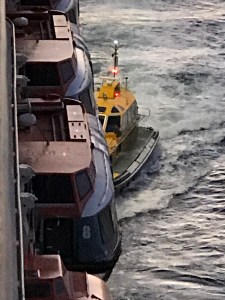
When the Pilot boat reappears, the pilot has been transferred back to his home vessel and the smaller craft pulls away with a wave and set of lighted signals. As he falls behind the ship gathers speed toward the open sea… and adventure.
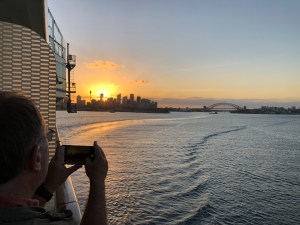
It’s time to have our first dinner on board. With one last wave we say goodbye to Sydney. Next stop Melbourne, then on to New Zealand for what we hope will be the trip of a lifetime.
©Stephen Tanham
Steve Tanham is a director of tbe Silent Eye School of Consciousness, a not for profit organisation that provides distance learning courses for the deepening of self understanding.
Share this:

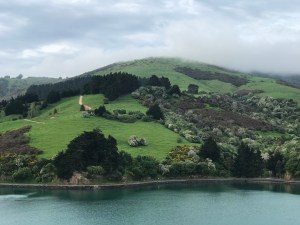
One of the most wonderful moments on our cruise around New Zealand, so far, was when we were leaving the estuary at Dunedin. Bernie and I were sitting on our balcony, watching the soft green hills passing by as the giant ship gained speed towards the open sea.
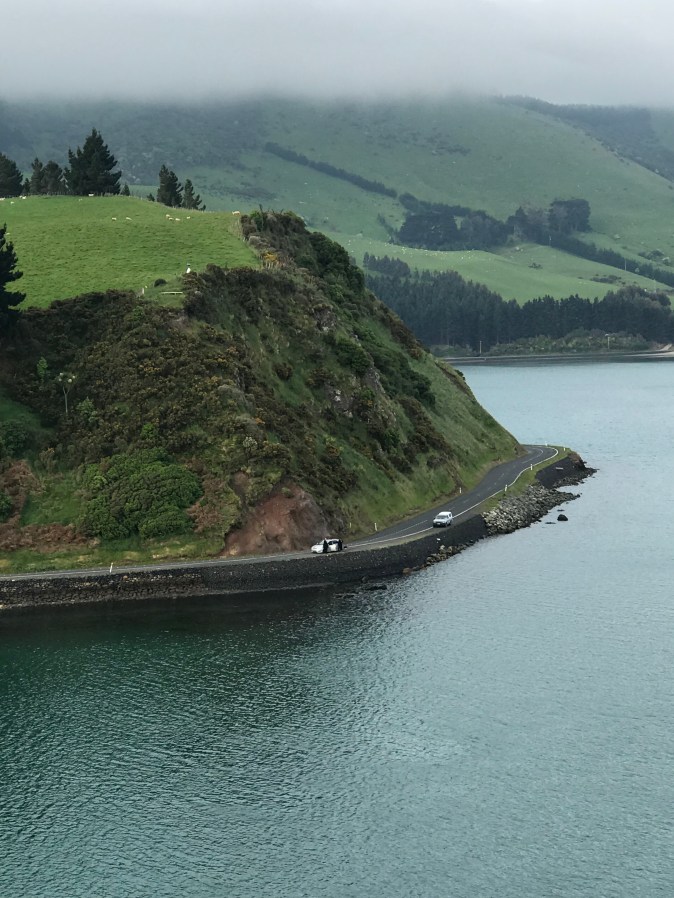
Just ahead of us was a promontory that jutted out in to the waterway. There was a road around its edge, and a couple of parking spots at the point nearest to where the ships pass. From a distance, we could see a car pull up… and could ‘feel’ the intensity of its purpose. Three figures raced out – two adults and a child – and began waving furiously at the Solstice – the name of our ship.
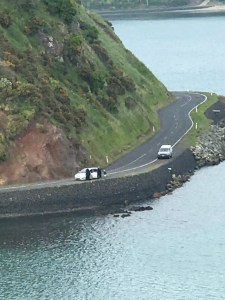 A few minutes prior, the captain had given the traditional parting signal: three loud blasts of the ship’s very deep and musical horn. But now, as though seeing the family waving, he did it again. It is a deep, sonorous and landscape-shaking thing. The little child danced with joy as this happened, and I managed to grab a shot or two with the iPhone. Zooming–in is not its strength, so, by the time the images get to this blog, the quality may be poor. Nevertheless it was worth it to try to capture the joy of the moment.
As we passed, we began to wave to the family from our balcony, not expecting them to notice us in the mass of this giant ship – but they did. They saw us and began waving, enthusiastically back. Such a simple thing, but, in the golden light of our departure, what a beautiful experience.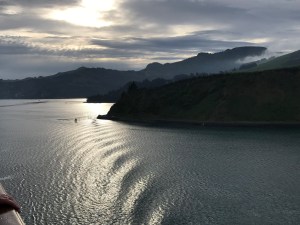
Next stop – Akaroa… and a Maori encounter.
©Stephen Tanham
Share this:


I take a lot of photographs, and like to share the ones that move me the most.
Looking back on these, there is a theme: they are, more often than not, a moment of natural beauty, defined by light on landscape, which could only be captured by camera or poem… so, here, for my less formal ‘Tuesday slot’, is picture and poem.
Twin Guardians
Twin guardians, we will play
And to those in the vale
We will escort your passing blaze
With turning leaf salute your days
And bowing, be your setting sail.
© Stephen Tanham
Steve Tanham is a director of the Silent Eye School of Consciousness; a correspondence-based method for living a fully conscious life, with personal mentoring.


 Sun in Gemini
You must be logged in to post a comment.