
We are ‘head people’. By that I mean that our lives are driven by our heads; by thinking, by brains. We are born vividly experiencing, but our life in society and in ‘convention’ gradually numbs us into an existence based largely on the thinking brain…
We may choose to involve our bodies more with sports, walking or other very physical activities, but most of our lives will be spent thinking, worrying or being otherwise preoccupied rather than consciously experiencing.
And yet, our heads – more specifically our brains, sit on top of a vastly complex life-support system that ‘grows’ from the ground up; we might say grows from the ‘earth’ up. In a material sense, our bodies are ‘what we are’, but our sense of ‘being’ locates itself in the head by habit – though our being-ness extends through our bodies.
The general awareness of our bodies fades – except when there is pain; and then the association is anguish, not celebration.
We are made of the stuff of the earth. The material of our planet – some of it left over from the explosions of ancient, dying suns – makes up our bodies, There is no other source. The organic molecules that came to make up our form had a long evolutionary journey of their own.
Organic molecules evolved, pre-life, with an imperative to become more ‘organised’ and eventually formed self-replicating molecular structures. These were condtioned by ‘evolution’ to become larger and more sophisticated groupings whose primary ‘drive’ was and is to persist – to survive.
These persistent molecules are the basis of organic life on Earth, We know them as RNA and DNA. They form the blueprint for our inherited bodies, and they are the micro-level factories with which our bodies make the proteins that keep our cells alive and renewed.
Everything that we are has the instinct to survive at its basis. Survival is persistence of the creature. When our lives – our own persistence – is threatened, all the niceties and culture of the layers of brain that came later in evolution are dropped in favour of an overpowering’ need to continue to exist – to live.
Sadly, in societies that are heavily stressed, the elements of survival erupt through the thin layers of cooperation formed by society. Competition in business, for example, is ruthless and brutal, and its thinking resembles the behaviour of a reptile rather than that of a caring and sharing society.
Acts and movements of cooperation, where the common good is paramount, are the fruit of the neo-cortex layers of our brains and our associated civilisation. They are constantly beset by high-energy attacks from, say, populism; which feeds on the lower instincts of ‘me first’ and the deliberate pedalling of untruths to make people feel they were ‘right all along’.
This primary survival drive that conditions all future drives, such as those that govern sexual and social actions, is housed in the upper parts of our brain stem, at the top of our spine. Above this the other, more ‘social’ components of our brain structures live. The primary concern of the latter stages of our brain history is largely concerned with our need to cooperate, intelligently, with others – the Social Instinct.
We can consider ourselves to have ‘three floors’ in this corporate headquarters. The upper brain-stem is the ground floor, and as we have seen, is concerned primarily with ‘me’ and survival and other forms of continuation.
Above the brain stem is the Limbic Brain, also known as the reptilian brain. Cold-blooded and lacking in feelings, this provides us with the instantaneous reactions that keep us alive, but is not concerned beyond its own needs. Reptiles are solitary creatures. They even abandon their young – as eggs, once laid. The life of a reptile is one of constant reaction. From this, we get our ability to defend ourselves in a crisis, but that is normally on the basis of ‘me’.
The sexual drives as we know them also originate in the reptile (limbic) brain. Sex is ultimately concerned with union, but fuelled by powerful desire originating in our more primitive components.
The layers above the limbic are often called the ‘Mammalian Brain’. The young are suckled and lovingly assisted to maturity. There are feelings. Mammals live in communities, gaining strength from working together. Society forms in the mammalian kingdom.
Why is all this important to know? Surely it’s just ‘how we are’ and unchangeable?
A new vision is emerging that has the potential to dramatically modify our view of instincts and their ability to consciously advance mankind’s evolutionary journey.
Instead of being considered as ancient survivors from our distant past, we can see a new potential in the further development of these guardians of our physical lives, one that brings an ocean of creative energy to our conscious service.
Mysticism is essentially holistic. Its primary vision is that all LIFE is One. When our soul enters matter for life’s journey, it gradually loses its knowing of oneness as it gets lost in its life in the world. However, the instincts gifted to the body from the long history of planetary life are the primary ‘feed’ from the life-force into the daily life.
As our personality develops, it is deeply conditioned by the particular mix of instincts acting on us. Each human is unique in this respect. It may seem far-fetched to entertain the idea of being able to further evolve our own instinctual survival, sexual and social drives, under our own efforts. But this may be surmountable…
By bringing full consciousness to our instincts, and ‘watching them at work’ we can begin to reprogram much of their activity – particularly the negative and reactive side of it. The key to this seems to be making the process a ‘peak experience’ with enough power to ‘re-wire’ negative parts of how instinctual history.
Instead of being rejected as ‘wild and untamed’, the instincts, nurtured in this way, can release into our lives a vast reservoir of life-force for our conscious and creative use.
Ironically, such ideas were put forward by the philosopher Gurdjieff in the 1940s. Only today are we catching up with his vast understanding of how we are made and what potential lies before us.
————————————-
©Stephen Tanham 2024
All photos taken and processed on an iPhone 12 ProMax.
Stephen Tanham is a writer-photographer and mystical teacher. He is the founding Director of the Silent Eye, which offers a monthly Zoom, based gathering of companions, each one on their own, unique journey to deeper knowledge of self and Self.
There is no charge to attend these meetings.
Guidance will be provided to each person joining the group in the form of questions and answers. In this way, understanding and companionship are deepened in a caring and sharing environment.
There is an optional extension of this work in the form of monthly studies into the nature and facets of our personalities, how to examine them and the finding of the keys of return in each of the facets.
There are two blog streams:
(mystically-oriented writing)
and
(general interest, poetry, humour and travel)
Contact: STEVETEMEQ@gmail.com.
Share this:

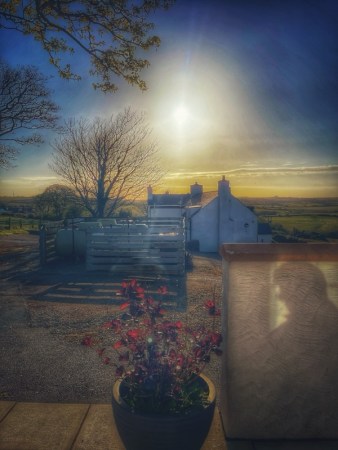
I was pleased with the composition; looking south into the sunset near Almwch (pronounced ‘am-lock’) on the Isle of Anglesey.
Everything seemed harmonious until I noticed the faint silhouette of my wife, Bernie, somehow ‘bounced’ onto the white render of the hotel room’s garden wall.
A few adjustments with light and texture and the figure took on the ‘role’ of the artist inside the work.
An unexpected gift from the sunset! Thank you, Almwch.
©Stephen Tanham 2024
—————
All photos taken and processed on an iPhone 12 ProMax.
Stephen Tanham is a writer-photographer and mystical teacher. He is the founding Director of the Silent Eye, which offers an exciting journey of the soul guided by lessons, inner experience and outer companionship.
There are two blog streams:
(mystically-oriented writing)
and
http://www.suningemini.blog is the
(general interest, poetry, humour and travel)
Contact: stevetemeq@gmail.com
Share this:


She’s completely blind with cateracts which cannot be operated on: she’s too old to survive the recovery period.
Her name is Rosie: a thirteen year old black Labrador.
She’s not our dog. Her ‘mum and dad’ are currently in Australia, enjoying a six-week sojourn. We’ve been good friends for a long time. Bernie and Rosie’s mum, Siobhan, grew up together in Heysham, Morecambe’s twin resort. They’ve been best friends for most of their lives. It’s not likely to change….
We’re looking after Rosie while they’re away.
“It’s a big ask,” said Paul, her beloved dad as they got in the car and left for their adventure,. “Thank you!”
We’ve done it before; as they have for us. They come up to stay in our house while we go off on our own trips.. They have a mini-holiday in Kendal and look after our dog and cat.
But we’ve never before looked after Rosie for so long. It’s a challenge, but like any major undertaking, you develop a method of coping.
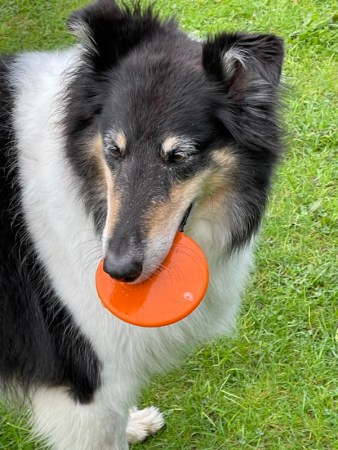
Siobhan told us that Rosie is at the end of her life, and they’re reconciled to her passing any month now. We’d prefer it not to be on our watch, but everyone is aware that it could be.
She’s a gentle and affectionate soul. Her physical and spiritual warmth are pervasive as she scans the room, locating us with sound and whatever’s left of her memory.
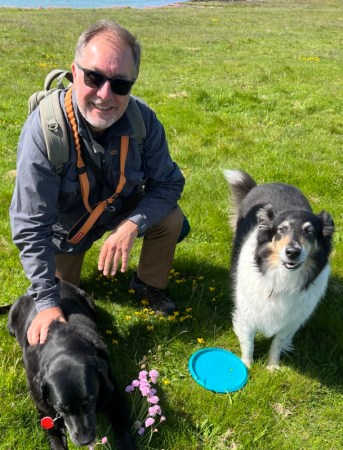
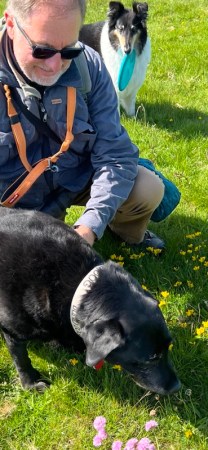
Two weeks in … four to go!
©Stephen Tanham 2024
All photos taken and processed on an iPhone 12 ProMax.
Stephen Tanham is a writer-photographer and mystical teacher. He is the founding Director of the Silent Eye, which offers an exciting journey of the soul guided by lessons, inner experience and outer companionship.
Contact: stevetemeq@gmail.com.
There are two blog streams:
(mystically-oriented writing)
and
(general interest, poetry, humour and travel)
Share this:


When Sue Vincent was with us, we used to share the admonition ‘Look up!’
For her, it was about finding the most interesting and, often, secret clues to a church’s past. She had taught herself to scan a building very quickly, then to home in on the details that had been revealed.
For me, it was all about the sky. The most fantastic forms and textures glide over our heads throughout the day, but how many of us regularly look up at their splendour?
The rapid development of the mobile phone means we always have the ability to capture images in our pockets. This is not true of the professional, who still has to carry a bulky camera (or two) to get the best results.
The Pro is working towards a use of the image that requires high definition, whereas we amateurs usually post our images on social media, where we get away with having a lower resolution as long as the composition works.
Clouds fascinate me. The infinite variety of light and colour can completely change the landscape below, in seconds.
Sometimes, there is drama too…
In the opening shot, I was walking the collie on one of the beaches at Morecambe when I noticed that the light was changing rapidly. I looked up to see a vertical wall of dark mist, looking for all the world as though it was growing out of the Midland Hotel,
So, with Tess in hot pursuit, and knowing that these things can last only for seconds, I ran down the beach towards the retreating sea to get a wider angle shot that would reveal what was going on.
When I saw the vast cloud system unfolding in the sky above, I knew we had something dramatic. A few minutes later, we also had a storm so violent that it was turning sand grains into bullets.
Sometimes we have to suffer for our art!
©Stephen Tanham 2024
All photos taken and processed on an iPhone 12 ProMax.
Stephen Tanham is a writer-photographer and mystical teacher. He is the founding Director of the Silent Eye, which offers an exciting journey of the soul guided by lessons, inner experience and outer companionship.
There are two blog streams:
(mystically-oriented writing)
and
(general interest, poetry, humour and travel)
Share this:

(📩 Poetry, irony, 18 words, a ten-second read)

Perhaps, and while
We slept
The world turned upside down
And missing spring
Lies far below
Reluctant winter’s crown.
——-/——-/——-
©Stephen Tanham 2024
All photos taken and processed on an iPhone 12 ProMax.
Stephen Tanham is a writer-photographer and mystical teacher. He is the founding Director of the Silent Eye, which offers an exciting journey of the soul guided by lessons, inner experience and outer companionship.
There are two blog streams:
(mystically-oriented writing)
and
(general interest, poetry, humour and travel)
Share this:

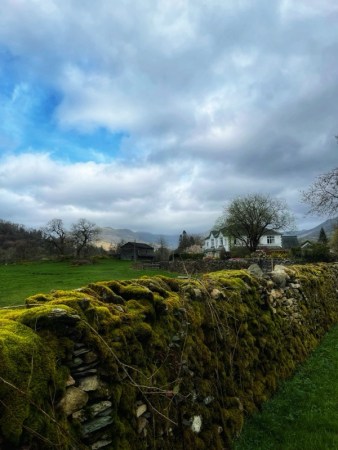
Waterhead to Ambleside; it’s a walk we do often. We park the car near the ferry point in Waterhead and do the thirty-minute stroll into the town.
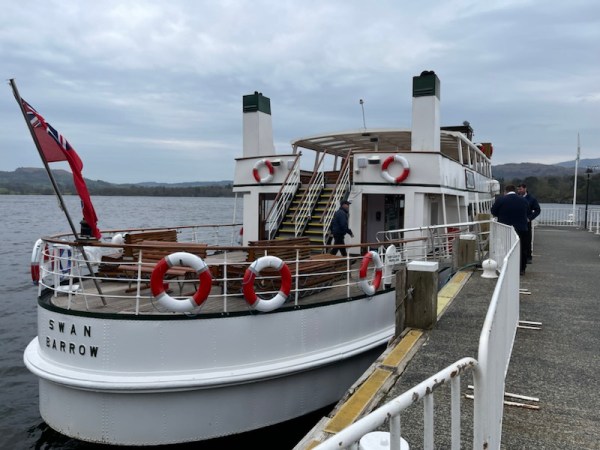
Leaving Waterhead, we hug the coast of Lake Windermere by cutting through Borran’s Park – a place unseen by many visitors, who hike by on the road, not realising that one of the best views of Windermere is only 100 metres away…
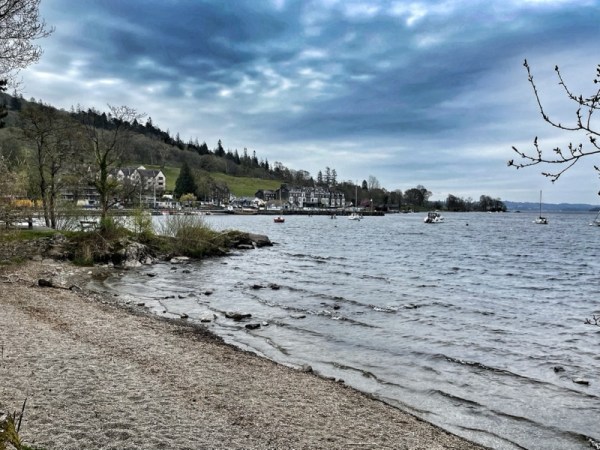
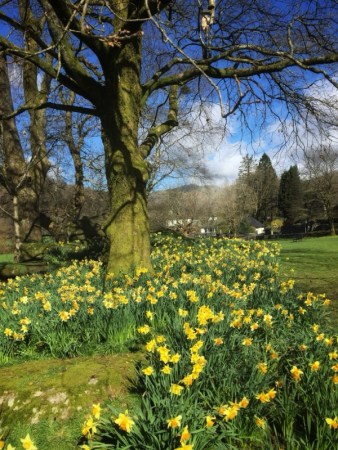
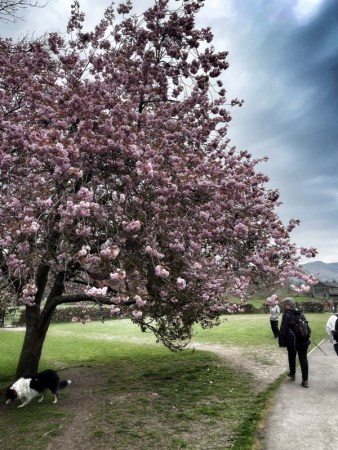
As Waterhead falls behind us, the views through the fields on the outskirts of Ambleside reveal the High Fells.
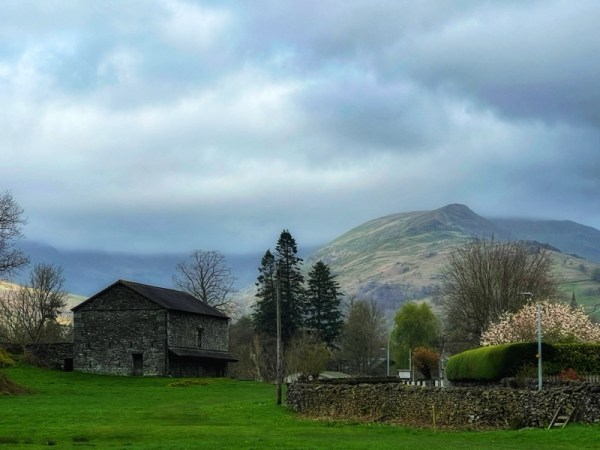
It’s worth seeing how vast that landscape is from the air. This is a map of the whole of the Fairfield Horseshoe. Diagonally, it connects Rydal and Helvellyn–right across the centre of the Lake District.
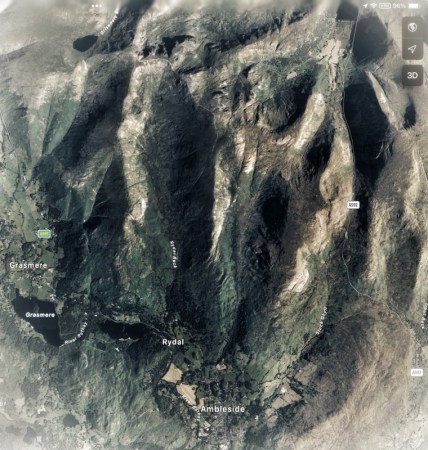
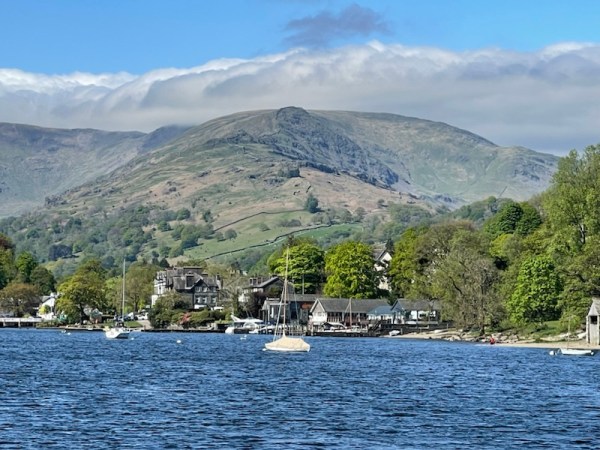
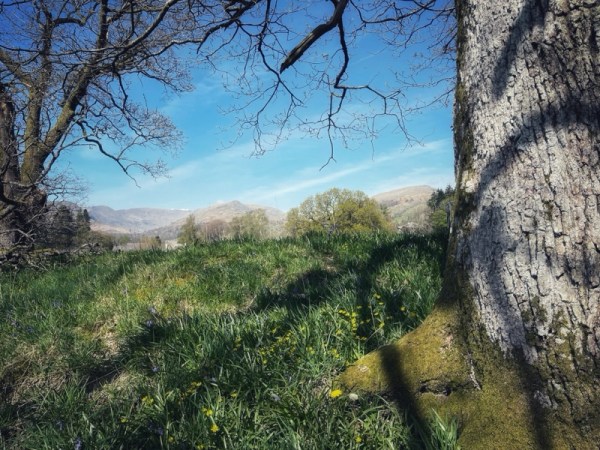
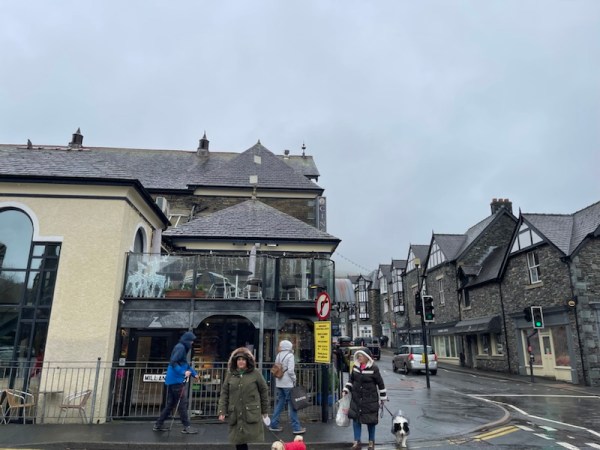
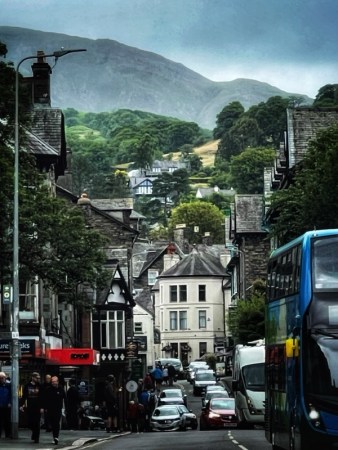
Soon after that, we’re in Ambleside. The photos are not all from the same day. The shot below is typical of the relentless wet and windy weather of the past two months.
———-
©Stephen Tanham 2024
All photos taken and processed on an iPhone 12 ProMax.
Stephen Tanham is a writer-photographer and mystical teacher. He is the founding Director of the Silent Eye, which offers an exciting journey of the soul guided by lessons, inner experience and outer companionship.
There are two blog streams:
(mystically-oriented writing)
and
(general interest, poetry, humour and travel)
Share this:

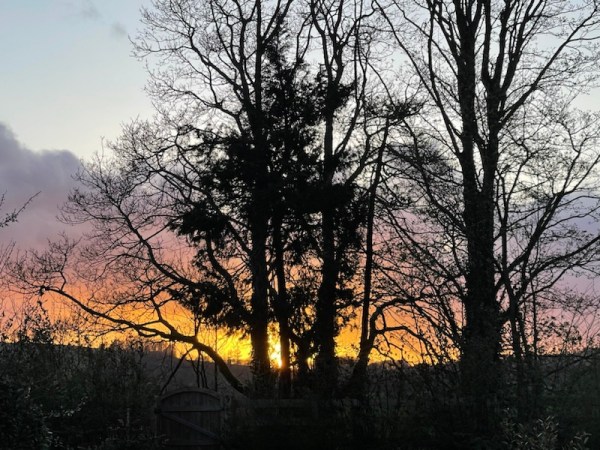
There is a mysterious fire within the human being. All of us have it, and it’s waiting to serve us … but in most, it is left dormant.
The Alchemists named it ‘fire’, thereby hiding and describing it in the same definition. We don’t have to believe in anything mystical to experience it. It’s simply a part of what we are, and can be felt by anyone who approaches it with the openness of discovery.
It belongs both to the body and to something else…
It’s part of us, biologically and experientially…and it’s intelligent. We might say it’s always present, as long as we’re alive, and hence its more modern name: presence.
Analogies help… If you’ve ever been outside in the snow, perhaps making snowballs to throw – without gloves – you will know the lovely feeling of active warmth that follows the intense cold of the melting ice crystals on your skin.
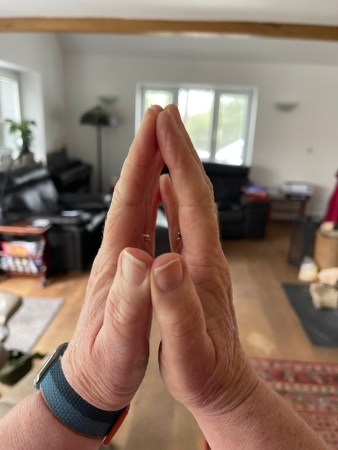
A useful starter exercise is to hold your hands in the ‘prayer position’, then begin taking a few deeper breaths and directing your attention to the space between the palms. After a short time, you will feel a gentle warm glow, which, at first you will mistake for simple body heat.
It’s worth pointing out that this gesture of the hands has come down to us as one of prayer. Could this be more significant than we ever thought?
Can we use the hands to spread this healing warmth? Sit quietly in a straight chair and place your ‘charged’ hands onto your thighs. At first you’ll feel the ordinary warmth. If you continue to energise it with breathing, you’ll feel something more powerful that spreads, gently.
I’ve thrown in a few comments from friends discussing this over the years.
When I began to do this, the feeling was like ‘coming home’ to myself…
See if you can direct it to your knees and then on down to your feet. Use the intelligent warmth to explore your feet. Can you use it to feel your toes; then each toe in turn? This may take a little practice…
When we know what the intelligent warmth feels like, we can choose where to begin the ‘fire’ of its presence. Our whole body is there to ‘ignite’ in this way. The effect will be to make us feel more ‘alive’ and settled.
Taking it very slowly, next week we’ll consider the inner nature of this fire … and how it might be related to other aspects of our inner and outer lives.
“Gentle,
alive,
loving
Very much me!”
©Stephen Tanham 2024
All photos taken and processed on an iPhone 12 ProMax.
Stephen Tanham is a writer-photographer and mystical teacher. He is the founding Director of the Silent Eye, which offers an exciting journey of the soul guided by lessons, inner experience and outer companionship.
There are two blog streams:
(mystically-oriented writing)
and
(general interest, poetry, humour and travel)
Share this:

I’ve been watching, with interest and a degree of admiration, the fruits of the new generation of AI products that allow you to create images from literal descriptions like:
‘A young boy chases a red balloon through narrow dark streets in Paris.

The result is a good quality glossy image that is royalty-free and allows us writers to create a tailored image for our wordage.
But I have noticed that they all have a similar ‘artificial’ look, in that they have a painted style that is similarly ‘over-perfect’ – a chocolate box, as I have come to think of them.
It may simply be that I’ve not seen enough of them to appreciate what can be done. In any event, I have no issue with their generation or use, simply their ‘sameness’
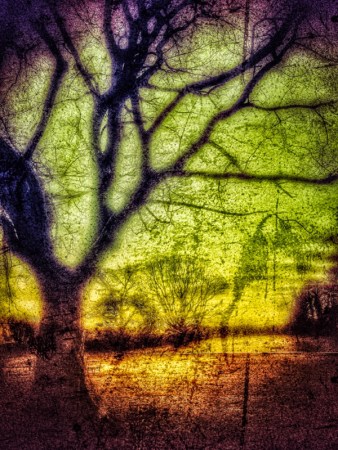
I set out to explore this sameness by contrasting my AI image with one I created based on a ‘look’ that had a lot of artistic integrity.
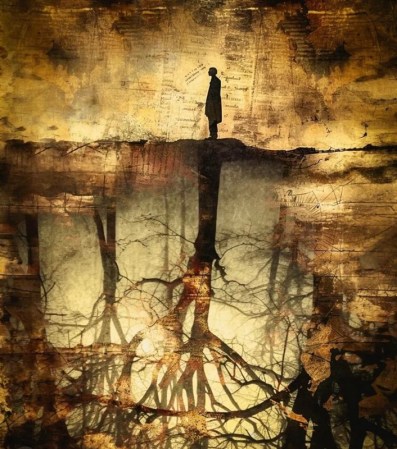
Above is an image I spotted in my Instagram feed. I liked it, followed the author, and began to examine how the creator had achieved this far more real look, despite it being heavily manipulated.
To continue the experiment, I set out to take a simple photograph of a natural scene and then manually use a variety of favourite techniques to both distort and enhance it.
I’m also interested in how and why these and the AI images look different. I have a sense that the ‘original’ content of the actual photograph is more ‘vital to our minds and emotions than the ‘wholly fabricated’ AI image,which is drawn from a ‘mechanical’ past.

Here are the stages, dead ends, and another look at the finished result:.

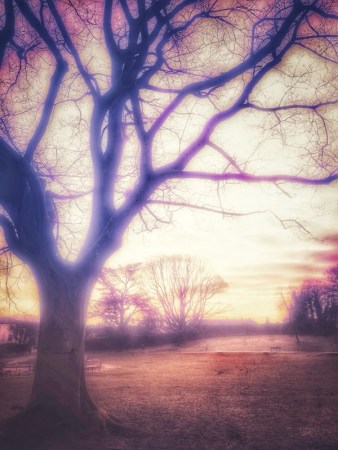

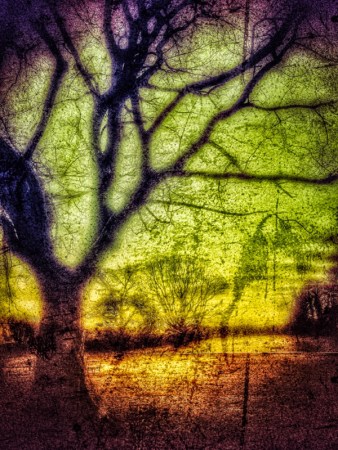
There are no rights or wrongs here. It would be very difficult to match the power of AI to create a highly specific picture, such as the Red Balloon image.
But, as a writer, it would be much easier to wrap my emotions around the natural image above … and possibly pen an appropriate poem or similar.
What do you think?
For reference: The Red Balloon, 1956.

“The story follows Pascal, a young boy, through Paris streets where he sees a red balloon atop a lamppost, chases it, catches it and discovers that it has a wonderful magic power.”
———— ———-
©Stephen Tanham 2024
All photos taken and processed on an iPhone 12 ProMax.
AI Generated by NightStudio Cafe
Stephen Tanham is a writer-photographer and mystical teacher. He is the founding Director of the Silent Eye, which offers an exciting journey of the soul guided by lessons, inner experience and outer companionship.
There are two blog streams:
(mystically-oriented writing)
and
(general interest, poetry, humour and travel)
Share this:

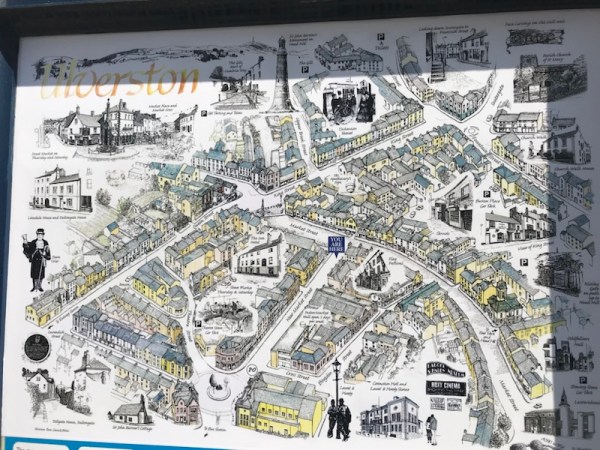
I’ve written before about Ulverston and its surroundings, but mainly about the town rather than the walks around it.
Ulverston, like Kendal, now has a new identity, so we decided to re-visit and see how much it had changed. ‘We’ being a small group of dedicated dog-walkers characterised by a liking for fish chowder and taking photographs of Lakeland’s Southern Fells – views enhanced by their rapid morphing into the associated southern estuaries.
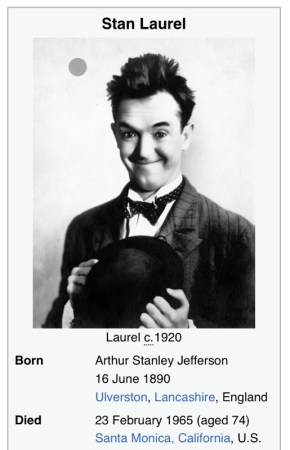
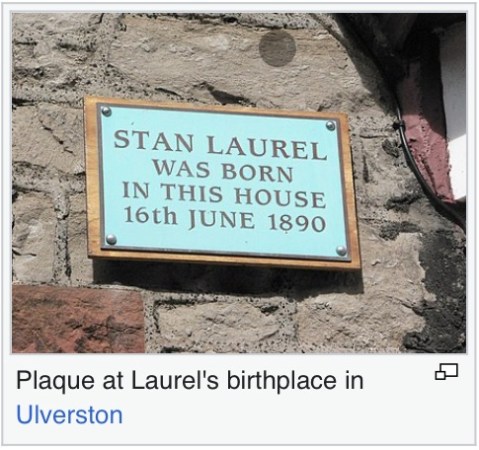
‘We’ also have strong views about representation or the lack of it in modern politics, so we have decided to become a ‘Sons of the Desert’ group. The idea for these was created by fans in memory of Stan Laurel, a son of Ulverston. One of his early films had the same name and was filmed in the sand dunes of a nearby stretch of coastline. Anyone can form such a society, but apart from drinking, it needs to have stated objectives. We had work to do…
We duly inaugurated our Sons of the Desert group in a local pub with a swift half, then set off to discuss and define our purpose!
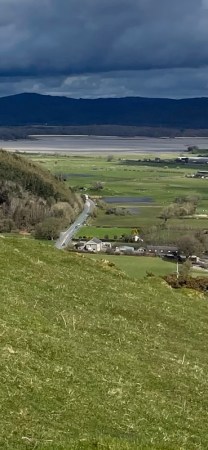
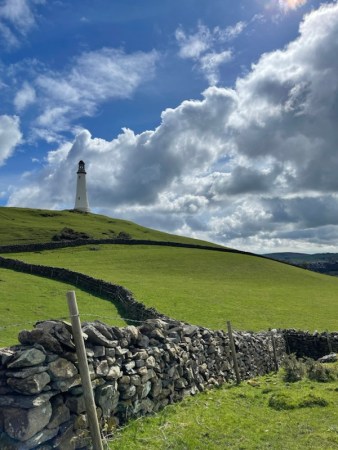
We had already decided that, this year, we would begin our get-together with a walk up The Hoad, or ‘up t’oad’ to paraphrase the excellent local dialect of this former part of Lancashire, recently Cumbria, but now administratively governed as part of ‘Westmorland and Furness’, a diagonal slice of Cumbria linking the likes of Barrow, Ulverston, Kendal and Penrith … obvious really.
And there it was. No sooner had the fate of this part of old Lancashire left our lips when it became obvious that we should dedicate our Sons of the Desert efforts to publicising the nonsense that had overtaken its former geographic glory.
The fate of our beloved part of old Lancashire is best summed up by its current gerrymongering – a word we coined as we climbed up the steep path of the Hoad.
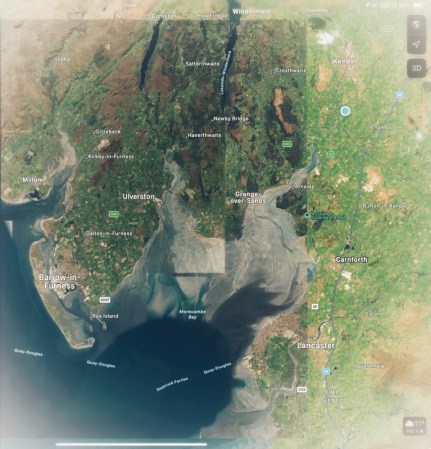
Fascinating.. here, in this rather anemic orange line, it is on the map…
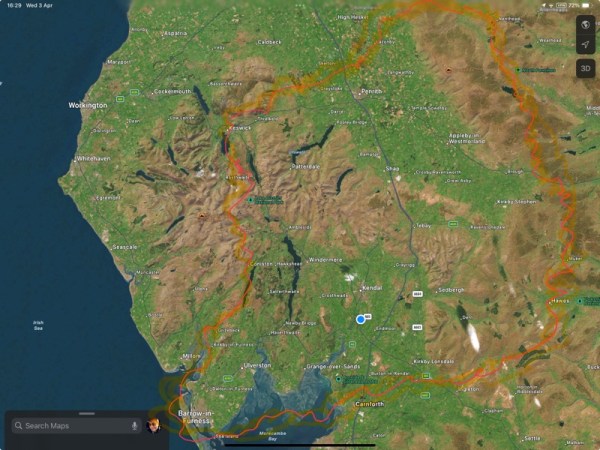
If you’re confused, it’s quite understandable. Everyone who lives in ‘Westmorland and Furness’ is, too. It’s the latest product of the Boundary Commission, that beacon of logic and legalised re-grouping of local populations., whether they want it or not. Cumbria – all of it not just this part of Old Lancashire – did not, but that didn’t stop anything.
I can’t think who benefits …. Actually, I can, but hopefully it’s a temporary problem.
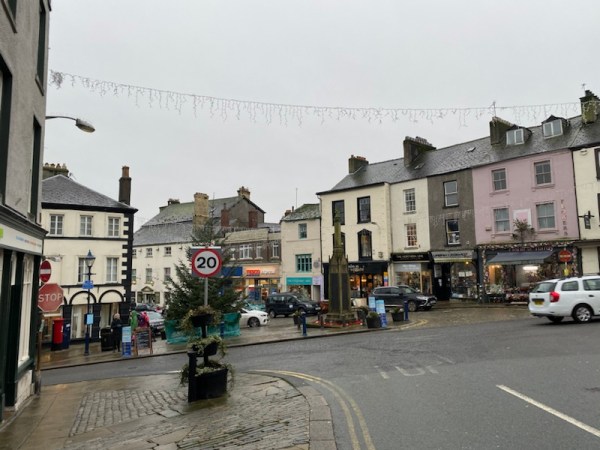
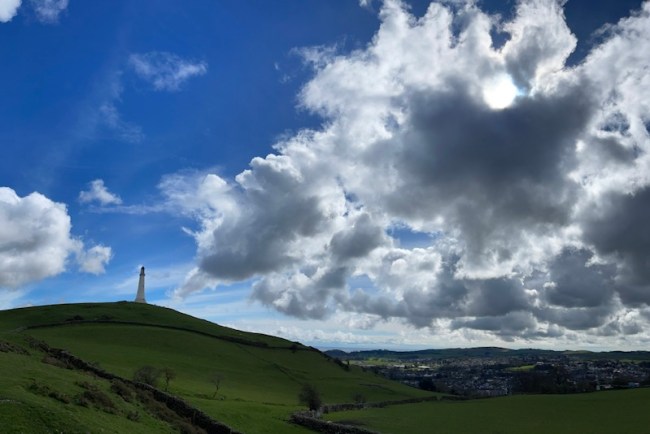
Early April offered this hardy group the brighter light ushered in by the clock-change, combined with dramatic, high-contrast skies and the glorious and rather unusual mixture of sky, fell and the unique landscape of the plentiful southern estuaries.
The climb from Ulverston begins at Ford Park, where we parked the cars, put on boots and waterproofs, paid for parking via the honesty box, gave the dogs a mad frishbee chuck on the large grassed area (right hand side only, the kids have the left), before hardening our resolve with a delicious latté at the renamed ‘Base Cafe’, which has wisely adopted the image of The Hoad as its logo.

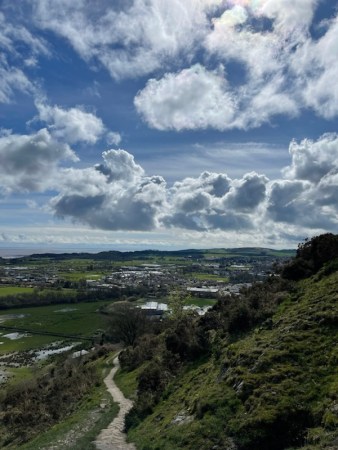
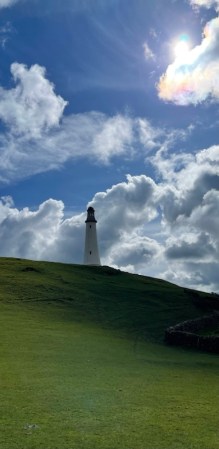
Soon, and sweatier – for we are not youfs, anymore, we arrived at the approach track to the mightly Hoad.
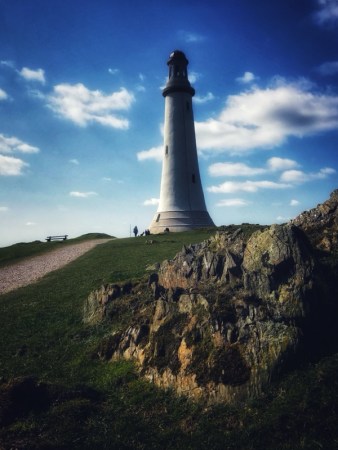
While we got our breath back, we considered the fine structure before us.
Despite being based on the third of the Eddystone lighthouses, the Hoad is singularly a monument to a celebrated local figure: Sir John Barrow, First Baronet, geographer, mathematician, diplomat and linguist.
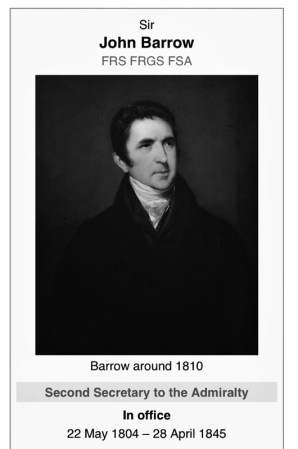
His story is worthy of a post in its own right, but that is for another time. Suffice to say that he was a man of the people and sacrificed his early career to found a school for disadvantaged children in his hometown of Ulverston.
Sir John Barrow rose to become a founding member of the Royal Geographical Society. As a senior diplomat at the forefront of the British Empire, he travelled to China and South Aftrica, and held the positions of First Baronet and that of Second Secretary to the Admiralty from 1804 to 1845.
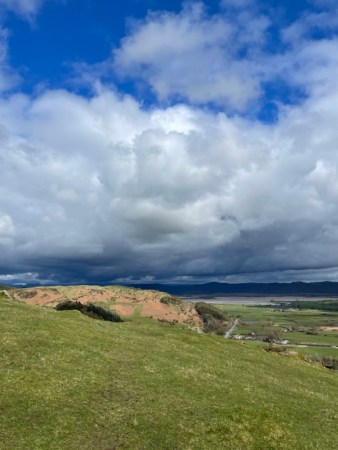
Somewhat restored by oxygen. We took in the views that never disappoint, and paused to imagine that the great man would have smiled on our small, democratic efforts…
Here in Cumbria, sorry – Westmorland and Furness – despite months of rain, we are finally seeing the odd sunny day. The landscape of lakes and mountains is very green – courtesy of all that rain, but due south from the well documented beauty of the central Lakes, in an area known as the ‘Peninsulas’, the region offers another feature, that of a south-facing sandy coastline full of inlets and estuaries.
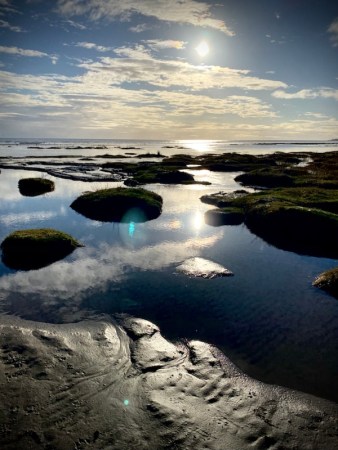
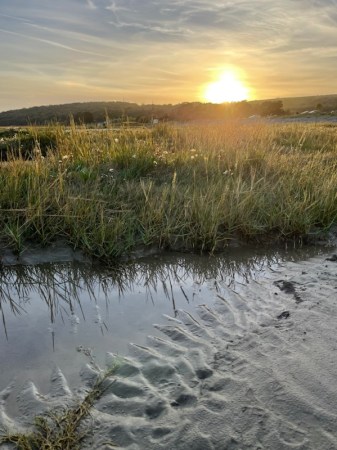
We considered further discussions, but chowder was calling. We were due at the beloved Fourpence Cafe in the middle of Ulverston. There was a gentler route down, so we took it. Soon, Sam and Jane were welcoming us and the divine fish stew was arriving.
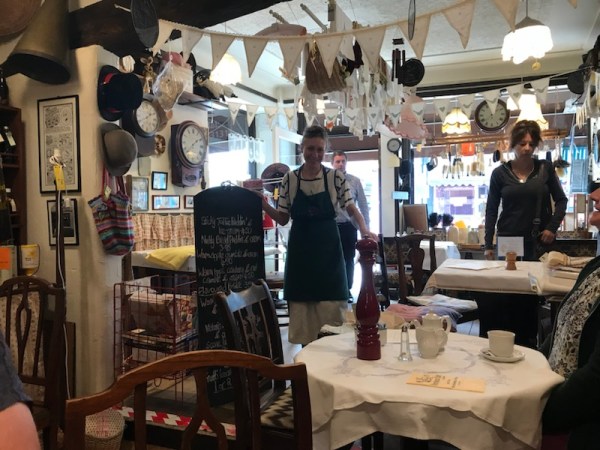
We will be back…
©Stephen Tanham 2024
All photos taken and processed on an iPhone 12 ProMax.
Stephen Tanham is a writer-photographer and mystical teacher. He is the founding Director of the Silent Eye, which offers an exciting journey of the soul guided by lessons, inner experience and outer companionship.
There are two blog streams:
(mystically-oriented writing)
and
(general interest, poetry, humour and travel)
Share this:


When the settee to the phone
Is half-hearted … and alone
And you ring it back,
but only in your mind
—-
If you sit and hold the minute
And the people who aren’t in it
And wonder how to harvest
Passing time
—-
Does a ghostly alter-presence
Steal your silenced effervescence
And delightfully rehearsed
Excuse or ten?
—-
When your eyes refuse to leave the phone
And sticky stillness of the known
In the quiet of the lengthening
Isolation?
—-
But you’re really only frozen
On the path so wisely chosen
In the moment that checked out
Not long ago.
——
From the ashes of confusion
Rise the sheddings of delusion
And the in-breath of a greater you
That sails upon the new.
———-
©Stephen Tanham 2024
Image by the author.
All photos taken and processed on an iPhone 12 ProMax.
Stephen Tanham is a writer-photographer and mystical teacher. He is the founding Director of the Silent Eye, which offers an exciting journey of the soul guided by lessons, inner experience and outer companionship.
There are two blog streams:
(mystically-oriented writing)
and
(general interest, poetry, humour and travel)
Share this:


We often hear the phrase, ‘there’s always light and dark’: two things that stand in polarity – opposition, even – but do we ever stop to let the mind and emotions lead us to a deeper realisation?
Light may be mysterious but it’s a clearly identified ‘thing’ – though it doesn’t have edges. We will see, later, why this is important.
We can flick a switch and have light flow, just like water from a tap.
But which switch do we flick to turn on darkness?
The brain’s cogs begin to twitch suspiciously at this point, as we are brought closer to the semi-intuitive relationship between the light we can turn on and the ‘not-light’ we can’t.
Can we investigate the nature of dark more deeply?
Darkness would appear to be the ‘absence of light’? I can’t turn on dark, but I can engineer a situation where all the light is removed, such as a room at night in which I close the curtains and switch off the lights.
Instant darkness…and I’ve ’created’ it, but not with a positive action. My action was to completely remove a positive thing, leaving the negative not-thing behind.
We can appreciate darkness with our senses. The lack of light makes our pupils dilate, and our mind hunts familiar outlines in the gloom; prompted by the insistent hard-wiring of our survival instincts. Our heart rate usually increases, as we use only partly successful logic to tell ourselves that everything’s okay.
And yet there is no-thing there… There’s nothing that can pursue and bite us, and yet we behave as thought there is.
But … we have a very real awareness that some ‘state’ is most certainly present, and its nature, while not overtly hostile, is one which triggers the highest alerts in our protective nervous system.
Can darkness be a friend?
In magical work, we might hear a reference to the ‘restful darkness of the West’; a place in the temple where we traditionally enter, seeing the light-filled East across the temple floor opposite us. When our work (to refine our collective ‘selves’) is complete, we leave, in silence, via the same gate in the West, returning the temple to its pristine darkness.
In one tradition it is said that ‘darkness fills the space until light comes, but light does not originate from darkness, which is its absence.’
From where does light come, then?
We know that physical light is generated as tiny entities called photons. ‘Orbiting’ electrons in the atom drop to a lower energy ‘shell’ and release light in a magical act of creation. The electron is both a particle and a wave, and obligingly assumes the form we want to observe. It has no knowable existence until we measure it – that is, become conscious of it.
This light from, say, a torch, radiates out to infinity, never losing its energy. A hundred million years from now, it will still be visible a hundred million light years away if we have sensitive enough instruments.
The light is always there, streaming from its point of origin. The darkness is everywhere, but only in potential. Without light, the potential contents of the darkness are unknown,
Our society, our collective world, is full of anxiety. Our minds exists to recognise patterns of events to make sense of them; sense in the ‘sense’ of arranging them into things that may threaten us. This is the survival drive, the instinctive patterning of experience that ‘ranks’ the level of threat against us. The early years after birth are main concerned with making sense of our experiences, with particular focus on what can hurt or kill us. Once learned, this knowledge becomes the bedrock of our physical existence, overriding everything else that is recognised in the category of an important pattern. We learn to group elements of our experience into objects.
Objects have edges…
We get so good at this that we are able to work out not only which ‘objects’ are a direct threat, but also to evaluate what patterns of events and object might be a threat, and to what degree.
In the media and our peer groups – which thrive on anything that smacks of an existential threat to our sense of self – we now have rich field of that which we should be anxious about.
But mostly it is darkness: the potential for a threat which is not present, but ‘could be’.
To go deeper into this, we need to ‘see’ that understanding is a form of light; that it intelligently pervades anything we let it consider. Here, the world consider is used in its old fashioned form, related to the sentence ‘she was considerate’. Mindful might be another appropriate word, but that has now been debased through overuse.
Overfamiliarity through systemic mauling by the societal mind is the fastest way to kill a good idea.
Behind all this is the idea that light may reveal recognisable objects and their patterns to us, but that darkness may have something quite wonderful up its sleeve…
Because without the restful backdrop of darkness, light and its infinite variations of pattern would be invisible to us. In the world of manifestation, contrast is everything…
The darkness, therefore, contains everything, but in potential. The light shining in the darkness manifests and reveals it. They are an intimately-related brother and sister.
©Stephen Tanham 2024
All photos taken and processed on an iPhone 12 ProMax.
Stephen Tanham is a writer-photographer and mystical teacher. He is the founding Director of the Silent Eye, which offers an exciting journey of the soul guided by lessons, inner experience and outer companionship.
There are two blog streams:
(mystically-oriented writing)
and
(general interest, poetry, humour and travel)
Share this:

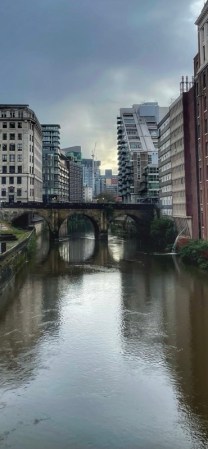
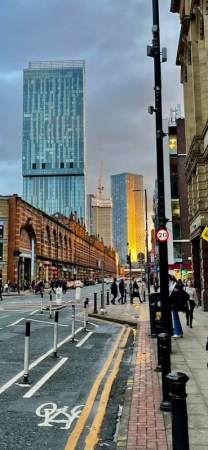
Being here, on the boundary between the cities of Manchester and its ‘lesser’ neighbour, Salford, made me think of the folk song, Dirty Old Town.
I met my love by the gas works wall
Folk song: Dirty Old Town
Dreamed a dream by the old canal
Kissed my girl by the factory wall
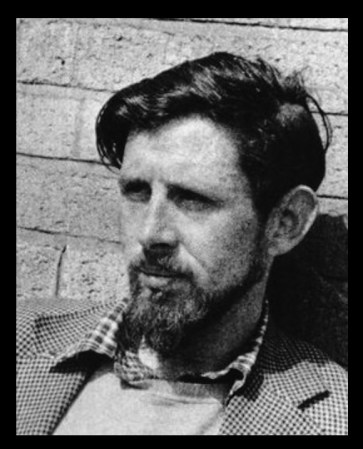
James Henry Miller, the writer of the song, is better known to us as the folk singer Ewan MacColl; his stage name.
I’m gonna makes me a good sharp axe
He was born in England to Scottish parents, and rose to fame as one of the leading lights of the 1960s folk revival. He was also an active defender of workers’ rights and a collector of history songs, in order to preserve them.
Ewan MacColl died in October 1989, age 74.
His two most famous works were the already mentioned ‘Dirty Old Town’ and ‘The First Time Ever I Saw Your Face‘. MacColl was a lifelong friend of Peggy Seeger, with whom he had a creative partnership in expanding the appeal of folk music over many decades.
Shining steel tempered in the fire
He wrote ‘Dirty Old Town’ to describe his feelings about Salford – his home for many years. After the glory years of the Manchester Ship Canal, which ended (commercially speaking) at Salford’s docks, the city of Salford was seen, increasingly, as the poor relation to its neighbour, central Manchester.
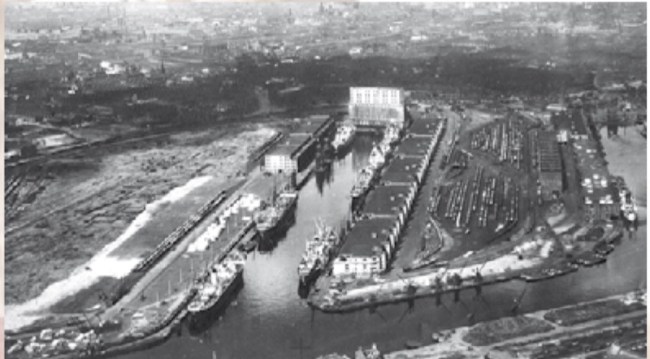
It was left to fester as a grimy and smelly inland port, with terrible housing problems and short life expectancy. Alcoholism was rife…
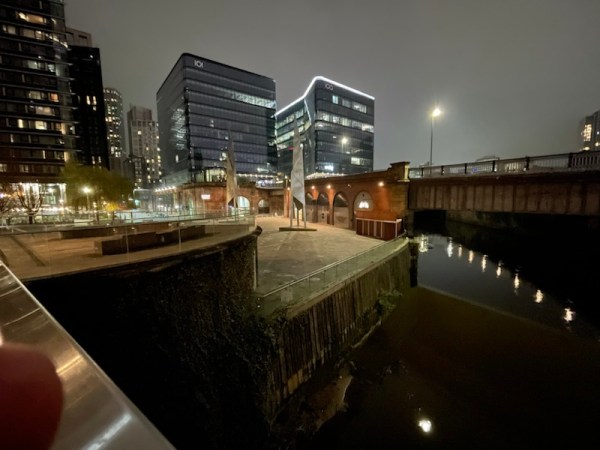
I remember that Salford from visits in my childhood. It was a grim place. It’s ironic that, 35 years later, we were to set up our software company on the rejuvenated docks there – newly and ambitiously named Salford Quays.
We were among the first of the companies to move there. In those days the only social facilities, outside of the grim old pubs (in which you were not safe) was a floating wine bar. It served us well, and corporate visitors such as Barclays Bank IT specialists, who would travel up from Poole, were impressed.
The Dutch barge wine bar, was burned down by local thugs when the owner refused to pay protection money…
Salford Quays has changed a lot over the years. We saw it all happen outside our windows.
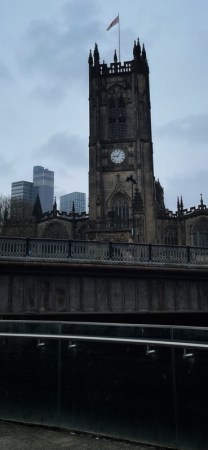
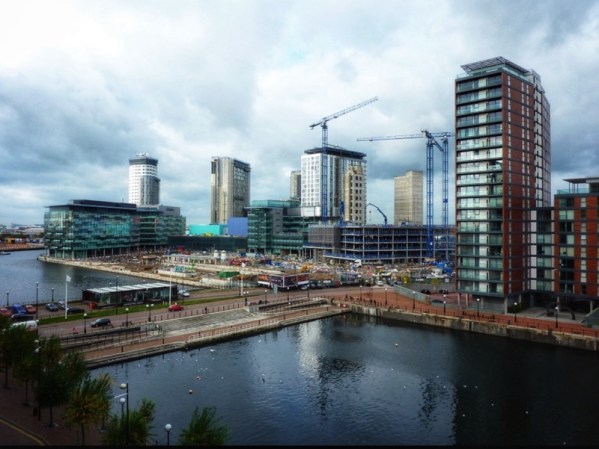
The landscape was already changed when the Quays development began to succeed, but the years to come would see the arrival of Media City and other spectacular urban transformations. We were proud to be part of it, even in a small way.
It was our company home for over 20 years. It’s good to go back and see how the old place is doing…
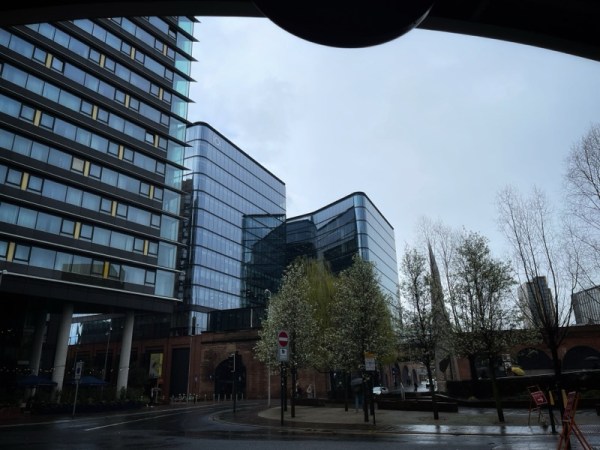
I’ll chop you down like an old dead tree
What a contrast Ewan MacColl would find, now, as the photos show. The dirty old town was indeed chopped down…and a fine new one rose in its place.
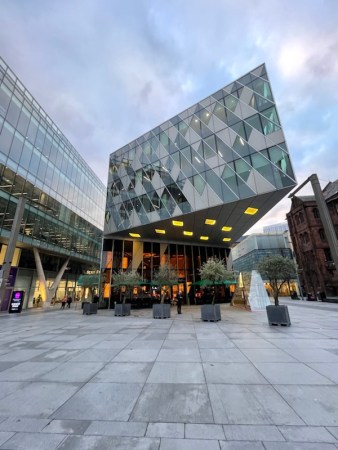
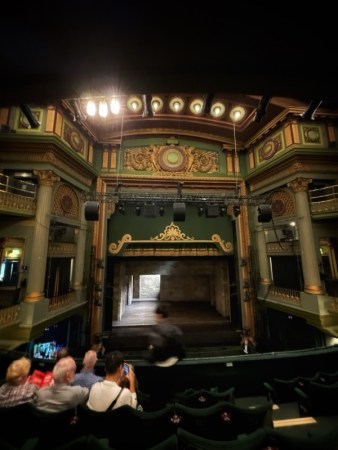
It was fun to return. We were in Manchester with friends to see Ian McKellen in the special version of Henry IV parts one and two on the same evening; demanding on both the players and the audience inside the very warm auditorium, but a wonderful production.
Both Manchester and Salford have seen dramatic redevelopment. There is a surging positive energy about their future. We can only wonder what the next fifty years will bring…
They move together because they are co-located, but their essential natures are different, and Greater Manchester is the stronger because of it.
©Stephen Tanham 2024
All photos taken and processed on an iPhone 12 ProMax.
Stephen Tanham is a writer-photographer and mystical teacher. He is the founding Director of the Silent Eye, which offers an exciting journey of the soul guided by lessons, inner experience and outer companionship.
There are two blog streams:
(mystically-oriented writing)
and
(general interest, poetry, humour and travel)


 Sun in Gemini
You must be logged in to post a comment.