
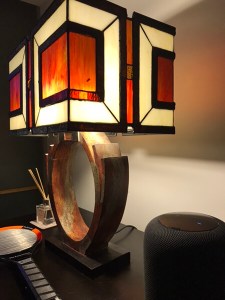
Waking from a deep sleep, Sunday looked up from the leather settee. It was dark; the day had gone. He stood and stretched, glancing across at the Art Deco light he didn’t remember switching on… something on the cabinet was wrong: the tennis racket he didn’t own was too small and labelled ‘Executioner’.
Maybe the redhead had been telling the truth, after all?
©Stephen Tanham.
Share this:

Part One
It is unusual to be able to say definite things in the teaching of spirituality, and yet, with essence, we can…
We can say three definite things: that Essence is our life; and that everything that is not essence is reaction and the history of reaction. We can also say, as did the ancient alchemists, that essence is not an idea, not a creation of the mind, not a thing to be imagined and created, but a physical pre-existing thing with substance. The alchemists, with their gift for hiding things under our own noses, described this ‘stone of the wise’ as ‘hidden in plain sight’.
You may never have heard of the word essence in the context of spirituality. Its use was an attempt by practical mystics of the last century to resolve the profusion of ideas surrounding the real meaning of the word ‘soul’. The word soul is used all the time, and we may already have an idea as to what it is. We think of something as ‘soulful’ when it touches us at a depth beyond the usual reaction. We think of our lives as, perhaps, a journey towards our own soul. We may consider that our soul will survive the death of our body, and travel through some afterlife. Or you may not… You may love the idea of a very exact definition of something that has been described as the centre of our real existence.
The ancients, who gave us the name soul, did not have the benefit of what we now call psychology – the study of the self. In this context, the self is the intense feeling of ‘me’ that is the centre of what we feel and do. The self feels pleasure – running towards it – and is frightened of pain, from which it retreats. The body feels pleasure and pain, but, beyond automatic responses, such as being burned, it is the self, rather than the body, that has control of how we react. We can force ourselves to feel pain, we can force ourselves to indulge in excessive pleasures, we can direct ourselves towards the good. For some reason, the forces of nature and evolution have placed an engine of determination at the supposed summit of our physical and psychological being.
Ultimately, and of the deepest significance, we can choose what we do… and, with guidance, how we react.
This engine of reaction and determination was viewed, in ancient times, as inseparable from the soul–the supposedly deeper and better part of us. Religion is aimed at the soul, and, like alchemy, the separation of the base response from the finer response is considered to be under its jurisdiction.
And then, in the early years of the last century, a man named Sigmund Freud began to scientifically study how this self – this engine of reaction and determination – is formed in the human childhood. His work is now considered to be slanted too much towards the effects of sex, but, despite this, he gave us a rich and accurate vocabulary of the real divisions of the self. Other psychologists followed, like Carl Gustav Jung, who held wider views of the layers of conscious and unconscious motivation in the human – us. There were many more, and this article has to be brief.
Someone touched by the spark of the mystical life seeks to deepen that relationship with the real, seeing that their ordinary perceptions, passed on by society and education, are really descriptions of morality and normality, not the fire of that which lifts the heart and mind, bestowing on it the certainty of a higher and self-evident set of truths.
For the mystical path, Freud’s insights remain of great use, though no claim is made that he was mystical in his outlook. Carl Jung was far more spiritual in his approach, but saw spirituality as the extension of the life we know. Freud established that there were three parts of the human engine of self: the ego, the superego, and the id.
The id is the ‘animal side’ of our natures. It is a storehouse of vast energies – many of which we suppress out of fear or misunderstanding. Much of what the id does has been pushed from our consciousness. We therefore name its domain the subconscious, and this refusal to come to terms with its potential results in great suffering in our idealised lives. Society does not like the id. It is an untamed expression of what is within us…
The Superego is the idealised self – an ongoing image of perfection that we can never reach. It nags at our lives and can never be pacified until we recognise its real nature. It often takes the inner form of an authority figure from our own past, such as our mother or father. Its presence within our lives is very active. It is the opponent of real spirituality, though the zealot often delights in its merciless company.
The ego is the bit in the middle; the ‘me’, the personality that tries to hold the whole thing together, attempting to mediate and keep the ship afloat. The ego is what we usually present to the world, but the inner picture of ourselves includes the doubts, wild energies and fears of our real inner state – which encompasses the other, hidden sides of the self.
Esoteric psychology has taken this picture much deeper. Where psychology is concerned with stabilising the personality and ensuring the ego serves society, esoteric psychology recognises that the spiritual is already part of our lives… in fact is the deepest part; beyond the reach and power of the ordinary self, though suppressed in the sense that the egoic self is established as a false king or queen in our lives. To understand the perspective of esoteric psychology, we need to understand our own origin…
Within the womb, we share our lives with Mother, in what is sometimes called the merged state. We are not conscious of our separateness from Mother. What she feels or fears, we do, too. Because we have no sense of self, we come to externalise our consciousness and reactions into the ‘sea and sky’ of our mother. This forms the deepest of patterns that will determine how we interact with our future world – and with other people in that world.
We can speculate all we like about the nature of time in the universe. They will remain ideas. What is real for us is that our time began when our pre-infant consciousness in the womb began to register that things detected by what we would later know as our senses changed.
When we are born, the shock of separation from this merged state is profound, but Mother is still with us. Our mouth becomes the link to her goodness and her gentle hands and body warmth compensate for the oneness that we have lost. But this state cannot last. When we were merged, her desires were ours. Now, born as an independent creature, our needs and desires are our own, and, increasingly, they are not met in the same way as before. This forces us to a second ‘birth’–one in which the self, as described above, is born. Fighting to get back to a merged state, it forms itself, in the first few years of life, into the engine of reaction and determination described above. The result is that the perfect newborn nature, full of qualities like joy, love and a sense of its own intrinsic value, becomes submerged beneath a suit of armour that the self builds for protection from ‘life’.
Our personality develops very quickly after that. Unsettled yet empowered by the id, besieged by the nagging superego, the self that is <insert your name> staggers into the world…
For some, the walls of the self become a container that they are no longer prepared to tolerate. They feel that their own depths contain a very beautiful, if unattended child of light. The journey to that begins when they notice certain patterns in the mental and emotional ‘sky’ of their lives. These patterns may at first seem negative, but investigation reveals that they are capable of functioning as signposts back to a personal world in which the original child of light can be restored at the centre of our lives, protected by the now mature warrior of the self.
There’s just one problem. The warrior of the worldly self, the ego, has no intention of surrendering its castle… in which it has installed itself as King or Queen.
But the Child of Light is real. She is the essence of the being. And, alongside the maturity of the outer warrior, her strength is ready to take on the negative world of the self and break down its false walls.
In Part Two, we will consider the steps we need to take if we are to embark on this journey of the discovery and crowning of the true Self.
©️Stephen Tanham
Stephen Tanham is a director of the Silent Eye School of Consciousness, a not-for-profit organisation that helps people find the reality and essence of their existence via home-based, practical courses which are low-cost and personally supervised.
His personal blog, Sun in Gemini, is at stevetanham.wordpress.com.
You’ll find friends, poetry, literature and photography there…and some great guest posts on related topics.
Share this:

A lovely poem from Anita.

The August 2018 Blog Battle
The prompt word for August is MOON
My silver lady hangs safely among the stars,
Swimming through the firmament on her 28-day cycle.
Shedding her light upon the earth
Often she sits in the pale blue sky during the day
On dark nights, she brings romance and mystery
Often time’s shady dealings are done beneath her gaze
Yet for me, she is my lady bringing magic
A time of spells, for love and luck
She is known for inspiration, which all writers need
A friend since early childhood and remains so to this day
At 72, the years have been long. I whisper my thoughts to her
On nights when I cannot see her, still I whisper
As I know she is out there somewhere in the world
I believe she has stopped me losing my marbles
My mind as sharp as it was years…
View original post 866 more words
Share this:

From Anne Copeland. The first post from her new blog. Please say hi to Anne.

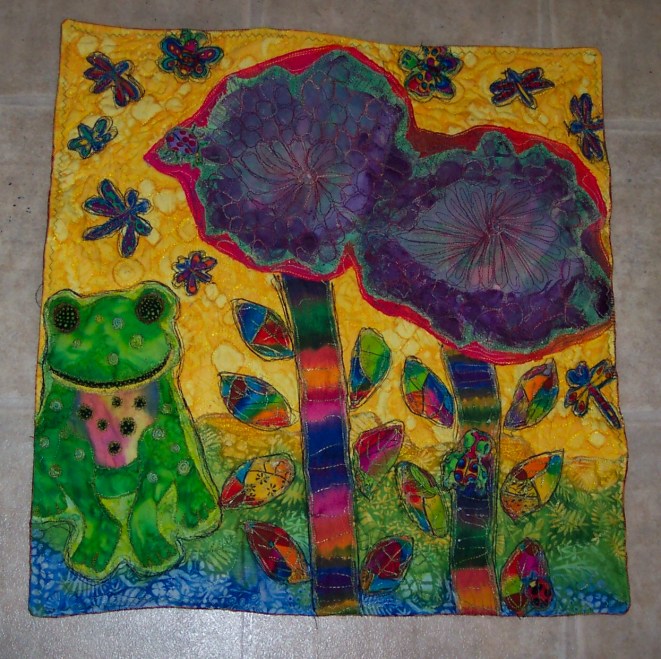
My Garden of Earthly Delights by Anne Copeland
Life is like a landscape, and it would be a boring life if it were all flat. We can appreciate the flat because we know the hills and the valleys, just as we appreciate hot because we know cold, light because we know dark and happiness because we know depression.
Every day we can choose the colors we will paint the landscape of our lives, and we can also choose how much of the landscape we will paint. Some may choose dull colors and stop the painting with a minimum of strokes laid down, and others may cover their landscapes with colors and texture and depth. But in the end result, each of us paints a life landscape that is unlike anyone else’s.
Some will look at their palettes and canvases and feel they have been short-changed. Still others look at the…
View original post 191 more words
Share this:


➰
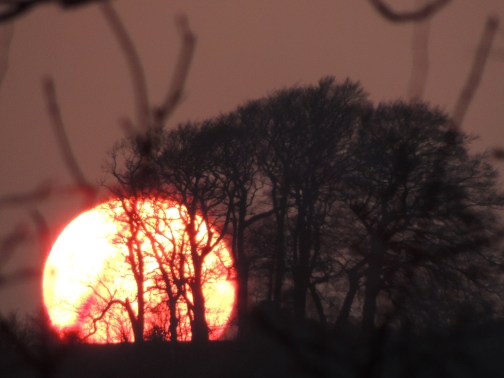
Within the sky
You formed one day
I have you said
With dipping horn
Not gone away
➰
I willed you go
Your old one eye
Belligerent
Inclined to stay
Declined my sigh
➰
Am home, it cried
Among and in
The shallow mind
The narrow gaze
The snarling din
➰
Resistant to
My magic frown
This hungry eye
Just widens now
And gazes ever down
➰
©Stephen Tanham
Share this:

From Sue.
Share this:

From Stuart.

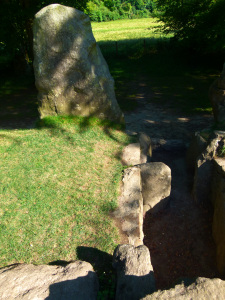
*
But according to some, Wayland has far more onerous
responsibilities than shoeing the horses of passing way farers…
*
A group of local lads were enjoying a drink
one evening at the White Horse Inn, Woolstone,
when an unknown man wearing old fashioned garb
entered and ordered a pint of the local beverage.
*
He wore a leather apron, a tall hat,
and he took his drink and sat
to one side of the ale-house by himself…
*
After awhile the sound of a horn rang out
and could be heard
echoing eerily through the vale…
*
Startled from his reverie by the horn,
the stranger leapt to his feet and hobbled
out into the night, his pint unfinished.
*
As the uncanny sound faded over the downs
the locals looked out and up to the hillside
to find that the White Horse was gone!
*
When dawn broke…
View original post 54 more words
Share this:


Inspector Sunday examined the room in minute detail. His deadly enemy, Adrian Cheng, might be anywhere. But the sinister arch-criminal and master of disguise was nowhere to be see.
“Perhaps a coffee would help?” the tocking of the clock seemed to say. Sunday considered the suggestion, and gave in to its subtle persuasion…
“I’ll find you,” Sunday muttered, a few minutes later, sipping the latté, slowly.
©Stephen Tanham
Share this:

From Sue
Share this:

From Stuart.
*
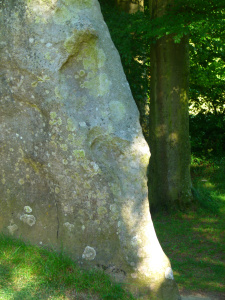
The tone of the tale once Britain is reached,
becomes very different…
*
Alighting on Berkshire’s High Downs,
Wayland came upon an ancient chambered tomb,
and made it his home.
*
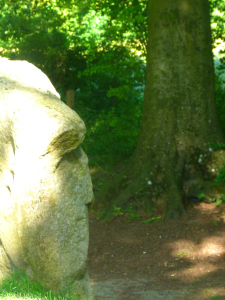
Tradition now has it,
that if ever you are riding the Ridgeway,
and your horse loses a shoe,
you need only tether it nearby,
leave a silver-sixpence on the uppermost stone of the tomb,
and on your return your horse will be shod and your money gone…
*
Wayland, it seems, never works while being observed.
*
Share this:

From Stuart.
*
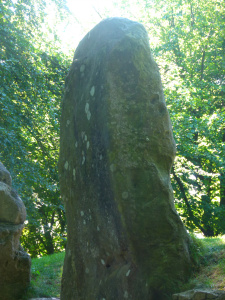
There are a number of intriguing aspects to the legend of Wayland Smithy…
The earliest written sources appear late and are decidedly piecemeal.
*
Wayland is the son of a God, Giant, or King of the Otherworld.
He is schooled in metallurgy by Dwarves, whom, in skill, he quickly surpasses.
He lives, hunts, and works alone in a region associated with wolves and bears.
One day he comes upon a swan-maiden bathing skin-less.
He finds her skin, appropriates it, and she lives with him for nine years.
At the end of which time she discovers her hidden skin and flies away.
*
Wayland is then taken captive by the King of Sweden,
maimed to prevent escape and set to work on an island…
Wayland surreptitiously kills the king’s sons, turns their skulls into goblets
and presents them to the king and queen.
Their teeth he turns into a brooch…
View original post 65 more words
Share this:

From Sue.


 Sun in Gemini
You must be logged in to post a comment.